Stay Ahead, Stay ONMINE

Powering the future of robotics in Europe

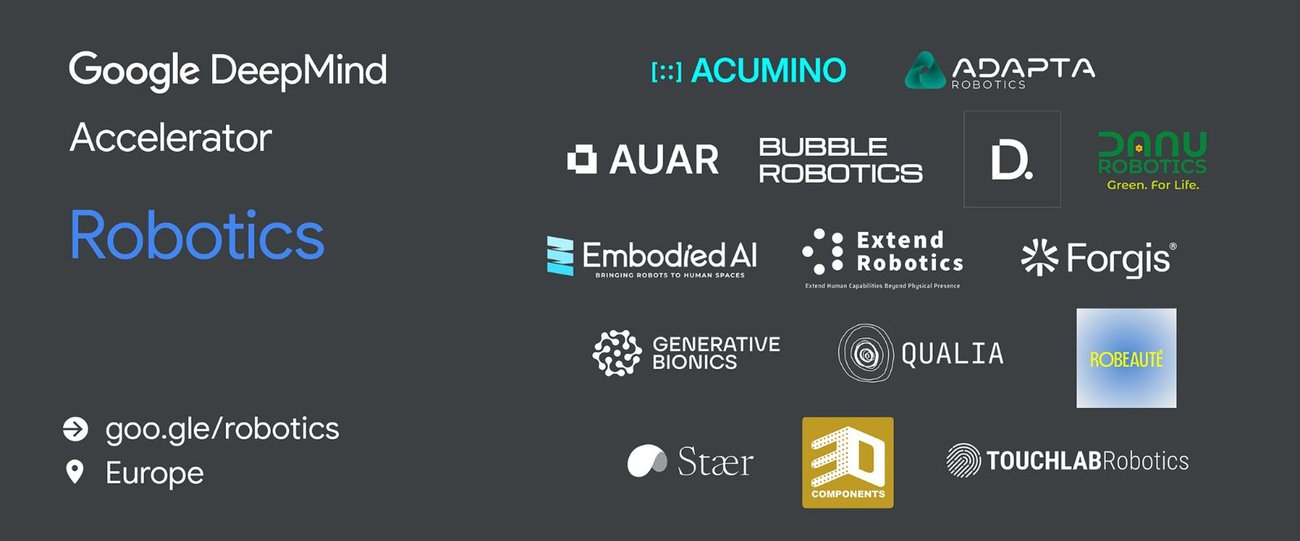
AI has the potential to help solve some of the world’s biggest challenges — not just in the digital realm, but in the physical world, too. Robotics is one of the most exciting frontiers of AI, where advances in language, vision and action models can help create intelligent machines that interact with the real world in safer, more helpful and more adaptive ways.That’s why we’re launching the Google DeepMind Accelerator: Robotics, a three-month program for early-stage robotics startups across Europe. This week, the selected startup founders are coming together to kick off the program, meet the Google DeepMind and Google teams, and begin a journey designed to support the next generation of physical AI. They’ll have access to our AI stack, technical expertise and Gemini robotics models.Selected from a strong pool of applicants, these startups will receive hands-on support from Google DeepMind and Google experts throughout the program. Through technical mentorship, product guidance and a wide network of partners, the accelerator will help founders turn cutting-edge AI research into real-world robotics applications. The cohort joining us in London this week reflects the breadth of opportunity in embodied AI — from logistics and manufacturing to healthcare, climate, and advanced navigation.Meet the startups and founders shaping the future of robotics and embodied AI:3D-Components AS (Norway): An AI-driven platform that automates welding selection and inspection, delivering results 280× faster than traditional trial-and-error methods.Acumino (Greece): Develops hardware-agnostic Physical AI that enables robots to perform complex industrial tasks in a scalable, cost-efficient, reliable manner with high ROI.Adapta Robotics (Romania): Provides a flexible software ecosystem for scalable and cost-effective device testing in industries like automotive and healthcare.AUAR (Automated Architecture) (United Kingdom): Makes homebuilding more affordable by deploying robotic MicroFactories directly to construction sites.Bubble Robotics (France): Building the ocean’s autonomous workforce: a vessel-free constellation of self-docking surface and subsea robots that see, hear, and act, feeding a live underwater world model.Danu Robotics (United Kingdom): Uses embodied AI robotic systems to automate complex waste sorting, increasing efficiency, improving safety, and enabling scalable recovery of valuable materials that supports the circular economy.Deltia GmbH (Germany): Digitizes production-line work, transforming workflows into process graphs that help teams optimize manual processes and automate repetitive tasks so people can focus where they matter most.Embodied AI (Switzerland): Deploys teleoperated humanoids that collect data during customer service to continuously train and improve their manipulation skills.Extend Robotics (United Kingdom): Provides teleoperation software and data pipelines that help train and fine-tune foundation models for real-world robotics applications.Forgis (Switzerland): Develops AI agents that understand machines like experienced engineers, predicting failures and optimizing operations.Generative Bionics (Italy): Amplifies human potential by developing humanoid robots based on physical AI, developed in Europe but built to scale globally.Qualia (Denmark): Building infrastructure that enables companies to turn robotic foundation models into working deployments, automating and optimising time-consuming manual labor.ROBEAUTE (France): Building microrobots that navigate through brain tissue to diagnose, treat and monitor neuropathology, establishing a new physical infrastructure layer in neurosurgery.Staer (Sweden): Uses computer vision on existing cameras and sensors to build 3D spatial models of facilities, giving robots a shared environment to navigate and operators real-time visibility into how their physical operations actually run.Touchlab (United Kingdom): Uses advanced nano inks to create an “e-skin” that gives robots a high-resolution sense of touch across flexible surfaces.These startups reflect the growing momentum of robotics and intelligent systems across Europe. Each company will receive mentorship and strategic guidance from Google DeepMind and Google to help them accelerate development and scale responsibly.Congratulations to this cohort! To learn more about the Google DeepMind Accelerator: Robotics, visit the official program page.


AI has the potential to help solve some of the world’s biggest challenges — not just in the digital realm, but in the physical world, too. Robotics is one of the most exciting frontiers of AI, where advances in language, vision and action models can help create intelligent machines that interact with the real world in safer, more helpful and more adaptive ways.

That’s why we’re launching the Google DeepMind Accelerator: Robotics, a three-month program for early-stage robotics startups across Europe. This week, the selected startup founders are coming together to kick off the program, meet the Google DeepMind and Google teams, and begin a journey designed to support the next generation of physical AI. They’ll have access to our AI stack, technical expertise and Gemini robotics models.

Selected from a strong pool of applicants, these startups will receive hands-on support from Google DeepMind and Google experts throughout the program. Through technical mentorship, product guidance and a wide network of partners, the accelerator will help founders turn cutting-edge AI research into real-world robotics applications. The cohort joining us in London this week reflects the breadth of opportunity in embodied AI — from logistics and manufacturing to healthcare, climate, and advanced navigation.

Meet the startups and founders shaping the future of robotics and embodied AI:

  • 3D-Components AS (Norway): An AI-driven platform that automates welding selection and inspection, delivering results 280× faster than traditional trial-and-error methods.
  • Acumino (Greece): Develops hardware-agnostic Physical AI that enables robots to perform complex industrial tasks in a scalable, cost-efficient, reliable manner with high ROI.
  • Adapta Robotics (Romania): Provides a flexible software ecosystem for scalable and cost-effective device testing in industries like automotive and healthcare.
  • AUAR (Automated Architecture) (United Kingdom): Makes homebuilding more affordable by deploying robotic MicroFactories directly to construction sites.
  • Bubble Robotics (France): Building the ocean’s autonomous workforce: a vessel-free constellation of self-docking surface and subsea robots that see, hear, and act, feeding a live underwater world model.
  • Danu Robotics (United Kingdom): Uses embodied AI robotic systems to automate complex waste sorting, increasing efficiency, improving safety, and enabling scalable recovery of valuable materials that supports the circular economy.
  • Deltia GmbH (Germany): Digitizes production-line work, transforming workflows into process graphs that help teams optimize manual processes and automate repetitive tasks so people can focus where they matter most.
  • Embodied AI (Switzerland): Deploys teleoperated humanoids that collect data during customer service to continuously train and improve their manipulation skills.
  • Extend Robotics (United Kingdom): Provides teleoperation software and data pipelines that help train and fine-tune foundation models for real-world robotics applications.
  • Forgis (Switzerland): Develops AI agents that understand machines like experienced engineers, predicting failures and optimizing operations.
  • Generative Bionics (Italy): Amplifies human potential by developing humanoid robots based on physical AI, developed in Europe but built to scale globally.
  • Qualia (Denmark): Building infrastructure that enables companies to turn robotic foundation models into working deployments, automating and optimising time-consuming manual labor.
  • ROBEAUTE (France): Building microrobots that navigate through brain tissue to diagnose, treat and monitor neuropathology, establishing a new physical infrastructure layer in neurosurgery.
  • Staer (Sweden): Uses computer vision on existing cameras and sensors to build 3D spatial models of facilities, giving robots a shared environment to navigate and operators real-time visibility into how their physical operations actually run.
  • Touchlab (United Kingdom): Uses advanced nano inks to create an “e-skin” that gives robots a high-resolution sense of touch across flexible surfaces.

These startups reflect the growing momentum of robotics and intelligent systems across Europe. Each company will receive mentorship and strategic guidance from Google DeepMind and Google to help them accelerate development and scale responsibly.

Congratulations to this cohort! To learn more about the Google DeepMind Accelerator: Robotics, visit the official program page.

Shape
Shape
Stay Ahead

Explore More Insights

Stay ahead with more perspectives on cutting-edge power, infrastructure, energy,  bitcoin and AI solutions. Explore these articles to uncover strategies and insights shaping the future of industries.

Shape

Zscaler launches zero trust platform for agentic AI

The company will be extending its Zscaler Zero Trust Exchange platform to cover AI agents, including how they connect, how they access data, and how they run on devices. According to Christina Powers, partner and cybersecurity consulting leader at management consulting firm West Monroe Partners, zero trust for agentic systems

Read More »

AI inference moving to private clouds, Broadcom says

Overall, 72% of enterprises intend to increase their private cloud spending over the next three years, up from just 51% in 2025’s survey. In addition, 50% of enterprises have already repatriated some workloads, up from 35% in 2025, and another 33% are considering doing so. Public clouds are also growing,

Read More »

Attackers exploiting unpatched Cisco SD-WAN flaw

The older authentication bypass flaws were exploited by a cyberespionage threat actor Cisco Talos tracks as UAT-8616. It’s not clear whether the new vulnerability was exploited by the same group as part of its campaigns against enterprise SD-WAN deployments, but it was reported to Cisco by Google’s Mandiant division, which

Read More »

Department of Energy Celebrates First Advanced Reactor Criticality

WASHINGTON—The rebirth of America’s nuclear industry has officially arrived. Today, as part of the U.S. Department of Energy (DOE) Reactor Pilot Program, Antares Nuclear’s advanced reactor design, the Mark-0, successfully completed a zero-power fueled criticality demonstration at DOE’s Idaho National Laboratory. This test confirms that the reactor can operate safely and establishes a basis that would allow subsequent reactors to produce electricity in 2027 and beyond. The Mark-0 is the first of multiple advanced reactors anticipated to go critical by the July 4th deadline set by President Trump in his May 2025 executive order. “It is fitting that on the eve of our nation’s 250th anniversary, we are witnessing a historic moment for American energy,” U.S. Energy Secretary Chris Wright said. “For the first time in more than four decades, a new privately developed non-light-water reactor has reached criticality in the United States. Thank you to President Trump for his bold leadership and thank you to the bold scientists and entrepreneurs at Antares and Idaho National Laboratory who helped make this moment possible. I look forward to seeing continued progress in the American nuclear renaissance.” Criticality is the culmination of carefully planned and executed steps that result in a reactor going operational. The Mark-0 criticality test is a tremendous accomplishment that validates the safety and operational performance of Antares Nuclear’s fission reactor. One of the most significant technological achievements in nuclear energy in over 40 years, this test will go on to inform the design and licensing of future commercial reactor deployments. When commercialized after further tests and licensure by the Nuclear Regulatory Commission, microreactors like those that Antares makes are anticipated to be used in a variety of terrestrial and space applications and to ensure readiness at military installations requiring reliable energy. As the 53rd reactor to be built

Read More »

Energy Department to Use Defense Production Act Funding to Expand Coal Capacity at 13 Plants and Build Export Infrastructure

WASHINGTON—The U.S. Department of Energy (DOE) today announced it will support 13 American coal-fired power plants and new coal export infrastructure by providing up to $500 million in Defense Production Act Title III (DPA) funds.  The DPA funding includes up to $425 million for twelve projects selected to expand and reinvigorate America’s coal fleet and up to $75 million for the West Gateway Terminal Project, a rail-served marine export terminal capable of handling more than 10 million tons of bulk commodities annually. The West Gateway project in Oakland, California, will expand West Coast export capacity and support energy exports to allied nations including Japan, South Korea, Taiwan, Vietnam, and Malaysia.  The selected projects are intended to strengthen domestic coal mining value chains, support reliable baseload power generation, and enhance the resilience of critical energy infrastructure. By leveraging DPA authorities, DOE is helping ensure the United States maintains the industrial capacity and energy resources needed to strengthen national security.    “To ensure our national security, the United States will continue to support our coal fleet and domestic supply chains,” said U.S. Secretary of Energy Chris Wright. “For too long, limited West Coast export capacity has constrained America’s ability to move coal and other energy resources to global markets. By investing in both coal generation and critical export infrastructure, including the West Gateway Terminal Project, the Energy Department is strengthening U.S. energy security, reinforcing strategic supply chains, and advancing American energy dominance.”  “The West Gateway Terminal Project fills a critical infrastructure gap in the U.S. energy export system by providing additional West Coast export capacity for American coal producers,” said DOE Under Secretary of Energy Kyle Haustveit. “By expanding access to global markets, the project will support continued growth in U.S. coal exports, improve supply chain resilience, and strengthen energy partnerships with allies throughout the Indo-Pacific region.”  Read more about the DPA-funded projects here. 

Read More »

United States and Japan Announce Historic $1 Billion Partnership Under President Trump’s Genesis Mission

WASHINGTON—The U.S. Department of Energy (DOE) and Japan’s Ministry of Education, Culture, Sports, Science and Technology (MEXT) and Ministry of Economy, Trade and Industry (METI), today announced an historic $1 billion strategic partnership making Japan the first international partner in President Trump’s Genesis Mission. Today’s announcement marks one of the most significant scientific and technological collaborations between the United States and Japan. Under the partnership, eleven joint scientific teams will unite twelve DOE National Laboratories, one DOE Office of Science User Facility, and twelve leading Japanese research institutions—bringing together some of the world’s most advanced scientific facilities, computing resources, and research talent—to advance breakthroughs in quantum information science, fusion energy, biotechnology, advanced materials, particle physics, and autonomous laboratory systems. “This partnership brings together two of the world’s great scientific powers to accelerate discovery and unlock breakthroughs that will shape the future,” said DOE Under Secretary for Science and Genesis Mission Lead Dr. Darío Gil. “For generations, DOE’s National Laboratories have set the global standard for scientific excellence, delivering breakthroughs that transformed industries, advanced human knowledge, and strengthened prosperity around the world. By combining their unparalleled capabilities with Japan’s world-class scientific institutions, we are helping define how science will be conducted in the age of AI.” “Under Japan’s Seventh Basic Plan for Science, Technology and Innovation, we are expanding investments in science and technology, recognizing AI and computing resources as essential to both research excellence and industrial competitiveness,” said Dr. Yasuyoshi Kakita, Vice-Minister for Policy Coordination, MEXT. “Through our ‘AI for Science’ strategy, MEXT is advancing bold and timely investments in these areas. In this context, the Japan–U.S. strategic partnership will significantly strengthen research capabilities in both countries. We will continue to deepen our cooperation with the United States in close coordination with the Ministry of Economy, Trade and Industry.” “Japan

Read More »

Energy Secretary Keeps Coal-Fired Power Generation Alive in Florida

WASHINGTON—U.S. Secretary of Energy Chris Wright issued an emergency order to keep affordable, reliable, and secure coal generation online and address critical grid reliability issues in Florida. The emergency order directs the Orlando Utilities Commission (OUC) to ensure that Unit 1 at the Stanton Energy Center (Stanton) in Orlando, Florida, a coal-fired power plant, remains available to operate. Unit 1 was slated to enter a premature extended cold shutdown in June 2026.   “Taking reliable generation off the grid compromises energy reliability and needlessly raises energy costs for Americans,” said Energy Secretary Wright. “During peak summer demand, Floridians deserve continued access to affordable, reliable, and secure energy to power and cool their homes.”  Thanks to President Trump’s leadership, coal plants across the country are being saved from premature retirement and reversing plans to shut down. In 2025, more than 17 gigawatts of coal-powered electricity generation were saved from going offline.   As outlined in DOE’s Resource Adequacy Report, power outages could increase by 100 times in 2030 if the U.S. continues to take reliable power offline.   NERC’s 2025 Long-Term Reliability Assessment highlights that within the Florida Peninsula subregion, projections for resource and transmission growth lag behind what is needed to support new data centers and other large loads that drive escalating demand forecasts.  This order is in effect beginning on June 4, 2026, through September 1, 2026.  Background:   The North American Electric Reliability Corporation’s (NERC) 2025 Long-Term Reliability Assessment warns, “The growing penetration of renewable energy means that SERC and the SERC-Florida Peninsula entities will need to continue to monitor the resource adequacy studies and the impact that renewable resources will have. As solar generation continues to grow, the need to ensure the availability of quick start generating units to meet the ramp in demand will increase.”                                                                                   ###

Read More »

Energy Department to Invest $350 Million to Build, Modernize, and Restart Coal Plants

WASHINGTON—The U.S. Department of Energy (DOE) today announced the selection of four coal modernization and reliability projects to strengthen coal-based generation, grid reliability, and strategic energy infrastructure. The selected projects will expand and reinvigorate America’s coal fleet through targeted upgrades that increase efficiency, extend plant life, and support reliable baseload power generation.   “American coal miners remain essential to American energy dominance,” said U.S. Secretary of Energy Chris Wright. “Unfortunately, previous leaders launched relentless attacks on U.S. coal workers and industry, threatening grid reliability and driving energy prices higher for the American people. Thanks to President Trump, we are not only stopping the premature closure of our coal plants, but also taking steps to expand and modernize existing coal infrastructure. These actions will help ensure affordable, reliable, and secure energy access for decades to come.”  “Affordable, reliable energy is the foundation of human prosperity and economic growth,” said DOE Undersecretary of Energy Kyle Haustveit.  “These investments will help unleash America’s coal miners so they can continue delivering the energy our nation needs to keep the lights on and power the future. Rest assured, coal will play a critical role in our nation’s long-term energy security.” The four projects selected under DOE’s “Restoring Reliability: Coal Recommissioning and Modernization” initiative will receive up to $350 million to expand and reinvigorate America’s coal fleet through targeted upgrades that increase efficiency, extend plant life, and add dependable capacity. Combined, these projects could add or preserve approximately 3,565 megawatts (MW) of coal-fired generation capacity—enough electricity to serve roughly three million U.S. households each year:  Two projects in Anchorage, Alaska, and Mt. Storm, West Virginia, are planning new coal-fired power plants with a combined capacity of 2,850 MW.  One project in Guayama, Puerto Rico, will retrofit and modernize an existing 510-MW coal-fired plant. One project in Cumberland, Maryland, plans to recommission a 205-MW coal facility that ceased operations in 2024.  DOE has committed $525 million to the overall funding opportunity, including $175 million for six previously announced projects to upgrade existing coal facilities.  ###

Read More »

Trump administration advances oil industry plan to streamline Alaska infrastructure permitting

The oil and gas industry offered a plan to streamline permitting of oil and gas infrastructure in Alaska, and the US Bureau of Land Management (BLM) is advancing the plan to speed development in the nearly 23-million-acre National Petroleum Reserve–Alaska (NPR-A). BLM said May 15 it would amend regulations “to create a new development program” for NPR-A that echoes a proposed rule developed by the Alaska Oil and Gas Association (AOGA), which the group filed with the agency May 12. The plan would apply to gravel pads and roads, pipeline installation, support-infrastructure buildout, materials transport, as well as construction of bridges, culverts, ice roads and pads, according to the AOGA petition. Under the plan, an operator would apply for a permit with a specified number of desired wells along with the size and locations of gravel pads and other construction projects. If BLM deems the application meets the definition of a production site as described in the rule, the agency would have 14 days to review the application and 60 days to approve the permit. The plan only applies to sites meeting “common specifications” of sites already “exhaustively analyzed” for environmental impacts, the petition states. BLM noted Greater Mooses Tooth 1 and 2, Willow, Alpine, among projects analyzed for the types of development covered in AOGA’s petition. “Industry has shown for years that energy development in the National Petroleum Reserve in Alaska can be done responsibly,” said Interior Secretary Doug Burgum. “The Trump administration is building on that record by giving companies the certainty they need to invest.” Drilling opponents pushed back. “It would be beyond reckless and irresponsible for BLM to turn over the keys to the Western Arctic and virtually walk away,” said Matt Jackson, Alaska senior manager for The Wilderness Society.   Jackson said the proposed changes would

Read More »

New data center routing design cuts AWS networking energy costs by 40%, Amazon claims

According to Amazon’s overview, RNG has been the default routing architecture for most new AWS data centers since April, spurred by the architecture’s ability to deliver 33% better throughput from 69% fewer routers. Importantly, in an industry where operating costs are always a focus, using fewer switch-routers has led to a projected reduction in network infrastructure electricity consumption of 40%. “For customers, it means more resilient infrastructure behind every API call, database query, and machine learning training job, without changing a single line of code,” said Amazon’s researchers. Random graph theory Tech is overwhelmed with big claims, especially regarding energy efficiency, which has turned out to be a fundamental limit in an era where power consumption is a major constraint. Does this one stand up?

Read More »

Will Broadcom’s VMware strategy keep paying big dividends?

On the other hand, Broadcom has poured significant resources into VCF, as evidenced by the recent release of VCF 9.1, which the company describes as an AI- and Kubernetes-native private cloud platform with integrated security. And CEO Hock Tan has articulated a clear vision for VMware as the indispensable platform for enterprises running both traditional and AI workloads in a private cloud setting. “VMware Cloud Foundation, VCF, is the essential software layer in data centers integrating CPUs, GPUs, storage, and networking into a common, high-performance, private cloud environment,” Tan said during Broadcom’s earnings call in March. “As the permanent abstraction layer between AI software and physical chips, VCF cannot be disintermediated or replaced.”  Whether Broadcom’s strategy is brilliant (from the Wall Street perspective) or diabolical (from the enterprise perspective), it seems to be working. Broadcom’s first quarter 2026 revenue was up 29%, and the company said it expects an astounding 47% year-over-year increase in the current quarter. While much of that is driven by chip sales, VMware revenue was up 13% year-over-year, and recurring VMware-based revenue growth is on pace for a 19% increase.

Read More »

Netskope introduces AI Command Center to monitor and secure enterprise AI sprawl

“Organizations have adopted AI faster than any security team can manually track, triage, or contain, and the tools nobody approved are almost always the ones carrying the highest risk,” said Sanjay Beri, co-founder and CEO of Netskope, in a statement. “We’re delivering a fundamental shift from security teams that react to AI risk, to security operations that anticipate and eliminate it.” The visibility provided by AI Command Center is enabled by NewEdge, Netskope’s privately built global network that carries customer traffic through more than 120 data centers worldwide before it reaches cloud and AI services. NewEdge serves as the foundation of the company’s Netskope One secure access service edge (SASE) platform. When organizations deploy Netskope, software on end-user devices routes web, SaaS, private application, and AI traffic through the Netskope cloud, allowing the company to inspect activity and enforce security and governance policies. “Enterprise AI adoption has skyrocketed. Data volume and sprawl have created a pervasive visibility gap for security teams. For many organizations, effectively correlating risk across managed and shadow AI assets, user identities, and data stores is difficult,” said Jennifer Glenn, research director for data and information security at IDC, said in a statement. “Addressing this challenge requires moving beyond siloed tools to a unified intelligence layer. Platforms that combine comprehensive AI discovery with real-time risk correlation are essential for enabling security operations to anticipate, prioritize, and autonomously eliminate AI-fueled threats at the speed the landscape demands.” In a blog post accompanying the announcement, Netskope said enterprises are struggling to keep pace with the rapid growth of AI technologies and the risks they introduce. “Security teams know AI is everywhere,” wrote Rich Beckett, senior product marketing manager at Netskope. “What they don’t know is exactly where, what is managed, unmanaged, or personal, what data it touches, who has

Read More »

TeraWulf’s Lake Mariner Campus: How a Retired Coal Plant Became an AI Factory Prototype

Brownfields Become AI Infrastructure During the tour, Khan repeatedly returned to a central thesis now emerging across portions of the AI infrastructure market: the next generation of AI infrastructure may increasingly depend on industrial reuse. Rather than pursuing greenfield sites and building entirely new transmission systems, TeraWulf has focused on locations that previously generated or consumed enormous amounts of electricity. “We focus on brownfield industrial sites that either produced power or consumed large quantities of power,” Khan explained. “Those sites already have the transmission, the substations, the switching infrastructure, the industrial zoning, and typically the local support for continued industrial use.” That distinction matters. As AI deployments accelerate nationally, power availability increasingly determines where data centers can actually be built. Across many markets, the challenge is no longer identifying land parcels or raising capital. It is securing transmission access and avoiding multiyear utility interconnection timelines. For Khan, Lake Mariner represents a practical answer. The site’s existing transmission assets, combined with the New York grid’s approximately 89% zero-carbon generation mix and nearby hydro resources, create conditions that are increasingly difficult to replicate from scratch. Khan pointed to another TeraWulf project in Kentucky centered on a former aluminum smelter facility. “For forty years that facility consumed roughly 480 megawatts continuously,” Khan said. “It already had five independent transmission lines for redundancy.” The implication was obvious. “If you tried to recreate that infrastructure today, the capital expenditure would be enormous.” That line of thinking increasingly echoes conversations occurring across the wider AI infrastructure market, where retired coal facilities, heavy industrial campuses and manufacturing sites are drawing new interest from developers searching for existing power capacity. The infrastructure backbone of twentieth-century industry may become an important foundation for twenty-first century AI growth.

Read More »

The NextEra-Dominion Merger and the New Economics of AI Power

Taken together, the commitments illustrate how politically sensitive AI-driven infrastructure expansion has become for utilities, regulators, and local communities alike. Many of the provisions are clearly designed to address concerns around customer costs, grid reliability, employment stability, community investment, and the growing perception that utilities may be building increasingly large infrastructure programs primarily to support hyperscale data center demand. NextEra Energy and Dominion Energy will argue that greater scale enables the combined company to build infrastructure faster, finance projects more efficiently, and improve long-term reliability. Critics, however, are likely to ask whether the merger simply creates a larger rate base and a more powerful utility platform to finance AI and data center-driven infrastructure expansion. For hyperscalers, colocation providers, and large-load customers, the stakes extend beyond the merger itself. Regulatory approval could ultimately include explicit customer-protection measures, cost-allocation requirements, large-load tariff structures, reporting mandates, investment benchmarks, ring-fencing provisions, or limitations on shifting infrastructure costs onto residential and small-business ratepayers. GS-5 and the New Economics of AI Power One of the clearest indicators of where the market is heading can already be seen in Virginia’s evolving large-load tariff structure. In November 2025, the Virginia State Corporation Commission approved Dominion Energy’s GS-5 rate class for customers requesting 25 MW or more of capacity, including large data center deployments. The rate structure, which takes effect January 1, 2027, requires certain large-load customers to pay minimum levels of contracted transmission, distribution, and generation demand in order to help shield ordinary ratepayers from infrastructure costs associated with rapid hyperscale expansion. The implications for the data center industry could be significant. Developers that once treated utility reservations as strategic optionality may increasingly need stronger tenant commitments, more substantial credit backing, and more disciplined deployment schedules. Hyperscalers may face longer-duration contractual obligations tied directly to the infrastructure investments

Read More »

Phillip Koblence on AI Infrastructure, Inference Demand, and the Industry’s Growing Visibility

The Inference Inflection Point Arrives The conversation also turned toward one of the defining infrastructure shifts now underway across AI deployments: the movement from model training toward inference. Vincent referenced NVIDIA CEO Jensen Huang’s declaration at GTC 2026 that the market had entered an “inference inflection point,” arguing that the shift is already beginning to reshape infrastructure planning decisions. “People are starting to build for it,” Vincent said. “And along with the inference uptick, people are taking a harder look at enterprise data science centers and interconnection.” For Koblence, the shift toward inference represents another iteration of the data center industry’s longstanding cycle between workload aggregation and distribution. “The cyclical nature of our industry has always been aggregation of workloads and disaggregation of workloads,” he said. “The cloud was going to displace the data center. Then you had cloud repatriation.” AI workloads, he argued, are now entering a similar phase as enterprises begin operationalizing large language models for practical business use cases. “As data is generated at the edge — on our fingers, on our watches, with autonomous vehicles and IoT devices — that data needs to be manipulated and inferenced at the edge,” Koblence said. That dynamic, he added, is driving renewed interest in highly interconnected urban facilities positioned close to population centers and latency-sensitive applications. “There’s going to be a big swing back to these highly interconnected Tier One NFL cities,” he said. Why Interconnection Hubs Matter Again For companies like NYI, which operate within major interconnection ecosystems, the inference transition could significantly elevate the strategic importance of carrier-dense urban facilities. But deploying AI infrastructure in major cities introduces a completely different set of operational constraints compared to greenfield hyperscale campuses. “You have logistical issues associated with legacy infrastructure and legacy buildings,” Koblence explained. “At 60 Hudson Street,

Read More »

Microsoft will invest $80B in AI data centers in fiscal 2025

And Microsoft isn’t the only one that is ramping up its investments into AI-enabled data centers. Rival cloud service providers are all investing in either upgrading or opening new data centers to capture a larger chunk of business from developers and users of large language models (LLMs).  In a report published in October 2024, Bloomberg Intelligence estimated that demand for generative AI would push Microsoft, AWS, Google, Oracle, Meta, and Apple would between them devote $200 billion to capex in 2025, up from $110 billion in 2023. Microsoft is one of the biggest spenders, followed closely by Google and AWS, Bloomberg Intelligence said. Its estimate of Microsoft’s capital spending on AI, at $62.4 billion for calendar 2025, is lower than Smith’s claim that the company will invest $80 billion in the fiscal year to June 30, 2025. Both figures, though, are way higher than Microsoft’s 2020 capital expenditure of “just” $17.6 billion. The majority of the increased spending is tied to cloud services and the expansion of AI infrastructure needed to provide compute capacity for OpenAI workloads. Separately, last October Amazon CEO Andy Jassy said his company planned total capex spend of $75 billion in 2024 and even more in 2025, with much of it going to AWS, its cloud computing division.

Read More »

John Deere unveils more autonomous farm machines to address skill labor shortage

Join our daily and weekly newsletters for the latest updates and exclusive content on industry-leading AI coverage. Learn More Self-driving tractors might be the path to self-driving cars. John Deere has revealed a new line of autonomous machines and tech across agriculture, construction and commercial landscaping. The Moline, Illinois-based John Deere has been in business for 187 years, yet it’s been a regular as a non-tech company showing off technology at the big tech trade show in Las Vegas and is back at CES 2025 with more autonomous tractors and other vehicles. This is not something we usually cover, but John Deere has a lot of data that is interesting in the big picture of tech. The message from the company is that there aren’t enough skilled farm laborers to do the work that its customers need. It’s been a challenge for most of the last two decades, said Jahmy Hindman, CTO at John Deere, in a briefing. Much of the tech will come this fall and after that. He noted that the average farmer in the U.S. is over 58 and works 12 to 18 hours a day to grow food for us. And he said the American Farm Bureau Federation estimates there are roughly 2.4 million farm jobs that need to be filled annually; and the agricultural work force continues to shrink. (This is my hint to the anti-immigration crowd). John Deere’s autonomous 9RX Tractor. Farmers can oversee it using an app. While each of these industries experiences their own set of challenges, a commonality across all is skilled labor availability. In construction, about 80% percent of contractors struggle to find skilled labor. And in commercial landscaping, 86% of landscaping business owners can’t find labor to fill open positions, he said. “They have to figure out how to do

Read More »

2025 playbook for enterprise AI success, from agents to evals

Join our daily and weekly newsletters for the latest updates and exclusive content on industry-leading AI coverage. Learn More 2025 is poised to be a pivotal year for enterprise AI. The past year has seen rapid innovation, and this year will see the same. This has made it more critical than ever to revisit your AI strategy to stay competitive and create value for your customers. From scaling AI agents to optimizing costs, here are the five critical areas enterprises should prioritize for their AI strategy this year. 1. Agents: the next generation of automation AI agents are no longer theoretical. In 2025, they’re indispensable tools for enterprises looking to streamline operations and enhance customer interactions. Unlike traditional software, agents powered by large language models (LLMs) can make nuanced decisions, navigate complex multi-step tasks, and integrate seamlessly with tools and APIs. At the start of 2024, agents were not ready for prime time, making frustrating mistakes like hallucinating URLs. They started getting better as frontier large language models themselves improved. “Let me put it this way,” said Sam Witteveen, cofounder of Red Dragon, a company that develops agents for companies, and that recently reviewed the 48 agents it built last year. “Interestingly, the ones that we built at the start of the year, a lot of those worked way better at the end of the year just because the models got better.” Witteveen shared this in the video podcast we filmed to discuss these five big trends in detail. Models are getting better and hallucinating less, and they’re also being trained to do agentic tasks. Another feature that the model providers are researching is a way to use the LLM as a judge, and as models get cheaper (something we’ll cover below), companies can use three or more models to

Read More »

OpenAI’s red teaming innovations define new essentials for security leaders in the AI era

Join our daily and weekly newsletters for the latest updates and exclusive content on industry-leading AI coverage. Learn More OpenAI has taken a more aggressive approach to red teaming than its AI competitors, demonstrating its security teams’ advanced capabilities in two areas: multi-step reinforcement and external red teaming. OpenAI recently released two papers that set a new competitive standard for improving the quality, reliability and safety of AI models in these two techniques and more. The first paper, “OpenAI’s Approach to External Red Teaming for AI Models and Systems,” reports that specialized teams outside the company have proven effective in uncovering vulnerabilities that might otherwise have made it into a released model because in-house testing techniques may have missed them. In the second paper, “Diverse and Effective Red Teaming with Auto-Generated Rewards and Multi-Step Reinforcement Learning,” OpenAI introduces an automated framework that relies on iterative reinforcement learning to generate a broad spectrum of novel, wide-ranging attacks. Going all-in on red teaming pays practical, competitive dividends It’s encouraging to see competitive intensity in red teaming growing among AI companies. When Anthropic released its AI red team guidelines in June of last year, it joined AI providers including Google, Microsoft, Nvidia, OpenAI, and even the U.S.’s National Institute of Standards and Technology (NIST), which all had released red teaming frameworks. Investing heavily in red teaming yields tangible benefits for security leaders in any organization. OpenAI’s paper on external red teaming provides a detailed analysis of how the company strives to create specialized external teams that include cybersecurity and subject matter experts. The goal is to see if knowledgeable external teams can defeat models’ security perimeters and find gaps in their security, biases and controls that prompt-based testing couldn’t find. What makes OpenAI’s recent papers noteworthy is how well they define using human-in-the-middle

Read More »