Stay Ahead, Stay ONMINE

😲 Quantifying Surprise – A Data Scientist’s Intro To Information Theory – Part 1/4: Foundations

Surprise! Generated using Gemini. During the telecommunication boom, Claude Shannon, in his seminal 1948 paper¹, posed a question that would revolutionise technology: How can we quantify communication? Shannon’s findings remain fundamental to expressing information quantification, storage, and communication. These insights made major contributions to the creation of technologies ranging from signal processing, data compression (e.g., Zip files and compact discs) to the Internet and artificial intelligence. More broadly, his work has significantly impacted diverse fields such as neurobiology, statistical physics and computer science (e.g, cybersecurity, cloud computing, and machine learning). [Shannon’s paper is the] Magna Carta of the Information Age Scientific American This is the first article in a series that explores information quantification – an essential tool for data scientists. Its applications range from enhancing statistical analyses to serving as a go-to decision heuristic in cutting-edge machine learning algorithms. Broadly speaking, quantifying information is assessing uncertainty, which may be phrased as: “how surprising is an outcome?”. This article idea quickly grew into a series since I found this topic both fascinating and diverse. Most researchers, at one stage or another, come across commonly used metrics such as entropy, cross-entropy/KL-divergence and mutual-information. Diving into this topic I found that in order to fully appreciate these one needs to learn a bit about the basics which we cover in this first article. By reading this series you will gain an intuition and tools to quantify: Bits/Nats – Unit measures of information. Self-Information – **** The amount of information in a specific event. Pointwise Mutual Information – The amount of information shared between two specific events. Entropy – The average amount of information of a variable’s outcome. Cross-entropy – The misalignment between two probability distributions (also expressed by its derivative KL-Divergence – a distance measure). Mutual Information – The co-dependency of two variables by their conditional probability distributions. It expresses the information gain of one variable given another. No prior knowledge is required – just a basic understanding of probabilities. I demonstrate using common statistics such as coin and dice 🎲 tosses as well as machine learning applications such as in supervised classification, feature selection, model monitoring and clustering assessment. As for real world applications I’ll discuss a case study of quantifying DNA diversity 🧬. Finally, for fun, I also apply to the popular brain twister commonly known as the Monty Hall problem 🚪🚪 🐐 . Throughout I provide python code 🐍 , and try to keep formulas as intuitive as possible. If you have access to an integrated development environment (IDE) 🖥 you might want to plug 🔌 and play 🕹 around with the numbers to gain a better intuition. This series is divided into four articles, each exploring a key aspect of Information Theory: 😲 Quantifying Surprise: 👈 👈 👈 YOU ARE HERE In this opening article, you’ll learn how to quantify the “surprise” of an event using _self-informatio_n and understand its units of measurement, such as _bit_s and _nat_s. Mastering self-information is essential for building intuition about the subsequent concepts, as all later heuristics are derived from it. 🤷 Quantifying Uncertainty: Building on self-information, this article shifts focus to the uncertainty – or “average surprise” – associated with a variable, known as entropy. We’ll dive into entropy’s wide-ranging applications, from Machine Learning and data analysis to solving fun puzzles, showcasing its adaptability. 📏 Quantifying Misalignment: Here, we’ll explore how to measure the distance between two probability distributions using entropy-based metrics like cross-entropy and KL-divergence. These measures are particularly valuable for tasks like comparing predicted versus true distributions, as in classification loss functions and other alignment-critical scenarios. 💸 Quantifying Gain: Expanding from single-variable measures, this article investigates the relationships between two. You’ll discover how to quantify the information gained about one variable (e.g, target Y) by knowing another (e.g., predictor X). Applications include assessing variable associations, feature selection, and evaluating clustering performance. Each article is crafted to stand alone while offering cross-references for deeper exploration. Together, they provide a practical, data-driven introduction to information theory, tailored for data scientists, analysts and machine learning practitioners. Disclaimer: Unless otherwise mentioned the formulas analysed are for categorical variables with c≥2 classes (2 meaning binary). Continuous variables will be addressed in a separate article. 🚧 Articles (3) and (4) are currently under construction. I will share links once available. Follow me to be notified 🚧 Quantifying Surprise with Self-Information Self-information is considered the building block of information quantification. It is a way of quantifying the amount of “surprise” of a specific outcome. Formally self-information, or also referred to as Shannon Information or information content, quantifies the surprise of an event x occurring based on its probability, p(x). Here we denote it as hₓ: Self-information _h_ₓ is the information of event x that occurs with probability p(x). The units of measure are called bits. One bit (binary digit) is the amount of information for an event x that has probability of p(x)=½. Let’s plug in to verify: hₓ=-log₂(½)= log₂(2)=1 bit. This heuristic serves as an alternative to probabilities, odds and log-odds, with certain mathematical properties which are advantageous for information theory. We discuss these below when learning about Shannon’s axioms behind this choice. It’s always informative to explore how an equation behaves with a graph: Bernoulli trial self-information h(p). Key features: Monotonic, h(p=1)=0, h(p →)→∞. To deepen our understanding of self-information, we’ll use this graph to explore the said axioms that justify its logarithmic formulation. Along the way, we’ll also build intuition about key features of this heuristic. To emphasise the logarithmic nature of self-information, I’ve highlighted three points of interest on the graph: At p=1 an event is guaranteed, yielding no surprise and hence zero bits of information (zero bits). A useful analogy is a trick coin (where both sides show HEAD). Reducing the probability by a factor of two (p=½​) increases the information to _hₓ=_1 bit. This, of course, is the case of a fair coin. Further reducing it by a factor of four results in hₓ(p=⅛)=3 bits. If you are interested in coding the graph here is a python script: To summarise this section: Self-Information hₓ=-log₂(p(x)) quantifies the amount of “surprise” of a specific outcome x. Three Axioms Referencing prior work by Ralph Hartley, Shannon chose -log₂(p) as a manner to meet three axioms. We’ll use the equation and graph to examine how these are manifested: An event with probability 100% is not surprising and hence does not yield any information. In the trick coin case this is evident by p(x)=1 yielding hₓ=0. Less probable events are more surprising and provide more information. This is apparent by self-information decreasing monotonically with increasing probability. The property of Additivity – the total self-information of two independent events equals the sum of individual contributions. This will be explored further in the upcoming fourth article on Mutual Information. There are mathematical proofs (which are beyond the scope of this series) that show that only the log function adheres to all three². The application of these axioms reveals several intriguing and practical properties of self-information: Important properties : Minimum bound: The first axiom hₓ(p=1)=0 establishes that self-information is non-negative, with zero as its lower bound. This is highly practical for many applications. Monotonically decreasing: The second axiom ensures that self-information decreases monotonically with increasing probability. No Maximum bound: At the extreme where _p→_0, monotonicity leads to self-information growing without bound hₓ(_p→0) →_ ∞, a feature that requires careful consideration in some contexts. However, when averaging self-information – as we will later see in the calculation of entropy – probabilities act as weights, effectively limiting the contribution of highly improbable events to the overall average. This relationship will become clearer when we explore entropy in detail. It is useful to understand the close relationship to log-odds. To do so we define p(x) as the probability of event x to happen and p(¬x)=1-p(x) of it not to happen. log-odds(x) = log₂(p(x)/p(¬x))= h(¬x) – h(x). The main takeaways from this section are Axiom 1: An event with probability 100% is not surprising Axiom 2: Less probable events are more surprising and, when they occur, provide more information. Self information (1) monotonically decreases (2) with a minimum bound of zero and (3) no upper bound. In the next two sections we further discuss units of measure and choice of normalisation. Information Units of Measure Bits or Shannons? A bit, as mentioned, represents the amount of information associated with an event that has a 50% probability of occurring. The term is also sometimes referred to as a Shannon, a naming convention proposed by mathematician and physicist David MacKay to avoid confusion with the term ‘bit’ in the context of digital processing and storage. After some deliberation, I decided to use ‘bit’ throughout this series for several reasons: This series focuses on quantifying information, not on digital processing or storage, so ambiguity is minimal. Shannon himself, encouraged by mathematician and statistician John Tukey, used the term ‘bit’ in his landmark paper. ‘Bit’ is the standard term in much of the literature on information theory. For convenience – it’s more concise Normalisation: Log Base 2 vs. Natural Throughout this series we use base 2 for logarithms, reflecting the intuitive notion of a 50% chance of an event as a fundamental unit of information. An alternative commonly used in machine learning is the natural logarithm, which introduces a different unit of measure called nats (short for natural units of information). One nat corresponds to the information gained from an event occurring with a probability of 1/e where e is Euler’s number (≈2.71828). In other words, 1 nat = -ln(p=(1/e)). The relationship between bits (base 2) and nats (natural log) is as follows: 1 bit = ln(2) nats ≈ 0.693 nats. Think of it as similar to a monetary current exchange or converting centimeters to inches. In his seminal publication Shanon explained that the optimal choice of base depends on the specific system being analysed (paraphrased slightly from his original work): “A device with two stable positions […] can store one bit of information” (bit as in binary digit). “A digit wheel on a desk computing machine that has ten stable positions […] has a storage capacity of one decimal digit.”³ “In analytical work where integration and differentiation are involved the base e is sometimes useful. The resulting units of information will be called natural units.” Key aspects of machine learning, such as popular loss functions, often rely on integrals and derivatives. The natural logarithm is a practical choice in these contexts because it can be derived and integrated without introducing additional constants. This likely explains why the machine learning community frequently uses nats as the unit of information – it simplifies the mathematics by avoiding the need to account for factors like ln(2). As shown earlier, I personally find base 2 more intuitive for interpretation. In cases where normalisation to another base is more convenient, I will make an effort to explain the reasoning behind the choice. To summarise this section of units of measure: bit = amount of information to distinguish between two equally likely outcomes. Now that we are familiar with self-information and its unit of measure let’s examine a few use cases. Quantifying Event Information with Coins and Dice In this section, we’ll explore examples to help internalise the self-information axioms and key features demonstrated in the graph. Gaining a solid understanding of self-information is essential for grasping its derivatives, such as entropy, cross-entropy (or KL divergence), and mutual information – all of which are averages over self-information. The examples are designed to be simple, approachable, and lighthearted, accompanied by practical Python code to help you experiment and build intuition. Note: If you feel comfortable with self-information, feel free to skip these examples and go straight to the Quantifying Uncertainty article. Generated using Gemini. To further explore the self-information and bits, I find analogies like coin flips and dice rolls particularly effective, as they are often useful analogies for real-world phenomena. Formally, these can be described as multinomial trials with n=1 trial. Specifically: A coin flip is a Bernoulli trial, where there are c=2 possible outcomes (e.g., heads or tails). Rolling a die represents a categorical trial, where c≥3 outcomes are possible (e.g., rolling a six-sided or eight-sided die). As a use case we’ll use simplistic weather reports limited to featuring sun 🌞 , rain 🌧 , and snow ⛄️. Now, let’s flip some virtual coins 👍 and roll some funky-looking dice 🎲 … Fair Coins and Dice Generated using Gemini. We’ll start with the simplest case of a fair coin (i.e, 50% chance for success/Heads or failure/Tails). Imagine an area for which at any given day there is a 50:50 chance for sun or rain. We can write the probability of each event be: p(🌞 )=p(🌧 )=½. As seen above, according the the self-information formulation, when 🌞 or 🌧 is reported we are provided with h(🌞 __ )=h(🌧 )=-log₂(½)=1 bit of information. We will continue to build on this analogy later on, but for now let’s turn to a variable that has more than two outcomes (c≥3). Before we address the standard six sided die, to simplify the maths and intuition, let’s assume an 8 sided one (_c=_8) as in Dungeons Dragons and other tabletop games. In this case each event (i.e, landing on each side) has a probability of p(🔲 ) = ⅛. When a die lands on one side facing up, e.g, value 7️⃣, we are provided with h(🔲 =7️⃣)=-log₂(⅛)=3 bits of information. For a standard six sided fair die: p(🔲 ) = ⅙ → an event yields __ h(🔲 )=-log₂(⅙)=2.58 bits. Comparing the amount of information from the fair coin (1 bit), 6 sided die (2.58 bits) and 8 sided (3 bits) we identify the second axiom: The less probable an event is, the more surprising it is and the more information it yields. Self information becomes even more interesting when probabilities are skewed to prefer certain events. Loaded Coins and Dice Generated using Gemini. Let’s assume a region where p(🌞 ) = ¾ and p(🌧 )= ¼. When rain is reported the amount of information conveyed is not 1 bit but rather h(🌧 )=-log₂(¼)=2 bits. When sun is reported less information is conveyed: h(🌞 )=-log₂(¾)=0.41 bits. As per the second axiom— a rarer event, like p(🌧 )=¼, reveals more information than a more likely one, like p(🌞 )=¾ – and vice versa. To further drive this point let’s now assume a desert region where p(🌞 ) =99% and p(🌧 )= 1%. If sunshine is reported – that is kind of expected – so nothing much is learnt (“nothing new under the sun” 🥁) and this is quantified as h(🌞 )=0.01 bits. If rain is reported, however, you can imagine being quite surprised. This is quantified as h(🌧 )=6.64 bits. In the following python scripts you can examine all the above examples, and I encourage you to play with your own to get a feeling. First let’s define the calculation and printout function: import numpy as np def print_events_self_information(probs): for ps in probs: print(f”Given distribution {ps}”) for event in ps: if ps[event] != 0: self_information = -np.log2(ps[event]) #same as: -np.log(ps[event])/np.log(2) text_ = f’When `{event}` occurs {self_information:0.2f} bits of information is communicated’ print(text_) else: print(f’a `{event}` event cannot happen p=0 ‘) print(“=” * 20) Next we’ll set a few example distributions of weather frequencies # Setting multiple probability distributions (each sums to 100%) # Fun fact – 🐍 💚 Emojis! probs = [{‘🌞 ‘: 0.5, ‘🌧 ‘: 0.5}, # half-half {‘🌞 ‘: 0.75, ‘🌧 ‘: 0.25}, # more sun than rain {‘🌞 ‘: 0.99, ‘🌧 ‘: 0.01} , # mostly sunshine ] print_events_self_information(probs) This yields printout Given distribution {‘🌞 ‘: 0.5, ‘🌧 ‘: 0.5} When `🌞 ` occurs 1.00 bits of information is communicated When `🌧 ` occurs 1.00 bits of information is communicated ==================== Given distribution {‘🌞 ‘: 0.75, ‘🌧 ‘: 0.25} When `🌞 ` occurs 0.42 bits of information is communicated When `🌧 ` occurs 2.00 bits of information is communicated ==================== Given distribution {‘🌞 ‘: 0.99, ‘🌧 ‘: 0.01} When `🌞 ` occurs 0.01 bits of information is communicated When `🌧 ` occurs 6.64 bits of information is communicated Let’s examine a case of a loaded three sided die. E.g, information of a weather in an area that reports sun, rain and snow at uneven probabilities: p(🌞 ) = 0.2, p(🌧 )=0.7, p(⛄️)=0.1. Running the following print_events_self_information([{‘🌞 ‘: 0.2, ‘🌧 ‘: 0.7, ‘⛄️’: 0.1}]) yields Given distribution {‘🌞 ‘: 0.2, ‘🌧 ‘: 0.7, ‘⛄️’: 0.1} When `🌞 ` occurs 2.32 bits of information is communicated When `🌧 ` occurs 0.51 bits of information is communicated When `⛄️` occurs 3.32 bits of information is communicated What we saw for the binary case applies to higher dimensions. To summarise – we clearly see the implications of the second axiom: When a highly expected event occurs – we do not learn much, the bit count is low. When an unexpected event occurs – we learn a lot, the bit count is high. Event Information Summary In this article we embarked on a journey into the foundational concepts of information theory, defining how to measure the surprise of an event. Notions introduced serve as the bedrock of many tools in information theory, from assessing data distributions to unraveling the inner workings of machine learning algorithms. Through simple yet insightful examples like coin flips and dice rolls, we explored how self-information quantifies the unpredictability of specific outcomes. Expressed in bits, this measure encapsulates Shannon’s second axiom: rarer events convey more information. While we’ve focused on the information content of specific events, this naturally leads to a broader question: what is the average amount of information associated with all possible outcomes of a variable? In the next article, Quantifying Uncertainty, we build on the foundation of self-information and bits to explore entropy – the measure of average uncertainty. Far from being just a beautiful theoretical construct, it has practical applications in data analysis and machine learning, powering tasks like decision tree optimisation, estimating diversity and more. Claude Shannon. Credit: Wikipedia Loved this post? ❤️🍕 💌 Follow me here, join me on LinkedIn or 🍕 buy me a pizza slice! About This Series Even though I have twenty years of experience in data analysis and predictive modelling I always felt quite uneasy about using concepts in information theory without truly understanding them. The purpose of this series was to put me more at ease with concepts of information theory and hopefully provide for others the explanations I needed. 🤷 Quantifying Uncertainty – A Data Scientist’s Intro To Information Theory – Part 2/4: EntropyGa_in intuition into Entropy and master its applications in Machine Learning and Data Analysis. Python code included. 🐍 me_dium.com Check out my other articles which I wrote to better understand Causality and Bayesian Statistics: Footnotes ¹ A Mathematical Theory of Communication, Claude E. Shannon, Bell System Technical Journal 1948. It was later renamed to a book The Mathematical Theory of Communication in 1949. [Shannon’s “A Mathematical Theory of Communication”] the blueprint for the digital era – Historian James Gleick ² See Wikipedia page on Information Content (i.e, self-information) for a detailed derivation that only the log function meets all three axioms. ³ The decimal-digit was later renamed to a hartley (symbol Hart), a ban or a dit. See Hartley (unit) Wikipedia page. Credits Unless otherwise noted, all images were created by the author. Many thanks to Will Reynolds and Pascal Bugnion for their useful comments.
Surprise! Generated using Gemini.

During the telecommunication boom, Claude Shannon, in his seminal 1948 paper¹, posed a question that would revolutionise technology:

How can we quantify communication?

Shannon’s findings remain fundamental to expressing information quantification, storage, and communication. These insights made major contributions to the creation of technologies ranging from signal processing, data compression (e.g., Zip files and compact discs) to the Internet and artificial intelligence. More broadly, his work has significantly impacted diverse fields such as neurobiology, statistical physics and computer science (e.g, cybersecurity, cloud computing, and machine learning).

[Shannon’s paper is the]

Magna Carta of the Information Age

  • Scientific American

This is the first article in a series that explores information quantification – an essential tool for data scientists. Its applications range from enhancing statistical analyses to serving as a go-to decision heuristic in cutting-edge machine learning algorithms.

Broadly speaking, quantifying information is assessing uncertainty, which may be phrased as: “how surprising is an outcome?”.

This article idea quickly grew into a series since I found this topic both fascinating and diverse. Most researchers, at one stage or another, come across commonly used metrics such as entropy, cross-entropy/KL-divergence and mutual-information. Diving into this topic I found that in order to fully appreciate these one needs to learn a bit about the basics which we cover in this first article.

By reading this series you will gain an intuition and tools to quantify:

  • Bits/Nats – Unit measures of information.
  • Self-Information – **** The amount of information in a specific event.
  • Pointwise Mutual Information – The amount of information shared between two specific events.
  • Entropy – The average amount of information of a variable’s outcome.
  • Cross-entropy – The misalignment between two probability distributions (also expressed by its derivative KL-Divergence – a distance measure).
  • Mutual Information – The co-dependency of two variables by their conditional probability distributions. It expresses the information gain of one variable given another.

No prior knowledge is required – just a basic understanding of probabilities.

I demonstrate using common statistics such as coin and dice 🎲 tosses as well as machine learning applications such as in supervised classification, feature selection, model monitoring and clustering assessment. As for real world applications I’ll discuss a case study of quantifying DNA diversity 🧬. Finally, for fun, I also apply to the popular brain twister commonly known as the Monty Hall problem 🚪🚪 🐐 .

Throughout I provide python code 🐍 , and try to keep formulas as intuitive as possible. If you have access to an integrated development environment (IDE) 🖥 you might want to plug 🔌 and play 🕹 around with the numbers to gain a better intuition.

This series is divided into four articles, each exploring a key aspect of Information Theory:

  1. 😲 Quantifying Surprise: 👈 👈 👈 YOU ARE HERE
    In this opening article, you’ll learn how to quantify the “surprise” of an event using _self-informatio_n and understand its units of measurement, such as _bit_s and _nat_s. Mastering self-information is essential for building intuition about the subsequent concepts, as all later heuristics are derived from it.

  2. 🤷 Quantifying Uncertainty: Building on self-information, this article shifts focus to the uncertainty – or “average surprise” – associated with a variable, known as entropy. We’ll dive into entropy’s wide-ranging applications, from Machine Learning and data analysis to solving fun puzzles, showcasing its adaptability.
  3. 📏 Quantifying Misalignment: Here, we’ll explore how to measure the distance between two probability distributions using entropy-based metrics like cross-entropy and KL-divergence. These measures are particularly valuable for tasks like comparing predicted versus true distributions, as in classification loss functions and other alignment-critical scenarios.
  4. 💸 Quantifying Gain: Expanding from single-variable measures, this article investigates the relationships between two. You’ll discover how to quantify the information gained about one variable (e.g, target Y) by knowing another (e.g., predictor X). Applications include assessing variable associations, feature selection, and evaluating clustering performance.

Each article is crafted to stand alone while offering cross-references for deeper exploration. Together, they provide a practical, data-driven introduction to information theory, tailored for data scientists, analysts and machine learning practitioners.

Disclaimer: Unless otherwise mentioned the formulas analysed are for categorical variables with c≥2 classes (2 meaning binary). Continuous variables will be addressed in a separate article.

🚧 Articles (3) and (4) are currently under construction. I will share links once available. Follow me to be notified 🚧


Quantifying Surprise with Self-Information

Self-information is considered the building block of information quantification.

It is a way of quantifying the amount of “surprise” of a specific outcome.

Formally self-information, or also referred to as Shannon Information or information content, quantifies the surprise of an event x occurring based on its probability, p(x). Here we denote it as hₓ:

Self-information _h_ₓ is the information of event x that occurs with probability p(x).

The units of measure are called bits. One bit (binary digit) is the amount of information for an event x that has probability of p(x)=½. Let’s plug in to verify: hₓ=-log₂(½)= log₂(2)=1 bit.

This heuristic serves as an alternative to probabilities, odds and log-odds, with certain mathematical properties which are advantageous for information theory. We discuss these below when learning about Shannon’s axioms behind this choice.

It’s always informative to explore how an equation behaves with a graph:
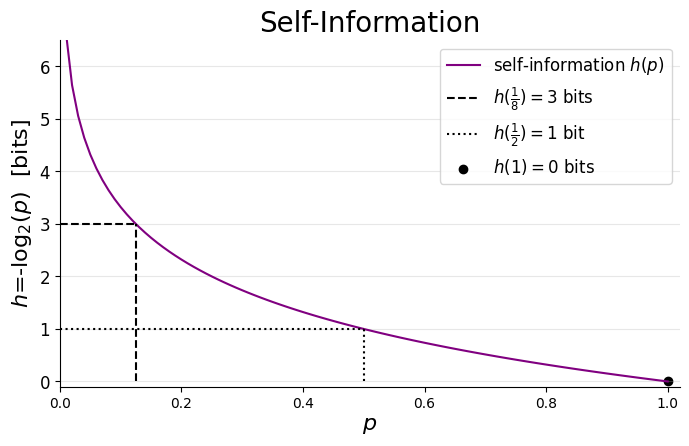
Bernoulli trial self-information h(p). Key features: Monotonic, h(p=1)=0, h(p →)→∞.

To deepen our understanding of self-information, we’ll use this graph to explore the said axioms that justify its logarithmic formulation. Along the way, we’ll also build intuition about key features of this heuristic.

To emphasise the logarithmic nature of self-information, I’ve highlighted three points of interest on the graph:

  • At p=1 an event is guaranteed, yielding no surprise and hence zero bits of information (zero bits). A useful analogy is a trick coin (where both sides show HEAD).
  • Reducing the probability by a factor of two (p=½​) increases the information to _hₓ=_1 bit. This, of course, is the case of a fair coin.
  • Further reducing it by a factor of four results in hₓ(p=⅛)=3 bits.

If you are interested in coding the graph here is a python script:

To summarise this section:

Self-Information hₓ=-log₂(p(x)) quantifies the amount of “surprise” of a specific outcome x.

Three Axioms

Referencing prior work by Ralph Hartley, Shannon chose -log₂(p) as a manner to meet three axioms. We’ll use the equation and graph to examine how these are manifested:

  1. An event with probability 100% is not surprising and hence does not yield any information.
    In the trick coin case this is evident by p(x)=1 yielding hₓ=0.

  2. Less probable events are more surprising and provide more information.
    This is apparent by self-information decreasing monotonically with increasing probability.

  3. The property of Additivity – the total self-information of two independent events equals the sum of individual contributions. This will be explored further in the upcoming fourth article on Mutual Information.

There are mathematical proofs (which are beyond the scope of this series) that show that only the log function adheres to all three².

The application of these axioms reveals several intriguing and practical properties of self-information:

Important properties :

  • Minimum bound: The first axiom hₓ(p=1)=0 establishes that self-information is non-negative, with zero as its lower bound. This is highly practical for many applications.
  • Monotonically decreasing: The second axiom ensures that self-information decreases monotonically with increasing probability.
  • No Maximum bound: At the extreme where _p→_0, monotonicity leads to self-information growing without bound hₓ(_p→0) →_ ∞, a feature that requires careful consideration in some contexts. However, when averaging self-information – as we will later see in the calculation of entropy – probabilities act as weights, effectively limiting the contribution of highly improbable events to the overall average. This relationship will become clearer when we explore entropy in detail.

It is useful to understand the close relationship to log-odds. To do so we define p(x) as the probability of event x to happen and px)=1-p(x) of it not to happen. log-odds(x) = log₂(p(x)/px))= hx) – h(x).

The main takeaways from this section are

Axiom 1: An event with probability 100% is not surprising

Axiom 2: Less probable events are more surprising and, when they occur, provide more information.

Self information (1) monotonically decreases (2) with a minimum bound of zero and (3) no upper bound.

In the next two sections we further discuss units of measure and choice of normalisation.

Information Units of Measure

Bits or Shannons?

A bit, as mentioned, represents the amount of information associated with an event that has a 50% probability of occurring.

The term is also sometimes referred to as a Shannon, a naming convention proposed by mathematician and physicist David MacKay to avoid confusion with the term ‘bit’ in the context of digital processing and storage.

After some deliberation, I decided to use ‘bit’ throughout this series for several reasons:

  • This series focuses on quantifying information, not on digital processing or storage, so ambiguity is minimal.
  • Shannon himself, encouraged by mathematician and statistician John Tukey, used the term ‘bit’ in his landmark paper.
  • ‘Bit’ is the standard term in much of the literature on information theory.
  • For convenience – it’s more concise

Normalisation: Log Base 2 vs. Natural

Throughout this series we use base 2 for logarithms, reflecting the intuitive notion of a 50% chance of an event as a fundamental unit of information.

An alternative commonly used in machine learning is the natural logarithm, which introduces a different unit of measure called nats (short for natural units of information). One nat corresponds to the information gained from an event occurring with a probability of 1/e where e is Euler’s number (≈2.71828). In other words, 1 nat = -ln(p=(1/e)).

The relationship between bits (base 2) and nats (natural log) is as follows:

1 bit = ln(2) nats ≈ 0.693 nats.

Think of it as similar to a monetary current exchange or converting centimeters to inches.

In his seminal publication Shanon explained that the optimal choice of base depends on the specific system being analysed (paraphrased slightly from his original work):

  • “A device with two stable positions […] can store one bit of information” (bit as in binary digit).
  • “A digit wheel on a desk computing machine that has ten stable positions […] has a storage capacity of one decimal digit.”³
  • “In analytical work where integration and differentiation are involved the base e is sometimes useful. The resulting units of information will be called natural units.

Key aspects of machine learning, such as popular loss functions, often rely on integrals and derivatives. The natural logarithm is a practical choice in these contexts because it can be derived and integrated without introducing additional constants. This likely explains why the machine learning community frequently uses nats as the unit of information – it simplifies the mathematics by avoiding the need to account for factors like ln(2).

As shown earlier, I personally find base 2 more intuitive for interpretation. In cases where normalisation to another base is more convenient, I will make an effort to explain the reasoning behind the choice.

To summarise this section of units of measure:

bit = amount of information to distinguish between two equally likely outcomes.

Now that we are familiar with self-information and its unit of measure let’s examine a few use cases.

Quantifying Event Information with Coins and Dice

In this section, we’ll explore examples to help internalise the self-information axioms and key features demonstrated in the graph. Gaining a solid understanding of self-information is essential for grasping its derivatives, such as entropy, cross-entropy (or KL divergence), and mutual information – all of which are averages over self-information.

The examples are designed to be simple, approachable, and lighthearted, accompanied by practical Python code to help you experiment and build intuition.

Note: If you feel comfortable with self-information, feel free to skip these examples and go straight to the Quantifying Uncertainty article.

Generated using Gemini.

To further explore the self-information and bits, I find analogies like coin flips and dice rolls particularly effective, as they are often useful analogies for real-world phenomena. Formally, these can be described as multinomial trials with n=1 trial. Specifically:

  • A coin flip is a Bernoulli trial, where there are c=2 possible outcomes (e.g., heads or tails).
  • Rolling a die represents a categorical trial, where c≥3 outcomes are possible (e.g., rolling a six-sided or eight-sided die).

As a use case we’ll use simplistic weather reports limited to featuring sun 🌞 , rain 🌧 , and snow ⛄️.

Now, let’s flip some virtual coins 👍 and roll some funky-looking dice 🎲 …

Fair Coins and Dice

Generated using Gemini.

We’ll start with the simplest case of a fair coin (i.e, 50% chance for success/Heads or failure/Tails).

Imagine an area for which at any given day there is a 50:50 chance for sun or rain. We can write the probability of each event be: p(🌞 )=p(🌧 )=½.

As seen above, according the the self-information formulation, when 🌞 or 🌧 is reported we are provided with h(🌞 __ )=h(🌧 )=-log₂(½)=1 bit of information.

We will continue to build on this analogy later on, but for now let’s turn to a variable that has more than two outcomes (c≥3).

Before we address the standard six sided die, to simplify the maths and intuition, let’s assume an 8 sided one (_c=_8) as in Dungeons Dragons and other tabletop games. In this case each event (i.e, landing on each side) has a probability of p(🔲 ) = ⅛.

When a die lands on one side facing up, e.g, value 7️⃣, we are provided with h(🔲 =7️⃣)=-log₂(⅛)=3 bits of information.

For a standard six sided fair die: p(🔲 ) = ⅙ → an event yields __ h(🔲 )=-log₂(⅙)=2.58 bits.

Comparing the amount of information from the fair coin (1 bit), 6 sided die (2.58 bits) and 8 sided (3 bits) we identify the second axiom: The less probable an event is, the more surprising it is and the more information it yields.

Self information becomes even more interesting when probabilities are skewed to prefer certain events.

Loaded Coins and Dice

Generated using Gemini.

Let’s assume a region where p(🌞 ) = ¾ and p(🌧 )= ¼.

When rain is reported the amount of information conveyed is not 1 bit but rather h(🌧 )=-log₂(¼)=2 bits.

When sun is reported less information is conveyed: h(🌞 )=-log₂(¾)=0.41 bits.

As per the second axiom— a rarer event, like p(🌧 )=¼, reveals more information than a more likely one, like p(🌞 )=¾ – and vice versa.

To further drive this point let’s now assume a desert region where p(🌞 ) =99% and p(🌧 )= 1%.

If sunshine is reported – that is kind of expected – so nothing much is learnt (“nothing new under the sun” 🥁) and this is quantified as h(🌞 )=0.01 bits. If rain is reported, however, you can imagine being quite surprised. This is quantified as h(🌧 )=6.64 bits.

In the following python scripts you can examine all the above examples, and I encourage you to play with your own to get a feeling.

First let’s define the calculation and printout function:

import numpy as np

def print_events_self_information(probs):
    for ps in probs:
        print(f"Given distribution {ps}")
        for event in ps:
            if ps[event] != 0:
                self_information = -np.log2(ps[event]) #same as: -np.log(ps[event])/np.log(2) 
                text_ = f'When `{event}` occurs {self_information:0.2f} bits of information is communicated'
                print(text_)
            else:
                print(f'a `{event}` event cannot happen p=0 ')
        print("=" * 20)

Next we’ll set a few example distributions of weather frequencies

# Setting multiple probability distributions (each sums to 100%)
# Fun fact - 🐍  💚  Emojis!
probs = [{'🌞   ': 0.5, '🌧   ': 0.5},   # half-half
        {'🌞   ': 0.75, '🌧   ': 0.25},  # more sun than rain
        {'🌞   ': 0.99, '🌧   ': 0.01} , # mostly sunshine
]

print_events_self_information(probs)

This yields printout

Given distribution {'🌞      ': 0.5, '🌧      ': 0.5}
When `🌞      ` occurs 1.00 bits of information is communicated 
When `🌧      ` occurs 1.00 bits of information is communicated 
====================
Given distribution {'🌞      ': 0.75, '🌧      ': 0.25}
When `🌞      ` occurs 0.42 bits of information is communicated 
When `🌧      ` occurs 2.00 bits of information is communicated 
====================
Given distribution {'🌞      ': 0.99, '🌧      ': 0.01}
When `🌞      ` occurs 0.01 bits of information is communicated 
When `🌧      ` occurs 6.64 bits of information is communicated  

Let’s examine a case of a loaded three sided die. E.g, information of a weather in an area that reports sun, rain and snow at uneven probabilities: p(🌞 ) = 0.2, p(🌧 )=0.7, p(⛄️)=0.1.

Running the following

print_events_self_information([{'🌞 ': 0.2, '🌧 ': 0.7, '⛄️': 0.1}])

yields

Given distribution {'🌞  ': 0.2, '🌧  ': 0.7, '⛄️': 0.1}
When `🌞  ` occurs 2.32 bits of information is communicated 
When `🌧  ` occurs 0.51 bits of information is communicated 
When `⛄️` occurs 3.32 bits of information is communicated 

What we saw for the binary case applies to higher dimensions.

To summarise – we clearly see the implications of the second axiom:

  • When a highly expected event occurs – we do not learn much, the bit count is low.
  • When an unexpected event occurs – we learn a lot, the bit count is high.

Event Information Summary

In this article we embarked on a journey into the foundational concepts of information theory, defining how to measure the surprise of an event. Notions introduced serve as the bedrock of many tools in information theory, from assessing data distributions to unraveling the inner workings of machine learning algorithms.

Through simple yet insightful examples like coin flips and dice rolls, we explored how self-information quantifies the unpredictability of specific outcomes. Expressed in bits, this measure encapsulates Shannon’s second axiom: rarer events convey more information.

While we’ve focused on the information content of specific events, this naturally leads to a broader question: what is the average amount of information associated with all possible outcomes of a variable?

In the next article, Quantifying Uncertainty, we build on the foundation of self-information and bits to explore entropy – the measure of average uncertainty. Far from being just a beautiful theoretical construct, it has practical applications in data analysis and machine learning, powering tasks like decision tree optimisation, estimating diversity and more.

Claude Shannon. Credit: Wikipedia

Loved this post? ❤️🍕

💌 Follow me here, join me on LinkedIn or 🍕 buy me a pizza slice!

About This Series

Even though I have twenty years of experience in data analysis and predictive modelling I always felt quite uneasy about using concepts in information theory without truly understanding them.

The purpose of this series was to put me more at ease with concepts of information theory and hopefully provide for others the explanations I needed.

🤷 Quantifying Uncertainty – A Data Scientist’s Intro To Information Theory – Part 2/4: EntropyGa_in intuition into Entropy and master its applications in Machine Learning and Data Analysis. Python code included. 🐍 me_dium.com

Check out my other articles which I wrote to better understand Causality and Bayesian Statistics:

Footnotes

¹ A Mathematical Theory of Communication, Claude E. Shannon, Bell System Technical Journal 1948.

It was later renamed to a book The Mathematical Theory of Communication in 1949.

[Shannon’s “A Mathematical Theory of Communication”] the blueprint for the digital era – Historian James Gleick

² See Wikipedia page on Information Content (i.e, self-information) for a detailed derivation that only the log function meets all three axioms.

³ The decimal-digit was later renamed to a hartley (symbol Hart), a ban or a dit. See Hartley (unit) Wikipedia page.

Credits

Unless otherwise noted, all images were created by the author.

Many thanks to Will Reynolds and Pascal Bugnion for their useful comments.

Shape
Shape
Stay Ahead

Explore More Insights

Stay ahead with more perspectives on cutting-edge power, infrastructure, energy,  bitcoin and AI solutions. Explore these articles to uncover strategies and insights shaping the future of industries.

Shape

It’s the end of set-and-forget security

For IT pros, this translates into: Designing topologies and routing policies that support near real‑time, partial restores of critical services without hard cutovers. Ensuring backup traffic, recovery workflows, and security tooling share telemetry so SecOps can correlate “what changed on the wire” with “what was restored.” Treating recovery points and

Read More »

Google bets on workload-specific TPUs with 8t and 8i launch

For model providers, such as OpenAI and Anthropic, the choice of chips, Dai pointed out, enables a clearer separation between training and serving fleets, while still allowing reuse of common tools and code paths, in turn lowering total costs, improving fleet efficiency, and simplifying model lifecycle transitions. In fact, Google

Read More »

US BLM to offer 400,000 acres for oil and gas leasing under ANWR’s coastal plain in June

The US Bureau of Land Management (BLM) will offer oil and gas leases on 400,000 acres under the Alaska National Wildlife Refuge (ANWR)’s coastal plain on June 5, the first in a series of at least four sales required under the One Big Beautiful Bill Act (OBBBA), which the Trump administration now calls the Working Families Tax Cut act. Recent attempts to lease land for oil and gas development in the 1.5-million-acre coastal plain (the “1002 Area”) of ANWR have generated little interest, with the most recent federal lease sale in January 2025 yielding zero bids and no revenue for federal or state taxpayers. This sale was the second auction mandated by another bill, the 2017 Tax Cuts and Jobs Act. The first sale under that law, held in January 2021, offered 1.1 million acres but yielded only $14.4 million in high bids, less than 1% of the roughly $1 billion originally estimated. BLM noted, however, that a recent federal lease sale in the National Petroleum Reserve in Alaska generated strong participation, which could portend a stronger showing for the upcoming ANWR sale. “The record-breaking success of last month’s lease sale in Alaska’s National Petroleum Reserve sent a clear signal: There is robust and continuing demand for Alaskan energy, underscoring the need for more opportunities like the Coastal Plain sale,” Acting BLM Director Bill Groffy said in a statement. “By expanding these opportunities, we strengthen our national energy security, support high-paying jobs for Alaskans, and help ensure Americans have access to affordable energy.” The Mar. 18 NPR-A sale resulted in 187 leases and $163.7 million in total receipts. Oil and gas development in ANWR remains contentious because of its ecologically sensitive environment and ongoing lawsuits from indigenous groups and environmental organizations. Majors, including ExxonMobil, ConocoPhillips, and bp have left the area

Read More »

Oil prices decline as Strait traffic resumes

Friday’s move has the May 2026 WTI NYMEX futures are trading below the 8-, 13-, and 21-day Moving Averages with a Low that breached the Lower-Bollinger Band limit. Volume is down to 80,000 as May expires next week and traders turn their attention to June. The Relative Strength Indicator (RSI), a momentum indicator, has fallen back into neutral territory at 42. Resistance is now pegged at $93.70 (8-day MA) while near-term Support is $82.45 (Bollinger Band). As has been the pattern for several weeks now, traders have to be cautious with their Friday positions as the market is closed until Sunday evening and the US/Iran talks continue on Saturday.   Looking ahead Questions now remain in terms of the duration of the Israeli ceasefire with Lebanon which Iran has tied to the opening of the Strait of Hormuz. Should Israel violate the ceasefire, it would put Iran’s IRGC back in direct conflict with US naval forces in the area should the former attempt to close the Strait again. US/Iran negotiations are scheduled to continue this weekend in Islamabad. Once again, markets will be closed until Sunday evening so the outcome of those talks will be key to market direction on the Open. Should peace hold, there will need to be a very detailed assessment of the long-term damage to all oil and gas infrastructure in the region. The tanker tracking map below indicates loaded oil vessels are exiting the Strait of Hormuz. Natural gas, fundamental analysis May NYMEX natural gas futures have now been on a 5-week downtrend on mild weather and a larger-than-expected storage injections despite healthy LNG export volumes. The week’s High was Monday’s $2.72/MMbtu while the Low was Tuesday’s $2.56, a tight range which indicates market direction uncertainty.   Natural gas demand this week has been estimated at about

Read More »

Phillips 66, Kinder Morgan move forward with Western Gateway pipeline with secured shipper interest

Phillips 66 Co. and Kinder Morgan Inc. have secured sufficient shipper interest to advance the proposed Western Gateway refined products pipeline project to supply fuel to ‌Arizona and California, the companies said in a joint release Apr. 20. Following a second open season to secure long-term shipper commitments, the companies will “move the project forward, subject to the execution of definitive transportation service agreements, joint venture agreements, and respective board approvals,” the companies said. “Customer response during the open season underscores the importance of Western Gateway in addressing long term refined products logistics needs in the region,” said Phillips 66 chairman and chief executive officer Mark Lashier. “By utilizing existing pipeline assets across multiple states along the route, we’re uniquely well-positioned to support a refined products transportation solution,” said Kim Dang, Kinder Morgan chief executive officer. Western Gateway pipeline specs The planned 200,000-b/d Western Gateway project is designed as a 1,300-mile refined products system with a new-build pipeline from Borger, Tex. to Phoenix, Ariz., combined with Kinder Morgan’s existing SFPP LP pipeline from Colton, Calif. to Phoenix, Ariz., which will be reversed to enable east-to-west product flows into California. It will be fed from supplies connected to Borger as well as supplies already connected to SFPP’s system in El Paso, Tex. The Gold Pipeline, operated by Phillips 66, which currently flows from Borger to St. Louis, will be reversed to enable refined products from midcontinent refineries to flow toward Borger and supply the Western Gateway pipeline. Western Gateway will also have connectivity to Las Vegas, Nev. via Kinder Morgan’s 566-mile CALNEV Pipeline. The Western Gateway Pipeline is targeting completion by 2029.  Phillips 66 will build the entirety of the new pipeline and will operate the line from Borger, Tex., to El Paso, Tex. Kinder Morgan will operate the line from El

Read More »

Viva Energy reports on Geelong refinery status following fire

Viva Energy Group Ltd. has stabilized operations at its 120,000-b/d Geelong refinery in Victoria, Australia, which continues operating at reduced rates following a mid-April fire in the site’s gasoline complex. In an Apr. 20 update to the market, Viva Energy confirmed the Apr. 15 fire specifically occurred in the complex’s alkylation unit and was not fully extinguished until the morning of Apr. 16. While the refinery’s crude distillation units and reformer continue operating, the site’s residue catalytic cracking unit (RCCU) remains temporarily offline as part of ongoing stabilization efforts, according to the company. In the near term, Viva Energy said it expects the refinery’s diesel and jet fuel production to average about 80% normal capacity, with gasoline output reduced to about 60% capacity. The company anticipates production constraints to ease in the coming weeks, subject to inspection and restart of the RCCU, which would allow the refinery’s combined output diesel, jet fuel, and gasoline to exceed 90% of nameplate capacity until all necessary repairs are completed. With sufficient fuel inventories already on hand, Viva Energy said it remains well-positioned to maintain normal fuel supplies to customers during the production shortfalls. “The whole Viva Energy team understands how important our refinery is to the energy security of the country, especially at the current time. We will progressively restore production once we are confident that it is safe to do so, and do not expect any disruptions to fuel availability or price increases for Viva Energy’s customers as a result of this incident,” Scott Wyatt, Viva Energy’s chief executive officer, said in a separate statement. While the company confirmed an assessment of damage to the alkylation unit and associated systems is under way, estimated timelines for full repairs and financial impacts resulting from the fire have yet to be determined. Alongside prioritizing

Read More »

Oil prices plunge following full reopening of the Strait of Hormuz to commercial vessels

Oil prices plunged on Apr. 17, as geopolitical tensions in the Middle East showed signs of easing, following the full reopening of the Strait of Hormuz to commercial vessels. Global crude markets reacted sharply after Iran confirmed that the Strait of Hormuz is now “completely open” to commercial shipping during an ongoing ceasefire tied to regional conflict negotiations. The announcement marked a major turning point after weeks of disruption that had severely constrained global oil flows. Stay updated on oil price volatility, shipping disruptions, LNG market analysis, and production output at OGJ’s Iran war content hub. Brent crude fell by more than 10%, dropping to around $88–89/bbl, while US West Texas Intermediate (WTI) declined to the low $80s—both benchmarks hitting their lowest levels in over a month. The sell-off reflects a rapid unwinding of the geopolitical risk premium that had built up during the conflict. The reopening follows a fragile, 10-day ceasefire involving Israel and Lebanon, alongside tentative progress in US–Iran negotiations. While the waterway is now open, the US has maintained a naval blockade on Iranian ports, signaling that broader geopolitical risks have not fully dissipated. The return of tanker traffic through the Gulf could gradually restore millions of barrels per day to global markets, easing the tight conditions that had driven recent price volatility. However, some uncertainty remains over how quickly shipping activity will normalize and whether the ceasefire will hold. Despite the sharp price decline, the oil market remains structurally fragile. Weeks of disruption have depleted inventories and altered trade flows, and it may take time for supply chains to fully recover. Additionally, any breakdown in ceasefire talks could quickly reverse the current trend. Beyond energy markets, the development rippled across global financial systems. Equity markets surged, with major US indices posting strong gains as lower oil

Read More »

EIA: US crude inventories up 1.9 million bbl

US crude oil inventories for the week ended Apr. 17, excluding the Strategic Petroleum Reserve, increased by 1.9 million bbl from the previous week, according to data from the US Energy Information Administration (EIA). At 465.7 million bbl, US crude oil inventories are about 3% above the 5-year average for this time of year, the EIA report indicated. EIA said total motor gasoline inventories decreased by 4.6 million bbl from last week and are about 0.5% below the 5-year average for this time of year. Finished gasoline inventories increased while blending components inventories decreased last week. Distillate fuel inventories decreased by 3.4 million bbl last week and are about 8% below the 5-year average for this time of year. Propane-propylene inventories increased by 2.1 million bbl from last week and are 69% above the 5-year average for this time of year, EIA said. US crude oil refinery inputs averaged 16.0 million b/d for the week, which was 55,000 b/d less than the previous week’s average. Refineries operated at 89.1% of capacity. Gasoline production increased, averaging 10.1 million b/d. Distillate fuel production increased, averaging 5.0 million b/d. US crude oil imports averaged 6.1 million b/d, up 787,000 b/d from the previous week. Over the last 4 weeks, crude oil imports averaged about 6.0 million b/d, 0.4% less than the same 4-week period last year. Total motor gasoline imports averaged 587,000 b/d. Distillate fuel imports averaged 190,000 b/d.

Read More »

How AI is changing copper, fiber networking

In a side-by-side comparison using 1.6 Tb/s ports, optical cables can consume up to 20 watts of power, vs. virtually none for copper. That gap has major implications at scale. In massive AI installations with thousands of connections, optical power draw can quickly add up to a meaningful share of a facility’s total energy usage. Despite its efficiency, copper has a hard physical limitation: distance. As data rates increase, the maximum length of passive copper cables shrinks dramatically. At common speeds—such as 1Gb/s—copper Ethernet cables can span long distances without issue. But at the speeds used inside AI systems, the story changes. At roughly 200 Gb/s per lane, passive copper connections are limited to only a few meters, typically around two to three meters. Beyond that, signal integrity breaks down and fiber becomes inevitable, said Shainer. This constraint shapes how modern data centers are built. Copper is ideal for scale‑up networking, such as connecting GPUs within the same rack, where distances are short. Scale‑out networking—linking racks across rows, halls, or entire buildings—requires fiber optics. Fiber also matches copper in raw speed potential. Both media can support extremely high data rates, but fiber maintains those speeds over vastly longer distances. The tradeoff is higher cost, greater fragility, and significantly higher power consumption. Copper cables are physically tough and difficult to damage. Fiber cables contain delicate glass strands that can break if bent or mishandled.

Read More »

Almost 40% of data center projects will be late this year, 2027 looks no better

Add to that the significant parts and components shortage as well as the growing revolt by both nearby residents living near proposed data center sites as well as state and local governments. OpenAI told the Financial Times,  “Our historic data center build-out is on schedule and we will accelerate from here. In partnership with Oracle, SB Energy and a broader ecosystem of partners, we are delivering rapid progress in Abilene, Shackelford County and Milam County in Texas,” while Oracle said,  “Each data center we’re developing for OpenAI is moving forward on time, and construction is proceeding according to plan.” Two construction executives working on OpenAI-linked projects said there were not enough specialist workers, from electricians to pipe fitters, to meet demand across the build-out as companies race to construct clusters of increasingly large and complex facilities. Data center construction is facing growing headwinds from all quarters. Umm the high hardware demands of AI’s data centers has resulted in a significant shortage of not only GPUs but also memory and storage. Hard drive makers are sold out through the end of this year and into next year and memories going for hundreds if not thousands of dollars. Power is another issue. GPUs especially our power hungry and the demands of data centers have gone through the roof. With the current grid unable to support the demands, data center providers are looking to provide their own power, namely through modular nuclear data centers. Nuclear power has come back into vogue after being on the outs for so many years. Then there’s the revolt of both citizens and governments. What started out as individual groups in cities and states opposing data centers has now moved on to the state of Maine putting a pause on all data center construction through next year, and

Read More »

Data centers are costing local governments billions

Tax benefits for hyperscalers and other data center operators are costing local administrations billions of dollars. In the US, three states are already giving away more than $1 billion in potential tax revenue, while 14 are failing to declare how much data center subsidies are costing taxpayers, according to Good Jobs First. The campaign group said the failure to declare the tax subsidies goes against US Generally Accepted Accounting Principles (GAAP) and that they should, since 2017, be declared as lost revenue. “Tax-abatement laws written long ago for much smaller data centers, predating massive artificial intelligence (AI) facilities, are now unexpectedly costing governments billions of dollars in lost tax revenue,” Good Jobs First said. “Three states, Georgia, Virginia, and Texas, already lose $1 billion or more per year,” it reported in its new study, “Data Center Tax Abatements: Why States and Localities Must Disclose These Soaring Revenue Losses.”

Read More »

Equinix offering targets automated AI-centric network operations

Another component, Fabric Application Connect, functions as a private, dedicated connectivity marketplace for AI services. It lets enterprises access inference, training, storage, and security providers over private connections, bypassing the public Internet and limiting data exposure during AI development and deployment. Operational visibility is provided through Fabric Insights, an AI-powered monitoring layer that analyzes real-time network telemetry to detect anomalies and predict potential issues before they impact workloads. Fabric Insights integrates with security information and event management (SIEM) platforms such as Splunk and Datadog and feeds data directly into Fabric Super-Agent to support automated remediation. Fabric Intelligence operates on top of Equinix’s global infrastructure footprint, which includes hundreds of data centers across dozens of metropolitan markets. The platform is positioned as part of Equinix Fabric, a connectivity portfolio used by thousands of customers worldwide to link cloud providers, enterprises, and network services. Fabric Intelligence is available now to preview.

Read More »

Blue Owl Builds a Capital Platform for the Hyperscale AI Era

Capital as a Service: The Hyperscaler Shift This is not just another project financing. It points to a model in which hyperscalers can externalize a significant portion of the capital required for AI campuses while retaining operational control. Under the Hyperion structure, Meta provides construction and property management, while Blue Owl supplies capital at scale alongside infrastructure expertise. Reuters described the transaction as Meta’s largest private capital deal to date, with the campus projected to exceed 2 gigawatts of capacity. For Blue Owl, it marks a shift in role: from backing developers serving hyperscalers to working directly with a hyperscaler to structure ownership more efficiently at scale. Hyperion also helps explain why this model is gaining traction. Hyperscalers are now deploying capital at a pace that makes flexibility a strategic priority. Structures like the Meta–Blue Owl JV allow them to continue expanding infrastructure without fully absorbing the balance-sheet impact of each new campus. Analyst commentary cited by Reuters suggested the arrangement could help Meta mitigate risk and avoid concentrating too much capital in land, buildings, and long-lived infrastructure, preserving capacity for additional facilities and ongoing AI investment. That is the service Blue Owl is effectively providing. Not just capital, but balance-sheet flexibility at a time when AI infrastructure demand is stretching even the largest technology companies. With major tech firms projected to spend hundreds of billions annually on AI infrastructure, that capability is becoming central to how the next generation of campuses gets built. The Capital Baseline Resets In early 2026, hyperscalers effectively reset the capital baseline for the sector. Alphabet projected $175 billion to $185 billion in annual capex, citing continued constraints across servers, data centers, and networking. Amazon pointed to roughly $200 billion, up from $131 billion the prior year, while noting persistent demand pressure in AWS. Meta

Read More »

OpenAI pulls out of a second Stargate data center deal

“OpenAI is embattled on several fronts. Anthropic has been doing very well in the enterprise, and OpenAI’s cash burn might be a problem if it wants to go public at an astronomical $800 billion+ valuation. This is especially true with higher energy prices due to geopolitics, and the public and regulators increasingly skeptical of AI companies, especially outside of the United States,” Roberts said. “I see these moves as OpenAI tightening its belt a bit and being more deliberate about spending as it moves past the interesting tech demo stage of its existence and is expected to provide a real return for investors.” He added, “I expect it’s a symptom of a broader problem, which is that OpenAI has thrown some good money after bad in bets that didn’t work out, like the Sora platform it just shut down, and it’s under increasing pressure to translate its first-mover advantage into real upside for its investors. Spending operational money instead of capital money might give it some flexibility in the short term, and perhaps that’s what this is about.” All in all, he noted, “on a scale of business-ending event to nothingburger, I would put it somewhere in the middle, maybe a little closer to nothingburger.” Acceligence CIO Yuri Goryunov agreed with Roberts, and said, “OpenAI has a problem with commercialization and runaway operating costs, for sure. They are trying to rightsize their commitments and make sure that they deliver on their core products before they run out of money.” Goryunov described OpenAI’s arrangement with Microsoft in Norway as “prudent financial engineering” that allows it to access the data center resources without having to tie up too much capital. “It’s financial discipline. OpenAI [executives] are starting to behave like grownups.” Forrester senior analyst Alvin Nguyen echoed those thoughts. 

Read More »

Microsoft will invest $80B in AI data centers in fiscal 2025

And Microsoft isn’t the only one that is ramping up its investments into AI-enabled data centers. Rival cloud service providers are all investing in either upgrading or opening new data centers to capture a larger chunk of business from developers and users of large language models (LLMs).  In a report published in October 2024, Bloomberg Intelligence estimated that demand for generative AI would push Microsoft, AWS, Google, Oracle, Meta, and Apple would between them devote $200 billion to capex in 2025, up from $110 billion in 2023. Microsoft is one of the biggest spenders, followed closely by Google and AWS, Bloomberg Intelligence said. Its estimate of Microsoft’s capital spending on AI, at $62.4 billion for calendar 2025, is lower than Smith’s claim that the company will invest $80 billion in the fiscal year to June 30, 2025. Both figures, though, are way higher than Microsoft’s 2020 capital expenditure of “just” $17.6 billion. The majority of the increased spending is tied to cloud services and the expansion of AI infrastructure needed to provide compute capacity for OpenAI workloads. Separately, last October Amazon CEO Andy Jassy said his company planned total capex spend of $75 billion in 2024 and even more in 2025, with much of it going to AWS, its cloud computing division.

Read More »

John Deere unveils more autonomous farm machines to address skill labor shortage

Join our daily and weekly newsletters for the latest updates and exclusive content on industry-leading AI coverage. Learn More Self-driving tractors might be the path to self-driving cars. John Deere has revealed a new line of autonomous machines and tech across agriculture, construction and commercial landscaping. The Moline, Illinois-based John Deere has been in business for 187 years, yet it’s been a regular as a non-tech company showing off technology at the big tech trade show in Las Vegas and is back at CES 2025 with more autonomous tractors and other vehicles. This is not something we usually cover, but John Deere has a lot of data that is interesting in the big picture of tech. The message from the company is that there aren’t enough skilled farm laborers to do the work that its customers need. It’s been a challenge for most of the last two decades, said Jahmy Hindman, CTO at John Deere, in a briefing. Much of the tech will come this fall and after that. He noted that the average farmer in the U.S. is over 58 and works 12 to 18 hours a day to grow food for us. And he said the American Farm Bureau Federation estimates there are roughly 2.4 million farm jobs that need to be filled annually; and the agricultural work force continues to shrink. (This is my hint to the anti-immigration crowd). John Deere’s autonomous 9RX Tractor. Farmers can oversee it using an app. While each of these industries experiences their own set of challenges, a commonality across all is skilled labor availability. In construction, about 80% percent of contractors struggle to find skilled labor. And in commercial landscaping, 86% of landscaping business owners can’t find labor to fill open positions, he said. “They have to figure out how to do

Read More »

2025 playbook for enterprise AI success, from agents to evals

Join our daily and weekly newsletters for the latest updates and exclusive content on industry-leading AI coverage. Learn More 2025 is poised to be a pivotal year for enterprise AI. The past year has seen rapid innovation, and this year will see the same. This has made it more critical than ever to revisit your AI strategy to stay competitive and create value for your customers. From scaling AI agents to optimizing costs, here are the five critical areas enterprises should prioritize for their AI strategy this year. 1. Agents: the next generation of automation AI agents are no longer theoretical. In 2025, they’re indispensable tools for enterprises looking to streamline operations and enhance customer interactions. Unlike traditional software, agents powered by large language models (LLMs) can make nuanced decisions, navigate complex multi-step tasks, and integrate seamlessly with tools and APIs. At the start of 2024, agents were not ready for prime time, making frustrating mistakes like hallucinating URLs. They started getting better as frontier large language models themselves improved. “Let me put it this way,” said Sam Witteveen, cofounder of Red Dragon, a company that develops agents for companies, and that recently reviewed the 48 agents it built last year. “Interestingly, the ones that we built at the start of the year, a lot of those worked way better at the end of the year just because the models got better.” Witteveen shared this in the video podcast we filmed to discuss these five big trends in detail. Models are getting better and hallucinating less, and they’re also being trained to do agentic tasks. Another feature that the model providers are researching is a way to use the LLM as a judge, and as models get cheaper (something we’ll cover below), companies can use three or more models to

Read More »

OpenAI’s red teaming innovations define new essentials for security leaders in the AI era

Join our daily and weekly newsletters for the latest updates and exclusive content on industry-leading AI coverage. Learn More OpenAI has taken a more aggressive approach to red teaming than its AI competitors, demonstrating its security teams’ advanced capabilities in two areas: multi-step reinforcement and external red teaming. OpenAI recently released two papers that set a new competitive standard for improving the quality, reliability and safety of AI models in these two techniques and more. The first paper, “OpenAI’s Approach to External Red Teaming for AI Models and Systems,” reports that specialized teams outside the company have proven effective in uncovering vulnerabilities that might otherwise have made it into a released model because in-house testing techniques may have missed them. In the second paper, “Diverse and Effective Red Teaming with Auto-Generated Rewards and Multi-Step Reinforcement Learning,” OpenAI introduces an automated framework that relies on iterative reinforcement learning to generate a broad spectrum of novel, wide-ranging attacks. Going all-in on red teaming pays practical, competitive dividends It’s encouraging to see competitive intensity in red teaming growing among AI companies. When Anthropic released its AI red team guidelines in June of last year, it joined AI providers including Google, Microsoft, Nvidia, OpenAI, and even the U.S.’s National Institute of Standards and Technology (NIST), which all had released red teaming frameworks. Investing heavily in red teaming yields tangible benefits for security leaders in any organization. OpenAI’s paper on external red teaming provides a detailed analysis of how the company strives to create specialized external teams that include cybersecurity and subject matter experts. The goal is to see if knowledgeable external teams can defeat models’ security perimeters and find gaps in their security, biases and controls that prompt-based testing couldn’t find. What makes OpenAI’s recent papers noteworthy is how well they define using human-in-the-middle

Read More »