In an oil and gas report sent to Rigzone late Monday by the Macquarie team, Macquarie strategists, including Walt Chancellor, revealed that they are forecasting that U.S. crude inventories will be up by 5.0 million barrels for the week ending January 9.
“This follows a 3.8 million barrel draw in the prior week, with the crude balance realizing relatively close to our expectations,” the strategists said in the report.
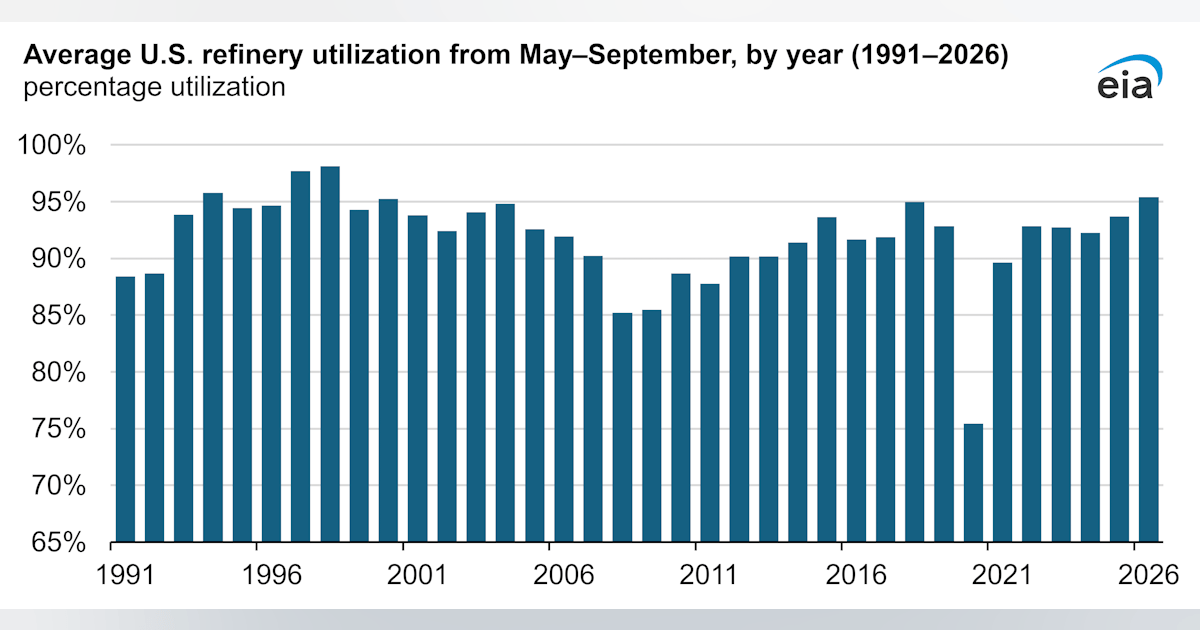
“For the week ending 1/9, from refineries, we look for a modest reduction in crude runs (-0.1 million barrels per day). Among net imports, we model a healthy increase, with exports sharply lower (-0.9 million barrels per day) and imports up slightly (+0.1 million barrels per day) on a nominal basis,” they added.
The strategists stated in the report that timing of cargoes remains a source of potential volatility in the weekly crude balance. They also noted in the report that they “see some lingering potential for noise from year-end effects”.
“From implied domestic supply (prod.+adj.+transfers), we look for a small nominal increase (+0.1 million barrels per day),” the Macquarie strategists went on to note.
“Rounding out the picture, we anticipate another small increase (+0.2 million barrels) in SPR [Strategic Petroleum Reserve] stocks for the week ending 1/9,” they said.
The Macquarie strategists also highlighted in the report that, “among products”, they “again look for another large build led by gasoline (+7.1 million barrels), with distillate (+2.4 million barrels) and jet stocks (+0.7 million barrels) also higher”.
“We model implied demand for these three products at ~13.6 million barrels per day for the week ending January 9,” the strategists went on to state.
In its latest weekly petroleum status report at the time of writing, which was released on January 7 and included data for the week ending January 2, the U.S. Energy Information Administration (EIA) highlighted that U.S. commercial crude oil inventories, excluding those in the SPR, decreased by 3.8 million barrels from the week ending December 26 to the week ending January 2.
According to that report, crude oil stocks, not including the SPR, stood at 419.1 million barrels on January 2, 422.9 million barrels on December 26, 2025, and 414.6 million barrels on January 3, 2025. Crude oil in the SPR stood at 413.5 million barrels on January 2, 413.2 million barrels on December 26, and 393.8 million barrels on January 3, 2025, that report showed.
Total petroleum stocks – including crude oil, total motor gasoline, fuel ethanol, kerosene type jet fuel, distillate fuel oil, residual fuel oil, propane/propylene, and other oils – stood at 1.707 billion barrels on January 2, the EIA report revealed. Total petroleum stocks were up 8.4 million barrels week on week and up 78.7 million barrels year on year, the report pointed out.
In an oil and gas report sent to Rigzone on January 6 by the Macquarie team, Macquarie strategists, including Walt Chancellor, revealed that they were forecasting that U.S. crude inventories would be down by 3.5 million barrels for the week ending January 2.
“This follows a 1.9 million barrel draw in the prior week, with the crude balance realizing tight relative to our expectations alongside oddly low import levels, particularly from Canada,” the strategists said in that report.
The EIA’s next weekly petroleum status report is scheduled to be released on January 14. It will include data for the week ending January 9.
The EIA’s weekly petroleum status report states that it “provides timely information on supply and selected prices of crude oil and principal petroleum products”. In this report, the EIA describes itself as the independent statistical and analytical agency within the Department of Energy.
On its site, Macquarie describes itself as “a global financial services group operating in asset management, retail and business banking, wealth management, as well as advisory, and risk and capital solutions across debt, equity, financial markets and commodities”.
To contact the author, email andreas.exarheas@rigzone.com