Stay Ahead, Stay ONMINE

The network automation imperative: ‘Too many devices to copy-paste configs. Automate or die’

After years of maintaining heavily customized vendor tools—and more than 60 supporting servers—Intel reached another inflection point. The cost and technical debt were no longer sustainable. The team began searching for an off-the-shelf platform built around open standards and centralized management. They ultimately selected the open-source version of Nautobot, created and maintained by Network to […]

After years of maintaining heavily customized vendor tools—and more than 60 supporting servers—Intel reached another inflection point. The cost and technical debt were no longer sustainable.

The team began searching for an off-the-shelf platform built around open standards and centralized management. They ultimately selected the open-source version of Nautobot, created and maintained by Network to Code, to serve as a network source of truth and automation foundation. Migration required scripting and cleanup to transform existing device data into usable, structured network data—but it laid the groundwork for a more disciplined model.

A network source of truth is a centrally located, authoritative repository of operations data that’s been validated and consolidated. It can document network intent and provide programmatic access to data for network automation tools and other systems, according to Enterprise Management Associates (EMA).

“Network automation tools need to reference an authoritative set of network data to make sure that the changes they make reflect what you want the network to look like and do,” said Shamus McGillicuddy, research director for the network management practice at EMA, during a recent webinar.

For Intel, the philosophical shift was as important as the platform choice. “Start with your network data,” Botts says. “Everything else should be a byproduct of the data.”

Instead of updating documentation after changes were made, Intel reversed the process. All changes now begin in the source of truth and are pushed to the network via automation. CLI-driven copy-and-paste workflows are no longer part of normal operations.


Shape
Shape
Stay Ahead

Explore More Insights

Stay ahead with more perspectives on cutting-edge power, infrastructure, energy,  bitcoin and AI solutions. Explore these articles to uncover strategies and insights shaping the future of industries.

Shape

F5 tackles AI security with new platform extensions

F5 AI Guardrails deploys as a proxy between users and AI models. Wormke describes it as being inserted as a proxy layer at the “front door” of AI interaction, between AI applications, users and agents. It intercepts prompts before they reach the model and analyzes outputs before they return to

Read More »

AWS European cloud service launch raises questions over sovereignty

There are examples of similar scenarios in recent years. The International Criminal Court’s chief prosecutor was reportedly shut out of Microsoft applications following the imposition of US sanctions, for example. Other instances include Adobe cutting off Venezuelan customers in compliance with US sanctions against that country in 2019, while Microsoft

Read More »

Mol to Buy Gazprom Stake in Sanctioned Serbian Refinery

Mol Nyrt. and Gazprom Neft PJSC have agreed on the terms of a deal which will see the Hungarian company gain control of Serbia’s only oil refinery, paving the way for the lifting of US sanctions on the plant’s operator. Mol will buy Gazprom’s combined 56.2 percent interest in Naftna Industrija Srbije, which came under US sanctions in October due to its Russian majority ownership, the Budapest-based firm said in a statement on Monday. The deal, subject to the approval of the US Office of Foreign Assets Control and the Serbian government, may be completed by March 31, Mol said, without disclosing the purchase price.  Mol is in talks with Abu Dhabi National Oil Co. to enter NIS as a minority shareholder, Mol Chairman and Chief Executive Officer Zsolt Hernadi said in the statement. The United Arab Emirates has a long relationship with Serbia, with several government-linked entities having made investments in property, agriculture and other businesses in the Balkan state.  Serbia is also looking to raise its nearly 30 percent stake in NIS by 5 percentage points, Serbian Energy Minister Dubravka Djedovic Handanovic told reporters in Belgrade earlier on Monday. The deal is a win for Hungarian Prime Minister Viktor Orban ahead of elections in April where his party is trailing in polls. The premier leveraged his ties to the leaders of Russia, Serbia and the US to bring the deal to fruition, discussing the potential purchase in back-to-back meetings with the three presidents late last year. Removing Sanctions Hungary and Serbia will now ask the US to lift sanctions on NIS. They were imposed amid a raft of penalties on multiple Russian-controlled energy assets following Moscow’s 2022 invasion of Ukraine. The sanctions on NIS – announced a year ago but in effect since October – halted oil deliveries via the Adriatic pipeline

Read More »

Venezuelan Oil Moves Into the Caribbean

Tankers have begun discharging Venezuelan crude at Caribbean islands, publicly signaling their activity in a move that marks a new trade order after US exerted control over Caracas’ oil industry.  Two vessels delivered about 2.5 million barrels of Venezuela’s Merey crude to storage tanks on Saint Lucia and Curacao, staging posts for broader exports, over the weekend, according to ship-tracking data. In the coming days, others tankers are set to bring more of the nation’s oil to different destinations, including the Bahamas. The Trump administration tapped trading giants Trafigura Group and Vitol Group to help market Venezuelan crude, and is encouraging US majors to invest in the country to revive its battered oil industry. The shipping market is being shaken up by the intervention, with freight rates surging for some routes.  Some so-called dark fleet tankers laden with Venezuelan crude have turned on their transponders as they prepare to offload their oil, while ships that have stayed clear of the trade return to participate.  The Volans — an Aframax sanctioned by the US and UK — unloaded about 600,000 barrels at Curacao on Jan. 17, according to ship-tracking data. The discharge location is home to the Bullen Bay storage facility. The vessel was carrying a cargo for Vitol, Bloomberg reported last week. Separately, the Kelly, a very-large crude carrier, arrived at Castries on Saint Lucia on Jan. 18 to offload 1.9 million barrels of Merey, according to the data. The delivery is the first shipment of Venezuelan crude to the Caribbean island since Dec. 2018, according to Kpler and Vortexa. Castries is home to a storage facility that’s primarily operated by Houston-headquartered Buckeye Partners LP. The company didn’t immediately respond to an email seeking comment outside of working hours. Bloomberg News couldn’t identify the company or entity responsible for the oil trade. Meanwhile, VLCC Marbella reached South

Read More »

Xcel-led coalition proposes Minnesota-North Dakota transmission expansion

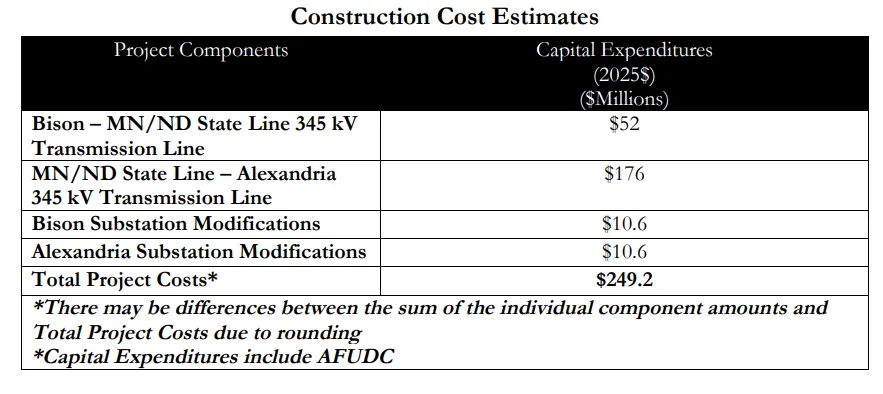
Listen to the article 3 min This audio is auto-generated. Please let us know if you have feedback. Five Upper Midwestern utilities, led by Xcel Energy, have proposed expanding transmission between North Dakota and Minnesota to address thermal and voltage issues on an existing 345-kV line operating at capacity. The companies, which include Great River Energy, Minnesota Power, Missouri River Energy Services and Otter Tail Power, on Jan. 15 filed an application with the Minnesota Public Utilities Commission to add a second 345-kV transmission circuit to the existing line between Douglas County, Minnesota, and Cass County, North Dakota. The original transmission line was completed about a decade ago as part of the CapX2020 project. The companies said all new infrastructure would be added within the existing right-of-way. The five energy providers will jointly own the project, with Xcel acting as project manager and responsible for construction. The entire project is estimated to cost about $249 million, with roughly $187 million for work in Minnesota, according to the application.  Retrieved from Minnesota PUC. The utilities said they plan to file a similar application with North Dakota regulators. “We designed the original transmission line with the future in mind by building infrastructure that could be expanded when our customers and electric cooperative members needed it,” the energy providers said in a statement. “We will soon expand this important project without affecting any new landowners, limiting our overall impact while saving money for our customers and electric cooperative members throughout the region.” The new line “will facilitate efficient electricity transmission across multiple states to local communities, supporting each state’s policy and reliability objectives in a more cost-effective and minimally disruptive manner,” the utilities said in their application. “The project is needed to provide additional transmission capacity and to maintain electric system reliability throughout the

Read More »

Murphy Oil Makes Noncommercial Find in Ivorian Frontier Campaign

Murphy Oil Corp said Monday it had encountered noncommercial quantities of hydrocarbons in the first of its three-well exploration campaign offshore Côte d’Ivoire. “A key outcome at Civette is that we confirmed the presence of hydrocarbons in this frontier play – a meaningful success in early-stage exploration”, president and chief executive Eric Hambly said in an online statement. “While Civette did not meet commercial thresholds, the well provided insights that strengthen our subsurface understanding for the potential of the [Tano] basin and inform the remaining prospectivity on the CI-502 Block”. The Houston, Texas-based oil and gas explorer and developer had placed a gross resource potential of 440-1,000 million barrels of oil equivalent (MMboe) on Civette, according to Murphy Oil’s investor presentation on January 7, 2026. The Civette well is in Block CI-502. The company said Monday it would continue with the Bubale prospect in Block CI-709 and the Caracal prospect in CI-102, “both targeting independent plays with significant resource potential”. According to the investor presentation, the gross resource potential for Bubale and Caracal is 340-850 MMboe and 150-360 MMboe respectively. They are scheduled to be spudded this year. The three blocks are among five held by Murphy Oil in the West African country. The five, all in deep waters, are co-owned with Société Nationale d’Opérations Pétrolières de la Côte d’Ivoire, the American company holding 85-90 percent operating interests. The licenses, acquired 2023, cover about 1.5 million gross acres in the Tano basin, according to Murphy Oil. Murphy Oil was scheduled to submit a development plan for the Paon discovery in Block CI-103 to Ivorian authorities by the end of 2025, according to the company’s annual report for 2024. Elsewhere, Murphy Oil has scheduled two more spuds in Vietnam this year, both appraisal wells for last year’s Hai Su Vang oil discovery.

Read More »

Gas Analyst Flags ‘Historic Cold’

In an EBW Analytics Group report sent to Rigzone by the EBW team on Tuesday, Eli Rubin, an energy analyst at the company, noted that “historic cold launche[d]… soaring NYMEX gas futures”. “Frigid weather is set to reshape the near-term natural gas outlook as Arctic air masses flash across the eastern U.S. and the huge weather demand gain over the MLK [Martin Luther King Jr.] weekend threatens severe market dislocation,” Rubin said in the report. “DTN’s 278 gHDDs for Week 2 presents chances for the coldest weekly gHDD total since February 2021,” he added. “Saturday may reach 45 gHDDs – threatening production freeze-offs as Marcellus temps drop toward 0°F and the Bakken reaches -25°F. Risks are high for Rockies, MidCon, and Texas, but the current outlook suggests limited regional supply losses,” he continued. “Still, spot prices are likely to spike into the weekend. Weather models often misjudge the magnitude and extent of severe cold – and any shifts colder could put more supply at risk,” he said. Rubin went on to state in the report that the “frigid weather pivot comes with speculator short positions at a 14-month high – suggesting further bullish risks as shorts are forced to buy back gas”. The EBW analyst warned in the report, however, that volatility will stay high, and said any weather model warming into mid-February could allow a near-term price spike to eventually soften. Rubin highlighted in the EBW report that, “fundamentally, the immediate-term consequences of cold may be to wipe out the 190 billion cubic foot natural gas storage surplus to five-year norms in mid-January”. “While subject to a broad range of uncertainty depending on the magnitude and expanse of cold – and resulting production freeze-offs – current projections suggest a huge storage draw above 750 billion cubic feet over Weeks

Read More »

TotalEnergies, Bapco Launch Trading JV for Bahraini Fuels

TotalEnergies SE and Bahrain’s state-owned Bapco Energies have launched an equally owned trading platform to sell output from the Bapco refinery in the kingdom to the domestic and international markets. “As a competitive new player in the Middle East, BxT Trading will support Bahrain’s oil industry by leveraging its downstream portfolio for maximizing value and broadening its access to global markets”, said a joint statement online. “Through this joint venture, Bapco Energies will benefit from TotalEnergies’ global expertise in trading and will develop advanced trading, pricing, analysis and risk management capabilities. “With BxT Trading, TotalEnergies is strengthening its trading position in the Middle East, where the company already has trading activities, in addition to its international hubs in Houston, Geneva and Singapore. “This new initiative enhances the trading teams’ responsiveness and agility, reinforcing their local footprint that enables them to better address regional specificities”. Bapco Energies chair Nasser bin Hamad Al Khalifa said, “Through this partnership with TotalEnergies, we are enhancing our global trading capabilities, strengthening our downstream value chain and reinforcing Bahrain’s position as a competitive and trusted player in the international energy markets”. The Bapco refinery has a capacity of 380,000 barrels per day (bpd), increased 42 percent under a “modernization program”, Bapco Energies says on its website. The upgrade included the installation of a hydrocracking unit designed to convert 78 percent of lower-grade feedstock into distillates, which are then refined into high-margin diesel and kerosene, according to Bapco Energies. In its trading and shipping segment, TotalEnergies last year sold 2.28 million bpd of petroleum products to external customers, up from 1.95 million bpd in 2023, according to the company’s annual report. “The activities of Trading & Shipping are focused primarily on serving the needs of TotalEnergies, and mainly include selling and marketing the TotalEnergies’ crude oil production; providing

Read More »

What’s causing the memory shortage?

Something else that they agree on is that OEMs, at least for now, are absorbing the increasing price and not passing it on to customers. However, that’s subject to change if the prices keep going up. “To date, we’ve not heard various vendors talking about increasing prices, but we’ve not seen those price increases hit yet, because most of the systems that are shipped into the channel and that are selling right now were shipped before the dramatic price increases hit,” said Mainelli. “What’s likely to happen, from a market perspective, is we’ll see the market grow less in 26 than we had anticipated but ASPs are likely to stay or increase. So revenues overall may not look too bad, but from a unit volume that’s likely going to be impacted as prices go up,” he said. Finally, they agree that if the often-rumored AI bubble bursting actually happens and construction comes to a stop? If expansion stops, demand will stop and that will free up supply, argue the analysts. “If you decide that you’re going to spend before you have the demand [for AI], then you bet that there’s going to be a lot of AI demand, so you end up increasing your capex as a percent of revenue. And that’s what these guys are doing. If investors complain because it is going to impact what their return is to investors, then eventually they’ll take their foot off the gas, and then that will cause prices to the collapse,” said Handy. “We’ll be watching very closely to look at all the hyperscalers and others that are building and leveraging all this RAM connecting it to all these GPUs in the data center, to see if there’s any indication they might slow down. If they were to slow down, then

Read More »

Recent compute infrastructure investments signal Big Tech’s AI priorities for 2026

According to research by Morgan Stanley, global data center capacity will need to grow six-fold by 2035 just to meet the demands of cloud computing and AI, while McKinsey forecasts that global demand for data center capacity could almost triple as early as 2030, with about 70% of that demand coming from AI workloads.  Both rising AI adoption and the growing compute-hungry use cases drive the need for greater computing power. Governments are investing heavily in AI to ensure economic and military security and drive tech independence. At the same time, enterprises turn to solutions such as agentic AI and generative AI video to gain a competitive edge. Agentic AI infrastructure is the new must-have Deloitte picks agentic AI as one of the top trends driving AI compute needs in the next year, speculating that it could overtake SaaS tools. According to its research, up to 75% of companies may invest in agentic AI in 2026, driving demand for chips, data centers and AI infrastructure. A mass of data backs up Deloitte’s estimates. Cisco forecasts that 56% of customer service and support interactions with tech vendors will be handled by agentic AI by the end of 2026, rising to 68% by 2028. The use of agentic AI has triggered an 8% drop in demand for software development skills.  Even IoT Analytics’ negative report about AI investments acknowledges that today’s projections could be insufficient if agentic AI delivers on its promise to automate workflows at scale.  AI generative video is in high demand GenAI video is starting to appear everywhere. By May 2025, four of the top ten most popular YouTube channels had AI-generated material in every video, and it’s predicted that by 2027, more than 60% of all digital video will be AI-generated, at least in part. And that’s only

Read More »

RISC-V chip designer SiFive integrates Nvidia NVLink Fusion to power AI data centers

RISC-V pioneer SiFive has signed a deal with Nvidia to incorporate Nvidia NVLink Fusion into its data center products. The agreement means that SiFive will be able to connect its RISC-V CPUs to Nvidia GPUs and accelerators over a high bandwidth interconnect that lets multiple GPUs share compute and memory resources, offering more options to operators of AI data centers. Historically, RISC-V technology has not had access to these types of high-level interconnects and pathways. In a statement, Patrick Little, president and CEO of SiFive, said, “AI infrastructure is no longer built from generic components, it is co-designed from the ground up. By integrating NVLink Fusion with SiFive’s high-performance compute subsystems, we’re enabling customers with an open and customizable CPU platform that pairs seamlessly with Nvidia’s AI Infrastructure to deliver exceptional efficiency at data center scale.”

Read More »

NVIDIA’s Rubin Redefines the AI Factory

The Architecture Shift: From “GPU Server” to “Rack-Scale Supercomputer” NVIDIA’s Rubin architecture is built around a single design thesis: “extreme co-design.” In practice, that means GPUs, CPUs, networking, security, software, power delivery, and cooling are architected together; treating the data center as the compute unit, not the individual server. That logic shows up most clearly in the NVL72 system. NVLink 6 serves as the scale-up spine, designed to let 72 GPUs communicate all-to-all with predictable latency, something NVIDIA argues is essential for mixture-of-experts routing and synchronization-heavy inference paths. NVIDIA is not vague about what this requires. Its technical materials describe the Rubin GPU as delivering 50 PFLOPS of NVFP4 inference and 35 PFLOPS of NVFP4 training, with 22 TB/s of HBM4 bandwidth and 3.6 TB/s of NVLink bandwidth per GPU. The point of that bandwidth is not headline-chasing. It is to prevent a rack from behaving like 72 loosely connected accelerators that stall on communication. NVIDIA wants the rack to function as a single engine because that is what it will take to drive down cost per token at scale. The New Idea NVIDIA Is Elevating: Inference Context Memory as Infrastructure If there is one genuinely new concept in the Rubin announcements, it is the elevation of context memory, and the admission that GPU memory alone will not carry the next wave of inference. NVIDIA describes a new tier called NVIDIA Inference Context Memory Storage, powered by BlueField-4, designed to persist and share inference state (such as KV caches) across requests and nodes for long-context and agentic workloads. NVIDIA says this AI-native context tier can boost tokens per second by up to 5× and improve power efficiency by up to 5× compared with traditional storage approaches. The implication is clear: the path to cheaper inference is not just faster GPUs.

Read More »

Power shortages, carbon capture, and AI automation: What’s ahead for data centers in 2026

“Despite a broader use of AI tools in enterprises and by consumers, that does not mean that AI compute, AI infrastructure in general, will be more evenly spread out,” said Daniel Bizo, research director at Uptime Institute, during the webinar. “The concentration of AI compute infrastructure is only increasing in the coming years.” For enterprises, the infrastructure investment remains relatively modest, Uptime Institute found. Enterprises will limit investment to inference and only some training, and inference workloads don’t require dramatic capacity increases. “Our prediction, our observation, was that the concentration of AI compute infrastructure is only increasing in the coming years by a couple of points. By the end of this year, 2026, we are projecting that around 10 gigawatts of new IT load will have been added to the global data center world, specifically to run generative AI workloads and adjacent workloads, but definitely centered on generative AI,” Bizo said. “This means these 10 gigawatts or so load, we are talking about anywhere between 13 to 15 million GPUs and accelerators deployed globally. We are anticipating that a majority of these are and will be deployed in supercomputing style.” 2. Developers will not outrun the power shortage The most pressing challenge facing the industry, according to Uptime, is that data centers can be built in less than three years, but power generation takes much longer. “It takes three to six years to deploy a solar or wind farm, around six years for a combined-cycle gas turbine plant, and even optimistically, it probably takes more than 10 years to deploy a conventional nuclear power plant,” said Max Smolaks, research analyst at Uptime Institute. This mismatch was manageable when data centers were smaller and growth was predictable, the report notes. But with projects now measured in tens and sometimes hundreds of

Read More »

Google warns transmission delays are now the biggest threat to data center expansion

The delays stem from aging transmission infrastructure unable to handle concentrated power demands. Building regional transmission lines currently takes seven to eleven years just for permitting, Hanna told the gathering. Southwest Power Pool has projected 115 days of potential loss of load if transmission infrastructure isn’t built to match demand growth, he added. These systemic delays are forcing enterprises to reconsider fundamental assumptions about cloud capacity. Regions including Northern Virginia and Santa Clara that were prime locations for hyperscale builds are running out of power capacity. The infrastructure constraints are also reshaping cloud competition around power access rather than technical capabilities. “This is no longer about who gets to market with the most GPU instances,” Gogia said. “It’s about who gets to the grid first.” Co-location emerges as a faster alternative to grid delays Unable to wait years for traditional grid connections, hyperscalers are pursuing co-location arrangements that place data centers directly adjacent to power plants, bypassing the transmission system entirely. Pricing for these arrangements has jumped 20% in power-constrained markets as demand outstrips availability, with costs flowing through to cloud customers via regional pricing differences, Gogia said. Google is exploring such arrangements, though Hanna said the company’s “strong preference is grid-connected load.” “This is a speed to power play for us,” he said, noting Google wants facilities to remain “front of the meter” to serve the broader grid rather than operating as isolated power sources. Other hyperscalers are negotiating directly with utilities, acquiring land near power plants, and exploring ownership stakes in power infrastructure from batteries to small modular nuclear reactors, Hanna said.

Read More »

Microsoft will invest $80B in AI data centers in fiscal 2025

And Microsoft isn’t the only one that is ramping up its investments into AI-enabled data centers. Rival cloud service providers are all investing in either upgrading or opening new data centers to capture a larger chunk of business from developers and users of large language models (LLMs).  In a report published in October 2024, Bloomberg Intelligence estimated that demand for generative AI would push Microsoft, AWS, Google, Oracle, Meta, and Apple would between them devote $200 billion to capex in 2025, up from $110 billion in 2023. Microsoft is one of the biggest spenders, followed closely by Google and AWS, Bloomberg Intelligence said. Its estimate of Microsoft’s capital spending on AI, at $62.4 billion for calendar 2025, is lower than Smith’s claim that the company will invest $80 billion in the fiscal year to June 30, 2025. Both figures, though, are way higher than Microsoft’s 2020 capital expenditure of “just” $17.6 billion. The majority of the increased spending is tied to cloud services and the expansion of AI infrastructure needed to provide compute capacity for OpenAI workloads. Separately, last October Amazon CEO Andy Jassy said his company planned total capex spend of $75 billion in 2024 and even more in 2025, with much of it going to AWS, its cloud computing division.

Read More »

John Deere unveils more autonomous farm machines to address skill labor shortage

Join our daily and weekly newsletters for the latest updates and exclusive content on industry-leading AI coverage. Learn More Self-driving tractors might be the path to self-driving cars. John Deere has revealed a new line of autonomous machines and tech across agriculture, construction and commercial landscaping. The Moline, Illinois-based John Deere has been in business for 187 years, yet it’s been a regular as a non-tech company showing off technology at the big tech trade show in Las Vegas and is back at CES 2025 with more autonomous tractors and other vehicles. This is not something we usually cover, but John Deere has a lot of data that is interesting in the big picture of tech. The message from the company is that there aren’t enough skilled farm laborers to do the work that its customers need. It’s been a challenge for most of the last two decades, said Jahmy Hindman, CTO at John Deere, in a briefing. Much of the tech will come this fall and after that. He noted that the average farmer in the U.S. is over 58 and works 12 to 18 hours a day to grow food for us. And he said the American Farm Bureau Federation estimates there are roughly 2.4 million farm jobs that need to be filled annually; and the agricultural work force continues to shrink. (This is my hint to the anti-immigration crowd). John Deere’s autonomous 9RX Tractor. Farmers can oversee it using an app. While each of these industries experiences their own set of challenges, a commonality across all is skilled labor availability. In construction, about 80% percent of contractors struggle to find skilled labor. And in commercial landscaping, 86% of landscaping business owners can’t find labor to fill open positions, he said. “They have to figure out how to do

Read More »

2025 playbook for enterprise AI success, from agents to evals

Join our daily and weekly newsletters for the latest updates and exclusive content on industry-leading AI coverage. Learn More 2025 is poised to be a pivotal year for enterprise AI. The past year has seen rapid innovation, and this year will see the same. This has made it more critical than ever to revisit your AI strategy to stay competitive and create value for your customers. From scaling AI agents to optimizing costs, here are the five critical areas enterprises should prioritize for their AI strategy this year. 1. Agents: the next generation of automation AI agents are no longer theoretical. In 2025, they’re indispensable tools for enterprises looking to streamline operations and enhance customer interactions. Unlike traditional software, agents powered by large language models (LLMs) can make nuanced decisions, navigate complex multi-step tasks, and integrate seamlessly with tools and APIs. At the start of 2024, agents were not ready for prime time, making frustrating mistakes like hallucinating URLs. They started getting better as frontier large language models themselves improved. “Let me put it this way,” said Sam Witteveen, cofounder of Red Dragon, a company that develops agents for companies, and that recently reviewed the 48 agents it built last year. “Interestingly, the ones that we built at the start of the year, a lot of those worked way better at the end of the year just because the models got better.” Witteveen shared this in the video podcast we filmed to discuss these five big trends in detail. Models are getting better and hallucinating less, and they’re also being trained to do agentic tasks. Another feature that the model providers are researching is a way to use the LLM as a judge, and as models get cheaper (something we’ll cover below), companies can use three or more models to

Read More »

OpenAI’s red teaming innovations define new essentials for security leaders in the AI era

Join our daily and weekly newsletters for the latest updates and exclusive content on industry-leading AI coverage. Learn More OpenAI has taken a more aggressive approach to red teaming than its AI competitors, demonstrating its security teams’ advanced capabilities in two areas: multi-step reinforcement and external red teaming. OpenAI recently released two papers that set a new competitive standard for improving the quality, reliability and safety of AI models in these two techniques and more. The first paper, “OpenAI’s Approach to External Red Teaming for AI Models and Systems,” reports that specialized teams outside the company have proven effective in uncovering vulnerabilities that might otherwise have made it into a released model because in-house testing techniques may have missed them. In the second paper, “Diverse and Effective Red Teaming with Auto-Generated Rewards and Multi-Step Reinforcement Learning,” OpenAI introduces an automated framework that relies on iterative reinforcement learning to generate a broad spectrum of novel, wide-ranging attacks. Going all-in on red teaming pays practical, competitive dividends It’s encouraging to see competitive intensity in red teaming growing among AI companies. When Anthropic released its AI red team guidelines in June of last year, it joined AI providers including Google, Microsoft, Nvidia, OpenAI, and even the U.S.’s National Institute of Standards and Technology (NIST), which all had released red teaming frameworks. Investing heavily in red teaming yields tangible benefits for security leaders in any organization. OpenAI’s paper on external red teaming provides a detailed analysis of how the company strives to create specialized external teams that include cybersecurity and subject matter experts. The goal is to see if knowledgeable external teams can defeat models’ security perimeters and find gaps in their security, biases and controls that prompt-based testing couldn’t find. What makes OpenAI’s recent papers noteworthy is how well they define using human-in-the-middle

Read More »