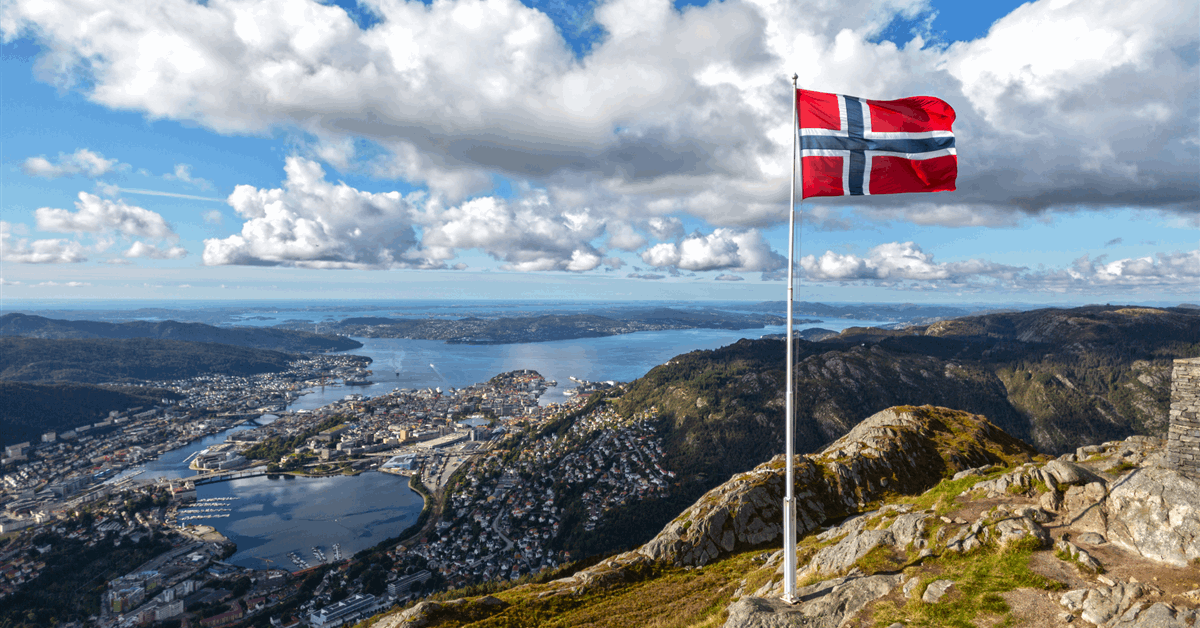
Norway’s natural gas output averaged 367.6 million cubic meters (12.98 billion cubic feet) a day (MMcmd) in December, increasing for the third consecutive month sequentially and marking last year’s highest monthly production, according to preliminary monthly production figures released Tuesday by the country’s upstream regulator.
Last month’s gas production exceeded the Norwegian Offshore Directorate’s (NOD) forecast by 2.9 percent and rose 1.5 percent from November, the NOD reported on its website. Year-on-year the December figure climbed 1.6 percent.
The Nordic country sold 11.4 billion cubic meters (Bcm) of gas in December, up 600 MMcm from November.
In the third quarter of 2025, the Nordic country accounted for 51.8 percent of pipeline gas imported into the European Union, according to EU statistics agency Eurostat.
“Norwegian gas accounts for about 30 percent of EU gas consumption, and Norway is Europe’s largest supplier after cutting off Russian gas”, the NOD said earlier in “The Shelf 2025” report published January 8, 2026.
The Equinor ASA-operated Troll field in the North Sea accounts for about one-third of Norway’s gas production. The NOD said in that report it expects Troll to hold onto the position “over the next few years”, noting most new developments “are relatively small discoveries that are being developed with subsea templates or wells from existing subsea templates, and tied back to existing infrastructure”.
Meanwhile Norway’s oil production in December averaged two million barrels per day (MMbpd), up 4.6 percent from November 2025 and 9.7 percent from December 2024, the NOD said Tuesday. The figure beat the NOD projection by 5.1 percent.
Total liquids production in December was 2.2 MMbpd, up 4.9 percent month-over-month and 8.1 percent year-on-year.
“Preliminary production figures for December 2025 show an average daily production of 2,190,000 barrels of oil, NGL [natural gas liquids] and condensate”, the NOD said.
“The total petroleum production in 2025 is about 240.5 million Sm3 [cubic meters] oil equivalents (MSm3 o.e.), broken down as follows: about 106.8 MSm3 o.e. of oil, about 11.9 MSm3 o.e. of NGL and condensate and about 121.8 MSm3 o.e. of gas for sale”, it said. “The total volume is 2.1 MSm3 o.e. less than 2024”.
Near-Term Stable Production
At the end of 2025, there were 97 fields producing in Norwegian waters, with no shutdowns over the year, according to “The Shelf” report.
“Production is expected to remain at a stable, high level over the next few years, and will then gradually decline towards the end of the 2020s”, the NOD said in that report.
At yearend 2025 the Norwegian continental shelf (NCS) had 17 field development projects underway, the report said. Eight of these are on Norway’s side of the North Sea, eight in the Norwegian Sea and one in the Norwegian part of the Barents Sea.
“These projects will help keep the investment level high and slow the underlying decline in production over the next decade”, the report said. “Additional development projects will also help extend lifetimes and thereby lead to improved recovery from existing fields.
“The largest discoveries that have yet to be developed are 7324/8-1 (Wisting) in the Barents Sea, 6406/9-1 (Linnorm) in the Norwegian Sea and 35/2-1 (Peon) in the North Sea. These discoveries are all being considered for development and could contribute considerable resources and values over the next few decades”.
Investment Slowdown
In 2026 the NOD expects investment in the NCS to fall 6.5 percent from 2025 to NOK 256 billion ($25.61 billion) and exploration activity to decline. “The Directorate expects the investment level to decline gradually leading up to 2030”, the report said.
“Significant activity and scarce capacity in parts of the supplier industry, presumed extended lifetimes for several production facilities and growth in costs have led to higher projected costs and investments.
“This is especially for 2026-2029, compared with what was presented in early 2025. Additional development wells and higher drilling costs per development well also contribute to a higher level of investment. Projected investments for certain ongoing developments have also increased.
“The primary cause of falling investments moving forward is the gradual completion and production startup of ongoing development projects. This will take place without new projects of an equivalent scope expected to come on stream.
“A few previously planned projects aimed at reducing greenhouse gas emissions by transitioning to operations with power from shore have been suspended due to challenging profitability. These were investment-heavy projects that, according to earlier forecasts, accounted for a substantial share of the level of investment and activity leading up to 2030”.
To contact the author, email [email protected]