Edged US is targeting a narrow but increasingly valuable lane of the hyperscale AI infrastructure market: high-density compute delivered at speed, paired with a sustainability posture centered on waterless, closed-loop cooling and a portfolio-wide design PUE target of roughly 1.15.
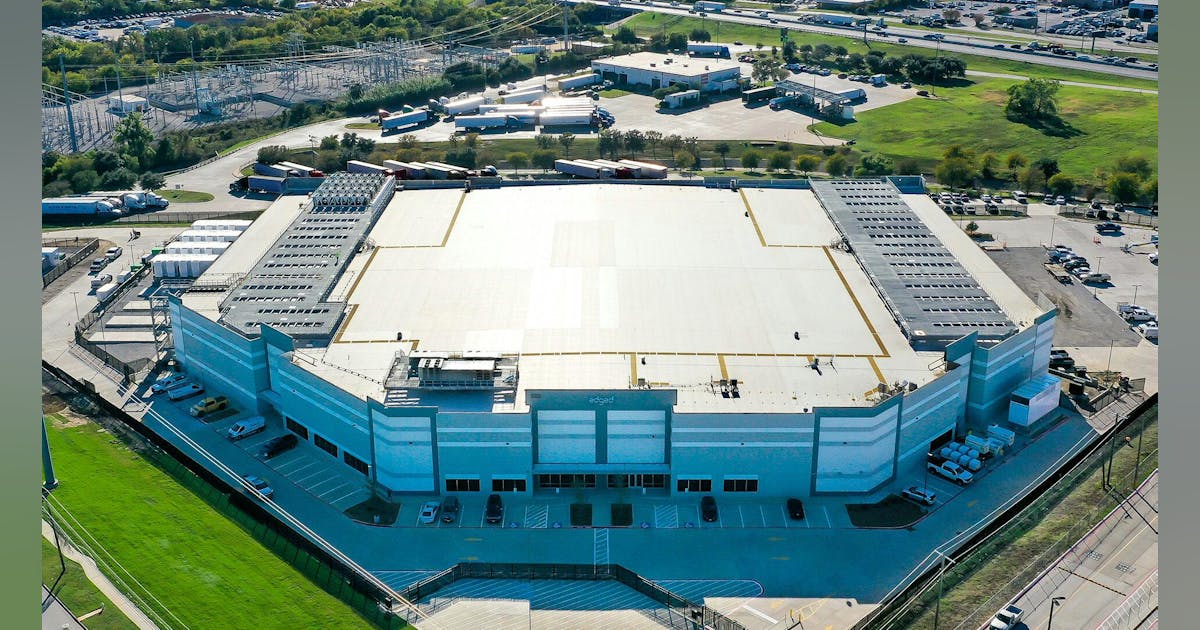
Two recent announcements illustrate the model. In Aurora, Illinois, Edged is developing a 72-MW facility purpose-built for AI training and inference, with liquid-to-chip cooling designed to support rack densities exceeding 200 kW. In Irving, Texas, a 24-MW campus expansion combines air-cooled densities above 120 kW per rack with liquid-to-chip capability reaching 400 kW.
Taken together, the projects point to a consistent strategy: standardized, multi-building campuses in major markets; a vertically integrated technical stack with cooling at its core; and an operating model built around repeatable designs, modular systems, and readiness for rapidly escalating AI densities.
A Campus-First Platform Strategy
Edged US’s platform strategy is built around campus-scale expansion rather than one-off facilities. The company positions itself as a gigawatt-scale, AI-ready portfolio expanding across major U.S. metros through repeatable design targets and multi-building campuses: an emphasis that is deliberate and increasingly consequential.
In Chicago/Aurora, Edged is developing a multi-building campus with an initial facility already online and a second 72-MW building under construction. Dallas/Irving follows the same playbook: the first facility opened in January 2025, with a second 24-MW building approved unanimously by the city. Taken together with developments in Atlanta, Chicago, Columbus, Dallas, Des Moines, Kansas City, and Phoenix, the footprint reflects a portfolio-first mindset rather than a collection of bespoke sites.
This focus on campus-based expansion matters because the AI factory era increasingly rewards developers that can execute three things at once:
-
Lock down power and land at scale.
-
Standardize delivery across markets.
-
Operate efficiently while staying aligned with community and regulatory expectations.
Edged is explicitly selling the second and third elements of that equation. In high-density, supply-constrained markets such as Chicago and DFW where water use, grid capacity, and permitting timelines are front-page issues, that combination can become a meaningful differentiator.
Waterless Cooling as a Competitive Advantage
Edged US closely ties its platform identity to ThermalWorks, a sister company within its corporate ecosystem that serves as the technical foundation for its waterless cooling strategy and high-density readiness. ThermalWorks is positioned not as an optional feature, but as a core enabler of Edged’s campus-scale model, delivering closed-loop cooling with a stated water usage effectiveness (WUE) of 0.00 while supporting escalating AI rack densities.
Across recent announcements, the technical profile is notably consistent:
-
Waterless, closed-loop cooling, marketed portfolio-wide as “zero water for cooling” (WUE 0.00)
-
High rack-density support, including:
-
Chicago/Aurora: liquid-to-chip cooling designed to exceed 200 kW per rack
-
Dallas/Irving: air-cooled densities above 120 kW per rack, with liquid-to-chip capability up to 400 kW
-
-
Portfolio-wide design PUE targeted at approximately 1.15.
Edged leans heavily on the sustainability implications of this architecture but the strategic value goes beyond efficiency metrics. Water has become one of the fastest flashpoints for community opposition to large-scale data center development, particularly in the Southwest and other water-stressed regions. Leading with a waterless cooling platform directly addresses one of the most visible and emotionally charged concerns in local permitting and public discourse.
That dynamic has already played out in markets such as Phoenix, where Edged’s early adoption of waterless cooling has elevated its profile not just among developers, but within municipal and political circles. Prior reporting on those facilities has underscored the growing scrutiny around data center water use and framed closed-loop, waterless designs as one of the few approaches that directly neutralize a core community objection rather than attempting to mitigate it.
As Bryant Farland, President and Chief Executive Officer of Edged US, said of the Chicago/Aurora development: