Stay Ahead, Stay ONMINE

New Pact Signed to Advance North Seas Wind Development

North Sea countries and transmission system operators on Monday signed an agreement committing to advancing investment in offshore wind projects and expanding cleaner power interconnection. The Joint Offshore Wind Investment Pact for the North Seas supports a goal set by the neighbors to reach 300 gigawatts (GW) of installed wind generation capacity in the North […]

North Sea countries and transmission system operators on Monday signed an agreement committing to advancing investment in offshore wind projects and expanding cleaner power interconnection.

The Joint Offshore Wind Investment Pact for the North Seas supports a goal set by the neighbors to reach 300 gigawatts (GW) of installed wind generation capacity in the North Seas by 2050, including 100 GW from cooperation projects.

The pact was signed by the governments of Belgium, Denmark, France, Germany, Ireland, Luxembourg, the Netherlands, Norway and the United Kingdom, as well as electricity and transmission system operators, during the North Sea Summit in Hamburg, Germany.

Under the pact, the governments pledged to ensure “a more evenly distributed offshore wind tender pipeline between 2031 and 2040 across the North Seas contributing to a European installation capacity of up to 15 GW per year”, according to the official text published online by Germany’s Economic Affairs Ministry.

They also committed to crafting an Offshore Financing Framework for North Sea wind cooperation projects. The framework would “build on and strengthen existing instruments and processes such as the framework for trans-European networks for energy and the identification of projects of common interest and projects of mutual interest”.

The Offshore TSO Collaboration and project developers have agreed to implement cooperation projects with a combined capacity of 20 GW in the 2030s. The first of these would be identified by 2026, according to the pact.

The participating governments also pledged to improve their national regulatory frameworks “to increase investor certainty in cooperation projects, including cross-border liability schemes, connection and balancing schemes”.

The pact provides for an investigation by the participating European Union member states into “market arrangements for offshore hybrid projects to address hybrid-specific risks for generators”, read the text. “The UK is also committed to the development of the most suitable market arrangements for hybrid projects”.

The North Sea countries plan to introduce “targeted mechanisms such as cross-border and/or nationally implemented two-sided Contracts for Difference as well as Power Purchase Agreements (PPAs), including cross-border PPAs”, the pact said.

Meanwhile the industry side committed to reducing offshore wind development costs to ultimately reduce the levelized cost of electricity by 30 percent by 2040 compared to 2025 levels, the pact said.

Industry players agreed to “offer capital and capacity for investments to ensure an installation capacity of the derisked and committed 15 GW annually between 2031 and 2040 by mobilizing EUR 1 trillion ($1.19 trillion) of economic activity for Europe, hiring 91,000 people by 2031 reaching a total of 187,000 employees – 75 percent (140,000) of these will serve the North Seas Region – [and] investing EUR 9.5 billion in supply chain capacities by 2030”, the pact said.

Industry players also pledged to develop and commercialize needed offshore high-voltage direct current (HVDC) transmission technologies, as well as work out “pathways for harmonizing manufacturing standards together with electricity TSOs”.

Under the pact, industry players including the members of the Hydrogen Networks for the Northern Seas also agreed to “assess, on a case-by-case basis, for which future HVDC-converter stations H2-readiness is proportionate and cost-effective”.

“Where justified, such stations could be designed in a way that keeps open the possibility of connecting offshore electrolysis in the future, provided that a robust cost-benefit assessment demonstrates that the expected benefits outweigh the additional costs”, the signatories said.

EU Commissioner for Energy and Housing Dan Jørgensen said in an online statement about the summit, “In these turbulent geopolitical times, Europe must stand strong and united – and choose independence”.

“That means doubling down on clean, safe, home-grown energy”, Jørgensen added. “It means building on our natural strengths, and few are greater than the North Sea and its vast offshore wind potential. It means strengthening our interconnections so that affordable energy can flow freely across our continent. And it means securing our industrial leadership while guaranteeing our security. This is Europe’s path to true independence”.

To contact the author, email [email protected]

Shape
Shape
Stay Ahead

Explore More Insights

Stay ahead with more perspectives on cutting-edge power, infrastructure, energy,  bitcoin and AI solutions. Explore these articles to uncover strategies and insights shaping the future of industries.

Shape

Nvidia is still working with suppliers on RAM chips for Rubin

Nvidia changed its requirements for suppliers of the next generation of high-bandwidth memory, HBM4, but is close to certifying revised chips from Samsung Electronics for use in its AI systems, according to reports. Nvidia revised its specifications for memory chips for its Rubin platform in the third quarter of 2025,

Read More »

Storage shortage may cause AI delays for enterprises

Higher prices ahead All indicators are showing a steep price increase for memory and storage in 2026. Brad Gastwirth, for example, says he met with many of the most important players in the market at CES earlier this month, and his analysis suggests there will be a 50% or more

Read More »

3D Energi Runs Out of Cash for Victoria Drill Campaign, Suspends Trading

3D Energi Ltd said Tuesday it has voluntarily halted trading on the Australian Securities Exchange (ASX), having defaulted on the payment of its share of costs in a ConocoPhillips-led exploration campaign in the Otway basin offshore Victoria. “Joint venture cash calls for the drilling program are higher than originally forecast and a balance of approximately $2.5 million remains outstanding by the company which it does not currently have”, Melbourne-based 3D Energi said in a stock filing. “A default notice has been issued by the joint venture operator to the company with a remedy period to 6th February. “Additional forecast company drilling program expenditure subject to cash calls due on 6th February is currently estimated at approximately $5.3 million, which if not paid by that date may well become the subject of an additional default notice and remedy period. “Consequently, the company is implementing a suspension of the trading of its shares on ASX while it addresses its funding position and the implications of payment default on the level of its ongoing interest in the permit”. 3D Energi plans to resume ASX trading in the first week of February. Earlier this month it announced the Charlemont-1 gas discovery, the joint venture’s second discovery under the VIC/P79 exploration after Essington-1. The newest well targeted the penultimate prospect in the Charlemont trend, which culminates with the La Bella discovery, according to 3D Energi. “Phase 1 of the Otway Exploration Drilling Program has identified important new natural gas resources close to existing offshore gas production and processing infrastructure in the Otway basin, supplying the Australian domestic gas market”, 3D Energi executive chair Noel Newell said in a statement January 14 announcing the second discovery. “This enhances the strategic significance of the discovery and supports future development optionality, subject to further technical and commercial evaluation,

Read More »

EIA Sees NatGas Price Dropping in 2026 and Rising in 2027

The U.S. Energy Information Administration (EIA) projected that the U.S. natural gas Henry Hub spot price will drop this year and rise next year in its latest short term energy outlook (STEO). In the EIA’s January STEO, which was released on January 13 and completed its forecast on January 8, the EIA forecast that the commodity will average $3.46 per million British thermal units (MMBtu) in 2026 and $4.59 per MMBtu in 2027. The U.S. natural gas Henry Hub spot price averaged $3.53 per MMBtu in 2025, the EIA’s latest STEO showed. According to a quarterly breakdown included in its latest STEO, the EIA sees the U.S. natural gas Henry Hub spot price coming in at $3.38 per MMBtu in the first quarter of 2026, $2.75 per MMBtu in the second quarter, $3.42 per MMBtu in the third quarter, $4.28 per MMBtu in the fourth quarter, $4.78 per MMBtu in the first quarter of 2027, $4.30 per MMBtu in the second quarter, $4.43 per MMBtu in the third quarter, and $4.84 per MMBtu in the fourth quarter of next year. Last year, the Henry Hub spot price averaged $4.15 per MMBtu in the first quarter, $3.19 per MMBtu in the second quarter, $3.03 per MMBtu in the third quarter, and $3.75 per MMBtu in the fourth quarter, the EIA’s January STEO showed. “On an annual basis, U.S. natural gas prices are relatively flat in 2026 before rising in 2027 as market conditions tighten,” the EIA said in its latest STEO. “We expect the Henry Hub natural gas spot price will average just under $3.50 per million British thermal units (MMBtu) this year, a two percent decrease from 2025, and then rise by 33 percent in 2027 to an annual average of almost $4.60 per MMBtu,” it added. In its STEO,

Read More »

Aramco Raises $4B in 1st Bond Sale of Year

(Update) January 26, 2026, 9:39 PM GMT: Article updated with pricing details in first three paragraphs. Saudi Aramco priced a $4 billion bond sale, its first note sale this year, as the world’s largest oil producer steps up borrowing to fund investment and dividends. The government-owned oil producer sold four bonds maturing in three to 30 years, according to a person familiar with the matter. The longest portion of the deal will pay 1.3 percentage point above Treasuries, said the person, who asked not to be identified because they are not authorized to speak publicly. That’s roughly a quarter-point less than initial pricing discussions. Overall, the sale attracted more than $22 billion of bids at the peak, with final books over $14 billion, the person said. Aramco is a key contributor to Saudi state finances, with large dividend payments supplementing royalties linked to crude sales. As oil prices have dipped and OPEC+ policy limited Saudi production, cash flows lagged payouts before a rebound in the third quarter. Aramco’s $17 billion in debt sales over the last two years helped support payouts. Saudi Arabia’s budget remains heavily dependent on oil revenue as the kingdom pursues an ambitious modernization drive. Crude prices remain well below levels needed to balance the state budget, forcing the government to project spending shortfalls for the coming years. Aramco has turned to debt to augment its cash flow and plans to invest more than $50 billion this year in oil and natural gas production, while maintaining its high base dividend of $21 billion. In November, the company reported a surprise jump in third-quarter profit as rising production outweighed lower crude prices. Earnings are set to slip for the full year, estimates compiled by Bloomberg show. While Brent crude has risen this year amid geopolitical tensions, including US attacks on

Read More »

New Pact Signed to Advance North Seas Wind Development

North Sea countries and transmission system operators on Monday signed an agreement committing to advancing investment in offshore wind projects and expanding cleaner power interconnection. The Joint Offshore Wind Investment Pact for the North Seas supports a goal set by the neighbors to reach 300 gigawatts (GW) of installed wind generation capacity in the North Seas by 2050, including 100 GW from cooperation projects. The pact was signed by the governments of Belgium, Denmark, France, Germany, Ireland, Luxembourg, the Netherlands, Norway and the United Kingdom, as well as electricity and transmission system operators, during the North Sea Summit in Hamburg, Germany. Under the pact, the governments pledged to ensure “a more evenly distributed offshore wind tender pipeline between 2031 and 2040 across the North Seas contributing to a European installation capacity of up to 15 GW per year”, according to the official text published online by Germany’s Economic Affairs Ministry. They also committed to crafting an Offshore Financing Framework for North Sea wind cooperation projects. The framework would “build on and strengthen existing instruments and processes such as the framework for trans-European networks for energy and the identification of projects of common interest and projects of mutual interest”. The Offshore TSO Collaboration and project developers have agreed to implement cooperation projects with a combined capacity of 20 GW in the 2030s. The first of these would be identified by 2026, according to the pact. The participating governments also pledged to improve their national regulatory frameworks “to increase investor certainty in cooperation projects, including cross-border liability schemes, connection and balancing schemes”. The pact provides for an investigation by the participating European Union member states into “market arrangements for offshore hybrid projects to address hybrid-specific risks for generators”, read the text. “The UK is also committed to the development of the most

Read More »

North America Adds More Rigs Week on Week

North America added six rigs week on week, according to Baker Hughes’ latest North America rotary rig count, which was published on January 23. The total U.S. rig count rose by one week on week and the total Canada rig count increased by five during the same period, pushing the total North America rig count up to 775, comprising 544 rigs from the U.S. and 231 rigs from Canada, the count outlined. Of the total U.S. rig count of 544, 526 rigs are categorized as land rigs, 15 are categorized as offshore rigs, and three are categorized as inland water rigs. The total U.S. rig count is made up of 411 oil rigs, 122 gas rigs, and 11 miscellaneous rigs, according to Baker Hughes’ count, which revealed that the U.S. total comprises 476 horizontal rigs, 55 directional rigs, and 13 vertical rigs. Week on week, the U.S. land rig count rose by two, its offshore rig count dropped by one, and its inland water rig count remained unchanged, Baker Hughes highlighted. The U.S. oil rig count rose by one week on week, while its gas and miscellaneous rig counts remained unchanged week on week, the count showed. The U.S. horizontal and vertical rig counts each increased by one week on week, and the country’s directional rig count dropped by one during the same period, the count revealed. A major state variances subcategory included in the rig count showed that, week on week, Louisiana dropped two rigs, Utah dropped one rig, Colorado added two rigs, and Wyoming and Texas each added one rig. A major basin variances subcategory included in the rig count showed that, week on week, the DJ-Niobrara basin added two rigs. Canada’s total rig count of 231 is made up of 158 oil rigs and 73 gas rigs,

Read More »

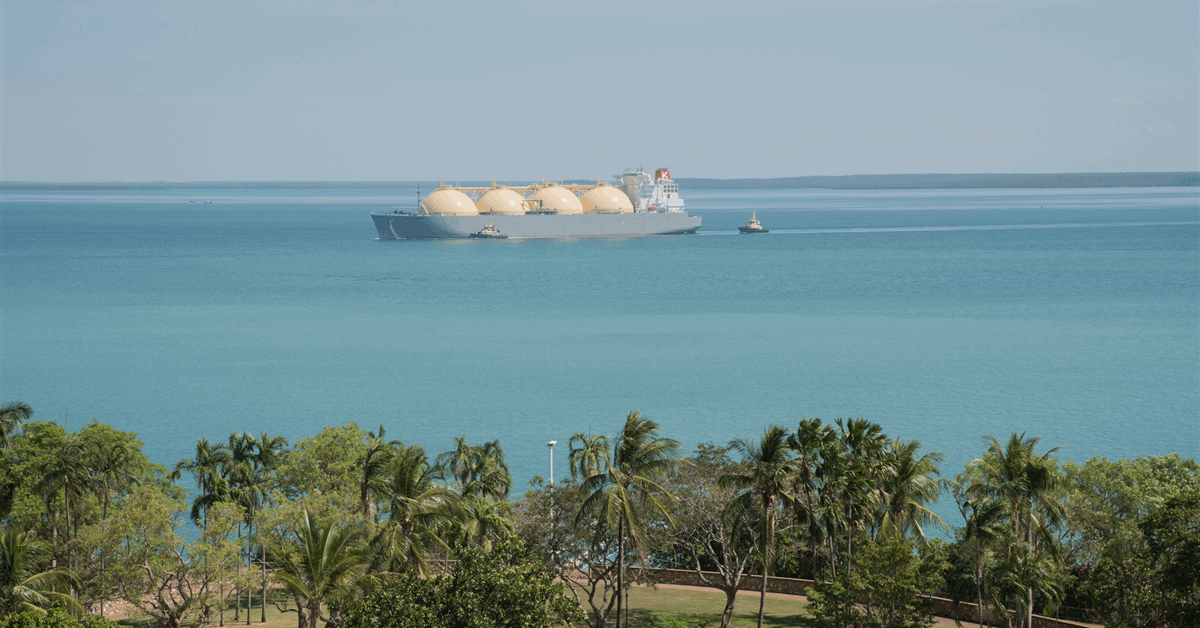
Santos Restarts Darwin LNG Exports

Santos Ltd and its partners have shipped the first cargo from the Darwin LNG life extension project in Australia’s Northern Territory. The inaugural volume will be delivered to the Sakai terminal in Japan on an ex-ship basis, the Adelaide-based natural gas-focused producer said in an online statement Tuesday. The life extension project, or the Barossa Gas Project, involves the development of the Barossa field as a new source for the liquefaction plant in Darwin, which began producing liquefied natural gas (LNG) 2006 and has an LNG capacity of about 3.7 million metric tons a year, according to Santos. Darwin LNG’s previous source field, Timor-Leste’s Bayu-Undan, stopped exporting gas to the facility late 2023 due to depletion, though Santos said 2024 Bayu-Undan would continue sending gas to the Northern Territory until the end of that year. In its quarterly report July 16, 2025 Santos confirmed Bayu-Undan ceased production May 2025. The life extension project started up approximately six months earlier than planned and within budget, said Santos, which announced a final investment decision (FID) on the Barossa Gas Project March 30, 2021. The FID announcement pegged costs at $3.6 billion, making Barossa LNG the biggest investment in Australia’s oil and gas sector then, according to Santos. According to a Santos update June 18, 2025 investment in the project reached $3.95 billion. The early startup “is an outstanding achievement for a project of this scale and complexity in the global offshore upstream sector”, said Santos managing director and chief executive Kevin Gallagher. Gallagher noted Barossa LNG had “navigated through the impacts of the COVID-19 pandemic, regulatory approvals, legal challenges and supply chain disruptions during the construction phase”. Japanese power utility JERA Co Inc, one of the partners, said separately on Tuesday about the restart of Darwin LNG, “As energy demand continues to

Read More »

Photonic chip vendor snags Gates investment

“Moore’s Law is slowing, but AI can’t afford to wait. Our breakthrough in photonics unlocks an entirely new dimension of scaling, by packing massive optical parallelism on a single chip,” said Patrick Bowen, CEO of Neurophos. “This physics-level shift means both efficiency and raw speed improve as we scale up, breaking free from the power walls that constrain traditional GPUs.” The new funding includes investments from Microsoft’s investment fund M12 that will help speed up delivery of Neurophos’ first integrated photonic compute system, including datacenter-ready OPU modules. Neurophos is not the only company exploring this field. Last April, Lightmatter announced the launch of photonic chips to tackle data center bottlenecks, And in 2024, IBM said its researchers were exploring optical chips and developing a prototype in this area.

Read More »

Intel wrestling with CPU supply shortage

“We have important customers in the data center side. We have important OEM customers on both data center and client and that needs to be our priority to get the limited supply we have to those customers,” he added. CEO Lip-Bu Tan added that the continuing proliferation and diversification of AI workloads is placing significant capacity constraints on traditional and new hardware infrastructure, reinforcing the growing and essential role CPUs play in the AI era. Because of this, Intel decided to simplify its server road map, focusing resources on the 16-channel Diamond Rapids product and accelerate the introduction of Coral Rapids. Intel had removed multithreading from diamond Rapids, presumably to get rid of the performance bottlenecks. With each core running two threads, they often competed for resources. That’s why, for example, Ampere does not use threading but instead applies many more cores per CPU. With Coral Rapids, Intel is not only reintroducing multi-threading back into our data center road map but working closely with Nvidia to build a custom Xeon fully integrated with their NVLink technology to Build the tighter connection between Intel Xeon processors and Nvidia GPUs. Another aspect impacting supply has been yields or the new 18A process node. Tan said he was disappointed that the company could not fully meet the demand of the markets, and that while yields are in line with internal plans, “they’re still below where I want them to be,” Tan said.  Tan said yields for 18A are improving month-over-month and Intel is targeting a 7% to 8% improvement each month.

Read More »

Intel’s AI pivot could make lower-end PCs scarce in 2026

However, he noted, “CPUs are not being cannibalized by GPUs. Instead, they have become ‘chokepoints’ in AI infrastructure.” For instance, CPUs such as Granite Rapids are essential in GPU clusters, and for handling agentic AI workloads and orchestrating distributed inference. How pricing might increase for enterprises Ultimately, rapid demand for higher-end offerings resulted in foundry shortages of Intel 10/7 nodes, Bickley noted, which represent the bulk of the company’s production volume. He pointed out that it can take up to three quarters for new server wafers to move through the fab process, so Intel will be “under the gun” until at least Q2 2026, when it projects an increase in chip production. Meanwhile, manufacturing capacity for Xeon is currently sold out for 2026, with varying lead times by distributor, while custom silicon programs are seeing lead times of 6 to 8 months, with some orders rolling into 2027, Bickley said. In the data center, memory is the key bottleneck, with expected price increases of more than 65% year over year in 2026 and up to 25% for NAND Flash, he noted. Some specific products have already seen price inflation of over 1,000% since 2025, and new greenfield capacity for memory is not expected until 2027 or 2028. Moor’s Sag was a little more optimistic, forecasting that, on the client side, “memory prices will probably stabilize this year until more capacity comes online in 2027.” How enterprises can prepare Supplier diversification is the best solution for enterprises right now, Sag noted. While it might make things more complex, it also allows data center operators to better absorb price shocks because they can rebalance against suppliers who have either planned better or have more resilient supply chains.

Read More »

Reports of SATA’s demise are overblown, but the technology is aging fast

The SATA 1.0 interface made its debut in 2003. It was developed by a consortium consisting of Intel, Dell, and storage vendors like Seagate and Maxtor. It quickly advanced to SATA III in 2009, but there never was a SATA IV. There was just nibbling around the edges with incremental updates as momentum and emphasis shifted to PCI Express and NVMe. So is there any life to be had in the venerable SATA interface? Surprisingly, yes, say the analysts. “At a high level, yes, SATA for consumer is pretty much a dead end, although if you’re storing TB of photos and videos, it is still the least expensive option,” said Bob O’Donnell, president and chief analyst with TECHnalysis Research. Similarly for enterprise, for massive storage demands, the 20 and 30 TB SATA drives from companies like Seagate and WD are apparently still in wide use in cloud data centers for things like cold storage. “In fact, both of those companies are seeing recording revenues based, in part, on the demand for these huge, high-capacity low-cost drives,” he said. “SATA doesn’t make much sense anymore. It underperforms NVMe significantly,” said Rob Enderle, principal analyst with The Enderle Group. “It really doesn’t make much sense to continue make it given Samsung allegedly makes three to four times more margin on NVMe.” And like O’Donnell, Enderle sees continued life for SATA-based high-capacity hard drives. “There will likely be legacy makers doing SATA for some time. IT doesn’t flip technology quickly and SATA drives do wear out, so there will likely be those producing legacy SATA products for some time,” he said.

Read More »

DCN becoming the new WAN for AI-era applications

“DCN is increasingly treated as an end-to-end operating model that standardizes connectivity, security policy enforcement, and telemetry across users, the middle mile, and cloud/application edges,” Sanchez said. Dell’Oro defines DCN as platforms and services that deliver consistent connectivity, policy enforcement, and telemetry from users, across the WAN, to distributed cloud and application edges spanning branch sites, data centers and public clouds. The category is gaining relevance as hybrid architectures and AI-era traffic patterns increase the operational penalty for fragmented control planes. DCN buyers are moving beyond isolated upgrades and are prioritizing architectures that reduce operational seams across connectivity, security and telemetry so that incident response and change control can follow a single thread, according to Dell’Oro’s research. What makes DCN distinct is that it links user-to-application experience with where policy and visibility are enforced. This matters as application delivery paths become more dynamic and workloads shift between on-premises data centers, public cloud, and edge locations. The architectural requirement is eliminating handoffs between networking and security teams rather than optimizing individual network segments. Where DCN is growing the fastest Cloud/application edge is the fastest-growing DCN pillar. This segment deploys policy enforcement and telemetry collection points adjacent to workloads rather than backhauling traffic to centralized security stacks. “Multi-cloud remains a reality, but it is no longer the durable driver by itself,” Sanchez said. “Cloud/application edge is accelerating because enterprises are trying to make application paths predictable and secure across hybrid environments, and that requires pushing application-aware steering, policy enforcement, and unified telemetry closer to workloads.”

Read More »

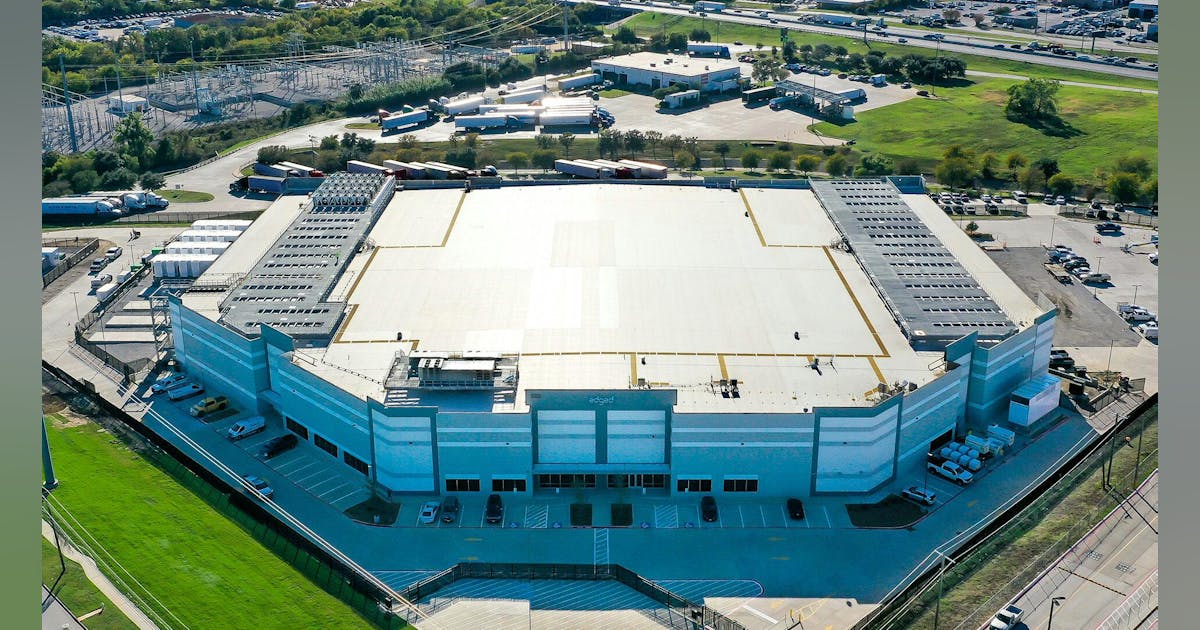
Edged US Builds Waterless, High-Density AI Data Center Campuses at Scale

Edged US is targeting a narrow but increasingly valuable lane of the hyperscale AI infrastructure market: high-density compute delivered at speed, paired with a sustainability posture centered on waterless, closed-loop cooling and a portfolio-wide design PUE target of roughly 1.15. Two recent announcements illustrate the model. In Aurora, Illinois, Edged is developing a 72-MW facility purpose-built for AI training and inference, with liquid-to-chip cooling designed to support rack densities exceeding 200 kW. In Irving, Texas, a 24-MW campus expansion combines air-cooled densities above 120 kW per rack with liquid-to-chip capability reaching 400 kW. Taken together, the projects point to a consistent strategy: standardized, multi-building campuses in major markets; a vertically integrated technical stack with cooling at its core; and an operating model built around repeatable designs, modular systems, and readiness for rapidly escalating AI densities. A Campus-First Platform Strategy Edged US’s platform strategy is built around campus-scale expansion rather than one-off facilities. The company positions itself as a gigawatt-scale, AI-ready portfolio expanding across major U.S. metros through repeatable design targets and multi-building campuses: an emphasis that is deliberate and increasingly consequential. In Chicago/Aurora, Edged is developing a multi-building campus with an initial facility already online and a second 72-MW building under construction. Dallas/Irving follows the same playbook: the first facility opened in January 2025, with a second 24-MW building approved unanimously by the city. Taken together with developments in Atlanta, Chicago, Columbus, Dallas, Des Moines, Kansas City, and Phoenix, the footprint reflects a portfolio-first mindset rather than a collection of bespoke sites. This focus on campus-based expansion matters because the AI factory era increasingly rewards developers that can execute three things at once: Lock down power and land at scale. Standardize delivery across markets. Operate efficiently while staying aligned with community and regulatory expectations. Edged is explicitly selling the second

Read More »

Microsoft will invest $80B in AI data centers in fiscal 2025

And Microsoft isn’t the only one that is ramping up its investments into AI-enabled data centers. Rival cloud service providers are all investing in either upgrading or opening new data centers to capture a larger chunk of business from developers and users of large language models (LLMs).  In a report published in October 2024, Bloomberg Intelligence estimated that demand for generative AI would push Microsoft, AWS, Google, Oracle, Meta, and Apple would between them devote $200 billion to capex in 2025, up from $110 billion in 2023. Microsoft is one of the biggest spenders, followed closely by Google and AWS, Bloomberg Intelligence said. Its estimate of Microsoft’s capital spending on AI, at $62.4 billion for calendar 2025, is lower than Smith’s claim that the company will invest $80 billion in the fiscal year to June 30, 2025. Both figures, though, are way higher than Microsoft’s 2020 capital expenditure of “just” $17.6 billion. The majority of the increased spending is tied to cloud services and the expansion of AI infrastructure needed to provide compute capacity for OpenAI workloads. Separately, last October Amazon CEO Andy Jassy said his company planned total capex spend of $75 billion in 2024 and even more in 2025, with much of it going to AWS, its cloud computing division.

Read More »

John Deere unveils more autonomous farm machines to address skill labor shortage

Join our daily and weekly newsletters for the latest updates and exclusive content on industry-leading AI coverage. Learn More Self-driving tractors might be the path to self-driving cars. John Deere has revealed a new line of autonomous machines and tech across agriculture, construction and commercial landscaping. The Moline, Illinois-based John Deere has been in business for 187 years, yet it’s been a regular as a non-tech company showing off technology at the big tech trade show in Las Vegas and is back at CES 2025 with more autonomous tractors and other vehicles. This is not something we usually cover, but John Deere has a lot of data that is interesting in the big picture of tech. The message from the company is that there aren’t enough skilled farm laborers to do the work that its customers need. It’s been a challenge for most of the last two decades, said Jahmy Hindman, CTO at John Deere, in a briefing. Much of the tech will come this fall and after that. He noted that the average farmer in the U.S. is over 58 and works 12 to 18 hours a day to grow food for us. And he said the American Farm Bureau Federation estimates there are roughly 2.4 million farm jobs that need to be filled annually; and the agricultural work force continues to shrink. (This is my hint to the anti-immigration crowd). John Deere’s autonomous 9RX Tractor. Farmers can oversee it using an app. While each of these industries experiences their own set of challenges, a commonality across all is skilled labor availability. In construction, about 80% percent of contractors struggle to find skilled labor. And in commercial landscaping, 86% of landscaping business owners can’t find labor to fill open positions, he said. “They have to figure out how to do

Read More »

2025 playbook for enterprise AI success, from agents to evals

Join our daily and weekly newsletters for the latest updates and exclusive content on industry-leading AI coverage. Learn More 2025 is poised to be a pivotal year for enterprise AI. The past year has seen rapid innovation, and this year will see the same. This has made it more critical than ever to revisit your AI strategy to stay competitive and create value for your customers. From scaling AI agents to optimizing costs, here are the five critical areas enterprises should prioritize for their AI strategy this year. 1. Agents: the next generation of automation AI agents are no longer theoretical. In 2025, they’re indispensable tools for enterprises looking to streamline operations and enhance customer interactions. Unlike traditional software, agents powered by large language models (LLMs) can make nuanced decisions, navigate complex multi-step tasks, and integrate seamlessly with tools and APIs. At the start of 2024, agents were not ready for prime time, making frustrating mistakes like hallucinating URLs. They started getting better as frontier large language models themselves improved. “Let me put it this way,” said Sam Witteveen, cofounder of Red Dragon, a company that develops agents for companies, and that recently reviewed the 48 agents it built last year. “Interestingly, the ones that we built at the start of the year, a lot of those worked way better at the end of the year just because the models got better.” Witteveen shared this in the video podcast we filmed to discuss these five big trends in detail. Models are getting better and hallucinating less, and they’re also being trained to do agentic tasks. Another feature that the model providers are researching is a way to use the LLM as a judge, and as models get cheaper (something we’ll cover below), companies can use three or more models to

Read More »

OpenAI’s red teaming innovations define new essentials for security leaders in the AI era

Join our daily and weekly newsletters for the latest updates and exclusive content on industry-leading AI coverage. Learn More OpenAI has taken a more aggressive approach to red teaming than its AI competitors, demonstrating its security teams’ advanced capabilities in two areas: multi-step reinforcement and external red teaming. OpenAI recently released two papers that set a new competitive standard for improving the quality, reliability and safety of AI models in these two techniques and more. The first paper, “OpenAI’s Approach to External Red Teaming for AI Models and Systems,” reports that specialized teams outside the company have proven effective in uncovering vulnerabilities that might otherwise have made it into a released model because in-house testing techniques may have missed them. In the second paper, “Diverse and Effective Red Teaming with Auto-Generated Rewards and Multi-Step Reinforcement Learning,” OpenAI introduces an automated framework that relies on iterative reinforcement learning to generate a broad spectrum of novel, wide-ranging attacks. Going all-in on red teaming pays practical, competitive dividends It’s encouraging to see competitive intensity in red teaming growing among AI companies. When Anthropic released its AI red team guidelines in June of last year, it joined AI providers including Google, Microsoft, Nvidia, OpenAI, and even the U.S.’s National Institute of Standards and Technology (NIST), which all had released red teaming frameworks. Investing heavily in red teaming yields tangible benefits for security leaders in any organization. OpenAI’s paper on external red teaming provides a detailed analysis of how the company strives to create specialized external teams that include cybersecurity and subject matter experts. The goal is to see if knowledgeable external teams can defeat models’ security perimeters and find gaps in their security, biases and controls that prompt-based testing couldn’t find. What makes OpenAI’s recent papers noteworthy is how well they define using human-in-the-middle

Read More »