Stay Ahead, Stay ONMINE

How uncrewed narco subs could transform the Colombian drug trade

On a bright morning last April, a surveillance plane operated by the Colombian military spotted a 40-foot-long shark-like silhouette idling in the ocean just off Tayrona National Park. It was, unmistakably, a “narco sub,” a stealthy fiberglass vessel that sails with its hull almost entirely underwater, used by drug cartels to move cocaine north. The plane’s crew radioed it in, and eventually nearby coast guard boats got the order, routine but urgent: Intercept. In Cartagena, about 150 miles from the action, Captain Jaime González Zamudio, commander of the regional coast guard group, sat down at his desk to watch what happened next. On his computer monitor, icons representing his patrol boats raced toward the sub’s coordinates as updates crackled over his radio from the crews at sea. This was all standard; Colombia is the world’s largest producer of cocaine, and its navy has been seizing narco subs for decades. And so the captain was pretty sure what the outcome would be. His crew would catch up to the sub, just a bit of it showing above the water’s surface. They’d bring it to heel, board it, and force open the hatch to find two, three, maybe four exhausted men suffocating in a mix of diesel fumes and humidity, and a cargo compartment holding several tons of cocaine. The boats caught up to the sub. A crew boarded, forced open the hatch, and confirmed that the vessel was secure. But from that point on, things were different. First, some unexpected details came over the radio: There was no cocaine on board. Neither was there a crew, nor a helm, nor even enough room for a person to lie down. Instead, inside the hull the crew found a fuel tank, an autopilot system and control electronics, and a remotely monitored security camera. González Zamudio’s crew started sending pictures back to Cartagena: Bolted to the hull was another camera, as well as two plastic rectangles, each about the size of a cookie sheet—antennas for connecting to Starlink satellite internet. The authorities towed the boat back to Cartagena, where military techs took a closer look. Weeks later, they came to an unsettling conclusion: This was Colombia’s first confirmed uncrewed narco sub. It could be operated by remote control, but it was also capable of some degree of autonomous travel. The techs concluded that the sub was likely a prototype built by the Clan del Golfo, a powerful criminal group that operates along the Caribbean coast. For decades, handmade narco subs have been some of the cocaine trade’s most elusive and productive workhorses, ferrying multi-ton loads of illicit drugs from Colombian estuaries toward markets in North America and, increasingly, the rest of the world. Now off-the-shelf technology—Starlink terminals, plug-and-play nautical autopilots, high-resolution video cameras—may be advancing that cat-and-mouse game into a new phase. Uncrewed subs could move more cocaine over longer distances, and they wouldn’t put human smugglers at risk of capture. Law enforcement around the world is just beginning to grapple with what the Tayrona sub means for the future—whether it was merely an isolated experiment or the opening move in a new era of autonomous drug smuggling at sea. Drug traffickers love the ocean. “You can move drug traffic through legal and illegal routes,” says Juan Pablo Serrano, a captain in the Colombian navy and head of the operational coordination center for Orión, a multiagency, multinational counternarcotics effort. The giant container ships at the heart of global commerce offer a favorite approach, Serrano says. Bribe a chain of dockworkers and inspectors, hide a load in one of thousands of cargo boxes, and put it on a totally legal commercial vessel headed to Europe or North America. That route is slow and expensive—involving months of transit and bribes spread across a wide network—but relatively low risk. “A ship can carry 5,000 containers. Good luck finding the right one,” he says. Far less legal, but much faster and cheaper, are small, powerful motorboats. Quick to build and cheap to crew, these “go-fasts” top out at just under 50 feet long and can move smaller loads in hours rather than days. But they’re also easy for coastal radars and patrols to spot. Submersibles—or, more accurately, “semisubmersibles”—fit somewhere in the middle. They take more money and engineering to build than an open speedboat, but they buy stealth—even if a bit of the vessel rides at the surface, the bulk stays hidden underwater. That adds another option to a portfolio that smugglers constantly rebalance across three variables: risk, time, and cost. When US and Colombian authorities tightened control over air routes and commercial shipping in the early 1990s, subs became more attractive. The first ones were crude wooden hulls with a fiberglass shell and extra fuel tanks, cobbled together in mangrove estuaries, hidden from prying eyes. Today’s fiberglass semisubmersible designs ride mostly below the surface, relying on diesel engines that can push multi-ton loads for days at a time while presenting little more than a ripple and a hot exhaust pipe to radar and infrared sensors. A typical semisubmersible costs under $2 million to build and can carry three metric tons of cocaine. That’s worth over $160 million in Europe—wholesale. Most ferry between South American coasts and handoff points in Central America and Mexico, where allied criminal organizations break up the cargo and slowly funnel it toward the US. But some now go much farther. In 2019, Spanish authorities intercepted a semisubmersible after a 27-day transatlantic voyage from Brazil. In 2024, police in the Solomon Islands found the first narco sub in the Asia-Pacific region, a semisubmersible probably originating from Colombia on its way to Australia or New Zealand. If the variables are risk, time, and cost, then the economics of a narco sub are simple. Even if they spend more time on the water than a powerboat, they’re less likely to get caught—and a relative bargain to produce. A narco sub might cost between $1 million and $2 million to build, but a kilo of cocaine costs just about $500 to make. “By the time that kilo reaches Europe, it can sell for between $44,000 and $55,000,” Serrano says. A typical semisubmersible carries up to three metric tons—cargo worth well over $160 million at European wholesale prices. Off-the-shelf nautical autopilots, WiFi antennas, Starlink satellite internet connections, and remote cameras are all drug smugglers need to turn semisubmersibles into drone ships. As a result, narco subs are getting more common. Seizures by authorities tripled in the last 20 years, according to Colombia’s International Center for Research and Analysis Against Maritime Drug Trafficking (CMCON), and Serrano admits that the Orión alliance has enough ships and aircraft to catch only a fraction of what sails. Until now, though, narco subs have had one major flaw: They depended on people, usually poor fishermen or low-level recruits sealed into stifling compartments for days at a time, steering by GPS and sight, hoping not to be spotted. That made the subs expensive and a risk to drug sellers if captured. Like good capitalists, the Tayrona boat’s builders seem to have been trying to obviate labor costs with automation. No crew means more room for drugs or fuel and no sailors to pay—or to get arrested or flip if a mission goes wrong. “If you don’t have a person or people on board, that makes the transoceanic routes much more feasible,” says Henry Shuldiner, a researcher at InSight Crime who has analyzed hundreds of narco-sub cases. It’s one thing, he notes, to persuade someone to spend a day or two going from Colombia to Panama for a big payout; it’s another to ask four people to spend three weeks sealed inside a cramped tube, sleeping, eating, and relieving themselves in the same space. “That’s a hard sell,” Shuldiner says. An uncrewed sub doesn’t have to race to a rendezvous because its crew can endure only a few days inside. It can move more slowly and stealthily. It can wait out patrols or bad weather, loiter near a meeting point, or take longer and less well-monitored routes. And if something goes wrong—if a military plane appears or navigation fails—its owners can simply scuttle the vessel from afar. Meanwhile, the basic technology to make all that work is getting more and more affordable, and the potential profit margins are rising. “The rapidly approaching universality of autonomous technology could be a nightmare for the U.S. Coast Guard,” wrote two Coast Guard officers in the US Naval Institute’s journal Proceedings in 2021. And as if to prove how good an idea drone narco subs are, the US Marine Corps and the weapons builder Leidos are testing a low-profile uncrewed vessel called the Sea Specter, which they describe as being “inspired” by narco-sub design. The possibility that drug smugglers are experimenting with autonomous subs isn’t just theoretical. Law enforcement agencies on other smuggling routes have found signs the Tayrona sub isn’t an isolated case. In 2022, Spanish police seized three small submersible drones near Cádiz, on Spain’s southern coast. Two years later, Italian authorities confiscated a remote-­controlled minisubmarine they believed was intended for drug runs. “The probability of expansion is high,” says Diego Cánovas, a port and maritime security expert in Spain. Tayrona, the biggest and most technologically advanced uncrewed narco sub found so far, is more likely a preview than an anomaly. Today, the Tayrona semisubmersible sits on a strip of grass at the ARC Bolívar naval base in Cartagena. It’s exposed to the elements; rain has streaked its paint. To one side lies an older, bulkier narco sub seized a decade ago, a blue cylinder with a clumsy profile. The Tayrona’s hull looks lower, leaner, and more refined. Up close, it is also unmistakably handmade. The hull is a dull gray-blue, the fiberglass rough in places, with scrapes and dents from the tow that brought it into port. It has no identifying marks on the exterior—nothing that would tie it to a country, a company, or a port. On the upper surface sit the two Starlink antennas, painted over in the same gray-blue to keep them from standing out against the sea. I climb up a ladder and drop through the small hatch near the stern. Inside, the air is damp and close, the walls beaded with condensation. Small puddles of fuel have collected in the bilge. The vessel has no seating, no helm or steering wheel, and not enough space to stand up straight or lie down. It’s clear it was never meant to carry people. A technical report by CMCON found that the sub would have enough fuel for a journey of some 800 nautical miles, and the central cargo bay would hold between 1 and 1.5 tons of cocaine. At the aft end, the machinery compartment is a tangle of hardware: diesel engine, batteries, pumps, and a chaotic bundle of cables feeding an electronics rack. All the core components are still there. Inside that rack, investigators identified a NAC-3 autopilot processor, a commercial unit designed to steer midsize boats by tying into standard hydraulic pumps, heading sensors, and rudder-­feedback systems. They cost about $2,200 on Amazon. “These are plug-and-play technologies,” says Wilmar Martínez, a mechatronics professor at the University of America in Bogotá, when I show him pictures of the inside of the sub. “Midcareer mechatronics students could install them.” For all its advantages, an autonomous drug-smuggling submarine wouldn’t be invincible. Even without a crew on board, there are still people in the chain. Every satellite internet terminal—Starlink or not—comes with a billing address, a payment method, and a log of where and when it pings the constellation. Colombian officers have begun to talk about negotiating formal agreements with providers, asking them to alert authorities when a transceiver’s movements match known smuggling patterns. Brazil’s government has already cut a deal with Starlink to curb criminal use of its service in the Amazon. The basic playbook for finding a drone sub will look much like the one for crewed semisubmersibles. Aircraft and ships will use radar to pick out small anomalies and infrared cameras to look for the heat of a diesel engine or the turbulence of a wake. That said, it might not work. “If they wind up being smaller, they’re going to be darn near impossible to detect,” says Michael Knickerbocker, a former US Navy officer who advises defense tech firms. Autonomous drug subs are “a great example of how resilient cocaine traffickers are, and how they’re continuously one step ahead of authorities,” says one researcher. Even worse, navies already act on only a fraction of their intelligence leads because they don’t have enough ships and aircraft. The answer, Knickerbocker argues, is “robot on robot.” Navies and coast guards will need swarms of their own small, relatively cheap uncrewed systems—surface vessels, underwater gliders, and long-endurance aerial vehicles that can loiter, sense, and relay data back to human operators. Those experiments have already begun. The US 4th Fleet, which covers Latin America and the Caribbean, is experimenting with uncrewed platforms in counternarcotics patrols. Across the Atlantic, the European Union’s European Maritime Safety Agency operates drones for maritime surveillance. Today, though, the major screens against oceangoing vessels of all kinds are coastal radar networks. Spain operates SIVE to watch over choke points like the Strait of Gibraltar, and in the Pacific, Australia’s over-the-horizon radar network, JORN, can spot objects hundreds of miles away, far beyond the range of conventional radar. Even so, it’s not enough to just spot an uncrewed narco sub. Law enforcement also has to stop it—and that will be tricky. To find drone subs, international law enforcement will likely have to rely on networks of surveillance systems and, someday, swarms of their own drones.CARLOS PARRA RIOS With a crewed vessel, Colombian doctrine says coast guard units should try to hail the boat first with lights, sirens, radio calls, and warning shots. If that fails, interceptor crews sometimes have to jump aboard and force the hatch. Officers worry that future autonomous craft could be wired to sink or even explode if someone gets too close. “If they get destroyed, we may lose the evidence,” says Víctor González Badrán, a navy captain and director of CMCON. “That means no seizure and no legal proceedings against that organization.”  That’s where electronic warfare enters the picture—radio-frequency jamming, cyber tools, perhaps more exotic options. In the simplest version, jamming means flooding the receiver with noise so that commands from the operator never reach the vessel. Spoofing goes a step further, feeding fake signals so that the sub thinks it’s somewhere else or obediently follows a fake set of waypoints. Cyber tools might aim higher up the chain, trying to penetrate the software that runs the vessel or the networks it uses to talk to satellite constellations. At the cutting edge of these countermeasures are electromagnetic pulses designed to fry electronics outright, turning a million-dollar narco sub into a dead hull drifting at sea. In reality, the tools that might catch a future Tayrona sub are unevenly distributed, politically sensitive, and often experimental. Powerful cyber or electromagnetic tricks are closely guarded secrets; using them in a drug case risks exposing capabilities that militaries would rather reserve for wars. Systems like Australia’s JORN radar are tightly held national security assets, their exact performance specs classified, and sharing raw data with countries on the front lines of the cocaine trade would inevitably mean revealing hints as to how they got it. “Just because a capability exists doesn’t mean you employ it,” Knickerbocker says.  Analysts don’t think uncrewed narco subs will reshape the global drug trade, despite the technological leap. Trafficking organizations will still hedge their bets across those three variables, hiding cocaine in shipping containers, dissolving it into liquids and paints, racing it north in fast boats. “I don’t think this is revolutionary,” Shuldiner says. “But it’s a great example of how resilient cocaine traffickers are, and how they’re continuously one step ahead of authorities.” There’s still that chance, though, that everything international law enforcement agencies know about drug smuggling is about to change. González Zamudio says he keeps getting requests from foreign navies, coast guards, and security agencies to come see the Tayrona sub. He greets their delegations, takes them out to the strip of grass on the base, and walks them around it, gives them tours. It has become a kind of pilgrimage. Everyone who makes it worries that the next time a narco sub appears near a distant coastline, they’ll board it as usual, force the hatch—and find it full of cocaine and gadgets, but without a single human occupant. And no one knows what happens after that.  Eduardo Echeverri López is a journalist based in Colombia.

On a bright morning last April, a surveillance plane operated by the Colombian military spotted a 40-foot-long shark-like silhouette idling in the ocean just off Tayrona National Park. It was, unmistakably, a “narco sub,” a stealthy fiberglass vessel that sails with its hull almost entirely underwater, used by drug cartels to move cocaine north. The plane’s crew radioed it in, and eventually nearby coast guard boats got the order, routine but urgent: Intercept.

In Cartagena, about 150 miles from the action, Captain Jaime González Zamudio, commander of the regional coast guard group, sat down at his desk to watch what happened next. On his computer monitor, icons representing his patrol boats raced toward the sub’s coordinates as updates crackled over his radio from the crews at sea. This was all standard; Colombia is the world’s largest producer of cocaine, and its navy has been seizing narco subs for decades. And so the captain was pretty sure what the outcome would be. His crew would catch up to the sub, just a bit of it showing above the water’s surface. They’d bring it to heel, board it, and force open the hatch to find two, three, maybe four exhausted men suffocating in a mix of diesel fumes and humidity, and a cargo compartment holding several tons of cocaine.

The boats caught up to the sub. A crew boarded, forced open the hatch, and confirmed that the vessel was secure. But from that point on, things were different.

First, some unexpected details came over the radio: There was no cocaine on board. Neither was there a crew, nor a helm, nor even enough room for a person to lie down. Instead, inside the hull the crew found a fuel tank, an autopilot system and control electronics, and a remotely monitored security camera. González Zamudio’s crew started sending pictures back to Cartagena: Bolted to the hull was another camera, as well as two plastic rectangles, each about the size of a cookie sheet—antennas for connecting to Starlink satellite internet.

The authorities towed the boat back to Cartagena, where military techs took a closer look. Weeks later, they came to an unsettling conclusion: This was Colombia’s first confirmed uncrewed narco sub. It could be operated by remote control, but it was also capable of some degree of autonomous travel. The techs concluded that the sub was likely a prototype built by the Clan del Golfo, a powerful criminal group that operates along the Caribbean coast.

For decades, handmade narco subs have been some of the cocaine trade’s most elusive and productive workhorses, ferrying multi-ton loads of illicit drugs from Colombian estuaries toward markets in North America and, increasingly, the rest of the world. Now off-the-shelf technology—Starlink terminals, plug-and-play nautical autopilots, high-resolution video cameras—may be advancing that cat-and-mouse game into a new phase.

Uncrewed subs could move more cocaine over longer distances, and they wouldn’t put human smugglers at risk of capture. Law enforcement around the world is just beginning to grapple with what the Tayrona sub means for the future—whether it was merely an isolated experiment or the opening move in a new era of autonomous drug smuggling at sea.


Drug traffickers love the ocean. “You can move drug traffic through legal and illegal routes,” says Juan Pablo Serrano, a captain in the Colombian navy and head of the operational coordination center for Orión, a multiagency, multinational counternarcotics effort. The giant container ships at the heart of global commerce offer a favorite approach, Serrano says. Bribe a chain of dockworkers and inspectors, hide a load in one of thousands of cargo boxes, and put it on a totally legal commercial vessel headed to Europe or North America. That route is slow and expensive—involving months of transit and bribes spread across a wide network—but relatively low risk. “A ship can carry 5,000 containers. Good luck finding the right one,” he says.

Far less legal, but much faster and cheaper, are small, powerful motorboats. Quick to build and cheap to crew, these “go-fasts” top out at just under 50 feet long and can move smaller loads in hours rather than days. But they’re also easy for coastal radars and patrols to spot.

Submersibles—or, more accurately, “semisubmersibles”—fit somewhere in the middle. They take more money and engineering to build than an open speedboat, but they buy stealth—even if a bit of the vessel rides at the surface, the bulk stays hidden underwater. That adds another option to a portfolio that smugglers constantly rebalance across three variables: risk, time, and cost. When US and Colombian authorities tightened control over air routes and commercial shipping in the early 1990s, subs became more attractive. The first ones were crude wooden hulls with a fiberglass shell and extra fuel tanks, cobbled together in mangrove estuaries, hidden from prying eyes. Today’s fiberglass semisubmersible designs ride mostly below the surface, relying on diesel engines that can push multi-ton loads for days at a time while presenting little more than a ripple and a hot exhaust pipe to radar and infrared sensors.

A typical semisubmersible costs under $2 million to build and can carry three metric tons of cocaine. That’s worth over $160 million in Europe—wholesale.

Most ferry between South American coasts and handoff points in Central America and Mexico, where allied criminal organizations break up the cargo and slowly funnel it toward the US. But some now go much farther. In 2019, Spanish authorities intercepted a semisubmersible after a 27-day transatlantic voyage from Brazil. In 2024, police in the Solomon Islands found the first narco sub in the Asia-Pacific region, a semisubmersible probably originating from Colombia on its way to Australia or New Zealand.

If the variables are risk, time, and cost, then the economics of a narco sub are simple. Even if they spend more time on the water than a powerboat, they’re less likely to get caught—and a relative bargain to produce. A narco sub might cost between $1 million and $2 million to build, but a kilo of cocaine costs just about $500 to make. “By the time that kilo reaches Europe, it can sell for between $44,000 and $55,000,” Serrano says. A typical semisubmersible carries up to three metric tons—cargo worth well over $160 million at European wholesale prices.

Off-the-shelf nautical autopilots, WiFi antennas, Starlink satellite internet connections, and remote cameras are all drug smugglers need to turn semisubmersibles into drone ships.

As a result, narco subs are getting more common. Seizures by authorities tripled in the last 20 years, according to Colombia’s International Center for Research and Analysis Against Maritime Drug Trafficking (CMCON), and Serrano admits that the Orión alliance has enough ships and aircraft to catch only a fraction of what sails.

Until now, though, narco subs have had one major flaw: They depended on people, usually poor fishermen or low-level recruits sealed into stifling compartments for days at a time, steering by GPS and sight, hoping not to be spotted. That made the subs expensive and a risk to drug sellers if captured. Like good capitalists, the Tayrona boat’s builders seem to have been trying to obviate labor costs with automation. No crew means more room for drugs or fuel and no sailors to pay—or to get arrested or flip if a mission goes wrong.

“If you don’t have a person or people on board, that makes the transoceanic routes much more feasible,” says Henry Shuldiner, a researcher at InSight Crime who has analyzed hundreds of narco-sub cases. It’s one thing, he notes, to persuade someone to spend a day or two going from Colombia to Panama for a big payout; it’s another to ask four people to spend three weeks sealed inside a cramped tube, sleeping, eating, and relieving themselves in the same space. “That’s a hard sell,” Shuldiner says.

An uncrewed sub doesn’t have to race to a rendezvous because its crew can endure only a few days inside. It can move more slowly and stealthily. It can wait out patrols or bad weather, loiter near a meeting point, or take longer and less well-monitored routes. And if something goes wrong—if a military plane appears or navigation fails—its owners can simply scuttle the vessel from afar.

Meanwhile, the basic technology to make all that work is getting more and more affordable, and the potential profit margins are rising. “The rapidly approaching universality of autonomous technology could be a nightmare for the U.S. Coast Guard,” wrote two Coast Guard officers in the US Naval Institute’s journal Proceedings in 2021. And as if to prove how good an idea drone narco subs are, the US Marine Corps and the weapons builder Leidos are testing a low-profile uncrewed vessel called the Sea Specter, which they describe as being “inspired” by narco-sub design.

The possibility that drug smugglers are experimenting with autonomous subs isn’t just theoretical. Law enforcement agencies on other smuggling routes have found signs the Tayrona sub isn’t an isolated case. In 2022, Spanish police seized three small submersible drones near Cádiz, on Spain’s southern coast. Two years later, Italian authorities confiscated a remote-­controlled minisubmarine they believed was intended for drug runs. “The probability of expansion is high,” says Diego Cánovas, a port and maritime security expert in Spain. Tayrona, the biggest and most technologically advanced uncrewed narco sub found so far, is more likely a preview than an anomaly.


Today, the Tayrona semisubmersible sits on a strip of grass at the ARC Bolívar naval base in Cartagena. It’s exposed to the elements; rain has streaked its paint. To one side lies an older, bulkier narco sub seized a decade ago, a blue cylinder with a clumsy profile. The Tayrona’s hull looks lower, leaner, and more refined.

Up close, it is also unmistakably handmade. The hull is a dull gray-blue, the fiberglass rough in places, with scrapes and dents from the tow that brought it into port. It has no identifying marks on the exterior—nothing that would tie it to a country, a company, or a port. On the upper surface sit the two Starlink antennas, painted over in the same gray-blue to keep them from standing out against the sea.

I climb up a ladder and drop through the small hatch near the stern. Inside, the air is damp and close, the walls beaded with condensation. Small puddles of fuel have collected in the bilge. The vessel has no seating, no helm or steering wheel, and not enough space to stand up straight or lie down. It’s clear it was never meant to carry people. A technical report by CMCON found that the sub would have enough fuel for a journey of some 800 nautical miles, and the central cargo bay would hold between 1 and 1.5 tons of cocaine.

At the aft end, the machinery compartment is a tangle of hardware: diesel engine, batteries, pumps, and a chaotic bundle of cables feeding an electronics rack. All the core components are still there. Inside that rack, investigators identified a NAC-3 autopilot processor, a commercial unit designed to steer midsize boats by tying into standard hydraulic pumps, heading sensors, and rudder-­feedback systems. They cost about $2,200 on Amazon.

“These are plug-and-play technologies,” says Wilmar Martínez, a mechatronics professor at the University of America in Bogotá, when I show him pictures of the inside of the sub. “Midcareer mechatronics students could install them.”


For all its advantages, an autonomous drug-smuggling submarine wouldn’t be invincible. Even without a crew on board, there are still people in the chain. Every satellite internet terminal—Starlink or not—comes with a billing address, a payment method, and a log of where and when it pings the constellation. Colombian officers have begun to talk about negotiating formal agreements with providers, asking them to alert authorities when a transceiver’s movements match known smuggling patterns. Brazil’s government has already cut a deal with Starlink to curb criminal use of its service in the Amazon.

The basic playbook for finding a drone sub will look much like the one for crewed semisubmersibles. Aircraft and ships will use radar to pick out small anomalies and infrared cameras to look for the heat of a diesel engine or the turbulence of a wake. That said, it might not work. “If they wind up being smaller, they’re going to be darn near impossible to detect,” says Michael Knickerbocker, a former US Navy officer who advises defense tech firms.

Autonomous drug subs are “a great example of how resilient cocaine traffickers are, and how they’re continuously one step ahead of authorities,” says one researcher.

Even worse, navies already act on only a fraction of their intelligence leads because they don’t have enough ships and aircraft. The answer, Knickerbocker argues, is “robot on robot.” Navies and coast guards will need swarms of their own small, relatively cheap uncrewed systems—surface vessels, underwater gliders, and long-endurance aerial vehicles that can loiter, sense, and relay data back to human operators. Those experiments have already begun. The US 4th Fleet, which covers Latin America and the Caribbean, is experimenting with uncrewed platforms in counternarcotics patrols. Across the Atlantic, the European Union’s European Maritime Safety Agency operates drones for maritime surveillance.

Today, though, the major screens against oceangoing vessels of all kinds are coastal radar networks. Spain operates SIVE to watch over choke points like the Strait of Gibraltar, and in the Pacific, Australia’s over-the-horizon radar network, JORN, can spot objects hundreds of miles away, far beyond the range of conventional radar.

Even so, it’s not enough to just spot an uncrewed narco sub. Law enforcement also has to stop it—and that will be tricky.
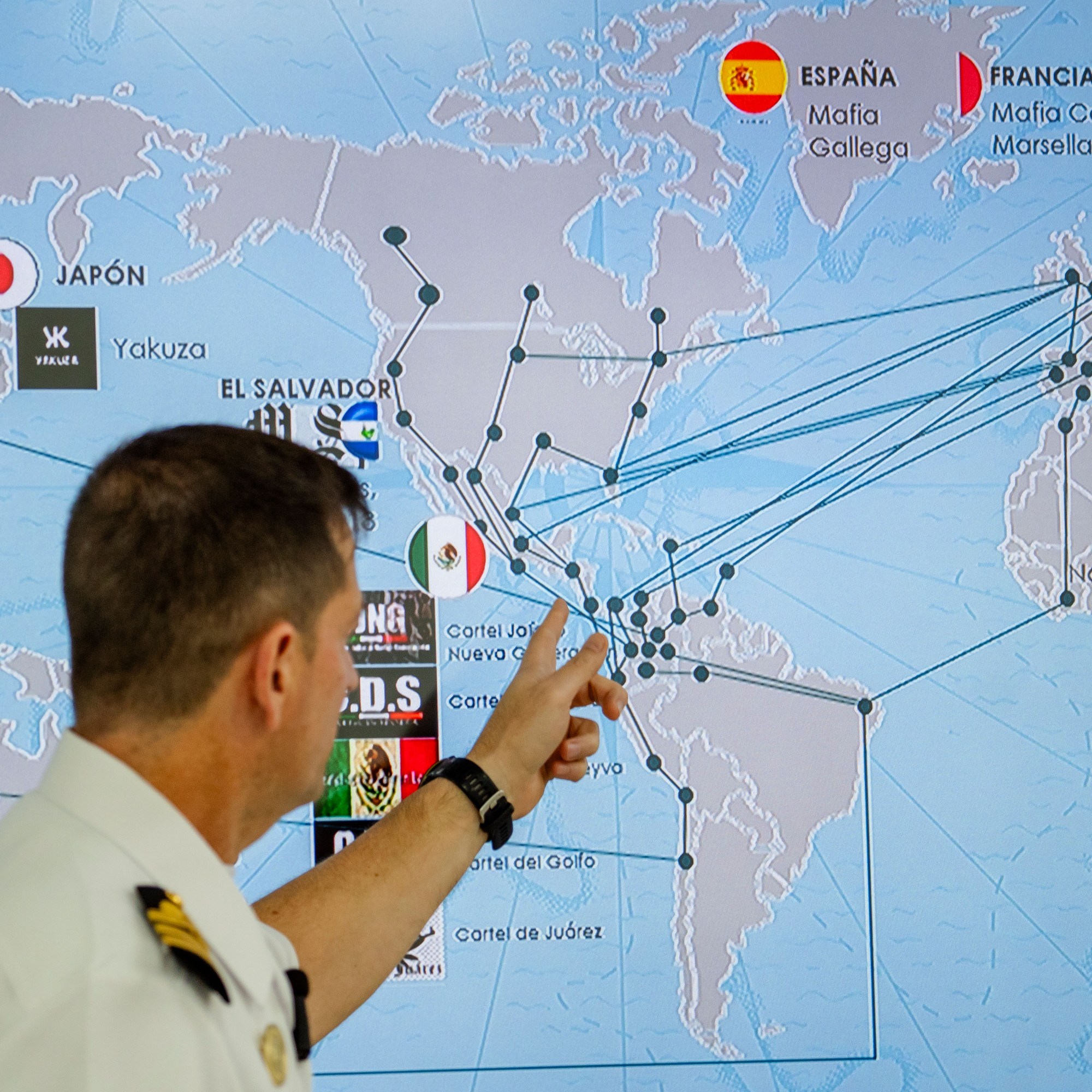
man in naval uniform pointing at a map
To find drone subs, international law enforcement will likely have to rely on networks of surveillance systems and, someday, swarms of their own drones.
CARLOS PARRA RIOS

With a crewed vessel, Colombian doctrine says coast guard units should try to hail the boat first with lights, sirens, radio calls, and warning shots. If that fails, interceptor crews sometimes have to jump aboard and force the hatch. Officers worry that future autonomous craft could be wired to sink or even explode if someone gets too close. “If they get destroyed, we may lose the evidence,” says Víctor González Badrán, a navy captain and director of CMCON. “That means no seizure and no legal proceedings against that organization.” 

That’s where electronic warfare enters the picture—radio-frequency jamming, cyber tools, perhaps more exotic options. In the simplest version, jamming means flooding the receiver with noise so that commands from the operator never reach the vessel. Spoofing goes a step further, feeding fake signals so that the sub thinks it’s somewhere else or obediently follows a fake set of waypoints. Cyber tools might aim higher up the chain, trying to penetrate the software that runs the vessel or the networks it uses to talk to satellite constellations. At the cutting edge of these countermeasures are electromagnetic pulses designed to fry electronics outright, turning a million-dollar narco sub into a dead hull drifting at sea.

In reality, the tools that might catch a future Tayrona sub are unevenly distributed, politically sensitive, and often experimental. Powerful cyber or electromagnetic tricks are closely guarded secrets; using them in a drug case risks exposing capabilities that militaries would rather reserve for wars. Systems like Australia’s JORN radar are tightly held national security assets, their exact performance specs classified, and sharing raw data with countries on the front lines of the cocaine trade would inevitably mean revealing hints as to how they got it. “Just because a capability exists doesn’t mean you employ it,” Knickerbocker says. 

Analysts don’t think uncrewed narco subs will reshape the global drug trade, despite the technological leap. Trafficking organizations will still hedge their bets across those three variables, hiding cocaine in shipping containers, dissolving it into liquids and paints, racing it north in fast boats. “I don’t think this is revolutionary,” Shuldiner says. “But it’s a great example of how resilient cocaine traffickers are, and how they’re continuously one step ahead of authorities.”

There’s still that chance, though, that everything international law enforcement agencies know about drug smuggling is about to change. González Zamudio says he keeps getting requests from foreign navies, coast guards, and security agencies to come see the Tayrona sub. He greets their delegations, takes them out to the strip of grass on the base, and walks them around it, gives them tours. It has become a kind of pilgrimage. Everyone who makes it worries that the next time a narco sub appears near a distant coastline, they’ll board it as usual, force the hatch—and find it full of cocaine and gadgets, but without a single human occupant. And no one knows what happens after that. 

Eduardo Echeverri López is a journalist based in Colombia.

Shape
Shape
Stay Ahead

Explore More Insights

Stay ahead with more perspectives on cutting-edge power, infrastructure, energy,  bitcoin and AI solutions. Explore these articles to uncover strategies and insights shaping the future of industries.

Shape

Arista hints at in-the-works telemetry tools to manage AI fabrics

“This greatly aids our customers in building an overall working solution, because the interactions between the network and the host can be complicated and difficult to debug when it’s different systems collecting them,” Duda said. Analysts react to telemetry preview Arista declined to share more details about its forthcoming AI

Read More »

CompTIA launches SecAI+ certification

The certification covers how to secure AI platforms and functionality, how to use AI to improve processes such as incident response, security analytics, threat intelligence, and penetration testing. It also focuses on how AI can automate compliance and risk management procedures under human guidance, according to CompTIA. “CompTIA SecAI+ addresses

Read More »

Energy Secretary Prevents Closure of Coal Plant That Provided Essential Power During Winter Storm

WASHINGTON—U.S. Secretary of Energy Chris Wright renewed an emergency order to address critical grid reliability issues facing the Midwestern region of the United States. The emergency order directs the Midcontinent Independent System Operator (MISO), in coordination with Consumers Energy, to ensure that the J.H. Campbell coal-fired power plant (Campbell Plant) in West Olive, Michigan shall take all steps necessary to remain available to operate and to employ economic dispatch to minimize costs for the American people. The Campbell Plant was originally scheduled to shut down on May 31, 2025 — 15 years before the end of its scheduled design life. “The energy sources that perform when you need them most are inherently the most valuable—that’s why beautiful, clean coal was the MVP of recent winter storms,” Secretary Wright said. “Hundreds of American lives have likely been saved because of President Trump’s actions saving America’s coal plants, including this Michigan coal plant which ran daily during Winter Storm Fern. This emergency order will mitigate the risk of blackouts and maintain affordable, reliable, and secure electricity access across the region.” The Campbell Plant was integral in stabilizing the grid during the recent winter storms. The plant operated at over 650 megawatts every day before and during Winter Storm Fern, January 21-February 1, proving that allowing it to cease operations would needlessly contribute to grid fragility. Thanks to President Trump’s leadership, coal plants across the country are reversing plans to shut down. In 2025, more than 17 gigawatts of coal-powered electricity generation were saved ahead of Winter Storm Fern. Since the Department of Energy’s (DOE) original order issued on May 23, the Campbell Plant has proven critical to MISO’s operations, operating regularly during periods of high energy demand and low levels of intermittent energy production. Subsequent orders were issued on August 20, 2025 and November 18, 2025. As outlined in DOE’s Resource

Read More »

EBW Warned of Faltering Gas Demand Heading into Holiday Weekend

In a U.S. natural gas focused EBW Analytics Group report sent to Rigzone by the EBW team on Friday, Eli Rubin, an energy analyst at the company, warned of “faltering demand” heading into the President’s Day holiday weekend. “The March contract tested as high as $3.316 yesterday before selling off after a bearish EIA [U.S. Energy Information Administration] storage surprise, and ahead of deteriorating heating demand into President’s Day holiday weekend and an 11 billion cubic foot per day drop into next Wednesday,” Rubin said in Friday’s report. “The threat of cold air in Western Canada and the Pacific Northwest moving into the U.S. remains a primary source of support,” he added. “If the market returns from the holiday weekend without this threat materializing, however, sub-$3.00 per million British thermal units may be in play as the year over year storage deficit flips to a 170 billion cubic foot surplus by late February,” he continued. In the report, Rubin went on to state that “steep storage refill demand east of the Rockies and loose supply/demand fundamentals during recent Marches may offer some medium-term support”. He added, however, that “storage exiting March near 1,800 billion cubic feet, with gathering production tailwinds and decelerating year over year LNG growth into mid to late 2026, suggest a bearish outlook for NYMEX gas futures”. In its latest weekly natural gas storage report, which was released on February 12 and included data for the week ending February 6, the EIA revealed that, according to its estimates, working gas in storage was 2,214 billion cubic feet as of February 6. “This represents a net decrease of 249 billion cubic feet from the previous week,” the EIA highlighted in the report. “Stocks were 97 billion cubic feet less than last year at this time and 130 billion

Read More »

North America Drops 6 Rigs Week on Week

North America dropped six rigs week on week, according to Baker Hughes’ latest North America rotary rig count, which was published on February 13. The total U.S. rig count remained unchanged week on week and the total Canada rig count dropped by six during the same period, pushing the total North America rig count down to 773, comprising 551 rigs from the U.S. and 222 rigs from Canada, the count outlined. Of the total U.S. rig count of 551, 531 rigs are categorized as land rigs, 17 are categorized as offshore rigs, and three are categorized as inland water rigs. The total U.S. rig count is made up of 409 oil rigs, 133 gas rigs, and nine miscellaneous rigs, according to Baker Hughes’ count, which revealed that the U.S. total comprises 481 horizontal rigs, 57 directional rigs, and 13 vertical rigs. Week on week, the U.S. land rig count dropped by one, its offshore rig count rose by one, and its inland water rig count remained unchanged, Baker Hughes highlighted. The U.S. oil rig count decreased by three week on week, while its gas rig count increased by three and its miscellaneous rig count remained unchanged, the count showed. The U.S. horizontal rig count dropped by two week on week, its directional rig count rose by two week on week, and its vertical rig count remained flat during the same period, the count revealed. A major state variances subcategory included in the rig count showed that, week on week, Texas dropped three rigs, Oklahoma and North Dakota each dropped one rig, Louisiana added two rigs, and New Mexico, Pennsylvania, and Wyoming each added one rig. A major basin variances subcategory included in the rig count showed that, week on week, the Permian basin dropped three rigs, the Williston basin dropped

Read More »

Aramco Commits to 1 MMtpa for 20 Years from Commonwealth LNG

Saudi Arabian Oil Co (Aramco) has signed a 20-year agreement to buy one million metric tons per annum (MMtpa) of liquefied natural gas from the under-development Commonwealth LNG in Cameron Parish, Louisiana. “Commonwealth is advancing toward a final investment decision with line of sight to secure its remaining capacity”, said a joint statement by the offtake parties. “Aramco Trading joins Glencore, JERA, PETRONAS, Mercuria and EQT among international energy companies entering into long-term offtake contracts with the platform”. Early this month Commonwealth announced a 20-year deal to supply one MMtpa to Geneva, Switzerland-based energy and commodities trader Mercuria. Commonwealth LNG is a project of Kimmeridge Energy Management Co LLC and Mubadala Investment Co through their joint venture Caturus HoldCo LLC. Expected to start operation 2030, Commonwealth LNG is designed to produce up to 9.5 million metric tons a year of LNG. “This agreement highlights the strong international demand for U.S. LNG and underscores how our longstanding relationships and capabilities position Caturus to serve global markets”, said Caturus chief executive David Lawler. “Our contract with Aramco Trading underscores the differentiated value Caturus can bring through our global reach in offering wellhead to water services”, Lawler added. Mohammed K. Al Mulhim, Aramco Trading president and CEO, said, “This agreement reflects Aramco Trading’s efforts to secure a reliable, long-term energy supply for global markets while strengthening our presence in the LNG sector”. The Gulf Coast project is permitted to ship up to 9.5 MMtpa of LNG, equivalent to around 1.21 billion cubic feet per day of gas according to Kimmeridge. The United States Energy Department granted the project authorization to export to countries without a free trade agreement (FTA) with the U.S. in August 2025 and FTA authorization in April 2020. The developers expect the first phase of the project to generate around

Read More »

Enbridge Q4 Profit Up YoY

Enbridge Inc has reported CAD 1.95 billion ($1.43 billion) in earnings and CAD 1.92 billion in adjusted earnings for the fourth quarter of 2025, up from CAD 493 million and CAD 1.64 billion for the same three-month period in 2024 respectively. Q4 2025 income per share of CAD 0.88 ($0.63), adjusted for extraordinary items, beat the Zacks Consensus Estimate of $0.6. Calgary-based Enbridge, which operates oil and gas pipelines in Canada and the United States, earlier bumped up its quarterly dividend by three percent against the prior rate to CAD 0.97. The annualized rate for 2026 is CAD 3.88 per share. Q4 2025 adjusted EBITDA rose 1.62 percent year-on-year to CAD 5.21 billion “due primarily to favorable gas transmission contracting and Venice Extension entering service, colder weather and higher rates and customer growth at Enbridge Gas Ontario, partially offset by the absence in 2025 of equity earnings related to investment tax credits from our investment in Fox Squirrel Solar”, Enbridge said in an online statement. United States gas transmission contributed CAD 997 million to segment adjusted EBITDA, down from CAD 1 billion for Q4 2024. The U.S. figure benefited from the startup of the Venice Extension Project, which expands the Texas Eastern system’s capacity to deliver gas to Gulf Coast markets, and Enbridge’s acquisition of a stake in the Matterhorn Express Pipeline. Enbridge also recognized “favorable contracting and successful rate case settlements on our U.S. Gas Transmission assets”, partially offset by the timing of operating costs. Adjusted EBITDA from Canadian gas transmission increased from CAD 157 million for Q4 2024 to CAD 190 million for Q4 2025, helped by “higher revenues at Aitken Creek due to favorable storage spreads”. Liquid pipelines logged CAD 2.45 billion in adjusted EBITDA, up from CAD 2.4 billion for Q4 2024. The Mainline System, which carries

Read More »

Analyst Highlights Focus of IEW Event

Focus at the London International Energy Week (IEW) last week was the balancing of geopolitics versus assessed surplus of oil globally in 2026. That’s what Skandinaviska Enskilda Banken AB (SEB) Chief Commodities Analyst Bjarne Schieldrop noted in a SEB report sent to Rigzone on Monday morning, adding that one delegate at the event stated that “if OPEC doesn’t cut, we’ll have $45 per barrel in June”. “That may be true,” Schieldrop said in the report. “But OPEC+ is meeting every month, taking a measure of the state of the global oil market and then decides what to do on the back of that. The group has been very explicit that they may cut, increase, or keep production steady depending on their findings,” he added. “We believe they will and thus we do not buy into $45 per barrel by June because, if need-be, they will trim production as they say they will,” he continued, pointing out that OPEC+ is next scheduled to meet on March 1 “to discuss production for April”. Schieldrop highlighted in the report that, in its February oil market report, the International Energy Agency (IEA) “restated its view that the world will only need 25.7 million barrels per day of crude from OPEC in 2026 versus a recent production by the group of 28.8 million barrels per day”. “I.e. that to keep the market balanced the group will need to cut production by some three million barrels per day,” he said. “Though strategic stock building around the world needs to be deducted from that. And the appetite for such stock building could be solid given elevated geopolitical risks. Thus what will flow to commercial stocks in the end remains to be seen,” he stated. Schieldrop went on to note in the report that increased Iranian tension could drive Brent

Read More »

ECL targets AI data centers with fuel-agnostic power platform

Power availability has become a gating factor for many data center projects, particularly where developers need larger connections or rapid delivery. Grid constraints can also influence where operators place compute for low-latency AI workloads. “Inference has to live close to people, data and applications, in and around major cities, smaller metros and industrial hubs where there is rarely a spare 50 or 100 megawatts sitting on the grid, and almost never a mature hydrogen ecosystem,” said Bachar. In typical data center design, the facilities are planned around 1 energy source, be it electrical grid, solar and other renewables, or diesel generated. All require different layouts and designs. One design does not fit all power sources. FlexGrid lets the data center use any power source it wants and switch to a new source without requiring a redesign of the facilities.

Read More »

AI likely to put a major strain on global networks—are enterprises ready?

“When AI pipelines slow down or traffic overloads common infrastructure, business processes slow down, and customer experience degrades,” Kale says. “Since many organizations are using AI to enable their teams to make critical decisions, disruptions caused by AI-related failures will be experienced instantly by both internal teams and external customers.” A single bottleneck can quickly cascade through an organization, Kales says, “reducing the overall value of the broader digital ecosystem.” In 2026, “we will see significant disruption from accelerated appetite for all things AI,” research firm Forrester noted in a late-year predictions post. “Business demands of AI systems, network connectivity, AI for IT operations, the conversational AI-powered service desk, and more are driving substantial changes that tech leaders must enable within their organizations.” And in a 2025 study of about 1,300 networking, operations, cloud, and architecture professionals worldwide, Broadcom noted a “readiness gap” between the desire for AI and network preparedness. While 99% of organizations have cloud strategies and are adopting AI, only 49% say their networks can support the bandwidth and low latency that AI requires, according to Broadcom’s  2026 State of Network Operations report. “AI is shifting Internet traffic from human-paced to machine-paced, and machines generate 100 times more requests with zero off-hours,” says Ed Barrow, CEO of Cloud Capital, an investment management firm focused on acquiring, managing, and operating data centers. “Inference workloads in particular create continuous, high-intensity, globally distributed traffic patterns,” Barrow says. “A single AI feature can trigger millions of additional requests per hour, and those requests are heavier—higher bandwidth, higher concurrency, and GPU-accelerated compute on the other side of the network.”

Read More »

Adani bets $100 billion on AI data centers as India eyes global hub status

The sovereignty question Adani framed the investment as a matter of national digital sovereignty, saying it would reserve a significant portion of GPU capacity for Indian AI startups and research institutions. Analysts were not convinced the structure supported the claim. “I believe it is too distant from digital sovereignty if the majority of the projects are being built to serve leading MNC AI hyperscalers,” said Shah. “Equal investments have to happen for public AI infrastructure, and the data of billions of users — from commerce to content to health — must remain sovereign.” Gogia framed the gap in operational terms. “Ownership alone does not define sovereignty,” he said. “The practical determinants are who controls privileged access during incidents, where critical workloads fail over when grids are stressed, and what regulatory oversight mechanisms are contractually enforceable.” Those are questions Adani has not yet answered and the market, analysts say, will be watching for more than just construction progress. But Banerjee said the market would not wait nine years to judge the announcement. “In practice, I think the market will judge this on near-term proof points, grid capacity secured, power contracting in place, and anchor tenants signed, rather than the headline capex or long-dated targets,” he said.

Read More »

Arista laments ‘horrendous’ memory situation

Digging in on campus Arista has been clear about its plans to grow its presence campus networking environments. Last Fall, Ullal said she expects Arista’s campus and WAN business would grow from the current $750 million-$800 million run rate to $1.25 billion, representing a 60% growth opportunity for the company. “We are committed to our aggressive goal of $1.25 billion for ’26 for the cognitive campus and branch. We have also successfully deployed in many routing edge, core spine and peering use cases,” Ullal said. “In Q4 2025, Arista launched our flagship 7800 R4 spine for many routing use cases, including DCI, AI spines with that massive 460 terabits of capacity to meet the demanding needs of multiservice routing, AI workloads and switching use cases. The combined campus and routing adjacencies together contribute approximately 18% of revenue.” Ethernet leads the way “In terms of annual 2025 product lines, our core cloud, AI and data center products built upon our highly differentiated Arista EOS stack is successfully deployed across 10 gig to 800 gigabit Ethernet speeds with 1.6 terabit migration imminent,” Ullal said. “This includes our portfolio of EtherLink AI and our 7000 series platforms for best-in-class performance, power efficiency, high availability, automation, agility for both the front and back-end compute, storage and all of the interconnect zones.” Ullal said she expects Ethernet will get even more of a boost later this year when the multivendor Ethernet for Scale-Up Networking (ESUN) specification is released.  “We have consistently described that today’s configurations are mostly a combination of scale out and scale up were largely based on 800G and smaller ratings. Now that the ESUN specification is well underway, we need a good solid spec. Otherwise, we’ll be shipping proprietary products like some people in the world do today. And so we will tie our

Read More »

From NIMBY to YIMBY: A Playbook for Data Center Community Acceptance

Across many conversations at the start of this year, at PTC and other conferences alike, the word on everyone’s lips seems to be “community.” For the data center industry, that single word now captures a turning point from just a few short years ago: we are no longer a niche, back‑of‑house utility, but a front‑page presence in local politics, school board budgets, and town hall debates. That visibility is forcing a choice in how we tell our story—either accept a permanent NIMBY-reactive framework, or actively build a YIMBY narrative that portrays the real value digital infrastructure brings to the markets and surrounding communities that host it. Speaking regularly with Ilissa Miller, CEO of iMiller Public Relations about this topic, there is work to be done across the ecosystem to build communications. Miller recently reflected: “What we’re seeing in communities isn’t a rejection of digital infrastructure, it’s a rejection of uncertainty driven by anxiety and fear. Most local leaders have never been given a framework to evaluate digital infrastructure developments the way they evaluate roads, water systems, or industrial parks. When there’s no shared planning language, ‘no’ becomes the safest answer.” A Brief History of “No” Community pushback against data centers is no longer episodic; it has become organized, media‑savvy, and politically influential in key markets. In Northern Virginia, resident groups and environmental organizations have mobilized against large‑scale campuses, pressing counties like Loudoun and Prince William to tighten zoning, question incentives, and delay or reshape projects.1 Loudoun County’s move in 2025 to end by‑right approvals for new facilities, requiring public hearings and board votes, marked a watershed moment as the world’s densest data center market signaled that communities now expect more say over where and how these campuses are built. Prince William County’s decision to sharply increase its tax rate on

Read More »

Nomads at the Frontier: PTC 2026 Signals the Digital Infrastructure Industry’s Moment of Execution

Each January, the Pacific Telecommunications Council conference serves as a barometer for where digital infrastructure is headed next. And according to Nomad Futurist founders Nabeel Mahmood and Phillip Koblence, the message from PTC 2026 was unmistakable: The industry has moved beyond hype. The hard work has begun. In the latest episode of The DCF Show Podcast, part of our ongoing ‘Nomads at the Frontier’ series, Mahmood and Koblence joined Data Center Frontier to unpack the tone shift emerging across the AI and data center ecosystem. Attendance continues to grow year over year. Conversations remain energetic. But the character of those conversations has changed. As Mahmood put it: “The hype that the market started to see is actually resulting a bit more into actions now, and those conversations are resulting into some good progress.” The difference from prior years? Less speculation. More execution. From Data Center Cowboys to Real Deployments Koblence offered perhaps the sharpest contrast between PTC conversations in 2024 and those in 2026. Two years ago, many projects felt speculative. Today, developers are arriving with secured power, customers, and construction underway. “If 2024’s PTC was data center cowboys — sites that in someone’s mind could be a data center — this year was: show me the money, show me the power, give me accurate timelines.” In other words, the market is no longer rewarding hypothetical capacity. It is demanding delivered capacity. Operators now speak in terms of deployments already underway, not aspirational campuses still waiting on permits and power commitments. And behind nearly every conversation sits the same gating factor. Power. Power Has Become the Industry’s Defining Constraint Whether discussions centered on AI factories, investment capital, or campus expansion, Mahmood and Koblence noted that every conversation eventually returned to energy availability. “All of those questions are power,” Koblence said.

Read More »

Microsoft will invest $80B in AI data centers in fiscal 2025

And Microsoft isn’t the only one that is ramping up its investments into AI-enabled data centers. Rival cloud service providers are all investing in either upgrading or opening new data centers to capture a larger chunk of business from developers and users of large language models (LLMs).  In a report published in October 2024, Bloomberg Intelligence estimated that demand for generative AI would push Microsoft, AWS, Google, Oracle, Meta, and Apple would between them devote $200 billion to capex in 2025, up from $110 billion in 2023. Microsoft is one of the biggest spenders, followed closely by Google and AWS, Bloomberg Intelligence said. Its estimate of Microsoft’s capital spending on AI, at $62.4 billion for calendar 2025, is lower than Smith’s claim that the company will invest $80 billion in the fiscal year to June 30, 2025. Both figures, though, are way higher than Microsoft’s 2020 capital expenditure of “just” $17.6 billion. The majority of the increased spending is tied to cloud services and the expansion of AI infrastructure needed to provide compute capacity for OpenAI workloads. Separately, last October Amazon CEO Andy Jassy said his company planned total capex spend of $75 billion in 2024 and even more in 2025, with much of it going to AWS, its cloud computing division.

Read More »

John Deere unveils more autonomous farm machines to address skill labor shortage

Join our daily and weekly newsletters for the latest updates and exclusive content on industry-leading AI coverage. Learn More Self-driving tractors might be the path to self-driving cars. John Deere has revealed a new line of autonomous machines and tech across agriculture, construction and commercial landscaping. The Moline, Illinois-based John Deere has been in business for 187 years, yet it’s been a regular as a non-tech company showing off technology at the big tech trade show in Las Vegas and is back at CES 2025 with more autonomous tractors and other vehicles. This is not something we usually cover, but John Deere has a lot of data that is interesting in the big picture of tech. The message from the company is that there aren’t enough skilled farm laborers to do the work that its customers need. It’s been a challenge for most of the last two decades, said Jahmy Hindman, CTO at John Deere, in a briefing. Much of the tech will come this fall and after that. He noted that the average farmer in the U.S. is over 58 and works 12 to 18 hours a day to grow food for us. And he said the American Farm Bureau Federation estimates there are roughly 2.4 million farm jobs that need to be filled annually; and the agricultural work force continues to shrink. (This is my hint to the anti-immigration crowd). John Deere’s autonomous 9RX Tractor. Farmers can oversee it using an app. While each of these industries experiences their own set of challenges, a commonality across all is skilled labor availability. In construction, about 80% percent of contractors struggle to find skilled labor. And in commercial landscaping, 86% of landscaping business owners can’t find labor to fill open positions, he said. “They have to figure out how to do

Read More »

2025 playbook for enterprise AI success, from agents to evals

Join our daily and weekly newsletters for the latest updates and exclusive content on industry-leading AI coverage. Learn More 2025 is poised to be a pivotal year for enterprise AI. The past year has seen rapid innovation, and this year will see the same. This has made it more critical than ever to revisit your AI strategy to stay competitive and create value for your customers. From scaling AI agents to optimizing costs, here are the five critical areas enterprises should prioritize for their AI strategy this year. 1. Agents: the next generation of automation AI agents are no longer theoretical. In 2025, they’re indispensable tools for enterprises looking to streamline operations and enhance customer interactions. Unlike traditional software, agents powered by large language models (LLMs) can make nuanced decisions, navigate complex multi-step tasks, and integrate seamlessly with tools and APIs. At the start of 2024, agents were not ready for prime time, making frustrating mistakes like hallucinating URLs. They started getting better as frontier large language models themselves improved. “Let me put it this way,” said Sam Witteveen, cofounder of Red Dragon, a company that develops agents for companies, and that recently reviewed the 48 agents it built last year. “Interestingly, the ones that we built at the start of the year, a lot of those worked way better at the end of the year just because the models got better.” Witteveen shared this in the video podcast we filmed to discuss these five big trends in detail. Models are getting better and hallucinating less, and they’re also being trained to do agentic tasks. Another feature that the model providers are researching is a way to use the LLM as a judge, and as models get cheaper (something we’ll cover below), companies can use three or more models to

Read More »

OpenAI’s red teaming innovations define new essentials for security leaders in the AI era

Join our daily and weekly newsletters for the latest updates and exclusive content on industry-leading AI coverage. Learn More OpenAI has taken a more aggressive approach to red teaming than its AI competitors, demonstrating its security teams’ advanced capabilities in two areas: multi-step reinforcement and external red teaming. OpenAI recently released two papers that set a new competitive standard for improving the quality, reliability and safety of AI models in these two techniques and more. The first paper, “OpenAI’s Approach to External Red Teaming for AI Models and Systems,” reports that specialized teams outside the company have proven effective in uncovering vulnerabilities that might otherwise have made it into a released model because in-house testing techniques may have missed them. In the second paper, “Diverse and Effective Red Teaming with Auto-Generated Rewards and Multi-Step Reinforcement Learning,” OpenAI introduces an automated framework that relies on iterative reinforcement learning to generate a broad spectrum of novel, wide-ranging attacks. Going all-in on red teaming pays practical, competitive dividends It’s encouraging to see competitive intensity in red teaming growing among AI companies. When Anthropic released its AI red team guidelines in June of last year, it joined AI providers including Google, Microsoft, Nvidia, OpenAI, and even the U.S.’s National Institute of Standards and Technology (NIST), which all had released red teaming frameworks. Investing heavily in red teaming yields tangible benefits for security leaders in any organization. OpenAI’s paper on external red teaming provides a detailed analysis of how the company strives to create specialized external teams that include cybersecurity and subject matter experts. The goal is to see if knowledgeable external teams can defeat models’ security perimeters and find gaps in their security, biases and controls that prompt-based testing couldn’t find. What makes OpenAI’s recent papers noteworthy is how well they define using human-in-the-middle

Read More »