Stay Ahead, Stay ONMINE

A boost for manufacturing

Several years ago, Suzanne Berger was visiting a manufacturing facility in Ohio, talking to workers on the shop floor, when a machinist offered a thought that could serve as her current credo.  “Technology takes a step forward—workers take a step forward too,” the employee said.  Berger, to explain, is an MIT political scientist who for decades has advocated for the revitalization of US manufacturing. She has written books and coauthored reports about the subject, visited scores of factories, helped the issue regain traction in America, and in the process earned the title of Institute Professor, MIT’s highest faculty honor.  Over time, Berger has developed a distinctive viewpoint about manufacturing, seeing it as an arena where technological advances can drive economic growth and nimble firms can thrive.  This stands in contrast to the view that manufacturing is a sunsetting part of the US economy, lagging behind knowledge work and service industries and no longer a prime source of jobs. To Berger, the sector might have suffered losses, but we should think about it differently now: Rather than being threatened by change, it can thrive on innovation. She is keenly interested in medium-size and small manufacturers, not just huge factories, given that 98% of US manufacturers have 500 or fewer employees. And she is interested, especially, in how technology can help them. Roughly one-tenth of US manufacturers use robots, for instance, a number that clearly disappoints her.  Her focus on these smaller manufacturers is pragmatic. The US is not going to bring back textile manufacturing or steelmaking jobs anytime soon. And although the tech giants have made some concessions to domestic manufacturing, all major product lines from all tech companies are made largely overseas. Small and midsize firms may also have more opportunities to be flexible and innovative. And in the middle of Ohio, there it was, in a simple sentence: Technology takes a step forward—workers take a step forward too.  “I think workers do recognize that,” Berger says, sitting in her MIT office, with a view of East Cambridge out the window. “People don’t want to work on technologies of the 1940s. People do want to feel they’re moving to the future, and that’s what young workers also want. They want decent pay. They want to feel they’re advancing, the company is advancing, and they are somehow part of the future. That’s what we all want in jobs.” Now Berger is part of a new campus-­wide effort to do something tangible about these issues. She is a co-director of MIT’s Initiative for New Manufacturing (INM), launched in May 2025, which aims to reinvigorate the business of making things in the US. The idea is to enhance innovation and encourage companies to tightly link their innovation and production processes. This lets them rapidly fine-tune new products and new production technologies—and create good jobs along the way. “We want to work with firms big and small, in cities, small towns, and everywhere in between, to help them adopt new approaches for increased productivity,” MIT President Sally A. Kornbluth explained at the launch of INM. “We want to deliberately design high-quality, human-centered manufacturing jobs that bring new life to communities across the country.”  An unexpected product Whether she is examining data, talking to visitors about manufacturing, or venturing into yet another plant to look around and ask questions, Berger’s involvement with the Initiative for New Manufacturing is just the latest chapter in a fascinating, unpredictable career.  Once upon a time—her first two decades in academia—Berger was a political scientist who didn’t study either the US or manufacturing. She was a highly regarded scholar of French and European politics, whose research focused on rural workers, other laborers, and the persistence of political polarization. After growing up in New Jersey, she attended the University of Chicago and got her PhD from Harvard, where she studied with the famed political scientist Stanley Hoffmann.  Berger joined the MIT faculty in 1968 and soon began publishing extensively. Her 1972 book, Peasants Against Politics, argued that geographical political divisions in contemporary France largely replicated those seen at the time of the French Revolution. Her other books include The French Political System (1974) and Dualism and Discontinuity in Industrial Societies (1980), the latter written with the MIT economist Michael Piore.  By the mid-1980s, Berger was a well-established, tenured professor who had never set foot in a factory. In 1986, however, she was named to MIT’s newly formed Commission on Industrial Productivity on the strength of her studies about worker politics and economic change. The commission was a multiyear study group examining broad trends in US industry: By the 1980s, after decades of postwar dominance, US manufacturing had found itself challenged by other countries, most famously by Japan in areas like automaking and consumer electronics.  US BUREAU OF LABOR STATISTICS Two unexpected things emerged from that group. One was a best-selling book. Made in America: Regaining the Productive Edge, coauthored by Michael Dertouzos, Richard Lester, and Robert Solow, rapidly sold 300,000 copies, a sign of how much industrial decline was weighing on Americans. Looking at eight industries, Made in America found, among other things, that US manufacturers overemphasized short-term thinking and were neglecting technology transfer—that is, they were missing chances to turn lab innovations into new products. The other unexpected thing to materialize from the Commission on Industrial Productivity was the rest of Suzanne Berger’s career. Once she started studying manufacturing in close empirical fashion, she never really stopped.  “MIT really changed me,” Berger told MIT News in 2019, referring to her move into the study of manufacturing. “I’ve learned a lot at MIT.” At first she started examining some of the US’s important competitors, including Hong Kong and Taiwan. She and Richard Lester co-edited the books Made by Hong Kong (1997) and Global Taiwan (2005), scrutinizing those countries’ manufacturing practices. Christopher Love, a co-director of MIT’s Initiative for New ManufacturingWEBB CHAPPELL Over time, though, Berger has mostly turned her attention to US manufacturing. She was a core player in a five-year MIT examination of manufacturing that led her to write How We Compete (2006), a book about why and when multinational companies start outsourcing work to other firms and moving their operations overseas. She followed that up by cochairing the MIT commission known as Production in the Innovation Economy (PIE), formed in 2010, which looked closely at US manufacturing, and coauthored the 2013 book Making in America, summarizing the ways manufacturing had started incorporating advanced technologies. Then she participated extensively in MIT’s Work of the Future study group, whose research concluded that while AI and other technologies are changing the workplace, they will not necessarily wipe out whole cohorts of employees. “Suzanne is amazing,” says Christopher Love, the Raymond A. (1921) and Helen E. St. Laurent Professor of Chemical Engineering at MIT and another co-­director of the Initiative for New Manufacturing. “She’s been in this space and thinking about these questions for decades. Always asking, ‘What does it look like to be successful in manufacturing? What are the requirements around it?’ She’s obviously had a really large role to play here on the MIT campus in any number of important studies.”  “If I have a great idea for a new drug or food product … if I have to ship it off somewhere to figure out if I can make it or not, I lose time, I lose momentum, I lose financing.” Christopher Love “She always asks challenging questions and really values the collaboration between engineering and social science and management,” says John Hart, head of the MIT Department of Mechanical Engineering, director of the Center for Advanced Production Technologies, and the third co-director, with Berger and Love, of the Initiative for New Manufacturing. Moreover, Love adds, “the number of people she’s trained and mentored and brought along through the years reflects her commitment.”  For instance, Berger was the PhD advisor of Richard Locke, currently dean of the MIT Sloan School of Management. Separately, she spent nearly two decades as director of MISTI, the MIT program that sends students abroad for internships and study. Basically, Berger’s footprints are all around MIT. And now, in her 80s, she is helping to lead the Initiative for New Manufacturing. Indeed, she came up with its name herself. The initiative raises a couple of questions. What is new in the world of US manufacturing? And what can MIT do to help it? Home alone To start with, the Initiative for New Manufacturing is an ongoing project designed to enhance many aspects of US manufacturing. Berger’s previous efforts ended in written summaries—which have helped shape public dialogue around manufacturing. But the new initiative was not designed with an endpoint in mind. Since last spring, the Initiative for New Manufacturing has signed up industry partners—Amgen, Autodesk, Flex, GE Vernova, PTC, Sanofi, and Siemens—with which it may collaborate on manufacturing advances. It has also launched a 12-month certificate program, the Technologist Advanced Manufacturing Program (TechAMP), in partnership with six universities, community colleges, and technology centers. The courses, held at the partner institutions, give manufacturing employees and other students the chance to study basic manufacturing principles developed at MIT.  “We hope that the program equips manufacturing technologists to be innovators and problem-solvers in their organizations, and to effectively deploy new technologies that can improve manufacturing productivity,” says Hart, an expert in, among other things, 3D printing, an area where firms can find new manufacturing applications. But to really grasp what MIT can do today, we need to look at how manufacturing in the US has shrunk.  The first few decades after World War II were a golden age of American manufacturing. The country led the world in making things, and the sector accounted for about a quarter of US GDP throughout the 1950s. In recent years, that figure has hovered around 10%.  In 1959 there were 15 million manufacturing jobs in the US. By 1979, the rapidly growing country had around 20 million such jobs, even as the economy was diversifying. But the 1980s and the first decade of the 2000s saw big losses of manufacturing jobs, and there are about 12.8 million in the US today. As even Berger will acknowledge, the situation is not going to turn around instantly.  “Manufacturing at the moment is really still in decline,” she says. “The number of workers has gone down, and investment in manufacturing has actually gone down over the last year.”  As she sees it, diminished manufacturing capacity is a problem for three big reasons: It hurts a country’s general innovation capacity, it makes it harder to respond to times of need (such as pandemics), and it’s bad for national security.  “If you look at what the defense industrial base is in the United States, it is the same industrial base we’re talking about, with old technology,” she says. That is, defense technology comes from the same firms that haven’t updated their production methods lately. “Our national security is sitting on top of a worn-out industrial base,” Berger says, adding: “It’s a very stark picture.”  However, the first point—that manufacturing more makes a country more innovative—is the most essential conclusion she has developed on this subject. Production and innovation go better together. The ability to make things stems from innovation, but our useful advances are not just abstract lab discoveries. They often get worked out while we produce stuff.  “Innovation is closely connected to production, and if we outsource and offshore all our production, we’re also offshoring and outsourcing our innovation capabilities,” Berger says. “If we go back 40 years, the whole manufacturing landscape has changed in ways that are very detrimental to the US capabilities. The great American companies of 40 years ago were all vertically integrated and did everything from basic R&D through sales.” Think of General Electric, IBM, and DuPont.  Berger continues: “There was a technological disruption in the late 1980s and early 1990s, when people discovered it was possible to separate design and production. In the past, if you were making wafers, the chip designer and the engineer who figured out how to make the chip had to be together in the same plant. Once you were able to send that all as a digital file over the internet, you could separate those things. That’s what made outsourcing and offshoring more feasible.” Meanwhile, seeing the possibilities of offshoring, markets started punishing big firms that didn’t pare down to their “core competency.” Companies like AT&T and Xerox used to run famous research departments. That is no longer how such firms work. “DuPont closed the basic research labs that discovered nylon,” Berger notes. But back in the 1930s, DuPont was able to move that material from the lab to the market within five years, building a factory that quickly scaled up production of wildly popular nylon stockings. “The picture looked a little different,” she says.  Indeed, she says, “we had a radical change in the structure of companies. With the collapse of the vertically integrated companies, huge holes opened up in the industrial ecosystem.” Major companies that did their own research, trained workers, and manufactured in the US had spillover effects, producing the advances and the skilled, talented workers who populated the whole manufacturing ecosystem. “Once the big firms were no longer doing those activities, other companies were left home alone,” Berger says, meaning they were unable to afford research activities or generate as many advances. “All of this explains the state we see in manufacturing today. The big question is, how do we rebuild this?” “Innovation can come from anywhere” Over a decade ago, Christopher Love received a US Department of Defense grant to develop a small, portable system for creating biologic drugs, which are made from living organisms or their products. The idea was to see if such a device could be taken out onto the battlefield. The research was promising enough for Love to cofound a startup, Sunflower Therapeutics, that focuses on small-scale protein production for biopharmaceutical manufacturing and other medical applications. One might characterize the original project as either a piece of military equipment or a medical advance. It’s also a case study in new manufacturing.  John Hart, a co-director of MIT’s Initiative for New ManufacturingM SCOTT BRAUER After all, Love and his colleagues created a new method for making batches of certain types of drugs. That’s manufacturing; it’s an innovation leading directly to production, and the small size of the operation means it won’t get shipped overseas. And, as Love enjoys pointing out, his team’s innovation is hardly the first case of using living cells to make a product for nearby consumption. Your local craft brewery is actually a modestly sized manufacturer that won’t be shipping its jobs overseas either.  “The emerging generation of manufacturing has this new equilibrium between automation (machines, robots), human work, and software and data.” John Hart “Innovation can come from anywhere,” Love says. “What you really need is access to production. This is something Suzanne has been thinking about for a long time—that proximity. The same thing can happen in biomanufacturing. If I have a great idea for a new drug or food product or new material, if I have to ship it off somewhere to figure out if I can make it or not, I lose time, I lose momentum, I lose financing. I need that manufacturing to be super close.” New manufacturing can come in multiple forms and, yes, can include robots and other forms of automation. The issue is complex. Robots do replace workers, in the aggregate. But if they increase productivity, firms that are early adopters of robots grow more than other firms and employ more people, as economic studies in France, Spain, and Canada have shown. The wager is that a sensible deployment of robots leads to more overall growth. Meanwhile, US firms added more than 34,000 robots in workplaces in 2024; China added nearly 300,000. Berger hopes US firms won’t be technology laggards, as that could lead to an even steeper decline in the manufacturing sector. Instead, she encourages manufacturers to use robots productively to stay ahead of the competition.  “The emerging generation of manufacturing has this new equilibrium between automation (machines, robots), human work, and software and data,” Hart says. “A lot of the interesting opportunities in manufacturing, I think, come from the combination of those capabilities to improve productivity, improve quality, and make manufacturing more flexible.” Another form of new manufacturing may happen at firms that, like the old heavyweight corporations, see value in keeping research and development in-house. At the Initiative for New Manufacturing launch event in May, one of the speakers was JB Straubel, founder of Redwood Materials, which recycles rechargeable batteries. The company has figured out how to extract materials like cobalt, nickel, and lithium, which otherwise are typically mined. To do so, the company has had to develop a variety of new industrial processes—again, one of the keys to reviving manufacturing here. “Whether you’re building a new machine or trying a new process … acquiring a new technology is one of the most important ways a company can innovate,” Berger says. Although she acknowledges that “innovation is risky, and everything does not succeed,” she points out that “a single focus on optimization [in firms] has not served us well.” Manufacturing success stories  The future of US manufacturing, then, can take many forms. But Berger, when she visits factories, is consistently struck by the vintage machines often on display. She tells the story of a manufacturer she visited within the last couple of years that not only uses milling machines made during World War II but buys them up when other firms in the field discard them.  “If you have all old equipment, your productivity is going to be low, your profits are going to be low, you’ll want low-skill workers, and you’re only going to be able to pay low wages,” she says. “And each one of those features reinforces the others. It’s like a dead-end trap.” But things don’t need to be this way, Berger believes. And in some places, she visits firms that represent manufacturing success stories.  “The idea that Americans don’t like manufacturing, that it’s dirty and difficult—I think this is totally [wrong],” she says. “Americans really do like making things with their hands, and Americans do think we ought to have manufacturing. Whenever I’ve been in a plant where it seems well run—and the owners, the managers, are proud of their workers and recognize their accomplishments, and people are respected—people seem pleased about having those jobs.” Flash back to the exchange Berger had with that worker in Ohio, and the vision for the Initiative for New Manufacturing falls further into place: Technological change has a key role to play in creating that kind of work. Okay, US manufacturing may not be overhauled overnight. It will take an effort to change it, one midsize manufacturer after another. But getting that done seems vital for Americans in Ohio, in Massachusetts, and all over.   “We really see a moral imperative,” Berger says, “which is to be able to reach out to the whole country to try to rebuild manufacturing.”
Several years ago, Suzanne Berger was visiting a manufacturing facility in Ohio, talking to workers on the shop floor, when a machinist offered a thought that could serve as her current credo. 

“Technology takes a step forward—workers take a step forward too,” the employee said. 

Berger, to explain, is an MIT political scientist who for decades has advocated for the revitalization of US manufacturing. She has written books and coauthored reports about the subject, visited scores of factories, helped the issue regain traction in America, and in the process earned the title of Institute Professor, MIT’s highest faculty honor. 

Over time, Berger has developed a distinctive viewpoint about manufacturing, seeing it as an arena where technological advances can drive economic growth and nimble firms can thrive. 

This stands in contrast to the view that manufacturing is a sunsetting part of the US economy, lagging behind knowledge work and service industries and no longer a prime source of jobs. To Berger, the sector might have suffered losses, but we should think about it differently now: Rather than being threatened by change, it can thrive on innovation.

She is keenly interested in medium-size and small manufacturers, not just huge factories, given that 98% of US manufacturers have 500 or fewer employees. And she is interested, especially, in how technology can help them. Roughly one-tenth of US manufacturers use robots, for instance, a number that clearly disappoints her. 

Her focus on these smaller manufacturers is pragmatic. The US is not going to bring back textile manufacturing or steelmaking jobs anytime soon. And although the tech giants have made some concessions to domestic manufacturing, all major product lines from all tech companies are made largely overseas. Small and midsize firms may also have more opportunities to be flexible and innovative.

And in the middle of Ohio, there it was, in a simple sentence: Technology takes a step forward—workers take a step forward too. 

“I think workers do recognize that,” Berger says, sitting in her MIT office, with a view of East Cambridge out the window. “People don’t want to work on technologies of the 1940s. People do want to feel they’re moving to the future, and that’s what young workers also want. They want decent pay. They want to feel they’re advancing, the company is advancing, and they are somehow part of the future. That’s what we all want in jobs.”

Now Berger is part of a new campus-­wide effort to do something tangible about these issues. She is a co-director of MIT’s Initiative for New Manufacturing (INM), launched in May 2025, which aims to reinvigorate the business of making things in the US. The idea is to enhance innovation and encourage companies to tightly link their innovation and production processes. This lets them rapidly fine-tune new products and new production technologies—and create good jobs along the way.

“We want to work with firms big and small, in cities, small towns, and everywhere in between, to help them adopt new approaches for increased productivity,” MIT President Sally A. Kornbluth explained at the launch of INM. “We want to deliberately design high-quality, human-centered manufacturing jobs that bring new life to communities across the country.” 

An unexpected product

Whether she is examining data, talking to visitors about manufacturing, or venturing into yet another plant to look around and ask questions, Berger’s involvement with the Initiative for New Manufacturing is just the latest chapter in a fascinating, unpredictable career. 

Once upon a time—her first two decades in academia—Berger was a political scientist who didn’t study either the US or manufacturing. She was a highly regarded scholar of French and European politics, whose research focused on rural workers, other laborers, and the persistence of political polarization. After growing up in New Jersey, she attended the University of Chicago and got her PhD from Harvard, where she studied with the famed political scientist Stanley Hoffmann. 

Berger joined the MIT faculty in 1968 and soon began publishing extensively. Her 1972 book, Peasants Against Politics, argued that geographical political divisions in contemporary France largely replicated those seen at the time of the French Revolution. Her other books include The French Political System (1974) and Dualism and Discontinuity in Industrial Societies (1980), the latter written with the MIT economist Michael Piore. 

By the mid-1980s, Berger was a well-established, tenured professor who had never set foot in a factory. In 1986, however, she was named to MIT’s newly formed Commission on Industrial Productivity on the strength of her studies about worker politics and economic change. The commission was a multiyear study group examining broad trends in US industry: By the 1980s, after decades of postwar dominance, US manufacturing had found itself challenged by other countries, most famously by Japan in areas like automaking and consumer electronics. 

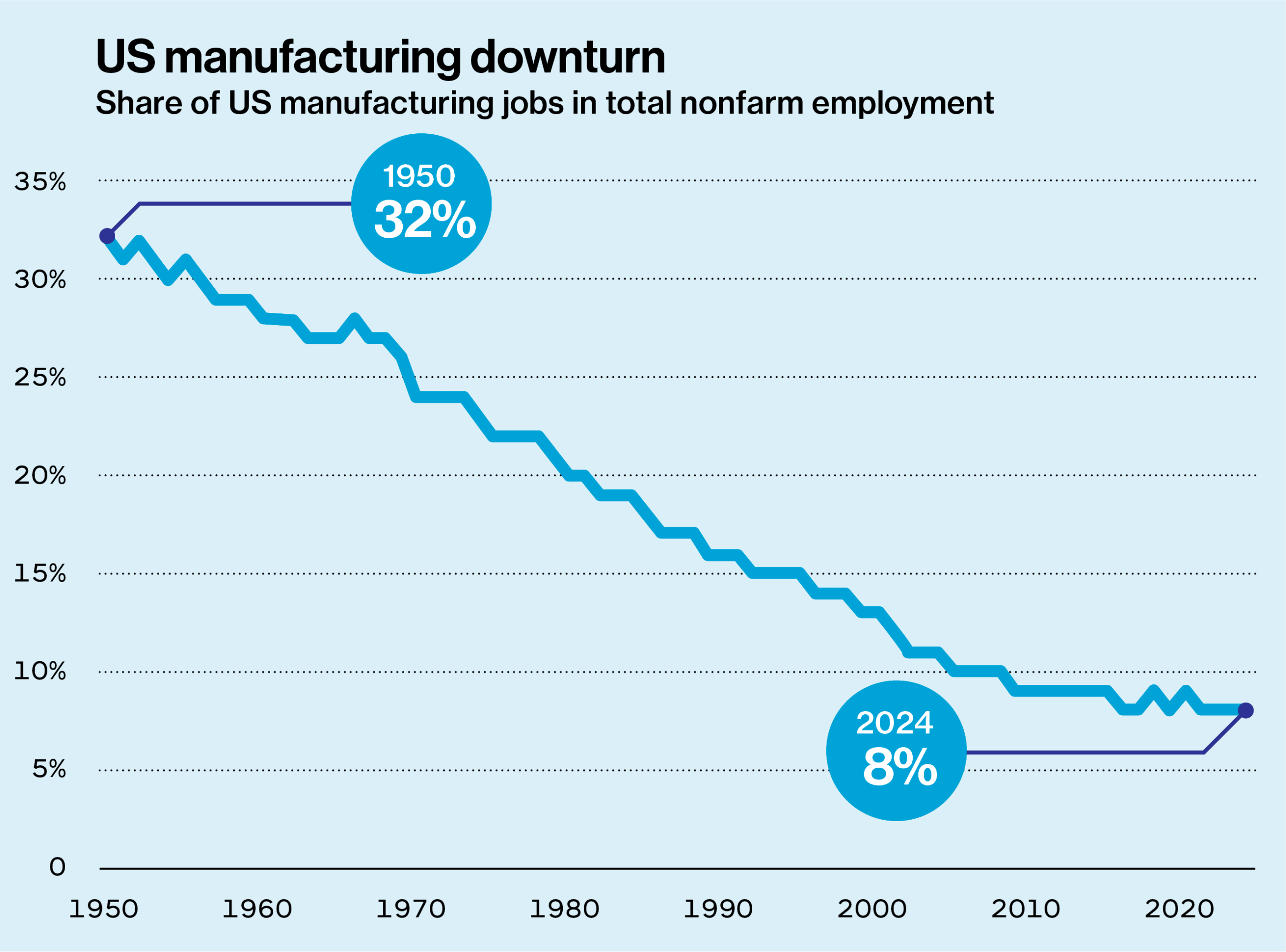
chart showing US manufacturing downturn. Share of US manufacturing jobs in total nonfarm employment.  A callout shows 1950 to be at 32% and the downward trend continues to fall to 8% in 2024.

US BUREAU OF LABOR STATISTICS

Two unexpected things emerged from that group. One was a best-selling book. Made in America: Regaining the Productive Edge, coauthored by Michael Dertouzos, Richard Lester, and Robert Solow, rapidly sold 300,000 copies, a sign of how much industrial decline was weighing on Americans. Looking at eight industries, Made in America found, among other things, that US manufacturers overemphasized short-term thinking and were neglecting technology transfer—that is, they were missing chances to turn lab innovations into new products.

The other unexpected thing to materialize from the Commission on Industrial Productivity was the rest of Suzanne Berger’s career. Once she started studying manufacturing in close empirical fashion, she never really stopped. 

“MIT really changed me,” Berger told MIT News in 2019, referring to her move into the study of manufacturing. “I’ve learned a lot at MIT.”

At first she started examining some of the US’s important competitors, including Hong Kong and Taiwan. She and Richard Lester co-edited the books Made by Hong Kong (1997) and Global Taiwan (2005), scrutinizing those countries’ manufacturing practices.

Christopher Love
Christopher Love, a co-director of MIT’s Initiative for New Manufacturing
WEBB CHAPPELL

Over time, though, Berger has mostly turned her attention to US manufacturing. She was a core player in a five-year MIT examination of manufacturing that led her to write How We Compete (2006), a book about why and when multinational companies start outsourcing work to other firms and moving their operations overseas.

She followed that up by cochairing the MIT commission known as Production in the Innovation Economy (PIE), formed in 2010, which looked closely at US manufacturing, and coauthored the 2013 book Making in America, summarizing the ways manufacturing had started incorporating advanced technologies. Then she participated extensively in MIT’s Work of the Future study group, whose research concluded that while AI and other technologies are changing the workplace, they will not necessarily wipe out whole cohorts of employees.

“Suzanne is amazing,” says Christopher Love, the Raymond A. (1921) and Helen E. St. Laurent Professor of Chemical Engineering at MIT and another co-­director of the Initiative for New Manufacturing. “She’s been in this space and thinking about these questions for decades. Always asking, ‘What does it look like to be successful in manufacturing? What are the requirements around it?’ She’s obviously had a really large role to play here on the MIT campus in any number of important studies.” 

“If I have a great idea for a new drug or food product … if I have to ship it off somewhere to figure out if I can make it or not, I lose time, I lose momentum, I lose financing.”

Christopher Love

“She always asks challenging questions and really values the collaboration between engineering and social science and management,” says John Hart, head of the MIT Department of Mechanical Engineering, director of the Center for Advanced Production Technologies, and the third co-director, with Berger and Love, of the Initiative for New Manufacturing.

Moreover, Love adds, “the number of people she’s trained and mentored and brought along through the years reflects her commitment.” 

For instance, Berger was the PhD advisor of Richard Locke, currently dean of the MIT Sloan School of Management. Separately, she spent nearly two decades as director of MISTI, the MIT program that sends students abroad for internships and study. Basically, Berger’s footprints are all around MIT.

And now, in her 80s, she is helping to lead the Initiative for New Manufacturing. Indeed, she came up with its name herself. The initiative raises a couple of questions. What is new in the world of US manufacturing? And what can MIT do to help it?

Home alone

To start with, the Initiative for New Manufacturing is an ongoing project designed to enhance many aspects of US manufacturing. Berger’s previous efforts ended in written summaries—which have helped shape public dialogue around manufacturing. But the new initiative was not designed with an endpoint in mind.

Since last spring, the Initiative for New Manufacturing has signed up industry partners—Amgen, Autodesk, Flex, GE Vernova, PTC, Sanofi, and Siemens—with which it may collaborate on manufacturing advances. It has also launched a 12-month certificate program, the Technologist Advanced Manufacturing Program (TechAMP), in partnership with six universities, community colleges, and technology centers. The courses, held at the partner institutions, give manufacturing employees and other students the chance to study basic manufacturing principles developed at MIT. 

“We hope that the program equips manufacturing technologists to be innovators and problem-solvers in their organizations, and to effectively deploy new technologies that can improve manufacturing productivity,” says Hart, an expert in, among other things, 3D printing, an area where firms can find new manufacturing applications.

But to really grasp what MIT can do today, we need to look at how manufacturing in the US has shrunk. 

The first few decades after World War II were a golden age of American manufacturing. The country led the world in making things, and the sector accounted for about a quarter of US GDP throughout the 1950s. In recent years, that figure has hovered around 10%. 

In 1959 there were 15 million manufacturing jobs in the US. By 1979, the rapidly growing country had around 20 million such jobs, even as the economy was diversifying. But the 1980s and the first decade of the 2000s saw big losses of manufacturing jobs, and there are about 12.8 million in the US today.

As even Berger will acknowledge, the situation is not going to turn around instantly. 

“Manufacturing at the moment is really still in decline,” she says. “The number of workers has gone down, and investment in manufacturing has actually gone down over the last year.” 

As she sees it, diminished manufacturing capacity is a problem for three big reasons: It hurts a country’s general innovation capacity, it makes it harder to respond to times of need (such as pandemics), and it’s bad for national security. 

“If you look at what the defense industrial base is in the United States, it is the same industrial base we’re talking about, with old technology,” she says. That is, defense technology comes from the same firms that haven’t updated their production methods lately. “Our national security is sitting on top of a worn-out industrial base,” Berger says, adding: “It’s a very stark picture.” 

However, the first point—that manufacturing more makes a country more innovative—is the most essential conclusion she has developed on this subject. Production and innovation go better together. The ability to make things stems from innovation, but our useful advances are not just abstract lab discoveries. They often get worked out while we produce stuff. 

“Innovation is closely connected to production, and if we outsource and offshore all our production, we’re also offshoring and outsourcing our innovation capabilities,” Berger says. “If we go back 40 years, the whole manufacturing landscape has changed in ways that are very detrimental to the US capabilities. The great American companies of 40 years ago were all vertically integrated and did everything from basic R&D through sales.” Think of General Electric, IBM, and DuPont. 

Berger continues: “There was a technological disruption in the late 1980s and early 1990s, when people discovered it was possible to separate design and production. In the past, if you were making wafers, the chip designer and the engineer who figured out how to make the chip had to be together in the same plant. Once you were able to send that all as a digital file over the internet, you could separate those things. That’s what made outsourcing and offshoring more feasible.”

Meanwhile, seeing the possibilities of offshoring, markets started punishing big firms that didn’t pare down to their “core competency.” Companies like AT&T and Xerox used to run famous research departments. That is no longer how such firms work. “DuPont closed the basic research labs that discovered nylon,” Berger notes. But back in the 1930s, DuPont was able to move that material from the lab to the market within five years, building a factory that quickly scaled up production of wildly popular nylon stockings. “The picture looked a little different,” she says. 

Indeed, she says, “we had a radical change in the structure of companies. With the collapse of the vertically integrated companies, huge holes opened up in the industrial ecosystem.” Major companies that did their own research, trained workers, and manufactured in the US had spillover effects, producing the advances and the skilled, talented workers who populated the whole manufacturing ecosystem. “Once the big firms were no longer doing those activities, other companies were left home alone,” Berger says, meaning they were unable to afford research activities or generate as many advances. “All of this explains the state we see in manufacturing today. The big question is, how do we rebuild this?”

“Innovation can come from anywhere”

Over a decade ago, Christopher Love received a US Department of Defense grant to develop a small, portable system for creating biologic drugs, which are made from living organisms or their products. The idea was to see if such a device could be taken out onto the battlefield. The research was promising enough for Love to cofound a startup, Sunflower Therapeutics, that focuses on small-scale protein production for biopharmaceutical manufacturing and other medical applications. One might characterize the original project as either a piece of military equipment or a medical advance. It’s also a case study in new manufacturing. 
John Hart
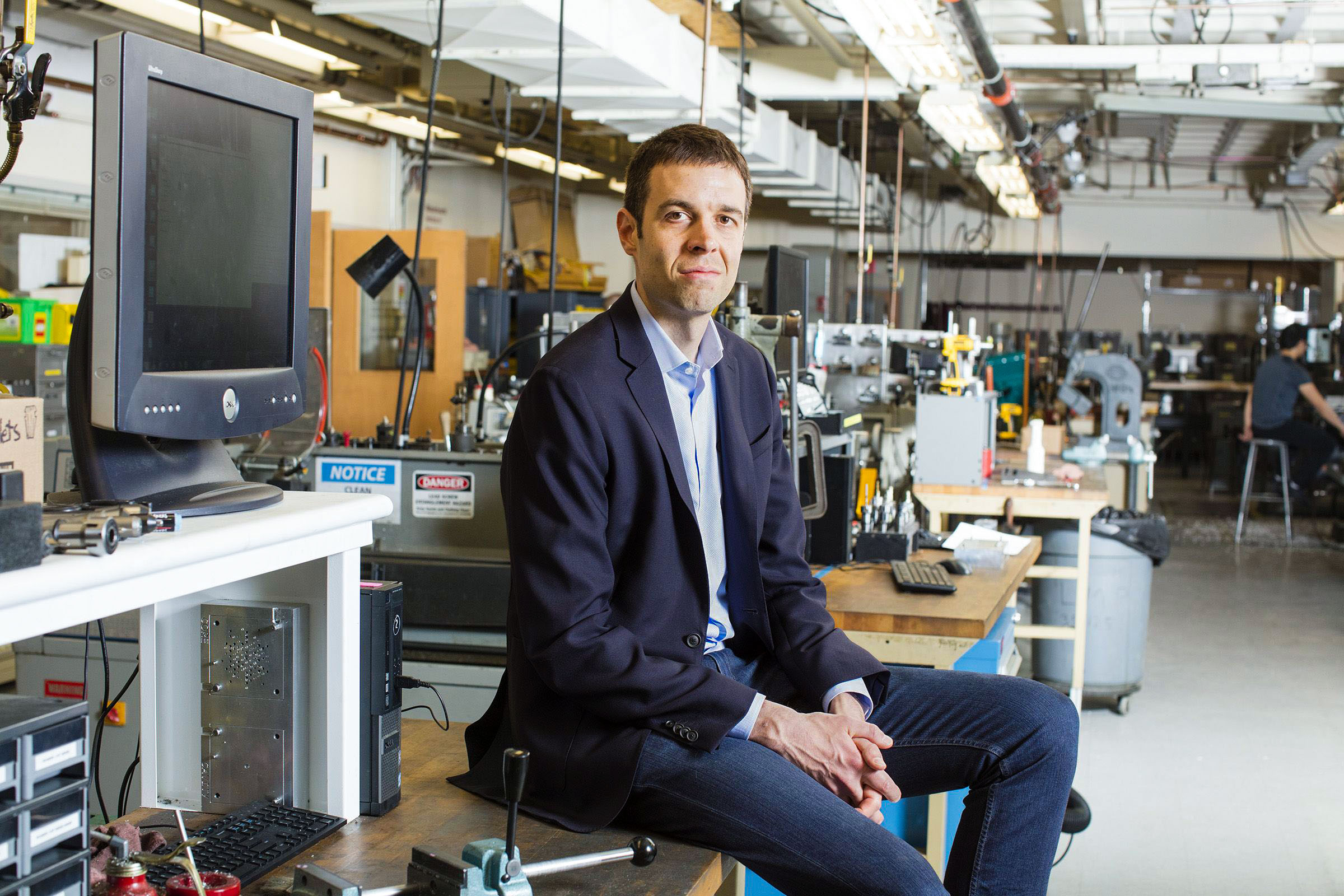
John Hart, a co-director of MIT’s Initiative for New Manufacturing
M SCOTT BRAUER

After all, Love and his colleagues created a new method for making batches of certain types of drugs. That’s manufacturing; it’s an innovation leading directly to production, and the small size of the operation means it won’t get shipped overseas. And, as Love enjoys pointing out, his team’s innovation is hardly the first case of using living cells to make a product for nearby consumption. Your local craft brewery is actually a modestly sized manufacturer that won’t be shipping its jobs overseas either. 

“The emerging generation of manufacturing has this new equilibrium between automation (machines, robots), human work, and software and data.”

John Hart

“Innovation can come from anywhere,” Love says. “What you really need is access to production. This is something Suzanne has been thinking about for a long time—that proximity. The same thing can happen in biomanufacturing. If I have a great idea for a new drug or food product or new material, if I have to ship it off somewhere to figure out if I can make it or not, I lose time, I lose momentum, I lose financing. I need that manufacturing to be super close.”

New manufacturing can come in multiple forms and, yes, can include robots and other forms of automation. The issue is complex. Robots do replace workers, in the aggregate. But if they increase productivity, firms that are early adopters of robots grow more than other firms and employ more people, as economic studies in France, Spain, and Canada have shown. The wager is that a sensible deployment of robots leads to more overall growth. Meanwhile, US firms added more than 34,000 robots in workplaces in 2024; China added nearly 300,000. Berger hopes US firms won’t be technology laggards, as that could lead to an even steeper decline in the manufacturing sector. Instead, she encourages manufacturers to use robots productively to stay ahead of the competition. 

“The emerging generation of manufacturing has this new equilibrium between automation (machines, robots), human work, and software and data,” Hart says. “A lot of the interesting opportunities in manufacturing, I think, come from the combination of those capabilities to improve productivity, improve quality, and make manufacturing more flexible.”

Another form of new manufacturing may happen at firms that, like the old heavyweight corporations, see value in keeping research and development in-house. At the Initiative for New Manufacturing launch event in May, one of the speakers was JB Straubel, founder of Redwood Materials, which recycles rechargeable batteries. The company has figured out how to extract materials like cobalt, nickel, and lithium, which otherwise are typically mined. To do so, the company has had to develop a variety of new industrial processes—again, one of the keys to reviving manufacturing here.

“Whether you’re building a new machine or trying a new process … acquiring a new technology is one of the most important ways a company can innovate,” Berger says. Although she acknowledges that “innovation is risky, and everything does not succeed,” she points out that “a single focus on optimization [in firms] has not served us well.”

Manufacturing success stories 

The future of US manufacturing, then, can take many forms. But Berger, when she visits factories, is consistently struck by the vintage machines often on display. She tells the story of a manufacturer she visited within the last couple of years that not only uses milling machines made during World War II but buys them up when other firms in the field discard them. 

“If you have all old equipment, your productivity is going to be low, your profits are going to be low, you’ll want low-skill workers, and you’re only going to be able to pay low wages,” she says. “And each one of those features reinforces the others. It’s like a dead-end trap.”

But things don’t need to be this way, Berger believes. And in some places, she visits firms that represent manufacturing success stories. 

“The idea that Americans don’t like manufacturing, that it’s dirty and difficult—I think this is totally [wrong],” she says. “Americans really do like making things with their hands, and Americans do think we ought to have manufacturing. Whenever I’ve been in a plant where it seems well run—and the owners, the managers, are proud of their workers and recognize their accomplishments, and people are respected—people seem pleased about having those jobs.”

Flash back to the exchange Berger had with that worker in Ohio, and the vision for the Initiative for New Manufacturing falls further into place: Technological change has a key role to play in creating that kind of work. Okay, US manufacturing may not be overhauled overnight. It will take an effort to change it, one midsize manufacturer after another. But getting that done seems vital for Americans in Ohio, in Massachusetts, and all over.  

“We really see a moral imperative,” Berger says, “which is to be able to reach out to the whole country to try to rebuild manufacturing.”


Shape
Shape
Stay Ahead

Explore More Insights

Stay ahead with more perspectives on cutting-edge power, infrastructure, energy,  bitcoin and AI solutions. Explore these articles to uncover strategies and insights shaping the future of industries.

Shape

From packets to prompts: What Cisco’s AITECH certification means for IT pros

Cisco positions the AITECH learning path as a bridge from “traditional knowledge-based work” to innovation-driven roles augmented by AI, explicitly targeting professionals who need to design technical solutions, automate tasks, and lead teams using modern AI tools and methodologies. The curriculum spans AI-assisted code generation, AI-driven data analysis, model customization (including RAG),

Read More »

HPE’s latest Juniper routers target large‑scale AI fabrics

The three new models give customers several options for configurations and throughput capacity, but they all share support for the same deep buffers, security, and optics for AI network fabric buildouts, Francis said. In addition to the new hardware, HPE added new AI support, including a Model Context Protocol (MCP)

Read More »

New Relic connects observability platform to business outcomes

Industry watchers believe that vision will take some time to become a reality across enterprise organizations. “Every organization is a snowflake in its adoption curve and readiness timeline,” says Stephen Elliot, global group vice president at IDC. “IT behavioral change is one of the most underreported requirements for agentic AI

Read More »

Pure Storage becomes Everpure, acquires 1touch

Other recent research confirms this. In an October Cisco survey of over 8,000 AI leaders, only 35% of companies have clean, centralized data with real-time integration for AI agents. And by 2027, according to IDC, companies that don’t prioritize high-quality, AI-ready data will struggle scaling gen AI and agentic solutions,

Read More »

Energy Secretary Keeps Critical Generation Online in Mid-Atlantic

Emergency order keeps critical generation online and addresses critical grid reliability issues facing the Mid-Atlantic region of the United States WASHINGTON—U.S. Secretary of Energy Chris Wright issued an emergency order to address critical grid reliability issues facing the Mid-Atlantic region of the United States. The emergency order directs PJM Interconnection, L.L.C. (PJM), in coordination with Constellation Energy Corporation, to ensure Units 3 and 4 of the Eddystone Generating Station in Pennsylvania remain available for operation and to employ economic dispatch to minimize costs for the American people. The units were originally slated to shut down on May 31, 2025. “The energy sources that perform when you need them most are inherently the most valuable—that’s why natural gas and oil were valuable during recent winter storms,” Secretary Wright said. “Hundreds of American lives have likely been saved because of President Trump’s actions keeping critical generation online, including this Pennsylvania generating station which ran during Winter Storm Fern. This emergency order will mitigate the risk of blackouts and maintain affordable, reliable, and secure electricity access across the region.” The Eddystone Units were integral in stabilizing the grid during Winter Storm Fern. Between January 26-29, the units ran for over 124 hours cumulatively, providing critical generation in the midst of the energy emergency. As outlined in DOE’s Resource Adequacy Report, power outages could increase by 100 times in 2030 if the U.S. continues to take reliable power offline. Furthermore, NERC’s 2025 Long-Term Reliability Assessment warns, “The continuing shift in the resource mix toward weather-dependent resources and less fuel diversity increases risks of supply shortfalls during winter months.” Secretary Wright ordered that the two Eddystone Generating Station units remain online past their planned retirement date in a May 30, 2025 emergency order. Subsequent orders were issued on August 28, 2025 and November 26, 2025. Keeping these units operational

Read More »

Insights: Venezuela – new legal frameworks vs. the inertia of history

@import url(‘https://fonts.googleapis.com/css2?family=Inter:[email protected]&display=swap’); a { color: var(–color-primary-main); } .ebm-page__main h1, .ebm-page__main h2, .ebm-page__main h3, .ebm-page__main h4, .ebm-page__main h5, .ebm-page__main h6 { font-family: Inter; } body { line-height: 150%; letter-spacing: 0.025em; font-family: Inter; } button, .ebm-button-wrapper { font-family: Inter; } .label-style { text-transform: uppercase; color: var(–color-grey); font-weight: 600; font-size: 0.75rem; } .caption-style { font-size: 0.75rem; opacity: .6; } #onetrust-pc-sdk [id*=btn-handler], #onetrust-pc-sdk [class*=btn-handler] { background-color: #c19a06 !important; border-color: #c19a06 !important; } #onetrust-policy a, #onetrust-pc-sdk a, #ot-pc-content a { color: #c19a06 !important; } #onetrust-consent-sdk #onetrust-pc-sdk .ot-active-menu { border-color: #c19a06 !important; } #onetrust-consent-sdk #onetrust-accept-btn-handler, #onetrust-banner-sdk #onetrust-reject-all-handler, #onetrust-consent-sdk #onetrust-pc-btn-handler.cookie-setting-link { background-color: #c19a06 !important; border-color: #c19a06 !important; } #onetrust-consent-sdk .onetrust-pc-btn-handler { color: #c19a06 !important; border-color: #c19a06 !important; } In this Insights episode of the Oil & Gas Journal ReEnterprised podcast, Head of Content Chris Smith updates the evolving situation in Venezuela as the industry attempts to navigate the best path forward while the two governments continue to hammer out the details. The discussion centers on the new legal frameworks being established in both countries within the context of fraught relations stretching back for decades. Want to hear more? Listen in on a January episode highlighting industry’s initial take following the removal of Nicholas Maduro from power. References Politico podcast Monaldi Substack Baker webinar Washington, Caracas open Venezuela to allow more oil sales 

Read More »

Eni makes Calao South discovery offshore Ivory Coast

@import url(‘https://fonts.googleapis.com/css2?family=Inter:[email protected]&display=swap’); a { color: var(–color-primary-main); } .ebm-page__main h1, .ebm-page__main h2, .ebm-page__main h3, .ebm-page__main h4, .ebm-page__main h5, .ebm-page__main h6 { font-family: Inter; } body { line-height: 150%; letter-spacing: 0.025em; font-family: Inter; } button, .ebm-button-wrapper { font-family: Inter; } .label-style { text-transform: uppercase; color: var(–color-grey); font-weight: 600; font-size: 0.75rem; } .caption-style { font-size: 0.75rem; opacity: .6; } #onetrust-pc-sdk [id*=btn-handler], #onetrust-pc-sdk [class*=btn-handler] { background-color: #c19a06 !important; border-color: #c19a06 !important; } #onetrust-policy a, #onetrust-pc-sdk a, #ot-pc-content a { color: #c19a06 !important; } #onetrust-consent-sdk #onetrust-pc-sdk .ot-active-menu { border-color: #c19a06 !important; } #onetrust-consent-sdk #onetrust-accept-btn-handler, #onetrust-banner-sdk #onetrust-reject-all-handler, #onetrust-consent-sdk #onetrust-pc-btn-handler.cookie-setting-link { background-color: #c19a06 !important; border-color: #c19a06 !important; } #onetrust-consent-sdk .onetrust-pc-btn-handler { color: #c19a06 !important; border-color: #c19a06 !important; } Eni SPA discovered gas and condensate in the Murene South-1X exploration well in Block CI-501, Ivory Coast. The well is the first exploration in the block and was drilled by the Saipem Santorini drilling ship about 8 km southwest of the Murene-1X discovery well in adjacent CI-205 block. The well was drilled to about 5,000 m TD in 2,200 m of water. Extensive data acquisition confirmed a main hydrocarbon bearing interval in high-quality Cenomanian sands with a gross thickness of about 50 m with excellent petrophysical properties, the operator said. Murene South-1X will undergo a full conventional drill stem test (DST) to assess the production capacity of this discovery, named Calao South. Calao South confirms the potential of the Calao channel complex that also includes the Calao discovery. It is the second largest discovery in the country after Baleine, with estimated volumes of up to 5.0 tcf of gas and 450 million bbl of condensate (about 1.4 billion bbl of oil). Eni is operator of Block CI-501 (90%) with partner Petroci Holding (10%).

Read More »

CFEnergía to supply natural gas to low-carbon methanol plant in Mexico

CFEnergía, a subsidiary of Mexico’s Federal Electricity Commission (CFE), has agreed to supply natural gas to Transition Industries LLC for its Pacifico Mexinol project near Topolobampo, Sinaloa, Mexico. Under the signed agreement, which enables the start of Pacifico Mexinol’s construction phase, CFEnergía will supply about 160 MMcfd of natural gas for an unspecified timeframe noted as “long term,” Transition Industries said in a release Feb. 16. The natural gas—to be sourced from the US and supplied at market prices via existing infrastructure—will be used as “critical input for Mexinol’s production of ultra-low carbon methanol,” the company said. Pacifico Mexinol The $3.3-billion Mexinol project, when it begins operations in late 2029 to early 2030, is expected to be the world’s largest ultra-low carbon chemicals plant with production of about 1.8 million tonnes of blue methanol and 350,000 tonnes of green methanol annually. Supply is aimed at markets in Asia, including Japan, while also boosting the development of the domestic market and the Mexican chemical industry. Mitsubishi Gas Chemical has committed to purchasing about 1 million tonnes/year of methanol from the project, about 50% of the project’s planned production. Transition Industries is jointly developing Pacifico Mexinol with the International Finance Corporation (IFC), a member of the World Bank Group. Last year, the company signed a contingent engineering, procurement, and construction (EPC) contract with the consortium of Samsung E&A Co., Ltd., Grupo Samsung E&A Mexico SA de CV, and Techint Engineering and Construction for the project. MAIRE group’s technology division NextChem, through its subsidiary KT TECH SpA, also signed a basic engineering, critical and proprietary equipment supply agreement with Samsung E&A in connection with its proprietary NX AdWinMethanol®Zero technology supply to the project.

Read More »

North Atlantic’s Gravenchon refinery scheduled for major turnaround

Canada-based North Atlantic Refining Ltd. France-based subsidiary North Atlantic France SAS is undertaking planned maintenance in March at its North Atlantic Energies-operated 230,000-b/d Notre-Dame-de-Gravenchon refinery in Port-Jérôme-sur-Seine, Normandy. Scheduled to begin on Mar. 3 with the phased shutdown of unidentified units at the refinery, the upcoming turnaround will involve thorough inspections of associated equipment designed for continuous operation, as well as unspecified works to improve energy efficiency, environmental performance, and overall competitiveness of the site, North Atlantic Energies said on Feb. 16. Part of the operator’s routine maintenance program aimed at meeting regulatory requirements to ensure the safety, compliance, and long-term performance of the refinery, North Atlantic Energies said the scheduled turnaround will not interrupt product supplies to customers during the shutdown period. While the company confirmed the phased shutdown of units slated for work during the maintenance event would last for several days, the operator did not reveal a definitive timeline for the entire duration of the turnaround. Further details regarding specific works to be carried out during the major maintenance event were not revealed. The upcoming turnaround will be the first to be executed under North Atlantic Group’s ownership, which completed its purchase of the formerly majority-owned ExxonMobil Corp. refinery and associated petrochemical assets at the site in November 2025.

Read More »

Azule Energy starts Ndungu full field production offshore Angola

Azule Energy has started full field production from Ndungu, part of the Agogo Integrated West Hub Project (IWH) in the western area of Block 15/06, offshore Angola. Ndungo full field lies about 10 km from the NGOMA FPSO in a water depth of around 1,100 m and comprises seven production wells and four injection wells, with an expected production peak of 60,000 b/d of oil. The National Agency for Petroleum, Gas and Biofuels (ANPG) and Azule Energy noted the full field start-up with first oil of three production wells. The phased integration of IWH, with Ndungu full field producing first via N’goma FPSO and later via Agogo FPSO, is expected to reach a peak output of about 175,000 b/d across the two fields. The fields have combined estimated reserves of about 450 million bbl. The Agogo IWH project is operated by Azule Energy with a 36.84% stake alongside partners Sonangol E&P (36.84%) and Sinopec International (26.32%).   

Read More »

Nvidia lines up partners to boost security for industrial operations

Akamai extends its micro-segmentation and zero-trust security platform Guardicore to run on Nvidia BlueField GPUs The integration offloads user-configurable security processes from the host system to the Nvidia BlueField DPU and enables zero-trust segmentation without requiring software agents on fragile or legacy systems, according to Akamai. Organizations can implement this hardware-isolated, “agentless” security approach to help align with regulatory requirements and lower their risk profile for cyber insurance. “It delivers deep, out-of-band visibility across systems, networks, and applications without disrupting operations. Security policies can be enforced in real time and are capable of creating a strong protective boundary around critical operational systems. The result is trusted insight into operational activity and improved overall cyber resilience,” according to Akamai. Forescout works with Nvidia to bring zero-trust technology to OT networks Forescout applies network segmentation to contain lateral movement and enforce zero-trust controls. The technology would be further integrated into partnership work already being done by the two companies. By running Forescout’s on-premises sensor directly on the Nvidia BlueField, part of Nvidia Cybersecurity AI platform, customers can offload intensive computing tasks, such as deep packet inspections. This speeds up data processing, enhances asset intelligence, and improves real-time monitoring, providing security teams with the insights needed to stay ahead of emerging threats, according to Forescout. Palo Alto to demo Prisma AIRS AI Runtime Security on Nvidia BlueField DPU Palo Alto Networks recently partnered with Nvidia to run its Prisma AI-powered Radio Security(AIRs) package on the Nvidia BlueField DPU and will show off the technology at the conference. The technology is part of the Nvidia Enterprise AI Factory validated design and can offer real-time security protection for industrial network settings. “Prisma AIRS AI Runtime Security delivers deep visibility into industrial traffic and continuous monitoring for abnormal behavior. By running these security services on Nvidia BlueField, inspection

Read More »

Raising the temp on liquid cooling

IBM isn’t the only one. “We’ve been doing liquid cooling since 2012 on our supercomputers,” says Scott Tease, vice president and general manager of AI and high-performance computing at Lenovo’s infrastructure solutions group. “And we’ve been improving it ever since—we’re now on the sixth generation of that technology.” And the liquid Lenovo uses in its Neptune liquid cooling solution is warm water. Or, more precisely, hot water: 45 degrees Celsius. And when the water leaves the servers, it’s even hotter, Tease says. “I don’t have to chill that water, even if I’m in a hot climate,” he says. Even at high temperatures, the water still provides enough cooling to the chips that it has real value. “Generally, a data center will use evaporation to chill water down,” Tease adds. “Since we don’t have to chill the water, we don’t have to use evaporation. That’s huge amounts of savings on the water. For us, it’s almost like a perfect solution. It delivers the highest performance possible, the highest density possible, the lowest power consumption. So, it’s the most sustainable solution possible.” So, how is the water cooled down? It gets piped up to the roof, Tease says, where there are giant radiators with massive amounts of surface area. The heat radiates away, and then all the water flows right back to the servers again. Though not always. The hot water can also be used to, say, heat campus or community swimming pools. “We have data centers in the Nordics who are giving the heat to the local communities’ water systems,” Tease says.

Read More »

Vertiv’s AI Infrastructure Surge: Record Orders, Liquid Cooling Expansion, and Grid-Scale Power Reflect Data Center Growth

2) “Units of compute”: OneCore and SmartRun On the earnings call, Albertazzi highlighted Vertiv OneCore, an end-to-end data center solution designed to accelerate “time to token,” scaling in 12.5 MW building blocks; and Vertiv SmartRun, a prefabricated white space infrastructure solution aimed at rapidly accelerating fit-out and readiness. He pointed to collaborations (including Hut 8 and Compass Data Centers) as proof points of adoption, emphasizing that SmartRun can stand alone or plug into OneCore. 3) Cooling evolution: hybrid thermal chains and the “trim cooler” Asked how cooling architectures may change (amid industry chatter about warmer-temperature operations and shifting mixes of chillers, CDUs, and other components) Albertazzi leaned into complexity as a feature, not a bug. He argued heat rejection doesn’t disappear, even if some GPU loads can run at higher temperatures. Instead, the future looks hybrid, with mixed loads and resiliency requirements forcing more nuanced thermal chains. Vertiv’s strategic product anchor here is its “trim cooler” concept: a chiller optimized for higher-temperature operation while retaining flexibility for lower-temperature requirements in the same facility, maximizing free cooling where climate and design allow. And importantly, Albertazzi dismissed the idea that CDUs are going away: “We are pretty sure that CDUs in various shapes and forms are a long-term element of the thermal chain.” 4) Edge densification: CoolPhase Ceiling + CoolPhase Row (Feb. 3) Vertiv also expanded its thermal portfolio for edge and small IT environments with the: Vertiv CoolPhase Ceiling (launching Q2 2026): ceiling-mounted, 3.5 kW to 28 kW, designed to preserve floor space. Vertiv CoolPhase Row (available now in North America) for row-based cooling up to 30 kW (300 mm width) or 40 kW (600 mm width). Vertiv Director of Edge Thermal Michal Podmaka tied the products directly to AI-driven edge densification and management consistency, saying the new systems “integrate seamlessly

Read More »

Execution, Power, and Public Trust: Rich Miller on 2026’s Data Center Reality and Why He Built Data Center Richness

DCF founder Rich Miller has spent much of his career explaining how the data center industry works. Now, with his latest venture, Data Center Richness, he’s also examining how the industry learns. That thread provided the opening for the latest episode of The DCF Show Podcast, where Miller joined present Data Center Frontier Editor in Chief Matt Vincent and Senior Editor David Chernicoff for a wide-ranging discussion that ultimately landed on a simple conclusion: after two years of unprecedented AI-driven announcements, 2026 will be the year reality asserts itself. Projects will either get built, or they won’t. Power will either materialize, or it won’t. Communities will either accept data center expansion – or they’ll stop it. In other words, the industry is entering its execution phase. Why Data Center Richness Matters Now Miller launched Data Center Richness as both a podcast and a Substack publication, an effort to experiment with formats and better understand how professionals now consume industry information. Podcasts have become a primary way many practitioners follow the business, while YouTube’s discovery advantages increasingly make video versions essential. At the same time, Miller remains committed to written analysis, using Substack as a venue for deeper dives and format experimentation. One example is his weekly newsletter distilling key industry developments into just a handful of essential links rather than overwhelming readers with volume. The approach reflects a broader recognition: the pace of change has accelerated so much that clarity matters more than quantity. The topic of how people learn about data centers isn’t separate from the industry’s trajectory; it’s becoming part of it. Public perception, regulatory scrutiny, and investor expectations are now shaped by how stories are told as much as by how facilities are built. That context sets the stage for the conversation’s core theme. Execution Defines 2026 After

Read More »

Utah’s 4 GW AI Campus Tests the Limits of Speed-to-Power

Back in September 2025, we examined an ambitious proposal from infrastructure developer Joule Capital Partners – often branding the effort as “Joule Power” – in partnership with Caterpillar. The concept is straightforward but consequential: acquire a vast rural tract in Millard County, Utah, and pair an AI-focused data center campus with large-scale, on-site “behind-the-meter” generation to bypass the interconnection queues, transmission constraints, and substation bottlenecks slowing projects nationwide. The appeal is clear: speed-to-power and greater control over delivery timelines. But that speed shifts the project’s risk profile. Instead of navigating traditional utility procurement, the development begins to resemble a distributed power plant subject to industrial permitting, fuel supply logistics, air emissions scrutiny, noise controls, and groundwater governance. These are issues communities typically associate with generation facilities, not hyperscale data centers. Our earlier coverage focused on the technical and strategic logic of pairing compute with on-site generation. Now the story has evolved. Community opposition is emerging as a material variable that could influence schedule and scope. Although groundbreaking was held in November 2025, final site plans and key conditional use permits remain pending at the time of publication. What Is Actually Being Proposed? Public records from Millard County show Joule pursuing a zone change for approximately 4,000 acres (about 6.25 square miles), converting agricultural land near 11000 N McCornick Road to Heavy Industrial use. At a July 2025 public meeting, residents raised familiar concerns that surface when a rural landscape is targeted for hyperscale development: labor influx and housing strain, water use, traffic, dust and wildfire risk, wildlife disruption, and the broader loss of farmland and local character. What has proven less clear is the precise scale and sequencing of the buildout. Local reporting describes an initial phase of six data center buildings, each supported by a substantial fleet of Caterpillar

Read More »

From Lab to Gigawatt: CoreWeave’s ARENA and the AI Validation Imperative

The Production Readiness Gap AI teams continue to confront a familiar challenge: moving from experimentation to predictable production performance. Models that train successfully on small clusters or sandbox environments often behave very differently when deployed at scale. Performance characteristics shift. Data pipelines strain under sustained load. Cost assumptions unravel. Synthetic benchmarks and reduced test sets rarely capture the complex interactions between compute, storage, networking, and orchestration that define real-world AI systems. The result can be an expensive “Day One” surprise:  unexpected infrastructure costs, bottlenecks across distributed components, and delays that ripple across product timelines. CoreWeave’s view is that benchmarking and production launch can no longer be treated as separate phases. Instead, validation must occur in environments that replicate the architectural, operational, and economic realities of live deployment. ARENA is designed around that premise. The platform allows customers to run full workloads on CoreWeave’s production-grade GPU infrastructure, using standardized compute stacks, network configurations, data paths, and service integrations that mirror actual deployment environments. Rather than approximating production behavior, the goal is to observe it directly. Key capabilities include: Running real workloads on GPU clusters that match production configurations. Benchmarking both performance and cost under realistic operational conditions. Diagnosing bottlenecks and scaling behavior across compute, storage, and networking layers. Leveraging standardized observability tools and guided engineering support. CoreWeave positions ARENA as an alternative to traditional demo or sandbox environments; one informed by its own experience operating large-scale AI infrastructure. By validating workloads under production conditions early in the lifecycle, teams gain empirical insight into performance dynamics and cost curves before committing capital and operational resources. Why Production-Scale Validation Has Become Strategic The demand for environments like ARENA reflects how fundamentally AI workloads have changed. Several structural shifts are driving the need for production-scale validation: Continuous, Multi-Layered Workloads AI systems are no longer

Read More »

Microsoft will invest $80B in AI data centers in fiscal 2025

And Microsoft isn’t the only one that is ramping up its investments into AI-enabled data centers. Rival cloud service providers are all investing in either upgrading or opening new data centers to capture a larger chunk of business from developers and users of large language models (LLMs).  In a report published in October 2024, Bloomberg Intelligence estimated that demand for generative AI would push Microsoft, AWS, Google, Oracle, Meta, and Apple would between them devote $200 billion to capex in 2025, up from $110 billion in 2023. Microsoft is one of the biggest spenders, followed closely by Google and AWS, Bloomberg Intelligence said. Its estimate of Microsoft’s capital spending on AI, at $62.4 billion for calendar 2025, is lower than Smith’s claim that the company will invest $80 billion in the fiscal year to June 30, 2025. Both figures, though, are way higher than Microsoft’s 2020 capital expenditure of “just” $17.6 billion. The majority of the increased spending is tied to cloud services and the expansion of AI infrastructure needed to provide compute capacity for OpenAI workloads. Separately, last October Amazon CEO Andy Jassy said his company planned total capex spend of $75 billion in 2024 and even more in 2025, with much of it going to AWS, its cloud computing division.

Read More »

John Deere unveils more autonomous farm machines to address skill labor shortage

Join our daily and weekly newsletters for the latest updates and exclusive content on industry-leading AI coverage. Learn More Self-driving tractors might be the path to self-driving cars. John Deere has revealed a new line of autonomous machines and tech across agriculture, construction and commercial landscaping. The Moline, Illinois-based John Deere has been in business for 187 years, yet it’s been a regular as a non-tech company showing off technology at the big tech trade show in Las Vegas and is back at CES 2025 with more autonomous tractors and other vehicles. This is not something we usually cover, but John Deere has a lot of data that is interesting in the big picture of tech. The message from the company is that there aren’t enough skilled farm laborers to do the work that its customers need. It’s been a challenge for most of the last two decades, said Jahmy Hindman, CTO at John Deere, in a briefing. Much of the tech will come this fall and after that. He noted that the average farmer in the U.S. is over 58 and works 12 to 18 hours a day to grow food for us. And he said the American Farm Bureau Federation estimates there are roughly 2.4 million farm jobs that need to be filled annually; and the agricultural work force continues to shrink. (This is my hint to the anti-immigration crowd). John Deere’s autonomous 9RX Tractor. Farmers can oversee it using an app. While each of these industries experiences their own set of challenges, a commonality across all is skilled labor availability. In construction, about 80% percent of contractors struggle to find skilled labor. And in commercial landscaping, 86% of landscaping business owners can’t find labor to fill open positions, he said. “They have to figure out how to do

Read More »

2025 playbook for enterprise AI success, from agents to evals

Join our daily and weekly newsletters for the latest updates and exclusive content on industry-leading AI coverage. Learn More 2025 is poised to be a pivotal year for enterprise AI. The past year has seen rapid innovation, and this year will see the same. This has made it more critical than ever to revisit your AI strategy to stay competitive and create value for your customers. From scaling AI agents to optimizing costs, here are the five critical areas enterprises should prioritize for their AI strategy this year. 1. Agents: the next generation of automation AI agents are no longer theoretical. In 2025, they’re indispensable tools for enterprises looking to streamline operations and enhance customer interactions. Unlike traditional software, agents powered by large language models (LLMs) can make nuanced decisions, navigate complex multi-step tasks, and integrate seamlessly with tools and APIs. At the start of 2024, agents were not ready for prime time, making frustrating mistakes like hallucinating URLs. They started getting better as frontier large language models themselves improved. “Let me put it this way,” said Sam Witteveen, cofounder of Red Dragon, a company that develops agents for companies, and that recently reviewed the 48 agents it built last year. “Interestingly, the ones that we built at the start of the year, a lot of those worked way better at the end of the year just because the models got better.” Witteveen shared this in the video podcast we filmed to discuss these five big trends in detail. Models are getting better and hallucinating less, and they’re also being trained to do agentic tasks. Another feature that the model providers are researching is a way to use the LLM as a judge, and as models get cheaper (something we’ll cover below), companies can use three or more models to

Read More »

OpenAI’s red teaming innovations define new essentials for security leaders in the AI era

Join our daily and weekly newsletters for the latest updates and exclusive content on industry-leading AI coverage. Learn More OpenAI has taken a more aggressive approach to red teaming than its AI competitors, demonstrating its security teams’ advanced capabilities in two areas: multi-step reinforcement and external red teaming. OpenAI recently released two papers that set a new competitive standard for improving the quality, reliability and safety of AI models in these two techniques and more. The first paper, “OpenAI’s Approach to External Red Teaming for AI Models and Systems,” reports that specialized teams outside the company have proven effective in uncovering vulnerabilities that might otherwise have made it into a released model because in-house testing techniques may have missed them. In the second paper, “Diverse and Effective Red Teaming with Auto-Generated Rewards and Multi-Step Reinforcement Learning,” OpenAI introduces an automated framework that relies on iterative reinforcement learning to generate a broad spectrum of novel, wide-ranging attacks. Going all-in on red teaming pays practical, competitive dividends It’s encouraging to see competitive intensity in red teaming growing among AI companies. When Anthropic released its AI red team guidelines in June of last year, it joined AI providers including Google, Microsoft, Nvidia, OpenAI, and even the U.S.’s National Institute of Standards and Technology (NIST), which all had released red teaming frameworks. Investing heavily in red teaming yields tangible benefits for security leaders in any organization. OpenAI’s paper on external red teaming provides a detailed analysis of how the company strives to create specialized external teams that include cybersecurity and subject matter experts. The goal is to see if knowledgeable external teams can defeat models’ security perimeters and find gaps in their security, biases and controls that prompt-based testing couldn’t find. What makes OpenAI’s recent papers noteworthy is how well they define using human-in-the-middle

Read More »