Stay Ahead, Stay ONMINE

America was winning the race to find Martian life. Then China jumped in.

To most people, rocks are just rocks. To geologists, they are much, much more: crystal-filled time capsules with the power to reveal the state of the planet at the very moment they were forged.  For decades, NASA had been on a time capsule hunt like none other—one across Mars. Its rovers have journeyed around a nightmarish ocher desert that, billions of years ago, was home to rivers, lakes, perhaps even seas and oceans. They’ve been seeking to answer a momentous question: Once upon a time, did microbial life wriggle across its surface?  Then, in July 2024, after more than three years on the planet, the Perseverance rover came across a peculiar rocky outcrop. Instead of the usual crystals or layers of sediment, this one had spots. Two kinds, in fact: one that looked like poppy seeds, and another that resembled those on a leopard. It’s possible that run-of-the-mill chemical reactions could have cooked up these odd features. But on Earth, these marks are almost always produced by microbial life. To put it plainly: Holy crap. Sure, those specks are not definitive proof of alien life. But they are the best hint yet that life may not be a one-off event in the cosmos. And they meant the most existential question of all—Are we alone?—might soon be addressed. “If you do it, then human history is never the same,” says Casey Dreier, chief of space policy at the Planetary Society, a nonprofit that promotes planetary exploration and defense and the search for extraterrestrial life. But the only way to confirm whether these seeds and spots are the fossilized imprint of alien biology is to bring a sample of that rock home to study.  Perseverance was the first stage of an ambitious scheme to do just that—in effect, to pull off a space heist. The mission—called Mars Sample Return and planned by the US, along with its European partners—would send a Rube Goldberg–like series of robotic missions to the planet to capture pristine rocks. The rover’s job was to find the most promising stones and extract samples; then it would pass them to another robot—the getaway driver—to take them off Mars and deliver them to Earth. But now, just over a year and a half later, the project is on life support, with zero funding flowing in 2026 and little backing left in Congress. As a result, those oh-so-promising rocks may be stuck out there forever. “We’ve spent 50 years preparing to get these samples back. We’re ready to do that,” says Philip Christensen, a planetary scientist at Arizona State University who works closely with NASA. “Now we’re two feet from the finish line—Oh, sorry, we’re not going to complete the job.” This also means that, in the race to find evidence of alien life, America has effectively ceded its pole position to its greatest geopolitical rival: China. The superpower is moving full steam ahead with its own version of MSR. It’s leaner than America and Europe’s mission, and the rock samples it will snatch from Mars will likely not be as high quality. But that won’t be the headline people remember—the one in the scientific journals and the history books. “At the rate we’re going, there’s a very good chance they’ll do it before we do,” laments Christensen. “Being there first is what matters.”   Of course, any finding of extraterrestrial life advances human knowledge writ large, no matter the identity of the discoverers. But there is the not-so-small issue of pride in an already heated nationalistic competition, not to mention the fact that many scientists in America (to say nothing of US lawmakers) don’t necessarily want their future research and scientific progress subject to a foreign gatekeeper. And even for those not especially concerned about potentially unearthing alien microbes, MSR and the comparable Chinese mission are technological stepping stones toward a long-held dream shared by many beyond Elon Musk: getting astronauts onto the Red Planet and, eventually, setting up long-term bases for astronauts there. It’d be a huge blow to show up only after a competitor had already set up shop … or not to get there at all.  “If we can’t do this, how do we think we’re gonna send humans there and get back safely?” says Victoria Hamilton, a planetary geologist at the Southwest Research Institute in Boulder, Colorado, who is also the chair of the NASA-affiliated Mars Exploration Program Analysis Group.  Or as Paul Byrne, a planetary scientist from the Washington University in St. Louis, puts it: “If you’re going to bring humans back from Mars, you sure as shit have to figure out how to bring the samples back first.”  Nearly a dozen project insiders and scientists in both the US and China shared with me the story of how America blew its lead in the new space race. It’s full of wild dreams and promising discoveries—as well as mismanagement, eye-watering costs, and, ultimately, anger and disappointment.     “I spent most of my career studying Mars,” says Christensen. There are countless things about it that bewitch him. But by examining it, he suspects, we’ll get further than ever in the Homeric investigation of how life began. Sure, the Mars of today is a postapocalyptic wasteland, an arid and cold desert bathed in lethal radiation. But billions of years ago, water lapped up against the slopes of fiery volcanoes that erupted under a clement sky. Then its geologic interior cooled down so quickly, changing everything. Its global magnetic field collapsed like a deflating balloon, and its protective atmosphere was stripped away by the sun.  NASA first touched down on Mars in 1976 with two Viking landers. The Mars Odyssey spacecraft has been orbiting the planet since 2001 and produced this image of Valles Marineris, which is 10 times longer, 5 times deeper, and 20 times wider than the Grand Canyon. NASA/ARIZONA STATE UNIVERSITY VIA GETTY IMAGES Its surface is now remarkably hostile to life as we know it. But deep below ground, where it’s shielded from space, and where it’s warmer and wetter, there could maybe be microbes inching about. Scientists have long possessed several Martian meteorites that have been flung our way, but none of them are pristine; they were all damaged by cosmic radiation midflight, before getting scorched in Earth’s atmosphere. Plus, there’s another problem: “We currently have no rocks from Mars that are sedimentary, the rock type likely to contain fossils,” says Sara Russell, a planetary scientist at London’s Natural History Museum.  For those, humans (or robots) would need to get on the ground. NASA first made the stuff of sci-fi films a reality 50 years ago, when two Viking landers touched down on the planet in 1976. One of their experiments dropped some radioactively tagged nutrients into soil samples, the idea being that if any microbes were present, they’d gobble up the nutrients and burp out some radioactive waste gas that the landers could detect. Tantalizingly, this experiment hinted that something microbe-like was interacting with those nutrients—but the result was inconclusive (and today most scientists don’t suspect biology was responsible). Still, it was enough to elevate scientists’ curiosity about the genuine possibility of Martian life. Over the coming decades, America sent an ever-expanding fleet of robots to Mars—orbiting spacecraft, landers, and wheeled rovers. But no matter how hard they studied their adoptive planet’s rocks, they weren’t designed to definitively detect signs of life. For that, promising-looking rocks would need to be captured and, somehow, shuttled back to labs on Earth in carefully sealed containers.  A 2023 plan from NASA and the European Space Agency to safely transport pristine samples received from Mars.NASA/JPL-CALTECH This became a top priority for the US planetary science community in 2003, following the publication of the first Planetary Decadal Survey, a census conducted at NASA’s request. The scientific case for the mission was clear—even to the people who didn’t think they’d find signs of life. “I bet there isn’t life on Mars. But if there is, or was, that would be an incredibly important discovery,” says Christensen. And if not, “Why not?”  He adds: “We may understand more about why life started on Earth by understanding why it may not have started on Mars. What was that key difference between those two planets?” And so, MSR was born. America went all in, and the European Space Agency joined the team. Over the next decade or so, a complex plan was drawn up.  First, a NASA rover would land on Mars in a spot that once was potentially habitable—later determined to be Jezero Crater. It would zip about, look for layered rocks of the sort that you’d find in lakes and riverbeds, extract cores of them, and cache them in sealed containers. Then a second NASA spacecraft would land on Mars, receive the rover’s sample tubes (in one of several different ways), and transfer the samples to a rocket that would launch them into Martian orbit. A European-provided orbiter would catch that rocket like a baseball glove before returning home and dropping the rocks into Earth’s atmosphere, where they would be guided, via parachute, to eagerly awaiting scientists no later than the mid-2030s. Two messages were encoded on the 70-foot parachute used by the Perseverance rover as it descended toward Mars. This annotated image shows how NASA systems engineer Ian Clark used a binary code to spell out “Dare Mighty Things” in the orange and white strips; he also included the GPS coordinates for the mission’s headquarters at the Jet Propulsion Laboratory.NASA/JPL-CALTECH VIA AP IMAGES “Put simply, this is the most scientifically careful sample collection mission possible, conducted in one of the most promising places on Mars to look for signs of past life,” says Jonathan Lunine, the chief scientist at NASA’s Jet Propulsion Laboratory in California. “And, of course, should evidence of life be found in the sediments, that would be an historic discovery.” It got off to an auspicious start. On July 30, 2020, in the throes of the covid-19 pandemic, NASA’s Perseverance rover launched atop a rocket from Florida’s Cape Canaveral. The NASA administrator at the time, Jim Bridenstine, didn’t mince words: “We are in extraordinary times right now,” he told reporters, “yet we have in fact persevered, and we have protected this mission because it is so important.”  But just earlier that same month, the mission to Mars had turned into a race. China was now prepping its own sample return spacecraft. And that’s when things for MSR started to unravel.  XINMEI LIU China was comparatively late to develop a competitive space program, but once it began doing so, it wasted no time. In 2003, it first sent one of its astronauts into space, via its own bespoke rocket; in the two decades since, it has launched its own space station and sent multiple uncrewed spacecraft to the moon—first orbiters, then landers—as part of its Chang’e Project, named after a lunar goddess.  But a real turning point for China’s interplanetary ambitions came in 2020, the same year as Perseverance’s launch to Mars.  That December, Chang’e-5 touched down in the moon’s Ocean of Storms, a realm of frozen lava 1,600 miles long. It grabbed some 2-billion-year-old rocks, put them in a rocket, and blasted them into the firmament. The samples were captured by a small orbiting spacecraft; crucially, the idea was not all that dissimilar from how MSR imagined catching its own samples, baseball-glove style. China’s lunar haul was then dropped off back on Earth just before Christmas. It marked the first time since 1976 that samples had been returned from the moon, and the mission was seamless.  China brought back soil samples from the moon’s Ocean of Storms during its Chang’e-5 mission, marking the first time since 1976 that samples had been returned from the moon.WIKIMEDIA COMMONS That same year, China made its first foray toward Mars. The project was called Tianwen-1, meaning “Questions to Heaven”—the first in a new series of audacious space missions to the Red Planet and orbiting asteroids. While its success was far from guaranteed, China was willing to kick into high gear immediately, sending both an orbiting spacecraft and a rover to Mars at the same time. No other country had ever managed to perform this act of spaceflight acrobatics on its first try. Just as China ramped up its space schemes, some people in the scientific community began to wonder if NASA was (inadvertently) promising too much with MSR—and whether the heist would be worth the cost. In 2020, the price tag for the program had jumped from an already expensive $5.3 billion to an estimated $7 billion. (For context, NASA’s Near-Earth Object Surveyor mission, which is currently being pieced together, has a price tag of around $1.2 billion. This space observatory is designed to find Earthbound asteroids and is tasked with defending all 8 billion of us from a catastrophic impact.) But Perseverance was already on its way to Mars. It wasn’t as if this expensive train could go back to the station. The project’s advocates just hoped it’d actually make it there in one piece.  While the US had previously entered Martian orbit successfully, several other entry, descent, and landing attempts on the planet had ended in explosive disaster; the primary antagonist is the Martian atmosphere, which can cause spacecraft to tumble wildly out of control or heat up and ignite. Perseverance would be traveling at nearly 12,500 miles per hour as it entered Mars’s airspace, and to land it’d need to decelerate, deploy a parachute, fire several rockets, and pilot itself to the skies above Jezero Crater—before a levitating crane would drop off the actual rover.  Thankfully, Perseverance’s deployment went off without a hitch. On February 18, 2021, Mars became its new home—and the rover’s makers hugged, high-fived, and whooped for joy in NASA’s flight control room.  As Lori Glaze, then director of NASA’s planetary science division, said at the time, “Now the fun really starts.” Members of NASA’s Perseverance rover team at the Jet Propulsion Laboratory in Pasadena, California, celebrate after receiving confirmation that the spacecraft successfully touched down on Mars in February 2021.NASA/BILL INGALLS That very same month, China arrived at Mars’s doorstep for the first time.  On February 10, 2021, Tianwen-1 began to orbit the planet. Then, on May 14, it slipped a drop shipment through the spacecraft-frying atmosphere to deliver a rover onto an expansive landscape called Utopia Planitia—giving Perseverance a neighbor, albeit one 1,200 miles away. This explorer was nowhere near as sophisticated as Perseverance, and its assignment was a far cry from a sample return mission. It had some cameras and scientific instruments for studying its environment, making it comparable to one of NASA’s older rovers. It was also supposed to operate for just three months (though it ended up persisting for an entire year before being fatally smothered by pernicious Martian dust).  Nevertheless, Tianwen-1 was a remarkable achievement for China, one that the US couldn’t help but applaud. “This is a really big deal,” said Roger Launius, then NASA’s chief historian.   And even if grabbing pieces of Mars was increasingly likely in China’s future, it was already happening in the present for the US. The race, the Americans thought, was over before it had even begun … right?  Over the next few years, Perseverance went on an extraterrestrial joyride. It meandered through frozen flows of lava and journeyed over fans of sediment once washed about by copious liquid water. It pulled out rocks that preserved salty, muddy layers—exactly the environment that, on Earth, would be teeming with microorganisms and organic matter.  “Jezero Crater clearly meets the astrobiological criterion for a sampling site where life may once have existed,” says Lunine from NASA’s Jet Propulsion Lab. “Rocks of broadly similar age and setting on Earth contain some of the earliest evidence for life on our own planet.”  The Perseverance rover has been on an extraterrestrial joyride since 2021, drilling holes in promising looking space rocks that it hopes could be teeming with microorganisms and organic matter. Then, in September 2023, as Perseverance was trundling across the ruins of what may once have been a microbial metropolis, an independent panel of researchers published a report that made it clear, in no uncertain terms, that MSR was the opposite of okay. They found that the project was too decentralized among the nation’s plethora of NASA centers, leaving confusion as to who was actually in charge. And at its current pace, MSR wouldn’t get its Mars rocks back home until the 2040s at the earliest—as much as a whole decade later than initial estimates. And it would cost as much as $11 billion, more than doubling the initial tab.  “MSR was established with unrealistic budget and schedule expectations from the beginning,” the report reads. “MSR was also organized under an unwieldy structure. As a result, there is currently no credible, congruent technical, nor properly margined schedule, cost, and technical baseline that can be accomplished with the likely available funding.” Members of Congress started to wonder aloud whether MSR should be canceled outright, and the scientific community that had once so enthusiastically supported the mission faced a moment of reckoning.  Byrne, the planetary scientist from the Washington University in St. Louis, had always been something of a rebel, never really a fan of NASA’s multi-decadal, over-the-top fascination with Mars. The solar system, he argued, is filled with curious worlds to explore—especially Venus, another nearby rocky world that was once rather Earth-like. Couldn’t we spare some of NASA’s budget to make sure we explore Venus, too? Still, like many other critical colleagues, Byrne did not want to see MSR put down. The report’s findings didn’t change the fact that Perseverance was dutifully working around the clock to accomplish the mission’s opening stages. What would be the point of gathering all those samples if they were going to be left to stay on Mars? The community, Byrne explains, just needed to answer one question: “How do you do this in a way that’s faster and cheaper?”  In April 2024, NASA publicly sought help from its industry partners in the space sector: Could anyone come up with a way to save MSR? Various players with spaceflight experience, like Lockheed Martin, sent in proposals for consideration.  Then, just a few months later in July 2024, Perseverance came in clutch, finding those special leopard-spotted and speckled rocks in an old river valley—a sign of hope that NASA had been desperately seeking. Now the agency’s request for help was all the more urgent—these rocks had to get home. After various panels assessed plans that could effectively save MSR, two potential options for a faster, leaner, less expensive version were previewed at a January 2025 press briefing.  One option brought in tried-and-tested tech: Since Perseverance had been safely deployed onto the surface of Mars using a hovering platform known as a sky crane, it was proposed that the sample-gathering lander for MSR could also be dropped off using a sky crane, which would simplify this step and reduce the overall cost of the program. The other suggestion was that the lander could be delivered to Mars via a spaceship from a commercial spaceflight company. The lander design itself could also be streamlined, and tweaks could be made to the rocket that would launch the samples back into space. The proposals needed greater study, but everyone’s spirits were lifted by the fact these plans could, at least theoretically, get samples back in the 2030s, not the 2040s. And, crucially, “it was possible to get the cost down,” says Jack Mustard, an Earth and planetary scientist at Brown University and a member of one of the two proposal-reviewing panels. Still, it didn’t save a lot: They could do MSR for $8 billion. “What we came up with was very reasonable, rational, much simpler,” says Christensen, who was part of the same review panel. “And $8 billion is about the right amount it would take to guarantee that it’s going to work.” XINMEI LIU While the US became increasingly consumed with its own interplanetary woes, China was riding high. In June 2024, the sixth installment in the Chang’e project made history. It was another lunar sample return mission, but this one did something nobody had ever done in the history of spaceflight: It landed on the difficult-to-reach, out-of-view far side of the moon and snagged samples from it.  China made it look effortless when a capsule containing matter from this previously untouched region safely landed in Inner Mongolia. Long Xiao, a planetary geoscientist at the China University of Geosciences, told reporters at the time that the mission’s success was “a cause for celebration for all humanity.”  But it was also effectively a bombshell for NASA. Yes, the moon is much closer to Earth, and it doesn’t have a spaceship-destroying atmosphere like Mars. But China was speedrunning through the race while America was largely looking the other way. Then, in May 2025, China launched Tianwen-2. Its destination was not Mars but a near-Earth asteroid. The plan is that it will scoop up some of the space rock’s primordial pebbles later this year and deliver them back to Earth in late 2027. In light of China’s past successes, many suspect it’ll nail this project, too.  China’s Tianwen missions, meaning “Questions to Heaven,” aim to explore both Mars and orbiting asteroids. The Tianwen-2 probe blasted off in May 2025, headed toward a near-Earth asteroid for a sample-return mission.VCG/VCG VIA AP IMAGES But perhaps the biggest blow to the US came in June 2025: China revealed its formal designs on returning samples from Mars—and potentially addressing the existence of life elsewhere in the cosmos. Chinese researchers outlined a bold plan for Tianwen-3 in the journal Nature Astronomy. “Searching for signs of life, or astrobiology studies, are the first priority,” says Yuqi Qian, a lunar geologist at the University of Hong Kong. And while many observers had long been cognizant of this ambition, seeing it so clearly spelled out in academic writing made it real. “The selection of the landing site is still ongoing,” says Li Yiliang, an astrobiologist at the University of Hong Kong, an author of the Tianwen-3 study, and a member of the spacecraft’s landing site selection team. But the paper notes, in no uncertain terms, that the mission will move at a breakneck pace. “The aim of China’s Mars sample return mission, known as Tianwen-3, is to collect at least 500g of samples from Mars and return them to Earth around 2031.” 2031. Even on its original, speedier timeline, America’s MSR plan wouldn’t get samples back by that date. So how is China planning to pull it off? Qian explains that Tianwen-3 is building on the success of the lunar sample return program. Doing something similar for Mars is a rather giant technological leap (requiring two rockets, not one)—but, he argues, “the technologies here are similar.”  The plan is for a duet of rockets to blast off from Earth in 2028. The first will contain the lander-ascender combination, or LAC. The second is the orbiter-returner combination, or ORC. The LAC will get to Mars and deploy a lander as well as a small helicopter, which will scout promising locations around the landing site while using a claw to bring several small samples back to the lander. China’s Tianwen-3 mission is searching for signs of Martian life with an eye toward having samples back home sometime in 2031.中国新闻社 VIA WIKIMEDIA COMMONS The LAC will then travel to the most promising site. The lander’s drill, which can get down to around seven feet below the surface, is the most important part of the mission. At that depth, there are greater odds of capturing signs of past life. When at least 500 grams of pristine rocks have been loaded aboard the lander, the samples will be launched into space, where the orbiter will be waiting to capture them and send them back home sometime in 2031. “The returned samples will be quarantined strictly in an under-planning facility near Hefei city,” says Yiliang. And there, in those bio-secure labs, scientists might very well find the first clear signs of alien life, past or present. The very same month that Chinese researchers published their daring plans for returning Mars samples, the new Trump administration released a draconian NASA budget for Congress to consider—one that sparked panic across the planetary science community. If enacted, it would have been a historic catastrophe for the venerable space agency, giving NASA its smallest budget since 1961. This would have forced it to let go of a huge number of staffers, slash its science program budget in half, and terminate 19 missions currently in operation. MSR was in the crosshairs, too.  “Grim is the word,” says Dreier of the Planetary Society.  Over the next few months, Congress pushed back on the potential gutting of NASA, but largely to save ongoing solar system exploration missions. MSR was not considered an active effort; Perseverance was effectively a scientific scout acting independently by this point. A counterproposal by the House offered up $300 million for MSR, but no policymaker was cheerleading for it. (The US Office of Management and Budget, the House Committee on Science, Space, and Technology, and the office of Sen. Ted Cruz of Texas, who chairs the Senate Committee on Commerce, Science, and Transportation did not respond to requests for comment.) “Mars Sample Return doesn’t seem to have very many advocates right now,” says Byrne. The project “isn’t featuring in anyone’s conversation at the moment, with all of the existential shit that’s happening to NASA.” Everyone working on a NASA mission hoped that they, and their spacecraft, would survive the onslaught. As Byrne adds: “[People are] just trying to keep their heads down.” Researchers in America suddenly found themselves at an inflection point. “The attack on science, and the attack on NASA science, has been very successful, in that it has completely demoralized the science community,” says Christensen. “Everyone’s in a state of shock.”  When I contacted NASA in July about the state of MSR, which was then in the middle of a months-long limbo, I was told that experts weren’t available to comment. Roxana Bardan, a spokesperson, instead sent a statement: “Under President Trump’s America First agenda, NASA is committed to sustained U.S. space leadership. We will continue to innovate, explore, and excel to ensure American preeminence in space.” (The agency did not respond to a follow-up request for comment.)  That notion stood in direct contrast to what Christensen told me around the same time. “The US … has led the exploration of Mars for 50 years,” he said. “And as we approach one of the key discovery points, we’re about to concede that leadership to someone else.” From China’s perspective, the fumbling of MSR is more confusing than anything else. “NASA has so well prepared for her MSR mission in both technology and science, and I and my colleagues have learned so much from NASA’s scientific communities,” says Yiliang.  And if China wins the race because America decided to shoot itself in the foot? “This is sad,” he says. “If this comes true, I believe the Chinese will not be that happy to win the race in this way.” Tianwen-3 will still have to overcome many of the same hurdles as MSR. Nobody, for example, has autonomously launched a rocket of any kind off the surface of Mars. But many believe the Chinese can succeed, even at their program’s superspeed. Christensen, for one, fully expected several of their past robotic missions to the moon and Mars to fail—but “the fact that they pulled it off the first time really says a lot about their engineering capability,” he says.  Mustard agrees: “They know how to land; they know how to leave. I have a lot of confidence that they’ve learned enough from the lunar work that they’ll be able to do it.” Plus, Tianwen-3’s architecture is simpler than the US-European mission. It has fewer components, and fewer points of potential failure. This also means, though, that the quality of the loot will be somewhat lacking. Tianwen-3 will sample from only one small patch of Mars. Conversely, Perseverance is roving around a vast and geologically diverse landscape, sampling as it goes, which would translate to “literally orders of magnitude more science than what will come from the Chinese samples,” says Christensen. But China could serendipitously land on a biologically rich patch of the planet. As the Southwest Research Institute’s Hamilton says, the mission could “pick up something entirely unexpected and, you know, miraculous.”  The likeliest outcome is still that neither nation finds fossilized microbes, but that China brings back rocks from Mars first. At the end of the day, that’s what Americans (and Europeans) will hear: “You’re second. You lost,” says Mustard. Xinmei Liu Like many of his colleagues, Christensen is irked by the thought of losing the race to Mars, because it would be such an own goal. The US has been sending robots over there for decades and investing billions in forging the technology that would be required to make MSR a success. And suddenly “the Chinese come along and say, Thank you very much, we’ll take all of that information—we’ll build one mission and go and do what you guys did the groundwork for,” Christensen says. “As a taxpayer, I’m like: It just seems foolish to me.” Even the MSR skeptics concede that this kind of loss would have sweeping ramifications. Byrne worries that if something like MSR can be snuffed out so easily, what’s to say the next big mission—to Jupiter, Saturn, and beyond—won’t suffer the same ignoble fate? In other words, the death of MSR would severely damage “the ability of the planetary community to dream big,” he says. “If we don’t pull this off, what does that mean? Are we not going to do big, expensive, difficult things?” Another big, expensive, difficult thing? Putting humans on Mars. Both critics and advocates of MSR largely agree it is an invaluable dress rehearsal. Making sure you can safely launch a rocket off Mars is a necessary prerequisite to ensuring that an array of equipment can survive for a long time on the planet’s lethal surface. China, too, has explicitly acknowledged this. As one of the first lines of the Tianwen-3 study states, “Mars is the most promising planet for humanity’s expansion beyond Earth, with its potential for future habitability and accessible resources.”  Though such expansion is still of course a far-future dream, it’s not hard to see how losing the race here would put the US at a huge disadvantage. Members of America’s planetary science community say that to try to sway politicians in their favor, they have framed MSR as a national security issue. But they haven’t had much luck. “We’ve been in discussions with decision-makers who have never heard that perspective before,” says the Planetary Society’s Dreier.  “It is surprising that doesn’t have more weight,” adds Mustard.  Despite months of purgatory, it still stung when the coup de grâce arrived in January. In the draft for a must-pass spending bill, House and Senate appropriators spared NASA from the harshest proposed cuts, thereby saving dozens of spaceflight missions and preserving much of the agency’s planetary science output. But the bill provided absolutely zero political or financial support for MSR. There it was, in black and white: America’s plans to perform a history-making heist on Mars were dead. The bill became law in January and Perseverance, it seems, is now destined to rove alone on the Red Planet until its nuclear battery burns out.  This austere reality clashes with the soaring aspirations outlined in the first Planetary Decadal Survey, written just over two decades ago. It stated that the US exploration of the solar system “has a proud past, a productive present, and an auspicious future.” It also noted that “answers to profound questions about our origins and our future may be within our grasp.”  Now the answers have all but slipped away. Even though Perseverance continues to roam, it’s increasingly likely we’ll never see those promising bespeckled rocks with human eyes, let alone any other rocks the rover finds intriguing. It is far easier to imagine that in the near future, perhaps in the early 2030s, Perseverance will point its camera up at the night sky above Jezero Crater. It will catch a small glimmer: Tianwen-3’s orbiter, preparing to send ancient rocks back to Earth. Meanwhile, Perseverance’s own sample tubes—perhaps some containing signs of life—will be trapped on the Martian surface, gathering dust. Sample tubes collected by the Perseverance rover may never make it home from the Martian surface.NASA/JPL-CALTECH/MSSS It is a sobering thought for Christensen. “We’ll wake up one day and go: What the hell?” he says. “How did we let this happen?” Robin George Andrews is an award-winning science journalist and doctor of volcanoes based in London. He regularly writes about the Earth, space, and planetary sciences, and is the author of two critically acclaimed books: Super Volcanoes (2021) and How to Kill An Asteroid (2024).

To most people, rocks are just rocks. To geologists, they are much, much more: crystal-filled time capsules with the power to reveal the state of the planet at the very moment they were forged. 

For decades, NASA had been on a time capsule hunt like none other—one across Mars.

Its rovers have journeyed around a nightmarish ocher desert that, billions of years ago, was home to rivers, lakes, perhaps even seas and oceans. They’ve been seeking to answer a momentous question: Once upon a time, did microbial life wriggle across its surface? 

Then, in July 2024, after more than three years on the planet, the Perseverance rover came across a peculiar rocky outcrop. Instead of the usual crystals or layers of sediment, this one had spots. Two kinds, in fact: one that looked like poppy seeds, and another that resembled those on a leopard. It’s possible that run-of-the-mill chemical reactions could have cooked up these odd features. But on Earth, these marks are almost always produced by microbial life.

To put it plainly: Holy crap.

Sure, those specks are not definitive proof of alien life. But they are the best hint yet that life may not be a one-off event in the cosmos. And they meant the most existential question of all—Are we alone?—might soon be addressed. “If you do it, then human history is never the same,” says Casey Dreier, chief of space policy at the Planetary Society, a nonprofit that promotes planetary exploration and defense and the search for extraterrestrial life.

But the only way to confirm whether these seeds and spots are the fossilized imprint of alien biology is to bring a sample of that rock home to study. 

Perseverance was the first stage of an ambitious scheme to do just that—in effect, to pull off a space heist. The mission—called Mars Sample Return and planned by the US, along with its European partners—would send a Rube Goldberg–like series of robotic missions to the planet to capture pristine rocks. The rover’s job was to find the most promising stones and extract samples; then it would pass them to another robot—the getaway driver—to take them off Mars and deliver them to Earth.

But now, just over a year and a half later, the project is on life support, with zero funding flowing in 2026 and little backing left in Congress. As a result, those oh-so-promising rocks may be stuck out there forever.

“We’ve spent 50 years preparing to get these samples back. We’re ready to do that,” says Philip Christensen, a planetary scientist at Arizona State University who works closely with NASA. “Now we’re two feet from the finish line—Oh, sorry, we’re not going to complete the job.”

This also means that, in the race to find evidence of alien life, America has effectively ceded its pole position to its greatest geopolitical rival: China. The superpower is moving full steam ahead with its own version of MSR. It’s leaner than America and Europe’s mission, and the rock samples it will snatch from Mars will likely not be as high quality. But that won’t be the headline people remember—the one in the scientific journals and the history books. “At the rate we’re going, there’s a very good chance they’ll do it before we do,” laments Christensen. “Being there first is what matters.”  

Of course, any finding of extraterrestrial life advances human knowledge writ large, no matter the identity of the discoverers. But there is the not-so-small issue of pride in an already heated nationalistic competition, not to mention the fact that many scientists in America (to say nothing of US lawmakers) don’t necessarily want their future research and scientific progress subject to a foreign gatekeeper. And even for those not especially concerned about potentially unearthing alien microbes, MSR and the comparable Chinese mission are technological stepping stones toward a long-held dream shared by many beyond Elon Musk: getting astronauts onto the Red Planet and, eventually, setting up long-term bases for astronauts there. It’d be a huge blow to show up only after a competitor had already set up shop … or not to get there at all. 

“If we can’t do this, how do we think we’re gonna send humans there and get back safely?” says Victoria Hamilton, a planetary geologist at the Southwest Research Institute in Boulder, Colorado, who is also the chair of the NASA-affiliated Mars Exploration Program Analysis Group. 

Or as Paul Byrne, a planetary scientist from the Washington University in St. Louis, puts it: “If you’re going to bring humans back from Mars, you sure as shit have to figure out how to bring the samples back first.” 

Nearly a dozen project insiders and scientists in both the US and China shared with me the story of how America blew its lead in the new space race. It’s full of wild dreams and promising discoveries—as well as mismanagement, eye-watering costs, and, ultimately, anger and disappointment.    


“I spent most of my career studying Mars,” says Christensen. There are countless things about it that bewitch him. But by examining it, he suspects, we’ll get further than ever in the Homeric investigation of how life began.

Sure, the Mars of today is a postapocalyptic wasteland, an arid and cold desert bathed in lethal radiation. But billions of years ago, water lapped up against the slopes of fiery volcanoes that erupted under a clement sky. Then its geologic interior cooled down so quickly, changing everything. Its global magnetic field collapsed like a deflating balloon, and its protective atmosphere was stripped away by the sun. 

NASA first touched down on Mars in 1976 with two Viking landers. The Mars Odyssey spacecraft has been orbiting the planet since 2001 and produced this image of Valles Marineris, which is 10 times longer, 5 times deeper, and 20 times wider than the Grand Canyon.
NASA/ARIZONA STATE UNIVERSITY VIA GETTY IMAGES

Its surface is now remarkably hostile to life as we know it. But deep below ground, where it’s shielded from space, and where it’s warmer and wetter, there could maybe be microbes inching about.

Scientists have long possessed several Martian meteorites that have been flung our way, but none of them are pristine; they were all damaged by cosmic radiation midflight, before getting scorched in Earth’s atmosphere. Plus, there’s another problem: “We currently have no rocks from Mars that are sedimentary, the rock type likely to contain fossils,” says Sara Russell, a planetary scientist at London’s Natural History Museum. 

For those, humans (or robots) would need to get on the ground.

NASA first made the stuff of sci-fi films a reality 50 years ago, when two Viking landers touched down on the planet in 1976. One of their experiments dropped some radioactively tagged nutrients into soil samples, the idea being that if any microbes were present, they’d gobble up the nutrients and burp out some radioactive waste gas that the landers could detect. Tantalizingly, this experiment hinted that something microbe-like was interacting with those nutrients—but the result was inconclusive (and today most scientists don’t suspect biology was responsible).

Still, it was enough to elevate scientists’ curiosity about the genuine possibility of Martian life. Over the coming decades, America sent an ever-expanding fleet of robots to Mars—orbiting spacecraft, landers, and wheeled rovers. But no matter how hard they studied their adoptive planet’s rocks, they weren’t designed to definitively detect signs of life. For that, promising-looking rocks would need to be captured and, somehow, shuttled back to labs on Earth in carefully sealed containers. 

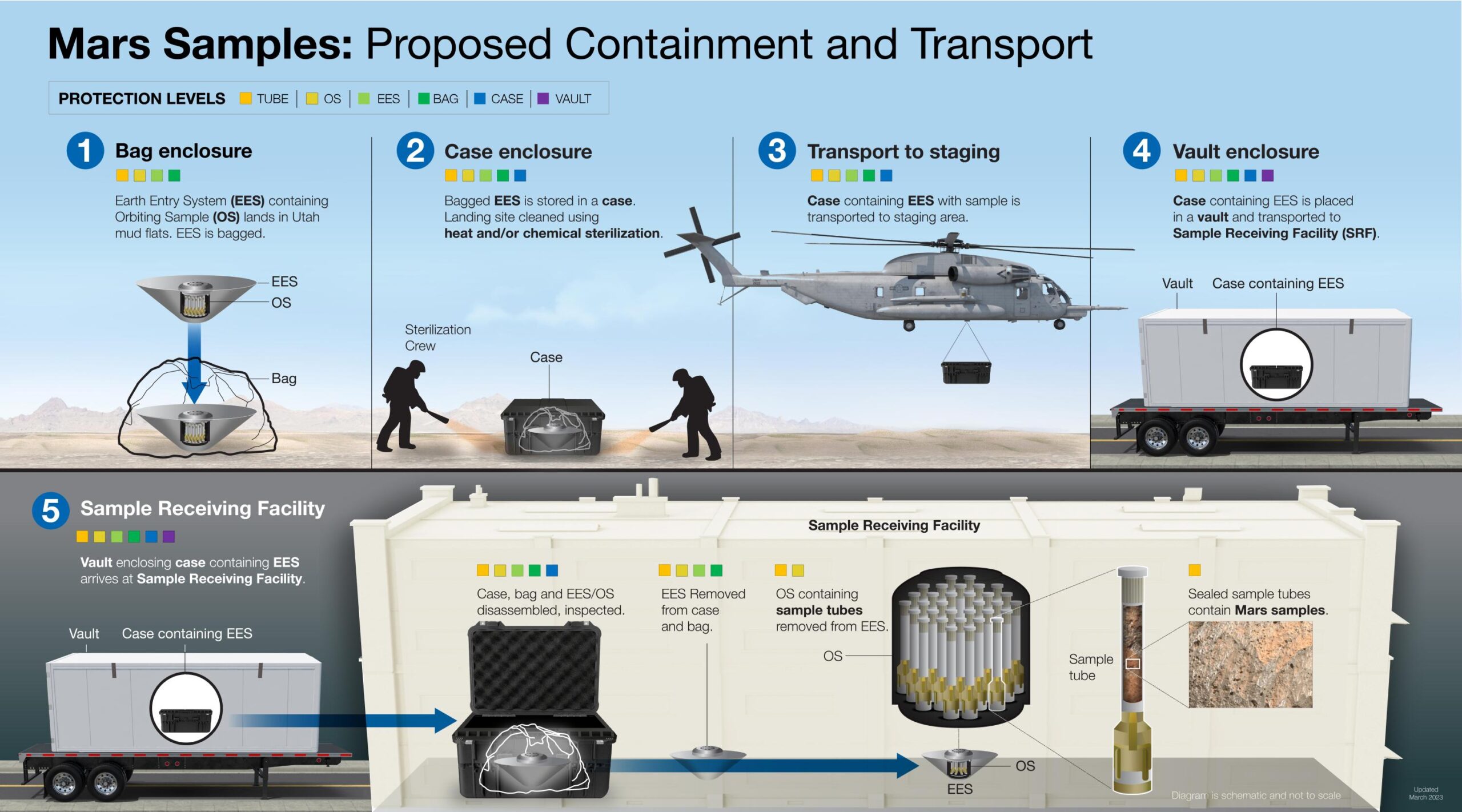
A 2023 plan from NASA and the European Space Agency to safely transport pristine samples received from Mars.
NASA/JPL-CALTECH

This became a top priority for the US planetary science community in 2003, following the publication of the first Planetary Decadal Survey, a census conducted at NASA’s request. The scientific case for the mission was clear—even to the people who didn’t think they’d find signs of life. “I bet there isn’t life on Mars. But if there is, or was, that would be an incredibly important discovery,” says Christensen. And if not, “Why not?” 

He adds: “We may understand more about why life started on Earth by understanding why it may not have started on Mars. What was that key difference between those two planets?”

And so, MSR was born. America went all in, and the European Space Agency joined the team. Over the next decade or so, a complex plan was drawn up. 

First, a NASA rover would land on Mars in a spot that once was potentially habitable—later determined to be Jezero Crater. It would zip about, look for layered rocks of the sort that you’d find in lakes and riverbeds, extract cores of them, and cache them in sealed containers. Then a second NASA spacecraft would land on Mars, receive the rover’s sample tubes (in one of several different ways), and transfer the samples to a rocket that would launch them into Martian orbit. A European-provided orbiter would catch that rocket like a baseball glove before returning home and dropping the rocks into Earth’s atmosphere, where they would be guided, via parachute, to eagerly awaiting scientists no later than the mid-2030s.

Two messages were encoded on the 70-foot parachute used by the Perseverance rover as it descended toward Mars. This annotated image shows how NASA systems engineer Ian Clark used a binary code to spell out “Dare Mighty Things” in the orange and white strips; he also included the GPS coordinates for the mission’s headquarters at the Jet Propulsion Laboratory.
NASA/JPL-CALTECH VIA AP IMAGES

“Put simply, this is the most scientifically careful sample collection mission possible, conducted in one of the most promising places on Mars to look for signs of past life,” says Jonathan Lunine, the chief scientist at NASA’s Jet Propulsion Laboratory in California. “And, of course, should evidence of life be found in the sediments, that would be an historic discovery.”

It got off to an auspicious start. On July 30, 2020, in the throes of the covid-19 pandemic, NASA’s Perseverance rover launched atop a rocket from Florida’s Cape Canaveral. The NASA administrator at the time, Jim Bridenstine, didn’t mince words: “We are in extraordinary times right now,” he told reporters, “yet we have in fact persevered, and we have protected this mission because it is so important.” 

But just earlier that same month, the mission to Mars had turned into a race. China was now prepping its own sample return spacecraft.

And that’s when things for MSR started to unravel. 

XINMEI LIU

China was comparatively late to develop a competitive space program, but once it began doing so, it wasted no time. In 2003, it first sent one of its astronauts into space, via its own bespoke rocket; in the two decades since, it has launched its own space station and sent multiple uncrewed spacecraft to the moon—first orbiters, then landers—as part of its Chang’e Project, named after a lunar goddess. 

But a real turning point for China’s interplanetary ambitions came in 2020, the same year as Perseverance’s launch to Mars. 

That December, Chang’e-5 touched down in the moon’s Ocean of Storms, a realm of frozen lava 1,600 miles long. It grabbed some 2-billion-year-old rocks, put them in a rocket, and blasted them into the firmament. The samples were captured by a small orbiting spacecraft; crucially, the idea was not all that dissimilar from how MSR imagined catching its own samples, baseball-glove style. China’s lunar haul was then dropped off back on Earth just before Christmas. It marked the first time since 1976 that samples had been returned from the moon, and the mission was seamless. 
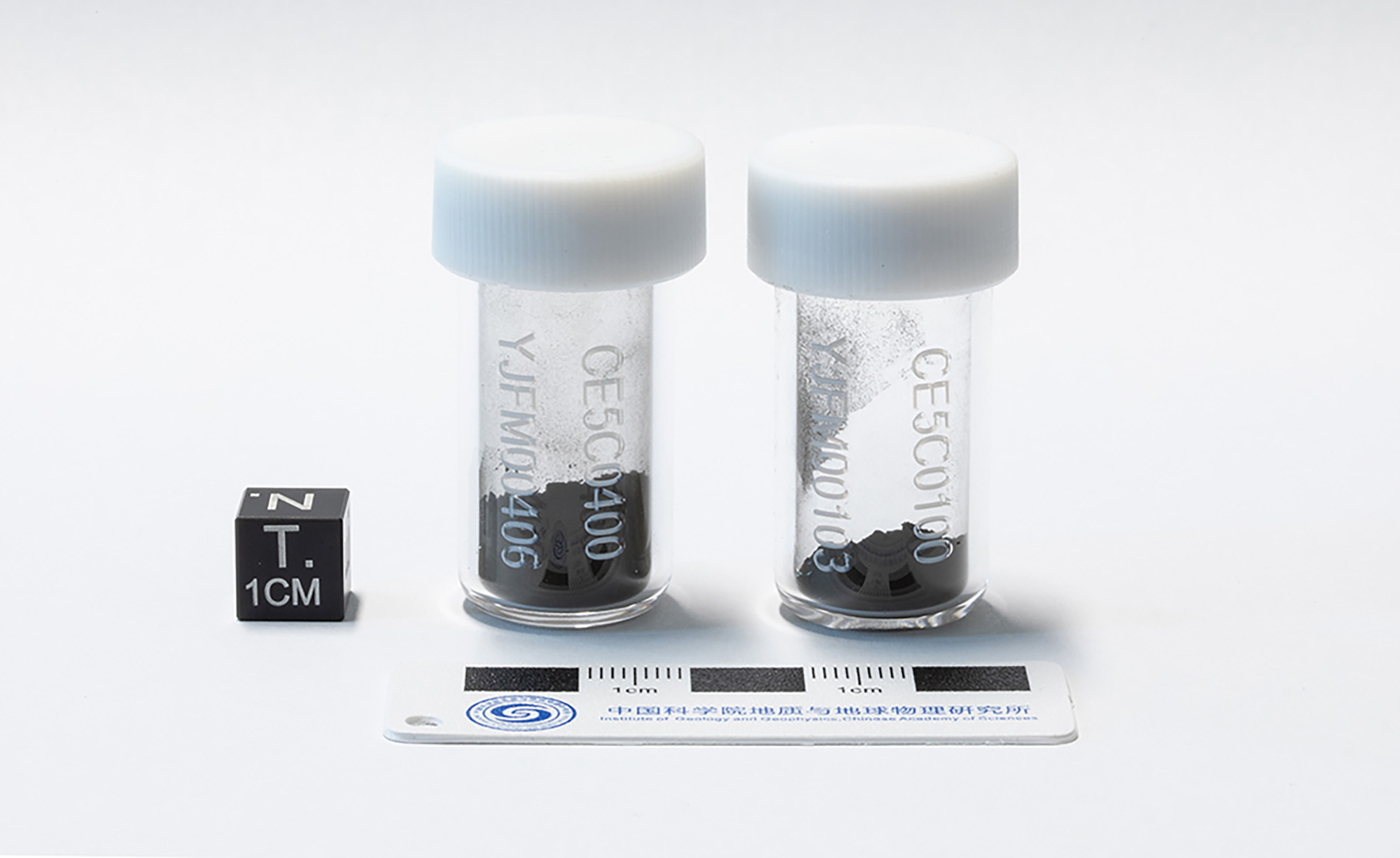
two labelled vials of soil next to a small ruler for scale
China brought back soil samples from the moon’s Ocean of Storms during its Chang’e-5 mission, marking the first time since 1976 that samples had been returned from the moon.
WIKIMEDIA COMMONS

That same year, China made its first foray toward Mars. The project was called Tianwen-1, meaning “Questions to Heaven”—the first in a new series of audacious space missions to the Red Planet and orbiting asteroids. While its success was far from guaranteed, China was willing to kick into high gear immediately, sending both an orbiting spacecraft and a rover to Mars at the same time. No other country had ever managed to perform this act of spaceflight acrobatics on its first try.


Just as China ramped up its space schemes, some people in the scientific community began to wonder if NASA was (inadvertently) promising too much with MSR—and whether the heist would be worth the cost.

In 2020, the price tag for the program had jumped from an already expensive $5.3 billion to an estimated $7 billion. (For context, NASA’s Near-Earth Object Surveyor mission, which is currently being pieced together, has a price tag of around $1.2 billion. This space observatory is designed to find Earthbound asteroids and is tasked with defending all 8 billion of us from a catastrophic impact.)

But Perseverance was already on its way to Mars. It wasn’t as if this expensive train could go back to the station. The project’s advocates just hoped it’d actually make it there in one piece. 

While the US had previously entered Martian orbit successfully, several other entry, descent, and landing attempts on the planet had ended in explosive disaster; the primary antagonist is the Martian atmosphere, which can cause spacecraft to tumble wildly out of control or heat up and ignite. Perseverance would be traveling at nearly 12,500 miles per hour as it entered Mars’s airspace, and to land it’d need to decelerate, deploy a parachute, fire several rockets, and pilot itself to the skies above Jezero Crater—before a levitating crane would drop off the actual rover. 

Thankfully, Perseverance’s deployment went off without a hitch. On February 18, 2021, Mars became its new home—and the rover’s makers hugged, high-fived, and whooped for joy in NASA’s flight control room. 

As Lori Glaze, then director of NASA’s planetary science division, said at the time, “Now the fun really starts.”
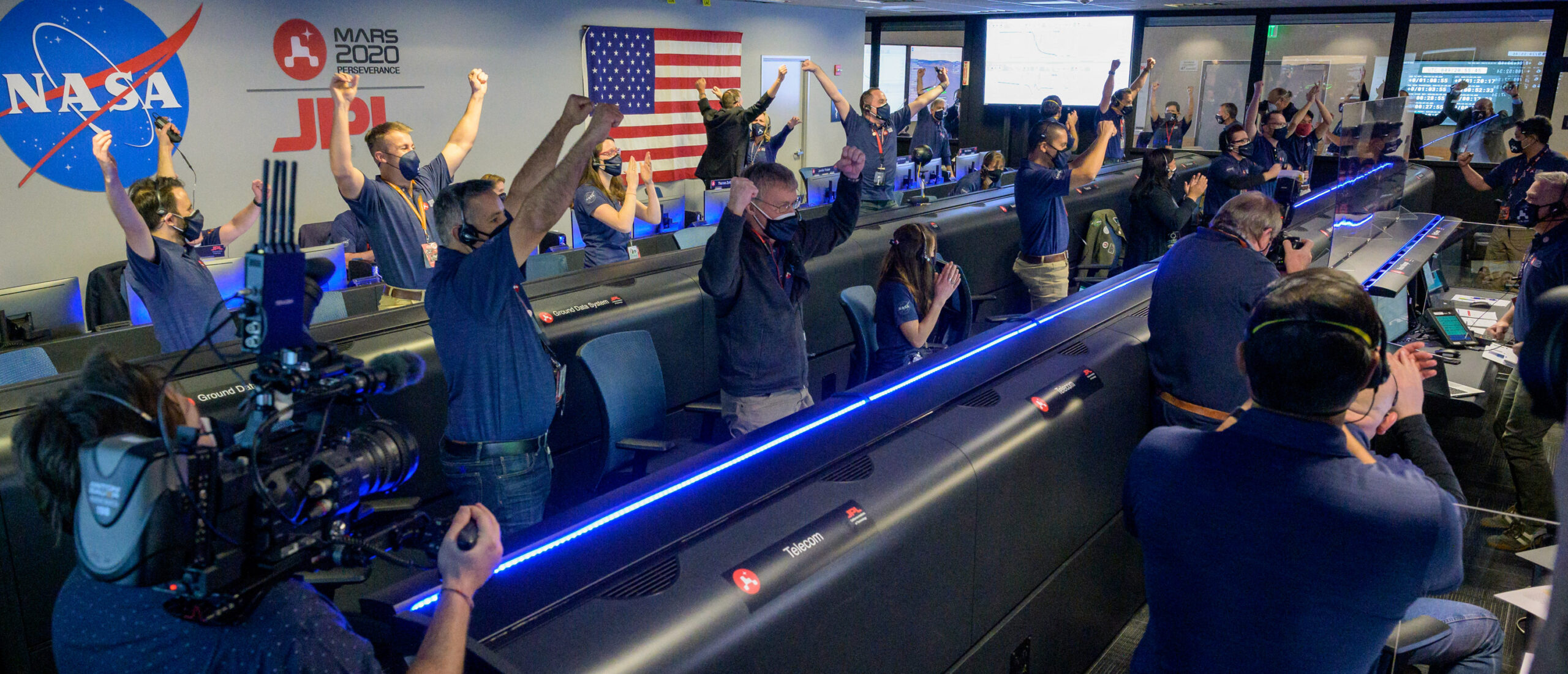
Members of NASA’s Perseverance rover team at the Jet Propulsion Laboratory in Pasadena, California, celebrate after receiving confirmation that the spacecraft successfully touched down on Mars in February 2021.
NASA/BILL INGALLS

That very same month, China arrived at Mars’s doorstep for the first time. 

On February 10, 2021, Tianwen-1 began to orbit the planet. Then, on May 14, it slipped a drop shipment through the spacecraft-frying atmosphere to deliver a rover onto an expansive landscape called Utopia Planitia—giving Perseverance a neighbor, albeit one 1,200 miles away.

This explorer was nowhere near as sophisticated as Perseverance, and its assignment was a far cry from a sample return mission. It had some cameras and scientific instruments for studying its environment, making it comparable to one of NASA’s older rovers. It was also supposed to operate for just three months (though it ended up persisting for an entire year before being fatally smothered by pernicious Martian dust). 

Nevertheless, Tianwen-1 was a remarkable achievement for China, one that the US couldn’t help but applaud. “This is a really big deal,” said Roger Launius, then NASA’s chief historian.  

And even if grabbing pieces of Mars was increasingly likely in China’s future, it was already happening in the present for the US. The race, the Americans thought, was over before it had even begun … right? 


Over the next few years, Perseverance went on an extraterrestrial joyride. It meandered through frozen flows of lava and journeyed over fans of sediment once washed about by copious liquid water. It pulled out rocks that preserved salty, muddy layers—exactly the environment that, on Earth, would be teeming with microorganisms and organic matter. 

“Jezero Crater clearly meets the astrobiological criterion for a sampling site where life may once have existed,” says Lunine from NASA’s Jet Propulsion Lab. “Rocks of broadly similar age and setting on Earth contain some of the earliest evidence for life on our own planet.” 
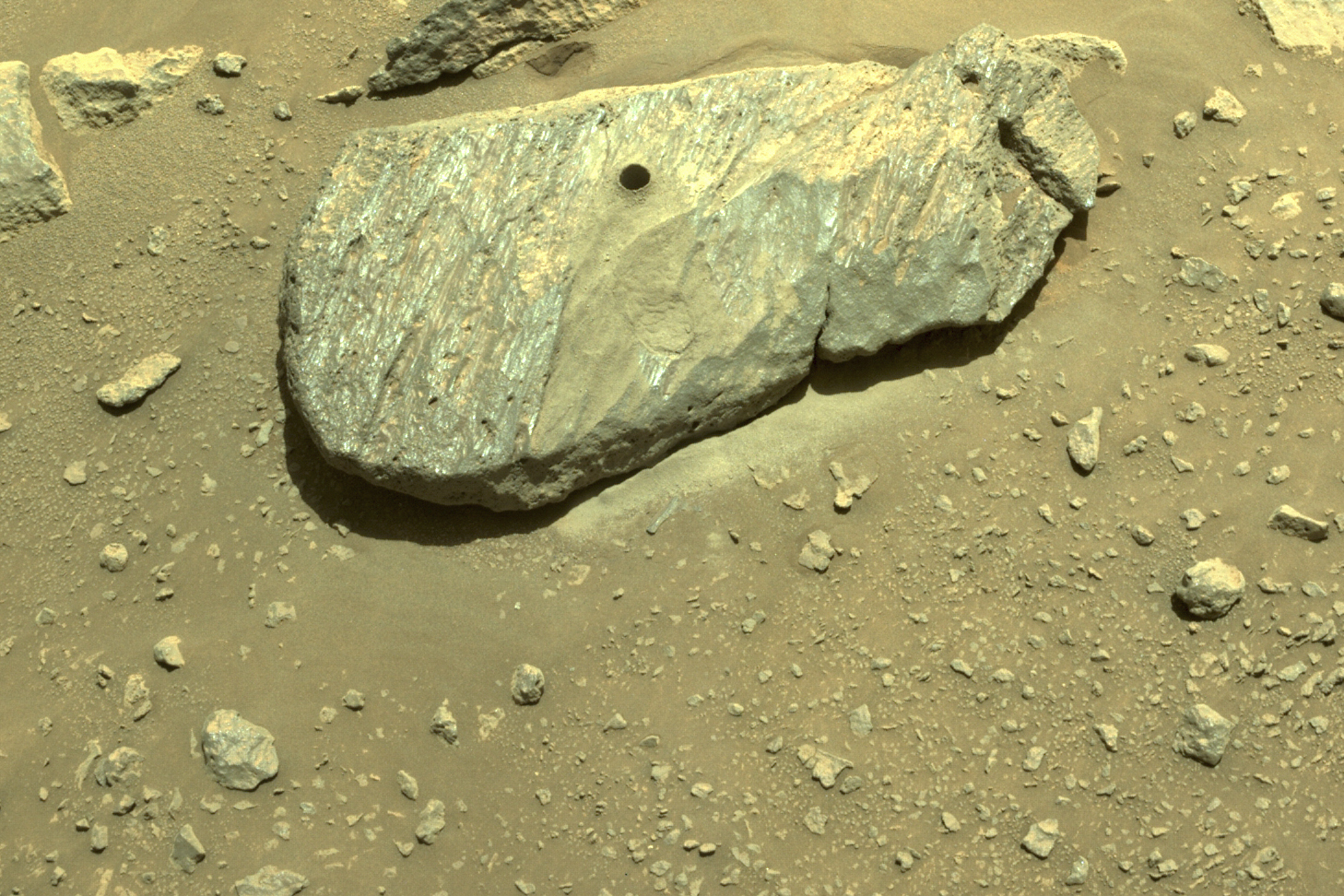
The Perseverance rover has been on an extraterrestrial joyride since 2021, drilling holes in promising looking space rocks that it hopes could be teeming with microorganisms and organic matter.

Then, in September 2023, as Perseverance was trundling across the ruins of what may once have been a microbial metropolis, an independent panel of researchers published a report that made it clear, in no uncertain terms, that MSR was the opposite of okay.

They found that the project was too decentralized among the nation’s plethora of NASA centers, leaving confusion as to who was actually in charge. And at its current pace, MSR wouldn’t get its Mars rocks back home until the 2040s at the earliest—as much as a whole decade later than initial estimates. And it would cost as much as $11 billion, more than doubling the initial tab. 

“MSR was established with unrealistic budget and schedule expectations from the beginning,” the report reads. “MSR was also organized under an unwieldy structure. As a result, there is currently no credible, congruent technical, nor properly margined schedule, cost, and technical baseline that can be accomplished with the likely available funding.”

Members of Congress started to wonder aloud whether MSR should be canceled outright, and the scientific community that had once so enthusiastically supported the mission faced a moment of reckoning. 

Byrne, the planetary scientist from the Washington University in St. Louis, had always been something of a rebel, never really a fan of NASA’s multi-decadal, over-the-top fascination with Mars. The solar system, he argued, is filled with curious worlds to explore—especially Venus, another nearby rocky world that was once rather Earth-like. Couldn’t we spare some of NASA’s budget to make sure we explore Venus, too?

Still, like many other critical colleagues, Byrne did not want to see MSR put down. The report’s findings didn’t change the fact that Perseverance was dutifully working around the clock to accomplish the mission’s opening stages. What would be the point of gathering all those samples if they were going to be left to stay on Mars? The community, Byrne explains, just needed to answer one question: “How do you do this in a way that’s faster and cheaper?” 

In April 2024, NASA publicly sought help from its industry partners in the space sector: Could anyone come up with a way to save MSR? Various players with spaceflight experience, like Lockheed Martin, sent in proposals for consideration. 

Then, just a few months later in July 2024, Perseverance came in clutch, finding those special leopard-spotted and speckled rocks in an old river valley—a sign of hope that NASA had been desperately seeking. Now the agency’s request for help was all the more urgent—these rocks had to get home. After various panels assessed plans that could effectively save MSR, two potential options for a faster, leaner, less expensive version were previewed at a January 2025 press briefing. 

One option brought in tried-and-tested tech: Since Perseverance had been safely deployed onto the surface of Mars using a hovering platform known as a sky crane, it was proposed that the sample-gathering lander for MSR could also be dropped off using a sky crane, which would simplify this step and reduce the overall cost of the program. The other suggestion was that the lander could be delivered to Mars via a spaceship from a commercial spaceflight company. The lander design itself could also be streamlined, and tweaks could be made to the rocket that would launch the samples back into space.

The proposals needed greater study, but everyone’s spirits were lifted by the fact these plans could, at least theoretically, get samples back in the 2030s, not the 2040s. And, crucially, “it was possible to get the cost down,” says Jack Mustard, an Earth and planetary scientist at Brown University and a member of one of the two proposal-reviewing panels. Still, it didn’t save a lot: They could do MSR for $8 billion.

“What we came up with was very reasonable, rational, much simpler,” says Christensen, who was part of the same review panel. “And $8 billion is about the right amount it would take to guarantee that it’s going to work.”

XINMEI LIU

While the US became increasingly consumed with its own interplanetary woes, China was riding high.

In June 2024, the sixth installment in the Chang’e project made history. It was another lunar sample return mission, but this one did something nobody had ever done in the history of spaceflight: It landed on the difficult-to-reach, out-of-view far side of the moon and snagged samples from it. 

China made it look effortless when a capsule containing matter from this previously untouched region safely landed in Inner Mongolia. Long Xiao, a planetary geoscientist at the China University of Geosciences, told reporters at the time that the mission’s success was “a cause for celebration for all humanity.” 

But it was also effectively a bombshell for NASA. Yes, the moon is much closer to Earth, and it doesn’t have a spaceship-destroying atmosphere like Mars. But China was speedrunning through the race while America was largely looking the other way.

Then, in May 2025, China launched Tianwen-2. Its destination was not Mars but a near-Earth asteroid. The plan is that it will scoop up some of the space rock’s primordial pebbles later this year and deliver them back to Earth in late 2027. In light of China’s past successes, many suspect it’ll nail this project, too. 
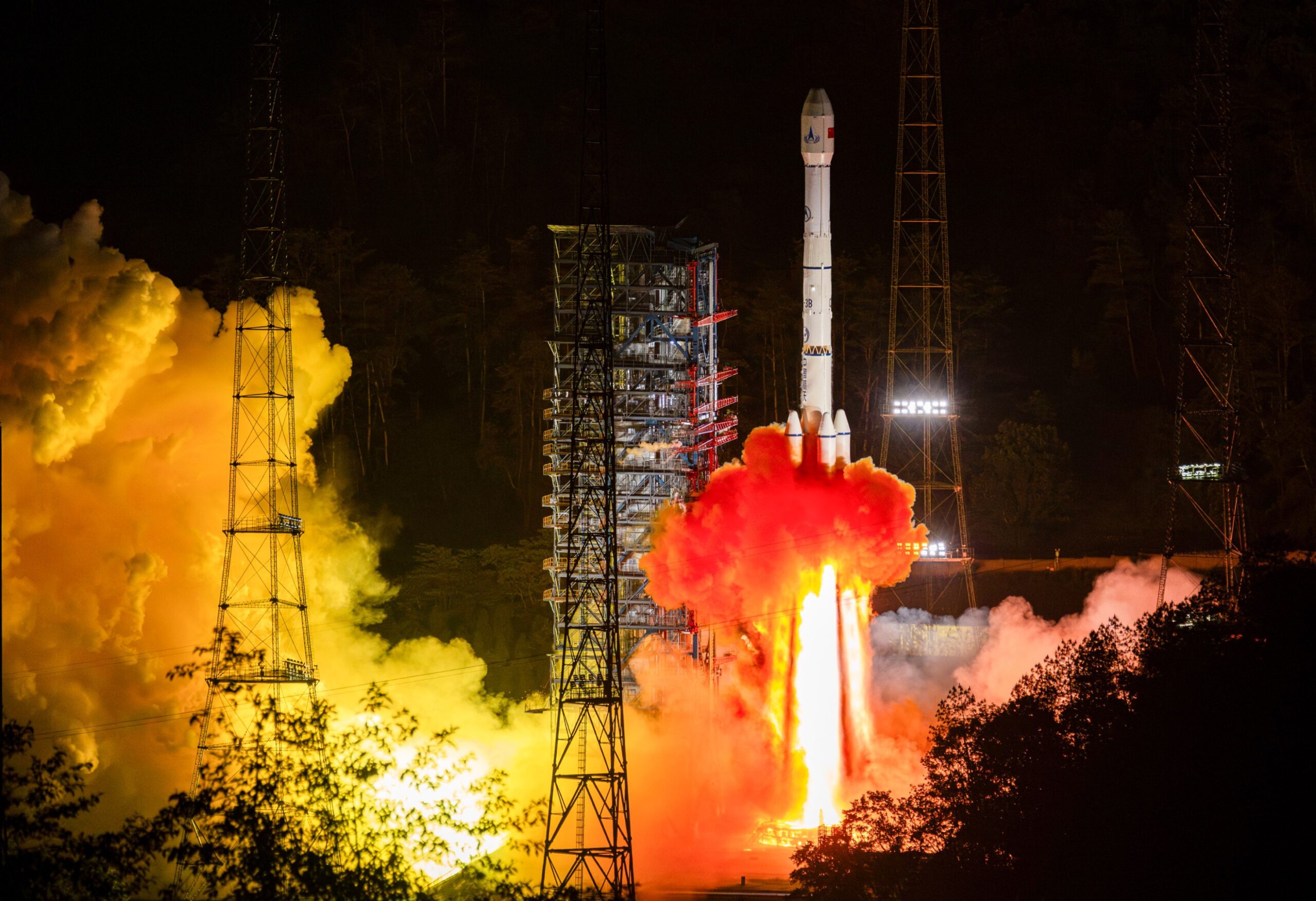
Tianwen-2 on the launchpad
China’s Tianwen missions, meaning “Questions to Heaven,” aim to explore both Mars and orbiting asteroids. The Tianwen-2 probe blasted off in May 2025, headed toward a near-Earth asteroid for a sample-return mission.
VCG/VCG VIA AP IMAGES

But perhaps the biggest blow to the US came in June 2025: China revealed its formal designs on returning samples from Mars—and potentially addressing the existence of life elsewhere in the cosmos. Chinese researchers outlined a bold plan for Tianwen-3 in the journal Nature Astronomy. “Searching for signs of life, or astrobiology studies, are the first priority,” says Yuqi Qian, a lunar geologist at the University of Hong Kong. And while many observers had long been cognizant of this ambition, seeing it so clearly spelled out in academic writing made it real.

“The selection of the landing site is still ongoing,” says Li Yiliang, an astrobiologist at the University of Hong Kong, an author of the Tianwen-3 study, and a member of the spacecraft’s landing site selection team. But the paper notes, in no uncertain terms, that the mission will move at a breakneck pace. “The aim of China’s Mars sample return mission, known as Tianwen-3, is to collect at least 500g of samples from Mars and return them to Earth around 2031.”

2031. Even on its original, speedier timeline, America’s MSR plan wouldn’t get samples back by that date. So how is China planning to pull it off?

Qian explains that Tianwen-3 is building on the success of the lunar sample return program. Doing something similar for Mars is a rather giant technological leap (requiring two rockets, not one)—but, he argues, “the technologies here are similar.” 

The plan is for a duet of rockets to blast off from Earth in 2028. The first will contain the lander-ascender combination, or LAC. The second is the orbiter-returner combination, or ORC. The LAC will get to Mars and deploy a lander as well as a small helicopter, which will scout promising locations around the landing site while using a claw to bring several small samples back to the lander.
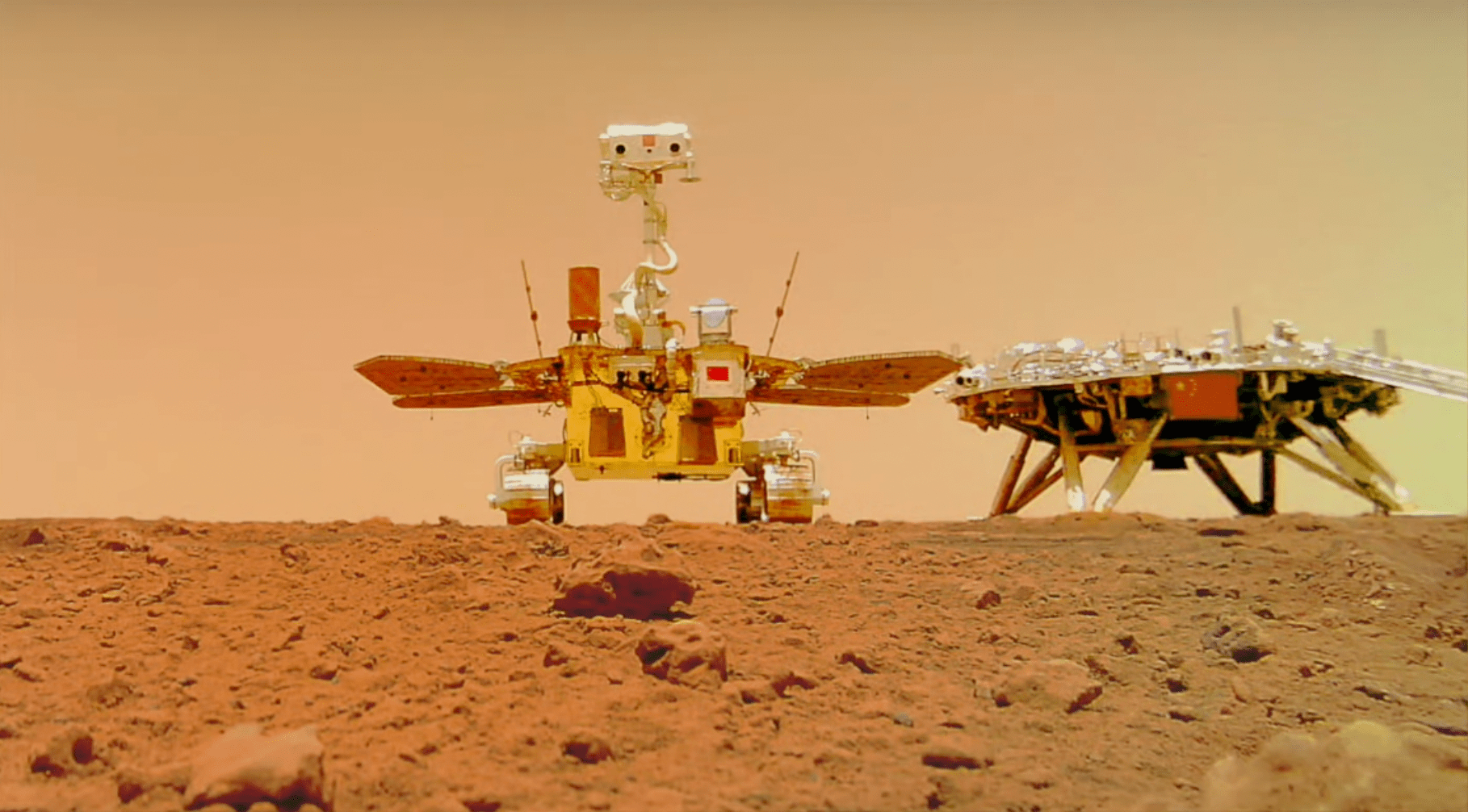
China’s Tianwen-3 mission is searching for signs of Martian life with an eye toward having samples back home sometime in 2031.
中国新闻社 VIA WIKIMEDIA COMMONS

The LAC will then travel to the most promising site. The lander’s drill, which can get down to around seven feet below the surface, is the most important part of the mission. At that depth, there are greater odds of capturing signs of past life. When at least 500 grams of pristine rocks have been loaded aboard the lander, the samples will be launched into space, where the orbiter will be waiting to capture them and send them back home sometime in 2031.

“The returned samples will be quarantined strictly in an under-planning facility near Hefei city,” says Yiliang. And there, in those bio-secure labs, scientists might very well find the first clear signs of alien life, past or present.


The very same month that Chinese researchers published their daring plans for returning Mars samples, the new Trump administration released a draconian NASA budget for Congress to consider—one that sparked panic across the planetary science community.

If enacted, it would have been a historic catastrophe for the venerable space agency, giving NASA its smallest budget since 1961. This would have forced it to let go of a huge number of staffers, slash its science program budget in half, and terminate 19 missions currently in operation. MSR was in the crosshairs, too. 

“Grim is the word,” says Dreier of the Planetary Society. 

Over the next few months, Congress pushed back on the potential gutting of NASA, but largely to save ongoing solar system exploration missions. MSR was not considered an active effort; Perseverance was effectively a scientific scout acting independently by this point. A counterproposal by the House offered up $300 million for MSR, but no policymaker was cheerleading for it. (The US Office of Management and Budget, the House Committee on Science, Space, and Technology, and the office of Sen. Ted Cruz of Texas, who chairs the Senate Committee on Commerce, Science, and Transportation did not respond to requests for comment.)

“Mars Sample Return doesn’t seem to have very many advocates right now,” says Byrne. The project “isn’t featuring in anyone’s conversation at the moment, with all of the existential shit that’s happening to NASA.” Everyone working on a NASA mission hoped that they, and their spacecraft, would survive the onslaught. As Byrne adds: “[People are] just trying to keep their heads down.”

Researchers in America suddenly found themselves at an inflection point. “The attack on science, and the attack on NASA science, has been very successful, in that it has completely demoralized the science community,” says Christensen. “Everyone’s in a state of shock.” 

When I contacted NASA in July about the state of MSR, which was then in the middle of a months-long limbo, I was told that experts weren’t available to comment. Roxana Bardan, a spokesperson, instead sent a statement: “Under President Trump’s America First agenda, NASA is committed to sustained U.S. space leadership. We will continue to innovate, explore, and excel to ensure American preeminence in space.” (The agency did not respond to a follow-up request for comment.) 

That notion stood in direct contrast to what Christensen told me around the same time. “The US … has led the exploration of Mars for 50 years,” he said. “And as we approach one of the key discovery points, we’re about to concede that leadership to someone else.”


From China’s perspective, the fumbling of MSR is more confusing than anything else. “NASA has so well prepared for her MSR mission in both technology and science, and I and my colleagues have learned so much from NASA’s scientific communities,” says Yiliang. 

And if China wins the race because America decided to shoot itself in the foot? “This is sad,” he says. “If this comes true, I believe the Chinese will not be that happy to win the race in this way.”

Tianwen-3 will still have to overcome many of the same hurdles as MSR. Nobody, for example, has autonomously launched a rocket of any kind off the surface of Mars. But many believe the Chinese can succeed, even at their program’s superspeed. Christensen, for one, fully expected several of their past robotic missions to the moon and Mars to fail—but “the fact that they pulled it off the first time really says a lot about their engineering capability,” he says. 

Mustard agrees: “They know how to land; they know how to leave. I have a lot of confidence that they’ve learned enough from the lunar work that they’ll be able to do it.”

Plus, Tianwen-3’s architecture is simpler than the US-European mission. It has fewer components, and fewer points of potential failure. This also means, though, that the quality of the loot will be somewhat lacking. Tianwen-3 will sample from only one small patch of Mars. Conversely, Perseverance is roving around a vast and geologically diverse landscape, sampling as it goes, which would translate to “literally orders of magnitude more science than what will come from the Chinese samples,” says Christensen.

But China could serendipitously land on a biologically rich patch of the planet. As the Southwest Research Institute’s Hamilton says, the mission could “pick up something entirely unexpected and, you know, miraculous.” 

The likeliest outcome is still that neither nation finds fossilized microbes, but that China brings back rocks from Mars first. At the end of the day, that’s what Americans (and Europeans) will hear: “You’re second. You lost,” says Mustard.
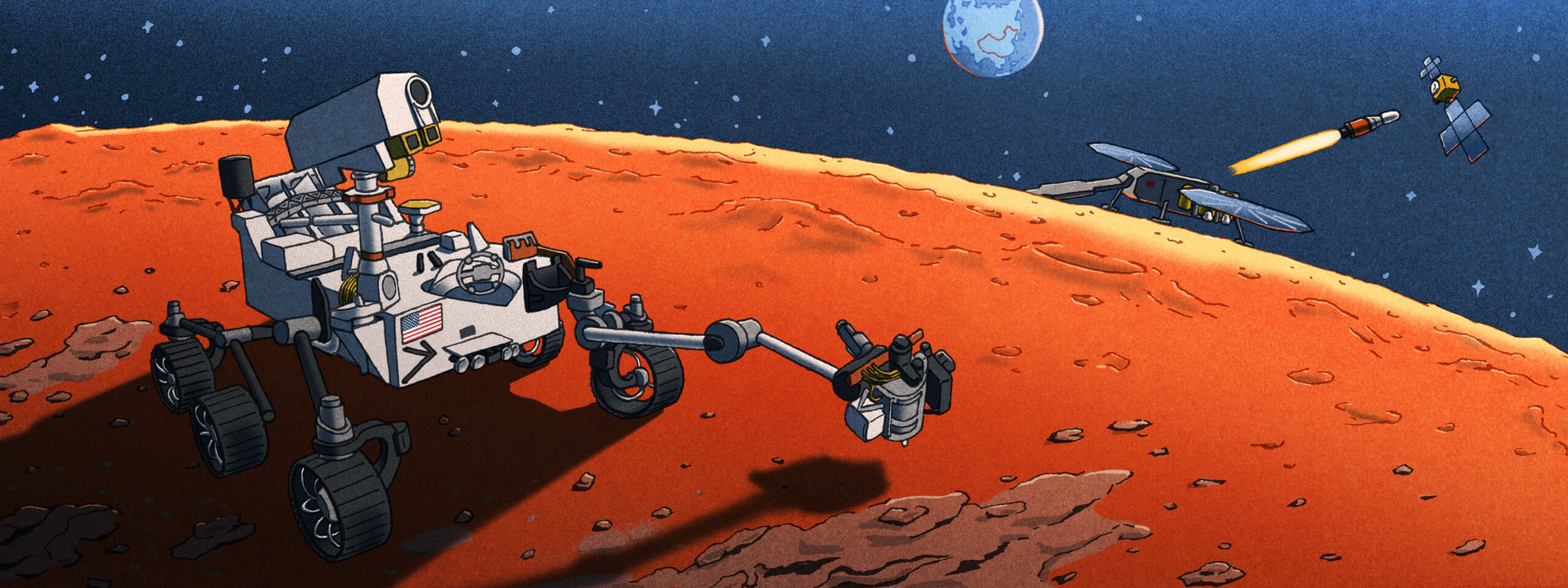
Xinmei Liu

Like many of his colleagues, Christensen is irked by the thought of losing the race to Mars, because it would be such an own goal. The US has been sending robots over there for decades and investing billions in forging the technology that would be required to make MSR a success. And suddenly “the Chinese come along and say, Thank you very much, we’ll take all of that information—we’ll build one mission and go and do what you guys did the groundwork for,” Christensen says. “As a taxpayer, I’m like: It just seems foolish to me.”

Even the MSR skeptics concede that this kind of loss would have sweeping ramifications. Byrne worries that if something like MSR can be snuffed out so easily, what’s to say the next big mission—to Jupiter, Saturn, and beyond—won’t suffer the same ignoble fate? In other words, the death of MSR would severely damage “the ability of the planetary community to dream big,” he says. “If we don’t pull this off, what does that mean? Are we not going to do big, expensive, difficult things?”

Another big, expensive, difficult thing? Putting humans on Mars. Both critics and advocates of MSR largely agree it is an invaluable dress rehearsal. Making sure you can safely launch a rocket off Mars is a necessary prerequisite to ensuring that an array of equipment can survive for a long time on the planet’s lethal surface.

China, too, has explicitly acknowledged this. As one of the first lines of the Tianwen-3 study states, “Mars is the most promising planet for humanity’s expansion beyond Earth, with its potential for future habitability and accessible resources.” 

Though such expansion is still of course a far-future dream, it’s not hard to see how losing the race here would put the US at a huge disadvantage. Members of America’s planetary science community say that to try to sway politicians in their favor, they have framed MSR as a national security issue. But they haven’t had much luck. “We’ve been in discussions with decision-makers who have never heard that perspective before,” says the Planetary Society’s Dreier. 

“It is surprising that doesn’t have more weight,” adds Mustard. 

Despite months of purgatory, it still stung when the coup de grâce arrived in January. In the draft for a must-pass spending bill, House and Senate appropriators spared NASA from the harshest proposed cuts, thereby saving dozens of spaceflight missions and preserving much of the agency’s planetary science output. But the bill provided absolutely zero political or financial support for MSR. There it was, in black and white: America’s plans to perform a history-making heist on Mars were dead. The bill became law in January and Perseverance, it seems, is now destined to rove alone on the Red Planet until its nuclear battery burns out. 

This austere reality clashes with the soaring aspirations outlined in the first Planetary Decadal Survey, written just over two decades ago. It stated that the US exploration of the solar system “has a proud past, a productive present, and an auspicious future.” It also noted that “answers to profound questions about our origins and our future may be within our grasp.” 

Now the answers have all but slipped away. Even though Perseverance continues to roam, it’s increasingly likely we’ll never see those promising bespeckled rocks with human eyes, let alone any other rocks the rover finds intriguing. It is far easier to imagine that in the near future, perhaps in the early 2030s, Perseverance will point its camera up at the night sky above Jezero Crater. It will catch a small glimmer: Tianwen-3’s orbiter, preparing to send ancient rocks back to Earth. Meanwhile, Perseverance’s own sample tubes—perhaps some containing signs of life—will be trapped on the Martian surface, gathering dust.
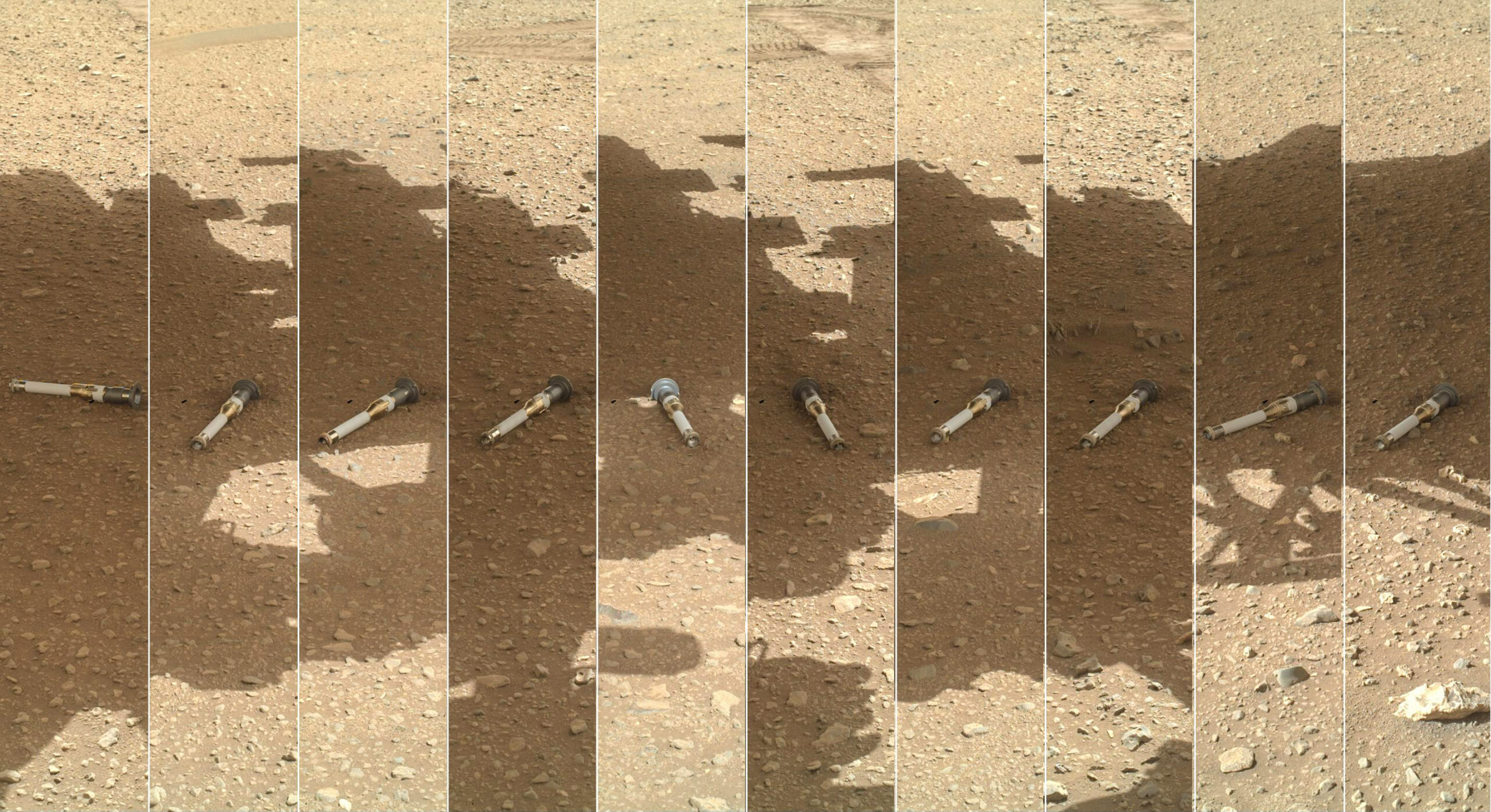
Sample tubes collected by the Perseverance rover may never make it home from the Martian surface.
NASA/JPL-CALTECH/MSSS

It is a sobering thought for Christensen. “We’ll wake up one day and go: What the hell?” he says. “How did we let this happen?”

Robin George Andrews is an award-winning science journalist and doctor of volcanoes based in London. He regularly writes about the Earth, space, and planetary sciences, and is the author of two critically acclaimed books: Super Volcanoes (2021) and How to Kill An Asteroid (2024).

Shape
Shape
Stay Ahead

Explore More Insights

Stay ahead with more perspectives on cutting-edge power, infrastructure, energy,  bitcoin and AI solutions. Explore these articles to uncover strategies and insights shaping the future of industries.

Shape

From packets to prompts: What Cisco’s AITECH certification means for IT pros

Cisco positions the AITECH learning path as a bridge from “traditional knowledge-based work” to innovation-driven roles augmented by AI, explicitly targeting professionals who need to design technical solutions, automate tasks, and lead teams using modern AI tools and methodologies. The curriculum spans AI-assisted code generation, AI-driven data analysis, model customization (including RAG),

Read More »

HPE’s latest Juniper routers target large‑scale AI fabrics

The three new models give customers several options for configurations and throughput capacity, but they all share support for the same deep buffers, security, and optics for AI network fabric buildouts, Francis said. In addition to the new hardware, HPE added new AI support, including a Model Context Protocol (MCP)

Read More »

Energy Department Announces $171.5 Million To Expand U.S. Geothermal Energy

Support for Field-Scale Tests and Exploration Drilling Can Help Advance Affordable, Reliable, Secure Geothermal Energy for American Homes and Businesses WASHINGTON—The U.S. Department of Energy (DOE) today announced a funding opportunity of $171.5 million to support next-generation geothermal field-scale tests for both electricity generation and exploration drilling to support characterization and potential confirmation of promising geothermal prospects. The activities enabled by this opportunity will help deliver on President Trump’s Executive Order, Unleashing American Energy by advancing geothermal technology, innovation, and exploration, in turn supporting the potential for geothermal energy to provide affordable, reliable, around-the-clock domestic electricity to Americans nationwide. “Work under this opportunity will directly support our commitments to advance energy addition, reduce energy costs for American families and businesses, and unleash American energy dominance and innovation,” said DOE Assistant Secretary of the Hydrocarbons and Geothermal Energy Office Kyle Haustveit. “Thanks to President Trump’s America First Energy Agenda, these demonstrations and drilling activities will help us realize the enormous potential of geothermal to spur domestic manufacturing, enable data center growth, and provide affordable, reliable, and secure energy solutions nationwide.” The funding opportunity includes six topics with varied levels of funding and awards anticipated. For the first round of applications, two of the six topics will be open, seeking field tests for enhanced geothermal systems and drilling for next-generation and hydrothermal resource characterization / confirmation. Although the United States leads the world in geothermal electricity capacity with about four gigawatts, DOE analysis shows the potential for at least 300 gigawatts of reliable, flexible geothermal power on the U.S. grid by 2050. Projects under this opportunity are expected to help derisk geothermal development approaches and locations nationwide, which can encourage private investment, spur industry growth, and help realize the country’s geothermal potential. Letters of Intent for the opportunity are due March 27, 2026, and full applications are due April 30, 2026.

Read More »

Energy Department Announces Largest Loan in Department History, Delivering Over $7 Billion in Electricity Cost Savings for Georgia and Alabama Customers

WASHINGTON—U.S. Secretary of Energy Chris Wright today announced the Department of Energy’s (DOE) Office of Energy Dominance Financing (EDF) has closed a historic $26.5 billion loan package to deliver over $7 billion in electricity cost savings to millions of customers in Georgia and Alabama. In accordance with President Trump’s Executive Order, Unleashing American Energy, this unprecedented loan package will support two wholly owned subsidiaries of Southern Company. Funded under President Trump’s Working Families Tax Cut, the investment will lower American energy costs, create thousands of jobs, and increase grid reliability in Georgia and Alabama. “Thanks to President Trump and the Working Families Tax Cut, the Energy Department is lowering energy costs and ensuring the American people have access to affordable, reliable, and secure energy for decades to come,” said Secretary Wright. “The President has been clear: America must reverse the energy subtraction agenda of past administrations and add more reliable power generation to our electrical grid. These loans will not only lower energy costs but also create thousands of jobs and increase grid reliability for the people of Georgia and Alabama.” The two loans will build or upgrade over 16 gigawatts (GW) of firm reliable power to the electrical grid. This includes 5 GW of new gas generation, 6 GW in nuclear improved through upgrades license renewals, hydropower modernization, battery energy storage systems and over 1,300 miles of transmission and grid enhancement projects. These loans represent the largest government investment aimed at directly lowering consumer energy costs and increasing grid reliability. Once all funds are received through the program, the loans are estimated to reduce Southern Company’s interest expenses by over $300 million per year, helping expedite lower electricity costs for customers. Southern Company is among the first utilities working with the DOE and the Trump Administration to restore American

Read More »

Energy Secretary Keeps Critical Generation Online in Mid-Atlantic

Emergency order keeps critical generation online and addresses critical grid reliability issues facing the Mid-Atlantic region of the United States WASHINGTON—U.S. Secretary of Energy Chris Wright issued an emergency order to address critical grid reliability issues facing the Mid-Atlantic region of the United States. The emergency order directs PJM Interconnection, L.L.C. (PJM), in coordination with Constellation Energy Corporation, to ensure Units 3 and 4 of the Eddystone Generating Station in Pennsylvania remain available for operation and to employ economic dispatch to minimize costs for the American people. The units were originally slated to shut down on May 31, 2025. “The energy sources that perform when you need them most are inherently the most valuable—that’s why natural gas and oil were valuable during recent winter storms,” Secretary Wright said. “Hundreds of American lives have likely been saved because of President Trump’s actions keeping critical generation online, including this Pennsylvania generating station which ran during Winter Storm Fern. This emergency order will mitigate the risk of blackouts and maintain affordable, reliable, and secure electricity access across the region.” The Eddystone Units were integral in stabilizing the grid during Winter Storm Fern. Between January 26-29, the units ran for over 124 hours cumulatively, providing critical generation in the midst of the energy emergency. As outlined in DOE’s Resource Adequacy Report, power outages could increase by 100 times in 2030 if the U.S. continues to take reliable power offline. Furthermore, NERC’s 2025 Long-Term Reliability Assessment warns, “The continuing shift in the resource mix toward weather-dependent resources and less fuel diversity increases risks of supply shortfalls during winter months.” Secretary Wright ordered that the two Eddystone Generating Station units remain online past their planned retirement date in a May 30, 2025 emergency order. Subsequent orders were issued on August 28, 2025 and November 26, 2025. Keeping these units operational

Read More »

Insights: Venezuela – new legal frameworks vs. the inertia of history

@import url(‘https://fonts.googleapis.com/css2?family=Inter:[email protected]&display=swap’); a { color: var(–color-primary-main); } .ebm-page__main h1, .ebm-page__main h2, .ebm-page__main h3, .ebm-page__main h4, .ebm-page__main h5, .ebm-page__main h6 { font-family: Inter; } body { line-height: 150%; letter-spacing: 0.025em; font-family: Inter; } button, .ebm-button-wrapper { font-family: Inter; } .label-style { text-transform: uppercase; color: var(–color-grey); font-weight: 600; font-size: 0.75rem; } .caption-style { font-size: 0.75rem; opacity: .6; } #onetrust-pc-sdk [id*=btn-handler], #onetrust-pc-sdk [class*=btn-handler] { background-color: #c19a06 !important; border-color: #c19a06 !important; } #onetrust-policy a, #onetrust-pc-sdk a, #ot-pc-content a { color: #c19a06 !important; } #onetrust-consent-sdk #onetrust-pc-sdk .ot-active-menu { border-color: #c19a06 !important; } #onetrust-consent-sdk #onetrust-accept-btn-handler, #onetrust-banner-sdk #onetrust-reject-all-handler, #onetrust-consent-sdk #onetrust-pc-btn-handler.cookie-setting-link { background-color: #c19a06 !important; border-color: #c19a06 !important; } #onetrust-consent-sdk .onetrust-pc-btn-handler { color: #c19a06 !important; border-color: #c19a06 !important; } In this Insights episode of the Oil & Gas Journal ReEnterprised podcast, Head of Content Chris Smith updates the evolving situation in Venezuela as the industry attempts to navigate the best path forward while the two governments continue to hammer out the details. The discussion centers on the new legal frameworks being established in both countries within the context of fraught relations stretching back for decades. Want to hear more? Listen in on a January episode highlighting industry’s initial take following the removal of Nicholas Maduro from power. References Politico podcast Monaldi Substack Baker webinar Washington, Caracas open Venezuela to allow more oil sales 

Read More »

Eni makes Calao South discovery offshore Ivory Coast

@import url(‘https://fonts.googleapis.com/css2?family=Inter:[email protected]&display=swap’); a { color: var(–color-primary-main); } .ebm-page__main h1, .ebm-page__main h2, .ebm-page__main h3, .ebm-page__main h4, .ebm-page__main h5, .ebm-page__main h6 { font-family: Inter; } body { line-height: 150%; letter-spacing: 0.025em; font-family: Inter; } button, .ebm-button-wrapper { font-family: Inter; } .label-style { text-transform: uppercase; color: var(–color-grey); font-weight: 600; font-size: 0.75rem; } .caption-style { font-size: 0.75rem; opacity: .6; } #onetrust-pc-sdk [id*=btn-handler], #onetrust-pc-sdk [class*=btn-handler] { background-color: #c19a06 !important; border-color: #c19a06 !important; } #onetrust-policy a, #onetrust-pc-sdk a, #ot-pc-content a { color: #c19a06 !important; } #onetrust-consent-sdk #onetrust-pc-sdk .ot-active-menu { border-color: #c19a06 !important; } #onetrust-consent-sdk #onetrust-accept-btn-handler, #onetrust-banner-sdk #onetrust-reject-all-handler, #onetrust-consent-sdk #onetrust-pc-btn-handler.cookie-setting-link { background-color: #c19a06 !important; border-color: #c19a06 !important; } #onetrust-consent-sdk .onetrust-pc-btn-handler { color: #c19a06 !important; border-color: #c19a06 !important; } Eni SPA discovered gas and condensate in the Murene South-1X exploration well in Block CI-501, Ivory Coast. The well is the first exploration in the block and was drilled by the Saipem Santorini drilling ship about 8 km southwest of the Murene-1X discovery well in adjacent CI-205 block. The well was drilled to about 5,000 m TD in 2,200 m of water. Extensive data acquisition confirmed a main hydrocarbon bearing interval in high-quality Cenomanian sands with a gross thickness of about 50 m with excellent petrophysical properties, the operator said. Murene South-1X will undergo a full conventional drill stem test (DST) to assess the production capacity of this discovery, named Calao South. Calao South confirms the potential of the Calao channel complex that also includes the Calao discovery. It is the second largest discovery in the country after Baleine, with estimated volumes of up to 5.0 tcf of gas and 450 million bbl of condensate (about 1.4 billion bbl of oil). Eni is operator of Block CI-501 (90%) with partner Petroci Holding (10%).

Read More »

CFEnergía to supply natural gas to low-carbon methanol plant in Mexico

CFEnergía, a subsidiary of Mexico’s Federal Electricity Commission (CFE), has agreed to supply natural gas to Transition Industries LLC for its Pacifico Mexinol project near Topolobampo, Sinaloa, Mexico. Under the signed agreement, which enables the start of Pacifico Mexinol’s construction phase, CFEnergía will supply about 160 MMcfd of natural gas for an unspecified timeframe noted as “long term,” Transition Industries said in a release Feb. 16. The natural gas—to be sourced from the US and supplied at market prices via existing infrastructure—will be used as “critical input for Mexinol’s production of ultra-low carbon methanol,” the company said. Pacifico Mexinol The $3.3-billion Mexinol project, when it begins operations in late 2029 to early 2030, is expected to be the world’s largest ultra-low carbon chemicals plant with production of about 1.8 million tonnes of blue methanol and 350,000 tonnes of green methanol annually. Supply is aimed at markets in Asia, including Japan, while also boosting the development of the domestic market and the Mexican chemical industry. Mitsubishi Gas Chemical has committed to purchasing about 1 million tonnes/year of methanol from the project, about 50% of the project’s planned production. Transition Industries is jointly developing Pacifico Mexinol with the International Finance Corporation (IFC), a member of the World Bank Group. Last year, the company signed a contingent engineering, procurement, and construction (EPC) contract with the consortium of Samsung E&A Co., Ltd., Grupo Samsung E&A Mexico SA de CV, and Techint Engineering and Construction for the project. MAIRE group’s technology division NextChem, through its subsidiary KT TECH SpA, also signed a basic engineering, critical and proprietary equipment supply agreement with Samsung E&A in connection with its proprietary NX AdWinMethanol®Zero technology supply to the project.

Read More »

Netskope targets AI-driven network bottlenecks with AI Fast Path

AI Fast Path focuses on optimizing traffic flows between enterprise users, the Netskope cloud, and major AI providers. Netskope says more than 90% of its 120 NewEdge data centers can now connect to leading AI applications in less than five milliseconds from the Netskope cloud, an effort aimed at minimizing added delay as traffic is inspected for data loss prevention (DLP), threat protection, and policy enforcement. “Customers realized that if they don’t adopt these AI apps, they’re probably going to be extinct in a few years. At the same time, we can’t afford to compromise on security,” Arandjelovic says. “So, with NewEdge and the AI Fast Path, we’ve created a super-optimized path where there is literally barely a bump in the wire. At the same time, they are not compromising security, because you’re passing through our cloud and getting all the benefits of our data protection and threat protection.” As a set of capabilities within NewEdge, AI Fast Path enables better performance and efficiency for AI applications. According to Netskope, AI Fast Path provides enterprises with:

Read More »

AMD strikes massive AI chip deal with Meta

The funding is also unique. Instead of a cash purchase, AMD has reportedly given Meta warrants to buy up to 160 million shares at $0.01 each. Stock warrants are financial instruments that give you the right (but not the obligation) to buy a company’s stock at a fixed price before a certain expiration date, according to the vendors. With 1.6 billion shares outstanding, Meta is poised to acquire 10% of AMD. But perhaps not. These shares vest only as Meta buys more computing capacity. The final tranche vests only if AMD’s stock price hits $600, according to a recent 8K filing. AMD shares are currently valued at just over $200 as of this writing. The deal is identical to the one AMD struck with OpenAI last October. That deal was also for 6 GW worth of GPUs and included a warrant for up to 160 million AMD common stock shares structured to payout once certain targets were met. Meta is not playing favorites. Last week it announced that it will also deploy standalone Nvidia Grace CPUs in its production data centers, citing greatly improved performance-per-watt. That doesn’t come as a surprise to Gaurav Gupta, vice president analyst at Gartner, who says we are compute constrained and Hyperscalers or frontier model companies will use a multisource approach to get access to compute.  “No one wants to be stuck with a single vendor. Diversify and then different workloads have different compute needs.,” he said.

Read More »

Nvidia lines up partners to boost security for industrial operations

Akamai extends its micro-segmentation and zero-trust security platform Guardicore to run on Nvidia BlueField GPUs The integration offloads user-configurable security processes from the host system to the Nvidia BlueField DPU and enables zero-trust segmentation without requiring software agents on fragile or legacy systems, according to Akamai. Organizations can implement this hardware-isolated, “agentless” security approach to help align with regulatory requirements and lower their risk profile for cyber insurance. “It delivers deep, out-of-band visibility across systems, networks, and applications without disrupting operations. Security policies can be enforced in real time and are capable of creating a strong protective boundary around critical operational systems. The result is trusted insight into operational activity and improved overall cyber resilience,” according to Akamai. Forescout works with Nvidia to bring zero-trust technology to OT networks Forescout applies network segmentation to contain lateral movement and enforce zero-trust controls. The technology would be further integrated into partnership work already being done by the two companies. By running Forescout’s on-premises sensor directly on the Nvidia BlueField, part of Nvidia Cybersecurity AI platform, customers can offload intensive computing tasks, such as deep packet inspections. This speeds up data processing, enhances asset intelligence, and improves real-time monitoring, providing security teams with the insights needed to stay ahead of emerging threats, according to Forescout. Palo Alto to demo Prisma AIRS AI Runtime Security on Nvidia BlueField DPU Palo Alto Networks recently partnered with Nvidia to run its Prisma AI-powered Radio Security(AIRs) package on the Nvidia BlueField DPU and will show off the technology at the conference. The technology is part of the Nvidia Enterprise AI Factory validated design and can offer real-time security protection for industrial network settings. “Prisma AIRS AI Runtime Security delivers deep visibility into industrial traffic and continuous monitoring for abnormal behavior. By running these security services on Nvidia BlueField, inspection

Read More »

Raising the temp on liquid cooling

IBM isn’t the only one. “We’ve been doing liquid cooling since 2012 on our supercomputers,” says Scott Tease, vice president and general manager of AI and high-performance computing at Lenovo’s infrastructure solutions group. “And we’ve been improving it ever since—we’re now on the sixth generation of that technology.” And the liquid Lenovo uses in its Neptune liquid cooling solution is warm water. Or, more precisely, hot water: 45 degrees Celsius. And when the water leaves the servers, it’s even hotter, Tease says. “I don’t have to chill that water, even if I’m in a hot climate,” he says. Even at high temperatures, the water still provides enough cooling to the chips that it has real value. “Generally, a data center will use evaporation to chill water down,” Tease adds. “Since we don’t have to chill the water, we don’t have to use evaporation. That’s huge amounts of savings on the water. For us, it’s almost like a perfect solution. It delivers the highest performance possible, the highest density possible, the lowest power consumption. So, it’s the most sustainable solution possible.” So, how is the water cooled down? It gets piped up to the roof, Tease says, where there are giant radiators with massive amounts of surface area. The heat radiates away, and then all the water flows right back to the servers again. Though not always. The hot water can also be used to, say, heat campus or community swimming pools. “We have data centers in the Nordics who are giving the heat to the local communities’ water systems,” Tease says.

Read More »

Vertiv’s AI Infrastructure Surge: Record Orders, Liquid Cooling Expansion, and Grid-Scale Power Reflect Data Center Growth

2) “Units of compute”: OneCore and SmartRun On the earnings call, Albertazzi highlighted Vertiv OneCore, an end-to-end data center solution designed to accelerate “time to token,” scaling in 12.5 MW building blocks; and Vertiv SmartRun, a prefabricated white space infrastructure solution aimed at rapidly accelerating fit-out and readiness. He pointed to collaborations (including Hut 8 and Compass Data Centers) as proof points of adoption, emphasizing that SmartRun can stand alone or plug into OneCore. 3) Cooling evolution: hybrid thermal chains and the “trim cooler” Asked how cooling architectures may change (amid industry chatter about warmer-temperature operations and shifting mixes of chillers, CDUs, and other components) Albertazzi leaned into complexity as a feature, not a bug. He argued heat rejection doesn’t disappear, even if some GPU loads can run at higher temperatures. Instead, the future looks hybrid, with mixed loads and resiliency requirements forcing more nuanced thermal chains. Vertiv’s strategic product anchor here is its “trim cooler” concept: a chiller optimized for higher-temperature operation while retaining flexibility for lower-temperature requirements in the same facility, maximizing free cooling where climate and design allow. And importantly, Albertazzi dismissed the idea that CDUs are going away: “We are pretty sure that CDUs in various shapes and forms are a long-term element of the thermal chain.” 4) Edge densification: CoolPhase Ceiling + CoolPhase Row (Feb. 3) Vertiv also expanded its thermal portfolio for edge and small IT environments with the: Vertiv CoolPhase Ceiling (launching Q2 2026): ceiling-mounted, 3.5 kW to 28 kW, designed to preserve floor space. Vertiv CoolPhase Row (available now in North America) for row-based cooling up to 30 kW (300 mm width) or 40 kW (600 mm width). Vertiv Director of Edge Thermal Michal Podmaka tied the products directly to AI-driven edge densification and management consistency, saying the new systems “integrate seamlessly

Read More »

Execution, Power, and Public Trust: Rich Miller on 2026’s Data Center Reality and Why He Built Data Center Richness

DCF founder Rich Miller has spent much of his career explaining how the data center industry works. Now, with his latest venture, Data Center Richness, he’s also examining how the industry learns. That thread provided the opening for the latest episode of The DCF Show Podcast, where Miller joined present Data Center Frontier Editor in Chief Matt Vincent and Senior Editor David Chernicoff for a wide-ranging discussion that ultimately landed on a simple conclusion: after two years of unprecedented AI-driven announcements, 2026 will be the year reality asserts itself. Projects will either get built, or they won’t. Power will either materialize, or it won’t. Communities will either accept data center expansion – or they’ll stop it. In other words, the industry is entering its execution phase. Why Data Center Richness Matters Now Miller launched Data Center Richness as both a podcast and a Substack publication, an effort to experiment with formats and better understand how professionals now consume industry information. Podcasts have become a primary way many practitioners follow the business, while YouTube’s discovery advantages increasingly make video versions essential. At the same time, Miller remains committed to written analysis, using Substack as a venue for deeper dives and format experimentation. One example is his weekly newsletter distilling key industry developments into just a handful of essential links rather than overwhelming readers with volume. The approach reflects a broader recognition: the pace of change has accelerated so much that clarity matters more than quantity. The topic of how people learn about data centers isn’t separate from the industry’s trajectory; it’s becoming part of it. Public perception, regulatory scrutiny, and investor expectations are now shaped by how stories are told as much as by how facilities are built. That context sets the stage for the conversation’s core theme. Execution Defines 2026 After

Read More »

Microsoft will invest $80B in AI data centers in fiscal 2025

And Microsoft isn’t the only one that is ramping up its investments into AI-enabled data centers. Rival cloud service providers are all investing in either upgrading or opening new data centers to capture a larger chunk of business from developers and users of large language models (LLMs).  In a report published in October 2024, Bloomberg Intelligence estimated that demand for generative AI would push Microsoft, AWS, Google, Oracle, Meta, and Apple would between them devote $200 billion to capex in 2025, up from $110 billion in 2023. Microsoft is one of the biggest spenders, followed closely by Google and AWS, Bloomberg Intelligence said. Its estimate of Microsoft’s capital spending on AI, at $62.4 billion for calendar 2025, is lower than Smith’s claim that the company will invest $80 billion in the fiscal year to June 30, 2025. Both figures, though, are way higher than Microsoft’s 2020 capital expenditure of “just” $17.6 billion. The majority of the increased spending is tied to cloud services and the expansion of AI infrastructure needed to provide compute capacity for OpenAI workloads. Separately, last October Amazon CEO Andy Jassy said his company planned total capex spend of $75 billion in 2024 and even more in 2025, with much of it going to AWS, its cloud computing division.

Read More »

John Deere unveils more autonomous farm machines to address skill labor shortage

Join our daily and weekly newsletters for the latest updates and exclusive content on industry-leading AI coverage. Learn More Self-driving tractors might be the path to self-driving cars. John Deere has revealed a new line of autonomous machines and tech across agriculture, construction and commercial landscaping. The Moline, Illinois-based John Deere has been in business for 187 years, yet it’s been a regular as a non-tech company showing off technology at the big tech trade show in Las Vegas and is back at CES 2025 with more autonomous tractors and other vehicles. This is not something we usually cover, but John Deere has a lot of data that is interesting in the big picture of tech. The message from the company is that there aren’t enough skilled farm laborers to do the work that its customers need. It’s been a challenge for most of the last two decades, said Jahmy Hindman, CTO at John Deere, in a briefing. Much of the tech will come this fall and after that. He noted that the average farmer in the U.S. is over 58 and works 12 to 18 hours a day to grow food for us. And he said the American Farm Bureau Federation estimates there are roughly 2.4 million farm jobs that need to be filled annually; and the agricultural work force continues to shrink. (This is my hint to the anti-immigration crowd). John Deere’s autonomous 9RX Tractor. Farmers can oversee it using an app. While each of these industries experiences their own set of challenges, a commonality across all is skilled labor availability. In construction, about 80% percent of contractors struggle to find skilled labor. And in commercial landscaping, 86% of landscaping business owners can’t find labor to fill open positions, he said. “They have to figure out how to do

Read More »

2025 playbook for enterprise AI success, from agents to evals

Join our daily and weekly newsletters for the latest updates and exclusive content on industry-leading AI coverage. Learn More 2025 is poised to be a pivotal year for enterprise AI. The past year has seen rapid innovation, and this year will see the same. This has made it more critical than ever to revisit your AI strategy to stay competitive and create value for your customers. From scaling AI agents to optimizing costs, here are the five critical areas enterprises should prioritize for their AI strategy this year. 1. Agents: the next generation of automation AI agents are no longer theoretical. In 2025, they’re indispensable tools for enterprises looking to streamline operations and enhance customer interactions. Unlike traditional software, agents powered by large language models (LLMs) can make nuanced decisions, navigate complex multi-step tasks, and integrate seamlessly with tools and APIs. At the start of 2024, agents were not ready for prime time, making frustrating mistakes like hallucinating URLs. They started getting better as frontier large language models themselves improved. “Let me put it this way,” said Sam Witteveen, cofounder of Red Dragon, a company that develops agents for companies, and that recently reviewed the 48 agents it built last year. “Interestingly, the ones that we built at the start of the year, a lot of those worked way better at the end of the year just because the models got better.” Witteveen shared this in the video podcast we filmed to discuss these five big trends in detail. Models are getting better and hallucinating less, and they’re also being trained to do agentic tasks. Another feature that the model providers are researching is a way to use the LLM as a judge, and as models get cheaper (something we’ll cover below), companies can use three or more models to

Read More »

OpenAI’s red teaming innovations define new essentials for security leaders in the AI era

Join our daily and weekly newsletters for the latest updates and exclusive content on industry-leading AI coverage. Learn More OpenAI has taken a more aggressive approach to red teaming than its AI competitors, demonstrating its security teams’ advanced capabilities in two areas: multi-step reinforcement and external red teaming. OpenAI recently released two papers that set a new competitive standard for improving the quality, reliability and safety of AI models in these two techniques and more. The first paper, “OpenAI’s Approach to External Red Teaming for AI Models and Systems,” reports that specialized teams outside the company have proven effective in uncovering vulnerabilities that might otherwise have made it into a released model because in-house testing techniques may have missed them. In the second paper, “Diverse and Effective Red Teaming with Auto-Generated Rewards and Multi-Step Reinforcement Learning,” OpenAI introduces an automated framework that relies on iterative reinforcement learning to generate a broad spectrum of novel, wide-ranging attacks. Going all-in on red teaming pays practical, competitive dividends It’s encouraging to see competitive intensity in red teaming growing among AI companies. When Anthropic released its AI red team guidelines in June of last year, it joined AI providers including Google, Microsoft, Nvidia, OpenAI, and even the U.S.’s National Institute of Standards and Technology (NIST), which all had released red teaming frameworks. Investing heavily in red teaming yields tangible benefits for security leaders in any organization. OpenAI’s paper on external red teaming provides a detailed analysis of how the company strives to create specialized external teams that include cybersecurity and subject matter experts. The goal is to see if knowledgeable external teams can defeat models’ security perimeters and find gaps in their security, biases and controls that prompt-based testing couldn’t find. What makes OpenAI’s recent papers noteworthy is how well they define using human-in-the-middle

Read More »