Stay Ahead, Stay ONMINE

Cooling’s New Reality: It’s Not Air vs. Liquid Anymore. It’s Architecture.

By early 2026, the data center cooling conversation has started to sound less like a product catalog and more like a systems engineering summit. The old framing – air cooling versus liquid cooling – still matters, but it increasingly misses the point. AI-era facilities are being defined by thermal constraints that run from chip-level cold plates […]

By early 2026, the data center cooling conversation has started to sound less like a product catalog and more like a systems engineering summit. The old framing – air cooling versus liquid cooling – still matters, but it increasingly misses the point. AI-era facilities are being defined by thermal constraints that run from chip-level cold plates to facility heat rejection, with critical decisions now shaped by pumping power, fluid selection, reliability under ambient extremes, water availability, and manufacturing throughput.

That full-stack shift is written all over a grab bag of recent cooling announcements. On one end of the spectrum we see a Department of Energy-funded breakthrough aimed directly at next-generation GPU heat flux. On the other, it’s OEM product launches built to withstand –20°F to 140°F operating conditions and recover full cooling capacity within minutes of a power interruption. In between we find a major acquisition move for advanced liquid cooling IP, a manufacturing expansion that more than doubles footprint, and the quiet rise of refrigerants and heat-transfer fluids as design-level considerations.

What’s emerging is a new reality. Cooling is becoming one of the primary constraints on AI deployment technically, economically, and geographically. The winners will be the players that can integrate the whole stack and scale it.

1) The Chip-level Arms Race: Single-phase Fights for More Runway

The most “pure engineering” signal in this news batch comes from HRL Laboratories, which on Feb. 24, 2026 unveiled details of a single-phase direct liquid cooling approach called Low-Chill™. HRL’s framing is pointed: the industry wants higher GPU and rack power densities, but many operators are wary of the cost and operational complexity of two-phase cooling.

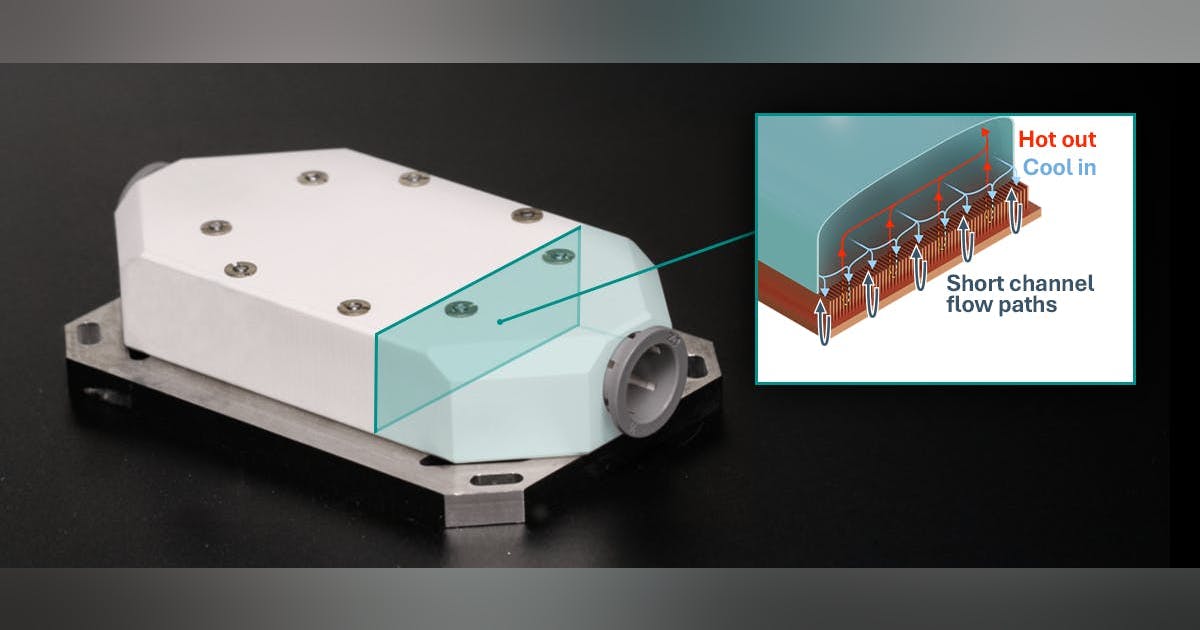
HRL says Low-Chill was developed under the U.S. Department of Energy’s ARPA-E COOLERCHIPS program, and claims a leap that goes straight at the bottleneck. It can increase processor cooling capability by 40% or reduce pumping power by more than 10X. That pumping-power claim is not a footnote. In AI-era liquid-cooled designs, it’s increasingly part of the economic and architectural equation.

“We designed this technology with real data center constraints in mind,” said Christopher Roper, principal investigator at HRL.

At the core is a cooling block architecture that uses an engineered 3D-printed manifold to distribute coolant through hundreds of short flow paths directly over the processor, addressing fundamental issues of conventional designs such as long channels, friction losses, and uneven coolant delivery. HRL’s disclosed metrics include:

  • Thermal interface resistance: 8.2 °C/kW

  • Pressure drop: below 1 psi per cooling block

  • Pumping power: less than 1% of rack IT power (block-level)

  • Hot-loop capability: coolant inlet temperatures up to 70°C

The company also claims that the approach can remove 40% more heat load compared to state-of-the-art cooling blocks under equivalent pumping power, supports heat flux up to 400 W/cm², and is scalable to higher powers. HRL even ties the performance envelope to future GPU roadmaps, stating the approach can help meet NVIDIA’s anticipated Rubin and Feynman GPU cooling needs.

Crucially, HRL’s “why it matters” pitch extends beyond silicon. By enabling ultra-low thermal resistance at the processor level, the approach can support hotter coolant loops, which in turn can make dry air coolers more viable, reducing reliance on evaporative systems and improving compatibility with water-constrained climates.

“As a private company owned jointly by Boeing and GM,” HRL positioned the work as deployable and partner-ready, while explicitly stating it is seeking development partners.

The takeaway? Single-phase liquid cooling isn’t done evolving. If the performance claims hold up in broader deployments, the “single-phase vs. two-phase” decision may be less about theoretical limits and more about how far innovations like manifold geometry can push practical limits.

2) OEMs Aren’t Just Shipping Chillers, They’re Buying Liquid Cooling IP

If HRL is about the physics, Johnson Controls’ news is about strategy. On Feb. 18, 2026, the company said it had signed an agreement to acquire Alloy Enterprises, a Boston-based firm founded in 2020 focused on a proprietary thermal management platform for high-performance data centers and other mission-critical industrial applications.

Johnson Controls says Alloy’s advanced direct liquid cooling components can enable:

Those numbers land squarely in the same territory HRL is emphasizing: cooling efficiency and pumping power, not just peak capacity.

“This acquisition is about enabling our customers to stay ahead of fast-changing compute demands by adding another core technology that enables us to optimize the overall thermal management architecture of a data center,” said Lei Schlitz, Vice President and President, Global Products & Solutions, for JCI. “It will also strengthen our core technology capabilities that can scale across the Johnson Controls portfolio and reinforces our long-term commitment to lead more broadly in advanced thermal management solutions for mission critical applications.”

The company also used the announcement to remind the market that it’s building a broad thermal toolbox, citing offerings including its:

  • YDAM magnetic bearing chiller delivering 3.5 MW of cooling and a 20% capacity density increase versus competing solutions.

  • YK-HT two-stage economized centrifugal chiller, almost 30% smaller than alternatives and requiring up to 60% fewer dry coolers.

  • Silent-Aire Coolant Distribution Unit (CDU) platform with cooling capacities from 500 kW to over 10 MW.

  • YHAU absorption chillers, designed to recover waste heat and deliver additional cooling more than 90% more efficiently than electrical cooling.

Alloy’s CEO Alison Forsyth framed the deal as a scaling moment:

“We’re excited to join Johnson Controls and accelerate the impact of our unique technology… We look forward to this new chapter and continuing to scale with one of the world’s most respected and experienced leaders in thermal management innovation.”

The transaction is expected to close in fiscal Q3, subject to regulatory approvals and closing conditions. Financial terms were not disclosed.

The bigger signal is to discern how cooling IP, especially for liquid cooling component architecture, is now strategic enough to acquire. That puts liquid cooling on the same playing field as power distribution and electrical gear as a domain where differentiation is increasingly tied to proprietary capability, not just integrator packaging.

3) Chillers Re-Examined for Reliability in the Real World

At the facility layer, two announcements make an unambiguous case that regardless of how “hot” future coolant loops get, real-world conditions still demand robust heat rejection and fast recovery.

Carrier’s AquaEdge 30CF: “Perform When it Matters Most”

On Feb. 26, 2026, Carrier introduced the AquaEdge® 30CF air-cooled centrifugal chiller, designed to help operators maintain continuous performance and protect uptime “under real-world operating conditions.” Carrier positioned the product as part of Carrier QuantumLeap™, its portfolio of integrated thermal management solutions for data centers.

“As data centers evolve, operators need confidence that their cooling systems will perform when it matters most,” said Christian Senu, Vice President, Data Centers, Carrier. “The AquaEdge® 30CF was engineered with our customers in mind to protect uptime through reliable operation across a range of ambient conditions and respond quickly if the unexpected occurs.”

Carrier’s key differentiators are very specific:

  • Operating range: –20°F to 140°F

  • Recovery: restore 100% cooling capacity in under three minutes after a power interruption

  • Capacity: more than 3 MW of cooling (depending on ambient conditions)

  • Architecture: proprietary two-stage, back-to-back centrifugal compressor with magnetic bearing technology

  • Oil-free platform derived from the AquaEdge® 19MV water-cooled centrifugal chiller

Carrier also emphasized its “expanded global chiller manufacturing capacity” as a lever to reduce deployment and supply chain risk, an increasingly important angle as campuses attempt to replicate deployments across multiple markets simultaneously.

Modine / Airedale TurboChill 3+MW: the hybrid case

Meanwhile, on Jan. 22, 2026, Airedale by Modine™ announced the TurboChill™ 3+MW, calling it a hybrid chiller engineered to manage rising AI workloads by maximizing free cooling when conditions allow while still deploying mechanical cooling for peaks and reliability.

Modine’s Art Laszlo, Group Vice President of Global Data Centers, directly addressed the industry speculation that chillers may become unnecessary as chips tolerate higher temperatures.

“There is speculation that chillers may no longer be required as next-generation chips are designed to operate at higher temperatures,” Laszlo said. “However, customers continue to demand proven cooling and reliability to protect their investments… Thermal architectures with dry coolers as the only form of heat rejection are not practical in many regions where varying ambient and recirculation conditions will still require refrigerant-based cooling for reliable data center operations.”

Modine’s “why hybrid” argument includes:

  • heat waves and ambient extremes

  • parasitic system losses and local recirculation

  • mixed-density facilities (some racks hot-loop, others still needing traditional returns)

  • global deployments across climates where “dry only” is insufficient

Taken together, Carrier and Modine are arguing that the future is not “chiller-less.” It’s more conditional, as in more free cooling where possible, more liquid at the rack, but with refrigerant-based capacity still serving as the reliability backstop.

4) Immersion Keeps Pressing its Case, Now with “Platform” Language

On Jan. 15, 2026, Infinium launched Infinium Edge™, described as an advanced infrastructure platform designed to enable high-density AI and HPC workloads through immersion cooling. The centerpiece is Infinium Edge Immersion Fluids™, custom-engineered dielectric fluids meant to remove heat “directly at the source.”

Infinium’s messaging was blunt. The company stated that “cooling has emerged as one of the primary constraints to data center performance, efficiency, siting and scale.”

“Cooling has become one of the defining constraints on deploying state-of-the-art AI compute systems,” said Robert Schuetzle, CEO of Infinium. “Infinium Edge leverages our expertise in advanced chemistry and industrial-scale manufacturing to deliver an immersion cooling platform that advances next-generation AI infrastructure.”

The company contrasted typical density bands:

  • Conventional air: ~10–20 kW/rack

  • Direct-to-chip: ~40–80 kW/rack

  • Immersion: higher still, positioned as a path beyond those limits

It also drew a line between its synthetic approach and “commodity” petroleum-derived immersion liquids, arguing that cleaner synthetic products avoid residual contaminants that can limit reliability and long-term performance.

The significance here is as much rhetorical as technical. Immersion is increasingly being sold not as a niche cooling method, but as a platform that unites chemistry + manufacturing + deployment model.

5) The Supply Chain Reality: Cooling is Also a Manufacturing Problem

If the AI era is compressing deployment schedules, then cooling has to scale in two dimensions: technology and throughput. On Feb. 17, 2026, Boyd announced a major expansion of its design and manufacturing facility in Juarez, Mexico to increase production for AI infrastructure, hyperscale, and colocation data centers.

Shape
Shape
Stay Ahead

Explore More Insights

Stay ahead with more perspectives on cutting-edge power, infrastructure, energy,  bitcoin and AI solutions. Explore these articles to uncover strategies and insights shaping the future of industries.

Shape

Equinor lets EPC contract for Gullfaks field

@import url(‘https://fonts.googleapis.com/css2?family=Inter:[email protected]&display=swap’); a { color: var(–color-primary-main); } .ebm-page__main h1, .ebm-page__main h2, .ebm-page__main h3, .ebm-page__main h4, .ebm-page__main h5, .ebm-page__main h6 { font-family: Inter; } body { line-height: 150%; letter-spacing: 0.025em; font-family: Inter; } button, .ebm-button-wrapper { font-family: Inter; } .label-style { text-transform: uppercase; color: var(–color-grey); font-weight: 600; font-size: 0.75rem; } .caption-style { font-size: 0.75rem; opacity: .6; } #onetrust-pc-sdk [id*=btn-handler], #onetrust-pc-sdk [class*=btn-handler] { background-color: #c19a06 !important; border-color: #c19a06 !important; } #onetrust-policy a, #onetrust-pc-sdk a, #ot-pc-content a { color: #c19a06 !important; } #onetrust-consent-sdk #onetrust-pc-sdk .ot-active-menu { border-color: #c19a06 !important; } #onetrust-consent-sdk #onetrust-accept-btn-handler, #onetrust-banner-sdk #onetrust-reject-all-handler, #onetrust-consent-sdk #onetrust-pc-btn-handler.cookie-setting-link { background-color: #c19a06 !important; border-color: #c19a06 !important; } #onetrust-consent-sdk .onetrust-pc-btn-handler { color: #c19a06 !important; border-color: #c19a06 !important; } Equinor Energy AS has let an engineering, procurement, and construction (EPC) contract to SLB to upgrade the subsea compression system for Gullfaks field in the Norwegian North Sea. Under the contract, SLB OneSubsea will deliver two next-generation compressor modules to replace the units originally supplied in 2015 as part of the world’s first multiphase subsea compression system. The upgraded modules will increase differential pressure and flow capacity, enhancing recovery and extending field life, SLB said, while installation within the existing subsea infrastructure will minimize downtime and reduce overall campaign costs, the company continued. Gullfaks field lies in block 34/10 in the northern part of the North Sea. Three large production platforms with concrete substructures make up the development solution for the main field.

Read More »

Oxy cutting oil-and-gas capex by $300 million, eyes 1% production growth

@import url(‘https://fonts.googleapis.com/css2?family=Inter:[email protected]&display=swap’); a { color: var(–color-primary-main); } .ebm-page__main h1, .ebm-page__main h2, .ebm-page__main h3, .ebm-page__main h4, .ebm-page__main h5, .ebm-page__main h6 { font-family: Inter; } body { line-height: 150%; letter-spacing: 0.025em; font-family: Inter; } button, .ebm-button-wrapper { font-family: Inter; } .label-style { text-transform: uppercase; color: var(–color-grey); font-weight: 600; font-size: 0.75rem; } .caption-style { font-size: 0.75rem; opacity: .6; } #onetrust-pc-sdk [id*=btn-handler], #onetrust-pc-sdk [class*=btn-handler] { background-color: #c19a06 !important; border-color: #c19a06 !important; } #onetrust-policy a, #onetrust-pc-sdk a, #ot-pc-content a { color: #c19a06 !important; } #onetrust-consent-sdk #onetrust-pc-sdk .ot-active-menu { border-color: #c19a06 !important; } #onetrust-consent-sdk #onetrust-accept-btn-handler, #onetrust-banner-sdk #onetrust-reject-all-handler, #onetrust-consent-sdk #onetrust-pc-btn-handler.cookie-setting-link { background-color: #c19a06 !important; border-color: #c19a06 !important; } #onetrust-consent-sdk .onetrust-pc-btn-handler { color: #c19a06 !important; border-color: #c19a06 !important; } Occidental Petroleum Corp., Houston, will spend $5.5-5.9 billion on capital projects this year, an 8% drop from 2025 and $800 million less than executives’ early forecast late last year, as the company continues to emphasize efficiency gains. Spending on oil-and-gas operations will be $300 million less than last year. Sunil Mathew, chief financial officer, late last week told investors and analysts that Occidental’s capital spending budget for 2026 (adjusted for the recently completed divestiture of OxyChem) will focus on short-cycle projects and be roughly 70% devoted to US onshore assets. Still, onshore capex will drop by $400 million from last year in part because of a drop in Permian basin activities and efficiency improvements. Other elements of Occidental’s spending plan include: A reduction of about $100 million compared to last year for exploration work A $250 million drop in spending at the company’s Low Carbon Ventures group housing Stratos Mathew said capex, which will be weighted a little to the first half, sets up Occidental’s production to average 1.45 MMboe/d for the full year, a tick up from 2025’s average of 1.434 MMboe/d but down from the roughly 1.48

Read More »

Diamondback’s Van’t Hof growing ‘more confident about the macro’

The early Barnett production will help Diamondback slightly increase its oil production this year from 2025’s average of 497,200 b/d. Van’t Hof and his team are eyeing 505,000 b/d this year with total expected production of 926,000-962,000 boe/d versus last year’s 921,000 boe/d. On a Feb. 24 conference call with analysts and investors, Van’t Hof said he’s feeling better than in recent quarters about that production number possibly moving up. The bigger picture for the oil-and-gas sector, he said, has grown a bit brighter. “Some people have been talking about [oversupplying the market] for 2 years. It just hasn’t seemed to happen as aggressively as some expected,” Van’t Hof said. “As we turn to higher demand in the summer and driving season […] people will start to find reasons to be less bearish […] In general, we just feel more confident about the macro after a couple of big shocks last year on the supply side and the demand side.” In the last 3 months of 2025, Diamondback posted a net loss of more than $1.4 billion due to a $3.6 billion impairment charge because of lower commodity prices’ effect on the company’s reserves. Adjusted EBITA fell to $2.0 billion from $2.5 billion in late 2024 and revenues during the quarter slipped to nearly $3.4 billion from $3.7 billion. Shares of Diamondback (Ticker: FANG) were essentially flat at $173.68 in early-afternoon trading on Feb. 24. Over the past 6 months, they are still up more than 20% and the company’s market value is now $50 billion.

Read More »

Vaalco Energy advances offshore drilling, development in Gabon and Ivory Coast

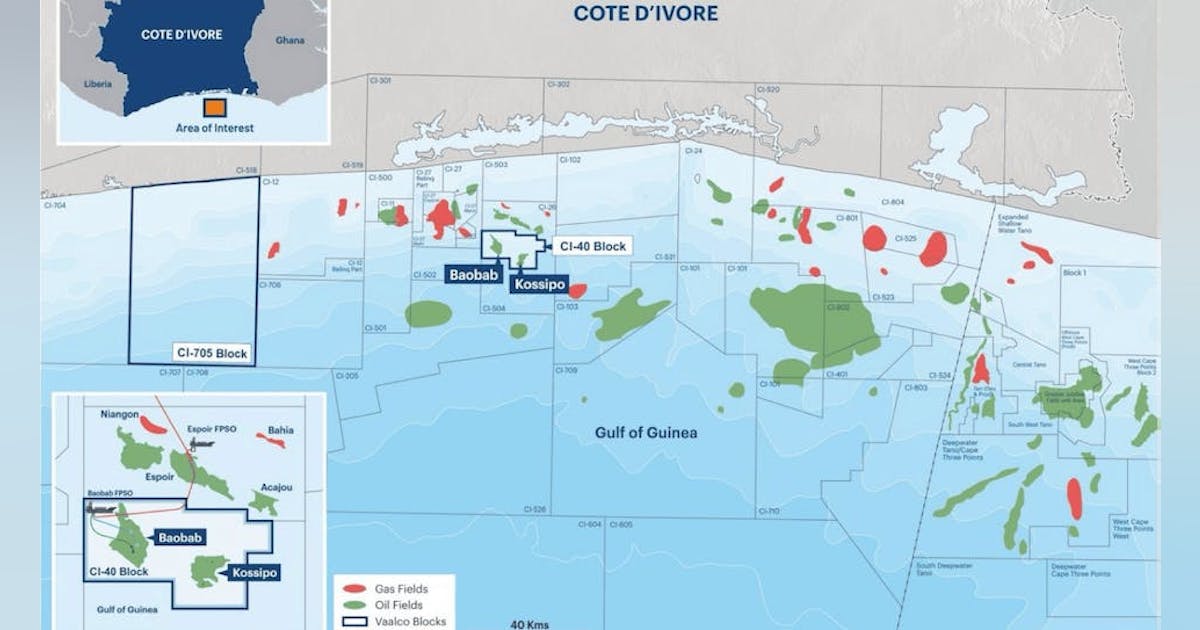
Vaalco Energy Inc. is drilling Etame field offshore Gabon and a preparing a field development plan (FDP) off Ivory Coast.  In Gabon, Vaalco drilled, completed, and placed Etame 15H-ST development well on production in Etame oil field in 1V block. The well has a 250 m lateral interval of net pay in high-quality Gamba sands near the top of the reservoir. The well had a stabilized flow rate of about 2,000 gross b/d of oil with a 38% water cut through a 42/64-in. choke and ESP at 54 Hz, confirming expectations from the ET-15P pilot well results. The company is working to stabilize pressure and manage the reservoir. West Etame step out exploration well spudded in mid-February. Drilling the well from the S1 slot on the Etame platform Etame West (ET-14P) exploration prospect has a 57% chance of geologic success and is expected to reach the target zone by mid-March. Etame Marin block lies in Congo basin about 32 km off the coast of Gabon. The license area is spread over five fields covering about 187 sq km. Vaalco is operator at the block with 58.8% interest. In Ivory Coast, Vaalco has been confirmed as operator (60%) of Kossipo field on the CI-40 Block southwest of Baobab field with partner PetroCI holding the remaining 40%. An FDP is expected to be completed in second-half 2026. New ocean bottom node (OBN) seismic data is expected to drive and derisk Vaalco’s updated evaluation and development plan. Estimated Gross 2C resources are 102-293 MMboe in place. The Baobab Ivorien (formerly MV10) floating production storage and offloading vessel (FPSO) is currently off the East coast of Africa and is expected to return to Ivory Coast by late March.  

Read More »

Ovintiv sets 2026 plan around Permian, Montney after declaring portfolio shift ‘complete’

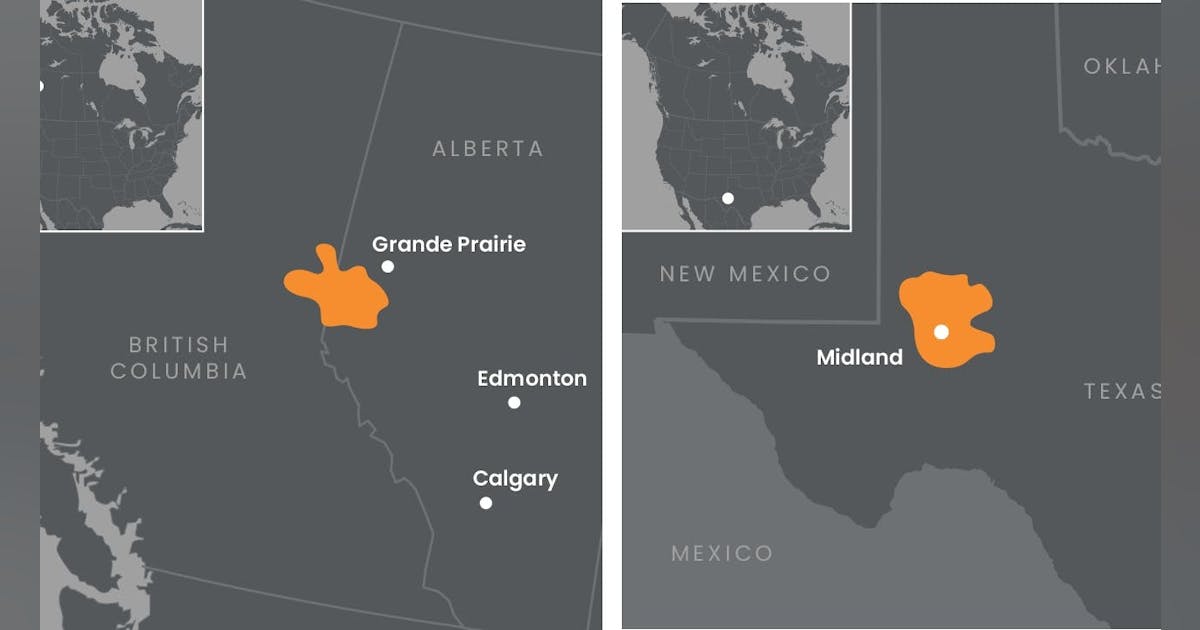
2026 guidance For 2026, Ovintiv plans to invest $2.25–2.35 billion, up slightly from the $2.147 billion spent in 2025. McCracken said capital spend will be highest in first-quarter 2026 at about $625 million, “largely due to $50 million of capital allocated to the Anadarko and some drilling activity in the Montney that we inherited from NuVista.” The program is designed to deliver 205,000–212,000 b/d of oil and condensate, some 2 bcfd of natural gas, and 620,000–645,000 boe/d total company production. For full-year 2025, the company produced 614,500 boe/d.  The company is pursuing a “stay‑flat” oil strategy, maintaining liquids output through steady activity rather than aggressive volume growth.  Permian Ovintiv plans to run 5 rigs and 1-2 frac crews in the Permian basin this year, bringing 125–135 net wells online. Oil and condensate volumes are expected to average 117,000–123,000 b/d, with natural gas production of 270–295 MMcfd. The company projects 2026 drilling and completion costs below $600/ft, about $25/ft lower than 2025. Chief operating officer Gregory Givens credited faster cycle times and ongoing application of surfactant technology. Ovintiv has now deployed surfactants in about 300 Permian wells, generating a 9% uplift in oil productivity versus comparable control wells. Givens also reiterated that Ovintiv remains committed to its established cube‑development model. Responding to an analyst question, he said the company continues completing entire cubes at once, then returning “18 months later” to develop adjacent cubes—an approach that stabilizes well performance and reduces parent‑child degradation, he said. “We are getting the whole cube at the same time, and that is working quite well for us,” he said. The company plans to drill its first Barnett Woodford test well across Midland basin acreage in 2026. Ovintiv holds Barnett rights across roughly 100,000 acres and intends to move cautiously given the zone’s depth, higher pressure,

Read More »

Interior trims environmental reviews to speed project development

The US DOI issued a final rule to reform NEPA, aiming to speed up energy project approvals on federal lands by reducing procedural delays and clarifying review processes, despite criticism from environmental groups. Feb. 24, 2026 2 min read Key Highlights The final rule streamlines environmental review processes for energy projects on federal lands, aiming to reduce approval times. It clarifies roles for federal, state, local, and tribal agencies, including procedures for public comments on significant projects. Environmental groups and Democratic attorneys general have challenged the rule, citing concerns over diminished public participation and environmental protections. Interior Secretary Doug Burgum emphasizes that the reforms restore NEPA to its original purpose of informing decisions without unnecessary delays. The rule adopts over 80% of provisions from the draft NEPA reform.

Read More »

JLL: Hyperscale and AI Demand Push North American Data Centers Toward Industrial Scale

JLL’s North America Data Center Report Year-End 2025 makes a clear argument that the sector is no longer merely expanding but has shifted into a phase of industrial-scale acceleration driven by hyperscalers, AI platforms, and capital markets that increasingly treat digital infrastructure as core, bond-like collateral. The report’s central thesis is straightforward. Structural demand has overwhelmed traditional real estate cycles. JLL supports that claim with a set of reinforcing signals: Vacancy remains pinned near zero. Most new supply is pre-leased years ahead. Rents continue to climb. Debt markets remain highly liquid. Investors are engineering new financial structures to sustain growth. Author Andrew Batson notes that JLL’s Data Center Solutions team significantly expanded its methodology for this edition, incorporating substantially more hyperscale and owner-occupied capacity along with more than 40 additional markets. The subtitle — “The data center sector shifts into hyperdrive” — serves as an apt one-line summary of the report’s posture. The methodological change is not cosmetic. By incorporating hyper-owned infrastructure, total market size increases, vacancy compresses, and historical time series shift accordingly. JLL is explicit that these revisions reflect improved visibility into the market rather than a change in underlying fundamentals; and, if anything, suggest prior reports understated the sector’s true scale. The Market in Three Words: Tight, Pre-Leased, Relentless The report’s key highlights page serves as an executive brief for investors, offering a concise snapshot of market conditions that remain historically constrained. Vacancy stands at just 1%, unchanged year over year, while 92% of capacity currently under construction is already pre-leased. At the same time, geographic diversification continues to accelerate, with 64% of new builds now occurring in so-called frontier markets. JLL also notes that Texas, when viewed as a unified market, could surpass Northern Virginia as the top data center market by 2030, even as capital

Read More »

7×24 Exchange’s Dennis Cronin on the Data Center Workforce Crisis: The Talent Cliff Is Already Here

The data center industry has spent the past two years obsessing over power constraints, AI density, and supply chain pressure. But according to longtime mission critical leader Dennis Cronin, the sector’s most consequential bottleneck may be far more human. In a recent episode of the Data Center Frontier Show Podcast, Cronin — a founding member of 7×24 Exchange International and board member of the Mission Critical Global Alliance (MCGA) — delivered a stark message: the workforce “talent cliff” the industry keeps discussing as a future risk is already impacting operations today. A Million-Job Gap Emerging Cronin’s assessment reframes the workforce conversation from a routine labor shortage to what he describes as a structural and demographic challenge. Based on recent analysis of open roles, he estimates the industry is currently short between 467,000 and 498,000 workers across core operational positions including facilities managers, operations engineers, electricians, generator technicians, and HVAC specialists. Layer in emerging roles tied to AI infrastructure, sustainability, and cyber-physical security, and the potential demand rises to roughly one million jobs. “The coming talent cliff is not coming,” Cronin said. “It’s here, here and now.” With data center capacity expanding at roughly 30% annually, the workforce pipeline is not keeping pace with physical buildout. The Five-Year Experience Trap One of the industry’s most persistent self-inflicted wounds, Cronin argues, is the widespread requirement for five years of experience in roles that are effectively entry level. The result is a closed-loop hiring dynamic: New workers can’t get hired without experience They can’t gain experience without being hired Operators end up poaching from each other Workers may benefit from the resulting 10–20% salary jumps, but the overall talent pool remains stagnant. “It’s not helping us grow the industry,” Cronin said. In a market defined by rapid expansion and increasing system complexity, that

Read More »

Aeroderivative Turbines Move to the Center of AI Data Center Power Strategy

From “Backup” to “Bridging” to Behind-the-Meter Power Plants The most important shift is conceptual: these systems are increasingly blurring the boundary between emergency backup and primary power supply. Traditionally, data center electrical architecture has been clearly tiered: UPS (seconds to minutes) to ride through utility disturbances and generator start. Diesel gensets (minutes to hours or days) for extended outages. Utility grid as the primary power source. What’s changing is the rise of bridging power:  generation deployed to energize a site before the permanent grid connection is ready, or before sufficient utility capacity becomes available. Providers such as APR Energy now explicitly market turbine-based solutions to data centers seeking behind-the-meter capacity while awaiting utility build-out. That framing matters because it fundamentally changes expected runtime. A generator that operates for a few hours per year is one regulatory category. A turbine that runs continuously for weeks or months while a campus ramps is something very different; and it is drawing increased scrutiny from regulators who are beginning to treat these installations as material generation assets rather than temporary backup systems. The near-term driver is straightforward. AI workloads are arriving faster than grid infrastructure can keep pace. Data Center Frontier and other industry observers have documented the growing scramble for onsite generation as interconnection queues lengthen and critical equipment lead times expand. Mainstream financial and business media have taken notice. The Financial Times has reported on data centers turning to aeroderivative turbines and diesel fleets to bypass multi-year power delays. Reuters has likewise covered large gas-turbine-centric strategies tied to hyperscale campuses, underscoring how quickly the co-located generation model is moving into the mainstream. At the same time, demand pressure is tightening turbine supply chains. Industry reporting points to extended waits for new units, one reason repurposed engine cores and mobile aeroderivative packages are gaining

Read More »

Cooling’s New Reality: It’s Not Air vs. Liquid Anymore. It’s Architecture.

By early 2026, the data center cooling conversation has started to sound less like a product catalog and more like a systems engineering summit. The old framing – air cooling versus liquid cooling – still matters, but it increasingly misses the point. AI-era facilities are being defined by thermal constraints that run from chip-level cold plates to facility heat rejection, with critical decisions now shaped by pumping power, fluid selection, reliability under ambient extremes, water availability, and manufacturing throughput. That full-stack shift is written all over a grab bag of recent cooling announcements. On one end of the spectrum we see a Department of Energy-funded breakthrough aimed directly at next-generation GPU heat flux. On the other, it’s OEM product launches built to withstand –20°F to 140°F operating conditions and recover full cooling capacity within minutes of a power interruption. In between we find a major acquisition move for advanced liquid cooling IP, a manufacturing expansion that more than doubles footprint, and the quiet rise of refrigerants and heat-transfer fluids as design-level considerations. What’s emerging is a new reality. Cooling is becoming one of the primary constraints on AI deployment technically, economically, and geographically. The winners will be the players that can integrate the whole stack and scale it. 1) The Chip-level Arms Race: Single-phase Fights for More Runway The most “pure engineering” signal in this news batch comes from HRL Laboratories, which on Feb. 24, 2026 unveiled details of a single-phase direct liquid cooling approach called Low-Chill™. HRL’s framing is pointed: the industry wants higher GPU and rack power densities, but many operators are wary of the cost and operational complexity of two-phase cooling. HRL says Low-Chill was developed under the U.S. Department of Energy’s ARPA-E COOLERCHIPS program, and claims a leap that goes straight at the bottleneck. It can increase

Read More »

Policy Shock: Big Tech Told to Power Its Own AI Buildout

The AI data center boom has been colliding with grid reality for more than two years. This week, the issue moved closer to the policy front lines. The White House is advancing a “ratepayer protection” framework that has gained visibility in recent days, aimed at ensuring large AI data center projects do not shift grid upgrade costs onto residential customers. It’s a signal widely interpreted by industry observers as encouraging hyperscalers to bring dedicated power solutions to the table. The Power Question Moves to Center Stage Washington now appears poised to push the industry toward a structural response to the data center power conundrum. The new federal impetus for major technology companies to shoulder the cost of their own power infrastructure is quickly emerging as one of the most consequential policy developments for the digital infrastructure sector in 2026. If formalized, the initiative would effectively codify a shift already underway which has found hyperscale and AI developers moving aggressively toward behind-the-meter generation and dedicated energy strategies. For an industry already grappling with interconnection delays, utility pushback, and mounting community scrutiny, the signal is unmistakable. The era of relying primarily on shared grid capacity for large AI campuses may be ending. From Market Trend to Policy Direction Large tech firms, including the biggest cloud and AI players, have been under increasing pressure from regulators and utilities concerned about ratepayer exposure and grid reliability. Policymakers are now signaling that future large-load approvals may hinge on whether developers can demonstrate energy self-sufficiency or dedicated supply. The logic is straightforward. AI campuses are arriving at hundreds of megawatts to gigawatt scale. Transmission upgrades are measured in multi-year timelines. Utilities face growing political pressure to protect residential customers. In that context, the emerging federal posture does not create a new trend so much as accelerate

Read More »

Enterprise Spotlight: Data Center Modernization

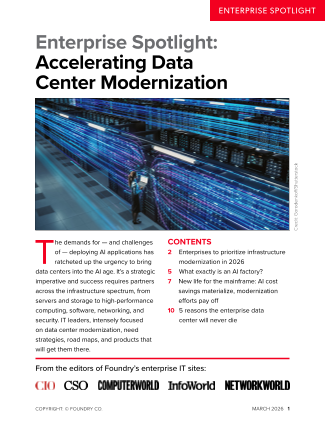
The demands for, and challenges of, deploying AI applications has ratcheted up the urgency to bring data centers into the AI age. It’s a strategic imperative and success requires partners across the infrastructure spectrum, from servers and storage to high-performance computing, networking, software, and security. IT leaders, intensely focused on data center modernization, need strategies, roadmaps, and products that will get them there. Download the March 2026 issue of the Enterprise Spotlight from the editors of CIO, Computerworld, CSO, InfoWorld, and Network World and learn how data center modernization is taking shape in 2026.

Read More »

Microsoft will invest $80B in AI data centers in fiscal 2025

And Microsoft isn’t the only one that is ramping up its investments into AI-enabled data centers. Rival cloud service providers are all investing in either upgrading or opening new data centers to capture a larger chunk of business from developers and users of large language models (LLMs).  In a report published in October 2024, Bloomberg Intelligence estimated that demand for generative AI would push Microsoft, AWS, Google, Oracle, Meta, and Apple would between them devote $200 billion to capex in 2025, up from $110 billion in 2023. Microsoft is one of the biggest spenders, followed closely by Google and AWS, Bloomberg Intelligence said. Its estimate of Microsoft’s capital spending on AI, at $62.4 billion for calendar 2025, is lower than Smith’s claim that the company will invest $80 billion in the fiscal year to June 30, 2025. Both figures, though, are way higher than Microsoft’s 2020 capital expenditure of “just” $17.6 billion. The majority of the increased spending is tied to cloud services and the expansion of AI infrastructure needed to provide compute capacity for OpenAI workloads. Separately, last October Amazon CEO Andy Jassy said his company planned total capex spend of $75 billion in 2024 and even more in 2025, with much of it going to AWS, its cloud computing division.

Read More »

John Deere unveils more autonomous farm machines to address skill labor shortage

Join our daily and weekly newsletters for the latest updates and exclusive content on industry-leading AI coverage. Learn More Self-driving tractors might be the path to self-driving cars. John Deere has revealed a new line of autonomous machines and tech across agriculture, construction and commercial landscaping. The Moline, Illinois-based John Deere has been in business for 187 years, yet it’s been a regular as a non-tech company showing off technology at the big tech trade show in Las Vegas and is back at CES 2025 with more autonomous tractors and other vehicles. This is not something we usually cover, but John Deere has a lot of data that is interesting in the big picture of tech. The message from the company is that there aren’t enough skilled farm laborers to do the work that its customers need. It’s been a challenge for most of the last two decades, said Jahmy Hindman, CTO at John Deere, in a briefing. Much of the tech will come this fall and after that. He noted that the average farmer in the U.S. is over 58 and works 12 to 18 hours a day to grow food for us. And he said the American Farm Bureau Federation estimates there are roughly 2.4 million farm jobs that need to be filled annually; and the agricultural work force continues to shrink. (This is my hint to the anti-immigration crowd). John Deere’s autonomous 9RX Tractor. Farmers can oversee it using an app. While each of these industries experiences their own set of challenges, a commonality across all is skilled labor availability. In construction, about 80% percent of contractors struggle to find skilled labor. And in commercial landscaping, 86% of landscaping business owners can’t find labor to fill open positions, he said. “They have to figure out how to do

Read More »

2025 playbook for enterprise AI success, from agents to evals

Join our daily and weekly newsletters for the latest updates and exclusive content on industry-leading AI coverage. Learn More 2025 is poised to be a pivotal year for enterprise AI. The past year has seen rapid innovation, and this year will see the same. This has made it more critical than ever to revisit your AI strategy to stay competitive and create value for your customers. From scaling AI agents to optimizing costs, here are the five critical areas enterprises should prioritize for their AI strategy this year. 1. Agents: the next generation of automation AI agents are no longer theoretical. In 2025, they’re indispensable tools for enterprises looking to streamline operations and enhance customer interactions. Unlike traditional software, agents powered by large language models (LLMs) can make nuanced decisions, navigate complex multi-step tasks, and integrate seamlessly with tools and APIs. At the start of 2024, agents were not ready for prime time, making frustrating mistakes like hallucinating URLs. They started getting better as frontier large language models themselves improved. “Let me put it this way,” said Sam Witteveen, cofounder of Red Dragon, a company that develops agents for companies, and that recently reviewed the 48 agents it built last year. “Interestingly, the ones that we built at the start of the year, a lot of those worked way better at the end of the year just because the models got better.” Witteveen shared this in the video podcast we filmed to discuss these five big trends in detail. Models are getting better and hallucinating less, and they’re also being trained to do agentic tasks. Another feature that the model providers are researching is a way to use the LLM as a judge, and as models get cheaper (something we’ll cover below), companies can use three or more models to

Read More »

OpenAI’s red teaming innovations define new essentials for security leaders in the AI era

Join our daily and weekly newsletters for the latest updates and exclusive content on industry-leading AI coverage. Learn More OpenAI has taken a more aggressive approach to red teaming than its AI competitors, demonstrating its security teams’ advanced capabilities in two areas: multi-step reinforcement and external red teaming. OpenAI recently released two papers that set a new competitive standard for improving the quality, reliability and safety of AI models in these two techniques and more. The first paper, “OpenAI’s Approach to External Red Teaming for AI Models and Systems,” reports that specialized teams outside the company have proven effective in uncovering vulnerabilities that might otherwise have made it into a released model because in-house testing techniques may have missed them. In the second paper, “Diverse and Effective Red Teaming with Auto-Generated Rewards and Multi-Step Reinforcement Learning,” OpenAI introduces an automated framework that relies on iterative reinforcement learning to generate a broad spectrum of novel, wide-ranging attacks. Going all-in on red teaming pays practical, competitive dividends It’s encouraging to see competitive intensity in red teaming growing among AI companies. When Anthropic released its AI red team guidelines in June of last year, it joined AI providers including Google, Microsoft, Nvidia, OpenAI, and even the U.S.’s National Institute of Standards and Technology (NIST), which all had released red teaming frameworks. Investing heavily in red teaming yields tangible benefits for security leaders in any organization. OpenAI’s paper on external red teaming provides a detailed analysis of how the company strives to create specialized external teams that include cybersecurity and subject matter experts. The goal is to see if knowledgeable external teams can defeat models’ security perimeters and find gaps in their security, biases and controls that prompt-based testing couldn’t find. What makes OpenAI’s recent papers noteworthy is how well they define using human-in-the-middle

Read More »