Stay Ahead, Stay ONMINE

Shifting to AI model customization is an architectural imperative

In partnership withMistral AI In the early days of large language models (LLMs), we grew accustomed to massive 10x jumps in reasoning and coding capability with every new model iteration. Today, those jumps have flattened into incremental gains. The exception is domain-specialized intelligence, where true step-function improvements are still the norm. When a model is fused with an organization’s proprietary data and internal logic, it encodes the company’s history into its future workflows. This alignment creates a compounding advantage: a competitive moat built on a model that understands the business intimately. This is more than fine-tuning; it is the institutionalization of expertise into an AI system. This is the power of customization. Intelligence tuned to context Every sector operates within its own specific lexicon. In automotive engineering, the “language” of the firm revolves around tolerance stacks, validation cycles, and revision control. In capital markets, reasoning is dictated by risk-weighted assets and liquidity buffers. In security operations, patterns are extracted from the noise of telemetry signals and identity anomalies. Custom-adapted models internalize the nuances of the field. They recognize which variables dictate a “go/no-go” decision, and they think in the language of the industry. Domain expertise in action The transition from general-purpose to tailored AI centers on one goal: encoding an organization’s unique logic directly into a model’s weights. Mistral AI partners with organizations to incorporate domain expertise into their training ecosystems. A few use cases illustrate customized implementations in practice: Software engineering and assisting at scale: A network hardware company with proprietary languages and specialized codebases found that out-of-the-box models could not grasp their internal stack. By training a custom model on their own development patterns, they achieved a step function in fluency. Integrated into Mistral’s software development scaffolding, this customized model now supports the entire lifecycle—from maintaining legacy systems to autonomous code modernization via reinforcement learning. This turns once-opaque, niche code into a space where AI reliably assists at scale. Automotive and the engineering copilot: A leading automotive company uses customization to revolutionize crash test simulations. Previously, specialists spent entire days manually comparing digital simulations with physical results to find divergences. By training a model on proprietary simulation data and internal analyses, they automated this visual inspection, flagging deformations in real time. Moving beyond detection, the model now acts as a copilot, proposing design adjustments to bring simulations closer to real-world behavior and radically accelerating the R&D loop. Public sector and sovereign AI: In Southeast Asia, a government agency is building a sovereign AI layer to move beyond Western-centric models. By commissioning a foundation model tailored to regional languages, local idioms, and cultural contexts, they created a strategic infrastructure asset. This ensures sensitive data remains under local governance while powering inclusive citizen services and regulatory assistants. Here, customization is the key to deploying AI that is both technically effective and genuinely sovereign. The blueprint for strategic customization Moving from a general-purpose AI strategy to a domain-specific advantage requires a structural rethinking of the model’s role within the enterprise. Success is defined by three shifts in organizational logic. 1. Treat AI as infrastructure, not an experiment.  Historically, enterprises have treated model customization as an ad hoc experiment—a single fine-tuning run for a niche use case or a localized pilot. While these bespoke silos often yield promising results, they are rarely built to scale. They produce brittle pipelines, improvised governance, and limited portability. When the underlying base models evolve, the adaptation work must often be discarded and rebuilt from scratch.In contrast, a durable strategy treats customization as foundational infrastructure. In this model, adaptation workflows are reproducible, version-controlled, and engineered for production. Success is measured against deterministic business outcomes. By decoupling the customization logic from the underlying model, firms ensure that their “digital nervous system” remains resilient, even as the frontier of base models shifts. 2. Retain control of your own data and models. As AI migrates from the periphery to core operations, the question of control becomes existential. Reliance on a single cloud provider or vendor for model alignment creates a dangerous asymmetry of power regarding data residency, pricing, and architectural updates. Enterprises that retain control of their training pipelines and deployment environments preserve their strategic agency. By adapting models within controlled environments, organizations can enforce their own data residency requirements and dictate their own update cycles. This approach transforms AI from a service consumed into an asset governed, reducing structural dependency and allowing for cost and energy optimizations aligned with internal priorities rather than vendor roadmaps. 3. Design for continuous adaptation. The enterprise environment is never static: regulations shift, taxonomies evolve, and market conditions fluctuate. A common failure is treating a customized model as a finished artifact. In reality, a domain-aligned model is a living asset subject to model decay if left unmanaged. Designing for continuous adaptation requires a disciplined approach to ModelOps. This includes automated drift detection, event-driven retraining, and incremental updates. By building the capacity for constant recalibration, the organization ensures that its AI does not just reflect its history, but it evolves in lockstep with its future. This is the stage where the competitive moat begins to compound: the model’s utility grows as it internalizes the organization’s ongoing response to change. Control is the new leverage We have entered an era where generic intelligence is a commodity, but contextual intelligence is a scarcity. While raw model power is now a baseline requirement, the true differentiator is alignment—AI calibrated to an organization’s unique data, mandates, and decision logic. In the next decade, the most valuable AI won’t be the one that knows everything about the world; it will be the one that knows everything about you. The firms that own the model weights of that intelligence will own the market. This content was produced by Mistral AI. It was not written by MIT Technology Review’s editorial staff.

In partnership withMistral AI

In the early days of large language models (LLMs), we grew accustomed to massive 10x jumps in reasoning and coding capability with every new model iteration. Today, those jumps have flattened into incremental gains. The exception is domain-specialized intelligence, where true step-function improvements are still the norm.
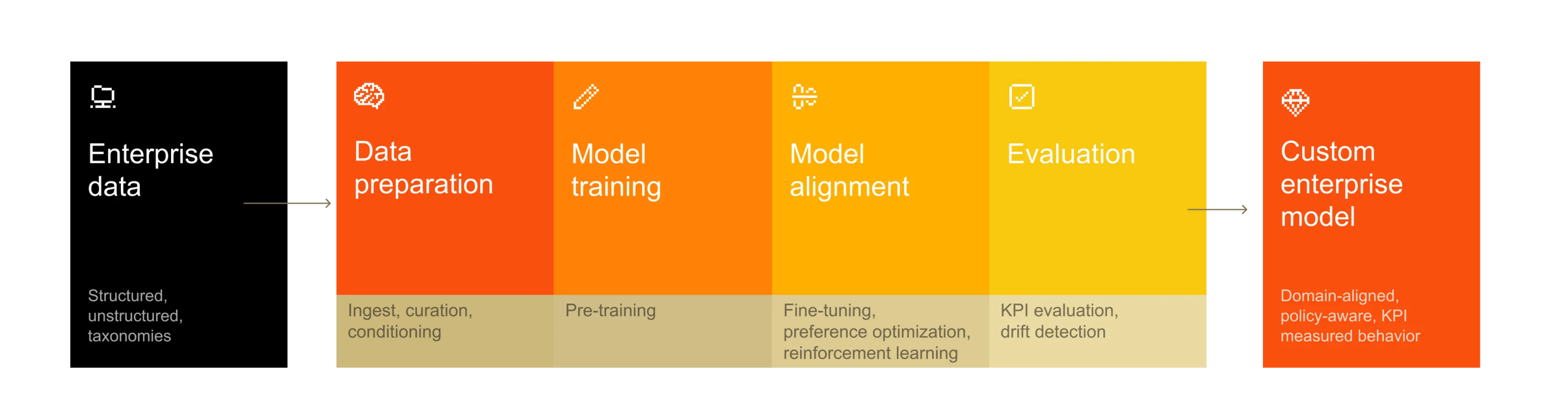
When a model is fused with an organization’s proprietary data and internal logic, it encodes the company’s history into its future workflows. This alignment creates a compounding advantage: a competitive moat built on a model that understands the business intimately. This is more than fine-tuning; it is the institutionalization of expertise into an AI system. This is the power of customization.

Intelligence tuned to context

Every sector operates within its own specific lexicon. In automotive engineering, the “language” of the firm revolves around tolerance stacks, validation cycles, and revision control. In capital markets, reasoning is dictated by risk-weighted assets and liquidity buffers. In security operations, patterns are extracted from the noise of telemetry signals and identity anomalies.

Custom-adapted models internalize the nuances of the field. They recognize which variables dictate a “go/no-go” decision, and they think in the language of the industry.

Domain expertise in action

The transition from general-purpose to tailored AI centers on one goal: encoding an organization’s unique logic directly into a model’s weights.

Mistral AI partners with organizations to incorporate domain expertise into their training ecosystems. A few use cases illustrate customized implementations in practice:

Software engineering and assisting at scale: A network hardware company with proprietary languages and specialized codebases found that out-of-the-box models could not grasp their internal stack. By training a custom model on their own development patterns, they achieved a step function in fluency. Integrated into Mistral’s software development scaffolding, this customized model now supports the entire lifecycle—from maintaining legacy systems to autonomous code modernization via reinforcement learning. This turns once-opaque, niche code into a space where AI reliably assists at scale.

Automotive and the engineering copilot: A leading automotive company uses customization to revolutionize crash test simulations. Previously, specialists spent entire days manually comparing digital simulations with physical results to find divergences. By training a model on proprietary simulation data and internal analyses, they automated this visual inspection, flagging deformations in real time. Moving beyond detection, the model now acts as a copilot, proposing design adjustments to bring simulations closer to real-world behavior and radically accelerating the R&D loop.

Public sector and sovereign AI: In Southeast Asia, a government agency is building a sovereign AI layer to move beyond Western-centric models. By commissioning a foundation model tailored to regional languages, local idioms, and cultural contexts, they created a strategic infrastructure asset. This ensures sensitive data remains under local governance while powering inclusive citizen services and regulatory assistants. Here, customization is the key to deploying AI that is both technically effective and genuinely sovereign.

The blueprint for strategic customization

Moving from a general-purpose AI strategy to a domain-specific advantage requires a structural rethinking of the model’s role within the enterprise. Success is defined by three shifts in organizational logic.

1. Treat AI as infrastructure, not an experiment.  Historically, enterprises have treated model customization as an ad hoc experiment—a single fine-tuning run for a niche use case or a localized pilot. While these bespoke silos often yield promising results, they are rarely built to scale. They produce brittle pipelines, improvised governance, and limited portability. When the underlying base models evolve, the adaptation work must often be discarded and rebuilt from scratch.

In contrast, a durable strategy treats customization as foundational infrastructure. In this model, adaptation workflows are reproducible, version-controlled, and engineered for production. Success is measured against deterministic business outcomes. By decoupling the customization logic from the underlying model, firms ensure that their “digital nervous system” remains resilient, even as the frontier of base models shifts.

    2. Retain control of your own data and models. As AI migrates from the periphery to core operations, the question of control becomes existential. Reliance on a single cloud provider or vendor for model alignment creates a dangerous asymmetry of power regarding data residency, pricing, and architectural updates.

    Enterprises that retain control of their training pipelines and deployment environments preserve their strategic agency. By adapting models within controlled environments, organizations can enforce their own data residency requirements and dictate their own update cycles. This approach transforms AI from a service consumed into an asset governed, reducing structural dependency and allowing for cost and energy optimizations aligned with internal priorities rather than vendor roadmaps.

    3. Design for continuous adaptation. The enterprise environment is never static: regulations shift, taxonomies evolve, and market conditions fluctuate. A common failure is treating a customized model as a finished artifact. In reality, a domain-aligned model is a living asset subject to model decay if left unmanaged.

    Designing for continuous adaptation requires a disciplined approach to ModelOps. This includes automated drift detection, event-driven retraining, and incremental updates. By building the capacity for constant recalibration, the organization ensures that its AI does not just reflect its history, but it evolves in lockstep with its future. This is the stage where the competitive moat begins to compound: the model’s utility grows as it internalizes the organization’s ongoing response to change.

    Control is the new leverage

    We have entered an era where generic intelligence is a commodity, but contextual intelligence is a scarcity. While raw model power is now a baseline requirement, the true differentiator is alignment—AI calibrated to an organization’s unique data, mandates, and decision logic.

    In the next decade, the most valuable AI won’t be the one that knows everything about the world; it will be the one that knows everything about you. The firms that own the model weights of that intelligence will own the market.

    This content was produced by Mistral AI. It was not written by MIT Technology Review’s editorial staff.


    Shape
    Shape
    Stay Ahead

    Explore More Insights

    Stay ahead with more perspectives on cutting-edge power, infrastructure, energy,  bitcoin and AI solutions. Explore these articles to uncover strategies and insights shaping the future of industries.

    Shape

    Why Seattle’s AI ambitions started with a hypervisor migration

    The IT team performed a seven-month analysis of different environments (from full cloud to hybrid), analyzed a half-dozen platforms, projected total-cost-of-ownership (TOC), evaluated feature parity, and mapped out every risk. Ultimately, they settled on Nutanix; Lloyd cited the company’s ability to quickly answer their key questions, collaborate, strategize on AI

    Read More »

    How Lumen is dismantling decades of network complexity

    The first step in transformation was building a unified data layer across all of those sources. Lumen ingested nearly 500 data sources into a common platform and built data objects that link network elements, customer services, cost data and revenue data across what were previously hard organizational and system boundaries.

    Read More »

    Trump Administration Keeps Colorado Coal Plant Open to Ensure Affordable, Reliable and Secure Power in Colorado

    WASHINGTON—U.S. Secretary of Energy Chris Wright today issued an emergency order to keep a Colorado coal plant operational to ensure Americans maintain access to affordable, reliable and secure electricity. The order directs Tri-State Generation and Transmission Association (Tri-State), Platte River Power Authority, Salt River Project, PacifiCorp, and Public Service Company of Colorado (Xcel Energy), in coordination with the Western Area Power Administration (WAPA) Rocky Mountain Region and Southwest Power Pool (SPP), to take all measures necessary to ensure that Unit 1 at the Craig Station in Craig, Colorado is available to operate. Unit One of the coal plant was scheduled to shut down at the end of 2025 but on December 30, 2025, Secretary Wright issued an emergency order directing Tri-State and the co-owners to ensure that Unit 1 at the Craig Station remains available to operate. “The last administration’s energy subtraction policies threatened America’s energy security and positioned our nation to likely experience significantly more blackouts in the coming years—thankfully, President Trump won’t let that happen,” said Energy Secretary Wright. “The Trump Administration will continue taking action to ensure we don’t lose critical generation sources. Americans deserve access to affordable, reliable, and secure energy to power their homes all the time, regardless of whether the wind is blowing or the sun is shining.” Thanks to President Trump’s leadership, coal plants across the country are reversing plans to shut down. In 2025, more than 17 gigawatts (GW) of coal-power electricity generation were saved. On April 1, once Tri-State and the WAPA Rocky Mountain Region join the SPP RTO West expansion, SPP is directed to take every step to employ economic dispatch to minimize costs to ratepayers. According to DOE’s Resource Adequacy Report, blackouts were on track to potentially increase 100 times by 2030 if the U.S. continued to take reliable

    Read More »

    NextDecade contractor Bechtel awards ABB more Rio Grande LNG automation work

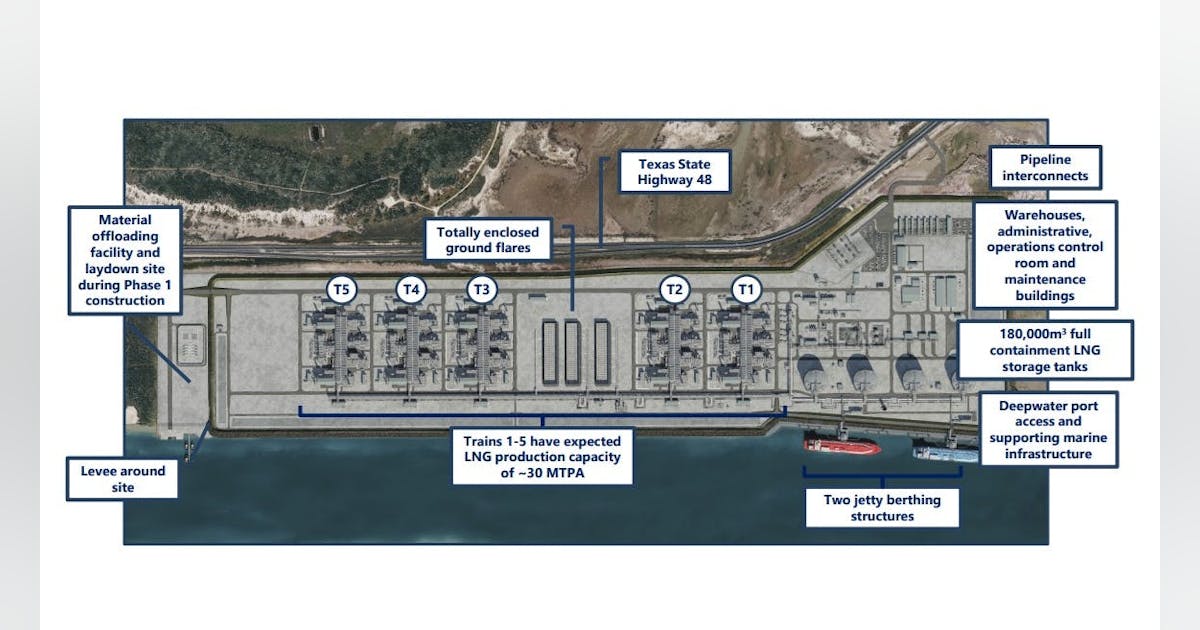
    NextDecade Corp. contractor Bechtel Corp. has awarded ABB Ltd. additional integrated automation and electrical solution orders, extending its scope to Trains 4 and 5 of NextDecade’s 30-million tonne/year (tpy)  Rio Grande LNG (RGLNG) plant in Brownsville, Tex. The orders were booked in third- and fourth-quarters 2025 and build on ABB’s Phase 1 work with Trains 1-3, totaling 17 million tpy.  The scope for RGLNG Trains 4 and 5 includes deployment of an integrated control and safety system consisting of a distributed control system, emergency shutdown, and fire and gas systems. An electrical controls and monitoring system will provide unified visibility of the plant’s electrical infrastructure. These two overarching solutions will provide a common automation platform. ABB will also supply medium-voltage drives, synchronous motors, transformers, motor controllers and switchgear.  The orders also include local equipment buildings—two for Train 4 and one for Train 5— housing critical control and electrical systems in prefabricated modules to streamline installation and commissioning on site. The solutions being delivered to Bechtel use ABB adaptive execution, a methodology for capital projects designed to optimize engineering work and reduce delivery timelines. Phase 1 of RGLNG is under construction and expected to begin operations in 2027. Operations at Train 4 are expected in 2030 and Train 5 in 2031. ABB’s senior vice-president for the Americas, Scott McCay, confirmed to Oil & Gas Journal at CERAWeek by S&P Global in Houston that the company is doing similar work through Tecnimont for Argent LNG’s planned 25-million tpy plant in Port Fourchon, La.; 10-million tpy Phase 1 and 15-million tpy Phase 2. Argent is targeting 2030 completion for its plant.

    Read More »

    Persistent oil flow imbalances drive Enverus to increase crude price forecast

    Citing impacts from the Iran war, near-zero flows through the Strait of Hormuz, accelerating global stock draws, and expectations for a muted US production response despite higher prices, Enverus Intelligence Research (EIR) raised its Brent crude oil price forecast. EIR now expects Brent to average $95/bbl for the remainder of 2026 and $100/bbl in 2027, reflecting what it described as a persistent global oil flow imbalance that continues to draw down inventories. “The world has an oil flow problem that is draining stocks,” said Al Salazar, director of research at EIR. “Whenever that oil flow problem is resolved, the world is left with low stocks. That’s what drives our oil price outlook higher for longer.” The outlook assumes the Strait of Hormuz remains largely closed for 3 months. EIR estimates that each month of constrained flows shifts the price outlook by about $10–15/bbl, underscoring the scale of the disruption and uncertainty around its duration. Despite West Texas Intermediate (WTI) prices of $90–100/bbl, EIR does not expect US producers to materially increase output. The firm forecasts US liquids production growth of 370,000 b/d by end-2026 and 580,000 b/d by end-2027, citing drilling-to-production lags, industry consolidation, and continued capital discipline. Global oil demand growth for 2026 has been reduced to about 500,000 b/d from 1.0 million b/d as higher energy prices and anticipated supply disruptions weigh on economic activity. Cumulative global oil stock draws are estimated at roughly 1 billion bbl through 2027, with non-OECD inventories—particularly in Asia—absorbing nearly half of the impact. A 60-day Jones Act waiver may provide limited short-term US shipping flexibility, but EIR said the measure is unlikely to materially affect global oil prices given broader market forces.

    Read More »

    Equinor begins drilling $9-billion natural gas development project offshore Brazil

    Equinor has started drilling the Raia natural gas project in the Campos basin presalt offshore Brazil. The $9-billion project is Equinor’s largest international investment, its largest project under execution, and marks the deepest water depth operation in its portfolio. The drilling campaign, which began Mar. 24 with the Valaris DS‑17 drillship, includes six wells in the Raia area 200 km offshore in water depths of around 2,900 m. The area is expected to hold recoverable natural gas and condensate reserves of over 1 billion boe. Raia’s development concept is based on production through wells connected to a 126,000-b/d floating production, storage and offloading unit (FPSO), which will treat produced oil/condensate and gas. Natural gas will be transported through a 200‑km pipeline from the FPSO to Cabiúnas, in the city of Macaé, Rio de Janeiro state. Once in operation, expected in 2028, the project will have the capacity to export up to 16 million cu m/day of natural gas, which could represent 15% of Brazil’s natural gas demand, the company said in a release Mar. 24. “While drilling takes place, integration and commissioning activities on the FPSO are progressing well putting us on track towards a safe start of operations in 2028,” said Geir Tungesvik, executive vice-president, projects, drilling and procurement, Equinor. The Raia project is operated by Equinor (35%), in partnership with Repsol Sinopec Brasil (35%) and Petrobras (30%).

    Read More »

    Woodfibre LNG receives additional modules as construction advances

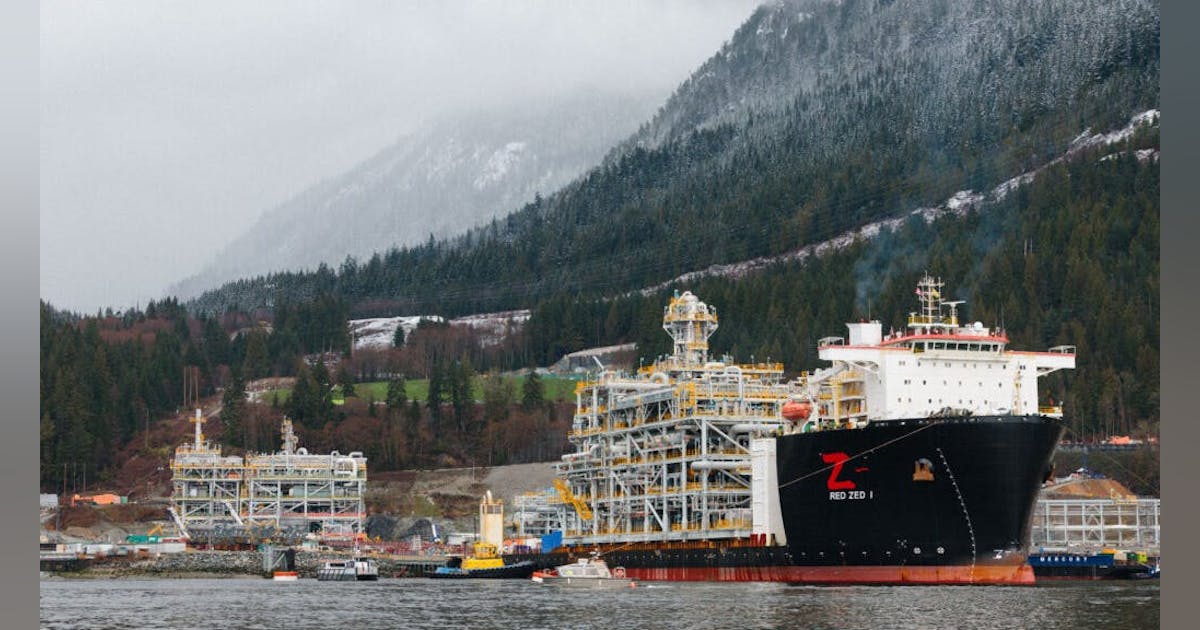
    Woodfibre LNG LP has received two major modules within a week for its under‑construction, 2.1‑million tonne/year (tpy) LNG export plant near Squamish, British Columbia, advancing construction to about 65% complete. The deliveries include the liquefaction module—the project’s heaviest and most critical process unit—and the powerhouse module, which will serve as the plant’s central power and control hub. The liquefaction module, delivered aboard the heavy cargo vessel Red Zed 1, is the 15th of 19 modules scheduled for installation at the site, the company said in a Mar. 24 release. Weighing about 10,847 metric tonnes and occupying a footprint roughly equivalent to a football field, it is among the largest modules fabricated for the project. Once installed and commissioned, the liquefaction module will cool natural gas to about –162°C, converting it into LNG for export. Shortly after the liquefaction module’s arrival, Woodfibre LNG received the powerhouse module, the 16th module delivered to site. Weighing more than 4,200 metric tonnes, the powerhouse module will function as a power and control system, receiving electricity from BC Hydro and managing and distributing power to the plant’s electric‑drive compressors. The Woodfibre LNG project is designed as the first LNG export plant to use electric‑drive motors for liquefaction, replacing conventional gas‑turbine‑driven compressors. The Siemens electric‑drive system will be powered by renewable hydroelectricity from BC Hydro, eliminating the largest operational source of greenhouse gas emissions typically associated with liquefaction, the company said. The project is being built near the community of Squamish on the traditional territory of the Sḵwx̱wú7mesh Úxwumixw (Squamish Nation) and is regulated in part by the Indigenous government.  All 19 modules are expected to arrive on site by spring 2026. Construction is scheduled for completion in 2027. Woodfibre LNG is owned by Woodfibre LNG Ltd. Partnership, which is 70% owned by Pacific Energy Corp.

    Read More »

    ExxonMobil begins Turrum Phase 3 drilling off Australia’s east coast

    @import url(‘https://fonts.googleapis.com/css2?family=Inter:[email protected]&display=swap’); a { color: var(–color-primary-main); } .ebm-page__main h1, .ebm-page__main h2, .ebm-page__main h3, .ebm-page__main h4, .ebm-page__main h5, .ebm-page__main h6 { font-family: Inter; } body { line-height: 150%; letter-spacing: 0.025em; font-family: Inter; } button, .ebm-button-wrapper { font-family: Inter; } .label-style { text-transform: uppercase; color: var(–color-grey); font-weight: 600; font-size: 0.75rem; } .caption-style { font-size: 0.75rem; opacity: .6; } #onetrust-pc-sdk [id*=btn-handler], #onetrust-pc-sdk [class*=btn-handler] { background-color: #c19a06 !important; border-color: #c19a06 !important; } #onetrust-policy a, #onetrust-pc-sdk a, #ot-pc-content a { color: #c19a06 !important; } #onetrust-consent-sdk #onetrust-pc-sdk .ot-active-menu { border-color: #c19a06 !important; } #onetrust-consent-sdk #onetrust-accept-btn-handler, #onetrust-banner-sdk #onetrust-reject-all-handler, #onetrust-consent-sdk #onetrust-pc-btn-handler.cookie-setting-link { background-color: #c19a06 !important; border-color: #c19a06 !important; } #onetrust-consent-sdk .onetrust-pc-btn-handler { color: #c19a06 !important; border-color: #c19a06 !important; } Esso Australia Pty Ltd., a subsidiary of ExxonMobil Corp. and current operator of the Gippsland basin oil and gas fields in Bass Strait offshore eastern Victoria, has started drilling the Turrum Phase 3 project in Australia. This $350-million investment will see the VALARIS 107 jack-up rig drill five new wells into Turrum and North Turrum gas fields within Production License VIC/L03 to support Australia’s east coast domestic gas market. The new wells will be drilled from Marlin B platform, about 42 km off the Gippsland coastline, southeast of Lakes Entrance in water depths of about 60 m, according to a 2025 information bulletin.   <!–> Turrum Phase 3, which builds on nearly $1 billion in recent investment across the Gippsland basin, is expected to be online before winter 2027, the company said in a post to its LinkedIn account Mar. 24. In 2025, Esso made a final investment decision to develop the Turrum Phase 3 project targeting underdeveloped gas resources. The Gippsland Basin joint venture is a 50-50 partnership between Esso Australia Resources and Woodside Energy (Bass Strait) and operated by Esso Australia.  ]–><!–> ]–>

    Read More »

    Q1 Executive Roundtable Recap

    Matt Vincent is Editor in Chief of Data Center Frontier, where he leads editorial strategy and coverage focused on the infrastructure powering cloud computing, artificial intelligence, and the digital economy. A veteran B2B technology journalist with more than two decades of experience, Vincent specializes in the intersection of data centers, power, cooling, and emerging AI-era infrastructure. Since assuming the EIC role in 2023, he has helped guide Data Center Frontier’s coverage of the industry’s transition into the gigawatt-scale AI era, with a focus on hyperscale development, behind-the-meter power strategies, liquid cooling architectures, and the evolving energy demands of high-density compute, while working closely with the Digital Infrastructure Group at Endeavor Business Media to expand the brand’s analytical and multimedia footprint. Vincent also hosts The Data Center Frontier Show podcast, where he interviews industry leaders across hyperscale, colocation, utilities, and the data center supply chain to examine the technologies and business models reshaping digital infrastructure. Since its inception he serves as Head of Content for the Data Center Frontier Trends Summit. Before becoming Editor in Chief, he served in multiple senior editorial roles across Endeavor Business Media’s digital infrastructure portfolio, with coverage spanning data centers and hyperscale infrastructure, structured cabling and networking, telecom and datacom, IP physical security, and wireless and Pro AV markets. He began his career in 2005 within PennWell’s Advanced Technology Division and later held senior editorial positions supporting brands such as Cabling Installation & Maintenance, Lightwave Online, Broadband Technology Report, and Smart Buildings Technology. Vincent is a frequent moderator, interviewer, and keynote speaker at industry events including the HPC Forum, where he delivers forward-looking analysis on how AI and high-performance computing are reshaping digital infrastructure. He graduated with honors from Indiana University Bloomington with a B.A. in English Literature and Creative Writing and lives in southern New Hampshire with

    Read More »

    Executive Roundtable: The AI Infrastructure Credibility Test

    For the fourth installment of DCF’s Executive Roundtable for the First Quarter of 2026, we turn to a question that increasingly sits alongside power and capital as a defining constraint. Credibility. As AI-driven data center development accelerates, public scrutiny is rising in parallel. Communities, regulators, and policymakers are taking a closer look at the industry’s footprintin terms of its energy consumption, its land use, and its broader impact on local infrastructure and ratepayers. What was once a relatively low-profile sector has become a visible and, at times, contested presence in regional economies. This shift reflects the sheer scale of the current build cycle. Multi-hundred-megawatt and gigawatt campuses are no longer theoretical in any sense. They are actively being proposed and constructed across key markets. With that scale comes heightened expectations around transparency, accountability, and tangible community benefit. At the same time, the industry faces a more complex regulatory and political landscape. Questions around grid capacity, rate structures, environmental impact, and economic incentives are increasingly being debated in public forums, from state utility commissions to local zoning boards. In this environment, the ability to secure approvals is no longer assured, even in historically favorable markets. The concept of a “social license to operate” has therefore moved to the forefront. Beyond technical execution, developers and operators must now demonstrate that AI infrastructure can be deployed in a way that aligns with community priorities and delivers shared value. In this roundtable, our panel of industry leaders explores what will define that credibility in the years ahead and what the data center industry must do to sustain its momentum in an era of growing public scrutiny.

    Read More »

    International Data Center Day: Future Frontiers 2030-2070

    In honor of this year’s International Data Center Day 2026 (Mar 25), Data Center Frontier presents a forward-looking vision of what the next era of digital infrastructure education—and imagination—could become. As the media partner of 7×24 Exchange, DCF is committed to elevating both the technical rigor and the human story behind the systems that power the AI age. What follows is not reportage, but a plausible future: a narrative exploration of how the next generation might learn to build, operate, and ultimately redefine data centers—from tabletop scale to lunar megacampuses. International Data Center Day, 2030 The Little Grid That Could They called it “Build the Cloud.” Which, to the adults in the room, sounded like branding. To the kids, it sounded literal. On a gymnasium floor somewhere in suburban Ohio (though it could just as easily have been Osaka, or Rotterdam, or Lagos) thirty-two teams of middle school students crouched over sprawling tabletop worlds the size of model train layouts. Only these weren’t towns with plastic trees and HO-scale diners. These were data centers. Tiny ones. Living ones. Or trying to be. Each team had been given the same kit six weeks earlier: modular rack frames no taller than a juice box, fiber spools thin as thread, micro solar arrays, a handful of millimeter-scale wind turbines, and a small fleet of programmable robotic “operators”—wheeled, jointed, blinking with LED status lights. The assignment had been deceptively simple: Design, build, and operate a self-sustaining data center campus. Then make it come alive. Now it was International Data Center Day, 2030, and the judging had begun. The Sound of Small Machines Thinking If you stood at the edge of the gym and closed your eyes, it didn’t sound like a science fair. It sounded like… something else. A low hum of micro-inverters stepping

    Read More »

    Superconducting the AI Era: Rethinking Power Delivery for Gigawatt Data Centers

    For the data center industry, the AI era has already rewritten the rules around capital deployment, site selection, and infrastructure scale. But as the build cycle accelerates into the gigawatt range, a deeper constraint is coming into focus; one that sits beneath generation, beneath interconnection queues, and even beneath permitting. It is the physical act of moving power. The challenge is no longer simply how to procure energy, but how to deliver it efficiently from the grid edge to the campus, across buildings, and ultimately into racks that are themselves becoming industrial-scale power consumers. In this emerging reality, traditional copper-based distribution systems are beginning to show signs of strain not just economically, but physically. In the latest episode of the Data Center Frontier Show Podcast, MetOx CEO Bud Vos frames this moment as a structural turning point for the industry, one where superconducting technologies may begin to shift from theoretical to practical. “When you start looking at gigawatt-type campuses,” Vos explains, “you find three fundamental constraints in the power distribution problem: the grid interconnect, the campus distribution, and then delivery inside the data hall.” Each of these layers compounds the difficulty of scaling infrastructure in a copper-based world. More capacity means more cables, more trenching, more materials, and more complexity in an exponential expansion of the physical systems required to support AI workloads. A Different Kind of Conductor High-temperature superconducting (HTS) wire offers a radically different path forward. Developed from research originating at the University of Houston and now manufactured through advanced thin-film processes, HTS replaces bulk conductive material with a highly efficient layered structure capable of carrying dramatically higher current densities. Vos describes the manufacturing approach in familiar terms for a data center audience: “You can think of it as a semiconductor process. We’re creating thin film depositions on

    Read More »

    DCF Poll: AI Data Center Assumptions

    Matt Vincent is Editor in Chief of Data Center Frontier, where he leads editorial strategy and coverage focused on the infrastructure powering cloud computing, artificial intelligence, and the digital economy. A veteran B2B technology journalist with more than two decades of experience, Vincent specializes in the intersection of data centers, power, cooling, and emerging AI-era infrastructure. Since assuming the EIC role in 2023, he has helped guide Data Center Frontier’s coverage of the industry’s transition into the gigawatt-scale AI era, with a focus on hyperscale development, behind-the-meter power strategies, liquid cooling architectures, and the evolving energy demands of high-density compute, while working closely with the Digital Infrastructure Group at Endeavor Business Media to expand the brand’s analytical and multimedia footprint. Vincent also hosts The Data Center Frontier Show podcast, where he interviews industry leaders across hyperscale, colocation, utilities, and the data center supply chain to examine the technologies and business models reshaping digital infrastructure. Since its inception he serves as Head of Content for the Data Center Frontier Trends Summit. Before becoming Editor in Chief, he served in multiple senior editorial roles across Endeavor Business Media’s digital infrastructure portfolio, with coverage spanning data centers and hyperscale infrastructure, structured cabling and networking, telecom and datacom, IP physical security, and wireless and Pro AV markets. He began his career in 2005 within PennWell’s Advanced Technology Division and later held senior editorial positions supporting brands such as Cabling Installation & Maintenance, Lightwave Online, Broadband Technology Report, and Smart Buildings Technology. Vincent is a frequent moderator, interviewer, and keynote speaker at industry events including the HPC Forum, where he delivers forward-looking analysis on how AI and high-performance computing are reshaping digital infrastructure. He graduated with honors from Indiana University Bloomington with a B.A. in English Literature and Creative Writing and lives in southern New Hampshire with

    Read More »

    A Faster Path to Power: What Natrium’s NRC Approval Means for AI Infrastructure

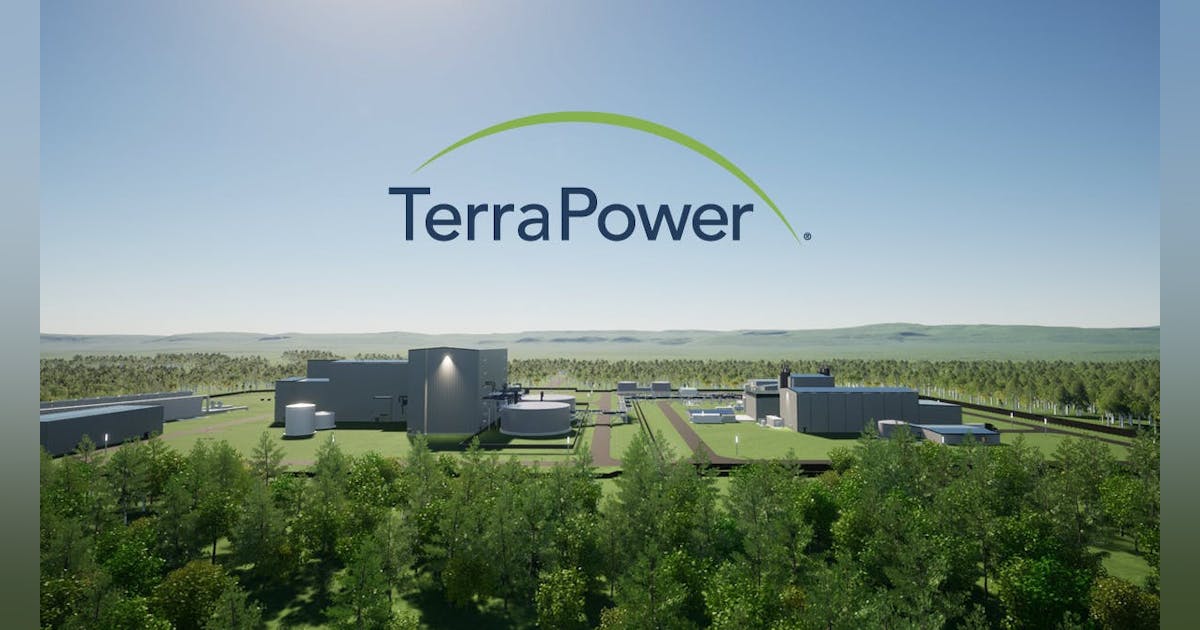
    The race to build AI infrastructure at scale has exposed a deeper constraint than capital or compute: power that can be delivered on predictable timelines. That constraint is now colliding with a system that has historically moved at the pace of decades. But in early March, a key signal emerged that the equation may be starting to change. A Regulatory Breakthrough at the Moment of Peak Power Demand TerraPower’s Natrium reactor cleared a major milestone with the Nuclear Regulatory Commission, which approved a construction permit for Kemmerer Power Station Unit 1 in Wyoming, representing the company’s first commercial-scale plant. It is the first reactor construction approval the NRC has granted in nearly a decade, and the first for a commercial non-light-water reactor in more than 40 years. More significantly, it is the first advanced reactor to reach this stage under the modern U.S. licensing framework. For an industry increasingly defined by gigawatt-scale AI campuses and compressed build cycles, that milestone lands with unusual timing. Construction Approved — But Not Yet ‘Power Delivered’ The distinction between construction approval and operational readiness is critical. TerraPower has not received a license to generate electricity. What the NRC has granted is permission to begin nuclear-related construction at the Kemmerer site, following safety and environmental review. Before the plant can operate, TerraPower’s subsidiary, US SFR Owner, must still secure a separate operating license. But in practical terms, this is the moment when a project transitions from concept to execution. It is a regulatory green light not for power generation, but for steel, concrete, and capital deployment. And in the context of advanced nuclear, that step has historically been the hardest to reach. An 18-Month Signal to the Market The speed of that approval may ultimately matter as much as the approval itself. TerraPower submitted its construction

    Read More »

    Microsoft will invest $80B in AI data centers in fiscal 2025

    And Microsoft isn’t the only one that is ramping up its investments into AI-enabled data centers. Rival cloud service providers are all investing in either upgrading or opening new data centers to capture a larger chunk of business from developers and users of large language models (LLMs).  In a report published in October 2024, Bloomberg Intelligence estimated that demand for generative AI would push Microsoft, AWS, Google, Oracle, Meta, and Apple would between them devote $200 billion to capex in 2025, up from $110 billion in 2023. Microsoft is one of the biggest spenders, followed closely by Google and AWS, Bloomberg Intelligence said. Its estimate of Microsoft’s capital spending on AI, at $62.4 billion for calendar 2025, is lower than Smith’s claim that the company will invest $80 billion in the fiscal year to June 30, 2025. Both figures, though, are way higher than Microsoft’s 2020 capital expenditure of “just” $17.6 billion. The majority of the increased spending is tied to cloud services and the expansion of AI infrastructure needed to provide compute capacity for OpenAI workloads. Separately, last October Amazon CEO Andy Jassy said his company planned total capex spend of $75 billion in 2024 and even more in 2025, with much of it going to AWS, its cloud computing division.

    Read More »

    John Deere unveils more autonomous farm machines to address skill labor shortage

    Join our daily and weekly newsletters for the latest updates and exclusive content on industry-leading AI coverage. Learn More Self-driving tractors might be the path to self-driving cars. John Deere has revealed a new line of autonomous machines and tech across agriculture, construction and commercial landscaping. The Moline, Illinois-based John Deere has been in business for 187 years, yet it’s been a regular as a non-tech company showing off technology at the big tech trade show in Las Vegas and is back at CES 2025 with more autonomous tractors and other vehicles. This is not something we usually cover, but John Deere has a lot of data that is interesting in the big picture of tech. The message from the company is that there aren’t enough skilled farm laborers to do the work that its customers need. It’s been a challenge for most of the last two decades, said Jahmy Hindman, CTO at John Deere, in a briefing. Much of the tech will come this fall and after that. He noted that the average farmer in the U.S. is over 58 and works 12 to 18 hours a day to grow food for us. And he said the American Farm Bureau Federation estimates there are roughly 2.4 million farm jobs that need to be filled annually; and the agricultural work force continues to shrink. (This is my hint to the anti-immigration crowd). John Deere’s autonomous 9RX Tractor. Farmers can oversee it using an app. While each of these industries experiences their own set of challenges, a commonality across all is skilled labor availability. In construction, about 80% percent of contractors struggle to find skilled labor. And in commercial landscaping, 86% of landscaping business owners can’t find labor to fill open positions, he said. “They have to figure out how to do

    Read More »

    2025 playbook for enterprise AI success, from agents to evals

    Join our daily and weekly newsletters for the latest updates and exclusive content on industry-leading AI coverage. Learn More 2025 is poised to be a pivotal year for enterprise AI. The past year has seen rapid innovation, and this year will see the same. This has made it more critical than ever to revisit your AI strategy to stay competitive and create value for your customers. From scaling AI agents to optimizing costs, here are the five critical areas enterprises should prioritize for their AI strategy this year. 1. Agents: the next generation of automation AI agents are no longer theoretical. In 2025, they’re indispensable tools for enterprises looking to streamline operations and enhance customer interactions. Unlike traditional software, agents powered by large language models (LLMs) can make nuanced decisions, navigate complex multi-step tasks, and integrate seamlessly with tools and APIs. At the start of 2024, agents were not ready for prime time, making frustrating mistakes like hallucinating URLs. They started getting better as frontier large language models themselves improved. “Let me put it this way,” said Sam Witteveen, cofounder of Red Dragon, a company that develops agents for companies, and that recently reviewed the 48 agents it built last year. “Interestingly, the ones that we built at the start of the year, a lot of those worked way better at the end of the year just because the models got better.” Witteveen shared this in the video podcast we filmed to discuss these five big trends in detail. Models are getting better and hallucinating less, and they’re also being trained to do agentic tasks. Another feature that the model providers are researching is a way to use the LLM as a judge, and as models get cheaper (something we’ll cover below), companies can use three or more models to

    Read More »

    OpenAI’s red teaming innovations define new essentials for security leaders in the AI era

    Join our daily and weekly newsletters for the latest updates and exclusive content on industry-leading AI coverage. Learn More OpenAI has taken a more aggressive approach to red teaming than its AI competitors, demonstrating its security teams’ advanced capabilities in two areas: multi-step reinforcement and external red teaming. OpenAI recently released two papers that set a new competitive standard for improving the quality, reliability and safety of AI models in these two techniques and more. The first paper, “OpenAI’s Approach to External Red Teaming for AI Models and Systems,” reports that specialized teams outside the company have proven effective in uncovering vulnerabilities that might otherwise have made it into a released model because in-house testing techniques may have missed them. In the second paper, “Diverse and Effective Red Teaming with Auto-Generated Rewards and Multi-Step Reinforcement Learning,” OpenAI introduces an automated framework that relies on iterative reinforcement learning to generate a broad spectrum of novel, wide-ranging attacks. Going all-in on red teaming pays practical, competitive dividends It’s encouraging to see competitive intensity in red teaming growing among AI companies. When Anthropic released its AI red team guidelines in June of last year, it joined AI providers including Google, Microsoft, Nvidia, OpenAI, and even the U.S.’s National Institute of Standards and Technology (NIST), which all had released red teaming frameworks. Investing heavily in red teaming yields tangible benefits for security leaders in any organization. OpenAI’s paper on external red teaming provides a detailed analysis of how the company strives to create specialized external teams that include cybersecurity and subject matter experts. The goal is to see if knowledgeable external teams can defeat models’ security perimeters and find gaps in their security, biases and controls that prompt-based testing couldn’t find. What makes OpenAI’s recent papers noteworthy is how well they define using human-in-the-middle

    Read More »