Stay Ahead, Stay ONMINE

Why worms (and microbes) are catching on as a manure pollution solution

Anthony Agueda, a third-generation California dairy farmer, pulls a rake through a bed of dark, wet wood chips on his family’s land in Hickman, a tiny town in the state’s agricultural heartland. He reaches down with both hands and pulls up a clump of muck, turning it over to reveal a half-dozen squirming red earthworms. There are likely hundreds of thousands more wriggling just under the surface of the three-foot mound of wood and crushed river rock before us, which stretches across the equivalent of six football fields. These natural materials form a biofilter that may dramatically cut the methane, nitrous oxide, and water pollution generated by the massive amounts of manure that hundreds of Holstein cows produce each day. Agueda’s family business, the Alberto Dairy, was one of the first cattle operations in California to adopt this approach to manure treatment, developed and patented by the Chilean company BioFiltro. Eight more of these so-called vermifiltration systems are already operating on US dairies, according to the company, while another 16 are under construction or set to be next year, nearly all of them in California.  Vermifiltration is just one of a variety of methods that farmers, companies, and scientists are employing to drive down manure pollution as the livestock industry faces growing pressure to address the environmental harms from one of the smelliest parts of the business. California, easily the nation’s largest milk producer, has established a handful of programs to promote their adoption, including one initiative that has funneled more than a billion dollars to farms. Researchers stress that much more work needs to be done to determine the most effective approaches, the trade-offs between them, and their success over the long term, under actual farm conditions. Agueda says that he and his family recognized the need to adopt new practices as environmental rules tightened. They were drawn to vermifiltration because it’s simple and relatively cheap compared with other, higher-tech options. “California daily farmers are constantly facing more and more regulation,” says Agueda, standing alongside one of the farm’s free-stall barns. “This makes me excited, because it shows how we are part of the solution.” The growing manure problem Manure is responsible for a significant portion of the climate pollution from livestock operations. The World Resources Institute estimates that manure management on dairy and swine farms accounts for 1.6% of the US’s greenhouse-gas emissions. Globally, manure storage and processing makes up about 10% of the livestock industry’s contributions to climate change.  “Farms have become larger in the past two decades or so, so there’s much more manure—and that has to be stored somewhere,” says Swati Hegde, the organization’s global manager of agricultural methane. Typically, cattle and swine farms spray manure into lagoons or tanks, creating a foul-smelling, low-oxygen slurry in which microorganisms known as methanogens thrive. They gobble up hydrogen, carbon dioxide, and other compounds and produce methane as a by-product. Other microbes in the mix produce smaller amounts of nitrous oxide. A pair of Holstein cows poke their heads through the rails of a free-stall barn at the Alberto Dairy.JOE PROUDMAN/UC DAVIS Both are particularly potent greenhouse gases, with as much as 30 to nearly 275 times the warming power of carbon dioxide, respectively, over a century. The slurry is often spread onto fields to add nutrients to the soil. When it’s done excessively or improperly, this part of the practice can pollute soil or groundwater with drug residues, pathogens like salmonella and E. coli, and nitrates. Nitrates that leach into drinking water have been linked to a variety of human health risks. And those that flow into rivers, lakes, and coastal waters can spawn algae blooms that poison fish, block sunlight, suck up oxygen, or form large coastal dead zones devoid of marine life. Policy drivers A number of regions, nations, and states have passed regulations or offered subsidies designed to limit the pollution from livestock manure, but so far, most of the major initiatives have focused on water contamination rather than greenhouse-gas emissions. The European Union, for instance, restricts the amount of manure that farmers can apply to fields and requires member nations to monitor nitrate levels in ground and surface water. The US’s Clean Water Act requires large livestock operations to obtain permits and develop manure management plans that limit pollution.  But California has arguably done the most to use government policy specifically to drive down the methane emissions from livestock. The dairy industry accounts for about 45% of the state’s pollution from the potent greenhouse gas, and more than half of that comes from manure, according to the government’s estimates.  In 2016, the state enacted a law that requires dairies, landfills, and other businesses to cut methane emissions 40% below 2013 levels by 2030, as part of a broader effort to reduce pollution from powerful but short-lived greenhouse gases. The measure directed the California Air Resources Board, the state’s main climate regulatory agency, to set up various incentive programs to encourage these industries to shift to cleaner practices.  “In terms of bang for your buck, short-term benefits, methane can go a long way toward reaching climate goals,” says Tawny Mata, director of California’s Office of Agricultural Resilience and Sustainability.  Between these various programs—and falling livestock numbers in the state—the dairy sector is on track to reduce annual methane emissions by the equivalent of 5 million metric tons of carbon dioxide by 2030, the state estimates. That would still fall about 4 million tons short of the target under the 2016 law. The downsides of dairy digesters Excluding the decline in herd populations—which has been driven by growing international competition and rising costs—the vast majority of California’s estimated methane reductions come from the use of what are known as anaerobic digesters. This technology entails covering the slurry lagoons to prevent methane from leaking into the air and then piping the biogas into separate vessels, where it’s cleaned and converted into natural gas.  Under California’s Low Carbon Fuel Standard program, dairies that use digesters to produce gas delivered into pipelines can earn credits and sell them to petroleum refineries and other major polluters, as a means of helping those companies meet their own emissions reduction requirements.  The gas can then fuel power plants, produce hydrogen, or power natural-gas vehicles. These uses still release carbon dioxide, but the state considers it a climate win because it avoids the release of methane, which traps even more heat.  The rich revenue stream from California’s program has spurred hundreds of US farms to install anaerobic digesters over the last decade. Since 2020, it has produced more than $1 billion for farms, Cal Poly researchers noted in a paper last year. But there are a variety of concerns about this approach. The first is that it’s viable only for farms with about 2,000 cattle or more, because the equipment is very expensive to install, says Frank Mitloehner, a professor and chair of the Department of Animal Science at the University of California, Davis. “For the lion’s share of dairies, digesters will not be a solution,” he says.  Since the manure is often still spread across fields, digesters also do little to address the water pollution problems—and can even exacerbate them because of some of the chemistry that occurs during that process.  Yet the huge subsidies flowing to digesters have steered money, energy, and attention away from other solutions that may offer better overall environmental outcomes, says Danny Cullenward, a senior fellow with the Kleinman Center for Energy Policy at the University of Pennsylvania, who has closely studied the California program. “That is really not a solution at scale, and it’s diverting a huge fraction of precious resources to what I think is mostly not the right answer,” he says.  Alternatives The high up-front costs and limitations of digesters have spawned growing interest in alternative solutions—many of which work by reducing the formation of methane in the first place instead of turning that methane into a sellable fuel. One of the cheapest, easiest, and most popular approaches, known as solid separation, uses simple machinery like a screw press to squeeze much of the water out of the manure slurry. The remaining solids are dry and exposed to open air, shifting away from the oxygen-free conditions in which methane is readily produced. Other methods include increasing acidity in lagoons, bubbling air through them, or adding methane-eating microbes to the slurry, all of which alter the chemistry in ways that promise to reduce the amount of methane released. One company, Sedron Technologies of Sedro-Woolley, Washington, has also developed a sort of high-tech solid separation approach that extracts several marketable products from the animal waste, including a liquid organic fertilizer.   The state of California set up a pair of additional programs to help smaller farmers adopt some of these other approaches, dubbed the Alternative Manure Management Program and the Dairy Plus Program. The bulk of the funds have gone to solid separation systems. But the state has provided more than $18 million to support 15 vermifiltration projects. The Alberto Dairy has received nearly $2 million between the two programs. Oreo cows As I drove down a dusty road bordering the dairy, black-and-white bovines, affectionately known as Oreo cows, stretched their heads through the rails of an open barn, nibbling on golden silage scattered along the structure. Agueda’s grandfather Antonio Alberto founded the dairy 45 years ago in nearby Atwater, California, but eventually settled in Hickman, population 604, in 1989.  A series of large metal contraptions separate most of the solids from the manure wastewater.JOE PROUDMAN/UC DAVIS It was mid-March but already above 80 °F in the Central Valley, which is walled off from the cool Pacific air by the coastal mountain range. Knee-high oat stalks swayed in fields that stretched to a line of almond trees in the distance. Agueda, who graduated from Fresno State last year and now helps lead the operations on the farm, met me and UC Davis’s Mitloehner, who has studied the effects of vermifiltration, along the side of the barn. (UC Davis has no affiliation with the farm, but the university helped facilitate the meeting.) He led us along dirt lanes as he explained the workings of the vermifiltration system, which they began using in October 2024.   As before, a flush system washes manure from the floors of the barns into a large collection pit. But now a set of pumps funnels it through a series of large V-shaped metal contraptions standing on a nearby concrete pad, where mechanical screens separate most of the solids from the water. A conveyor belt takes away the solids, which the farm composts for cow bedding or fertilizer. The remaining liquid moves through a system of pipes, first to settling ponds and then on to an irrigation system suspended above the vermifiltration beds. The long, tubular structure runs over the mounds on wheels set in gravel tracks, wetting the wood chips as it goes. The worms and various microbes residing in the biofilter then set to work consuming much of the remaining solid material, according to BioFiltro. An irrigation system sprinkles wastewater onto the vermifiltration beds.JOE PROUDMAN/UC DAVIS “Once the water is sprinkled on top, it takes about four hours from beginning to end for it to percolate through and drain to the end,” Agueda says. He then defers to Mitloehner to explain the science of what happens as it does, adding, “I’m just the dairyman.” The science Mitloehner says he was skeptical of BioFiltro’s claims when he first heard them, particularly the assertion that the system could nearly eliminate nitrogen and, with it, the various forms of pollution it can produce, including ammonia and nitrates.  So he decided to study a similar setup at the Fanelli Dairy, an operation in Hilmar, California, about 20 miles to the south. He and colleagues monitored the emissions from wastewater samples that were taken from the system before and after the liquid moved through the filter. In a paper published in 2018, the researchers concluded that vermifiltration reduced ammonia emissions from the resulting water by about 90%. BioFiltro, whose tagline is “worm-powered solutions,” states that its technology “catalyzes the digestive power of worms and microbes to remove up to 99% of wastewater contaminants.” But Mitloehner questions how big a role the invertebrates play in the process, calling it “kind of a catchy narrative.” His take is simpler: The rocks and wood chips form a porous filter that replaces the anaerobic environment of a manure lagoon with an aerobic one. And in that oxygen-rich environment, different types of microbes thrive.  His study suggests that these microbes are highly effective at converting nitrogen compounds in manure into nitrogen gas—a benign gas that makes up 78% of Earth’s atmosphere—instead of ammonia. That’s notable because while ammonia in manure acts as a fertilizer when it’s applied to fields, it also converts into the nitrates that can leach into groundwater. Several more recent studies, which were partially or fully funded by BioFiltro and one of its regional distribution partners, Organix, produced similarly promising results. For instance, a 2022 study in Bioresource Technology Reports, also conducted at the Fanelli Dairy, concluded that the filter removed nearly 85% of the nitrogen in the operation’s wastewater.  But a befuddling wrinkle is that when it came to methane, those studies and Mitloehner’s independent one found nearly opposite results. While both the company- and partner-supported studies concluded that the filter eliminated the vast majority of methane pollution, Mitloehner’s study found that methane emissions were nearly 85% higher than those from the lagoon.  In a follow-up email exchange, Mitloehner stressed that it’s not appropriate to compare his results with those that emerged from the other study at the same dairy, because the teams used very different methods, instruments, and measurement periods. Moreover, the focus of his research was the effect on nitrogen. Anthony Agueda pulls a rake through a vermifiltration bed at his family’s dairy.JOE PROUDMAN/UC DAVIS He said it’s “entirely reasonable” and “biologically plausible” that vermifiltration could substantially reduce methane emissions, simply by creating that aerobic environment. “That said, I would be cautious about calling the magnitude of the reduction a fully settled issue,” he added. “While the available studies, including those you mentioned, point in the same general direction, the number of independent studies remains relatively limited, and results can vary.” Patrick Beckett, BioFiltro’s vice president of quality and R&D, also stressed that there were crucial differences in the methodology of Mitloehner’s study that could have affected his methane findings.In addition, he said the Organix funding came by way of a Washington state grant and described that study and the one BioFiltro supported as “high quality, peer reviewed” research that “has been submitted to other technical third parties for review and acceptance.” Beckett says he agrees that additional independent reviews of BioFiltro’s systems is “fair and necessary” and notes that other studies have occurred or are underway.   “That said,” Beckett wrote in an emailed response to questions from MIT Technology Review, “it seems unreasonable that BioFiltro would be held to a standard of not being allowed to invest in technical research by qualified third parties to learn more about the capabilities of our technology, and use the results of that research to enter new markets and to understand the value we can bring to projects or entire industries beyond water treatment.” Milk money BioFiltro is already building a business model around the available findings. The company, founded in 2009, has been selling its vermifiltration systems or services to other industries around the world for years. It says there are around 225 operating in nine countries, at sites including municipal wastewater facilities, wineries, fruit processors, and other industrial operations. But BioFiltro, whose US headquarters are in Davis, California, is seeing increasing demand among dairies as the industry faces growing pressure to address manure pollution. Late last year, it raised $35 million that the business says it will use, in large part, to accelerate its growth across the sector. In an interview, Sarah Ploss, the company’s senior vice president of agriculture, explains the basic financial template for how it works with dairies: BioFiltro pays for, owns, installs, and operates the system. The farm, in turn, covers a share of the additional electricity, operations, and maintenance costs.  Ploss says the dairy gets back clean water and the ability to focus on what it does best: producing milk. For its part, BioFiltro can generate carbon credits from the reduction in greenhouse gases, which it can then sell to makers of consumer packaged goods that are looking for ways to address the emissions throughout their supply chains, she says. BioFiltro says that Verra, which sets standards for and assesses greenhouse-gas crediting projects, has registered two of its projects: the Royal Dairy and Moxee Dairy, both in Washington. The Swiss confectionary giant Nestlé has bought more than 150,000 credits generated by the Royal Dairy’s vermifiltration system, according to an offsets database managed by CarbonPlan, which assesses the scientific integrity of climate action programs. Ploss said that BioFiltro has sold more than 200,000 credits from the project so far, and adds that it secured a different buyer for a project in California, which she said she couldn’t name.  The vermifiltration system has cleaned up the water that circulates through various parts of the Alberto Dairy operation.JOE PROUDMAN/UC DAVIS Three additional projects involving BioFiltro systems took the initial steps to become registered through Verra but didn’t move forward and weren’t built, Ploss said in an email. The request for registration for the Alberto Dairy estimates that the system there will reduce emissions by the equivalent of more than 30,000 metric tons of carbon dioxide per year.  BioFiltro could take advantage of another revenue source as well: selling what it calls vermicompost, a rich soil additive composed of the leftover materials in the biofilter, including worm castings—a combination of cocoons, excrement, and remains. At retail, worm castings can run more than $500 per ton. Beckett says the company is still developing that market but notes that it could help the industry offset rising fertilizer costs.  “I think we’re going to enable a larger-scale use and adoption of it that could be meaningful to agriculture,” he says, adding: “These will become basically soil production facilities.”  Concerns Determining how well vermifiltration and other manure management approaches work will require more time and more research, experts say.  Katharine Dickson, an agricultural emissions scientist who recently finished a postdoctoral program at UC Davis, says there should be in-the-field accounting to ensure that any of these methods are working as well as hoped—or to the degree government policy programs assume. All of which is tricky to achieve given the dynamic biological processes playing out in live animals and microbial communities on open farms, she adds. “Vermifiltration, for example, depends on a live earthworm population whose performance is sensitive to temperature, moisture, and toxicity, and can shift with seasonal conditions or changes in herd size and manure characteristics on a given farm,” Dickson said in an email.  The use of carbon credits to earn money from vermifiltration projects raises a different set of potential concerns. Most notably, if the methane decreases aren’t as significant as assumed, the projects could receive more credits than they deserve.  There are more complicated issues as well. For the carbon credit system to make any real difference in the net amount of greenhouse gas in the atmosphere, it must produce emissions reductions that wouldn’t have occurred without that financial incentive. If it was going to happen anyway—as a result, say, of rich grants, legal pressures, or looming policies—the buyer of the credits can’t legitimately claim to have made any progress on its own climate emissions, says Grayson Badgley, a research scientist at CarbonPlan. On that point, if California agriculture doesn’t meet its looming methane reduction targets, the carrots the state offers could be replaced by sticks: The California Air Resources Board recently began discussing rules that would force, rather than nudge, the sector to meet the 40% reduction required under the 2016 law. “If lots of dairies are cleaning up their act ahead of pending regulation, it really does seem like the regulation, not offsets, is driving that action,” Badgley wrote in an email. “Trying to collect as many offsets prior to that deadline might adhere to the rules of the market, while still raising questions about whether those rules have enabled real climate action.” Investing in sustainability  Beckett disagreed that the possibility of forthcoming regulations undermines the case for generating carbon credits from current projects.  “It’s true the state has net reduction targets that it hopes to meet, but it’s clear the state of California has favored market-based solutions and tried to provide some support via grant programs,” he wrote. “I’m on the science side of our business, not the business development side, but still think I can tell you with complete transparency that we would not have systems installed on [California] dairies without the sale of voluntary carbon credits.” Ploss also stressed that the company goes through a careful “validation and verification process” on the farms to understand how much vermifiltration reduces greenhouse gases. “We’ve got sensors and cameras and all sorts of stuff so that we can look into any of our systems, 24-7,” Ploss says. “We know through sampling. We know through what’s going through the system, what came out of the system. We know by all the measurements on any given month: What did that system do in terms of generating carbon credits?” Agueda also disputes the critique.  “The installation of the vermifiltration system would not have occurred without the ability to generate carbon credits,” he said in an email. “The project required a substantial capital investment, and the anticipated carbon credit revenue was a key factor in making the investment financially feasible.” Anthony Agueda helps to lead the operations at the Alberto Dairy.JOE PROUDMAN/UC DAVIS California decided to incentivize vermifiltration, along with other approaches, because it can offer multiple benefits, including cleaner water, less nitrogen, and lower greenhouse-gas emissions, while also creating economic value from manure, wrote Roberta Franco, a senior environmental scientist at the California Department of Food and Agriculture, in an emailed response to questions from MIT Technology Review. She added that the decision was based on a number of studies as well as the 2022 recommendations from a task force composed of scientists, technical experts, and others.  Even if California has made missteps, most notably in funneling too much money to anaerobic digesters at the expense of other methods, it’s created a test lab that’s achieved real progress and provided lessons that other regions can learn from.One way or another, more parts of the world will need to set up similar programs, offering greater support or creating stricter rules, if we hope to really drive down the emissions from manure, says Maria Bowman, who leads the Agricultural Nitrogen Transformation Program at Spark Climate, a San Francisco nonprofit. For his part, Agueda says that the vermifiltration system has offered a number of benefits to his family’s farm, at little additional cost to them. By cleaning up the water that cycles back through their flush and irrigation systems, the biofilter has reduced clogging, decreased odors, and improved the health of the herd.   He says that each generation modernizes dairy farming in its own way. His father and uncle, for instance, incorporated computers and data management systems into the daily operations of the Alberto Dairy. He believes it’s the responsibility of his generation to make a similar effort to reduce the pollution that’s long plagued the sector. “We knew that in the next generation we have to invest in environmental sustainability,” he says. “We didn’t know if it was gonna work or not, but we’re very happy with how it’s turned out.”

Anthony Agueda, a third-generation California dairy farmer, pulls a rake through a bed of dark, wet wood chips on his family’s land in Hickman, a tiny town in the state’s agricultural heartland.

He reaches down with both hands and pulls up a clump of muck, turning it over to reveal a half-dozen squirming red earthworms. There are likely hundreds of thousands more wriggling just under the surface of the three-foot mound of wood and crushed river rock before us, which stretches across the equivalent of six football fields. These natural materials form a biofilter that may dramatically cut the methane, nitrous oxide, and water pollution generated by the massive amounts of manure that hundreds of Holstein cows produce each day.

Agueda’s family business, the Alberto Dairy, was one of the first cattle operations in California to adopt this approach to manure treatment, developed and patented by the Chilean company BioFiltro. Eight more of these so-called vermifiltration systems are already operating on US dairies, according to the company, while another 16 are under construction or set to be next year, nearly all of them in California. 

Vermifiltration is just one of a variety of methods that farmers, companies, and scientists are employing to drive down manure pollution as the livestock industry faces growing pressure to address the environmental harms from one of the smelliest parts of the business. California, easily the nation’s largest milk producer, has established a handful of programs to promote their adoption, including one initiative that has funneled more than a billion dollars to farms.

Researchers stress that much more work needs to be done to determine the most effective approaches, the trade-offs between them, and their success over the long term, under actual farm conditions.

Agueda says that he and his family recognized the need to adopt new practices as environmental rules tightened. They were drawn to vermifiltration because it’s simple and relatively cheap compared with other, higher-tech options.

“California daily farmers are constantly facing more and more regulation,” says Agueda, standing alongside one of the farm’s free-stall barns. “This makes me excited, because it shows how we are part of the solution.”

The growing manure problem

Manure is responsible for a significant portion of the climate pollution from livestock operations. The World Resources Institute estimates that manure management on dairy and swine farms accounts for 1.6% of the US’s greenhouse-gas emissions. Globally, manure storage and processing makes up about 10% of the livestock industry’s contributions to climate change. 

“Farms have become larger in the past two decades or so, so there’s much more manure—and that has to be stored somewhere,” says Swati Hegde, the organization’s global manager of agricultural methane.

Typically, cattle and swine farms spray manure into lagoons or tanks, creating a foul-smelling, low-oxygen slurry in which microorganisms known as methanogens thrive. They gobble up hydrogen, carbon dioxide, and other compounds and produce methane as a by-product. Other microbes in the mix produce smaller amounts of nitrous oxide.
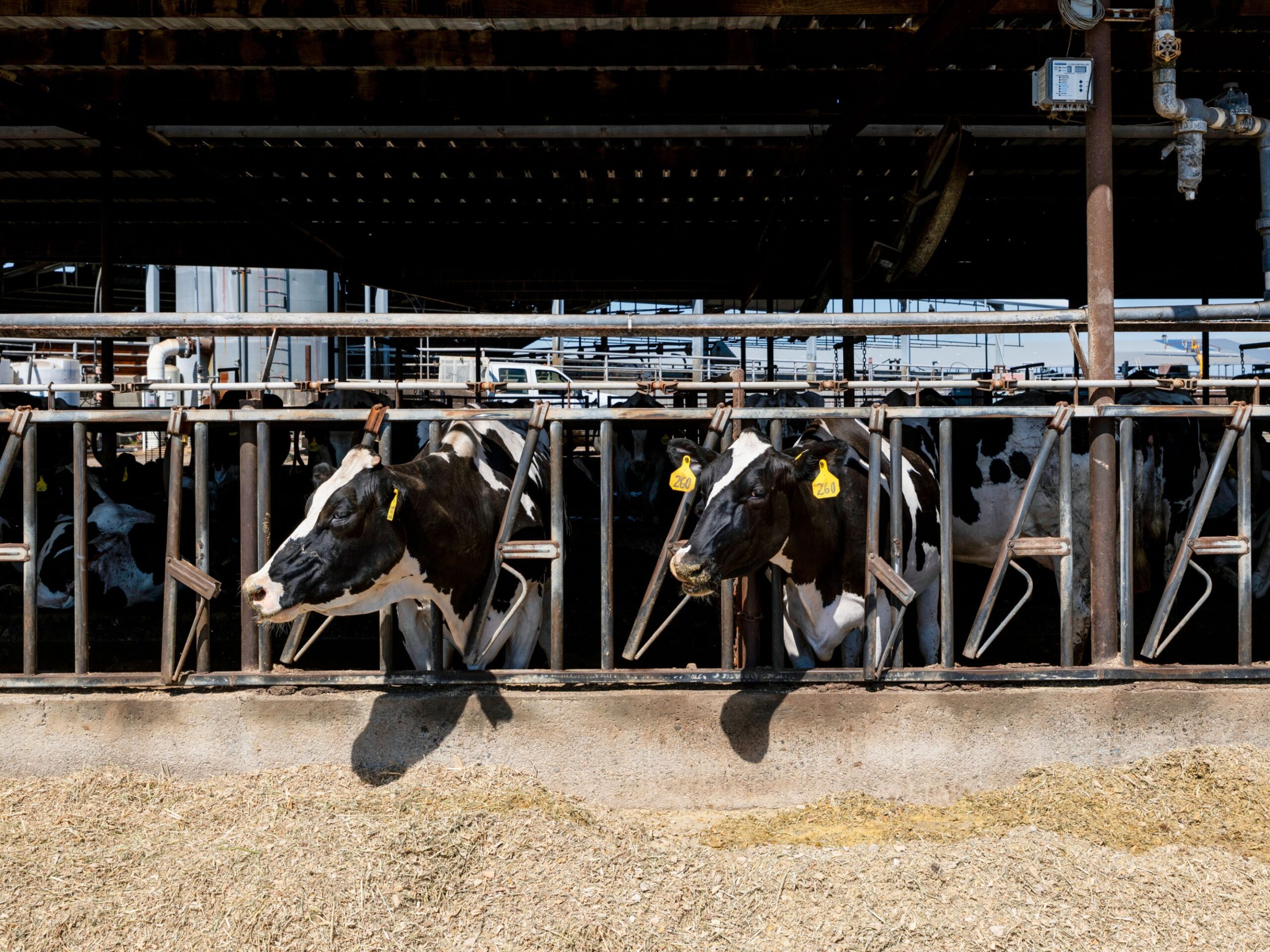
A pair of Holstein cows poke their heads through the rails of a free-stall barn at the Alberto Dairy.
JOE PROUDMAN/UC DAVIS

Both are particularly potent greenhouse gases, with as much as 30 to nearly 275 times the warming power of carbon dioxide, respectively, over a century.

The slurry is often spread onto fields to add nutrients to the soil. When it’s done excessively or improperly, this part of the practice can pollute soil or groundwater with drug residues, pathogens like salmonella and E. coli, and nitrates. Nitrates that leach into drinking water have been linked to a variety of human health risks. And those that flow into rivers, lakes, and coastal waters can spawn algae blooms that poison fish, block sunlight, suck up oxygen, or form large coastal dead zones devoid of marine life.

Policy drivers

A number of regions, nations, and states have passed regulations or offered subsidies designed to limit the pollution from livestock manure, but so far, most of the major initiatives have focused on water contamination rather than greenhouse-gas emissions.

The European Union, for instance, restricts the amount of manure that farmers can apply to fields and requires member nations to monitor nitrate levels in ground and surface water. The US’s Clean Water Act requires large livestock operations to obtain permits and develop manure management plans that limit pollution. 

But California has arguably done the most to use government policy specifically to drive down the methane emissions from livestock. The dairy industry accounts for about 45% of the state’s pollution from the potent greenhouse gas, and more than half of that comes from manure, according to the government’s estimates. 

In 2016, the state enacted a law that requires dairies, landfills, and other businesses to cut methane emissions 40% below 2013 levels by 2030, as part of a broader effort to reduce pollution from powerful but short-lived greenhouse gases. The measure directed the California Air Resources Board, the state’s main climate regulatory agency, to set up various incentive programs to encourage these industries to shift to cleaner practices. 

“In terms of bang for your buck, short-term benefits, methane can go a long way toward reaching climate goals,” says Tawny Mata, director of California’s Office of Agricultural Resilience and Sustainability. 

Between these various programs—and falling livestock numbers in the state—the dairy sector is on track to reduce annual methane emissions by the equivalent of 5 million metric tons of carbon dioxide by 2030, the state estimates. That would still fall about 4 million tons short of the target under the 2016 law.

The downsides of dairy digesters

Excluding the decline in herd populations—which has been driven by growing international competition and rising costs—the vast majority of California’s estimated methane reductions come from the use of what are known as anaerobic digesters. This technology entails covering the slurry lagoons to prevent methane from leaking into the air and then piping the biogas into separate vessels, where it’s cleaned and converted into natural gas. 

Under California’s Low Carbon Fuel Standard program, dairies that use digesters to produce gas delivered into pipelines can earn credits and sell them to petroleum refineries and other major polluters, as a means of helping those companies meet their own emissions reduction requirements. 

The gas can then fuel power plants, produce hydrogen, or power natural-gas vehicles. These uses still release carbon dioxide, but the state considers it a climate win because it avoids the release of methane, which traps even more heat. 

The rich revenue stream from California’s program has spurred hundreds of US farms to install anaerobic digesters over the last decade. Since 2020, it has produced more than $1 billion for farms, Cal Poly researchers noted in a paper last year.

But there are a variety of concerns about this approach.

The first is that it’s viable only for farms with about 2,000 cattle or more, because the equipment is very expensive to install, says Frank Mitloehner, a professor and chair of the Department of Animal Science at the University of California, Davis.

“For the lion’s share of dairies, digesters will not be a solution,” he says. 

Since the manure is often still spread across fields, digesters also do little to address the water pollution problems—and can even exacerbate them because of some of the chemistry that occurs during that process. 

Yet the huge subsidies flowing to digesters have steered money, energy, and attention away from other solutions that may offer better overall environmental outcomes, says Danny Cullenward, a senior fellow with the Kleinman Center for Energy Policy at the University of Pennsylvania, who has closely studied the California program.

“That is really not a solution at scale, and it’s diverting a huge fraction of precious resources to what I think is mostly not the right answer,” he says. 

Alternatives

The high up-front costs and limitations of digesters have spawned growing interest in alternative solutions—many of which work by reducing the formation of methane in the first place instead of turning that methane into a sellable fuel.

One of the cheapest, easiest, and most popular approaches, known as solid separation, uses simple machinery like a screw press to squeeze much of the water out of the manure slurry. The remaining solids are dry and exposed to open air, shifting away from the oxygen-free conditions in which methane is readily produced.

Other methods include increasing acidity in lagoons, bubbling air through them, or adding methane-eating microbes to the slurry, all of which alter the chemistry in ways that promise to reduce the amount of methane released. One company, Sedron Technologies of Sedro-Woolley, Washington, has also developed a sort of high-tech solid separation approach that extracts several marketable products from the animal waste, including a liquid organic fertilizer.  

The state of California set up a pair of additional programs to help smaller farmers adopt some of these other approaches, dubbed the Alternative Manure Management Program and the Dairy Plus Program.

The bulk of the funds have gone to solid separation systems. But the state has provided more than $18 million to support 15 vermifiltration projects. The Alberto Dairy has received nearly $2 million between the two programs.

Oreo cows

As I drove down a dusty road bordering the dairy, black-and-white bovines, affectionately known as Oreo cows, stretched their heads through the rails of an open barn, nibbling on golden silage scattered along the structure. Agueda’s grandfather Antonio Alberto founded the dairy 45 years ago in nearby Atwater, California, but eventually settled in Hickman, population 604, in 1989. 
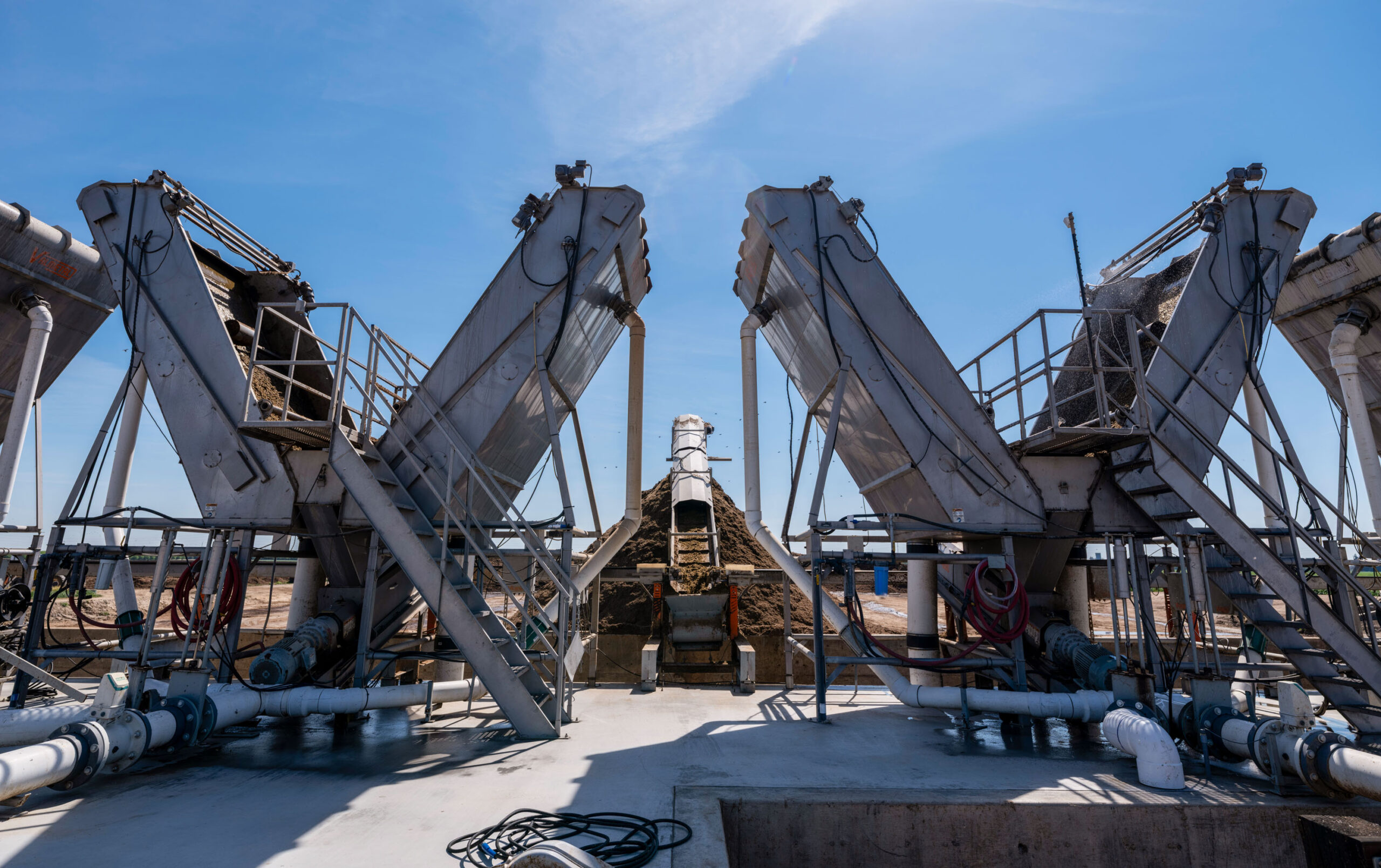
A series of large metal contraptions separate most of the solids from the manure wastewater.
JOE PROUDMAN/UC DAVIS

It was mid-March but already above 80 °F in the Central Valley, which is walled off from the cool Pacific air by the coastal mountain range. Knee-high oat stalks swayed in fields that stretched to a line of almond trees in the distance.

Agueda, who graduated from Fresno State last year and now helps lead the operations on the farm, met me and UC Davis’s Mitloehner, who has studied the effects of vermifiltration, along the side of the barn. (UC Davis has no affiliation with the farm, but the university helped facilitate the meeting.)

He led us along dirt lanes as he explained the workings of the vermifiltration system, which they began using in October 2024.  

As before, a flush system washes manure from the floors of the barns into a large collection pit. But now a set of pumps funnels it through a series of large V-shaped metal contraptions standing on a nearby concrete pad, where mechanical screens separate most of the solids from the water.

A conveyor belt takes away the solids, which the farm composts for cow bedding or fertilizer. The remaining liquid moves through a system of pipes, first to settling ponds and then on to an irrigation system suspended above the vermifiltration beds. The long, tubular structure runs over the mounds on wheels set in gravel tracks, wetting the wood chips as it goes. The worms and various microbes residing in the biofilter then set to work consuming much of the remaining solid material, according to BioFiltro.
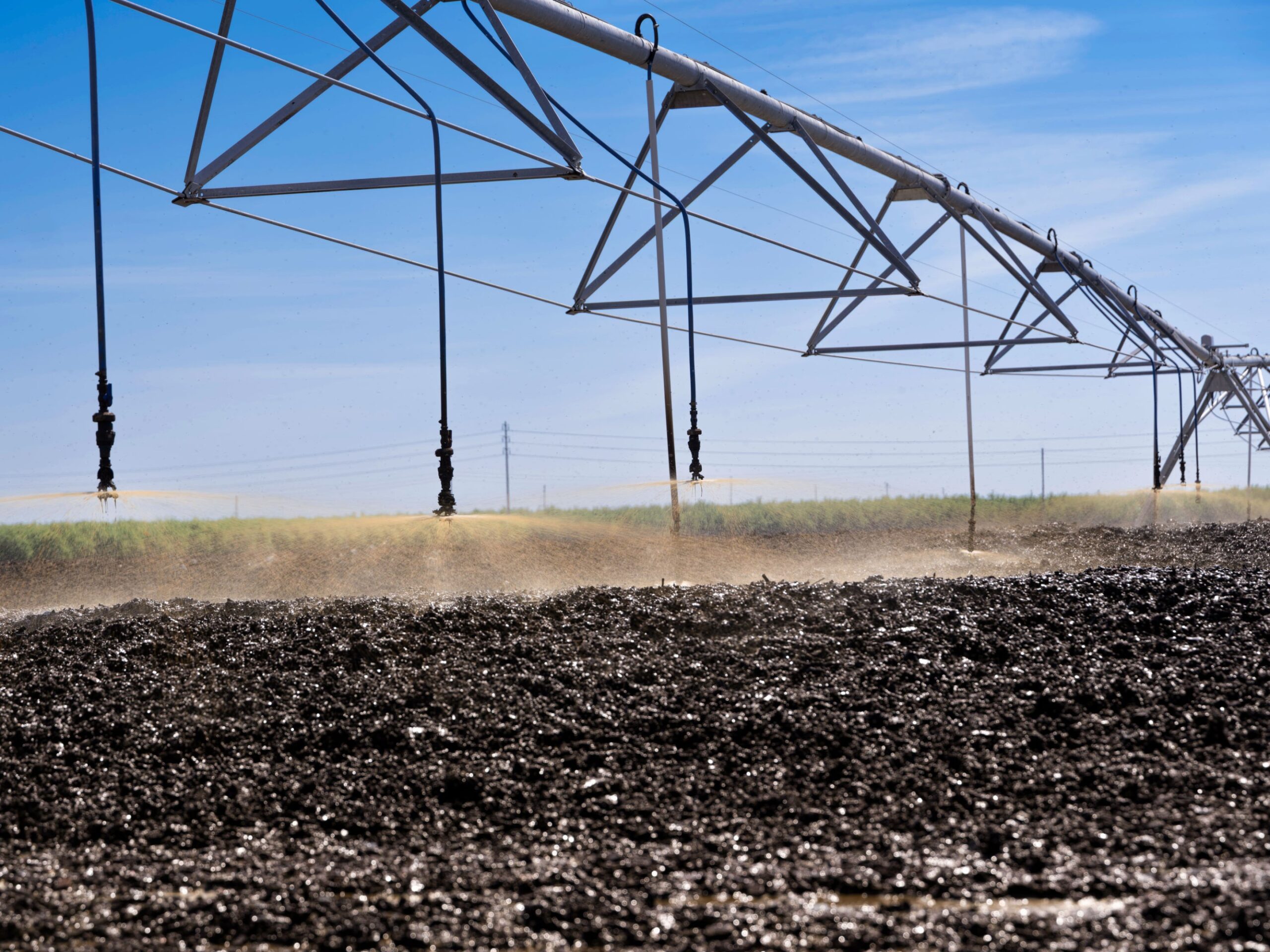
An irrigation system sprinkles wastewater onto the vermifiltration beds.
JOE PROUDMAN/UC DAVIS

“Once the water is sprinkled on top, it takes about four hours from beginning to end for it to percolate through and drain to the end,” Agueda says.

He then defers to Mitloehner to explain the science of what happens as it does, adding, “I’m just the dairyman.”

The science

Mitloehner says he was skeptical of BioFiltro’s claims when he first heard them, particularly the assertion that the system could nearly eliminate nitrogen and, with it, the various forms of pollution it can produce, including ammonia and nitrates. 

So he decided to study a similar setup at the Fanelli Dairy, an operation in Hilmar, California, about 20 miles to the south. He and colleagues monitored the emissions from wastewater samples that were taken from the system before and after the liquid moved through the filter. In a paper published in 2018, the researchers concluded that vermifiltration reduced ammonia emissions from the resulting water by about 90%.

BioFiltro, whose tagline is “worm-powered solutions,” states that its technology “catalyzes the digestive power of worms and microbes to remove up to 99% of wastewater contaminants.”

But Mitloehner questions how big a role the invertebrates play in the process, calling it “kind of a catchy narrative.”

His take is simpler: The rocks and wood chips form a porous filter that replaces the anaerobic environment of a manure lagoon with an aerobic one. And in that oxygen-rich environment, different types of microbes thrive. 

His study suggests that these microbes are highly effective at converting nitrogen compounds in manure into nitrogen gas—a benign gas that makes up 78% of Earth’s atmosphere—instead of ammonia. That’s notable because while ammonia in manure acts as a fertilizer when it’s applied to fields, it also converts into the nitrates that can leach into groundwater.

Several more recent studies, which were partially or fully funded by BioFiltro and one of its regional distribution partners, Organix, produced similarly promising results. For instance, a 2022 study in Bioresource Technology Reports, also conducted at the Fanelli Dairy, concluded that the filter removed nearly 85% of the nitrogen in the operation’s wastewater. 

But a befuddling wrinkle is that when it came to methane, those studies and Mitloehner’s independent one found nearly opposite results.

While both the company- and partner-supported studies concluded that the filter eliminated the vast majority of methane pollution, Mitloehner’s study found that methane emissions were nearly 85% higher than those from the lagoon. 

In a follow-up email exchange, Mitloehner stressed that it’s not appropriate to compare his results with those that emerged from the other study at the same dairy, because the teams used very different methods, instruments, and measurement periods. Moreover, the focus of his research was the effect on nitrogen.
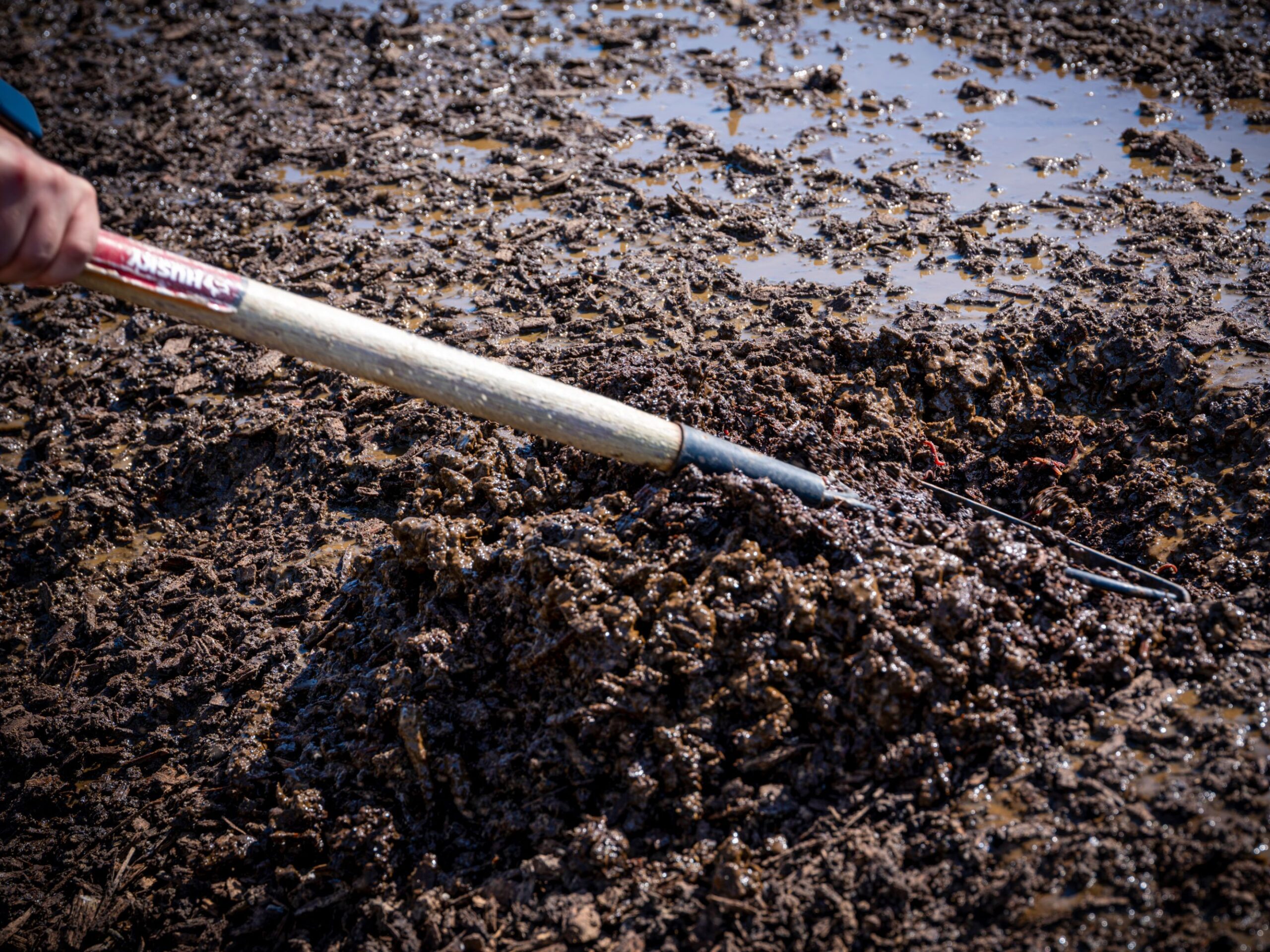
Anthony Agueda pulls a rake through a vermifiltration bed at his family’s dairy.
JOE PROUDMAN/UC DAVIS

He said it’s “entirely reasonable” and “biologically plausible” that vermifiltration could substantially reduce methane emissions, simply by creating that aerobic environment.

“That said, I would be cautious about calling the magnitude of the reduction a fully settled issue,” he added. “While the available studies, including those you mentioned, point in the same general direction, the number of independent studies remains relatively limited, and results can vary.”

Patrick Beckett, BioFiltro’s vice president of quality and R&D, also stressed that there were crucial differences in the methodology of Mitloehner’s study that could have affected his methane findings.

In addition, he said the Organix funding came by way of a Washington state grant and described that study and the one BioFiltro supported as “high quality, peer reviewed” research that “has been submitted to other technical third parties for review and acceptance.”

Beckett says he agrees that additional independent reviews of BioFiltro’s systems is “fair and necessary” and notes that other studies have occurred or are underway.  

“That said,” Beckett wrote in an emailed response to questions from MIT Technology Review, “it seems unreasonable that BioFiltro would be held to a standard of not being allowed to invest in technical research by qualified third parties to learn more about the capabilities of our technology, and use the results of that research to enter new markets and to understand the value we can bring to projects or entire industries beyond water treatment.”

Milk money

BioFiltro is already building a business model around the available findings.

The company, founded in 2009, has been selling its vermifiltration systems or services to other industries around the world for years. It says there are around 225 operating in nine countries, at sites including municipal wastewater facilities, wineries, fruit processors, and other industrial operations.

But BioFiltro, whose US headquarters are in Davis, California, is seeing increasing demand among dairies as the industry faces growing pressure to address manure pollution. Late last year, it raised $35 million that the business says it will use, in large part, to accelerate its growth across the sector.

In an interview, Sarah Ploss, the company’s senior vice president of agriculture, explains the basic financial template for how it works with dairies: BioFiltro pays for, owns, installs, and operates the system. The farm, in turn, covers a share of the additional electricity, operations, and maintenance costs. 

Ploss says the dairy gets back clean water and the ability to focus on what it does best: producing milk. For its part, BioFiltro can generate carbon credits from the reduction in greenhouse gases, which it can then sell to makers of consumer packaged goods that are looking for ways to address the emissions throughout their supply chains, she says.

BioFiltro says that Verra, which sets standards for and assesses greenhouse-gas crediting projects, has registered two of its projects: the Royal Dairy and Moxee Dairy, both in Washington.

The Swiss confectionary giant Nestlé has bought more than 150,000 credits generated by the Royal Dairy’s vermifiltration system, according to an offsets database managed by CarbonPlan, which assesses the scientific integrity of climate action programs. Ploss said that BioFiltro has sold more than 200,000 credits from the project so far, and adds that it secured a different buyer for a project in California, which she said she couldn’t name. 
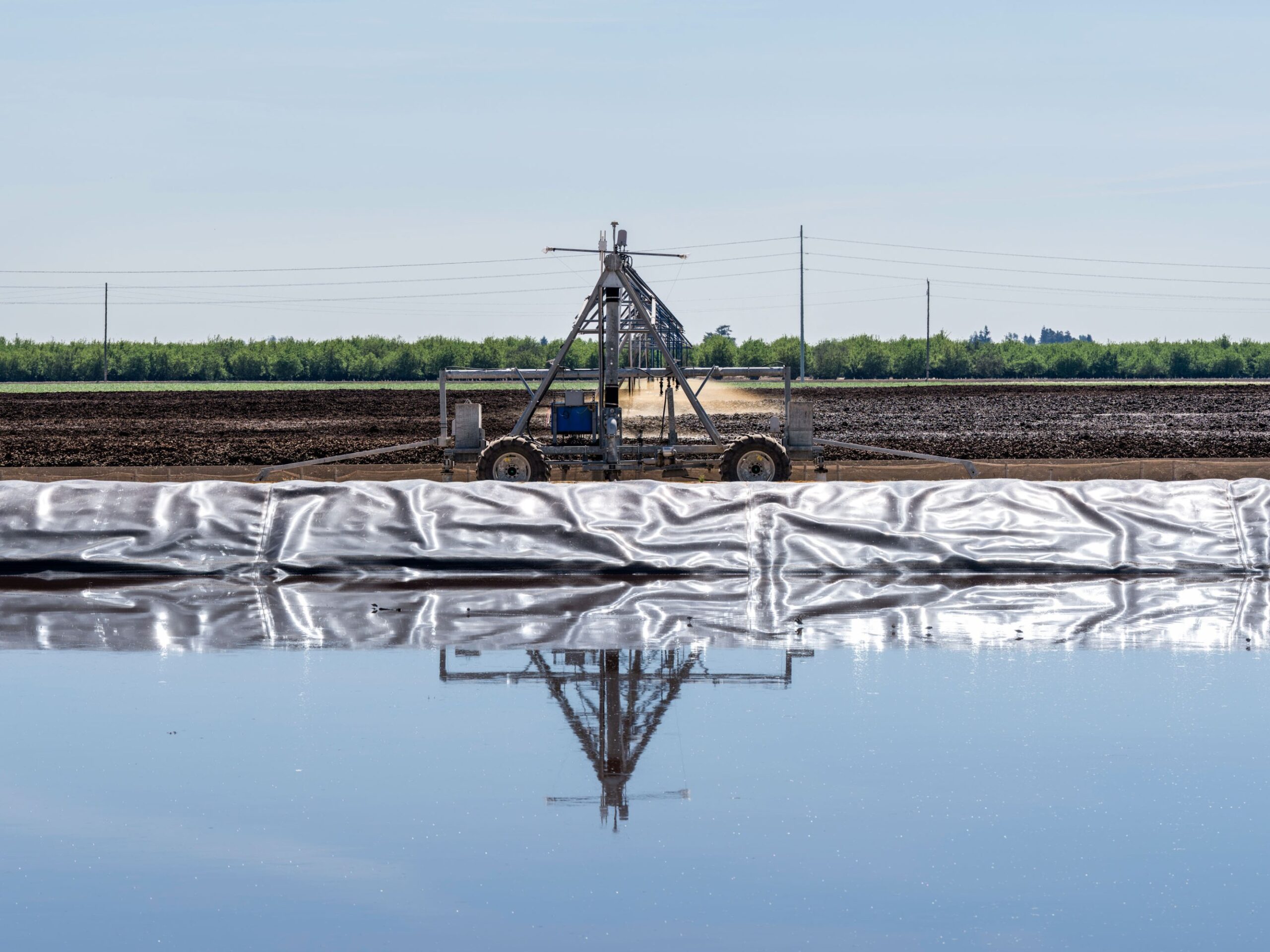
The vermifiltration system has cleaned up the water that circulates through various parts of the Alberto Dairy operation.
JOE PROUDMAN/UC DAVIS

Three additional projects involving BioFiltro systems took the initial steps to become registered through Verra but didn’t move forward and weren’t built, Ploss said in an email. The request for registration for the Alberto Dairy estimates that the system there will reduce emissions by the equivalent of more than 30,000 metric tons of carbon dioxide per year. 

BioFiltro could take advantage of another revenue source as well: selling what it calls vermicompost, a rich soil additive composed of the leftover materials in the biofilter, including worm castings—a combination of cocoons, excrement, and remains. At retail, worm castings can run more than $500 per ton.

Beckett says the company is still developing that market but notes that it could help the industry offset rising fertilizer costs. 

“I think we’re going to enable a larger-scale use and adoption of it that could be meaningful to agriculture,” he says, adding: “These will become basically soil production facilities.” 

Concerns

Determining how well vermifiltration and other manure management approaches work will require more time and more research, experts say. 

Katharine Dickson, an agricultural emissions scientist who recently finished a postdoctoral program at UC Davis, says there should be in-the-field accounting to ensure that any of these methods are working as well as hoped—or to the degree government policy programs assume. All of which is tricky to achieve given the dynamic biological processes playing out in live animals and microbial communities on open farms, she adds.

“Vermifiltration, for example, depends on a live earthworm population whose performance is sensitive to temperature, moisture, and toxicity, and can shift with seasonal conditions or changes in herd size and manure characteristics on a given farm,” Dickson said in an email. 

The use of carbon credits to earn money from vermifiltration projects raises a different set of potential concerns. Most notably, if the methane decreases aren’t as significant as assumed, the projects could receive more credits than they deserve. 

There are more complicated issues as well. For the carbon credit system to make any real difference in the net amount of greenhouse gas in the atmosphere, it must produce emissions reductions that wouldn’t have occurred without that financial incentive. If it was going to happen anyway—as a result, say, of rich grants, legal pressures, or looming policies—the buyer of the credits can’t legitimately claim to have made any progress on its own climate emissions, says Grayson Badgley, a research scientist at CarbonPlan.

On that point, if California agriculture doesn’t meet its looming methane reduction targets, the carrots the state offers could be replaced by sticks: The California Air Resources Board recently began discussing rules that would force, rather than nudge, the sector to meet the 40% reduction required under the 2016 law.

“If lots of dairies are cleaning up their act ahead of pending regulation, it really does seem like the regulation, not offsets, is driving that action,” Badgley wrote in an email. “Trying to collect as many offsets prior to that deadline might adhere to the rules of the market, while still raising questions about whether those rules have enabled real climate action.”

Investing in sustainability 

Beckett disagreed that the possibility of forthcoming regulations undermines the case for generating carbon credits from current projects. 

“It’s true the state has net reduction targets that it hopes to meet, but it’s clear the state of California has favored market-based solutions and tried to provide some support via grant programs,” he wrote. “I’m on the science side of our business, not the business development side, but still think I can tell you with complete transparency that we would not have systems installed on [California] dairies without the sale of voluntary carbon credits.”

Ploss also stressed that the company goes through a careful “validation and verification process” on the farms to understand how much vermifiltration reduces greenhouse gases.

“We’ve got sensors and cameras and all sorts of stuff so that we can look into any of our systems, 24-7,” Ploss says. “We know through sampling. We know through what’s going through the system, what came out of the system. We know by all the measurements on any given month: What did that system do in terms of generating carbon credits?”

Agueda also disputes the critique. 

“The installation of the vermifiltration system would not have occurred without the ability to generate carbon credits,” he said in an email. “The project required a substantial capital investment, and the anticipated carbon credit revenue was a key factor in making the investment financially feasible.”
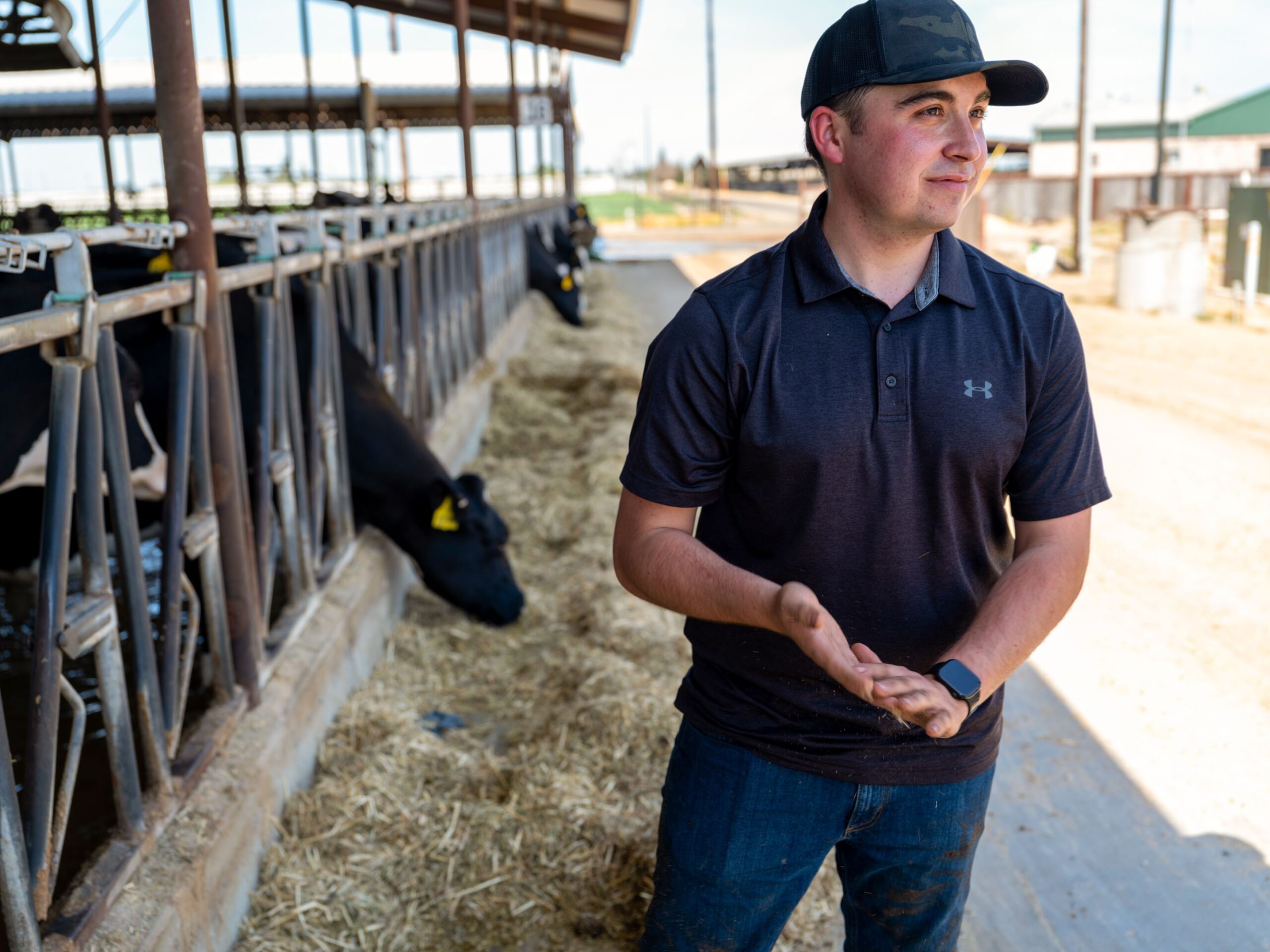
Anthony Agueda helps to lead the operations at the Alberto Dairy.
JOE PROUDMAN/UC DAVIS

California decided to incentivize vermifiltration, along with other approaches, because it can offer multiple benefits, including cleaner water, less nitrogen, and lower greenhouse-gas emissions, while also creating economic value from manure, wrote Roberta Franco, a senior environmental scientist at the California Department of Food and Agriculture, in an emailed response to questions from MIT Technology Review.

She added that the decision was based on a number of studies as well as the 2022 recommendations from a task force composed of scientists, technical experts, and others. 

Even if California has made missteps, most notably in funneling too much money to anaerobic digesters at the expense of other methods, it’s created a test lab that’s achieved real progress and provided lessons that other regions can learn from.

One way or another, more parts of the world will need to set up similar programs, offering greater support or creating stricter rules, if we hope to really drive down the emissions from manure, says Maria Bowman, who leads the Agricultural Nitrogen Transformation Program at Spark Climate, a San Francisco nonprofit.

For his part, Agueda says that the vermifiltration system has offered a number of benefits to his family’s farm, at little additional cost to them. By cleaning up the water that cycles back through their flush and irrigation systems, the biofilter has reduced clogging, decreased odors, and improved the health of the herd.  

He says that each generation modernizes dairy farming in its own way. His father and uncle, for instance, incorporated computers and data management systems into the daily operations of the Alberto Dairy. He believes it’s the responsibility of his generation to make a similar effort to reduce the pollution that’s long plagued the sector.

“We knew that in the next generation we have to invest in environmental sustainability,” he says. “We didn’t know if it was gonna work or not, but we’re very happy with how it’s turned out.”

Shape
Shape
Stay Ahead

Explore More Insights

Stay ahead with more perspectives on cutting-edge power, infrastructure, energy,  bitcoin and AI solutions. Explore these articles to uncover strategies and insights shaping the future of industries.

Shape

Network evolution for the Agentic AI era

With all of the attention being paid to the compute resources required to power AI, connectivity is sometimes overlooked. This poses a new dynamic for those planning their next phase of AI deployment. Those who modernize their IP networks can unlock new revenue from AI-driven services, while those who delay

Read More »

Bharat Petroleum awards contract for Bina refinery expansion

Bharat Petroleum Corp. Ltd. (BPCL) has let a contract to Duncan Engineering Ltd. (DEL) for supply of valves as part of the operator’s project to expand production of petrochemicals at its 7.8-million tonne/year (tpy) refinery at Bina, Madya Pradesh. As part the late-June contract award, DEL will deliver its critical

Read More »

Neste plans 9-week turnaround at Porvoo refinery

Neste Corp. will undertake a major turnaround beginning in August at its 10-million tonne/year (tpy) refinery in the Kilpilahti industrial area of Porvoo, Finland, about 20 miles east of Helsinki. Budgeted at an overall investment of more than €400-million ($457 million) and scheduled to run through October, the 9-week turnaround

Read More »

Energy Department Announces Up to $150 Million to Boost Unconventional Oil and Gas Recovery, Advance Hydraulic Fracture Characterization, and Revolutionize Produced Water Management

WASHINGTON—The U.S. Department of Energy’s (DOE) Hydrocarbons and Geothermal Energy Office (HGEO) today announced up to $150 million in federal funding for cost-shared projects aimed at advancing three critical priorities for the U.S. oil and natural gas industry—dramatically improving recovery efficiency from unconventional oil and gas reservoirs, advancing hydraulic fracture characterization technologies, and developing innovative solutions for produced water management. This initiative advances resident Trump’s Executive Order , “Unleashing American Energy,” and the Secretarial Order “Unleashing the Golden Era of Energy Dominance,” to provide affordable, reliable, and secure energy to all Americans through the responsible development of our nation’s abundant domestic oil and natural gas supplies. “Under President Trump’s leadership, we are unleashing America’s energy potential to secure our nation’s future,” said DOE Acting Assistant Secretary of the Hydrocarbons and Geothermal Energy Office Curt Coccodrilli. “By unlocking more of our domestic oil and natural gas resources, improving our understanding of hydraulic fracturing, and innovating in produced water management, we are not only creating jobs and lowering energy costs for American families, we are also driving innovation that will benefit our economy for generations to come.” DOE has released a Notice of Funding Opportunity (NOFO) seeking innovative proposals that address technical, economic, and environmental barriers across the following areas, with a focus on increasing domestic energy production and strengthening American energy dominance: Enhanced Recovery from Unconventional Oil and Gas Reservoirs: With recovery rates from unconventional reservoirs often below 10%, significant oil and gas resources remain untapped. Funding in this area will support the rapid field deployment of novel technologies and processes—including exploring the potential of carbon dioxide as an injectant—to improve oil and gas extraction, increase the recovery factor, and lower the break-even cost of primary recovery operations to increase the efficiency of our national resources and provide more affordable energy.  Advanced Characterization of Fracture Propagation,

Read More »

Department of Energy Celebrates Fourth Criticality Ahead of July 4th Goal

WASHINGTON—The U.S. Department of Energy celebrates yet another win for the American nuclear energy renaissance. Early Saturday, as part of the U.S. Department of Energy (DOE) Reactor Pilot Program, Aalo Atomics’ test reactor, Aalo-X, successfully completed a zero-power fueled criticality demonstration. The experiment took place at Idaho National Laboratory and is the fourth DOE-authorized advanced reactor to achieve the criticality milestone, exceeding the July 4th goal outlined by President Trump in his May 2025 executive order. “Last month I toured the Aalo facility at Idaho National Laboratory and was impressed by the company’s determination to successfully demonstrate their technology by the Fourth of July,” said U.S. Energy Secretary Chris Wright. “President Trump asked for three advanced reactors to be authorized and achieve criticality by the 250th anniversary of our great country. I’m pleased to share that through the dedication and hard work of Aalo, INL and DOE, we have surpassed that ask and delivered four!” Aalo-X joins a growing list of successful advanced reactor designs and spotlights the continued progress and momentum of participants in DOE’s Reactor Pilot Program and the Nuclear Energy Launch Pad initiative. In June, Antares Nuclear’s Mark-0 reactor, Valar Atomics’ Ward 250, and Deployable Energy’s Unity achieved criticality. “The hardest problem in nuclear was never the physics, our country simply forgot how to build. The success of the Department of Energy Reactor Pilot Program is proof America can execute again,” said Yasir Arafat, President and CTO, Aalo Atomics. “We are proud to play a major role in America’s nuclear renaissance, going from breaking ground to a sustained chain reaction in just eight months, one of the fastest reactor builds in modern American history.” The fourth criticality of a DOE authorized reactor design surpasses what many skeptics thought American reactor developers could achieve in response to President

Read More »

San Mateo Midstream expands Delaware basin footprint with $752-million acquisition

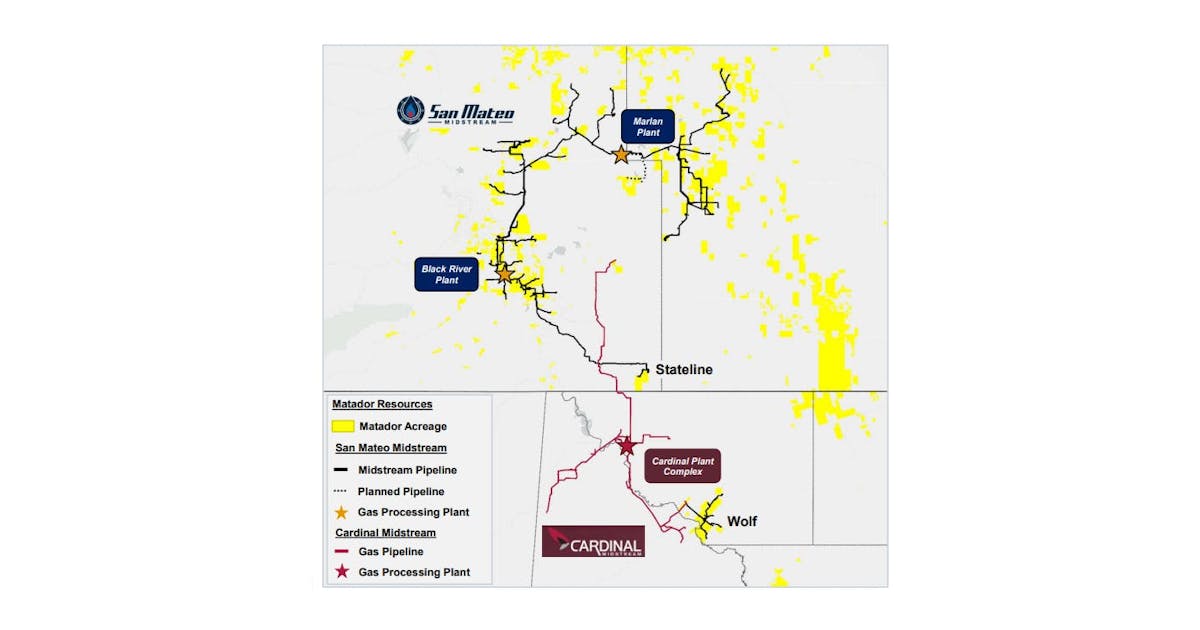
San Mateo said the assets complement its existing gathering and processing system and will improve natural gas flow across the northern Delaware basin in southeast New Mexico and West Texas. The acquisition is expected to increase San Mateo’s designed processing capacity to more than 1 bcfd and expand its gathering network to more than 800 miles. Integration of the systems is expected to provide immediate operating synergies, including the ability to move volumes between Cardinal’s Loving County plant and San Mateo’s Marlan and Black River plants in Eddy County. “With this acquisition, San Mateo not only gains more processing capacity, a larger pipeline system and a more diverse customer base but also improves its positioning for strategic transactions in the future,” said Brian J. Willey, San Mateo chairman and executive vice-president of midstream for Matador. Willey added that connecting the systems will “complete the circle” of San Mateo’s Delaware basin infrastructure, enhancing flow assurance for Matador and third‑party customers and improving flexibility to move natural gas throughout the northern Delaware basin north to south or south to north. The transaction is expected to close on or before July 31, 2026, subject to customary conditions. Cardinal’s field employees are expected to join San Mateo upon closing.

Read More »

QatarEnergy signs commercial declaration for offshore Cyprus

QatarEnergy has signed a commercial discovery declaration for the Glaucus and Pegasus fields in Cyprus, partnering with Cyprus and ExxonMobil to progress development plans and regulatory approvals for offshore gas production. <!–> June 30, 2026 –> Key Highlights QatarEnergy signed a commercial discovery declaration for offshore Cyprus. QatarEnergy, the government of Cyprus, and ExxonMobil will support the next phase of Block 10 development.

Read More »

Neste charts course for renewable fuels amidst industry retreat

Another technology that could provide massive potential to help meet rising energy demand and contribute to global climate goals is renewable hydrogen. Renewable hydrogen—or green hydrogen—is produced by electrolysis, where hydrogen is processed from water using renewable electricity (e.g., wind, solar) by splitting water molecules. Currently, around 95% of all hydrogen is made using fossil-derived natural gas, resulting in high GHG emissions. Since renewable hydrogen is nearly free of GHG emissions, the transition to a renewable hydrogen economy hold potential to transform the energy landscape. Just as with Neste’s the pilot program in Rotterdam, renewable fuel producers could benefit by evaluating options for replacing fossil-based hydrogen with renewable hydrogen in their production processes. In the renewable fuels production process, supply chain optimization is critical to ensure stable flows of both raw materials and end products. For Neste, this means an extensive global network for sourcing renewable raw materials and a market-centric distribution network to ensure renewable fuels reach customers and key markets quickly and efficiently. In the US, Neste made a major strategic move to enhance its supply network with the acquisition of Mahoney Environmental in 2020. This integration provides Neste with access to used cooking oil from over 100,000 locations across the country. To ensure efficient product delivery, Neste has also been fostering partnerships with infrastructure providers to lease terminals that are strategically located near key markets. These terminals are often well-connected to fuel logistics via vessels, barges, trucks, and pipelines. Having terminal capacities close to key markets can notably increase the availability and accessibility of Neste’s renewable fuels to customers. For example, the streamlined logistics system enabled a major expansion of Neste’s SAF supply in 2025, when Neste and United Airlines Inc. extended their partnership, making United the first commercial airline to purchase SAF for use on flights

Read More »

Talos Energy, Ridgewood sign deal to acquire Gulf of Mexico assets from Shell Offshore

Talos would acquire a 25% non-operated working interest in the bp plc-operated (50%) Na Kika platform and the Kepler, Ariel, Fourier, and Herschel fields, along with a 50% working interest and operatorship in the Coulomb field, the company said in a separate release. The Na Kika interests are subject to a 30-day preferential purchase right held by affiliates of bp. According to bp’s website, Na Kika is one of bp’s “most prolific producers in the Gulf,” as a hub for 8 subsea fields with more than 100 miles of infield flowlines which make up the gathering system. Na Kika, which lies 140 miles southeast of New Orleans in 6,340 ft of water, is designed to process up to 130,000 b/d of oil and 550 MMcfd of natural gas. If exercised, Talos would acquire only the 50% working interest and operatorship in Coulomb field, Talos said. Shell’s entitlement production from the assets is expected to average 37,000 boe/d in 2025. The company reported proved reserves at year-end 2025 of 4.3 MMboe for Na Kika and 7.2 MMboe for Coulomb. Based on its internal modeling, Na Kika and Coulomb “will not be meaningful contributors to production by 2030,” Shell said. Average first-quarter 2026 production attributable to the interests Talos expects to acquire was about 16,000 boe/d, of which about 77% was oil, Talos said. What Shell retains The agreement includes a 50% upside-sharing arrangement with Shell from closing through year-end 2027, subject to commodity price thresholds and certain other contingencies. The arrangement applies if realized oil prices exceed $60/bbl, Talos said. According to Shell, it will receive uncapped upside-linked payments through 2027 and overriding royalty interests on production from future Na Kika tiebacks, subject to specified conditions. Shell Trading US Co. will retain rights to offtake production from Na Kika and Coulomb

Read More »

Envirotech Vehicles Closes Merger with Azio AI Ahead of Schedule, Positioning Combined Company to Capture $487 Billion 2026 AI Infrastructure Opportunity

This press release contains forward-looking statements within the meaning of the Private Securities Litigation Reform Act of 1995. In some cases, you can identify forward-looking statements by words such as “may,” “will,” “could,” “expect,” “anticipate,” “believe,” “estimate,” “project,” “intend,” “continue,” “potential,” “ongoing,” or the negative of these terms or other comparable terminology, although not all forward-looking statements contain these words. Forward-looking statements include statements regarding the Company’s ability to capitalize on accelerating demand for AI infrastructure, enterprise GPU compute, digital power solutions, data center development, and digital asset infrastructure; the Company’s plans to continue expanding its digital infrastructure platform through AI data center development, enterprise GPU compute solutions, power hosting services, digital asset mining operations, strategic infrastructure investments, and additional commercial partnerships; the Company’s ability to maximize utilization of its power resources while creating multiple long-term revenue opportunities; the ability to continue deploying modular digital infrastructure at the Company’s South Texas site; the anticipated deployment and scaling of NVIDIA B200 and B300 GPU systems; the ability to advance and execute against the Company’s commercial infrastructure pipeline; the anticipated development of the Company’s footprint; the ability to monetize power assets across multiple complementary revenue streams, including AI data centers, enterprise compute infrastructure, power hosting, and digital asset mining operations; customer demand for AI infrastructure, enterprise compute, and digital infrastructure; the Company’s ability to build a scalable platform designed to serve that demand and create long-term shareholder value; and the Company’s broader business strategy and long-term growth objectives. These statements are based on current expectations and assumptions that involve risks and uncertainties that could cause actual results to differ materially. Most of these factors are outside the Company’s control and are difficult to predict. Factors that may affect actual results include, but are not limited to, the Company’s limited operating history within

Read More »

Cloud sovereignty: First four providers sign up to CISPE certification program

“Public bodies, hospitals and industrial operators are today seeking concrete guarantees of digital sovereignty. The CISPE Sovereignty Badge provides that guarantee. It is a natural complement to European standards such as Gaia-X Level 3, strengthening transparency, compliance and digital trust. It is this ability to provide concrete proof, beyond rhetoric, that underpins genuine European digital autonomy.” said Antoine Fournier, CEO of Thésée Datacenter The EU is keen to guard against ‘sovereignty washing’ — claims by foreign-owned cloud providers that they meet local control criteria. Last month, CISPE warned about Broadcom’s claim it complied with EU conditions. It probably won’t be the last to make such claims.

Read More »

What Meta, Oracle moves say about data center economics

Meta, meanwhile, is continuing its spending spree on AI infrastructure, anonymous sources told Bloomberg. The company is purportedly developing plans for new cloud infrastructure business lines that would sell access to AI computing power and models, putting it in competition with other data center giants. One potential scenario would have Meta selling access to models, including its new Muse Spark, hosted on its own AI infrastructure, as well as running the underlying data centers. This model is similar to AWS’ Bedrock offering. Another possibility is Meta selling access to “raw” computing capacity, as do neocloud businesses such as CoreWeave. This move is part of the company’s internal Meta Compute initiative, the sources said. Like Oracle, Meta has been investing hundreds of billions of dollars in data centers and expensive AI chips. And, according to its latest 10-K: “We plan to continue to significantly expand the size of our infrastructure primarily through data centers, subsea and terrestrial fiber optic cable systems, and other projects.”

Read More »

Executive Roundtable: The Rise of Integrated Infrastructure

Steve Altizer, Compu Dynamics: Integration has to be foundational. It has to start at the first planning conversation, not after the equipment is selected or once the building is already designed. In previous generations of data center development, mechanical, electrical, IT, and operations teams could often work in parallel and bring the pieces together later. That worked when the load profile was more predictable and the facility had more room to absorb change. Before the introduction of ChatGPT, there was very little change to absorb. AI removes that tolerance. A change in rack density can affect electrical distribution, structural requirements, thermal strategy, commissioning, service access, and the way the site is operated. These are no longer independent decisions. They are all part of one performance system. As AI systems move toward POD-scale platforms, the boundary between IT and facility infrastructure becomes much harder to separate. The challenge is that AI workloads are too varied for a one-size-fits-all approach. Training clusters, inference nodes, enterprise AI environments, and edge sites can all have different requirements for density, cooling architecture, network connectivity, security, site conditions, and serviceability. That is why many companies are adopting a modular approach, while others are embracing hybrid models where turnkey modular AI capacity is integrated into larger campus environments.  At the campus level, that means standardizing the backbone infrastructure that serves the site (utility power feeds, central cooling capacity, and network pathways), while allowing the IT environment and the integrated critical infrastructure components to evolve as workload requirements change. The goal is not modularity for its own sake. The goal is to support the next generation of AI deployments without forcing every hardware change to become a major redesign. AI infrastructure cannot be planned as a collection of disparate systems. It has to be designed as one coordinated

Read More »

Data Center Insights 2026 Brings Industry Leaders Together for a Two-Day Look at the AI Infrastructure Era

The data center industry has never been more visible, more vital, or more challenged. Support for AI and its overall industry impact has pushed digital infrastructure into the public conversation. It has become clear that the sector is confronting unprecedented demands for everything from power to basic infrastructure. That convergence is the focus of Data Center Insights 2026, a two-day virtual event taking place July 15–16, 2026, produced by Endeavor B2B’s Data Center Frontier, Cabling Installation & Maintenance, ISE, Lightwave, and SecurityInfoWatch. Designed for data center owners, operators, engineers, IT leaders, and the people supporting the next generation of data center development, the event offers a concentrated look at the technologies and strategies shaping the future of digital infrastructure. The program arrives at a crucial moment. AI workloads are changing almost every assumption behind data center design. Rack densities are rising, liquid cooling is becoming mainstream, and fiber networks are being rethought for 400G and beyond. Power constraints are now central to site selection. Security is becoming highlighted and operators are being asked to build faster, scale larger, be more resource efficient and maintain resilience in an environment where downtime carries higher consequences than ever. Data Center Insights 2026 is structured to help attendees make sense of this moment. Rather than treating data center infrastructure as a set of separate disciplines, the event brings together experts across cooling, cabling, fiber, power distribution, modular design, AI infrastructure, and operational strategy. The result is a practical, cross-functional program built around the real-world questions now facing the industry. What will I learn at this event? The event opens with “Expert Roundup: The State of the Data Center Industry,” featuring perspectives from Steven Carlini of Schneider Electric.This session sets the stage by examining the forces driving change across the data center landscape in 2026.

Read More »

Executive Roundtable: Scaling Beyond the Prototype Phase

Steve Altizer, Compu Dynamics: The defining challenge is keeping pace with the rate of change in the IT environment. It takes time to design, permit, build, and commission a data center. AI hardware operates on a completely different timeline. New GPU families are being introduced every 12 to 18 months, and from one generation to the next, rack power densities can double or even triple. At prototype scale, you can design around a single cluster or a specific density profile. At production scale, that approach becomes a real liability. The facility has to support today’s deployment while remaining adaptable for the next compute profile. We are not just talking about adding more power. We are preparing for major architectural shifts, including the move toward DC power delivery or cooling systems that may rely on two-phase liquid to remove heat at scale. That is what becomes materially harder. You are no longer solving for a single, static deployment. You are solving for a moving target inside a live operating environment. This is where strategic modularity proves its value. It helps decouple the lifecycle of the building from the lifecycle of the IT hardware. Instead of treating the data center as one monolithic design, modularity creates a more agile framework that can absorb new power and cooling architectures without requiring a full facility retrofit every time the IT roadmap shifts. At Compu Dynamics Modular, we are seeing this play out in real time. The value of a turnkey modular approach is not simply speed. It is the agility owners need to keep pace with ever-evolving rack densities, power delivery requirements, and cooling architectures.

Read More »

Microsoft will invest $80B in AI data centers in fiscal 2025

And Microsoft isn’t the only one that is ramping up its investments into AI-enabled data centers. Rival cloud service providers are all investing in either upgrading or opening new data centers to capture a larger chunk of business from developers and users of large language models (LLMs).  In a report published in October 2024, Bloomberg Intelligence estimated that demand for generative AI would push Microsoft, AWS, Google, Oracle, Meta, and Apple would between them devote $200 billion to capex in 2025, up from $110 billion in 2023. Microsoft is one of the biggest spenders, followed closely by Google and AWS, Bloomberg Intelligence said. Its estimate of Microsoft’s capital spending on AI, at $62.4 billion for calendar 2025, is lower than Smith’s claim that the company will invest $80 billion in the fiscal year to June 30, 2025. Both figures, though, are way higher than Microsoft’s 2020 capital expenditure of “just” $17.6 billion. The majority of the increased spending is tied to cloud services and the expansion of AI infrastructure needed to provide compute capacity for OpenAI workloads. Separately, last October Amazon CEO Andy Jassy said his company planned total capex spend of $75 billion in 2024 and even more in 2025, with much of it going to AWS, its cloud computing division.

Read More »

John Deere unveils more autonomous farm machines to address skill labor shortage

Join our daily and weekly newsletters for the latest updates and exclusive content on industry-leading AI coverage. Learn More Self-driving tractors might be the path to self-driving cars. John Deere has revealed a new line of autonomous machines and tech across agriculture, construction and commercial landscaping. The Moline, Illinois-based John Deere has been in business for 187 years, yet it’s been a regular as a non-tech company showing off technology at the big tech trade show in Las Vegas and is back at CES 2025 with more autonomous tractors and other vehicles. This is not something we usually cover, but John Deere has a lot of data that is interesting in the big picture of tech. The message from the company is that there aren’t enough skilled farm laborers to do the work that its customers need. It’s been a challenge for most of the last two decades, said Jahmy Hindman, CTO at John Deere, in a briefing. Much of the tech will come this fall and after that. He noted that the average farmer in the U.S. is over 58 and works 12 to 18 hours a day to grow food for us. And he said the American Farm Bureau Federation estimates there are roughly 2.4 million farm jobs that need to be filled annually; and the agricultural work force continues to shrink. (This is my hint to the anti-immigration crowd). John Deere’s autonomous 9RX Tractor. Farmers can oversee it using an app. While each of these industries experiences their own set of challenges, a commonality across all is skilled labor availability. In construction, about 80% percent of contractors struggle to find skilled labor. And in commercial landscaping, 86% of landscaping business owners can’t find labor to fill open positions, he said. “They have to figure out how to do

Read More »

2025 playbook for enterprise AI success, from agents to evals

Join our daily and weekly newsletters for the latest updates and exclusive content on industry-leading AI coverage. Learn More 2025 is poised to be a pivotal year for enterprise AI. The past year has seen rapid innovation, and this year will see the same. This has made it more critical than ever to revisit your AI strategy to stay competitive and create value for your customers. From scaling AI agents to optimizing costs, here are the five critical areas enterprises should prioritize for their AI strategy this year. 1. Agents: the next generation of automation AI agents are no longer theoretical. In 2025, they’re indispensable tools for enterprises looking to streamline operations and enhance customer interactions. Unlike traditional software, agents powered by large language models (LLMs) can make nuanced decisions, navigate complex multi-step tasks, and integrate seamlessly with tools and APIs. At the start of 2024, agents were not ready for prime time, making frustrating mistakes like hallucinating URLs. They started getting better as frontier large language models themselves improved. “Let me put it this way,” said Sam Witteveen, cofounder of Red Dragon, a company that develops agents for companies, and that recently reviewed the 48 agents it built last year. “Interestingly, the ones that we built at the start of the year, a lot of those worked way better at the end of the year just because the models got better.” Witteveen shared this in the video podcast we filmed to discuss these five big trends in detail. Models are getting better and hallucinating less, and they’re also being trained to do agentic tasks. Another feature that the model providers are researching is a way to use the LLM as a judge, and as models get cheaper (something we’ll cover below), companies can use three or more models to

Read More »

OpenAI’s red teaming innovations define new essentials for security leaders in the AI era

Join our daily and weekly newsletters for the latest updates and exclusive content on industry-leading AI coverage. Learn More OpenAI has taken a more aggressive approach to red teaming than its AI competitors, demonstrating its security teams’ advanced capabilities in two areas: multi-step reinforcement and external red teaming. OpenAI recently released two papers that set a new competitive standard for improving the quality, reliability and safety of AI models in these two techniques and more. The first paper, “OpenAI’s Approach to External Red Teaming for AI Models and Systems,” reports that specialized teams outside the company have proven effective in uncovering vulnerabilities that might otherwise have made it into a released model because in-house testing techniques may have missed them. In the second paper, “Diverse and Effective Red Teaming with Auto-Generated Rewards and Multi-Step Reinforcement Learning,” OpenAI introduces an automated framework that relies on iterative reinforcement learning to generate a broad spectrum of novel, wide-ranging attacks. Going all-in on red teaming pays practical, competitive dividends It’s encouraging to see competitive intensity in red teaming growing among AI companies. When Anthropic released its AI red team guidelines in June of last year, it joined AI providers including Google, Microsoft, Nvidia, OpenAI, and even the U.S.’s National Institute of Standards and Technology (NIST), which all had released red teaming frameworks. Investing heavily in red teaming yields tangible benefits for security leaders in any organization. OpenAI’s paper on external red teaming provides a detailed analysis of how the company strives to create specialized external teams that include cybersecurity and subject matter experts. The goal is to see if knowledgeable external teams can defeat models’ security perimeters and find gaps in their security, biases and controls that prompt-based testing couldn’t find. What makes OpenAI’s recent papers noteworthy is how well they define using human-in-the-middle

Read More »