Stay Ahead, Stay ONMINE

The Download: your stake in OpenAI, and the Treasury’s AI warning

This is today’s edition of The Download, our weekday newsletter that provides a daily dose of what’s going on in the world of technology. Your family’s $300 stake in OpenAI Sam Altman’s proposal that Americans should share in the wealth created by AI is back in the spotlight, with reports that he is discussing giving the US government a 5% stake in OpenAI. At the company’s current valuation, that stake would be worth roughly $320 per American household. The idea is meant to address concerns that AI companies are benefiting from human-generated work without compensating creators, while also easing fears that AI will cause a collapse of the labor market by providing a safety net.  The details, however, remain unclear. Indeed, the offer may be more powerful as a political narrative than as a policy plan. Read the full story on what the dividend proposal reveals about the future of AI. —James O’Donnell This article is from The Algorithm, our weekly AI newsletter. Sign up to receive it in your inbox every Monday. The must-reads I’ve combed the internet to find you today’s most fun/important/scary/fascinating stories about technology.  1 A leaked Treasury report compares the AI market to the dotcom bubble Which contradicts the administration’s public optimism about AI. (NOTUS)+ Fears that the market is overinflated are growing. (Reuters $)+ And AI profits are hiding bigger risks in earnings reports. (FT $)+ What even is the AI bubble? (MIT Technology Review)2 Samsung profits have jumped 1,800% on booming AI chip salesIt just reported its third consecutive record quarterly profit. (BBC)+ But its shares slumped over fears that the AI boom will stall. (Reuters $)+ That boom has turned Samsung into a $1 trillion company. (CNBC) 3 A US cyber agency is using Mythos to audit government codeSources say CISA is tapping Anthropic’s model to search for bugs. (Reuters $)+ Agencies are using it despite Anthropic’s feud with the White House. (Axios) 4 Illinois’ governor has signed the nation’s strongest frontier AI lawIt’s designed to protect citizens from AI risks. (Gizmodo)+ US lawmakers are clashing over AI rules. (MIT Technology Review) 5 A hidden tracker in Claude Code has been exposed and removedIt secretly monitored users in China. (WP $)+ Critics said it shows Anthropic’s willingness to surveil users. (Ars Technica)+ The company has also found a hidden “thinking” space in Claude. (Axios)6 Russia is suspected of flying drones over Europe from a shadow fleetThe flights were reportedly launched from commercial ships. (Ars Technica)+ Europe has a drone-filled vision for future wars. (MIT Technology Review) 7 A controversial AI “actor” is set to star in its first feature filmTilly Norwood will debut in a comedy-drama called “Misaligned.” (Variety)+ A major actors union has lambasted the AI creation. (NBC News)8 AI costs are driving US companies toward Chinese modelsBusinesses are hunting for cheaper model alternatives. (CNBC)+ Chinese AI labs are betting big on open source. (MIT Technology Review) 9 Researchers have shown quantum proofs can beat classical onesThey found a problem that classical proofs can’t solve. (Quanta)10 Earth will never be swallowed by the sun, according to new modelsBut it probably won’t be much fun to live here by that point anyway! (Wired $) Quote of the day “The goal might be to make machines in our image. But what I fear is that—perhaps without even quite noticing—we remake ourselves in theirs.”  —Reporter Sarah O’Connor sounds a note of caution in her new book, We Are Not Machines, the Guardian reports. One More Thing KATE DEHLER Adventures in the genetic time machine Eske Willerslev, a specialist in recovering DNA from old bones and objects, has made numerous breakthroughs. These include recovering the first more or less complete genome of an ancient human and 2.4-million-year-old genetic material from Greenland, revealing that today’s Arctic desert was once a forest with poplar, birch, and mastodons. These findings are part of a wave of discoveries from what’s being called an “ancient-DNA revolution.”  Beyond revealing stories of human migration and vanished ecosystems, scientists believe ancient DNA can unearth clues about modern diseases. It could even lead to a better food supply for our warming world. “And can we get that?” Willerslev asks. “Yes, I believe we can.” Discover how ancient DNA could rescue the future.  —Antonio Regalado


This is today’s edition of The Download, our weekday newsletter that provides a daily dose of what’s going on in the world of technology.

Your family’s $300 stake in OpenAI

Sam Altman’s proposal that Americans should share in the wealth created by AI is back in the spotlight, with reports that he is discussing giving the US government a 5% stake in OpenAI. At the company’s current valuation, that stake would be worth roughly $320 per American household.

The idea is meant to address concerns that AI companies are benefiting from human-generated work without compensating creators, while also easing fears that AI will cause a collapse of the labor market by providing a safety net. 

The details, however, remain unclear. Indeed, the offer may be more powerful as a political narrative than as a policy plan.

Read the full story on what the dividend proposal reveals about the future of AI.

—James O’Donnell

This article is from The Algorithm, our weekly AI newsletter. Sign up to receive it in your inbox every Monday.

The must-reads

I’ve combed the internet to find you today’s most fun/important/scary/fascinating stories about technology.

 1 A leaked Treasury report compares the AI market to the dotcom bubble
 Which contradicts the administration’s public optimism about AI. (NOTUS)
+ Fears that the market is overinflated are growing. (Reuters $)
+ And AI profits are hiding bigger risks in earnings reports. (FT $)
+ What even is the AI bubble? (MIT Technology Review)

2 Samsung profits have jumped 1,800% on booming AI chip sales
It just reported its third consecutive record quarterly profit. (BBC)
+ But its shares slumped over fears that the AI boom will stall. (Reuters $)
+ That boom has turned Samsung into a $1 trillion company. (CNBC)
 
3 A US cyber agency is using Mythos to audit government code
Sources say CISA is tapping Anthropic’s model to search for bugs. (Reuters $)
+ Agencies are using it despite Anthropic’s feud with the White House. (Axios)
 
4 Illinois’ governor has signed the nation’s strongest frontier AI law
It’s designed to protect citizens from AI risks. (Gizmodo)
+ US lawmakers are clashing over AI rules. (MIT Technology Review)
 
5 A hidden tracker in Claude Code has been exposed and removed
It secretly monitored users in China. (WP $)
+ Critics said it shows Anthropic’s willingness to surveil users. (Ars Technica)
+ The company has also found a hidden “thinking” space in Claude. (Axios)

6 Russia is suspected of flying drones over Europe from a shadow fleet
The flights were reportedly launched from commercial ships. (Ars Technica)
+ Europe has a drone-filled vision for future wars. (MIT Technology Review)
 
7 A controversial AI “actor” is set to star in its first feature film
Tilly Norwood will debut in a comedy-drama called “Misaligned.” (Variety)
+ A major actors union has lambasted the AI creation. (NBC News)

8 AI costs are driving US companies toward Chinese models
Businesses are hunting for cheaper model alternatives. (CNBC)
+ Chinese AI labs are betting big on open source. (MIT Technology Review)
 
9 Researchers have shown quantum proofs can beat classical ones
They found a problem that classical proofs can’t solve. (Quanta)

10 Earth will never be swallowed by the sun, according to new models
But it probably won’t be much fun to live here by that point anyway! (Wired $)

Quote of the day

“The goal might be to make machines in our image. But what I fear is that—perhaps without even quite noticing—we remake ourselves in theirs.” 

—Reporter Sarah O’Connor sounds a note of caution in her new book, We Are Not Machines, the Guardian reports.

One More Thing

mammoth walking on a strand of DNA

KATE DEHLER


Adventures in the genetic time machine

Eske Willerslev, a specialist in recovering DNA from old bones and objects, has made numerous breakthroughs. These include recovering the first more or less complete genome of an ancient human and 2.4-million-year-old genetic material from Greenland, revealing that today’s Arctic desert was once a forest with poplar, birch, and mastodons.

These findings are part of a wave of discoveries from what’s being called an “ancient-DNA revolution.” 

Beyond revealing stories of human migration and vanished ecosystems, scientists believe ancient DNA can unearth clues about modern diseases. It could even lead to a better food supply for our warming world. “And can we get that?” Willerslev asks. “Yes, I believe we can.”

Discover how ancient DNA could rescue the future

—Antonio Regalado

Shape
Shape
Stay Ahead

Explore More Insights

Stay ahead with more perspectives on cutting-edge power, infrastructure, energy,  bitcoin and AI solutions. Explore these articles to uncover strategies and insights shaping the future of industries.

Shape

Network evolution for the Agentic AI era

With all of the attention being paid to the compute resources required to power AI, connectivity is sometimes overlooked. This poses a new dynamic for those planning their next phase of AI deployment. Those who modernize their IP networks can unlock new revenue from AI-driven services, while those who delay

Read More »

Bharat Petroleum awards contract for Bina refinery expansion

Bharat Petroleum Corp. Ltd. (BPCL) has let a contract to Duncan Engineering Ltd. (DEL) for supply of valves as part of the operator’s project to expand production of petrochemicals at its 7.8-million tonne/year (tpy) refinery at Bina, Madya Pradesh. As part the late-June contract award, DEL will deliver its critical

Read More »

Neste plans 9-week turnaround at Porvoo refinery

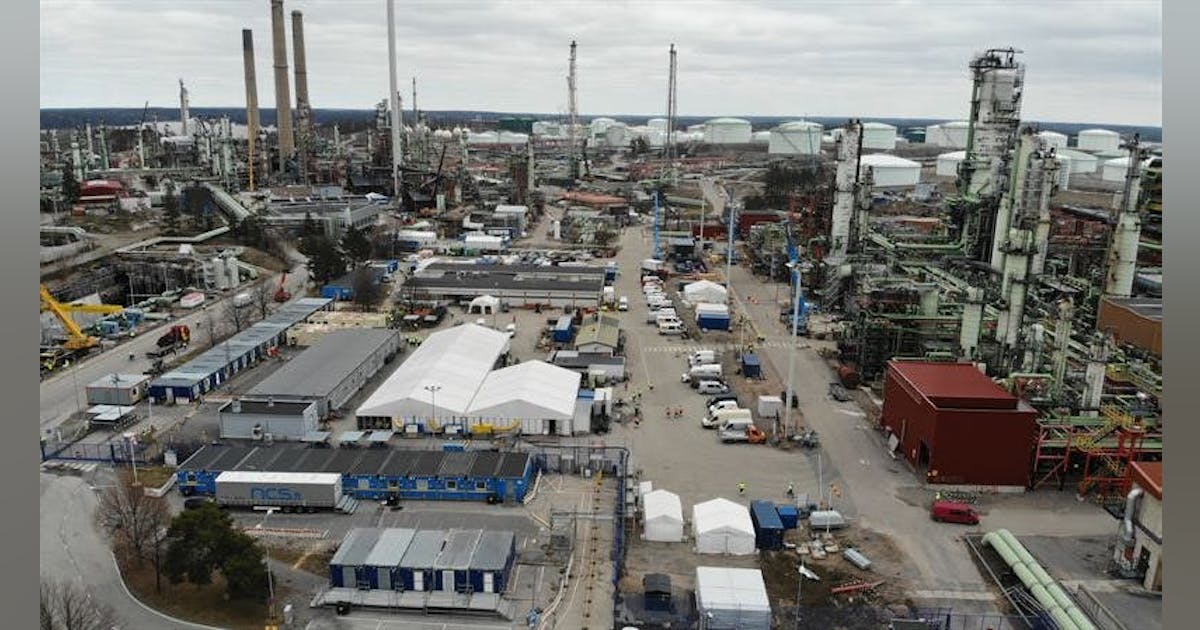
Neste Corp. will undertake a major turnaround beginning in August at its 10-million tonne/year (tpy) refinery in the Kilpilahti industrial area of Porvoo, Finland, about 20 miles east of Helsinki. Budgeted at an overall investment of more than €400-million ($457 million) and scheduled to run through October, the 9-week turnaround

Read More »

Energy Department Announces Up to $150 Million to Boost Unconventional Oil and Gas Recovery, Advance Hydraulic Fracture Characterization, and Revolutionize Produced Water Management

WASHINGTON—The U.S. Department of Energy’s (DOE) Hydrocarbons and Geothermal Energy Office (HGEO) today announced up to $150 million in federal funding for cost-shared projects aimed at advancing three critical priorities for the U.S. oil and natural gas industry—dramatically improving recovery efficiency from unconventional oil and gas reservoirs, advancing hydraulic fracture characterization technologies, and developing innovative solutions for produced water management. This initiative advances resident Trump’s Executive Order , “Unleashing American Energy,” and the Secretarial Order “Unleashing the Golden Era of Energy Dominance,” to provide affordable, reliable, and secure energy to all Americans through the responsible development of our nation’s abundant domestic oil and natural gas supplies. “Under President Trump’s leadership, we are unleashing America’s energy potential to secure our nation’s future,” said DOE Acting Assistant Secretary of the Hydrocarbons and Geothermal Energy Office Curt Coccodrilli. “By unlocking more of our domestic oil and natural gas resources, improving our understanding of hydraulic fracturing, and innovating in produced water management, we are not only creating jobs and lowering energy costs for American families, we are also driving innovation that will benefit our economy for generations to come.” DOE has released a Notice of Funding Opportunity (NOFO) seeking innovative proposals that address technical, economic, and environmental barriers across the following areas, with a focus on increasing domestic energy production and strengthening American energy dominance: Enhanced Recovery from Unconventional Oil and Gas Reservoirs: With recovery rates from unconventional reservoirs often below 10%, significant oil and gas resources remain untapped. Funding in this area will support the rapid field deployment of novel technologies and processes—including exploring the potential of carbon dioxide as an injectant—to improve oil and gas extraction, increase the recovery factor, and lower the break-even cost of primary recovery operations to increase the efficiency of our national resources and provide more affordable energy.  Advanced Characterization of Fracture Propagation,

Read More »

Department of Energy Celebrates Fourth Criticality Ahead of July 4th Goal

WASHINGTON—The U.S. Department of Energy celebrates yet another win for the American nuclear energy renaissance. Early Saturday, as part of the U.S. Department of Energy (DOE) Reactor Pilot Program, Aalo Atomics’ test reactor, Aalo-X, successfully completed a zero-power fueled criticality demonstration. The experiment took place at Idaho National Laboratory and is the fourth DOE-authorized advanced reactor to achieve the criticality milestone, exceeding the July 4th goal outlined by President Trump in his May 2025 executive order. “Last month I toured the Aalo facility at Idaho National Laboratory and was impressed by the company’s determination to successfully demonstrate their technology by the Fourth of July,” said U.S. Energy Secretary Chris Wright. “President Trump asked for three advanced reactors to be authorized and achieve criticality by the 250th anniversary of our great country. I’m pleased to share that through the dedication and hard work of Aalo, INL and DOE, we have surpassed that ask and delivered four!” Aalo-X joins a growing list of successful advanced reactor designs and spotlights the continued progress and momentum of participants in DOE’s Reactor Pilot Program and the Nuclear Energy Launch Pad initiative. In June, Antares Nuclear’s Mark-0 reactor, Valar Atomics’ Ward 250, and Deployable Energy’s Unity achieved criticality. “The hardest problem in nuclear was never the physics, our country simply forgot how to build. The success of the Department of Energy Reactor Pilot Program is proof America can execute again,” said Yasir Arafat, President and CTO, Aalo Atomics. “We are proud to play a major role in America’s nuclear renaissance, going from breaking ground to a sustained chain reaction in just eight months, one of the fastest reactor builds in modern American history.” The fourth criticality of a DOE authorized reactor design surpasses what many skeptics thought American reactor developers could achieve in response to President

Read More »

San Mateo Midstream expands Delaware basin footprint with $752-million acquisition

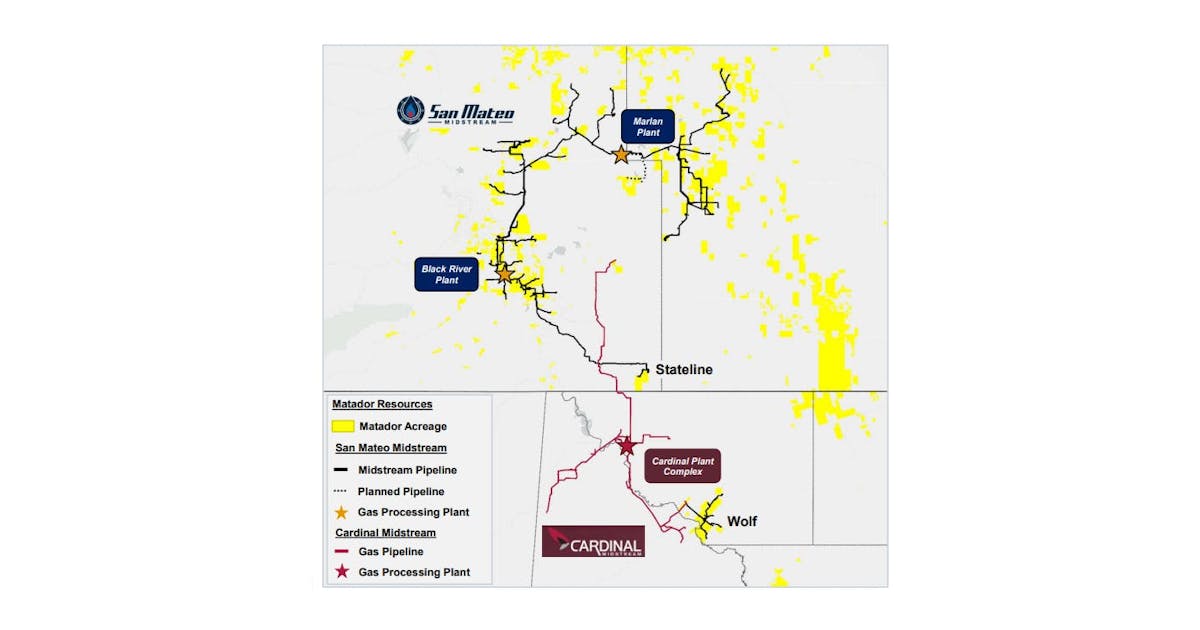
San Mateo said the assets complement its existing gathering and processing system and will improve natural gas flow across the northern Delaware basin in southeast New Mexico and West Texas. The acquisition is expected to increase San Mateo’s designed processing capacity to more than 1 bcfd and expand its gathering network to more than 800 miles. Integration of the systems is expected to provide immediate operating synergies, including the ability to move volumes between Cardinal’s Loving County plant and San Mateo’s Marlan and Black River plants in Eddy County. “With this acquisition, San Mateo not only gains more processing capacity, a larger pipeline system and a more diverse customer base but also improves its positioning for strategic transactions in the future,” said Brian J. Willey, San Mateo chairman and executive vice-president of midstream for Matador. Willey added that connecting the systems will “complete the circle” of San Mateo’s Delaware basin infrastructure, enhancing flow assurance for Matador and third‑party customers and improving flexibility to move natural gas throughout the northern Delaware basin north to south or south to north. The transaction is expected to close on or before July 31, 2026, subject to customary conditions. Cardinal’s field employees are expected to join San Mateo upon closing.

Read More »

QatarEnergy signs commercial declaration for offshore Cyprus

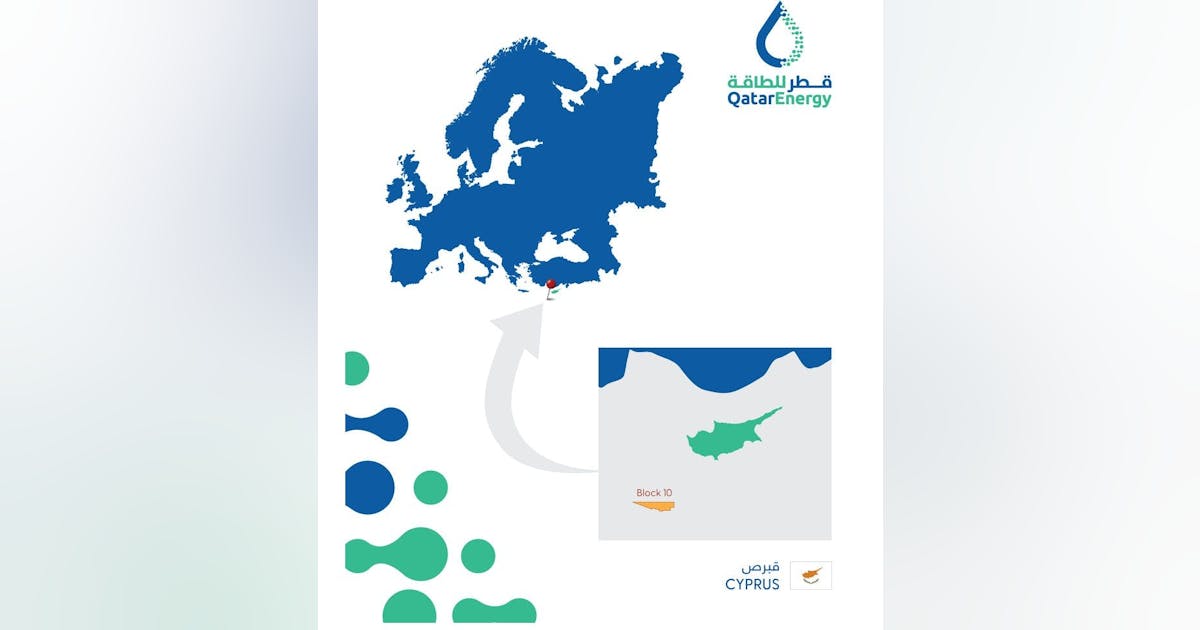
QatarEnergy has signed a commercial discovery declaration for the Glaucus and Pegasus fields in Cyprus, partnering with Cyprus and ExxonMobil to progress development plans and regulatory approvals for offshore gas production. <!–> June 30, 2026 –> Key Highlights QatarEnergy signed a commercial discovery declaration for offshore Cyprus. QatarEnergy, the government of Cyprus, and ExxonMobil will support the next phase of Block 10 development.

Read More »

Neste charts course for renewable fuels amidst industry retreat

Another technology that could provide massive potential to help meet rising energy demand and contribute to global climate goals is renewable hydrogen. Renewable hydrogen—or green hydrogen—is produced by electrolysis, where hydrogen is processed from water using renewable electricity (e.g., wind, solar) by splitting water molecules. Currently, around 95% of all hydrogen is made using fossil-derived natural gas, resulting in high GHG emissions. Since renewable hydrogen is nearly free of GHG emissions, the transition to a renewable hydrogen economy hold potential to transform the energy landscape. Just as with Neste’s the pilot program in Rotterdam, renewable fuel producers could benefit by evaluating options for replacing fossil-based hydrogen with renewable hydrogen in their production processes. In the renewable fuels production process, supply chain optimization is critical to ensure stable flows of both raw materials and end products. For Neste, this means an extensive global network for sourcing renewable raw materials and a market-centric distribution network to ensure renewable fuels reach customers and key markets quickly and efficiently. In the US, Neste made a major strategic move to enhance its supply network with the acquisition of Mahoney Environmental in 2020. This integration provides Neste with access to used cooking oil from over 100,000 locations across the country. To ensure efficient product delivery, Neste has also been fostering partnerships with infrastructure providers to lease terminals that are strategically located near key markets. These terminals are often well-connected to fuel logistics via vessels, barges, trucks, and pipelines. Having terminal capacities close to key markets can notably increase the availability and accessibility of Neste’s renewable fuels to customers. For example, the streamlined logistics system enabled a major expansion of Neste’s SAF supply in 2025, when Neste and United Airlines Inc. extended their partnership, making United the first commercial airline to purchase SAF for use on flights

Read More »

Talos Energy, Ridgewood sign deal to acquire Gulf of Mexico assets from Shell Offshore

Talos would acquire a 25% non-operated working interest in the bp plc-operated (50%) Na Kika platform and the Kepler, Ariel, Fourier, and Herschel fields, along with a 50% working interest and operatorship in the Coulomb field, the company said in a separate release. The Na Kika interests are subject to a 30-day preferential purchase right held by affiliates of bp. According to bp’s website, Na Kika is one of bp’s “most prolific producers in the Gulf,” as a hub for 8 subsea fields with more than 100 miles of infield flowlines which make up the gathering system. Na Kika, which lies 140 miles southeast of New Orleans in 6,340 ft of water, is designed to process up to 130,000 b/d of oil and 550 MMcfd of natural gas. If exercised, Talos would acquire only the 50% working interest and operatorship in Coulomb field, Talos said. Shell’s entitlement production from the assets is expected to average 37,000 boe/d in 2025. The company reported proved reserves at year-end 2025 of 4.3 MMboe for Na Kika and 7.2 MMboe for Coulomb. Based on its internal modeling, Na Kika and Coulomb “will not be meaningful contributors to production by 2030,” Shell said. Average first-quarter 2026 production attributable to the interests Talos expects to acquire was about 16,000 boe/d, of which about 77% was oil, Talos said. What Shell retains The agreement includes a 50% upside-sharing arrangement with Shell from closing through year-end 2027, subject to commodity price thresholds and certain other contingencies. The arrangement applies if realized oil prices exceed $60/bbl, Talos said. According to Shell, it will receive uncapped upside-linked payments through 2027 and overriding royalty interests on production from future Na Kika tiebacks, subject to specified conditions. Shell Trading US Co. will retain rights to offtake production from Na Kika and Coulomb

Read More »

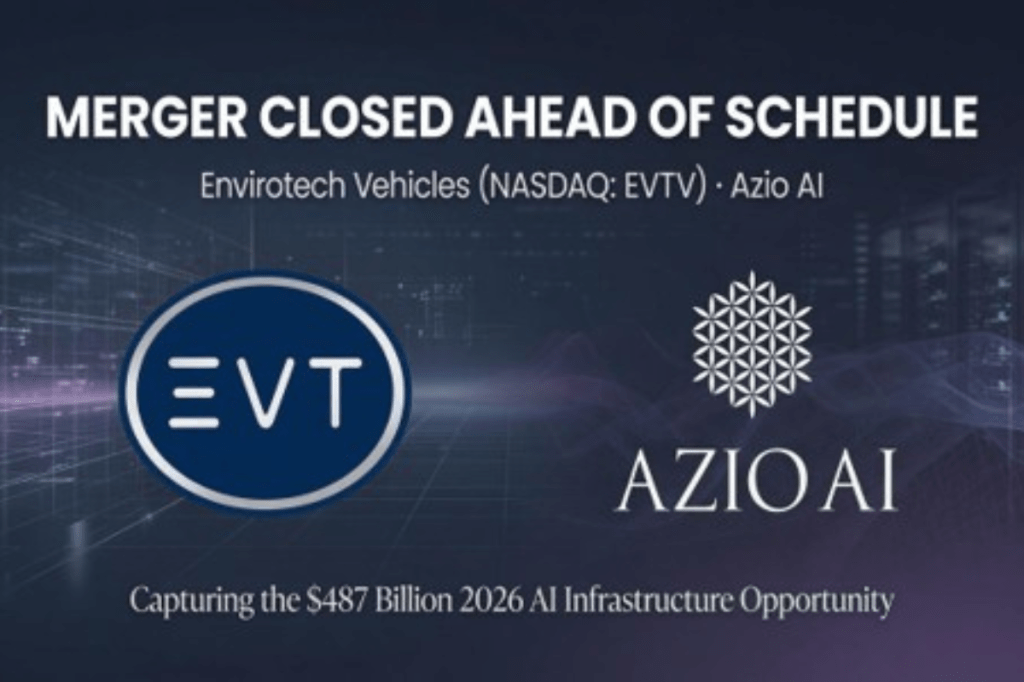
Envirotech Vehicles Closes Merger with Azio AI Ahead of Schedule, Positioning Combined Company to Capture $487 Billion 2026 AI Infrastructure Opportunity

This press release contains forward-looking statements within the meaning of the Private Securities Litigation Reform Act of 1995. In some cases, you can identify forward-looking statements by words such as “may,” “will,” “could,” “expect,” “anticipate,” “believe,” “estimate,” “project,” “intend,” “continue,” “potential,” “ongoing,” or the negative of these terms or other comparable terminology, although not all forward-looking statements contain these words. Forward-looking statements include statements regarding the Company’s ability to capitalize on accelerating demand for AI infrastructure, enterprise GPU compute, digital power solutions, data center development, and digital asset infrastructure; the Company’s plans to continue expanding its digital infrastructure platform through AI data center development, enterprise GPU compute solutions, power hosting services, digital asset mining operations, strategic infrastructure investments, and additional commercial partnerships; the Company’s ability to maximize utilization of its power resources while creating multiple long-term revenue opportunities; the ability to continue deploying modular digital infrastructure at the Company’s South Texas site; the anticipated deployment and scaling of NVIDIA B200 and B300 GPU systems; the ability to advance and execute against the Company’s commercial infrastructure pipeline; the anticipated development of the Company’s footprint; the ability to monetize power assets across multiple complementary revenue streams, including AI data centers, enterprise compute infrastructure, power hosting, and digital asset mining operations; customer demand for AI infrastructure, enterprise compute, and digital infrastructure; the Company’s ability to build a scalable platform designed to serve that demand and create long-term shareholder value; and the Company’s broader business strategy and long-term growth objectives. These statements are based on current expectations and assumptions that involve risks and uncertainties that could cause actual results to differ materially. Most of these factors are outside the Company’s control and are difficult to predict. Factors that may affect actual results include, but are not limited to, the Company’s limited operating history within

Read More »

Cloud sovereignty: First four providers sign up to CISPE certification program

“Public bodies, hospitals and industrial operators are today seeking concrete guarantees of digital sovereignty. The CISPE Sovereignty Badge provides that guarantee. It is a natural complement to European standards such as Gaia-X Level 3, strengthening transparency, compliance and digital trust. It is this ability to provide concrete proof, beyond rhetoric, that underpins genuine European digital autonomy.” said Antoine Fournier, CEO of Thésée Datacenter The EU is keen to guard against ‘sovereignty washing’ — claims by foreign-owned cloud providers that they meet local control criteria. Last month, CISPE warned about Broadcom’s claim it complied with EU conditions. It probably won’t be the last to make such claims.

Read More »

What Meta, Oracle moves say about data center economics

Meta, meanwhile, is continuing its spending spree on AI infrastructure, anonymous sources told Bloomberg. The company is purportedly developing plans for new cloud infrastructure business lines that would sell access to AI computing power and models, putting it in competition with other data center giants. One potential scenario would have Meta selling access to models, including its new Muse Spark, hosted on its own AI infrastructure, as well as running the underlying data centers. This model is similar to AWS’ Bedrock offering. Another possibility is Meta selling access to “raw” computing capacity, as do neocloud businesses such as CoreWeave. This move is part of the company’s internal Meta Compute initiative, the sources said. Like Oracle, Meta has been investing hundreds of billions of dollars in data centers and expensive AI chips. And, according to its latest 10-K: “We plan to continue to significantly expand the size of our infrastructure primarily through data centers, subsea and terrestrial fiber optic cable systems, and other projects.”

Read More »

Executive Roundtable: The Rise of Integrated Infrastructure

Steve Altizer, Compu Dynamics: Integration has to be foundational. It has to start at the first planning conversation, not after the equipment is selected or once the building is already designed. In previous generations of data center development, mechanical, electrical, IT, and operations teams could often work in parallel and bring the pieces together later. That worked when the load profile was more predictable and the facility had more room to absorb change. Before the introduction of ChatGPT, there was very little change to absorb. AI removes that tolerance. A change in rack density can affect electrical distribution, structural requirements, thermal strategy, commissioning, service access, and the way the site is operated. These are no longer independent decisions. They are all part of one performance system. As AI systems move toward POD-scale platforms, the boundary between IT and facility infrastructure becomes much harder to separate. The challenge is that AI workloads are too varied for a one-size-fits-all approach. Training clusters, inference nodes, enterprise AI environments, and edge sites can all have different requirements for density, cooling architecture, network connectivity, security, site conditions, and serviceability. That is why many companies are adopting a modular approach, while others are embracing hybrid models where turnkey modular AI capacity is integrated into larger campus environments.  At the campus level, that means standardizing the backbone infrastructure that serves the site (utility power feeds, central cooling capacity, and network pathways), while allowing the IT environment and the integrated critical infrastructure components to evolve as workload requirements change. The goal is not modularity for its own sake. The goal is to support the next generation of AI deployments without forcing every hardware change to become a major redesign. AI infrastructure cannot be planned as a collection of disparate systems. It has to be designed as one coordinated

Read More »

Data Center Insights 2026 Brings Industry Leaders Together for a Two-Day Look at the AI Infrastructure Era

The data center industry has never been more visible, more vital, or more challenged. Support for AI and its overall industry impact has pushed digital infrastructure into the public conversation. It has become clear that the sector is confronting unprecedented demands for everything from power to basic infrastructure. That convergence is the focus of Data Center Insights 2026, a two-day virtual event taking place July 15–16, 2026, produced by Endeavor B2B’s Data Center Frontier, Cabling Installation & Maintenance, ISE, Lightwave, and SecurityInfoWatch. Designed for data center owners, operators, engineers, IT leaders, and the people supporting the next generation of data center development, the event offers a concentrated look at the technologies and strategies shaping the future of digital infrastructure. The program arrives at a crucial moment. AI workloads are changing almost every assumption behind data center design. Rack densities are rising, liquid cooling is becoming mainstream, and fiber networks are being rethought for 400G and beyond. Power constraints are now central to site selection. Security is becoming highlighted and operators are being asked to build faster, scale larger, be more resource efficient and maintain resilience in an environment where downtime carries higher consequences than ever. Data Center Insights 2026 is structured to help attendees make sense of this moment. Rather than treating data center infrastructure as a set of separate disciplines, the event brings together experts across cooling, cabling, fiber, power distribution, modular design, AI infrastructure, and operational strategy. The result is a practical, cross-functional program built around the real-world questions now facing the industry. What will I learn at this event? The event opens with “Expert Roundup: The State of the Data Center Industry,” featuring perspectives from Steven Carlini of Schneider Electric.This session sets the stage by examining the forces driving change across the data center landscape in 2026.

Read More »

Executive Roundtable: Scaling Beyond the Prototype Phase

Steve Altizer, Compu Dynamics: The defining challenge is keeping pace with the rate of change in the IT environment. It takes time to design, permit, build, and commission a data center. AI hardware operates on a completely different timeline. New GPU families are being introduced every 12 to 18 months, and from one generation to the next, rack power densities can double or even triple. At prototype scale, you can design around a single cluster or a specific density profile. At production scale, that approach becomes a real liability. The facility has to support today’s deployment while remaining adaptable for the next compute profile. We are not just talking about adding more power. We are preparing for major architectural shifts, including the move toward DC power delivery or cooling systems that may rely on two-phase liquid to remove heat at scale. That is what becomes materially harder. You are no longer solving for a single, static deployment. You are solving for a moving target inside a live operating environment. This is where strategic modularity proves its value. It helps decouple the lifecycle of the building from the lifecycle of the IT hardware. Instead of treating the data center as one monolithic design, modularity creates a more agile framework that can absorb new power and cooling architectures without requiring a full facility retrofit every time the IT roadmap shifts. At Compu Dynamics Modular, we are seeing this play out in real time. The value of a turnkey modular approach is not simply speed. It is the agility owners need to keep pace with ever-evolving rack densities, power delivery requirements, and cooling architectures.

Read More »

Microsoft will invest $80B in AI data centers in fiscal 2025

And Microsoft isn’t the only one that is ramping up its investments into AI-enabled data centers. Rival cloud service providers are all investing in either upgrading or opening new data centers to capture a larger chunk of business from developers and users of large language models (LLMs).  In a report published in October 2024, Bloomberg Intelligence estimated that demand for generative AI would push Microsoft, AWS, Google, Oracle, Meta, and Apple would between them devote $200 billion to capex in 2025, up from $110 billion in 2023. Microsoft is one of the biggest spenders, followed closely by Google and AWS, Bloomberg Intelligence said. Its estimate of Microsoft’s capital spending on AI, at $62.4 billion for calendar 2025, is lower than Smith’s claim that the company will invest $80 billion in the fiscal year to June 30, 2025. Both figures, though, are way higher than Microsoft’s 2020 capital expenditure of “just” $17.6 billion. The majority of the increased spending is tied to cloud services and the expansion of AI infrastructure needed to provide compute capacity for OpenAI workloads. Separately, last October Amazon CEO Andy Jassy said his company planned total capex spend of $75 billion in 2024 and even more in 2025, with much of it going to AWS, its cloud computing division.

Read More »

John Deere unveils more autonomous farm machines to address skill labor shortage

Join our daily and weekly newsletters for the latest updates and exclusive content on industry-leading AI coverage. Learn More Self-driving tractors might be the path to self-driving cars. John Deere has revealed a new line of autonomous machines and tech across agriculture, construction and commercial landscaping. The Moline, Illinois-based John Deere has been in business for 187 years, yet it’s been a regular as a non-tech company showing off technology at the big tech trade show in Las Vegas and is back at CES 2025 with more autonomous tractors and other vehicles. This is not something we usually cover, but John Deere has a lot of data that is interesting in the big picture of tech. The message from the company is that there aren’t enough skilled farm laborers to do the work that its customers need. It’s been a challenge for most of the last two decades, said Jahmy Hindman, CTO at John Deere, in a briefing. Much of the tech will come this fall and after that. He noted that the average farmer in the U.S. is over 58 and works 12 to 18 hours a day to grow food for us. And he said the American Farm Bureau Federation estimates there are roughly 2.4 million farm jobs that need to be filled annually; and the agricultural work force continues to shrink. (This is my hint to the anti-immigration crowd). John Deere’s autonomous 9RX Tractor. Farmers can oversee it using an app. While each of these industries experiences their own set of challenges, a commonality across all is skilled labor availability. In construction, about 80% percent of contractors struggle to find skilled labor. And in commercial landscaping, 86% of landscaping business owners can’t find labor to fill open positions, he said. “They have to figure out how to do

Read More »

2025 playbook for enterprise AI success, from agents to evals

Join our daily and weekly newsletters for the latest updates and exclusive content on industry-leading AI coverage. Learn More 2025 is poised to be a pivotal year for enterprise AI. The past year has seen rapid innovation, and this year will see the same. This has made it more critical than ever to revisit your AI strategy to stay competitive and create value for your customers. From scaling AI agents to optimizing costs, here are the five critical areas enterprises should prioritize for their AI strategy this year. 1. Agents: the next generation of automation AI agents are no longer theoretical. In 2025, they’re indispensable tools for enterprises looking to streamline operations and enhance customer interactions. Unlike traditional software, agents powered by large language models (LLMs) can make nuanced decisions, navigate complex multi-step tasks, and integrate seamlessly with tools and APIs. At the start of 2024, agents were not ready for prime time, making frustrating mistakes like hallucinating URLs. They started getting better as frontier large language models themselves improved. “Let me put it this way,” said Sam Witteveen, cofounder of Red Dragon, a company that develops agents for companies, and that recently reviewed the 48 agents it built last year. “Interestingly, the ones that we built at the start of the year, a lot of those worked way better at the end of the year just because the models got better.” Witteveen shared this in the video podcast we filmed to discuss these five big trends in detail. Models are getting better and hallucinating less, and they’re also being trained to do agentic tasks. Another feature that the model providers are researching is a way to use the LLM as a judge, and as models get cheaper (something we’ll cover below), companies can use three or more models to

Read More »

OpenAI’s red teaming innovations define new essentials for security leaders in the AI era

Join our daily and weekly newsletters for the latest updates and exclusive content on industry-leading AI coverage. Learn More OpenAI has taken a more aggressive approach to red teaming than its AI competitors, demonstrating its security teams’ advanced capabilities in two areas: multi-step reinforcement and external red teaming. OpenAI recently released two papers that set a new competitive standard for improving the quality, reliability and safety of AI models in these two techniques and more. The first paper, “OpenAI’s Approach to External Red Teaming for AI Models and Systems,” reports that specialized teams outside the company have proven effective in uncovering vulnerabilities that might otherwise have made it into a released model because in-house testing techniques may have missed them. In the second paper, “Diverse and Effective Red Teaming with Auto-Generated Rewards and Multi-Step Reinforcement Learning,” OpenAI introduces an automated framework that relies on iterative reinforcement learning to generate a broad spectrum of novel, wide-ranging attacks. Going all-in on red teaming pays practical, competitive dividends It’s encouraging to see competitive intensity in red teaming growing among AI companies. When Anthropic released its AI red team guidelines in June of last year, it joined AI providers including Google, Microsoft, Nvidia, OpenAI, and even the U.S.’s National Institute of Standards and Technology (NIST), which all had released red teaming frameworks. Investing heavily in red teaming yields tangible benefits for security leaders in any organization. OpenAI’s paper on external red teaming provides a detailed analysis of how the company strives to create specialized external teams that include cybersecurity and subject matter experts. The goal is to see if knowledgeable external teams can defeat models’ security perimeters and find gaps in their security, biases and controls that prompt-based testing couldn’t find. What makes OpenAI’s recent papers noteworthy is how well they define using human-in-the-middle

Read More »