Stay Ahead, Stay ONMINE

Will Trump tariffs delay utility transmission, power plant plans?

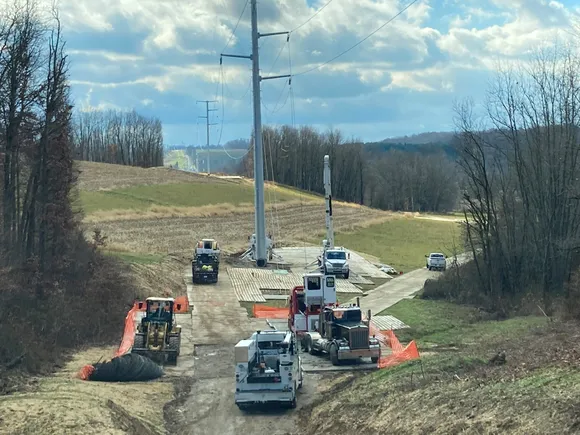
FirstEnergy and other utilities are warning that Trump administration tariffs on Canada, Mexico and other countries could hurt them, according to risk disclosures included in annual reports filed last month with the U.S. Securities and Exchange Commission. The alerts on tariffs come as U.S. utilities have been expanding their capital expenditure plans to build transmission […]

FirstEnergy and other utilities are warning that Trump administration tariffs on Canada, Mexico and other countries could hurt them, according to risk disclosures included in annual reports filed last month with the U.S. Securities and Exchange Commission.

The alerts on tariffs come as U.S. utilities have been expanding their capital expenditure plans to build transmission lines and power plants to meet rising demand growth, partly driven by data center development.

“Any widespread imposition of new or increased tariffs could have an adverse effect on our results of operations, cash flow and financial condition,” FirstEnergy said in a Feb. 27 filing. “New or increased tariffs could also negatively affect U.S. national or regional economies, which also could negatively impact our business and results of operations.”

Deteriorating economic conditions triggered by tariffs or other causes generally lead to reduced electric use by customers, particularly industrial customers, according to American Electric Power.

“The current administration has implemented tariffs on certain imported goods and may impose additional tariffs,” AEP said in a Feb. 13 filing. “As a result, prevailing economic conditions may reduce future net income and cash flows and negatively impact [our] financial condition.”

Tariffs could disrupt supply chains and delay building, maintaining and repairing infrastructure needed to support operations or are required to execute AEP’s plans for continued capital investment and to transition its generation fleet, the Akron, Ohio-based utility company said.

Tariffs could also drive up the price of materials and equipment, increase the cost of capital and extend procurement lead times, according to AEP.

President Trump on March 4 imposed 25% tariffs on imports from Mexico and Canada, and increased tariffs on imports from China by 10%. Those countries responded with plans to impose tariffs on U.S. imports.

The tariffs could limit access to electrical equipment, such as transformers, needed to maintain and expand the grid, according to a report released Monday by the Atlantic Council, a think tank. The U.S. imports about 80% of its electric transformers, with Mexico being the largest supplier, according to the report.

Also, Trump’s 25% tariffs on steel and aluminum will raise prices of grain-oriented electrical steel that is used to make transformers, increasing the price of U.S.-made transformers, the report’s authors said.

“Higher prices for transformers, especially transformers imported from Mexico, because of tariffs will raise project-development costs and delay infrastructure upgrades, hitting Texas hardest,” they said, noting there is a transformer shortage.

‘The operative word is uncertainty’

Even so, it’s not clear how the tariffs will affect utilities, according to analysts.

“It’s very hard to predict what’s going to happen. We’re in uncharted territory,” Paul Patterson, an equity analyst at Glenrock Associates, said in an interview, noting the tariffs could expand to Europe and other countries. “The operative word is uncertainty.”

However, it is unlikely that utility multi-year capital expenditure plans will be directly affected by tariffs, according to Patterson. More immediate issues are inflation and the possibility of the United States entering into a recession, he said. But, if infrastructure becomes more expensive to build, utilities may face pressure to delay projects, according to Patterson.

Travis Miller, a Morningstar analyst, doubts tariffs will have much effect on utility capital expenditure plans. “Most utilities either get their equipment from domestic manufacturers or have contracts for already secured equipment deliveries from outside the U.S.,” he said in an interview.

The Edison Electric Institute, a trade group for investor-owned utilities, plans to work with the Trump administration to ensure that any new tariffs don’t raise customer energy bills due to higher commodity prices, according to Scott Aaronson, EEI senior vice president, energy security and industry operations. 

“Our industry must have access to the critical components, commodities, and equipment needed to operate the grid, as we work to meet growing customer demands for electricity reliably and affordably,” Aaronson said in an email. “Electric companies are committed to keeping costs to customers as low as possible.”

The National Electrical Manufacturers Association on Tuesday called for trade policies that provide predictability and certainty, with a “reasonable” transition period for large-scale manufacturing to come online in the U.S.

“NEMA urges the Trump Administration to reach a long-term deal that strengthens trade across North America, provides business certainty for the essential electrical industry, and facilitates our shared goals of a robust energy sector and strong U.S. manufacturing base,” NEMA President and CEO Debra Phillips said in a statement.

It’s unclear how long the tariffs against Canada and Mexico will last, according to Capstone.

“Capstone believes the market’s reaction to the universal tariff on all imports from Canada, Mexico, and China, coupled with the impact these tariffs will have on the US auto industry and gas prices, will prompt Trump to remove the tariffs on Canada and Mexico,” analysts with the research firm said in a Tuesday note. “Even if superficial, concessions from Canada and Mexico could give Trump an out, allowing him to parade his tariffs as successful while avoiding further market volatility.”

Shape
Shape
Stay Ahead

Explore More Insights

Stay ahead with more perspectives on cutting-edge power, infrastructure, energy,  bitcoin and AI solutions. Explore these articles to uncover strategies and insights shaping the future of industries.

Shape

Chinese cyberspies target VMware vSphere for long-term persistence

Designed to work in virtualized environments The CISA, NSA, and Canadian Cyber Center analysts note that some of the BRICKSTORM samples are virtualization-aware and they create a virtual socket (VSOCK) interface that enables inter-VM communication and data exfiltration. The malware also checks the environment upon execution to ensure it’s running

Read More »

IBM boosts DNS protection for multicloud operations

“In addition to this DNS synchronization, you can publish DNS configurations to your Amazon Simple Storage Service (S3) bucket. As you implement DNS changes, the S3 bucket will automatically update. The ability to store multiple configurations in your S3 bucket allows you to choose the most appropriate restore point if

Read More »

Cloudflare firewall reacts badly to React exploit mitigation

During the same window, Downdetector saw a spike in problem reports for enterprise services including Shopify, Zoom, Claude AI, and Amazon Web Services, and a host of consumer services from games to dating apps. Cloudflare explained the outage on its service status page: “A change made to how Cloudflare’s Web

Read More »

New Fortress Energy Seals Deal to Continue Supplying Gas to Puerto Rico

New Fortress Energy Inc (NFE) has received approval from local authorities to continue delivering natural gas for Puerto Rico’s power system for seven more years. The consent from the Financial Oversight and Management Board for Puerto Rico provides for the supply of about 75 trillion British thermal units (TBtu), New York City-based NFE said in an online statement. “Under the terms of the agreement, NFE will supply reliable, lower-emission natural gas to help enhance grid stability and support cleaner power generation across Puerto Rico’s energy system”, NFE said. According to NFE’s September 16 announcement about the agreed contract terms, the agreement involved “minimum annual take-or-pay volumes of 40 TBtu, increasing to up to 50 TBtu if certain conditions are met”. “This landmark agreement provides two critical benefits to the island. First, it establishes security of supply in San Juan for the next seven years for power plants currently running on LNG”, NFE chief executive Wes Edens said then. “Second, it provides for incremental LNG volumes to be delivered, allowing for the conversion of additional gas-ready plants currently burning diesel, resulting in hundreds of millions of dollars in energy savings for Puerto Ricans”. NFE said at the time, “Pricing of the volumes supplied through the GSA [Gas Supply Agreement] is set at a blend of 115 percent of Henry Hub plus $7.95/million Btu, excluding natural gas supplied to the units at San Juan 5 & 6 (which has historically consumed ~20 TBtu per year). Instead, these volumes are priced at 115 percent of Henry Hub plus $6.50/MMBtu”. According to the September statement, NFE expects to source the LNG under the new GSA from its Fast LNG facility in Altamira, Mexico. With a capacity of 1.4 million metric tons per annum, the project started operations in the fourth quarter of 2024, according to NFE. On March 17 NFE said it had amended the

Read More »

BGN Plans Global Gas Push Ahead of New Supplies

Energy trader BGN is set to expand its fledgling natural gas business into a global portfolio with stakes in plants, vessels and pipelines.  The push comes as the market for liquefied natural gas is set to boom, with US exports ramping up and Qatar, another major producer, also adding output. While that’s likely to push prices lower, the wave of extra supplies is poised to create new trading opportunities. The firm is in talks to buy LNG on contracts as long as 15 years, as well as equity in U.S. export plants, the company’s co-heads of LNG, Ruben Mosquera Arias and Maria Eugenia Suardiaz, said in an interview in Istanbul on Thursday. BGN got its start in the market for liquefied petroleum gas and has amassed a fleet of about 40 ships. In recent years, it has expanded rapidly into crude, oil products and metals.    “In LNG, we would like to be present globally as well, from the Atlantic basin to Asia Pacific,” said Suardiaz, declining to provide details on the volume they plan to handle.  Producers are set to add a record 300 billion cubic meters of annual export capacity by 2030, the International Energy Agency wrote last month in a report. That’s poised to reshape the market after years of scarcity. “We want to capture this wave,” said Mosquera Arias.  The company is also applying for licenses to buy capacity in European pipelines. It expects to take delivery of its first newbuild LNG carriers in the next two years, although the executives declined to provide more details.  BGN started its LNG team in 2024 and sold spot cargoes to both Egypt and Germany earlier this year. In the summer, it struck a deal to supply as many as 42 shipments to the North African country, where it’s already a major

Read More »

Crude Finishes Higher on Short Covering

Oil gained, finishing the week positive as investors assessed the murky outlook for a cease-fire in Ukraine and as the commodity pushed past an important technical level. West Texas Intermediate rose 0.7% to settle above $60 a barrel, signaling that a risk premium persists as a peace deal between Russia and Ukraine remains elusive. Ukrainian negotiators continued talks with US officials in Florida for a second day, with Russia objecting to some of the points in a US-backed plan. The market is watching for progress on a settlement that could lower prices by potentially easing sanctions and boosting Russian oil flows just as an expected oversupply in the market starts to materialize. But an agreement appears distant: Ukraine took credit for an overnight attack on Russia’s Syzran refinery and the Temryuk seaport. Meanwhile, Washington reportedly lobbied European countries in an effort to block a plan to use Moscow’s frozen assets to back a massive loan for Ukraine. Adding to bullish momentum, WTI on Friday settled above its 50-day moving average, a key level of support for the commodity. Prices have also received a boost from algorithmic traders covering some of their bearish positions in recent sessions — and analysts say more buying could materialize in coming weeks. “This session should mark the first notable short covering program since algo selling activity exhausted itself, and the bar is low for subsequent CTA buying activity to hit the tapes over the coming week,” said Dan Ghali, a commodity strategist at TD Securities. Countering geopolitical risks, oversupply is putting downward pressure on prices globally. Saudi Aramco will reduce the price of its flagship Arab Light crude grade to the lowest level since 2021 for January, while Canadian oil has tumbled. And the number of crude oil rigs in the US rose by 6

Read More »

ITT Agrees to Buy Lone Star’s SPX Flow in $4.8B Deal

ITT Inc. has agreed to acquire industrial equipment manufacturer SPX Flow Inc. from Lone Star Funds in a $4.775 billion cash and stock deal. The deal will will consist of a combination of cash and $700 million in ITT common stock issued to Lone Star, according to a statement confirming an earlier report by Bloomberg News that the companies were nearing a deal. Charlotte, North Carolina-based SPX Flow makes products including valves and pumps under brands such as APV and Johnson Pump, as well as food processing equipment such as its Gerstenberg Schröder-branded butter maker. Lone Star Funds agreed in 2021 to take SPX Flow private for $3.8 billion including debt.  The SPX Flow acquisition is the largest ever by Stamford, Connecticut-based ITT, according to data compiled by Bloomberg. ITT’s shares have gained 28% this year, giving it a market value of $14.3 billion. ITT’s history dates to 1920, with its genesis as International Telephone and Telegraph, a provider of telephone switching equipment and services, according to the company’s website. In 1995, that conglomerate was split into three divisions, including the company that became the current manufacturer of components and technology for a range of transportation, industrial and energy markets. WHAT DO YOU THINK? Generated by readers, the comments included herein do not reflect the views and opinions of Rigzone. All comments are subject to editorial review. Off-topic, inappropriate or insulting comments will be removed.

Read More »

Energy Department Launches Breakthrough AI-Driven Biotechnology Platform at PNNL

Richland, Wash.—U.S. Secretary of Energy Chris Wright launched a new chapter to secure American leadership in autonomous biological discovery yesterday alongside scientists and private partners at Pacific Northwest National Laboratory (PNNL). As part of his visit to PNNL, Secretary Wright commissioned and signed the Anaerobic Microbial Phenotyping Platform (AMP2). PNNL scientists believe AMP2 will be the world’s largest autonomous-capable science system for anaerobic microbial experimentation. The platform supports the Trump Administration’s recently announced Genesis Mission, which calls on the Department of Energy (DOE) to transform American leadership in science and innovation with the development of artificial intelligence (AI). Built by Gingko Bioworks, AMP2 gives DOE scientists an unprecedented capability to explore the world of microbes—an invisible yet powerful workforce poised to boost biotech manufacturing as well as provide insights into basic life science questions. This first-of-its-kind capability will transform how the U.S. identifies, grows, and optimizes the use of microbes in days and weeks instead of years using automation and AI.  “President Trump launched the Genesis Mission to ensure American leadership in science and innovation,” said Secretary Chris Wright. “This ongoing public-private partnership at PNNL will help do exactly that in the field of biotechnology. By launching AI-enabled, autonomous platforms like AMP2, our DOE National Laboratories are driving scientific breakthroughs faster than ever before and ensuring the United States leads the world in technologies that will better human lives and secure our future.”  The AMP2 platform will serve as a prototype for DOE’s planned development of the larger Microbial Molecular Phenotyping Capability (M2PC). Together, the systems will establish the world’s largest autonomous microbial research infrastructure, and position the U.S. to lead in biotechnology, biomanufacturing, and next-generation materials innovation for decades to come. Secretary Wright visited PNNL as part of his ongoing tour of all 17 DOE National Laboratories. PNNL marks

Read More »

Chevron, Gorgon Partners OK $2B to Drill for More Gas

Chevron Corp’s Australian unit and its joint venture partners have reached a final investment decision to further develop the massive Gorgon natural gas project in Western Australia, it said in a statement on Friday. Chevron Australia and its partners — including Exxon Mobil Corp. and Shell Plc — will spend A$3 billion ($2 billion) connecting two offshore natural gas fields to existing infrastructure and processing facilities on Barrow Island as part of the Gorgon Stage 3 development, it said in the statement. Six wells will also be drilled.  Gorgon, on the remote Barrow Island in northwestern Australia, is the largest resource development in Australia’s history, and produces about 15.6 million tons of liquefied natural gas a year. WHAT DO YOU THINK? Generated by readers, the comments included herein do not reflect the views and opinions of Rigzone. All comments are subject to editorial review. Off-topic, inappropriate or insulting comments will be removed.

Read More »

At the Crossroads of AI and the Edge: Inside 1623 Farnam’s Rising Role as a Midwest Interconnection Powerhouse

That was the thread that carried through our recent conversation for the DCF Show podcast, where Severn walked through the role Farnam now plays in AI-driven networking, multi-cloud connectivity, and the resurgence of regional interconnection as a core part of U.S. digital infrastructure. Aggregation, Not Proximity: The Practical Edge Severn is clear-eyed about what makes the edge work and what doesn’t. The idea that real content delivery could aggregate at the base of cell towers, he noted, has never been realistic. The traffic simply isn’t there. Content goes where the network already concentrates, and the network concentrates where carriers, broadband providers, cloud onramps, and CDNs have amassed critical mass. In Farnam’s case, that density has grown steadily since the building changed hands in 2018. At the time an “underappreciated asset,” the facility has since become a meeting point for more than 40 broadband providers and over 60 carriers, with major content operators and hyperscale platforms routing traffic directly through its MMRs. That aggregation effect feeds on itself; as more carrier and content traffic converges, more participants anchor themselves to the hub, increasing its gravitational pull. Geography only reinforces that position. Located on the 41st parallel, the building sits at the historical shortest-distance path for early transcontinental fiber routes. It also lies at the crossroads of major east–west and north–south paths that have made Omaha a natural meeting point for backhaul routes and hyperscale expansions across the Midwest. AI and the New Interconnection Economy Perhaps the clearest sign of Farnam’s changing role is the sheer volume of fiber entering the building. More than 5,000 new strands are being brought into the property, with another 5,000 strands being added internally within the Meet-Me Rooms in 2025 alone. These are not incremental upgrades—they are hyperscale-grade expansions driven by the demands of AI traffic,

Read More »

Schneider Electric’s $2.3 Billion in AI Power and Cooling Deals Sends Message to Data Center Sector

When Schneider Electric emerged from its 2025 North American Innovation Summit in Las Vegas last week with nearly $2.3 billion in fresh U.S. data center commitments, it didn’t just notch a big sales win. It arguably put a stake in the ground about who controls the AI power-and-cooling stack over the rest of this decade. Within a single news cycle, Schneider announced: Together, the deals total about $2.27 billion in U.S. data center infrastructure, a number Schneider confirmed in background with multiple outlets and which Reuters highlighted as a bellwether for AI-driven demand.  For the AI data center ecosystem, these contracts function like early-stage fuel supply deals for the power and cooling systems that underpin the “AI factory.” Supply Capacity Agreements: Locking in the AI Supply Chain Significantly, both deals are structured as supply capacity agreements, not traditional one-off equipment purchase orders. Under the SCA model, Schneider is committing dedicated manufacturing lines and inventory to these customers, guaranteeing output of power and cooling systems over a multi-year horizon. In return, Switch and Digital Realty are providing Schneider with forecastable volume and visibility at the scale of gigawatt-class campus build-outs.  A Schneider spokesperson told Reuters that the two contracts are phased across 2025 and 2026, underscoring that this arrangement is about pipeline, as opposed to a one-time backlog spike.  That structure does three important things for the market: Signals confidence that AI demand is durable.You don’t ring-fence billions of dollars of factory output for two customers unless you’re highly confident the AI load curve runs beyond the current GPU cycle. Pre-allocates power & cooling the way the industry pre-allocated GPUs.Hyperscalers and neoclouds have already spent two years locking up Nvidia and AMD capacity. These SCAs suggest power trains and thermal systems are joining chips on the list of constrained strategic resources.

Read More »

The Data Center Power Squeeze: Mapping the Real Limits of AI-Scale Growth

As we all know, the data center industry is at a crossroads. As artificial intelligence reshapes the already insatiable digital landscape, the demand for computing power is surging at a pace that outstrips the growth of the US electric grid. As engines of the AI economy, an estimated 1,000 new data centers1 are needed to process, store, and analyze the vast datasets that run everything from generative models to autonomous systems. But this transformation comes with a steep price and the new defining criteria for real estate: power. Our appetite for electricity is now the single greatest constraint on our expansion, threatening to stall the very innovation we enable. In 2024, US data centers consumed roughly 4% of the nation’s total electricity, a figure that is projected to triple by 2030, reaching 12% or more.2 For AI-driven hyperscale facilities, the numbers are even more staggering. With the largest planned data centers requiring gigawatts of power, enough to supply entire cities, the cumulative demand from all data centers is expected to reach 134 gigawatts by 2030, nearly three times the current load.​3 This presents a systemic challenge. The U.S. power grid, built for a different era, is struggling to keep pace. Utilities are reporting record interconnection requests, with some regions seeing demand projections that exceed their total system capacity by fivefold.4 In Virginia and Texas, the epicenters of data center expansion, grid operators are warning of tight supply-demand balances and the risk of blackouts during peak periods.5 The problem is not just the sheer volume of power needed, but the speed at which it must be delivered. Data center operators are racing to secure power for projects that could be online in as little as 18 months, but grid upgrades and new generation can take years, if not decades. The result

Read More »

The Future of Hyperscale: Neoverse Joins NVLink Fusion as SC25 Accelerates Rack-Scale AI Architectures

Neoverse’s Expanding Footprint and the Power-Efficiency Imperative With Neoverse deployments now approaching roughly 50% of all compute shipped into top hyperscalers in 2025 (representing more than a billion Arm cores) and with nation-scale AI campuses such as the Stargate project already anchored on Arm compute, the addition of NVLink Fusion becomes a pivotal extension of the Neoverse roadmap. Partners can now connect custom Arm CPUs to their preferred NVIDIA accelerators across a coherent, high-bandwidth, rack-scale fabric. Arm characterized the shift as a generational inflection point in data-center architecture, noting that “power—not FLOPs—is the bottleneck,” and that future design priorities hinge on maximizing “intelligence per watt.” Ian Buck, vice president and general manager of accelerated computing at NVIDIA, underscored the practical impact: “Folks building their own Arm CPU, or using an Arm IP, can actually have access to NVLink Fusion—be able to connect that Arm CPU to an NVIDIA GPU or to the rest of the NVLink ecosystem—and that’s happening at the racks and scale-up infrastructure.” Despite the expanded design flexibility, this is not being positioned as an open interconnect ecosystem. NVIDIA continues to control the NVLink Fusion fabric, and all connections ultimately run through NVIDIA’s architecture. For data-center planners, the SC25 announcement translates into several concrete implications: 1.   NVIDIA “Grace-style” Racks Without Buying Grace With NVLink Fusion now baked into Neoverse, hyperscalers and sovereign operators can design their own Arm-based control-plane or pre-processing CPUs that attach coherently to NVIDIA GPU domains—such as NVL72 racks or HGX B200/B300 systems—without relying on Grace CPUs. A rack-level architecture might now resemble: Custom Neoverse SoC for ingest, orchestration, agent logic, and pre/post-processing NVLink Fusion fabric Blackwell GPU islands and/or NVLink-attached custom accelerators (Marvell, MediaTek, others) This decouples CPU choice from NVIDIA’s GPU roadmap while retaining the full NVLink fabric. In practice, it also opens

Read More »

Flex’s Integrated Data Center Bet: How a Manufacturing Giant Plans to Reshape AI-Scale Infrastructure

At this year’s OCP Global Summit, Flex made a declaration that resonated across the industry: the era of slow, bespoke data center construction is over. AI isn’t just stressing the grid or forcing new cooling techniques—it’s overwhelming the entire design-build process. To meet this moment, Flex introduced a globally manufactured, fully integrated data center platform aimed directly at multi-gigawatt AI campuses. The company claims it can cut deployment timelines by as much as 30 percent by shifting integration upstream into the factory and unifying power, cooling, compute, and lifecycle services into pre-engineered modules. This is not a repositioning on the margins. Flex is effectively asserting that the future hyperscale data center will be manufactured like a complex industrial system, not built like a construction project. On the latest episode of The Data Center Frontier Show, we spoke with Rob Campbell, President of Flex Communications, Enterprise & Cloud, and Chris Butler, President of Flex Power, about why Flex believes this new approach is not only viable but necessary in the age of AI. The discussion revealed a company leaning heavily on its global manufacturing footprint, its cross-industry experience, and its expanding cooling and power technology stack to redefine what deployment speed and integration can look like at scale. AI Has Broken the Old Data Center Model From the outset, Campbell and Butler made clear that Flex’s strategy is a response to a structural shift. AI workloads no longer allow power, cooling, and compute to evolve independently. Densities have jumped so quickly—and thermals have risen so sharply—that the white space, gray space, and power yard are now interdependent engineering challenges. Higher chip TDPs, liquid-cooled racks approaching one to two megawatts, and the need to assemble entire campuses in record time have revealed deep fragility in traditional workflows. As Butler put it, AI

Read More »

Data Center Jobs: Engineering, Construction, Commissioning, Sales, Field Service and Facility Tech Jobs Available in Major Data Center Hotspots

Each month Data Center Frontier, in partnership with Pkaza, posts some of the hottest data center career opportunities in the market. Here’s a look at some of the latest data center jobs posted on the Data Center Frontier jobs board, powered by Pkaza Critical Facilities Recruiting. Looking for Data Center Candidates? Check out Pkaza’s Active Candidate / Featured Candidate Hotlist Data Center Facility Technician (All Shifts Available) Impact, TX This position is also available in: Ashburn, VA; Abilene, TX; Needham, MA and New York, NY. Navy Nuke / Military Vets leaving service accepted!  This opportunity is working with a leading mission-critical data center provider. This firm provides data center solutions custom-fit to the requirements of their client’s mission-critical operational facilities. They provide reliability of mission-critical facilities for many of the world’s largest organizations facilities supporting enterprise clients, colo providers and hyperscale companies. This opportunity provides a career-growth minded role with exciting projects with leading-edge technology and innovation as well as competitive salaries and benefits. Electrical Commissioning Engineer Montvale, NJ This traveling position is also available in: New York, NY; White Plains, NY;  Richmond, VA; Ashburn, VA; Charlotte, NC; Atlanta, GA; Hampton, GA; Fayetteville, GA; New Albany, OH; Cedar Rapids, IA; Phoenix, AZ; Salt Lake City, UT; Dallas, TX or Chicago, IL. *** ALSO looking for a LEAD EE and ME CxA Agents and CxA PMs. *** Our client is an engineering design and commissioning company that has a national footprint and specializes in MEP critical facilities design. They provide design, commissioning, consulting and management expertise in the critical facilities space. They have a mindset to provide reliability, energy efficiency, sustainable design and LEED expertise when providing these consulting services for enterprise, colocation and hyperscale companies. This career-growth minded opportunity offers exciting projects with leading-edge technology and innovation as well as competitive salaries and

Read More »

Microsoft will invest $80B in AI data centers in fiscal 2025

And Microsoft isn’t the only one that is ramping up its investments into AI-enabled data centers. Rival cloud service providers are all investing in either upgrading or opening new data centers to capture a larger chunk of business from developers and users of large language models (LLMs).  In a report published in October 2024, Bloomberg Intelligence estimated that demand for generative AI would push Microsoft, AWS, Google, Oracle, Meta, and Apple would between them devote $200 billion to capex in 2025, up from $110 billion in 2023. Microsoft is one of the biggest spenders, followed closely by Google and AWS, Bloomberg Intelligence said. Its estimate of Microsoft’s capital spending on AI, at $62.4 billion for calendar 2025, is lower than Smith’s claim that the company will invest $80 billion in the fiscal year to June 30, 2025. Both figures, though, are way higher than Microsoft’s 2020 capital expenditure of “just” $17.6 billion. The majority of the increased spending is tied to cloud services and the expansion of AI infrastructure needed to provide compute capacity for OpenAI workloads. Separately, last October Amazon CEO Andy Jassy said his company planned total capex spend of $75 billion in 2024 and even more in 2025, with much of it going to AWS, its cloud computing division.

Read More »

John Deere unveils more autonomous farm machines to address skill labor shortage

Join our daily and weekly newsletters for the latest updates and exclusive content on industry-leading AI coverage. Learn More Self-driving tractors might be the path to self-driving cars. John Deere has revealed a new line of autonomous machines and tech across agriculture, construction and commercial landscaping. The Moline, Illinois-based John Deere has been in business for 187 years, yet it’s been a regular as a non-tech company showing off technology at the big tech trade show in Las Vegas and is back at CES 2025 with more autonomous tractors and other vehicles. This is not something we usually cover, but John Deere has a lot of data that is interesting in the big picture of tech. The message from the company is that there aren’t enough skilled farm laborers to do the work that its customers need. It’s been a challenge for most of the last two decades, said Jahmy Hindman, CTO at John Deere, in a briefing. Much of the tech will come this fall and after that. He noted that the average farmer in the U.S. is over 58 and works 12 to 18 hours a day to grow food for us. And he said the American Farm Bureau Federation estimates there are roughly 2.4 million farm jobs that need to be filled annually; and the agricultural work force continues to shrink. (This is my hint to the anti-immigration crowd). John Deere’s autonomous 9RX Tractor. Farmers can oversee it using an app. While each of these industries experiences their own set of challenges, a commonality across all is skilled labor availability. In construction, about 80% percent of contractors struggle to find skilled labor. And in commercial landscaping, 86% of landscaping business owners can’t find labor to fill open positions, he said. “They have to figure out how to do

Read More »

2025 playbook for enterprise AI success, from agents to evals

Join our daily and weekly newsletters for the latest updates and exclusive content on industry-leading AI coverage. Learn More 2025 is poised to be a pivotal year for enterprise AI. The past year has seen rapid innovation, and this year will see the same. This has made it more critical than ever to revisit your AI strategy to stay competitive and create value for your customers. From scaling AI agents to optimizing costs, here are the five critical areas enterprises should prioritize for their AI strategy this year. 1. Agents: the next generation of automation AI agents are no longer theoretical. In 2025, they’re indispensable tools for enterprises looking to streamline operations and enhance customer interactions. Unlike traditional software, agents powered by large language models (LLMs) can make nuanced decisions, navigate complex multi-step tasks, and integrate seamlessly with tools and APIs. At the start of 2024, agents were not ready for prime time, making frustrating mistakes like hallucinating URLs. They started getting better as frontier large language models themselves improved. “Let me put it this way,” said Sam Witteveen, cofounder of Red Dragon, a company that develops agents for companies, and that recently reviewed the 48 agents it built last year. “Interestingly, the ones that we built at the start of the year, a lot of those worked way better at the end of the year just because the models got better.” Witteveen shared this in the video podcast we filmed to discuss these five big trends in detail. Models are getting better and hallucinating less, and they’re also being trained to do agentic tasks. Another feature that the model providers are researching is a way to use the LLM as a judge, and as models get cheaper (something we’ll cover below), companies can use three or more models to

Read More »

OpenAI’s red teaming innovations define new essentials for security leaders in the AI era

Join our daily and weekly newsletters for the latest updates and exclusive content on industry-leading AI coverage. Learn More OpenAI has taken a more aggressive approach to red teaming than its AI competitors, demonstrating its security teams’ advanced capabilities in two areas: multi-step reinforcement and external red teaming. OpenAI recently released two papers that set a new competitive standard for improving the quality, reliability and safety of AI models in these two techniques and more. The first paper, “OpenAI’s Approach to External Red Teaming for AI Models and Systems,” reports that specialized teams outside the company have proven effective in uncovering vulnerabilities that might otherwise have made it into a released model because in-house testing techniques may have missed them. In the second paper, “Diverse and Effective Red Teaming with Auto-Generated Rewards and Multi-Step Reinforcement Learning,” OpenAI introduces an automated framework that relies on iterative reinforcement learning to generate a broad spectrum of novel, wide-ranging attacks. Going all-in on red teaming pays practical, competitive dividends It’s encouraging to see competitive intensity in red teaming growing among AI companies. When Anthropic released its AI red team guidelines in June of last year, it joined AI providers including Google, Microsoft, Nvidia, OpenAI, and even the U.S.’s National Institute of Standards and Technology (NIST), which all had released red teaming frameworks. Investing heavily in red teaming yields tangible benefits for security leaders in any organization. OpenAI’s paper on external red teaming provides a detailed analysis of how the company strives to create specialized external teams that include cybersecurity and subject matter experts. The goal is to see if knowledgeable external teams can defeat models’ security perimeters and find gaps in their security, biases and controls that prompt-based testing couldn’t find. What makes OpenAI’s recent papers noteworthy is how well they define using human-in-the-middle

Read More »