The race to build AI infrastructure at scale has exposed a deeper constraint than capital or compute: power that can be delivered on predictable timelines.
That constraint is now colliding with a system that has historically moved at the pace of decades. But in early March, a key signal emerged that the equation may be starting to change.
A Regulatory Breakthrough at the Moment of Peak Power Demand
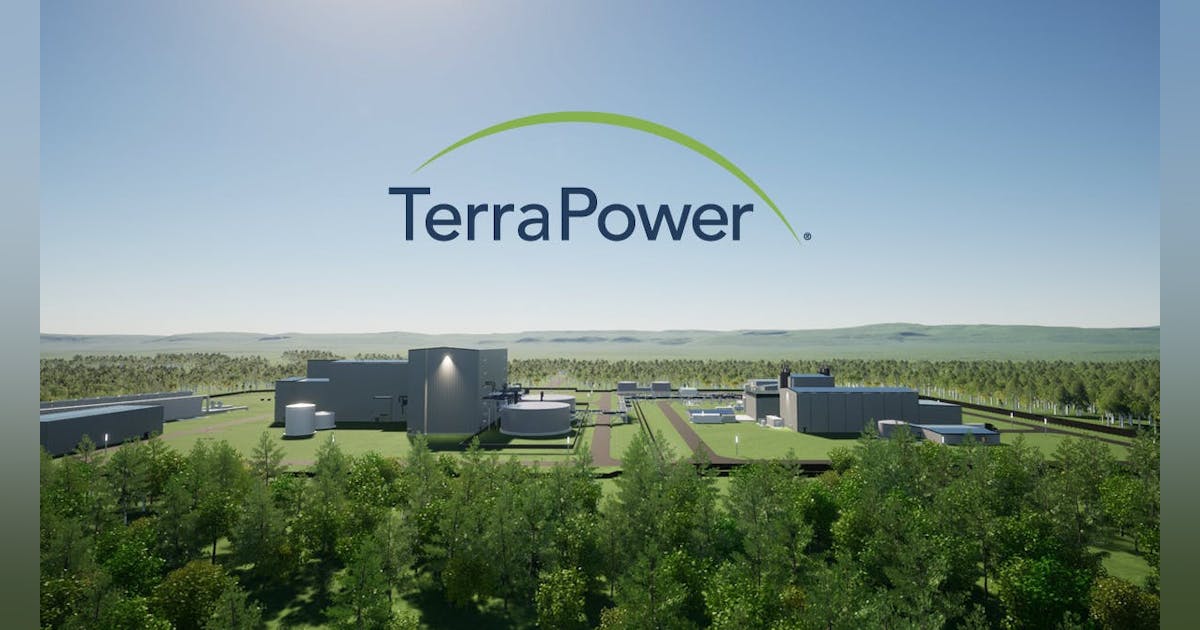
TerraPower’s Natrium reactor cleared a major milestone with the Nuclear Regulatory Commission, which approved a construction permit for Kemmerer Power Station Unit 1 in Wyoming, representing the company’s first commercial-scale plant. It is the first reactor construction approval the NRC has granted in nearly a decade, and the first for a commercial non-light-water reactor in more than 40 years. More significantly, it is the first advanced reactor to reach this stage under the modern U.S. licensing framework.
For an industry increasingly defined by gigawatt-scale AI campuses and compressed build cycles, that milestone lands with unusual timing.
Construction Approved — But Not Yet ‘Power Delivered’
The distinction between construction approval and operational readiness is critical.
TerraPower has not received a license to generate electricity. What the NRC has granted is permission to begin nuclear-related construction at the Kemmerer site, following safety and environmental review. Before the plant can operate, TerraPower’s subsidiary, US SFR Owner, must still secure a separate operating license.
But in practical terms, this is the moment when a project transitions from concept to execution. It is a regulatory green light not for power generation, but for steel, concrete, and capital deployment.
And in the context of advanced nuclear, that step has historically been the hardest to reach.
An 18-Month Signal to the Market
The speed of that approval may ultimately matter as much as the approval itself.
TerraPower submitted its construction permit application in March 2024. The NRC accepted it two months later, and by December 2025 had completed its final safety evaluation—finishing the process in roughly 18 months, well ahead of the original 27-month timeline.
That stands in stark contrast to the last major U.S. nuclear buildout. Vogtle Electric Generating Plant Units 3 and 4 took nearly 15 years to reach completion, a timeline increasingly incompatible with today’s energy and infrastructure demands.
For data center developers, hyperscalers, and neocloud operators, this is the real headline.
AI infrastructure is being planned, financed, and deployed on two- to three-year cycles. Until now, nuclear energy has operated on timelines that effectively excluded it from that conversation. An 18-month regulatory pathway—if it proves repeatable—begins to close that gap.
Why This Matters for AI Infrastructure
The NRC’s decision is not just about one reactor in Wyoming. It is a test of whether the U.S. regulatory system can support next-generation power infrastructure at the speed required by AI.
For an industry facing:
- Multi-year interconnection delays
- Transmission bottlenecks
- Rising community opposition to large-scale grid expansion
…the prospect of dispatchable, high-capacity generation that can be licensed on compressed timelines is strategically significant.
If advanced nuclear can move from application to construction approval in under two years, it begins to align (at least at the front end) with the development cadence of large-scale data center campuses.
That does not solve the full problem. But it changes the conversation.
A System Beginning to Move Faster
The NRC has signaled for several years that it intends to accelerate advanced reactor licensing. This approval is the clearest evidence to date that those efforts are translating into measurable outcomes.
As Jeremy Groom, acting director of the NRC’s Office of Nuclear Reactor Regulation, noted in December:
“We’ve finished our technical work on the Kemmerer review a month ahead of our already accelerated schedule, as we aim to make licensing decisions for new, advanced reactors in no more than 18 months.”
For investors, utilities, and increasingly for data center developers seeking long-term power certainty, the question is no longer whether advanced nuclear can be licensed.
It is whether it can now be licensed fast enough to matter.