Stay Ahead, Stay ONMINE

AI is a Positive Catalyst for Grid Growth

Data centers, particularly those optimized for artificial intelligence workloads, are frequently characterized in public discourse as a disruptive threat to grid stability and ratepayer affordability. But behind-the-narrative as we are, the AI‑driven data center growth is simply illuminating pre‑existing systemic weaknesses in electric infrastructure that have accumulated over more than a decade of underinvestment in […]

Data centers, particularly those optimized for artificial intelligence workloads, are frequently characterized in public discourse as a disruptive threat to grid stability and ratepayer affordability. But behind-the-narrative as we are, the AI‑driven data center growth is simply illuminating pre‑existing systemic weaknesses in electric infrastructure that have accumulated over more than a decade of underinvestment in transmission, substations, and interconnection capacity.

Over the same period, many utilities operated under planning assumptions shaped by slow demand growth and regulatory frameworks that incentivized incremental upgrades rather than large, anticipatory capital programs. As a result, the emergence of gigawatt‑scale computing campuses appears to be a sudden shock to a system that, in reality, was already misaligned with long‑term decarbonization, electrification, and digitalization objectives.

Utilities have been asked to do more with aging grids, slow permitting, and chronically constrained capital, and now AI and cloud are finally putting real urgency — and real investment — behind modernizing that backbone. In that sense, large‑scale compute is not the problem; it is the catalyst that makes it impossible to ignore the problem any longer.

We are at a moment when data centers, and especially AI data centers, are being blamed for exposing weaknesses that were already there, when in reality they are giving society a chance to fix a power system that has been underbuilt for more than a decade.

Utilities have been asked to do more with aging grids, slow permitting, and limited investment, and now AI and cloud are finally putting real urgency — and real capital — behind modernizing that backbone. In that sense, data centers aren’t the problem; they are the catalyst that makes it impossible to ignore the problem any longer.

AI Demand Provided a Long‑Overdue Stress Test

The nature of AI workloads intensified this dynamic. High‑performance computing clusters concentrate substantial power density into relatively compact geographic footprints, with thermal and redundancy requirements that further increase site‑level peak demand. In contrast to more diffuse residential or commercial load growth, these projects are typically capitalized with multiyear investment horizons, contractual commitments, and global performance expectations that assume reliable access to large blocks of power.

This combination of spatial concentration, temporal urgency, and financial scale interfaces poorly with a grid whose expansion cycles, particularly for high‑voltage transmission, often extend beyond a decade from initial planning to energization. In many jurisdictions, the interconnection queues for both new generation and large loads already contain more capacity than existing peak demand, underscoring the degree to which administrative and regulatory processes have become binding constraints independent of physical resource availability.

AI‑related data center development is therefore best understood as a long‑overdue load step stress test that is arriving just early enough to inform system redesign, forcing a reoptimization of network topology, planning assumptions, and protection philosophy rather than a one‑off anomaly.

The same failure modes that now surface visibly at AI campuses—multi‑year interconnection lead times, chronic congestion on critical 230–500 kV corridors, and legacy substations routinely operating near thermal and short‑circuit limits—would have been binding constraints for any serious electrification trajectory, whether dominated by EV penetration, building electrification at scale, or the addition of new, contiguous bulk industrial loads.

AI-Driven Grid Investment

AI‑driven data center expansion is more critical to understand than just the grid impact of yet another large load; it is triggering the largest coordinated infrastructure build‑out the power system has seen in decades. U.S. and global studies converge on the conclusion that the grid was already in need of massive capital infusions to meet policy goals before AI ever became a mainstream workload.

DOE’s National Transmission Needs work, for example, points to the requirement for roughly 57–60% growth in U.S. transmission capacity by 20351, with longer‑range scenarios calling for a two‑ to five‑fold expansion and cumulative transmission investment on the order of up to 2.4 trillion dollars by mid‑century. BloombergNEF’s grids outlook2 similarly estimates the need for on the order of 800 billion dollars per year in global grid spending by 2030 to support net‑zero trajectories.

These are not marginal upgrades; they are generational capital programs that were largely unfunded and viewed as politically abstract until very recently. What AI changes more so even than the power demand is the capital and timing on the demand side.

The data center and AI stack is now on track to become a multi‑trillion‑dollar asset class in its own right. Dell’Oro and others3 project that worldwide data center capex will reach roughly 1.7 trillion dollars by 20304, driven primarily by hyperscalers, neocloud providers, and sovereign AI infrastructure. Some analyses extend further, suggesting that cumulative AI‑related data center infrastructure requirements could run into the five‑trillion‑dollar range by 2030, with AI workloads accounting for the majority of incremental capacity growth.

At the same time, Moody’s and DOE‑cited projections indicate that data center electricity demand in the United States alone may rise from about 4.4% of total consumption today to the high single digits—on the order of 9–12%—by the end of the decade.5 In absolute terms, that implies hundreds of additional terawatt‑hours per year; Lawrence Berkeley National Laboratory estimates a ramp from roughly 176 TWh in 2023 to between 325 and 580 TWh by 2028.6

This is the alignment that matters: on one side, a grid that needs on the order of one to two trillion dollars of additional investment in transmission and related infrastructure over the coming decades simply to satisfy decarbonization and reliability targets; on the other, a data center and AI build‑out cycle measured in trillions of dollars of capex that cannot proceed without firm, high‑quality power.

AI‑optimized facilities are not speculative, short‑term loads; they are long‑lived, capital‑intensive assets with balance sheets that can underwrite dedicated reinforcements. Hyperscalers entered the current expansion with combined data center capital expenditures already approaching 600 billion dollars, and they are prepared to continue investing aggressively where power can be secured on acceptable timelines.7 That willingness to commit “hard” dollars to physical infrastructure is precisely what has been missing from many earlier, more abstract calls for grid modernization.

As S&P and other market observers have noted, U.S. utility‑supplied data center load is rebasing higher very quickly, with estimates of a 22% jump in 2025 alone8 and nearly a tripling of grid‑based power demand by 2030 to on the order of 130 GW. That scale redefines the economics of grid projects. A single region hosting multiple gigawatts of AI compute can anchor new 345–500 kV corridors, justify large‑scale substation expansions, and make advanced grid‑enhancing technologies bankable in ways that diffuse residential growth never could.9 

The gating factor is no longer whether there is load to support these assets—AI ensures that there is—but whether planning, permitting, and regulatory frameworks can evolve quickly enough to convert that load and its associated capital into durable network upgrades. The difference in the AI case is that capital is not the limiting factor. Global cloud and semiconductor supply chains are already mobilized around multi‑billion‑dollar deployment roadmaps; what constrains those roadmaps is the availability of suitable power and interconnection, not the availability of money.

That shift transforms the nature of the grid problem. Instead of asking how utilities can finance and justify large, forward‑leaning investments into an uncertain demand future, planners are increasingly presented with concrete, contracted loads that can share the cost of new infrastructure through long‑term arrangements, capacity payments, or direct co‑development.

There is, in other words, a rare alignment between a class of actors with both the willingness and the balance sheets to co‑finance upgrades, and a set of system needs that had previously struggled to attract sufficient attention and funding. Recognizing AI as a catalyst for this investment cycle, rather than as a purely exogenous burden, is central to any serious discussion of how to move from a historically underbuilt grid to one that can support digital growth, electrification, and resilience simultaneously.

From Scapegoat to System Modernizer

The common assertion that “data centers are breaking the grid” is, therefore, conceptually imprecise. A more accurate reading is that AI‑intensive campuses are compressing into a few planning cycles the visibility of problems that have accumulated over many years: underbuilt transmission, aging substations, and interconnection processes designed for a much flatter load trajectory.

A grid planned and financed for static or modestly rising demand is now encountering a class of customers whose requirements are measured not in incremental megawatts but in large, discrete gigawatt‑scale additions. This mismatch is what shows up as interconnection moratoria, resource‑adequacy warnings in regions with thin reserve margins, and heightened regulatory concern about who ultimately pays for catch‑up investment.

Those symptoms are not proof that AI‑driven growth is structurally incompatible with system stability; they point instead to planning, cost‑allocation, and regulatory regimes that were never tuned for a world where digital infrastructure is a primary driver of load rather than a peripheral one.

The rise of AI‑intensive computing as a major demand driver is already reshaping how institutional actors model and plan the power system. Utilities, system operators, and reliability authorities have begun revising load forecasts upward, often by double‑digit percentages over prior projections, to reflect scenarios in which data centers alone add tens of gigawatts of new demand over the next decade.

That shift from a low‑growth baseline to an AI‑inclusive outlook changes the optimal scale, timing, and siting of investments in transmission, substations, and local reinforcements, as well as the expected utilization and recoverability of those assets. When a single cluster of hyperscale facilities can anchor a multi‑gigawatt corridor, projects that previously looked speculative on a planning map become economically and politically defensible capital programs.

At the same time, the granularity of AI‑related siting decisions is forcing closer examination of distribution‑level and brownfield constraints—particularly in legacy industrial zones—where historical infrastructure was never sized for contemporary compute densities and the associated step changes in coincident peak load.

Planning Differently to Co-design the System

A visible shift is underway in how large digital infrastructure operators engage with utilities and system operators. Historically, many data center developers treated the grid as an external service: power was presumed to be available within standard interconnection timelines, and interaction with utilities focused on tariffs, reliability guarantees, and site‑level service design rather than on upstream network planning.

That posture is now shifting to co-planning as one of the most concrete ways to translate AI-driven pressure on the grid into a constructive solution. It’s much more intensive and publicized of a build, but early enough to address the looming needs.

Instead of treating data centers as late‑stage “new service” requests, utilities and large operators are beginning to align their planning horizons: multi‑year deployment roadmaps, preferred siting regions, load shapes, and redundancy requirements are now being shared early enough to influence transmission studies, substation design, and resource adequacy assessments.

When that information is on the table up front, network reinforcements can be scoped, phased, and financed around known anchor loads instead of generic growth assumptions, reducing the risk of both overbuild and chronic underbuild.

This shift is changing the composition of planning discussions. Rather than a one‑off negotiation over a particular interconnection, joint working groups are looking at portfolios of measures that can serve several large campuses and surrounding communities at once: new high‑voltage lines into emerging AI corridors; major substation expansions and re‑configurations; grid‑enhancing technologies such as dynamic line ratings, power flow controllers, and advanced protection; and, where appropriate, non‑wires solutions that combine storage and flexible load.

Examples are emerging in multiple jurisdictions. ERCOT has established large‑load task force processes and is now working with data center developers and utilities on a joint framework for integrating more than 200 GW of requested large‑load interconnections, most of which are data centers. In Virginia and the broader PJM footprint, state‑level bodies and utility commissions have convened cross‑stakeholder data center workgroups to examine transmission build‑out, risk of stranded costs, and coordinated planning for clusters serving both hyperscale campuses and surrounding communities.

This shift recognizes the strengths each stakeholder brings to the table: data center operators bring long‑term commitments and capital; utilities bring system visibility and regulatory mandates. Structured properly, those elements allow each side to underwrite pieces of an integrated plan instead of pushing isolated fixes onto already strained local networks.

Load flexibility is a critical part of this co‑designed model. A growing number of hyperscale operators are explicitly classifying portions of their compute footprint—batch AI training, non‑latency‑sensitive analytics, background processing—as controllable demand that can respond to system conditions. Google recently announced 1 GW of flexible load data centers as a means to aid the grid in both resiliency and cost-savings.10

Pilot programs and commercial arrangements are now treating slices of data center load as a demand‑side resource: shedding or shifting megawatts during peak hours, critical contingencies, or periods of low reserve margins, in exchange for defined price signals, performance credits, or streamlined access to new capacity. As these mechanisms mature, data centers start to function less like rigid blocks of demand and more like large, programmable devices that can be dispatched in ways that support frequency, relieve congestion, or accommodate variable renewable output.

Co‑planning also creates space for more rational cost allocation. When grid upgrades are designed in tandem with specific, contracted loads, it becomes easier to distinguish investments that primarily serve those loads from those that deliver broad system benefits. That, in turn, allows regulators to structure tariffs, contributions in aid of construction, or joint‑venture arrangements so that large customers absorb a meaningful share of incremental costs without over‑burdening general ratepayers.

The same process can incorporate expectations for on‑site resources—generation, storage, microgrid capabilities—as part of a negotiated package, reducing upstream stress while giving operators the resilience they require for mission‑critical AI workloads.

Taken together, these developments mark a shift from a defensive stance, trying to “fit” AI demand into planning tools built for a different era, to a more intentional, design‑forward posture. Co‑planning does not eliminate the scale of the challenge, but it does turn large AI campuses into focal points for coordinated investment, operational flexibility, and better‑aligned incentives.

AI Data Centers as an Efficient Power Partner

AI‑driven demand also intersects with efficiency and decarbonization targets in ways that are more nuanced than simple aggregate consumption figures suggest.

On the demand side, the high energy cost associated with each incremental unit of compute creates a powerful economic signal for efficiency gains. That signal propagates through multiple layers of the stack: processor architecture, server design, power distribution within facilities, and thermal management. Improvements in PUE, while not sufficient on their own to offset total demand growth, still represent a meaningful reduction in the infrastructure required per unit of useful computation.

On the supply side, AI‑intensive operators are among the most active corporate purchasers of low‑carbon electricity, entering into long‑term power purchase agreements and direct investments that help de‑risk new renewable and storage projects. While these procurement strategies raise legitimate debates about additionality and grid emissions accounting, they also accelerate the deployment of cleaner resources relative to a counterfactual in which the same demand did not exist.

Community concerns around data center expansion, often summarized under the shorthand of local opposition, are significantly influenced by perceptions of scarcity in critical resources—power, water, and land. Where communities believe that large new loads will crowd out residential or existing commercial demand, degrade reliability, or raise rates, skepticism is rational. In many cases, the communication from both utilities and developers has lagged the pace of development, reinforcing fears that benefits will be privatized while costs are socialized.

Recent federal attention, such as public commitments around ratepayer protection11 and the framing of large load growth as a national infrastructure issue, reflects an emerging recognition that the political sustainability of AI‑driven expansion depends on demonstrable protections for existing customers. That, in turn, influences how regulators approach cost allocation for network upgrades, the conditions attached to approvals, and the expectations placed on developers to contribute directly to system reinforcement.

Within this evolving landscape, the increasing prevalence of bring your own power (BYOP) strategies is a notable structural change whereby large data center operators develop or contract substantial on‑site generation and storage resources, often integrated into a facility‑level microgrid with the capability to island from the bulk system.

Motivations for BYOP include reducing dependence on constrained transmission capacity, mitigating interconnection delays, managing exposure to volatile wholesale prices, and ensuring high levels of reliability for critical AI workloads. From a system perspective, the presence of significant behind‑the‑meter capacity changes the profile of a data center’s interaction with the grid: instead of appearing solely as a large, inflexible load, the facility becomes a hybrid node with both consumption and potential supply or flexibility characteristics.

Only a handful of operators are willing to undertake this strategy, because the implications for grid planning and regulation are complex, and in some markets, quite contested. On one hand, on‑site generation can materially reduce the incremental demand that must be served through the bulk system, easing immediate constraints in regions where new transmission is difficult to site or slow to construct. It can also provide a form of distributed resilience, allowing critical services to continue operating during grid disturbances without drawing on limited system reserves.

On the other hand, if BYOP deployments are pursued in a fragmented, uncoordinated manner, they may complicate system operations, create challenges for visibility and control, and raise questions about equitable cost sharing for shared network infrastructure. The net impact depends on how regulators, utilities, and operators structure interconnection agreements and compensation mechanisms for services such as frequency support, black start capability, or emergency exports.

From a resourcing standpoint, BYOP signals a willingness among some data center operators to internalize a portion of the capacity investment that would otherwise fall entirely on utilities and, ultimately, ratepayers. It represents an acknowledgement that utilities have, in many cases, been under‑resourced for years and that expecting them to solve multi‑gigawatt capacity gaps on legacy timelines is unrealistic.

When framed correctly, BYOP does not replace the need for robust public‑interest infrastructure investment; it supplements it by aligning private capital with system needs. Over time, experience with large‑scale BYOP deployments may also inform broader strategies for integrating distributed energy resources into grid operations, providing empirical evidence on technical performance, reliability contributions, and regulatory models that support both innovation and system integrity.

Reframing the Power Resource Debates

There is no one ultimate driver of the power constraints we are facing, but the confluence of these trends—AI‑driven load growth, recognition of historic underinvestment, evolving utility–customer relationships, and the rise of BYOP—presents a compelling time to reexamine all the factors and potential outcomes. If we’re willing to look at this through an opportunistic lens, the convergence of these trends creates not an onslaught of issues, but a distinct opportunity for policy and planning.

Many of the structural deficits in the grid would have required attention regardless of AI. The difference is that AI data centers have concentrated those needs into specific load needs and timeframes, albeit geographically agnostic, but backed by substantial private capital and clear economic incentives to find solutions. For analysts, regulators, and policymakers, the central task is to design frameworks that convert this concentrated pressure into long‑term system improvements: expanded and modernized transmission, more flexible and resilient distribution networks, and regulatory models that support co‑investment and shared risk without compromising ratepayer protections.

AI‑driven data center expansion should be treated neither as an exogenous shock to be resisted nor as a narrow sectoral issue. It is a catalyst that brings forward innovation, and more importantly, funds, a wave of upgrades that the grid would have eventually required to support broader societal goals. The extent to which this potential is realized will depend on decisions made now about planning horizons, governance, and the distribution of costs and benefits, as well as how we communicate to shape the narrative and not just the forecasts.

References:

1.       https://www.belfercenter.org/publication/challenges-decarbonizing-us-electric-grid-2035

2.       https://about.bnef.com/insights/clean-energy/significant-investment-needed-to-ready-the-global-power-grid-for-net-zero-bloombergnef-report/

3.       https://www.delloro.com/news/ai-boom-drives-data-center-capex-to-1-7-trillion-by-2030/

4.       https://www.cio.com/article/4131876/data-center-capex-to-hit-1-7-trillion-by-2030-due-to-ai-boom.html

5.       https://avidsolutionsinc.com/13-data-center-growth-projections-that-will-shape-2026-2030/

6.       https://www.belfercenter.org/research-analysis/ai-data-centers-us-electric-grid

7.       https://www.deloitte.com/us/en/insights/industry/power-and-utilities/funding-growth-in-us-power-sector.html

8.       https://www.linkedin.com/posts/leeps_sp-global-us-data-centers-to-require-22-activity-7385125027572060160-LWki

9.       https://atwell.com/news-and-insights/the-u-s-grids-historic-crossroads-meeting-surging-electricity-demand-through-transmission-expansion/

10.  https://datacenterrichness.substack.com/p/google-hits-1-gigawatt-of-flexible

11.  https://www.whitehouse.gov/articles/2026/03/ratepayer-protection-pledge/

Shape
Shape
Stay Ahead

Explore More Insights

Stay ahead with more perspectives on cutting-edge power, infrastructure, energy,  bitcoin and AI solutions. Explore these articles to uncover strategies and insights shaping the future of industries.

Shape

SATORP halts processing activities at Jubail refinery

Saudi Aramco Total Refinery & Petrochemicals Co.—a joint venture of Saudi Aramco (62.5%) and TotalEnergies SE (37.5%)—has temporarily shuttered units at its 460,000 b/d full-conversion refinery complex at Jubail, on Saudi Arabia’s eastern coast, following disruptions resulting from the ongoing war in the Middle East. In an Apr. 10 update

Read More »

Intel secures Google cloud and AI infrastructure deal

“Scaling AI requires more than accelerators – it requires balanced systems. CPUs and IPUs are central to delivering the performance, efficiency and flexibility modern AI workloads demand,” said Lip-Bu Tan, CEO  of Intel in a statement. Google does offer custom Armv9-based Axion processors as an alternative to x86 based instances

Read More »

Broadcom strikes chip deals with Google, Anthropic

Anthropic said this week that the AI startup’s annual revenue run rate has now crossed $30 billion, up from about $9 billion the previous year. “We are making our most significant compute commitment to date to keep pace with our unprecedented growth,” said Krishna Rao, CFO of Anthropic, in a

Read More »

BW Energy granted 25-year extension of license offshore Gabon

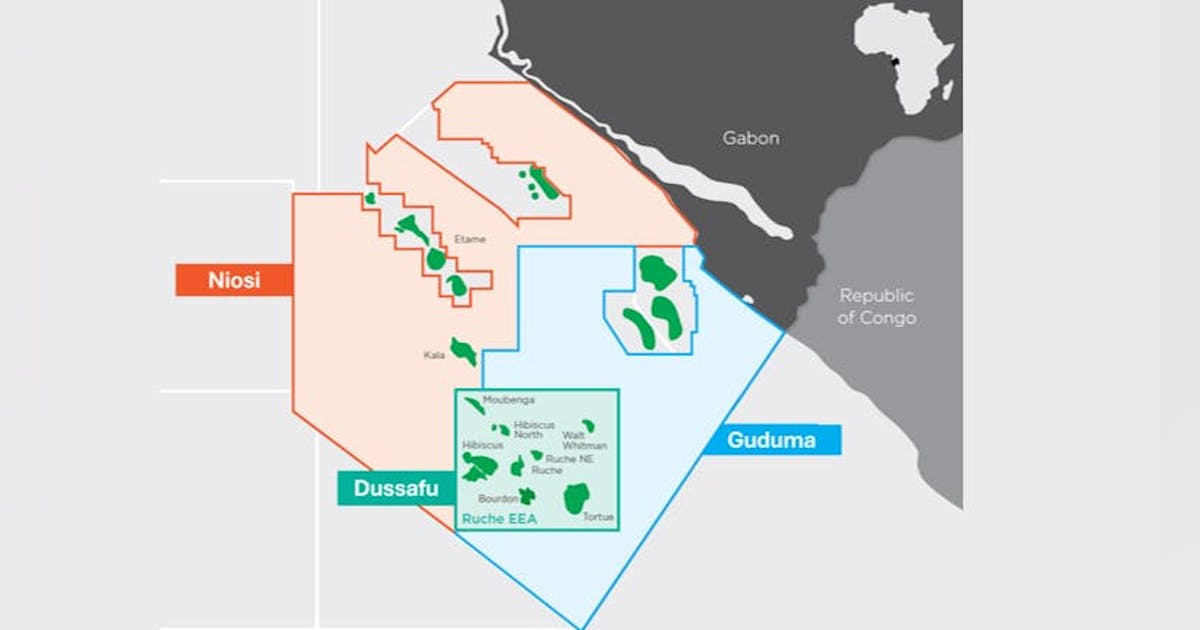
BW Energy Gabon has received approval from the Ministry of Oil and Gas of the Gabonese Republic to extend the Dussafu Marin production license offshore Gabon, West Africa. The license period has been extended to 2053 from 2028, inclusive of three 5-year option periods from 2038 onwards. The prior contract was until 2038 inclusive of two 5-year option periods from 2028 onwards. The extra time “provides long-term visibility for production, investments, and reserve development” of the operator’s “core producing asset,” the company said in a release Apr. 7. Ongoing license projects include MaBoMo Phase 2, with planned first oil in second-half 2026, and the Bourdon development following its discovery last year. The timeline also “strengthens the foundation for future infrastructure‑led growth opportunities across the adjacent Niosi and Guduma licenses, both operated by BW Energy,” the company continued. The Dussafu Marin permit is a development and exploitation license with multiple discoveries and prospects lying within a proven oil and gas play fairway within Southern Gabon basin. To the northwest of the block is the Etame-Ebouri Trend, a collection of fields producing from the pre-salt Gamba and Dentale sandstones, and to the north are Lucina and M’Bya fields which produce from the syn-rift Lucina sandstones beneath the Gamba. Oil fields within the Dussafu Permit include Moubenga, Walt Whitman, Ruche, Ruche North East, Tortue, Hibiscus, and Hibiscus North. BW Energy Gabon is operator at Dussafu (73.50%) with partners Panoro Energy ASA (17.5%) and Gabon Oil Co. (9%). Dussafu.

Read More »

Santos plans development of North Slope’s Quokka Unit

Santos Ltd. has started development planning in the Quokka Unit on Alaska’s North Slope after further delineating the Nanushuk reservoir. The Quokka-1 appraisal well spudded on Jan. 1, 2026, about 6 six miles from the Mitquq-1 discovery well drilled in 2020. It was drilled to 4,787 ft TD and encountered a high-quality reservoir with about 143 ft of net oil pay in the Nanushuk formation, demonstrating an average porosity of 19%. Following a single stage fracture stimulation, the well achieved a flow rate of 2,190 bo/d. Reservoir sands correlated between the two discoveries, coupled with fluid analyses, confirm the presence of high‑quality, light‑gravity oil, supporting strong well performance and improved pricing relative to Pikka oil. Together with additional geological data, these results underpin the potential for a two‑drill‑site development with production capacity comparable to Pikka phase 1, the company said.  Rate and resource potential for the two-drill-site development is being evaluated. Resource estimation is ongoing and appraisal results will be evaluated as part of the FY26 contingent resource assessment. In FY25, Santos reported 2C contingent resources of 177 MMboe for the Quokka Unit. Based on these results, Santos has started development planning, including the initiation of key permitting activities. Santos is operator of the Quokka Unit (51%) with partner Repsol (49%).

Read More »

Fluor, Axens secure contracts for US grassroots refinery project

Fluor Corp. and Axens Group have been awarded key contracts for America First Refining’s (AFR) proposed grassroots refinery at the Port of Brownsville, Tex., advancing development of what would be the first new US refinery to be built in more than 50 years. Fluor will execute front-end engineering and design (FEED) for the project, while Axens will serve as technology licensor of core refining process technologies to be used at the site, the service providers said in separate Apr. 7 releases. The AFR refinery is designed to process more than 60 million bbl/year—or about 164,400 b/d—of US light shale crude into transportation fuels, including gasoline, diesel, and jet fuel. Contract details Without disclosing a specific value of its contract, Fluor said the scope of its FEED study will cover early-stage engineering and design required to define project execution, cost, and schedule based on a complex that will incorporate commercially proven technologies to improve efficiency and emissions performance while processing domestic shale crude. As technology licensor, Axens said it will deliver process technologies for key refining units at the site, including those for: Naphtha, diesel hydrotreating. Continuous catalytic reforming. Isomerization. Alongside supporting improved fuel-quality specifications, the unspecified technologies to be supplied for the refinery will also help to reduce overall energy consumption at the site. Axens—which confirmed its involvement since 2017 in working with AFR on early-stage development of the project—said this latest licensing agreement will also cover engineering support, equipment, catalysts, and services across the refinery’s process configuration. Project background, commercial framework Upon first announcing the project in March 2026, AFR said the proposed development came alongside an already signed 20-year offtake agreement with a global integrated oil company covering 1.2 billion bbl of US light shale crude, as well as capital investment to support construction. As part of the

Read More »

EIA: US crude inventories up 3.1 million bbl

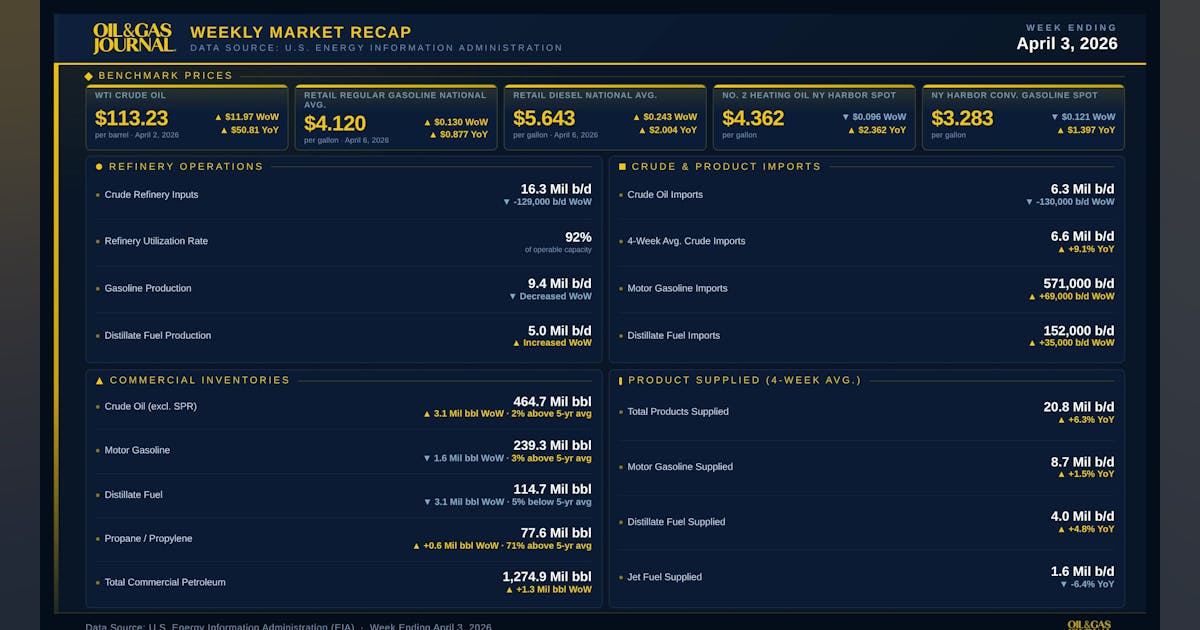
US crude oil inventories for the week ended Apr. 3, excluding the Strategic Petroleum Reserve, increased by 3.1 million bbl from the previous week, according to data from the US Energy Information Administration (EIA). At 464.7 million bbl, US crude oil inventories are about 2% above the 5-year average for this time of year, the EIA report indicated. EIA said total motor gasoline inventories decreased by 1.6 million bbl from last week and are about 3% above the 5-year average for this time of year. Finished gasoline inventories increased while blending components inventories decreased last week. Distillate fuel inventories decreased by 3.1 million bbl last week and are about 5% below the 5-year average for this time of year. Propane-propylene inventories increased by 600,000 bbl from last week and are 71% above the 5-year average for this time of year, EIA said. US crude oil refinery inputs averaged 16.3 million b/d for the week ended Apr. 3, which was 129,000 b/d less than the previous week’s average. Refineries operated at 92% of capacity. Gasoline production decreased, averaging 9.4 million b/d. Distillate fuel production increased, averaging 5.0 million b/d. US crude oil imports averaged 6.3 million b/d, down 130,000 b/d from the previous week. Over the last 4 weeks, crude oil imports averaged about 6.6 million b/d, 9.1% more than the same 4-week period last year. Total motor gasoline imports averaged 571,000 b/d. Distillate fuel imports averaged 152,000 b/d.

Read More »

Oil prices plunge as Iran war tensions ease amid tentative Hormuz reopening

Crude oil prices plunged sharply on Apr. 7 after US President Donald Trump announced a conditional 2-week ceasefire agreement with Iran, contingent on reopening the Strait of Hormuz and restoring safe passage for energy shipments. Both Brent and WTI crude oil fell towards $95/bbl, marking their largest single-day decline since 2020. Under the agreement, Iran signaled willingness to halt attacks on shipping and allow transit through Hormuz while broader negotiations continue. The US also indicated it would assist in clearing a backlog of tankers and stabilizing maritime traffic. Benchmark crude prices initially surged above $110/bbl in early April amid fears of prolonged supply disruption after Iran effectively restricted traffic through the strait—a corridor responsible for roughly 20% of global oil flows. The blockade, triggered by escalating US-Iran hostilities, caused tanker traffic to collapse and stranded millions of barrels of crude and refined products in the region. Despite the price correction, analysts caution that supply disruptions and infrastructure damage will continue to constrain markets. The conflict has already impaired regional energy assets, including LNG infrastructure in Qatar, and forced producers across the Middle East to curtail output or delay exports. The US Energy Information Administration (EIA) warned that fuel prices may remain elevated for months even if flows normalize, citing logistical bottlenecks, depleted inventories, and continued geopolitical uncertainty. “In theory, the 10–13 million b/d of crude oil and product supply stranded behind the Strait should now be gradually released. Whether the pre-March status quo will be re-established depends entirely on whether the truce can be turned into a permanent peace during the negotiations in Pakistan,” said Tamas Varga, analyst, PVM Oil Associates. “What appears evident, at least for now, is that the current quarter, the April–June period, will be the tightest, as the scarcity of available oil, both crude and refined

Read More »

EIA: Brent crude to reach $115/bbl in second-quarter 2026

Global oil markets have entered a period of acute volatility, with prices expected to surge into second-quarter 2026 as war-driven supply disruptions in the Middle East constrain flows through the Strait of Hormuz, according to the US Energy Information Administration (EIA)’s April Short-Term Energy Outlook. The agency estimates that Brent crude averaged $103/bbl in March and will climb further to a quarterly peak of about $115/bbl in second-quarter 2026, reflecting a sharp tightening in global supply following widespread production shut-ins across key Gulf producers. The disruption stems from the effective closure of the Strait of Hormuz, a critical chokepoint that typically carries nearly 20% of global oil supply. The US-Iran war in the region has forced producers including Saudi Arabia, Iraq, Kuwait, and the UAE to curtail output significantly. EIA estimates that crude production shut-ins averaged 7.5 million b/d in March and will rise to a peak of 9.1 million b/d in April. In this outlook, EIA assumes the conflict does not persist past April and that traffic through the Strait of Hormuz gradually resumes. Under those assumptions, EIA expects production shut-ins will fall to 6.7 million b/d in May and return close to pre-conflict levels in late 2026. The scale of the outage has rapidly flipped the market from prior expectations of oversupply into a pronounced deficit, with global inventories drawing sharply during the second quarter. Despite an assumption that the conflict does not persist beyond April, the agency warns that supply chains will take months to normalize, keeping a geopolitical risk premium embedded in prices through late 2026. EIA forecasts the Brent crude oil price will fall below $90/bbl in fourth-quarter 2026 and average $76/bbl in 2027, about $23/bbl higher than in its February STEO forecast. This price forecast is highly dependent on EIA’s assumptions of both the

Read More »

AI is a Positive Catalyst for Grid Growth

Data centers, particularly those optimized for artificial intelligence workloads, are frequently characterized in public discourse as a disruptive threat to grid stability and ratepayer affordability. But behind-the-narrative as we are, the AI‑driven data center growth is simply illuminating pre‑existing systemic weaknesses in electric infrastructure that have accumulated over more than a decade of underinvestment in transmission, substations, and interconnection capacity. Over the same period, many utilities operated under planning assumptions shaped by slow demand growth and regulatory frameworks that incentivized incremental upgrades rather than large, anticipatory capital programs. As a result, the emergence of gigawatt‑scale computing campuses appears to be a sudden shock to a system that, in reality, was already misaligned with long‑term decarbonization, electrification, and digitalization objectives. Utilities have been asked to do more with aging grids, slow permitting, and chronically constrained capital, and now AI and cloud are finally putting real urgency — and real investment — behind modernizing that backbone. In that sense, large‑scale compute is not the problem; it is the catalyst that makes it impossible to ignore the problem any longer. We are at a moment when data centers, and especially AI data centers, are being blamed for exposing weaknesses that were already there, when in reality they are giving society a chance to fix a power system that has been underbuilt for more than a decade. Utilities have been asked to do more with aging grids, slow permitting, and limited investment, and now AI and cloud are finally putting real urgency — and real capital — behind modernizing that backbone. In that sense, data centers aren’t the problem; they are the catalyst that makes it impossible to ignore the problem any longer. AI Demand Provided a Long‑Overdue Stress Test The nature of AI workloads intensified this dynamic. High‑performance computing clusters concentrate substantial power

Read More »

From Land Grab to Structured Scale: Kirkland & Ellis Explains How Capital, Power, and Deal Complexity Are Defining the AI Data Center Boom

The AI data center market is no longer defined by speed alone. For much of the past three years, capital moved aggressively into digital infrastructure, chasing land, power, and platform scale as generative AI workloads began to reshape demand curves. But as Melissa Kalka, M&A and private equity partner, and Kimberly McGrath, real estate partner at Kirkland & Ellis, explain on the latest episode of the Data Center Frontier Show, the industry is now entering a more complex and more consequential phase. The land grab is over. Execution has begun. Capital remains abundant, but it is no longer forgiving. From Capital Rush to Capital Discipline As noted by Kalka and McGrath, the period from roughly 2022 through 2025 marked a rapid acceleration in AI infrastructure investment. Take-private deals involving CyrusOne, QTS, and Switch signaled a structural shift, while hyperscale demand scaled from tens of megawatts to hundreds, and now toward gigawatt-class campuses. But the current phase is not defined by a pullback in capital. Instead, it reflects an expansion of investment pathways and a corresponding increase in scrutiny. “There’s actually more deal flow now,” Kalka notes, pointing to the growing range of entry points across the capital stack, including development vehicles, yield-oriented structures, and private credit. With more capital chasing larger and more complex opportunities, investors are evaluating not just platforms, but the full lifecycle of assets from early-stage development through stabilization and long-term hold. That shift has pulled capital earlier into the process, where risk is higher and less defined. Power availability, permitting, and execution timelines are now central to underwriting decisions. What Defines a “Bankable” Platform In this environment, the definition of a bankable data center platform has tightened. Execution history remains foundational. Investors are looking for consistent delivery, operational reliability, and clean contractual performance. But those factors alone

Read More »

CoreWeave and Bell Canada Reset AI Data Center Scale

From GPU Cloud to AI Factory Operator In sum, CoreWeave is moving beyond its origins as a fast-scaling GPU cloud built on scarcity. The company is increasingly positioning itself as an AI infrastructure operator, where competitive advantage comes from integration across hardware, networking, cooling, platform software, workload orchestration, and early access to NVIDIA’s latest systems. That positioning has been reinforced by NVIDIA itself. In January, NVIDIA outlined a deeper alignment with CoreWeave focused on building AI factories, accelerating the procurement of land, power, and shell, and validating CoreWeave’s AI-native software and reference architecture. The partnership also includes deployment of multiple generations of NVIDIA infrastructure across CoreWeave’s platform, including Rubin systems, Vera CPUs, and BlueField data processing units, alongside a $2 billion equity investment. No simple vendor relationship, this is co-development around physical AI infrastructure. Bell Canada and the Rise of Sovereign AI Capacity Viewed through that lens, Bell Canada’s Saskatchewan announcement can be seen as part of the same structural shift. On March 16, Bell and the Government of Saskatchewan unveiled plans for a 300 MW AI Fabric data center in the Rural Municipality of Sherwood, outside Regina. CoreWeave is expected to anchor the site’s NVIDIA-based GPU infrastructure, extending its AI-native platform into a sovereign, hyperscale, power-dense environment. BCE described the project as its largest-ever investment in the province and said it is expected to become Canada’s largest purpose-built AI data center campus. Bell projects up to $12 billion (CDN) in long-term economic impact, along with at least 800 construction jobs and a minimum of 80 permanent roles once the site is operational. More importantly, Bell is explicitly framing the development as a foundation for domestic compute capacity, positioning AI infrastructure as a national asset tied to economic growth and technological sovereignty. That project extends Bell’s broader sovereign AI strategy.

Read More »

From Reactor Designs to Real Projects: SMRs Enter the Execution Era as AI Power Demand Accelerates

The pattern emerging is clear. The SMR story is no longer about reactor design. Recent announcements are centered on permits, fuel, supply chains, financing, and customer traction, i.e. the factors that determine whether SMRs become a viable market or remain a technology narrative. The conversation has transitioned from technically compelling reactor concepts to the harder problem of industrial execution. Through the first quarter of 2026, and especially in March, vendors moved beyond partnership announcements to concrete progress in licensing, fuel access, supply-chain development, control systems, customer alignment, and capital formation. The distinction now is between companies building credible deployment pathways and those still positioned around long-dated opportunity. At a high level, these developments fall into three categories. First, regulatory progress: the most difficult and time-consuming milestone. Second, efforts to establish manufacturing and fuel ecosystems that can support repeatable, fleet-scale deployment. Third, a broad repositioning toward power-intensive industrial users, utilities, and increasingly data center–driven load growth. The result is an SMR market that looks less like a single competitive race and more like a set of parallel business models converging on the same objective: dispatchable, carbon-free power that can be financed and deployed with greater predictability than traditional gigawatt-scale nuclear. X-energy: Building a Commercial Path to Scale X-energy has emerged as one of the more credible commercialization stories in the SMR market, with recent moves spanning capital markets, customer development, and supply-chain expansion. Reuters reported on March 20 that the company has confidentially filed for an IPO, aiming to capitalize on renewed investor interest in nuclear and rising electricity demand tied to AI infrastructure. That filing followed closely on an agreement with Talen Energy to evaluate multiple four-unit Xe-100 deployments across U.S. power markets, as well as a MOU with Japan’s IHI to expand U.S.-Japan supply chain capabilities for the reactor.

Read More »

DCF Poll: Data Centers and the Public Trust Gap

Matt Vincent is Editor in Chief of Data Center Frontier, where he leads editorial strategy and coverage focused on the infrastructure powering cloud computing, artificial intelligence, and the digital economy. A veteran B2B technology journalist with more than two decades of experience, Vincent specializes in the intersection of data centers, power, cooling, and emerging AI-era infrastructure. Since assuming the EIC role in 2023, he has helped guide Data Center Frontier’s coverage of the industry’s transition into the gigawatt-scale AI era, with a focus on hyperscale development, behind-the-meter power strategies, liquid cooling architectures, and the evolving energy demands of high-density compute, while working closely with the Digital Infrastructure Group at Endeavor Business Media to expand the brand’s analytical and multimedia footprint. Vincent also hosts The Data Center Frontier Show podcast, where he interviews industry leaders across hyperscale, colocation, utilities, and the data center supply chain to examine the technologies and business models reshaping digital infrastructure. Since its inception he serves as Head of Content for the Data Center Frontier Trends Summit. Before becoming Editor in Chief, he served in multiple senior editorial roles across Endeavor Business Media’s digital infrastructure portfolio, with coverage spanning data centers and hyperscale infrastructure, structured cabling and networking, telecom and datacom, IP physical security, and wireless and Pro AV markets. He began his career in 2005 within PennWell’s Advanced Technology Division and later held senior editorial positions supporting brands such as Cabling Installation & Maintenance, Lightwave Online, Broadband Technology Report, and Smart Buildings Technology. Vincent is a frequent moderator, interviewer, and keynote speaker at industry events including the HPC Forum, where he delivers forward-looking analysis on how AI and high-performance computing are reshaping digital infrastructure. He graduated with honors from Indiana University Bloomington with a B.A. in English Literature and Creative Writing and lives in southern New Hampshire with

Read More »

OpenAI puts part of Stargate project on hold over runaway power costs

OpenAI has postponed plans to open one of the data centers central to its Stargate project. It announced its plan to open the data center in the UK with great fanfare last September, when it was regarded as a major boost for the country’s nascent AI industry, as well as proving a step up for OpenAI’s international credentials. At the time, Sam Altman, CEO of OpenAI, said, “The UK has been a longstanding pioneer of AI, and is now home to world-class researchers, millions of ChatGPT users, and a government that quickly recognized the potential of this technology.” All of that has been quietly forgotten. The plans for the data center in Northumberland, in the Northeast of England, have been put on hold, with the project ready to be revived when the conditions are ripe for major infrastructure investment, according to a report by the BBC.

Read More »

Microsoft will invest $80B in AI data centers in fiscal 2025

And Microsoft isn’t the only one that is ramping up its investments into AI-enabled data centers. Rival cloud service providers are all investing in either upgrading or opening new data centers to capture a larger chunk of business from developers and users of large language models (LLMs).  In a report published in October 2024, Bloomberg Intelligence estimated that demand for generative AI would push Microsoft, AWS, Google, Oracle, Meta, and Apple would between them devote $200 billion to capex in 2025, up from $110 billion in 2023. Microsoft is one of the biggest spenders, followed closely by Google and AWS, Bloomberg Intelligence said. Its estimate of Microsoft’s capital spending on AI, at $62.4 billion for calendar 2025, is lower than Smith’s claim that the company will invest $80 billion in the fiscal year to June 30, 2025. Both figures, though, are way higher than Microsoft’s 2020 capital expenditure of “just” $17.6 billion. The majority of the increased spending is tied to cloud services and the expansion of AI infrastructure needed to provide compute capacity for OpenAI workloads. Separately, last October Amazon CEO Andy Jassy said his company planned total capex spend of $75 billion in 2024 and even more in 2025, with much of it going to AWS, its cloud computing division.

Read More »

John Deere unveils more autonomous farm machines to address skill labor shortage

Join our daily and weekly newsletters for the latest updates and exclusive content on industry-leading AI coverage. Learn More Self-driving tractors might be the path to self-driving cars. John Deere has revealed a new line of autonomous machines and tech across agriculture, construction and commercial landscaping. The Moline, Illinois-based John Deere has been in business for 187 years, yet it’s been a regular as a non-tech company showing off technology at the big tech trade show in Las Vegas and is back at CES 2025 with more autonomous tractors and other vehicles. This is not something we usually cover, but John Deere has a lot of data that is interesting in the big picture of tech. The message from the company is that there aren’t enough skilled farm laborers to do the work that its customers need. It’s been a challenge for most of the last two decades, said Jahmy Hindman, CTO at John Deere, in a briefing. Much of the tech will come this fall and after that. He noted that the average farmer in the U.S. is over 58 and works 12 to 18 hours a day to grow food for us. And he said the American Farm Bureau Federation estimates there are roughly 2.4 million farm jobs that need to be filled annually; and the agricultural work force continues to shrink. (This is my hint to the anti-immigration crowd). John Deere’s autonomous 9RX Tractor. Farmers can oversee it using an app. While each of these industries experiences their own set of challenges, a commonality across all is skilled labor availability. In construction, about 80% percent of contractors struggle to find skilled labor. And in commercial landscaping, 86% of landscaping business owners can’t find labor to fill open positions, he said. “They have to figure out how to do

Read More »

2025 playbook for enterprise AI success, from agents to evals

Join our daily and weekly newsletters for the latest updates and exclusive content on industry-leading AI coverage. Learn More 2025 is poised to be a pivotal year for enterprise AI. The past year has seen rapid innovation, and this year will see the same. This has made it more critical than ever to revisit your AI strategy to stay competitive and create value for your customers. From scaling AI agents to optimizing costs, here are the five critical areas enterprises should prioritize for their AI strategy this year. 1. Agents: the next generation of automation AI agents are no longer theoretical. In 2025, they’re indispensable tools for enterprises looking to streamline operations and enhance customer interactions. Unlike traditional software, agents powered by large language models (LLMs) can make nuanced decisions, navigate complex multi-step tasks, and integrate seamlessly with tools and APIs. At the start of 2024, agents were not ready for prime time, making frustrating mistakes like hallucinating URLs. They started getting better as frontier large language models themselves improved. “Let me put it this way,” said Sam Witteveen, cofounder of Red Dragon, a company that develops agents for companies, and that recently reviewed the 48 agents it built last year. “Interestingly, the ones that we built at the start of the year, a lot of those worked way better at the end of the year just because the models got better.” Witteveen shared this in the video podcast we filmed to discuss these five big trends in detail. Models are getting better and hallucinating less, and they’re also being trained to do agentic tasks. Another feature that the model providers are researching is a way to use the LLM as a judge, and as models get cheaper (something we’ll cover below), companies can use three or more models to

Read More »

OpenAI’s red teaming innovations define new essentials for security leaders in the AI era

Join our daily and weekly newsletters for the latest updates and exclusive content on industry-leading AI coverage. Learn More OpenAI has taken a more aggressive approach to red teaming than its AI competitors, demonstrating its security teams’ advanced capabilities in two areas: multi-step reinforcement and external red teaming. OpenAI recently released two papers that set a new competitive standard for improving the quality, reliability and safety of AI models in these two techniques and more. The first paper, “OpenAI’s Approach to External Red Teaming for AI Models and Systems,” reports that specialized teams outside the company have proven effective in uncovering vulnerabilities that might otherwise have made it into a released model because in-house testing techniques may have missed them. In the second paper, “Diverse and Effective Red Teaming with Auto-Generated Rewards and Multi-Step Reinforcement Learning,” OpenAI introduces an automated framework that relies on iterative reinforcement learning to generate a broad spectrum of novel, wide-ranging attacks. Going all-in on red teaming pays practical, competitive dividends It’s encouraging to see competitive intensity in red teaming growing among AI companies. When Anthropic released its AI red team guidelines in June of last year, it joined AI providers including Google, Microsoft, Nvidia, OpenAI, and even the U.S.’s National Institute of Standards and Technology (NIST), which all had released red teaming frameworks. Investing heavily in red teaming yields tangible benefits for security leaders in any organization. OpenAI’s paper on external red teaming provides a detailed analysis of how the company strives to create specialized external teams that include cybersecurity and subject matter experts. The goal is to see if knowledgeable external teams can defeat models’ security perimeters and find gaps in their security, biases and controls that prompt-based testing couldn’t find. What makes OpenAI’s recent papers noteworthy is how well they define using human-in-the-middle

Read More »

Financial services

This page brings together essential resources to help financial institutions evaluate, adopt, and scale AI in regulated environments. Whether you’re exploring early use cases or

Read More »

Using skills

DepartmentReusable process skillTool-based skillConventions/standards skillMarketingcampaign-brief-builder Create a skill that turns a rough marketing idea into a complete campaign brief, including the goal, target audience, key

Read More »