Stay Ahead, Stay ONMINE

Are You Still Using LoRA to Fine-Tune Your LLM?

LoRA (Low Rank Adaptation – arxiv.org/abs/2106.09685) is a popular technique for fine-tuning Large Language Models (LLMs) on the cheap. But 2024 has seen an explosion of new parameter-efficient fine-tuning techniques, an alphabet soup of LoRA alternatives: SVF, SVFT, MiLoRA, PiSSA, LoRA-XS 🤯… And most are based on a matrix technique I like a lot: the SVD (Singular Value Decomposition). Let’s dive in. LoRA The original Lora insight is that fine-tuning all the weights of a model is overkill. Instead, LoRA freezes the model and only trains a small pair of low-rank “adapter” matrices. See the illustrations below (where W is any matrix of weights in a transformer LLM). This saves memory and compute cycles since far fewer gradients have to be computed and stored. For example, here is a Gemma 8B model fine-tuned to speak like a pirate using LoRA: only 22M parameters are trainable, 8.5B parameters remain frozen. LoRA is very popular. It has even made it as a single-line API into mainstream ML frameworks like Keras: gemma.backbone.enable_lora(rank=8) But is LoRA the best? Researchers have been trying hard to improve on the formula. Indeed, there are many ways of selecting smaller “adapter” matrices. And since most of them make clever use of the singular value decomposition (SVD) of a matrix, let’s pause for a bit of Math. SVD: the simple math The SVD is a great tool for understanding the structure of matrices. The technique splits a matrix into three: W = USVT where U and V are orthogonal (i.e., base changes), and S is the diagonal matrix of sorted singular values. This decomposition always exists. In “textbook” SVD, U and V are square, while S is a rectangle with singular values on the diagonal and a tail of zeros. In practice, you can work with a square S and a rectangular U or V – see the picture – the chopped-off pieces are just multiplications by zero. This “economy-sized” SVD is what is used in common libraries, for example, numpy.linalg.svd. So how can we use this to more efficiently select the weights to train? Let’s quickly go through five recent SVD-based low-rank fine-tuning techniques, with commented illustrations. SVF The simplest alternative to LoRA is to use the SVD on the model’s weight matrices and then fine-tune the singular values directly. Oddly, this is the most recent technique, called SVF, published in the Transformers² paper (arxiv.org/abs/2501.06252v2). SVF is much more economical in parameters than LoRA. And as a bonus, it makes tuned models composable. For more info on that, see my Transformers² explainer here, but composing two SVF fine-tuned models is just an addition: SVFT Should you need more trainable parameters, the SVFT paper (arxiv.org/abs/2405.19597) explores multiple ways of doing that, starting by adding more trainable weights on the diagonal. It also evaluates multiple alternatives like spreading them randomly through the “M” matrix. More importantly, the SVFT paper confirms that having more trainable values than just the diagonal is useful. See their fine-tuning results below. Next come several techniques that split singular values in two sets, “large” and “small”. But before we proceed, let’s pause for a bit more SVD math. More SVD math The SVD is usually seen as a decomposition into three matrices W=USVT but it can also be thought of as a weighted sum of many rank-1 matrices, weighted by the singular values: Should you want to prove it, express individual matrix elements Wjk using the USVT form and the formula for matrix multiplication on one hand, theΣ siuiviT form, on the other, simplify using the fact that S is diagonal and notice that it’s the same thing. In this representation, it’s easy to see that you can split the sum in two. And as you can always sort the singular values, you can make this a split between “large” and “small” singular values. Going back to the tree-matrix form W=USVT, this is what the split looks like: Based on this formula, two papers have explored what happens if you tune only the large singular values or only the small ones, PiSSA and MiLoRA. PiSSA PiSSA (Principal Singular values and Singular Vectors Adaptation, arxiv.org/abs/2404.02948) claims that you should only tune the large principal values. The mechanism is illustrated below: From the paper: “PiSSA is designed to approximate full finetuning by adapting the principal singular components, which are believed to capture the essence of the weight matrices. In contrast, MiLoRA aims to adapt to new tasks while maximally retaining the base model’s knowledge.” The PiSSA paper also has an interesting finding: full fine-tuning is prone to over-fitting. You might get better results in the absolute with a low-rank fine-tuning technique. MiLoRA MiLoRA (Minor singular component LoRA arxiv.org/abs/2406.09044), on the other hand, claims that you should only tune the small principal values. It uses a similar mechanism to PiSSA: Surprisingly, MiLoRA seems to have the upper hand, at least when tuning on math datasets which are probably fairly aligned with the original pre-training. Arguably, PiSSA should be better for bending the behavior of the LLM further from its pre-training. LoRA-XS Finally, I’d like to mention LoRA-XS (arxiv.org/abs/2405.17604). Very similar to PiSSA but slightly different mechanism. It also shows good results with significantly fewer params than LoRA. The paper offers a mathematical explanation of why this setup is “ideal’ under two conditions: that truncating the bottom principal values from the SVD still offers a good approximation of the weights matrices that the fine-tuning data distribution is close to the pre-training one Both are questionable IMHO, so I won’t detail the math. Some results: The underlying assumption seems to be that singular values come in “large” and “small” varieties but is it true? I made a quick Colab to check this on Gemma2 9B. Bottom line: 99% of the singular values are in the 0.1 – 1.1 range.  I’m not sure partitioning them into “large” and “small” makes that much sense. Conclusion There are many more parameter-efficient fine-tuning techniques. Worth mentioning: My conclusion: to go beyond the LoRA standard with 10x fewer params, I like the simplicity of Transformers²’s SVF. And if you need more trainable weights, SVFT is an easy extension. Both use all singular values (full rank, no singular value pruning) and are still cheap 😁. Happy tuning! Note: All illustrations are either created by the author or extracted from arxiv.org papers for comment and discussion purposes.

LoRA (Low Rank Adaptation – arxiv.org/abs/2106.09685) is a popular technique for fine-tuning Large Language Models (LLMs) on the cheap. But 2024 has seen an explosion of new parameter-efficient fine-tuning techniques, an alphabet soup of LoRA alternatives: SVF, SVFT, MiLoRA, PiSSA, LoRA-XS 🤯… And most are based on a matrix technique I like a lot: the SVD (Singular Value Decomposition). Let’s dive in.

LoRA

The original Lora insight is that fine-tuning all the weights of a model is overkill. Instead, LoRA freezes the model and only trains a small pair of low-rank “adapter” matrices. See the illustrations below (where W is any matrix of weights in a transformer LLM).

This saves memory and compute cycles since far fewer gradients have to be computed and stored. For example, here is a Gemma 8B model fine-tuned to speak like a pirate using LoRA: only 22M parameters are trainable, 8.5B parameters remain frozen.
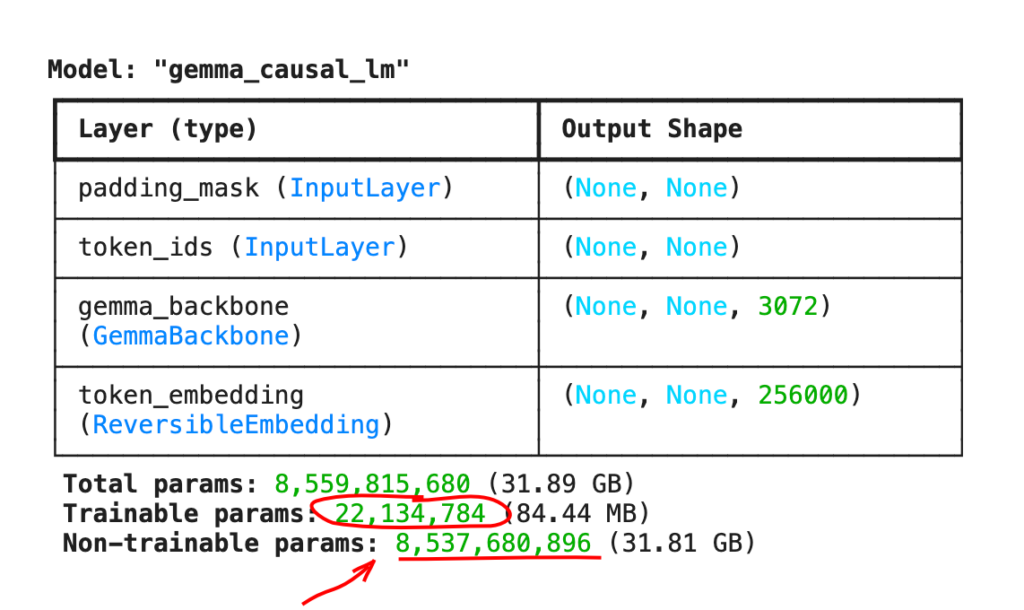
LoRA is very popular. It has even made it as a single-line API into mainstream ML frameworks like Keras:

gemma.backbone.enable_lora(rank=8)

But is LoRA the best? Researchers have been trying hard to improve on the formula. Indeed, there are many ways of selecting smaller “adapter” matrices. And since most of them make clever use of the singular value decomposition (SVD) of a matrix, let’s pause for a bit of Math.

SVD: the simple math

The SVD is a great tool for understanding the structure of matrices. The technique splits a matrix into three: W = USVT where U and V are orthogonal (i.e., base changes), and S is the diagonal matrix of sorted singular values. This decomposition always exists.
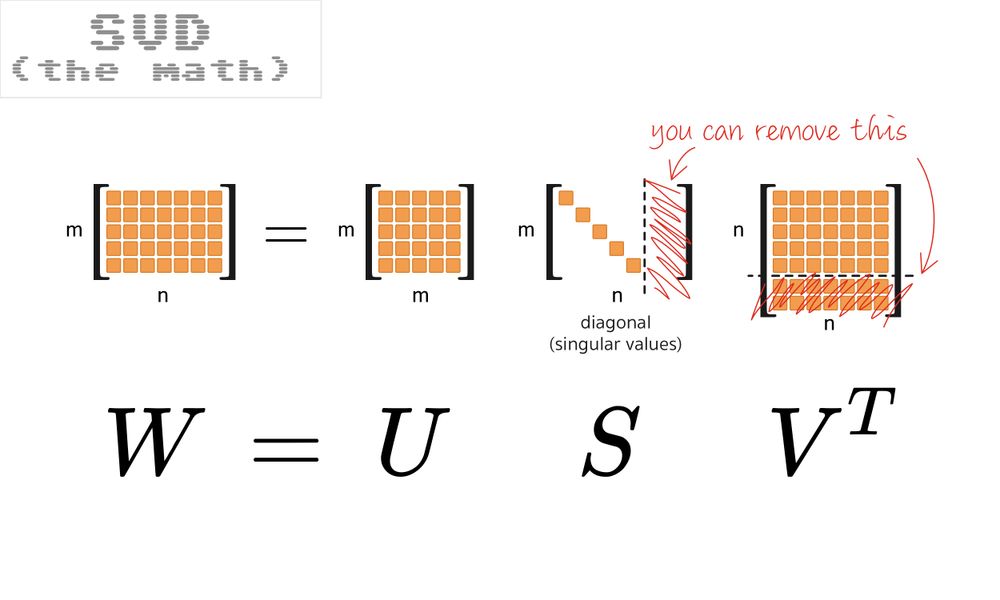
In “textbook” SVD, U and V are square, while S is a rectangle with singular values on the diagonal and a tail of zeros. In practice, you can work with a square S and a rectangular U or V – see the picture – the chopped-off pieces are just multiplications by zero. This “economy-sized” SVD is what is used in common libraries, for example, numpy.linalg.svd.

So how can we use this to more efficiently select the weights to train? Let’s quickly go through five recent SVD-based low-rank fine-tuning techniques, with commented illustrations.

SVF

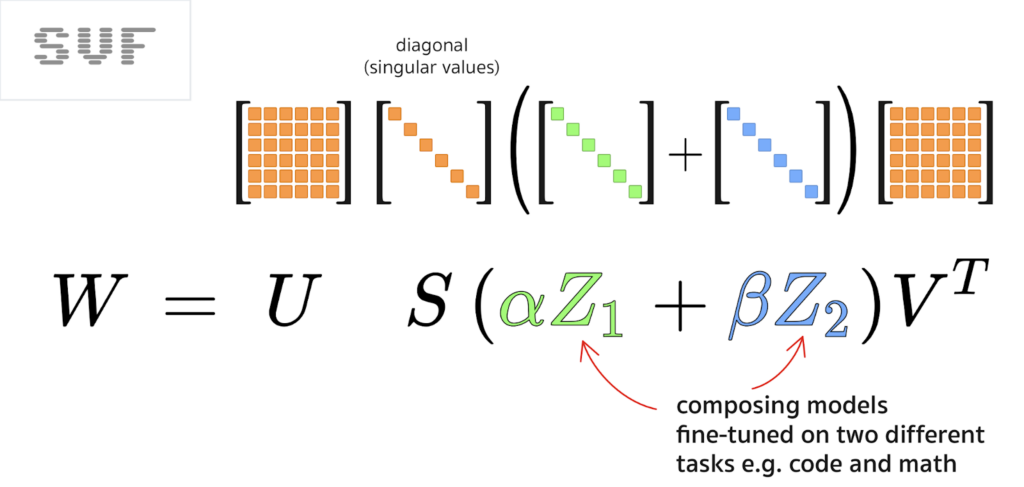
The simplest alternative to LoRA is to use the SVD on the model’s weight matrices and then fine-tune the singular values directly. Oddly, this is the most recent technique, called SVF, published in the Transformers² paper (arxiv.org/abs/2501.06252v2).
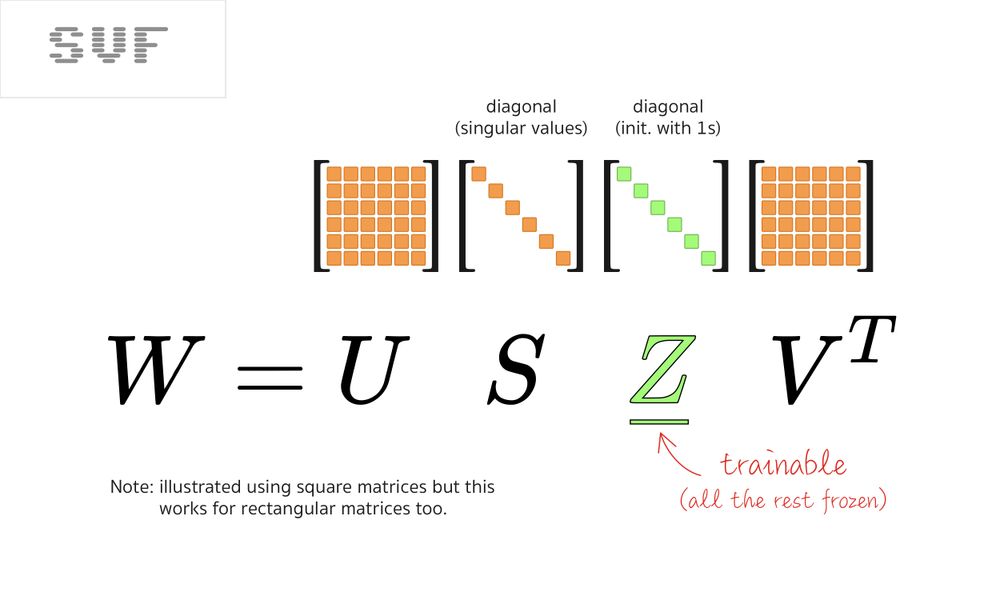
SVF is much more economical in parameters than LoRA. And as a bonus, it makes tuned models composable. For more info on that, see my Transformers² explainer here, but composing two SVF fine-tuned models is just an addition:
SVFT

Should you need more trainable parameters, the SVFT paper (arxiv.org/abs/2405.19597) explores multiple ways of doing that, starting by adding more trainable weights on the diagonal.
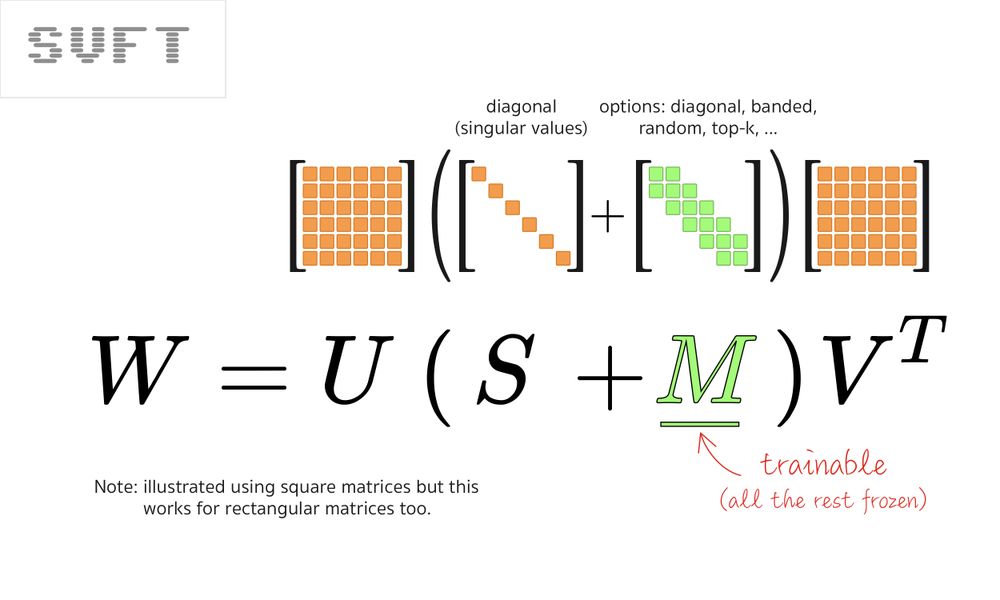
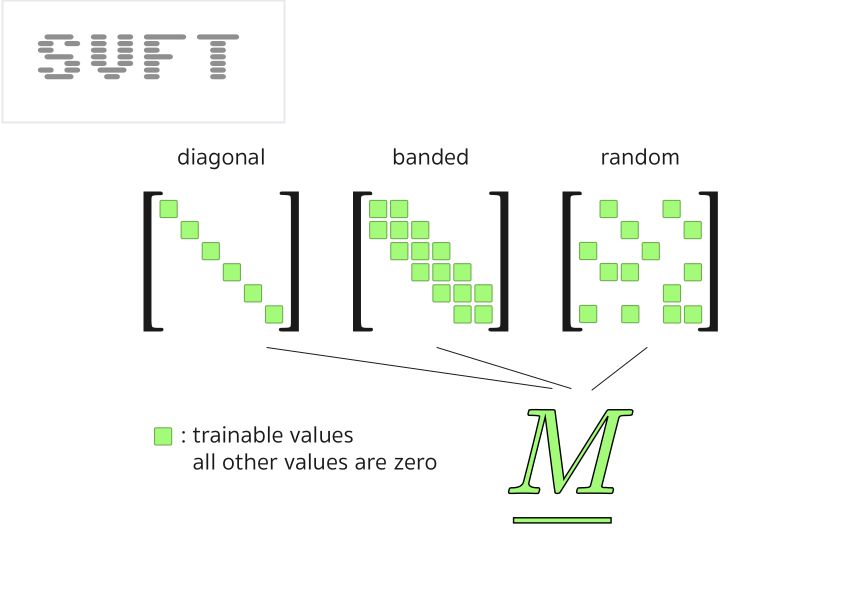
It also evaluates multiple alternatives like spreading them randomly through the “M” matrix.
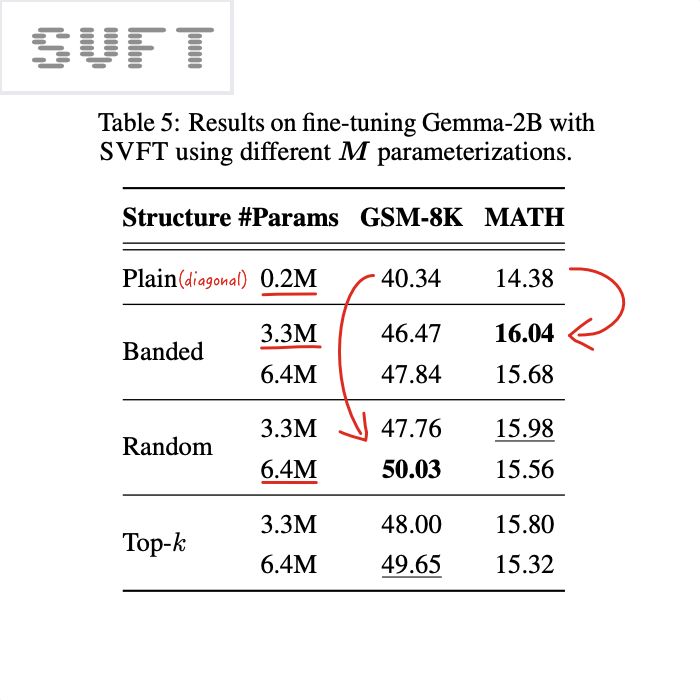
More importantly, the SVFT paper confirms that having more trainable values than just the diagonal is useful. See their fine-tuning results below.
Next come several techniques that split singular values in two sets, “large” and “small”. But before we proceed, let’s pause for a bit more SVD math.

More SVD math

The SVD is usually seen as a decomposition into three matrices W=USVT but it can also be thought of as a weighted sum of many rank-1 matrices, weighted by the singular values:
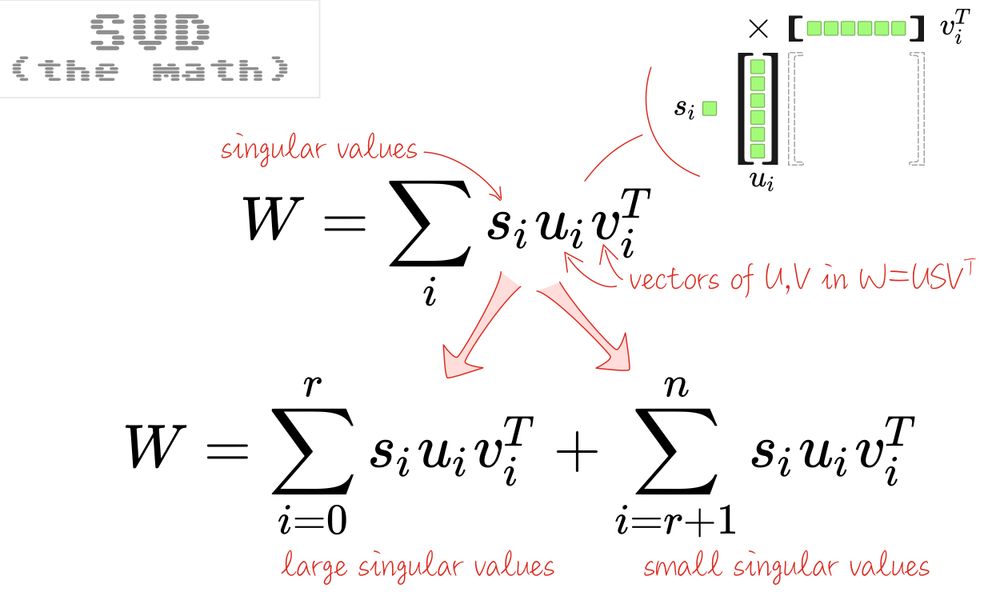
Should you want to prove it, express individual matrix elements Wjk using the USVT form and the formula for matrix multiplication on one hand, the
Σ siuiviT form, on the other, simplify using the fact that S is diagonal and notice that it’s the same thing.

In this representation, it’s easy to see that you can split the sum in two. And as you can always sort the singular values, you can make this a split between “large” and “small” singular values.

Going back to the tree-matrix form W=USVT, this is what the split looks like:
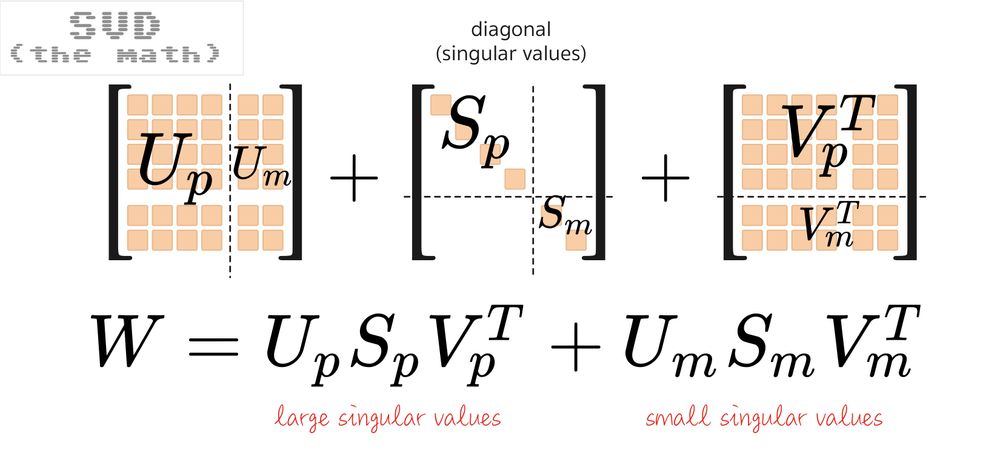
Based on this formula, two papers have explored what happens if you tune only the large singular values or only the small ones, PiSSA and MiLoRA.

PiSSA

PiSSA (Principal Singular values and Singular Vectors Adaptation, arxiv.org/abs/2404.02948) claims that you should only tune the large principal values. The mechanism is illustrated below:
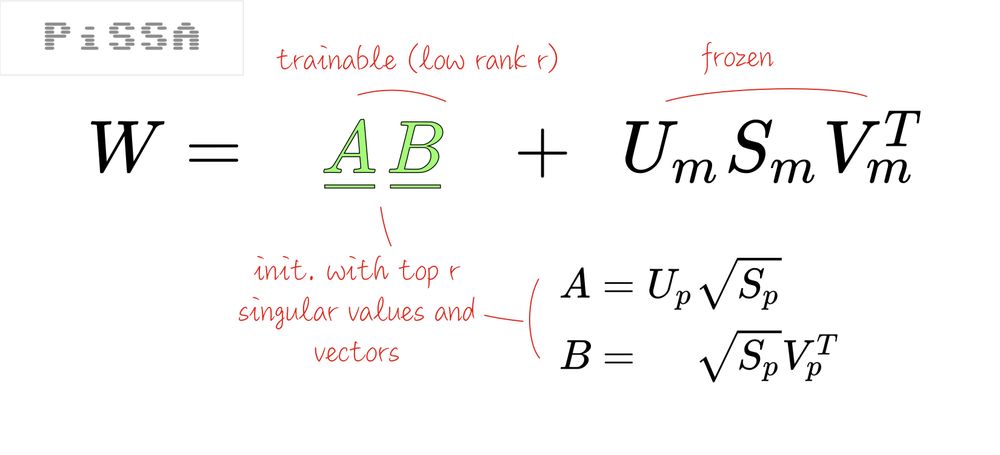
From the paper: “PiSSA is designed to approximate full finetuning by adapting the principal singular components, which are believed to capture the essence of the weight matrices. In contrast, MiLoRA aims to adapt to new tasks while maximally retaining the base model’s knowledge.”

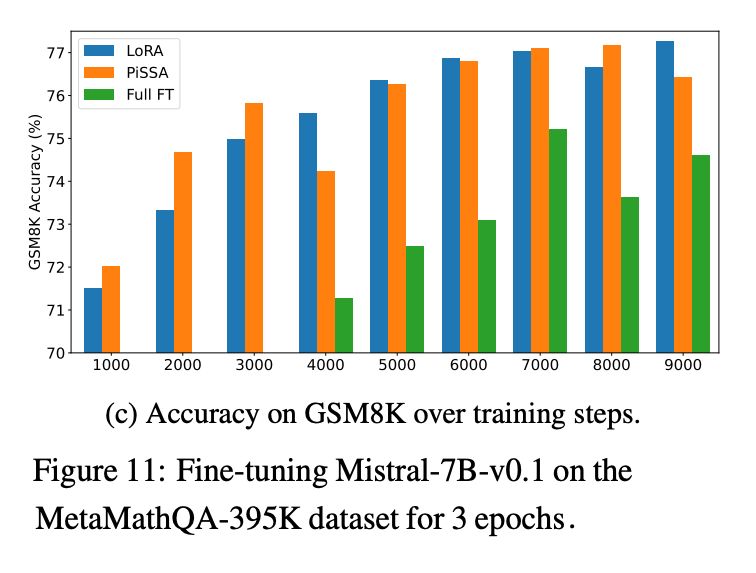
The PiSSA paper also has an interesting finding: full fine-tuning is prone to over-fitting. You might get better results in the absolute with a low-rank fine-tuning technique.
MiLoRA

MiLoRA (Minor singular component LoRA arxiv.org/abs/2406.09044), on the other hand, claims that you should only tune the small principal values. It uses a similar mechanism to PiSSA:
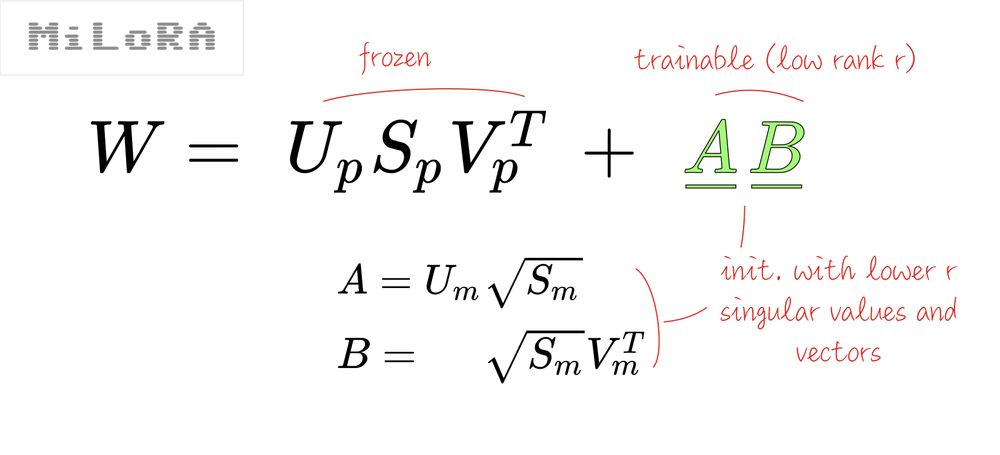
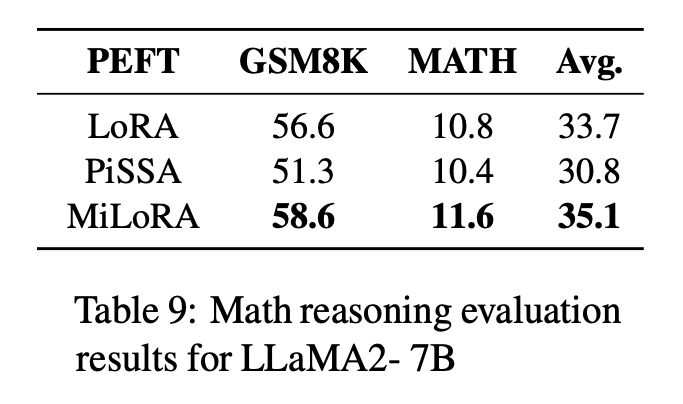
Surprisingly, MiLoRA seems to have the upper hand, at least when tuning on math datasets which are probably fairly aligned with the original pre-training. Arguably, PiSSA should be better for bending the behavior of the LLM further from its pre-training.
LoRA-XS

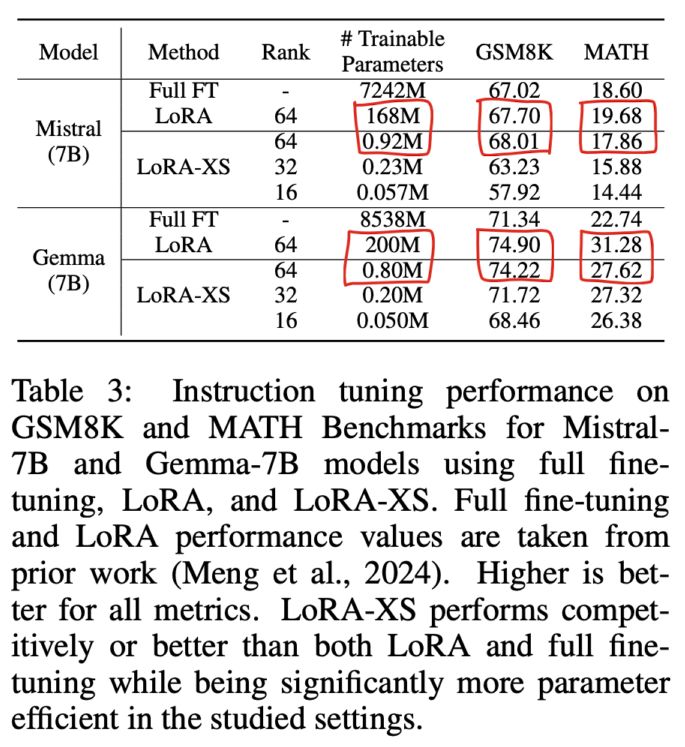
Finally, I’d like to mention LoRA-XS (arxiv.org/abs/2405.17604). Very similar to PiSSA but slightly different mechanism. It also shows good results with significantly fewer params than LoRA.
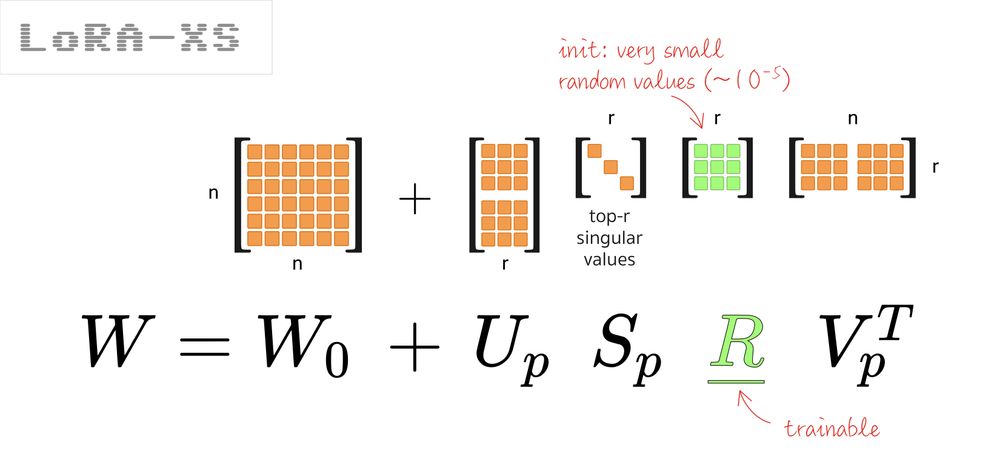
The paper offers a mathematical explanation of why this setup is “ideal’ under two conditions:

  • that truncating the bottom principal values from the SVD still offers a good approximation of the weights matrices
  • that the fine-tuning data distribution is close to the pre-training one

Both are questionable IMHO, so I won’t detail the math. Some results:
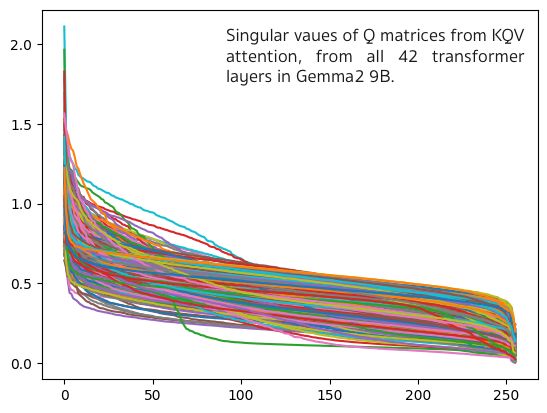
The underlying assumption seems to be that singular values come in “large” and “small” varieties but is it true? I made a quick Colab to check this on Gemma2 9B. Bottom line: 99% of the singular values are in the 0.1 – 1.1 range.  I’m not sure partitioning them into “large” and “small” makes that much sense.
Conclusion

There are many more parameter-efficient fine-tuning techniques. Worth mentioning:

My conclusion: to go beyond the LoRA standard with 10x fewer params, I like the simplicity of Transformers²’s SVF. And if you need more trainable weights, SVFT is an easy extension. Both use all singular values (full rank, no singular value pruning) and are still cheap 😁. Happy tuning!

Note: All illustrations are either created by the author or extracted from arxiv.org papers for comment and discussion purposes.


Shape
Shape
Stay Ahead

Explore More Insights

Stay ahead with more perspectives on cutting-edge power, infrastructure, energy,  bitcoin and AI solutions. Explore these articles to uncover strategies and insights shaping the future of industries.

Shape

Cisco routers knocked out due to Cloudflare DNS change

Exposes architectural fragility Networking consultant Yvette Schmitter, CEO of the Fusion Collective consulting firm, said the Cloudflare change “exposed Cisco’s architectural fragility when [some Cisco] switches worldwide entered fatal reboot loops every 10-30 minutes.” What happened? “Cloudflare changed record ordering. Cisco’s firmware, instead of handling unexpected DNS responses gracefully, treated

Read More »

Iran Turmoil Pushes Oil to Weekly Gain Streak

Oil notched its longest streak of weekly gains since June as Iran intensified a crackdown on protests across the country and US President Donald Trump threatened repercussions if demonstrators were targeted. West Texas Intermediate futures settled near $59 a barrel after rising more than 5% over the prior two sessions. Tehran said that “rioters” who damage public property or clash with security forces will face the death penalty, just a day after the US president warned the country’s regime would “pay hell” if protesters were killed. The unrest is the most significant challenge to Supreme Leader Ayatollah Ali Khamenei since a nationwide uprising in 2022. Protests are disrupting air travel in and out of the country, which produces more than 3 million barrels a day of crude. The scale of risk shows up clearest in options markets, where the skew toward bullish calls is the biggest for US crude futures since July. The Iranian turmoil shifted the focus away from Venezuela, where Trump said further attacks were canceled, citing improved cooperation from the country, leading to a brief dip in oil prices earlier. An energy quarantine is still in effect, though, and the US continues to have its military in position for further action in the region after the capture of Venezuelan President Nicolas Maduro last week. Trump met with oil executives at the White House on Friday and said the US intends to decide which companies will be allowed to go into Venezuela. “We’re dealing with the country, so we’re empowered to make that deal,” he said, adding that “giant” oil companies will spend $100 billion of their own money in investment. Venezuela’s acting President Delcy Rodriguez, for her part, issued a statement Friday saying the country is a victim of an “illegitimate and illegal criminal aggression” by the

Read More »

Russia’s Crude Output in December Made Deep Plunge

Russia’s crude oil production plunged by the most in 18 months in December, pincered by western sanctions that are causing the nation’s barrels to pile up at sea and a surge of Ukrainian drone attacks on its energy infrastructure. The nation pumped an average 9.326 million barrels a day of crude oil last month, according to people with knowledge of government data, who asked not to be identified discussing classified information. The figure — which doesn’t include output of condensate — is more than 100,000 barrels a day below November, and almost 250,000 barrels a day lower than Russia is allowed to pump under agreement with the Organization of the Petroleum Exporting Countries and allies. The slump comes at a time when Ukraine has been carrying out wide ranging drone attacks on Russian oil infrastructure — directly curbing output and affecting refineries that consume the barrels. At the same time, Russian cargoes are amassing at sea amid signs of reticence among some buyers to take them following sweeping US sanctions targeting the nation’s two largest producers, Rosneft PJSC and Lukoil PJSC. Russia’s Energy Ministry didn’t immediately respond to a Bloomberg request for comment on the December crude production figures. It’s a public holiday in Russia. The December decline was also the deepest since June 2024 — a period when Russia was supposed to be cutting its production anyway under an agreement with OPEC+. The producer group agreed to return barrels to the market between April and December 2025, and then hold output steady in the first quarter of 2026.  Until December, Russia’s output had been rising, even if growth had been petering out before year end. Russia’s required level of production for the final month of 2025 was 9.574 million barrels a day, according to OPEC data. Historically, Russia had been a laggard in complying with

Read More »

Burgum Says VEN Oil Revival Won’t Rely on Funding From USA

The Trump administration is unlikely to provide financial support to help US oil companies revitalize Venezuela’s oil sector, Interior Secretary Doug Burgum said Friday, throwing cold water on hopes the multibillion-dollar effort would be subsidized by the US government.  “The capital is going to come from the capital markets and come from the energy companies,” Burgum, who also leads the White House’s National Energy Dominance Council, told Bloomberg Television. “I don’t see that these companies are going to need support from the US, other than things around security. If we can provide a secure, stable environment, the resource here is so significant and so large that it’s going to be attractive for people to go in and develop.”  Burgum’s remarks come after President Donald Trump previously suggested the effort, estimated to cost upwards of $100 billion over the next decade, could be reimbursed by the US. The president on Monday told NBC News “a tremendous amount of money will have to be spent and the oil companies will spend it, and then they’ll get reimbursed by us or through revenue.” Oil companies, which are set to meet with Trump, Burgum and other administration officials at the White House later Friday, have been wary of committing tens of billions of dollars to Venezuela over the next decade. Executives have sought assurances on physical and financial security amid concerns about the stability of a post-Nicolás Maduro government.  Energy Secretary Chris Wright said on Fox News Friday the US Export-Import Bank could be used to provide credit support.  “I have been deluged with companies interested to go to Venezuela, and so far, no one’s asked for money,” Wright said in response to a question about providing direct grants to oil firms. “What they want is the US to use our leverage to make

Read More »

Texas Oil, Gas Industry Employed Nearly 500K Texans in 2025

The Texas oil and natural gas industry employed 495,501 Texans last year, according to the Texas Oil & Gas Association’s (TXOGA) 2025 Energy and Economic Impact report, which was released this week. The sector that employed the most workers in 2025 was ‘support activities for oil and gas operations’, with 110,612 employees, followed by ‘gasoline stations with convenience stores’, with 81,268 employees, and ‘oil and gas pipeline and related structures construction’, with 50,667 employees, the report showed. ‘Crude petroleum extraction’ ranked as the oil and gas sector with the fourth most employees in 2025, with 49,187, and ‘oil and gas field machinery and equipment’ ranked fifth, with 29,280, the report revealed. TXOGA stated in the report that “every direct job in the Texas oil and natural gas industry creates approximately two additional jobs”, outlining that “1.4 million total jobs [were] supported across the Texas economy” in 2025. Texas oil and natural gas employers paid an average of $133,095 per job in 2025, according to the report, which noted that this was 68 percent more than the average paid by the rest of Texas’ private sector. The report showed that oil and gas taxes came in at $54,481 per employee last year, while “all other sector taxes” were $7,225 per employee. “Based on the combined state and local taxes and state royalties attributable to the industry, the oil and natural gas industry pays far more per employee than the average across all other Texas private-sector industries,” TXOGA stated in its report. According to TXOGA’s latest report, in 2025, the Texas oil and natural gas industry paid state and local taxes and state royalties totaling $27.0 billion. TXOGA pointed out in the report that this equates to nearly $74 million every day. A statement sent to Rigzone by the TXOGA team this

Read More »

Nodal Hits Record Annual Volumes in Power, Environmental Markets

Nodal Exchange LLC, a derivatives trading platform for North American commodity markets, saw 3.1 billion megawatt hours (MWh) of power futures and 749,222 lots of environmental futures and options traded in 2025, achieving new annual highs. Power futures traded last year on the Tysons, Virginia-based exchange rose four percent year-on-year to 3.1 billion MWh. The December volume of 235 million MWh was up 29 percent from December 2024, Nodal said in an online statement Thursday. “Nodal continues to be the market leader in North American monthly power futures having 56 percent of the open interest with 1.51 billion MWh at the end of 2025”, Nodal said. “The open interest represents over $166 billion of notional value (both sides)”. Meanwhile environmental market open interest ended 2025 at a record 391,264 lots, up one percent from 2024. “December deliveries of 37,173 lots marked the fifth-largest delivery month for environmental products on Nodal”, Nodal said. “Renewable energy certificate futures and options posted volume of 465,189 lots in 2025, up 11 percent from a year earlier and ended the year with open interest of 323,591 lots, up 10 percent. “Nodal continues to expand environmental offerings having over 68 percent of the North American Renewable Energy Certificate market measured in clean MWh generation. “Nodal, in collaboration with IncubEx, launched several new environmental futures contracts in 2025, including Auction Clearing Price contracts for California, Washington and RGGI carbon allowances.  Nodal was the first exchange to launch PJM Emission Free Energy Certificate Futures, which allow for delivery of nuclear energy certificates alongside hydro. Other new launches included Virginia In-State Compliance REC Futures, New York Environmental Disclosure Program REC Futures and Alberta TIER EPC Options”. For natural gas, traded volumes last year totaled 958 trillion British thermal units (TBtu), Nodal said. Traded gas volumes in January-November 2025 reached a

Read More »

30 Pct of Oil Reserves Might be Consolidated Under US Influence

Around 30 percent of global oil reserves might be consolidated under U.S. influence. That’s what J.P. Morgan analysts, including the company’s head of global commodities strategy Natasha Kaneva, stated in a J.P. Morgan research note sent to Rigzone by Kaneva this week. “Combined oil reserves from Venezuela, Guyana, and the U.S. could give the U.S. about 30 percent of global oil reserves if consolidated under its influence,” the analysts said in the note. The J.P. Morgan analysts highlighted in the research note that Venezuela holds the world’s largest oil reserves, “particularly heavy crude needed by U.S. refiners”. “With 303 billion barrels of proven crude oil reserves, Venezuela represents nearly 20 percent of global reserves as of 2024 – more than any other country,” they pointed out. “If Guyana’s rapidly expanding discoveries are considered alongside U.S. conventional and unconventional reserves, the combined total could position the U.S. as a leading holder of global oil reserves, potentially accounting for about 30 percent of the world’s total if these figures are consolidated under U.S. influence,” they added. The analysts stated in the note that this would mark a notable shift in global energy dynamics. “With greater access to and influence over a substantial portion of global reserves, the U.S. could potentially exert more control over oil market trends, helping to stabilize prices and keep them within historically lower ranges,” the analysts said. “This increased leverage would not only enhance U.S. energy security but could also reshape the balance of power in international energy markets,” they added. In the note, the J.P. Morgan analysts revealed that they continue to maintain their view that “a regime change in Venezuela would immediately represent one of the largest upside risks to the global oil supply outlook for 2026-2027 and beyond”. “With a political transition, Venezuela could raise

Read More »

DCF Poll: Analyzing AI Data Center Growth

@import url(‘https://fonts.googleapis.com/css2?family=Inter:[email protected]&display=swap’); a { color: var(–color-primary-main); } .ebm-page__main h1, .ebm-page__main h2, .ebm-page__main h3, .ebm-page__main h4, .ebm-page__main h5, .ebm-page__main h6 { font-family: Inter; } body { line-height: 150%; letter-spacing: 0.025em; font-family: Inter; } button, .ebm-button-wrapper { font-family: Inter; } .label-style { text-transform: uppercase; color: var(–color-grey); font-weight: 600; font-size: 0.75rem; } .caption-style { font-size: 0.75rem; opacity: .6; } #onetrust-pc-sdk [id*=btn-handler], #onetrust-pc-sdk [class*=btn-handler] { background-color: #1796c1 !important; border-color: #1796c1 !important; } #onetrust-policy a, #onetrust-pc-sdk a, #ot-pc-content a { color: #1796c1 !important; } #onetrust-consent-sdk #onetrust-pc-sdk .ot-active-menu { border-color: #1796c1 !important; } #onetrust-consent-sdk #onetrust-accept-btn-handler, #onetrust-banner-sdk #onetrust-reject-all-handler, #onetrust-consent-sdk #onetrust-pc-btn-handler.cookie-setting-link { background-color: #1796c1 !important; border-color: #1796c1 !important; } #onetrust-consent-sdk .onetrust-pc-btn-handler { color: #1796c1 !important; border-color: #1796c1 !important; } Coming out of 2025, AI data center development remains defined by momentum. But momentum is not the same as certainty. Behind the headlines, operators, investors, utilities, and policymakers are all testing the assumptions that carried projects forward over the past two years, from power availability and capital conditions to architecture choices and community response. Some will hold. Others may not. To open our 2026 industry polling, we’re taking a closer look at which pillars of AI data center growth are under the most pressure. What assumption about AI data center growth feels most fragile right now?

Read More »

JLL’s 2026 Global Data Center Outlook: Navigating the AI Supercycle, Power Scarcity and Structural Market Transformation

Sovereign AI and National Infrastructure Policy JLL frames artificial intelligence infrastructure as an emerging national strategic asset, with sovereign AI initiatives representing an estimated $8 billion in cumulative capital expenditure by 2030. While modest relative to hyperscale investment totals, this segment carries outsized strategic importance. Data localization mandates, evolving AI regulation, and national security considerations are increasingly driving governments to prioritize domestic compute capacity, often with pricing premiums reaching as high as 60%. Examples cited across Europe, the Middle East, North America, and Asia underscore a consistent pattern: digital sovereignty is no longer an abstract policy goal, but a concrete driver of data center siting, ownership structures, and financing models. In practice, sovereign AI initiatives are accelerating demand for locally controlled infrastructure, influencing where capital is deployed and how assets are underwritten. For developers and investors, this shift introduces a distinct set of considerations. Sovereign projects tend to favor jurisdictional alignment, long-term tenancy, and enhanced security requirements, while also benefiting from regulatory tailwinds and, in some cases, direct state involvement. As AI capabilities become more tightly linked to economic competitiveness and national resilience, policy-driven demand is likely to remain a durable (if specialized) component of global data center growth. Energy and Sustainability as the Central Constraint Energy availability emerges as the report’s dominant structural constraint. In many major markets, average grid interconnection timelines now extend beyond four years, effectively decoupling data center development schedules from traditional utility planning cycles. As a result, operators are increasingly pursuing alternative energy strategies to maintain project momentum, including: Behind-the-meter generation Expanded use of natural gas, particularly in the United States Private-wire renewable energy projects Battery energy storage systems (BESS) JLL points to declining battery costs, seen falling below $90 per kilowatt-hour in select deployments, as a meaningful enabler of grid flexibility, renewable firming, and

Read More »

SoftBank, DigitalBridge, and Stargate: The Next Phase of OpenAI’s Infrastructure Strategy

OpenAI framed Stargate as an AI infrastructure platform; a mechanism to secure long-duration, frontier-scale compute across both training and inference by coordinating capital, land, power, and supply chain with major partners. When OpenAI announced Stargate in January 2025, the headline commitment was explicit: an intention to invest up to $500 billion over four to five years to build new AI infrastructure in the U.S., with $100 billion targeted for near-term deployment. The strategic backdrop in 2025 was straightforward. OpenAI’s model roadmap—larger models, more agents, expanded multimodality, and rising enterprise workloads—was driving a compute curve increasingly difficult to satisfy through conventional cloud procurement alone. Stargate emerged as a form of “control plane” for: Capacity ownership and priority access, rather than simply renting GPUs. Power-first site selection, encompassing grid interconnects, generation, water access, and permitting. A broader partner ecosystem beyond Microsoft, while still maintaining a working relationship with Microsoft for cloud capacity where appropriate. 2025 Progress: From Launch to Portfolio Buildout January 2025: Stargate Launches as a National-Scale Initiative OpenAI publicly launched Project Stargate on Jan. 21, 2025, positioning it as a national-scale AI infrastructure initiative. At this early stage, the work was less about construction and more about establishing governance, aligning partners, and shaping a public narrative in which compute was framed as “industrial policy meets real estate meets energy,” rather than simply an exercise in buying more GPUs. July 2025: Oracle Partnership Anchors a 4.5-GW Capacity Step On July 22, 2025, OpenAI announced that Stargate had advanced through a partnership with Oracle to develop 4.5 gigawatts of additional U.S. data center capacity. The scale of the commitment marked a clear transition from conceptual ambition to site- and megawatt-level planning. A figure of this magnitude reshaped the narrative. At 4.5 GW, Stargate forced alignment across transformers, transmission upgrades, switchgear, long-lead cooling

Read More »

Lenovo unveils purpose-built AI inferencing servers

There is also the Lenovo ThinkSystem SR650i, which offers high-density GPU computing power for faster AI inference and is intended for easy installation in existing data centers to work with existing systems. Finally, there is the Lenovo ThinkEdge SE455i for smaller, edge locations such as retail outlets, telecom sites, and industrial facilities. Its compact design allows for low-latency AI inference close to where data is generated and is rugged enough to operate in temperatures ranging from -5°C to 55°C. All of the servers include Lenovo’s Neptune air- and liquid-cooling technology and are available through the TruScale pay-as-you-go pricing model. In addition to the new hardware, Lenovo introduced new AI Advisory Services with AI Factory Integration. This service gives access to professionals for identifying, deploying, and managing best-fit AI Inferencing servers. It also launched Premier Support Plus, a service that gives professional assistance in data center management, freeing up IT resources for more important projects.

Read More »

Samsung warns of memory shortages driving industry-wide price surge in 2026

SK Hynix reported during its October earnings call that its HBM, DRAM, and NAND capacity is “essentially sold out” for 2026, while Micron recently exited the consumer memory market entirely to focus on enterprise and AI customers. Enterprise hardware costs surge The supply constraints have translated directly into sharp price increases across enterprise hardware. Samsung raised prices for 32GB DDR5 modules to $239 from $149 in September, a 60% increase, while contract pricing for DDR5 has surged more than 100%, reaching $19.50 per unit compared to around $7 earlier in 2025. DRAM prices have already risen approximately 50% year to date and are expected to climb another 30% in Q4 2025, followed by an additional 20% in early 2026, according to Counterpoint Research. The firm projected that DDR5 64GB RDIMM modules, widely used in enterprise data centers, could cost twice as much by the end of 2026 as they did in early 2025. Gartner forecast DRAM prices to increase by 47% in 2026 due to significant undersupply in both traditional and legacy DRAM markets, Chauhan said. Procurement leverage shifts to hyperscalers The pricing pressures and supply constraints are reshaping the power dynamics in enterprise procurement. For enterprise procurement, supplier size no longer guarantees stability. “As supply becomes more contested in 2026, procurement leverage will hinge less on volume and more on strategic alignment,” Rawat said. Hyperscale cloud providers secure supply through long-term commitments, capacity reservations, and direct fab investments, obtaining lower costs and assured availability. Mid-market firms rely on shorter contracts and spot sourcing, competing for residual capacity after large buyers claim priority supply.

Read More »

Eight Trends That Will Shape the Data Center Industry in 2026

For much of the past decade, the data center industry has been able to speak in broad strokes. Growth was strong. Demand was durable. Power was assumed to arrive eventually. And “the data center” could still be discussed as a single, increasingly important, but largely invisible, piece of digital infrastructure. That era is ending. As the industry heads into 2026, the dominant forces shaping data center development are no longer additive. They are interlocking and increasingly unforgiving. AI drives density. Density drives cooling. Cooling and density drive power. Power drives site selection, timelines, capital structure, and public response. And once those forces converge, they pull the industry into places it has not always had to operate comfortably: utility planning rooms, regulatory hearings, capital committee debates, and community negotiations. The throughline of this year’s forecast is clarity: Clarity about workload classes. Clarity about physics. Clarity about risk. And clarity about where the industry’s assumptions may no longer hold. One of the most important shifts entering 2026 is that it may increasingly no longer be accurate, or useful, to talk about “data centers” as a single category. What public discourse often lumps together now conceals two very different realities: AI factories built around sustained, power-dense GPU utilization, and general-purpose data centers supporting a far more elastic mix of cloud, enterprise, storage, and interconnection workloads. That distinction is no longer academic. It is shaping how projects are financed, how power is delivered, how facilities are cooled, and how communities respond. It’s also worth qualifying a line we’ve used before, and still stand by in spirit: that every data center is becoming an AI data center. In 2026, we feel that statement is best understood more as a trajectory, and less a design brief. AI is now embedded across the data center stack: in

Read More »

Microsoft will invest $80B in AI data centers in fiscal 2025

And Microsoft isn’t the only one that is ramping up its investments into AI-enabled data centers. Rival cloud service providers are all investing in either upgrading or opening new data centers to capture a larger chunk of business from developers and users of large language models (LLMs).  In a report published in October 2024, Bloomberg Intelligence estimated that demand for generative AI would push Microsoft, AWS, Google, Oracle, Meta, and Apple would between them devote $200 billion to capex in 2025, up from $110 billion in 2023. Microsoft is one of the biggest spenders, followed closely by Google and AWS, Bloomberg Intelligence said. Its estimate of Microsoft’s capital spending on AI, at $62.4 billion for calendar 2025, is lower than Smith’s claim that the company will invest $80 billion in the fiscal year to June 30, 2025. Both figures, though, are way higher than Microsoft’s 2020 capital expenditure of “just” $17.6 billion. The majority of the increased spending is tied to cloud services and the expansion of AI infrastructure needed to provide compute capacity for OpenAI workloads. Separately, last October Amazon CEO Andy Jassy said his company planned total capex spend of $75 billion in 2024 and even more in 2025, with much of it going to AWS, its cloud computing division.

Read More »

John Deere unveils more autonomous farm machines to address skill labor shortage

Join our daily and weekly newsletters for the latest updates and exclusive content on industry-leading AI coverage. Learn More Self-driving tractors might be the path to self-driving cars. John Deere has revealed a new line of autonomous machines and tech across agriculture, construction and commercial landscaping. The Moline, Illinois-based John Deere has been in business for 187 years, yet it’s been a regular as a non-tech company showing off technology at the big tech trade show in Las Vegas and is back at CES 2025 with more autonomous tractors and other vehicles. This is not something we usually cover, but John Deere has a lot of data that is interesting in the big picture of tech. The message from the company is that there aren’t enough skilled farm laborers to do the work that its customers need. It’s been a challenge for most of the last two decades, said Jahmy Hindman, CTO at John Deere, in a briefing. Much of the tech will come this fall and after that. He noted that the average farmer in the U.S. is over 58 and works 12 to 18 hours a day to grow food for us. And he said the American Farm Bureau Federation estimates there are roughly 2.4 million farm jobs that need to be filled annually; and the agricultural work force continues to shrink. (This is my hint to the anti-immigration crowd). John Deere’s autonomous 9RX Tractor. Farmers can oversee it using an app. While each of these industries experiences their own set of challenges, a commonality across all is skilled labor availability. In construction, about 80% percent of contractors struggle to find skilled labor. And in commercial landscaping, 86% of landscaping business owners can’t find labor to fill open positions, he said. “They have to figure out how to do

Read More »

2025 playbook for enterprise AI success, from agents to evals

Join our daily and weekly newsletters for the latest updates and exclusive content on industry-leading AI coverage. Learn More 2025 is poised to be a pivotal year for enterprise AI. The past year has seen rapid innovation, and this year will see the same. This has made it more critical than ever to revisit your AI strategy to stay competitive and create value for your customers. From scaling AI agents to optimizing costs, here are the five critical areas enterprises should prioritize for their AI strategy this year. 1. Agents: the next generation of automation AI agents are no longer theoretical. In 2025, they’re indispensable tools for enterprises looking to streamline operations and enhance customer interactions. Unlike traditional software, agents powered by large language models (LLMs) can make nuanced decisions, navigate complex multi-step tasks, and integrate seamlessly with tools and APIs. At the start of 2024, agents were not ready for prime time, making frustrating mistakes like hallucinating URLs. They started getting better as frontier large language models themselves improved. “Let me put it this way,” said Sam Witteveen, cofounder of Red Dragon, a company that develops agents for companies, and that recently reviewed the 48 agents it built last year. “Interestingly, the ones that we built at the start of the year, a lot of those worked way better at the end of the year just because the models got better.” Witteveen shared this in the video podcast we filmed to discuss these five big trends in detail. Models are getting better and hallucinating less, and they’re also being trained to do agentic tasks. Another feature that the model providers are researching is a way to use the LLM as a judge, and as models get cheaper (something we’ll cover below), companies can use three or more models to

Read More »

OpenAI’s red teaming innovations define new essentials for security leaders in the AI era

Join our daily and weekly newsletters for the latest updates and exclusive content on industry-leading AI coverage. Learn More OpenAI has taken a more aggressive approach to red teaming than its AI competitors, demonstrating its security teams’ advanced capabilities in two areas: multi-step reinforcement and external red teaming. OpenAI recently released two papers that set a new competitive standard for improving the quality, reliability and safety of AI models in these two techniques and more. The first paper, “OpenAI’s Approach to External Red Teaming for AI Models and Systems,” reports that specialized teams outside the company have proven effective in uncovering vulnerabilities that might otherwise have made it into a released model because in-house testing techniques may have missed them. In the second paper, “Diverse and Effective Red Teaming with Auto-Generated Rewards and Multi-Step Reinforcement Learning,” OpenAI introduces an automated framework that relies on iterative reinforcement learning to generate a broad spectrum of novel, wide-ranging attacks. Going all-in on red teaming pays practical, competitive dividends It’s encouraging to see competitive intensity in red teaming growing among AI companies. When Anthropic released its AI red team guidelines in June of last year, it joined AI providers including Google, Microsoft, Nvidia, OpenAI, and even the U.S.’s National Institute of Standards and Technology (NIST), which all had released red teaming frameworks. Investing heavily in red teaming yields tangible benefits for security leaders in any organization. OpenAI’s paper on external red teaming provides a detailed analysis of how the company strives to create specialized external teams that include cybersecurity and subject matter experts. The goal is to see if knowledgeable external teams can defeat models’ security perimeters and find gaps in their security, biases and controls that prompt-based testing couldn’t find. What makes OpenAI’s recent papers noteworthy is how well they define using human-in-the-middle

Read More »