At 20 kW per rack, the airflow velocity required to maintain safe operating temperatures triggers two failure modes. First, the acoustic vibration becomes severe enough to damage equipment. Organizations learn this lesson the hard way — high-frequency vibration from upgraded CRAC units causing bit errors in high-density Non-Volatile Memory Express (NVMe) storage arrays. The signature is mechanical resonance in drive enclosures. Fans shake storage infrastructure to death.
Second, the power required for that airflow becomes self-defeating. At 100 kW densities, nearly 30 percent of the total facility power goes to fans alone — before accounting for compressors and chillers working overtime to cool the air. According to Uptime Institute research, data centers spend an estimated $1.9 to $2.8 million per MW annually on operations, with cooling-related costs consuming nearly $500,000 of that figure. The American Society of Heating, Refrigerating and Air-Conditioning Engineers (ASHRAE) TC 9.9 guidelines governing data center thermal management were written for a 15 kW world. Many organizations now operate so far outside those parameters that the guidelines have become irrelevant.
One moment crystallized this reality. A single CRAC unit failed in a training cluster. Within eight minutes, hot-aisle temperatures exceeded 120°F. Monitoring systems triggered automatic throttling on millions of dollars of compute infrastructure. A multi-day processing run crashed and restarted from a checkpoint. Standing in that sweltering aisle watching temperature readouts climb, the conclusion was inescapable: air had carried the industry as far as it could go.
Crossing the Rubicon: Cold plates versus rear-door heat exchangers
Bringing liquid into a data center is terrifying. Water — or water-adjacent fluids — enters rooms filled with equipment worth tens of millions of dollars. Equipment that fails catastrophically when wet. “Crossing the Rubicon” captures the commitment: once started down this path, there is no returning to the comfortable certainty of air cooling.
The two primary architectures organizations evaluate are direct-to-chip (DTC) cold plates and rear-door heat exchangers (RDHx). Understanding both matters because the most successful implementations deploy a hybrid approach.
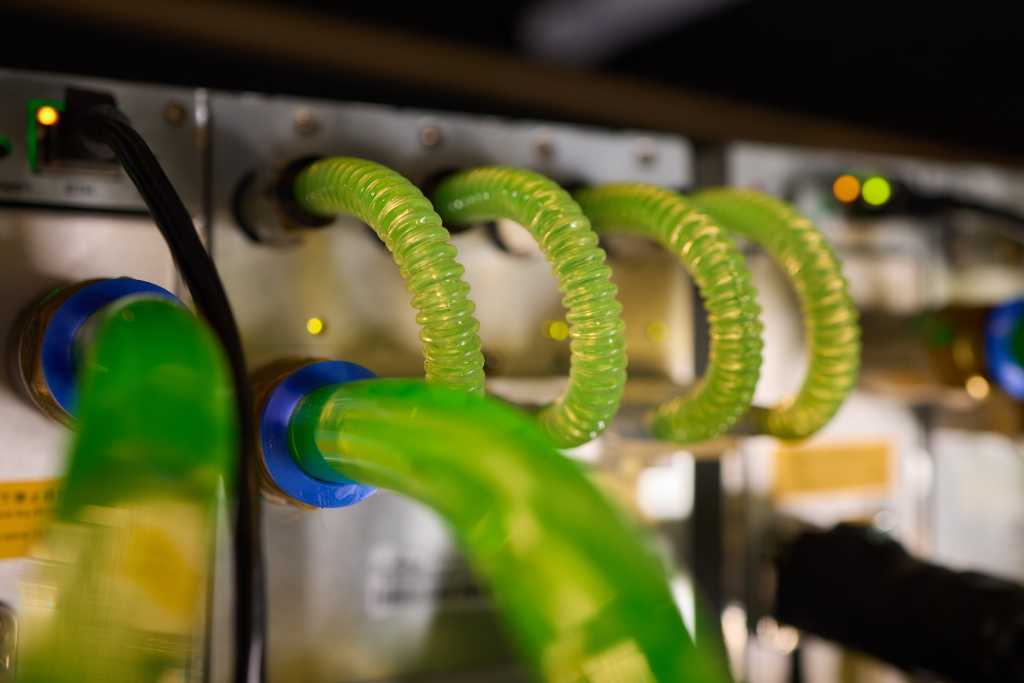
Cold plate systems pump coolant directly through metal plates, making physical contact with processors. The engineering elegance is remarkable. Instead of moving heat through air to a distant cooling system, heat conducts directly into liquid flowing inches from silicon. The most effective implementations use a secondary fluid distribution loop with a coolant distribution unit (CDU) at each row. The CDU receives chilled water from the central plant and uses heat exchangers to cool the secondary loop that touches servers. This architecture can handle the 1,000-watt-plus thermal design power (TDP) — the maximum heat a processor generates under load — of individual Blackwell GPUs. These are thermal loads that would require hurricane-force airflow to dissipate through convection alone.