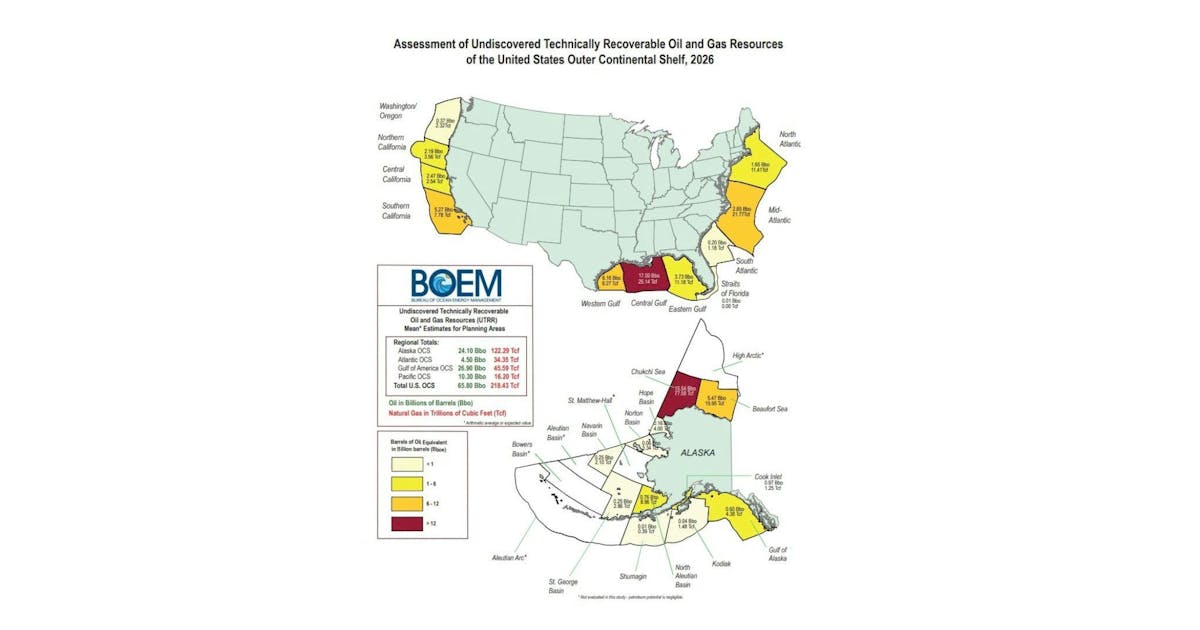
The US Outer Continental Shelf (OCS) holds mean undiscovered technically recoverable resources (UTRR) of 65.8 billion bbl of oil and 218.43 tcf of natural gas, the US Bureau of Ocean Energy Management (BOEM) said Mar. 9.
Based on current production trends, these undiscovered resources represent the potential for 100 or more years of energy production from the US Outer Continental Shelf (OCS), BOEM said.
A large portion of undiscovered OSC resources is located offshore the Gulf of Mexico and Alaska, according to the report. The offshore Gulf holds 26.9 million bbl of oil and 45.59 tcf of gas, while offshore Alaska holds an estimated mean 24.1 million bbl of oil and 122.29 tcf of gas.
Offshore Pacific holds a mean UTRR of 10.3 million barrels of oil and 16.2 trillion cubic feet of gas, the report said. Offshore Atlantic holds a mean UTRR of 10.3 billion barrels of oil and 16.2 trillion cubic feet of gas.
The assessment also evaluates the impact of prices on hydrocarbon recovery. Alaska is particularly price-sensitive, with mean undiscovered economically recoverable resources (UERR) negligible until prices average $100/bbl and $17.79/Mcf. At those levels, the mean UERR stands at 6.25 billion bbl and 13.25 tcf. At $160/bbl and $28.47/Mcf, recoverable resources jump to 14.67 billion bbl and 58.78 tcf.
In the Gulf of Mexico, the mean UERR is 17.51 billion bbl of oil and 13.71 tcf at average prices of $60/bbl and $3.20/Mcf, increasing to 20.51 billion bbl and 17.49 tcf at average prices of $100/bbl and $5.34/Mcf, respectively.
BOEM conducts a national resource assessment every 4 years to understand the “distribution of undiscovered oil and gas resources on the OCS” and identify opportunities for additional oil and gas exploration and development.
“The Outer Continental Shelf holds tremendous resource potential,” said BOEM Acting Director Matt Giacona. “This report provides the foundation for decisions that will ensure affordable energy and robust energy security for generations of Americans.”
The department explained that its findings are derived from analyzing each geologic play across the OCS and assigning a probability for the existence of undiscovered oil and gas resources for individual plays. Play results are then aggregated up to regional results and ultimately, a total OCS estimate.