Stay Ahead, Stay ONMINE

DCF Trends Summit 2025 – Scaling AI: Adaptive Reuse, Power-Rich Sites, and the New GPU Frontier

When Jones Lang LaSalle (JLL)’s Sean Farney walked back on stage after lunch at the Data Center Frontier Trends Summit 2025, he didn’t bother easing into the topic. “This is the best one of the day,” he joked, “and it’s got the most buzzwords in the title.” The session, “Scaling AI: The Role of Adaptive […]

When Jones Lang LaSalle (JLL)’s Sean Farney walked back on stage after lunch at the Data Center Frontier Trends Summit 2025, he didn’t bother easing into the topic.

“This is the best one of the day,” he joked, “and it’s got the most buzzwords in the title.”

The session, “Scaling AI: The Role of Adaptive Reuse and Power-Rich Sites in GPU Deployment,” lived up to that billing. Over the course of the hour, Farney and his panel of experts dug into the hard constraints now shaping AI infrastructure—and the unconventional sites and power strategies needed to overcome them.

Joining Farney on stage were:

  • Lovisa Tedestedt, Strategic Account Executive – Cloud & Service Providers, Schneider Electric
  • Phill Lawson-Shanks, Chief Innovation Officer, Aligned Data Centers
  • Scott Johns, Chief Commercial Officer, Sapphire Gas Solutions

Together, they painted a picture of an industry running flat-out, where adaptive reuse, modular buildouts, and behind-the-meter power are becoming the fastest path to AI revenue.

The Perfect Storm: 2.3% Vacancy, Power-Constrained Revenue

Farney opened with fresh JLL research that set the stakes in stark terms.

  • U.S. colo vacancy is down to 2.3% – roughly 98% utilization.
  • Just five years ago, vacancy was about 10%.
  • The industry is tracking to over 5.4 GW of colocation absorption this year, with 63% of first-half absorption concentrated in just two markets: Northern Virginia and Dallas.
  • There’s roughly 8 GW of build pipeline, but about 73% of that is already pre-leased, largely by hyperscalers and “Mag 7” cloud and AI giants.

“We are the envy of every industry on the planet,” Farney said. “That’s fantastic if you’re in the data center business. It’s a really bad thing if you’re a customer.”

The message to CIOs and CTOs was blunt: if you don’t have a capacity strategy dialed in, your growth may be constrained by infrastructure scarcity.

Farney then layered in the new reality: power has become the gating factor for revenue, citing NVIDIA’s GTC messaging that enterprise revenues are now effectively constrained by power availability.

“It’s a perfect storm of constraint,” he said. “You can’t just tap out. Data keeps doubling every few years. So what do we do in the face of these constraints?”

That question set up the rest of the discussion: how can adaptive reuse, modularity, and power-rich sites change the equation for GPU deployments?

Schneider: Grid-to-Chip, Liquid Cooling, and Energy-as-a-Service

From Schneider Electric’s vantage point, everyone is chasing power and time-to-revenue at once, said Lovisa Tedestedt.

“Customers are trying to find land with energized power, or repurpose land and buildings and re-energize them,” she explained. “Schneider is involved from grid to chip, chip to chiller—the full flow of infrastructure.”

For AI-scale builds, Tedestedt emphasized three interlocking themes:

Liquid cooling as the primary lever for usable IT power

With power headroom tight, the fastest way to “create” more effective capacity is better efficiency.

Moving from purely air-cooled systems to liquid-cooled architectures substantially increases the share of input power that reaches GPUs.

She pointed to warmer CDU (cooling distribution unit) setpoints—on the order of 45°C water temperatures—as a way to maximize efficiency and unlock more IT load from the same utility feed.

Behind-the-meter and microgrid strategies

In many markets, customers are now told they may wait up to eight years for full grid interconnection.

That reality is pushing operators toward onsite generation and microgrids, as well as a mix of supplemental power options.

Schneider is seeing strong traction in “energy-as-a-service” models, where a joint venture or specialist provider owns, maintains, and operates the power plant or microgrid—charging the data center via a per-kWh structure rather than forcing them to become utilities themselves.

Modular, prefabricated deployment for speed

Tedestedt argued that prefabricated, modular electrical rooms and IT pods are now the fastest and often most sustainable path to AI capacity.

“Engineering, stamped drawings, testing—it’s all done in the factory,” she said. “You roll skids in and you’re looking at on the order of a 60% faster deployment versus traditional stick-built infrastructure.”

The throughline in her remarks: finding power, adding power, and then squeezing as much usable IT capacity as possible out of every megawatt through liquid cooling and modular, factory-built systems.

Aligned: Adaptive Reuse, Edge AI, and Designing for an Uncertain Future

Phill Lawson-Shanks of Aligned Data Centers brought a long lens to the conversation, drawing on nearly four decades of digital infrastructure experience.

“We’ve been optimized for cloud for the last 10 years,” he said. “Now things are getting exciting again.”

Liquid + Air, and Why Immersion Isn’t a Default

Lawson-Shanks agreed that liquid cooling is now essential—not a niche technology—but stressed that air isn’t going away anytime soon.

  • Current and next-gen hardware stacks still contain numerous components that require air cooling.
  • Even in high-density liquid deployments, operators may only be pulling 60–70% of the heat into the liquid loop, with the remainder handled by air.

Full immersion, he argued, isn’t yet the mainstream answer due to chemical and regulatory concerns, especially around PFAS-based fluids and dual-phase systems. The industry is waiting for safer, more widely acceptable chemistries, even as R&D races ahead.

Building for Cloud, AI, and Whatever Comes Next

One of Lawson-Shanks’ central points was that design lifecycles and depreciation schedules haven’t shrunk just because AI is moving fast.

“We still need to monetize a building over 25 years,” he said. “But we don’t actually know how workloads will change over that life.”

That uncertainty is driving Aligned toward:

  • Highly adaptable electrical topologies (low-voltage today, but pre-engineered to pivot to higher-voltage AC/DC or blended systems).
  • Skidded electrical rooms that can be swapped, expanded, or reconfigured as AI workloads evolve.
  • A recognition that AI inference at the edge may dramatically shrink the number of racks while radically increasing density and gray space needed for power and cooling.

“We used to joke edge was always just around the corner,” he said. “Now with agentic AI and inference, we really may be looking at an ‘AI inference edge’—sites that are only a few racks, but carry massive power density and require very different logistics and design.”

Adaptive Reuse as Community Catalyst

Lawson-Shanks then brought the conversation back to adaptive reuse in a very literal sense.

Aligned has focused on large legacy industrial sites where substantial power once existed. He highlighted a project in Sandusky, Ohio, repurposing a former General Motors war-bearing plant that once powered electric arc furnaces.

  • The site had been dormant for years as manufacturing moved offshore.
  • By acquiring and rehabilitating the property, Aligned unlocked the potential for over a gigawatt of capacity.
  • Just as important, they used the project to re-introduce the community to digital infrastructure, visiting local high schools and trade programs to talk about careers in mechanical and electrical engineering and data center operations.

“People say data centers don’t create jobs,” Lawson-Shanks said. “But once you account for client teams, ongoing electrical and mechanical work, security, and services, these facilities absolutely help reinvigorate local economies.”

Adaptive reuse, in his telling, isn’t just about shaving months off a schedule. It’s also about re-energizing communities with new forms of digital-age industry.

Sapphire Gas: Virtual Pipelines and Behind-the-Fence Power

If power availability is the bottleneck, Sapphire Gas Solutions’ Scott Johns is in the business of widening the neck.

“We operate virtual pipelines,” he said. “Mobile pipeline operations. We keep power plants and entire towns running when utilities have to take pipelines down.”

Sapphire is active in 38 states, serving both:

  • Utilities that need temporary or emergency gas supply.
  • Large energy users like data centers that need fuel 24/7 but may lack immediate physical pipeline access.

Bridging the Gap to the Grid

Johns argued that while the industry is rightly alarmed by long interconnection queues, the U.S. has been here before.

“We’ve doubled the grid once; we’re getting ready to double it again,” he said. “When customers come to us, they’re in a panic. But this isn’t new in an absolute sense.”

His core message: stop thinking of backup generation and temporary gas services as add-ons, and start planning holistically:

  • Many customers start around 10–20 MW of demand and quickly find themselves needing 50, 100, or 150 MW.
  • Leasing large banks of generators is not a sustainable strategy at that scale.
  • Instead, operators should be purchasing or contracting for behind-the-fence generation—turbines, distributed generation, microgrids, and related infrastructure engineered for long-term scalability.

Utilities themselves are now bringing companies like Sapphire to the table, Johns said, especially when interconnection options look like “40–80 MW in six years, for $120 million-plus in infrastructure”—and when pipelines may require hundreds of millions more.

In those scenarios, virtual pipelines and onsite fuel logistics become critical to:

  • Bridge multi-year delays in both electric and gas infrastructure.
  • Provide flexible redundancy and curtailment support.
  • Supply on-site storage, including large-scale LNG tanks, to buffer price spikes (e.g., winter “polar vortex” events where gas prices can briefly trade at many multiples of summer levels).

From Diesel Gensets to Gas, RNG, and Hydrogen

Johns also challenged the industry to rethink construction and backup practices.

“Stop using diesel generation for construction phases,” he said. “Use natural gas.”

He pointed to:

  • Compressed and liquefied natural gas for primary and backup construction power.
  • Renewable natural gas (RNG) sourced from swine, dairy, landfills, and wastewater plants, blended into the fuel mix at 10% or more, with negative carbon intensity profiles.
  • A path where persistent, large, behind-the-fence loads—like data centers—could ultimately justify faster commercialization of hydrogen, especially if combined with renewable methane and low-carbon production pathways.

Hydrogen drew spirited debate on stage and from the audience. Johns framed it as a 2050-ish fuel that could be brought forward into the 2030s with data center demand and the right policy support. An audience member countered that hydrogen-powered data centers are already operating today at pilot scale, illustrating just how quickly this space is evolving.

Adaptive Reuse, Sustainability, and the Materials Question

For Lovisa Tedestedt, adaptive reuse is not just a clever strategy—it’s an inevitability.

“We have no other choice than to start looking at reuse,” she said. “There’s enough available real estate—warehouses, industrial buildings—that we should be considering for data centers. There’s no end in sight for demand.”

From a sustainability standpoint, she pointed out that:

  • Reusing existing buildings avoids a portion of the embodied carbon tied up in concrete and steel.
  • Combining reuse with factory-built, pre-tested modular systems can yield both higher uptime and faster deployment.
  • For hyperscale-class projects (100 MW-plus), behind-the-meter power plus adaptive reuse may be the only realistic path in many markets.

At the same time, Tedestedt raised a pointed cultural question that landed with the room:

“How did we go from ‘you can’t cook on natural gas at home’ to building tens of gigawatts of natural-gas generation for data centers in a year?” she asked. “What happened to the sustainability story?”

The panel’s collective answer was nuanced rather than neat. Johns defended the central role of gas and RNG in a high-demand transition period. Lawson-Shanks pointed toward nuclear and hydrogen as future complements. Tedestedt emphasized efficiency, reuse, and smarter infrastructure as near-term mitigation.

The exchange underscored an uncomfortable truth: scaling AI will require confronting tradeoffs between speed, reliability, and sustainability in very public ways.

AI Helping Build AI: Design and Operations Get Smarter

In the audience Q&A, one attendee asked the obvious meta-question:

“We’re doing all this to make AI run. Can we also use AI to make some of these problems better?”

Lawson-Shanks said Aligned already is:

  • Using AI-driven tools for logistics, such as systems that optimize equipment movements and scheduling.
  • Employing platforms like Foresight to analyze construction schedules (P6 files) and surface schedule and resource contention in minutes, rather than waiting weeks for manual analysis.
  • Trialing AI agents for cooling optimization, a descendant of work first done at Google DeepMind, to anticipate heat and load fluctuations and modulate valves and flows in real time.

He also pointed to the future of generative design for building structures and systems—akin to how Formula 1 teams use generative tools to optimize chassis designs.

“If you’re putting a billion dollars into a building, you’re not going to do that on day one,” he cautioned. “But as tools mature, we’ll see more organic, optimized structures and material choices that reduce both cost and embodied carbon.”

Will Enterprise Data Centers Be Reborn for AI Inference?

In a rapid-fire “speed round,” Farney posed one last strategic question to the panel:

After 15 years of sending workloads to the cloud and stranding power on-prem, will enterprises see a rebirth of the enterprise data center—specifically for GPU-driven AI inference?

The panel didn’t hesitate.

“Yeah.”
“Yeah.”
“Yeah.”

Their reasoning, woven through the earlier discussion, was straightforward:

  • Many enterprises will never put certain systems fully in the cloud, whether for regulatory, security, or data-sovereignty reasons.
  • They increasingly want to own their AI destiny, developing models and inference stacks that are deeply tied to internal data and processes.
  • The emerging “AI inference edge”—small, dense deployments close to users and data sources—is a natural fit for a next generation of enterprise-class facilities, often built on adaptive reuse and powered by a blend of grid and behind-the-meter sources.

The Road Ahead: From Constraint to Creative Deployment

If Farney opened the session with a “perfect storm of constraint,” the panel closed it with something closer to a roadmap.

  • Adaptive reuse offers a way to shortcut interconnection timelines, avoid some embodied carbon, and reinvigorate communities.
  • Power-rich and power-adjacent sites—whether near generation, pipelines, or future reactors—are emerging as strategic anchors for AI campuses.
  • Behind-the-fence generation, microgrids, and virtual pipelines are no longer exotic; they’re fast becoming table stakes for anyone playing at AI scale.
  • Liquid cooling and modular infrastructure are the primary levers for unlocking more usable IT power and compressing time-to-revenue.
  • And increasingly, AI itself will help design, build, and operate the infrastructure underpinning the AI era.

As vacancy tightens, power queues lengthen, and GPU clusters grow heavier, denser, and more expensive, the industry’s ability to reuse, re-route, and re-invent sites and power strategies will be the difference between sitting on the sidelines and actually scaling AI.
Shape
Shape
Stay Ahead

Explore More Insights

Stay ahead with more perspectives on cutting-edge power, infrastructure, energy,  bitcoin and AI solutions. Explore these articles to uncover strategies and insights shaping the future of industries.

Shape

Will Google throw gasoline on the AI chip arms race?

The Nvidia processors, he explains, are for processing massive, large language models (LLMs), while the Google TPU is used for inferencing, the next step after processing the LLM. So the two chips don’t compete with each other, they complement each other, according to Gold. Selling and supporting processors may not

Read More »

Nvidia moves deeper into AI infrastructure with SchedMD acquisition

“Slurm excels at orchestrating multi-node distributed training, where jobs span hundreds or thousands of GPUs,” said Lian Jye Su, chief analyst at Omdia. “The software can optimize data movement within servers by deciding where jobs should be placed based on resource availability. With strong visibility into the network topology, Slurm

Read More »

ExxonMobil bumps up 2030 target for Permian production

ExxonMobil Corp., Houston, is looking to grow production in the Permian basin to about 2.5 MMboe/d by 2030, an increase of 200,000 boe/d from executives’ previous forecasts and a jump of more than 45% from this year’s output. Helping drive that higher target is an expected 2030 cost profile that

Read More »

Russia Oil Prices Hit Lowest Since War Began

Russian crude prices are at their lowest since the war in Ukraine began, as sanctions deepen the discounts the nation’s oil industry needs to offer and benchmark futures tumble.  On average, Russian oil exporters are receiving just over $40 a barrel for cargoes shipped from the Baltic, Black Sea and the eastern port of Kozmino, according to data from Argus Media. That’s down 28% over the last three months, with recent restrictions targeting oil giants Rosneft PJSC and Lukoil PJSC widening the markdowns.  Mounting Western pressure on Russia’s oil trade has made it increasingly difficult to sell and deliver the barrels, with measures also targeting refiners at top buyers like India. In addition, global benchmark oil prices are sliding, trading below $60 a barrel for the first time since May on Tuesday.  The revenues Russia receives for its oil — which combined with gas account or about a quarter of the nation’s state budget — are critical to fund its war. Lower income strains the finances of the nation’s oil companies and reduces the amount of tax they pay into the Kremlin’s coffers.  The Trump administration has engaged in a diplomatic flurry geared toward ending the conflict over the last few weeks. President Vladimir Putin acknowledged that Russian economic growth was slowing down on a recent visit to India.  Indian officials said they expect imports from Russia to be about 800,000 barrels a day this month, sharply lower than in November, though still a significant volume of supplies. A Chinese refiner recently bought a shipment of crude from Russia’s eastern ports at the steepest discount this year. The two Asian nations are the main buyers of Russian oil.  WHAT DO YOU THINK? Generated by readers, the comments included herein do not reflect the views and opinions of Rigzone. All comments are subject to editorial review. Off-topic, inappropriate

Read More »

EIA Again Raises WTI Price Forecast for Both 2025 and 2026

In its latest short term energy outlook (STEO), which was released on December 9, the U.S. Energy Information Administration (EIA) again raised its West Texas Intermediate (WTI) price forecast for both 2025 and 2026. According to this STEO, the EIA now expects the WTI spot price to average $65.32 per barrel in 2025 and $51.42 per barrel in 2026. The EIA’s December STEO marks the latest in a line of STEOs with average WTI spot price forecast increases for both 2025 and 2026. In its previous November STEO, the EIA projected that the WTI spot price would average $65.15 per barrel in 2025 and $51.26 per barrel in 2026. The EIA’s October STEO projected that the WTI spot price would average $65.00 per barrel this year and $48.50 per barrel next year, and its September STEO forecast that the WTI spot price would average $64.16 per barrel in 2025 and $47.77 per barrel in 2026. Although the September STEO included an increase in the average WTI spot price forecast for 2025, compared to the previous August STEO, the average WTI spot price forecast for 2026 was unchanged from the previous STEO. A quarterly breakdown included in the EIA’s December STEO projected that the WTI spot price will average $59.31 per barrel in the fourth quarter of 2025, $50.93 per barrel in the first quarter of 2026, $50.68 per barrel in the second quarter, and $52.00 per barrel across the third and fourth quarters of next year. The WTI spot price averaged $71.85 per barrel in the first quarter, $64.63 per barrel in the second quarter, and $65.78 per barrel in the third quarter, the December STEO showed. It highlighted that the WTI spot price averaged $76.60 per barrel overall in 2024. In a J.P. Morgan report sent to Rigzone by

Read More »

Chevron Reduces Price for Venezuelan Oil

Chevron Corp, lowered the price of Venezuelan crude offered to US refiners after a tanker was seized by American forces in the Caribbean and as global prices drifted lower.  The oil supermajor sold a batch of Venezuelan oil on Dec. 11 — a day after US forces seized a vessel off the country’s coast — at weaker prices compared than a batch offered on Monday, according to people with knowledge of the situation.  The administration of President Donald Trump is stepping up pressure on Venezuela by targeting oil revenues critical to the survival of Nicolas Maduro regime. The seized vessel, the Skipper, is currently near the Dominican Republic and appeared to be en route to the US, according to vessel movements tracked by Bloomberg. While it’s unclear when the ship will be able to discharge, it’s expected arrival is pressuring already weak prices in the Gulf Coast market, the people said, asking not to be named because the information is private.  Chevron’s operations in Venezuela continue in full compliance with laws and regulations applicable to its business, as well as the sanctions frameworks provided for by the US government, the Houston-based company said in a statement.  The company sold about 10 oil cargoes of different grades for loading next month, in a sign that it’s pressing ahead despite heightened tensions between the two countries. The cargoes were sold in two separate tenders and price levels were not immediately available.  WHAT DO YOU THINK? Generated by readers, the comments included herein do not reflect the views and opinions of Rigzone. All comments are subject to editorial review. Off-topic, inappropriate or insulting comments will be removed.

Read More »

Phillips 66 Budgets $2.4B for 2026

Phillips 66 said Monday it expects a $2.4 billion budget for next year, consisting of $1.1 billion in sustaining capital and $1.3 billion in growth capital. “The 2026 capital budget reflects our ongoing commitment to capital discipline and maximizing shareholder returns”, chair and chief executive Mark Lashier said in an online statement. “We are investing growth capital in our NGL value chain and high-return refining projects, while also investing sustaining capital to support safe and reliable operations”. Houston, Texas-based Phillips 66 expects to shell out $1.1 billion into its refining business, comprising $590 million in sustaining capital and $520 million into growth projects. “With the consolidation of WRB Refining, we incorporated approximately $200 million of sustaining capital and $100 million of growth capital into the budget”, Lashier said. Phillips 66 recently acquired an additional 50 percent stake in WRB Refining LP from Cenovus Energy Inc for $1.4 billion, fully taking over the Wood River and Borger refineries, as confirmed by Phillips 66 in its third quarter report October 29. Wood River in Roxana, Illinois, has a gasoline and distillates production capacity of 176,000 bpd and 140,000 bpd respectively. Borger in Borger, Texas, produces up to 100,000 bpd of gasoline and 70,000 bpd of distillates, according to Phillips 66. The refining allotment for 2026 also includes a multiyear investment at the Humber refinery to enable the production of higher-quality gasoline and expand the facility’s access to “higher-value global markets”, the company said. Phillips 66 expects to start up the project in the second quarter of 2027. Located in North Lincolnshire on the English east coast, the Humber site produces up to 95,000 barrels per day (bpd) of gasoline and 115,000 bpd of distillates, according to Phillips 66. The refining budget also includes “over 100 low-capital, high-return projects to improve market capture

Read More »

USA Emerges as World’s Hydrocarbon Superpower

The U.S. has emerged as the world’s hydrocarbon superpower, exemplified by its meteoric rise in the liquefied natural gas (LNG) market.   That’s what Wood Mackenzie (WoodMac) said in a statement sent to Rigzone recently, which highlighted several charts that “spotlight the most significant trends reshaping the [energy and resources] sector globally” and were included in the company’s latest Horizons report. “You don’t need to look too far back to find a U.S. which was building LNG import infrastructure and now in under 10 years it has become the world’s largest LNG exporter,” WoodMac said in the statement. The company noted in the statement that, by 2030, the U.S. is projected to account for 30 percent of global LNG output. A chart included in the statement outlined that the U.S. would continue as the world’s largest LNG exporter in 2030, followed by Qatar and Australia. WoodMac also highlighted in its statement that the U.S. “leads global oil production (including oil, condensate, and natural gas liquids), delivering one-fifth of the world’s volumes”. “In comparison, its closest competitors, Saudi Arabia and Russia, produce only 65 percent and 50 percent of U.S. volumes, respectively,” it added.   Malcolm Forbes-Cable, Vice President, Upstream and Carbon Management Consulting at Wood Mackenzie, said in the statement, “the resurrection of U.S. LNG is a crucial reminder of what a resource-rich, free-market country like the U.S. can do”. “This hydrocarbon hegemony is now being leveraged as a diplomatic tool,” he added. In its latest short term energy outlook (STEO), which was released on December 9, the U.S. Energy Information Administration (EIA) projected that gross U.S. LNG exports will average 14.9 billion cubic feet per day in 2025 and 16.3 billion cubic feet per day in 2026. Gross U.S. LNG exports averaged 11.9 billion cubic feet per day in 2024, this STEO highlighted. A quarterly breakdown included in the EIA’s latest STEO forecasted that gross U.S. LNG exports will come in at

Read More »

North America Rig Count Stays Flat

North America’s rig count stayed flat week on week, according to Baker Hughes’ latest North America rotary rig count, which was published on December 12. The total U.S. rig count dropped by one week on week and the total Canada rig count rose by one during the same period, keeping the total North America rig count at 740, the count outlined. The total North America rig count comprised 548 rigs from the U.S. and 192 rigs from Canada, the count showed. Of the total U.S. rig count of 548, 528 rigs are categorized as land rigs, 17 are categorized as offshore rigs, and three are categorized as inland water rigs. The total U.S. rig count is made up of 414 oil rigs, 127 gas rigs, and seven miscellaneous rigs, according to Baker Hughes’ count, which revealed that the U.S. total comprises 478 horizontal rigs, 54 directional rigs, and 16 vertical rigs. Week on week, the U.S. land rig count rose by one, its offshore rig count dropped by two, and its inland water rig count remained unchanged, Baker Hughes highlighted. The U.S. oil rig count rose by one week on week, its gas rig count dropped by two by week on week, and its miscellaneous rig count remained unchanged week on week, the count showed. The U.S. horizontal rig count rose by two, its directional rig count dropped by four, and its vertical rig count increased by one, week on week, the count revealed. A major state variances subcategory included in the rig count showed that, week on week, Texas added two rigs, and Ohio and Louisiana each added one rig. This subcategory revealed that New Mexico dropped three rigs and Colorado dropped one rig week on week. A major basin variances subcategory included in Baker Hughes’ rig count showed

Read More »

Google’s TPU Roadmap: Challenging Nvidia’s Dominance in AI Infrastructure

Google’s roadmap for its Tensor Processing Units has quietly evolved into a meaningful counterweight to Nvidia’s GPU dominance in cloud AI infrastructure—particularly at hyperscale. While Nvidia sells physical GPUs and associated systems, Google sells accelerator services through Google Cloud Platform. That distinction matters: Google isn’t competing in the GPU hardware market, but it is increasingly competing in the AI compute services market, where accelerator mix and economics directly influence hyperscaler strategy. Over the past 18–24 months, Google has focused on identifying workloads that map efficiently onto TPUs and has introduced successive generations of the architecture, each delivering notable gains in performance, memory bandwidth, and energy efficiency. Currently, three major TPU generations are broadly available in GCP: v5e and v5p, the “5-series” workhorses tuned for cost-efficient training and scale-out learning. Trillium (v6), offering a 4–5× performance uplift over v5e with significant efficiency gains. Ironwood (v7 / TPU7x), a pod-scale architecture of 9,216 chips delivering more than 40 exaFLOPS FP8 compute, designed explicitly for the emerging “age of inference.” Google is also aggressively marketing TPU capabilities to external customers. The expanded Anthropic agreement (up to one million TPUs, representing ≥1 GW of capacity and tens of billions of dollars) marks the most visible sign of TPU traction. Reporting also suggests that Google and Meta are in advanced discussions for a multibillion-dollar arrangement in which Meta would lease TPUs beginning in 2026 and potentially purchase systems outright starting in 2027. At the same time, Google is broadening its silicon ambitions. The newly introduced Axion CPUs and the fully integrated AI Hypercomputer architecture frame TPUs not as a standalone option, but as part of a multi-accelerator environment that includes Nvidia H100/Blackwell GPUs, custom CPUs, optimized storage, and high-performance fabrics. What follows is a deeper look at how the TPU stack has evolved, and what

Read More »

DCF Trends Summit 2025: Beyond the Grid – Natural Gas, Speed, and the New Data Center Reality

By 2025, the data center industry’s power problem has become a site-selection problem, a finance problem, a permitting problem and, increasingly, a communications problem. That was the throughline of “Beyond the Grid: Natural Gas, Speed, and the New Data Center Reality,” a DCF Trends Summit panel moderated by Stu Dyer, First Vice President at CBRE, with Aad den Elzen, VP of Power Generation at Solar Turbines (a Caterpillar company); Creede Williams, CEO & President of Exigent Energy Partners; and Adam Michaelis, Vice President of Hyperscale Engineering at PointOne Data Centers. In an industry that once treated proximity to gas infrastructure as a red flag, Dyer opened with a blunt marker of the market shift: what used to be a “no-go” is now, for many projects, the shortest path to “yes.” Vacancy is tight, preleasing is high, and the center of gravity is moving both in scale and geography as developers chase power beyond the traditional core. From 48MW Campuses to Gigawatt Expectations Dyer framed the panel’s premise with a Northern Virginia memory: a “big” 48MW campus in Sterling that was expected to last five to seven years—until a hyperscale takedown effectively erased the runway. That was the early warning sign of what’s now a different era entirely. Today, Dyer said, the industry isn’t debating 72MW or even 150MW blocks. Increasingly, the conversation starts at 500MW critical and, for some customers, pushes past a gigawatt. Grid delivery timelines have not kept pace with that shift, and the mismatch is forcing alternative strategies into the mainstream. “If you’re interested in speed and scale… gas.” If there was a sharp edge to the panel, it came from Williams’ assertion that for near-term speed-to-power at meaningful scale, natural gas is the only broadly viable option. Williams spoke as an independent power producer (IPP) operator who

Read More »

Roundtable: The Economics of Acceleration

Ben Rapp, Rehlko: The pace of AI deployment is outpacing grid capacity in many regions, which means power strategy is now directly tied to deployment timelines. To move fast without sacrificing lifecycle cost or reliability, operators are adopting modular power systems that can be installed and commissioned quickly, then expanded or adapted as loads grow. From an energy perspective, this requires architectures that support multiple pathways: traditional generation, cleaner fuels like HVO, battery energy storage, and eventually hydrogen or renewable integrations where feasible. Backup power is no longer a static insurance policy, it’s a dynamic part of the operating model, supporting uptime, compliance, and long-term cost management. Rehlko’s global footprint and broad energy portfolio enable us to support operators through these transitions with scalable solutions that meet existing technical needs while providing a roadmap for future adaptation.

Read More »

DCF Trends Summit 2025: Bridging the Data Center Power Gap – Utilities, On-Site Power, and the AI Buildout

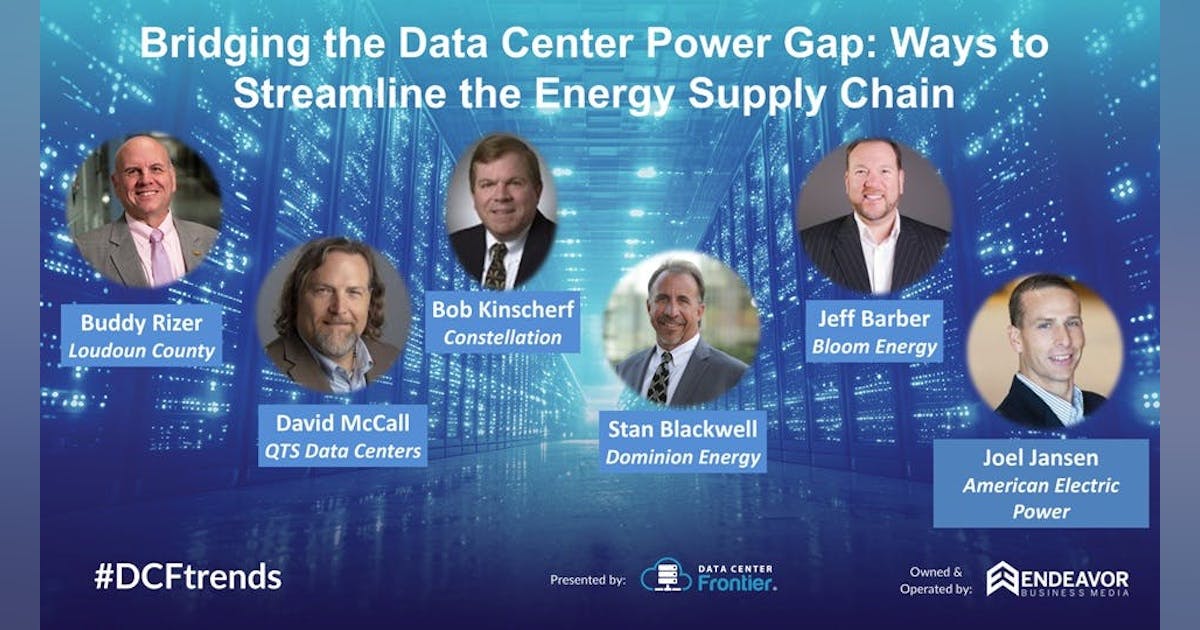
The second installment in our recap series from the 2025 Data Center Frontier Trends Summit highlights a panel that brought unusual candor—and welcome urgency—to one of the defining constraints of the AI era: power availability. Moderated by Buddy Rizer, Executive Director of Economic Development for Loudoun County, Bridging the Data Center Power Gap: Ways to Streamline the Energy Supply Chain convened a powerhouse group of energy and data center executives representing on-site generation, independent power markets, regulated utilities, and hyperscale operators: Jeff Barber, VP of Global Data Centers, Bloom Energy Bob Kinscherf, VP of National Accounts, Constellation Stan Blackwell, Director, Data Center Practice, Dominion Energy Joel Jansen, SVP Regulated Commercial Operations, American Electric Power David McCall, VP of Innovation, QTS Data Centers As presented on September 26, 2025 in Reston, Virginia, the discussion quickly revealed that while no single answer exists to the industry’s power crunch, a more collaborative, multi-path playbook is now emerging—and evolving faster than many realize. A Grid Designed for Yesterday Meets AI-Era Demand Curves Rizer opened with context familiar to anyone operating in Northern Virginia: this region sits at the epicenter of globally scaled digital infrastructure, but its once-ample headroom has evaporated under the weight of AI scaling cycles. Across the panel, the message was consistent: demand curves have shifted permanently, and the step-changes in load growth require new thinking across the entire energy supply chain. Joel Jansen (AEP) underscored the pace of change. A decade ago, utilities faced flat or declining load growth. Now, “our load curve is going straight up,” driven by hyperscale and AI training clusters that are large, high-density, and intolerant of slow development cycles. AEP’s 40,000 miles of transmission and 225,000 miles of distribution infrastructure give it perspective: generation is challenging, but transmission and interconnection timelines are becoming decisive gating factors.

Read More »

DCF Trends Summit 2025 – Scaling AI: Adaptive Reuse, Power-Rich Sites, and the New GPU Frontier

When Jones Lang LaSalle (JLL)’s Sean Farney walked back on stage after lunch at the Data Center Frontier Trends Summit 2025, he didn’t bother easing into the topic. “This is the best one of the day,” he joked, “and it’s got the most buzzwords in the title.” The session, “Scaling AI: The Role of Adaptive Reuse and Power-Rich Sites in GPU Deployment,” lived up to that billing. Over the course of the hour, Farney and his panel of experts dug into the hard constraints now shaping AI infrastructure—and the unconventional sites and power strategies needed to overcome them. Joining Farney on stage were: Lovisa Tedestedt, Strategic Account Executive – Cloud & Service Providers, Schneider Electric Phill Lawson-Shanks, Chief Innovation Officer, Aligned Data Centers Scott Johns, Chief Commercial Officer, Sapphire Gas Solutions Together, they painted a picture of an industry running flat-out, where adaptive reuse, modular buildouts, and behind-the-meter power are becoming the fastest path to AI revenue. The Perfect Storm: 2.3% Vacancy, Power-Constrained Revenue Farney opened with fresh JLL research that set the stakes in stark terms. U.S. colo vacancy is down to 2.3% – roughly 98% utilization. Just five years ago, vacancy was about 10%. The industry is tracking to over 5.4 GW of colocation absorption this year, with 63% of first-half absorption concentrated in just two markets: Northern Virginia and Dallas. There’s roughly 8 GW of build pipeline, but about 73% of that is already pre-leased, largely by hyperscalers and “Mag 7” cloud and AI giants. “We are the envy of every industry on the planet,” Farney said. “That’s fantastic if you’re in the data center business. It’s a really bad thing if you’re a customer.” The message to CIOs and CTOs was blunt: if you don’t have a capacity strategy dialed in, your growth may be constrained

Read More »

Dual Feed: NextEra Energy, TotalEnergies, ENGIE, NIPSCO, ProPetro, Claibrant Energy, DTE Energy, Redwood Materials, KULR, Honeywell

NextEra’s power strategy for the AI era rests on a simple requirement: data centers need power that is both clean and firm. To meet that dual mandate, the company is building a diversified portfolio that spans renewables, battery storage, nuclear generation, and, where appropriate, natural gas. A recent example of this approach is NextEra’s expanded clean-energy agreements with Meta, which now total more than 2.5 GW of solar and battery-storage capacity across the Midwest, Texas, and the Southwest to support Meta’s accelerating data center footprint. A Lot to Do — and Major Moves Ahead One of NextEra’s most consequential steps is the plan, in partnership with Google, to restart the shuttered 615 MW Duane Arnold Energy Center in Iowa. Targeted to return to service by 2029 under a 25-year PPA, the restart reflects growing recognition that intermittent renewables alone cannot reliably support AI-scale data centers. NextEra executives have framed the company’s posture as an “all-of-the-above” strategy that blends renewables, storage, nuclear, and gas to deliver clean, 24/7 power. Beyond nuclear, NextEra has indicated that its “land teams” are actively preparing additional generation near major data-center demand hubs — a mix that could include solar, wind, storage, and new gas-fired capacity depending on location and reliability requirements. Taken together, these moves point to a larger shift: NextEra is no longer simply a renewable-energy supplier selling PPAs at arm’s length. It is evolving into a bespoke energy-infrastructure partner, designing integrated generation, storage, and transmission solutions purpose-built for data center campuses. The Backbone of Data Center Supply: Renewables, Storage, and Firm Generation Even as nuclear and other firm resources become more prominent in its strategy, NextEra continues to expand its core business in renewables and battery storage: still essential for carbon-reduction goals, cost efficiency, and rapid scalability. In 2025 alone, the company added

Read More »

Microsoft will invest $80B in AI data centers in fiscal 2025

And Microsoft isn’t the only one that is ramping up its investments into AI-enabled data centers. Rival cloud service providers are all investing in either upgrading or opening new data centers to capture a larger chunk of business from developers and users of large language models (LLMs).  In a report published in October 2024, Bloomberg Intelligence estimated that demand for generative AI would push Microsoft, AWS, Google, Oracle, Meta, and Apple would between them devote $200 billion to capex in 2025, up from $110 billion in 2023. Microsoft is one of the biggest spenders, followed closely by Google and AWS, Bloomberg Intelligence said. Its estimate of Microsoft’s capital spending on AI, at $62.4 billion for calendar 2025, is lower than Smith’s claim that the company will invest $80 billion in the fiscal year to June 30, 2025. Both figures, though, are way higher than Microsoft’s 2020 capital expenditure of “just” $17.6 billion. The majority of the increased spending is tied to cloud services and the expansion of AI infrastructure needed to provide compute capacity for OpenAI workloads. Separately, last October Amazon CEO Andy Jassy said his company planned total capex spend of $75 billion in 2024 and even more in 2025, with much of it going to AWS, its cloud computing division.

Read More »

John Deere unveils more autonomous farm machines to address skill labor shortage

Join our daily and weekly newsletters for the latest updates and exclusive content on industry-leading AI coverage. Learn More Self-driving tractors might be the path to self-driving cars. John Deere has revealed a new line of autonomous machines and tech across agriculture, construction and commercial landscaping. The Moline, Illinois-based John Deere has been in business for 187 years, yet it’s been a regular as a non-tech company showing off technology at the big tech trade show in Las Vegas and is back at CES 2025 with more autonomous tractors and other vehicles. This is not something we usually cover, but John Deere has a lot of data that is interesting in the big picture of tech. The message from the company is that there aren’t enough skilled farm laborers to do the work that its customers need. It’s been a challenge for most of the last two decades, said Jahmy Hindman, CTO at John Deere, in a briefing. Much of the tech will come this fall and after that. He noted that the average farmer in the U.S. is over 58 and works 12 to 18 hours a day to grow food for us. And he said the American Farm Bureau Federation estimates there are roughly 2.4 million farm jobs that need to be filled annually; and the agricultural work force continues to shrink. (This is my hint to the anti-immigration crowd). John Deere’s autonomous 9RX Tractor. Farmers can oversee it using an app. While each of these industries experiences their own set of challenges, a commonality across all is skilled labor availability. In construction, about 80% percent of contractors struggle to find skilled labor. And in commercial landscaping, 86% of landscaping business owners can’t find labor to fill open positions, he said. “They have to figure out how to do

Read More »

2025 playbook for enterprise AI success, from agents to evals

Join our daily and weekly newsletters for the latest updates and exclusive content on industry-leading AI coverage. Learn More 2025 is poised to be a pivotal year for enterprise AI. The past year has seen rapid innovation, and this year will see the same. This has made it more critical than ever to revisit your AI strategy to stay competitive and create value for your customers. From scaling AI agents to optimizing costs, here are the five critical areas enterprises should prioritize for their AI strategy this year. 1. Agents: the next generation of automation AI agents are no longer theoretical. In 2025, they’re indispensable tools for enterprises looking to streamline operations and enhance customer interactions. Unlike traditional software, agents powered by large language models (LLMs) can make nuanced decisions, navigate complex multi-step tasks, and integrate seamlessly with tools and APIs. At the start of 2024, agents were not ready for prime time, making frustrating mistakes like hallucinating URLs. They started getting better as frontier large language models themselves improved. “Let me put it this way,” said Sam Witteveen, cofounder of Red Dragon, a company that develops agents for companies, and that recently reviewed the 48 agents it built last year. “Interestingly, the ones that we built at the start of the year, a lot of those worked way better at the end of the year just because the models got better.” Witteveen shared this in the video podcast we filmed to discuss these five big trends in detail. Models are getting better and hallucinating less, and they’re also being trained to do agentic tasks. Another feature that the model providers are researching is a way to use the LLM as a judge, and as models get cheaper (something we’ll cover below), companies can use three or more models to

Read More »

OpenAI’s red teaming innovations define new essentials for security leaders in the AI era

Join our daily and weekly newsletters for the latest updates and exclusive content on industry-leading AI coverage. Learn More OpenAI has taken a more aggressive approach to red teaming than its AI competitors, demonstrating its security teams’ advanced capabilities in two areas: multi-step reinforcement and external red teaming. OpenAI recently released two papers that set a new competitive standard for improving the quality, reliability and safety of AI models in these two techniques and more. The first paper, “OpenAI’s Approach to External Red Teaming for AI Models and Systems,” reports that specialized teams outside the company have proven effective in uncovering vulnerabilities that might otherwise have made it into a released model because in-house testing techniques may have missed them. In the second paper, “Diverse and Effective Red Teaming with Auto-Generated Rewards and Multi-Step Reinforcement Learning,” OpenAI introduces an automated framework that relies on iterative reinforcement learning to generate a broad spectrum of novel, wide-ranging attacks. Going all-in on red teaming pays practical, competitive dividends It’s encouraging to see competitive intensity in red teaming growing among AI companies. When Anthropic released its AI red team guidelines in June of last year, it joined AI providers including Google, Microsoft, Nvidia, OpenAI, and even the U.S.’s National Institute of Standards and Technology (NIST), which all had released red teaming frameworks. Investing heavily in red teaming yields tangible benefits for security leaders in any organization. OpenAI’s paper on external red teaming provides a detailed analysis of how the company strives to create specialized external teams that include cybersecurity and subject matter experts. The goal is to see if knowledgeable external teams can defeat models’ security perimeters and find gaps in their security, biases and controls that prompt-based testing couldn’t find. What makes OpenAI’s recent papers noteworthy is how well they define using human-in-the-middle

Read More »