Stay Ahead, Stay ONMINE

Designing the AI Factory: Cadence’s Sherman Ikemoto on Digital Twins, Power Reality, and the End of Guesswork

The AI data center is no longer just a building full of racks. It is a system: dense, interdependent, and increasingly unforgiving of bad assumptions. That reality sits at the center of the latest episode of The Data Center Frontier Show, where DCF Editor-in-Chief Matt Vincent sits down with Sherman Ikemoto, Senior Director of Product […]

The AI data center is no longer just a building full of racks. It is a system: dense, interdependent, and increasingly unforgiving of bad assumptions.

That reality sits at the center of the latest episode of The Data Center Frontier Show, where DCF Editor-in-Chief Matt Vincent sits down with Sherman Ikemoto, Senior Director of Product Management at Cadence, to talk about what it now takes to design an “AI factory” that actually works.

The conversation ranges from digital twins and GPU-dense power modeling to billion-cycle power analysis and the long-running Cadence–NVIDIA collaboration. But the through-line is simple: the industry is outgrowing rules of thumb.

As Ikemoto puts it, data center design has always been a distributed process. Servers are designed by one set of suppliers, cooling by another, power by another. Only at the end does the operator attempt to integrate those parts into a working system.

That final integration phase, he argues, has long been underserved by design tools. The risk shows up later, as downtime, cost overruns, or performance shortfalls.

Cadence’s answer is a new class of digital infrastructure: what it calls “DC elements,” validated building blocks that let operators assemble and simulate an AI factory before they ever pour concrete.

The DGX SuperPOD as a Digital Building Block

One of the most significant recent additions is a full behavioral model of NVIDIA’s DGX SuperPOD built around GB200 systems. This is not just a geometry file or a thermal sketch. It is a behaviorally accurate digital representation of how that system consumes power, moves heat, and interacts with airflow and liquid cooling.

In practice, that means an operator can drop a DGX SuperPOD element into a digital design and immediately see how it stresses the rest of the facility: power distribution, cooling loops, airflow patterns, and failure scenarios.

Ikemoto describes these as “DC elements”: digital building blocks that bridge the gap between suppliers and operators. Each element carries real performance data from the vendor, validated through a star-rating system that measures how closely the model matches real-world behavior.

The highest rating, five stars, requires strict validation and supplier sign-off. The GB200 DGX SuperPOD element reached that level, developed in close collaboration with NVIDIA.

The goal is not elegance in simulation. It is confidence in outcomes.

Designing to an SLA

Every data center is built to meet a set of service-level agreements, whether explicit or implied. Historically, uncertainty in design data forced engineers to pad those designs with large safety margins.

That padding shows up as overbuilt power systems, oversized cooling, and higher costs.

Ikemoto argues that GPU-dense environments are making that approach untenable. When racks move from 10–20 kW to 50–100 kW (and toward a future that could reach megawatt-class racks) guesswork becomes expensive and dangerous.

Simulation, paired with validated DC elements, allows designers to model directly to an SLA: uptime targets, thermal limits, power availability, and cost-performance thresholds. The more precise the input data, the smaller the required design margin.

In other words, better models let operators spend less money to get more reliability.

What “Behaviorally Accurate” Really Means

Calling a model “accurate” is easy. Proving it is harder.

Cadence validates every DC element against supplier data, using a star system that reflects depth of detail and level of verification. Five-star elements undergo the strictest validation and require supplier approval.

For extreme-density systems like GB200, that means validating not just steady-state power and thermal behavior, but how those systems respond dynamically—under load changes, partial failures, and localized stress.

That level of fidelity is what allows simulation to move from illustrative to operational.

The Real Bottleneck: Knowledge

When asked about the biggest bottleneck in AI data center buildouts, Ikemoto does not point first to utilities, transformers, or chillers. He points to knowledge.

The industry is moving from a world of gradual IT evolution to one of discontinuous jumps. Power density has multiplied in just a few years. Cooling has shifted from mostly air to increasingly liquid. Interactions between systems have become tighter and more fragile.

Traditional design tools and rules of thumb evolved for a slower world. They struggle to keep up with this rate of change.

Physical prototyping is too slow and too expensive to fill the gap. Virtual prototyping, i.e. simulation, offers a way to build that knowledge faster, safer, and at lower cost. Ikemoto compares the moment to what aerospace and automotive industries went through decades ago, when simulation became the backbone of design.

From CFD to a Digital Twin

Computational Fluid Dynamics has long been used in data centers to study airflow and heat transfer. But traditional CFD tools are slow, fragile, and built for general-purpose engineering, not for the specific realities of data centers.

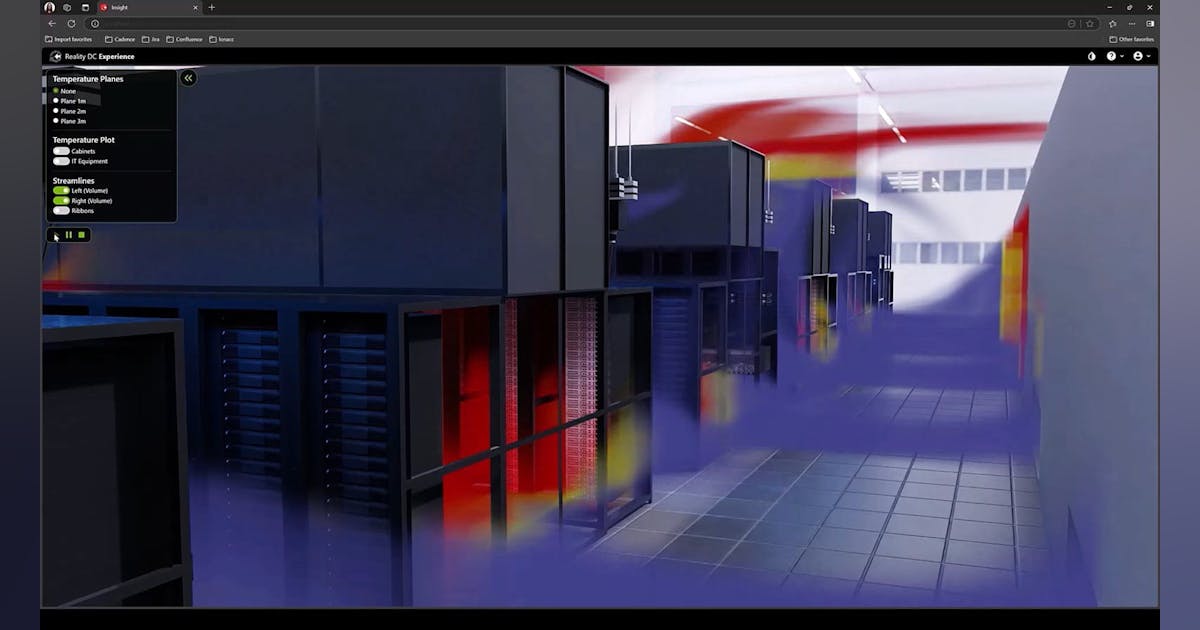
Cadence’s Reality Digital Twin platform includes a custom CFD engine designed specifically for data center environments. It is optimized for airflow, liquid cooling, and hybrid systems, and built to run fast and reliably.

More importantly, it is embedded in a broader platform that supports design, commissioning, and operations. It can simulate next-generation AI factory architectures that mix air and liquid cooling, and critically, show how those systems interact.

That interaction is where many modern failures hide.

Extreme Co-Design and Omniverse

AI factories are too complex for power, cooling, IT layout, and operations to be designed in isolation. Changes in one domain ripple into the others.

NVIDIA calls this “extreme co-design”: designing all major systems together, continuously, to avoid late-stage conflicts.

Cadence is embedding NVIDIA Omniverse capabilities into its digital twin platform to support that approach. The vision is a shared simulation environment where different design tools exchange data in real time, conflicts are caught early, and optimization happens across domains, not in silos.

Looking further out, Ikemoto describes NVIDIA’s long-term vision of the AI factory as a largely autonomous system: robots installing, maintaining, and upgrading infrastructure, guided by a digital twin that acts as the factory’s operating system.

In that future, the digital twin is not just a design tool. It is the control layer for a living system.

The Twin After Day One

Too many digital twins stop at commissioning. Cadence’s Reality platform is designed to carry forward into operations.

Ikemoto says more than 2.5 million square feet of data center space (or nearly 700 data halls globally) already use digital twins operationally.

A model that begins in design becomes, after commissioning, a virtual replica of a specific physical facility. Connected to live monitoring systems, it can simulate future changes before they happen: IT upgrades, maintenance work, power reconfiguration.

Operators can test decisions in the twin before risking them in steel and silicon. The same visual model can be used to train people and eventually robots who will operate those facilities.

The shift is from digital twin as project artifact to digital twin as operational platform.

What Real AI Workloads Reveal

One of the most revealing parts of the conversation centers on what happens when real AI and machine-learning traces are run through simulation.

Some workloads create short, sharp bursts of power demand in localized areas. To be safe, many facilities provision power 20–30% above what they usually need, just to cover those spikes.

Most of that extra capacity sits unused most of the time. In an era where power is the primary bottleneck for AI factories, that waste matters.

By linking application behavior to hardware power profiles and then to facility-level power distribution, simulation can help smooth those spikes and reduce overprovisioning. It ties software design, IT design, and facility design into a single performance conversation.

That integration is where cost performance now lives.

Billion-Cycle Power Analysis

The conversation also touches on Cadence’s new Palladium Dynamic Power Analysis App, which can analyze billion-gate designs across billions of cycles with up to 97% accuracy.

What made that possible, Ikemoto says, is a combination of advances in emulation hardware and new algorithms that allow massive workloads to be profiled at realistic scale.

For data centers, the significance is indirect but profound. Better chip-level power modeling feeds better system-level models, which feed better facility-level designs.

The data center is, in Ikemoto’s words, “the ultimate system”: the place where all these components finally meet.

A Collaboration That Keeps Expanding

Cadence and NVIDIA have worked together for decades, with NVIDIA long relying on Cadence tools to design its chips.

What has changed is the scope of that collaboration. As accelerated computing reshapes infrastructure, their shared work has expanded from chips to systems to entire data centers.

The partnership now stretches from silicon to server to rack to AI factory. The common thread is simulation as a way to manage complexity before it becomes expensive.

Ikemoto frames it as a response to the digital transformation of the world. As more of life depends on compute, the infrastructure behind that compute has to be designed with the same rigor as the chips inside it.

The AI factory is not a metaphor anymore. It is an industrial system and like any industrial system, it needs blueprints that reflect reality.


Shape
Shape
Stay Ahead

Explore More Insights

Stay ahead with more perspectives on cutting-edge power, infrastructure, energy,  bitcoin and AI solutions. Explore these articles to uncover strategies and insights shaping the future of industries.

Shape

Cisco extends Nexus 9000 support to Intel Gaudi 3 AI accelerators

Partnerships, validated designs strengthen Cisco offerings Cisco’s AI offerings also include Nvidia technologies, such as Spectrum-X-based switches that are part of Cisco Secure AI Factory with Nvidia.  Cisco also works with AMD and its Instinct AI GPUs for networking and compute stack in large AI clusters. In addition, Cisco integrates

Read More »

F5 tackles AI security with new platform extensions

F5 AI Guardrails deploys as a proxy between users and AI models. Wormke describes it as being inserted as a proxy layer at the “front door” of AI interaction, between AI applications, users and agents. It intercepts prompts before they reach the model and analyzes outputs before they return to

Read More »

AWS European cloud service launch raises questions over sovereignty

There are examples of similar scenarios in recent years. The International Criminal Court’s chief prosecutor was reportedly shut out of Microsoft applications following the imposition of US sanctions, for example. Other instances include Adobe cutting off Venezuelan customers in compliance with US sanctions against that country in 2019, while Microsoft

Read More »

Oil Settles Higher on Black Sea Supply Risks

Oil rose as traders weighed the supply impact from disruptions in the Black Sea region along with broader market gyrations in the wake of President Donald Trump’s ambitions to take over Greenland. West Texas Intermediate’s February contract, which settled Tuesday, rose 1.5% to settle above $60. The more active March contract rose by a similar amount. Supply disruptions have helped support prices, with Kazakhstan’s largest oil producer recently halting production at the Tengiz and Korolev fields after two fires at power generators. The Tengiz field will be shut for another seven to 10 days, Reuters reported. Kazakhstan had already reduced oil production after drone strikes affecting the Caspian Pipeline Consortium’s shipping terminal in Russia, which is the outlet for about 80% of Kazakh exports. “Crude is trading higher this morning on ongoing concerns around CPC loadings, which have remained constrained following recent Ukrainian attacks,” said Rebecca Babin, a senior energy trader at CIBC Private Wealth Group. “At the same time, broader geopolitical risks remain elevated, keeping traders focused closely on headlines.” Meanwhile, Trump unleashed fresh social media attacks against allies, with European leaders signaling a strong response to potential US tariffs over the semi-autonomous territory of Denmark. The escalation of tensions has pressured stock markets, helped send gold and silver to record highs and raised the specter of a US-EU trade war that could dent global growth and drag down oil prices with it. But so far, the direct impact on crude prices has been more muted. “Growth concerns as a result of tariff threats weigh on risk sentiment,” said Giovanni Staunovo, a commodity analyst at UBS Group AG. “Oil is, like equity markets, not immune to it.” Any new downward pressure on prices would add to broader concerns about crude supply outpacing demand, with the International Energy Agency forecasting

Read More »

Kenya Pipeline to Triple Capital Spend to $852MM Post IPO

State-owned Kenya Pipeline Co., which the East African state is listing through an initial public offering, plans to triple capital expenditure on projects to widen its network, increase storage and diversify into natural gas. The company plans to spend 110 billion shillings ($852.6 million) over the next five years, more than three times the 34 billion-shilling outlay between 2021 and 2025, according to the IPO prospectus for the sale of a 65% stake. It will raise the financing through “a combination of internally generated cash flows and innovative financing structures including access to debt capital markets, special purpose vehicle project financing, joint ventures and partnerships,” the listing document said. KPC is retaining none of the $824 million raised from the sale. The Kenyan government will instead utilize the proceeds to capitalize an infrastructure fund for its planned mega projects. KPC’s projects includes a new pipeline from the Rift Valley city of Eldoret to Uganda’s capital, Kampala, and onward to Rwanda. In addition, it will build an oil trading hub in Mombasa. The port city is the future site of a bulk natural gas handling facility for imports from Tanzania for power generation. The company plans additional storage facilities for Kenya’s strategic petroleum reserves. KPC intends to commercialize a power plant located at the defunct Kenya Petroleum Refineries Ltd. plant to supply electricity to the grid, in addition to solar farming. A crude refinery shut in 2013 will be converted into a biofuel refinery to produce blending components and sustainable aviation fuel. Eni SpA is undertaking studies on the proposed venture, according to KPC. Uganda’s plans for a refinery to be operation by 2030 poses “a significant risk to KPC in terms of its regional expansion strategy,” it said. “It will take a long time for the Eastern African regional market

Read More »

Mol to Buy Gazprom Stake in Sanctioned Serbian Refinery

Mol Nyrt. and Gazprom Neft PJSC have agreed on the terms of a deal which will see the Hungarian company gain control of Serbia’s only oil refinery, paving the way for the lifting of US sanctions on the plant’s operator. Mol will buy Gazprom’s combined 56.2 percent interest in Naftna Industrija Srbije, which came under US sanctions in October due to its Russian majority ownership, the Budapest-based firm said in a statement on Monday. The deal, subject to the approval of the US Office of Foreign Assets Control and the Serbian government, may be completed by March 31, Mol said, without disclosing the purchase price.  Mol is in talks with Abu Dhabi National Oil Co. to enter NIS as a minority shareholder, Mol Chairman and Chief Executive Officer Zsolt Hernadi said in the statement. The United Arab Emirates has a long relationship with Serbia, with several government-linked entities having made investments in property, agriculture and other businesses in the Balkan state.  Serbia is also looking to raise its nearly 30 percent stake in NIS by 5 percentage points, Serbian Energy Minister Dubravka Djedovic Handanovic told reporters in Belgrade earlier on Monday. The deal is a win for Hungarian Prime Minister Viktor Orban ahead of elections in April where his party is trailing in polls. The premier leveraged his ties to the leaders of Russia, Serbia and the US to bring the deal to fruition, discussing the potential purchase in back-to-back meetings with the three presidents late last year. Removing Sanctions Hungary and Serbia will now ask the US to lift sanctions on NIS. They were imposed amid a raft of penalties on multiple Russian-controlled energy assets following Moscow’s 2022 invasion of Ukraine. The sanctions on NIS – announced a year ago but in effect since October – halted oil deliveries via the Adriatic pipeline

Read More »

Venezuelan Oil Moves Into the Caribbean

Tankers have begun discharging Venezuelan crude at Caribbean islands, publicly signaling their activity in a move that marks a new trade order after US exerted control over Caracas’ oil industry.  Two vessels delivered about 2.5 million barrels of Venezuela’s Merey crude to storage tanks on Saint Lucia and Curacao, staging posts for broader exports, over the weekend, according to ship-tracking data. In the coming days, others tankers are set to bring more of the nation’s oil to different destinations, including the Bahamas. The Trump administration tapped trading giants Trafigura Group and Vitol Group to help market Venezuelan crude, and is encouraging US majors to invest in the country to revive its battered oil industry. The shipping market is being shaken up by the intervention, with freight rates surging for some routes.  Some so-called dark fleet tankers laden with Venezuelan crude have turned on their transponders as they prepare to offload their oil, while ships that have stayed clear of the trade return to participate.  The Volans — an Aframax sanctioned by the US and UK — unloaded about 600,000 barrels at Curacao on Jan. 17, according to ship-tracking data. The discharge location is home to the Bullen Bay storage facility. The vessel was carrying a cargo for Vitol, Bloomberg reported last week. Separately, the Kelly, a very-large crude carrier, arrived at Castries on Saint Lucia on Jan. 18 to offload 1.9 million barrels of Merey, according to the data. The delivery is the first shipment of Venezuelan crude to the Caribbean island since Dec. 2018, according to Kpler and Vortexa. Castries is home to a storage facility that’s primarily operated by Houston-headquartered Buckeye Partners LP. The company didn’t immediately respond to an email seeking comment outside of working hours. Bloomberg News couldn’t identify the company or entity responsible for the oil trade. Meanwhile, VLCC Marbella reached South

Read More »

Xcel-led coalition proposes Minnesota-North Dakota transmission expansion

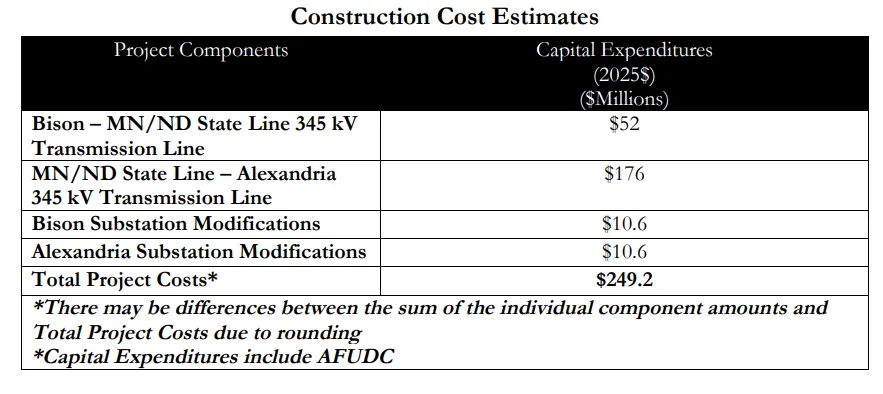
Listen to the article 3 min This audio is auto-generated. Please let us know if you have feedback. Five Upper Midwestern utilities, led by Xcel Energy, have proposed expanding transmission between North Dakota and Minnesota to address thermal and voltage issues on an existing 345-kV line operating at capacity. The companies, which include Great River Energy, Minnesota Power, Missouri River Energy Services and Otter Tail Power, on Jan. 15 filed an application with the Minnesota Public Utilities Commission to add a second 345-kV transmission circuit to the existing line between Douglas County, Minnesota, and Cass County, North Dakota. The original transmission line was completed about a decade ago as part of the CapX2020 project. The companies said all new infrastructure would be added within the existing right-of-way. The five energy providers will jointly own the project, with Xcel acting as project manager and responsible for construction. The entire project is estimated to cost about $249 million, with roughly $187 million for work in Minnesota, according to the application.  Retrieved from Minnesota PUC. The utilities said they plan to file a similar application with North Dakota regulators. “We designed the original transmission line with the future in mind by building infrastructure that could be expanded when our customers and electric cooperative members needed it,” the energy providers said in a statement. “We will soon expand this important project without affecting any new landowners, limiting our overall impact while saving money for our customers and electric cooperative members throughout the region.” The new line “will facilitate efficient electricity transmission across multiple states to local communities, supporting each state’s policy and reliability objectives in a more cost-effective and minimally disruptive manner,” the utilities said in their application. “The project is needed to provide additional transmission capacity and to maintain electric system reliability throughout the

Read More »

Murphy Oil Makes Noncommercial Find in Ivorian Frontier Campaign

Murphy Oil Corp said Monday it had encountered noncommercial quantities of hydrocarbons in the first of its three-well exploration campaign offshore Côte d’Ivoire. “A key outcome at Civette is that we confirmed the presence of hydrocarbons in this frontier play – a meaningful success in early-stage exploration”, president and chief executive Eric Hambly said in an online statement. “While Civette did not meet commercial thresholds, the well provided insights that strengthen our subsurface understanding for the potential of the [Tano] basin and inform the remaining prospectivity on the CI-502 Block”. The Houston, Texas-based oil and gas explorer and developer had placed a gross resource potential of 440-1,000 million barrels of oil equivalent (MMboe) on Civette, according to Murphy Oil’s investor presentation on January 7, 2026. The Civette well is in Block CI-502. The company said Monday it would continue with the Bubale prospect in Block CI-709 and the Caracal prospect in CI-102, “both targeting independent plays with significant resource potential”. According to the investor presentation, the gross resource potential for Bubale and Caracal is 340-850 MMboe and 150-360 MMboe respectively. They are scheduled to be spudded this year. The three blocks are among five held by Murphy Oil in the West African country. The five, all in deep waters, are co-owned with Société Nationale d’Opérations Pétrolières de la Côte d’Ivoire, the American company holding 85-90 percent operating interests. The licenses, acquired 2023, cover about 1.5 million gross acres in the Tano basin, according to Murphy Oil. Murphy Oil was scheduled to submit a development plan for the Paon discovery in Block CI-103 to Ivorian authorities by the end of 2025, according to the company’s annual report for 2024. Elsewhere, Murphy Oil has scheduled two more spuds in Vietnam this year, both appraisal wells for last year’s Hai Su Vang oil discovery.

Read More »

CleanArc’s Virginia Hyperscale Bet Meets the Era of Pay-Your-Way Power

What CleanArc’s Project Really Signals About Scaling in Virginia The more important story is what the project signals about how developers believe they can still scale in Virginia at hyperscale magnitude. To wit: 1) The campus is sized like a grid project, not a real estate project At 900 MW, CleanArc is not simply building a few facilities. It is effectively planning a utility-interface program that will require staged substation, transmission, and interconnection work over many years. The company describes the campus as a “flagship” designed for scalable demand and sustainability-focused procurement. Power delivery is planned in three 300 MW phases: the first targeted for 2027, the second for 2030, and the final block sometime between 2033 and 2035. That scale changes what “site selection” really means. For projects of this magnitude, the differentiator is no longer “Can we entitle buildings?” but “Can we secure a credible path for large power blocks, with predictable commercial terms, while regulators are rewriting the rules?” 2) It’s being marketed as sustainability-forward in a market that increasingly requires it CleanArc frames the campus as aligned with sustainability-focused infrastructure: a posture that is no longer optional for hyperscale procurement teams. That does not mean the grid power itself is automatically carbon-free. It means the campus is being positioned to support the modern contracting stack, involving renewables, clean-energy attributes, and related structures, while still delivering what hyperscalers buy first: capacity, reliability, and delivery certainty. 3) The timing is strategic as Virginia tightens around very large load CleanArc is launching its flagship in the nation’s premier data center corridor at the same moment Virginia has moved to formalize a large-customer category that explicitly includes data centers. The implication is not that Virginia has become anti-data center. It is that the state is entering a phase where it

Read More »

xAI’s AI Factories: From Colossus to MACROHARDRR in the Gigawatt Era

Colossus: The Prototype For much of the past year, xAI’s infrastructure story did not unfold across a portfolio of sites. It unfolded inside a single building in Memphis, where the company first tested what an “AI factory” actually looks like in physical form. That building had a name that matched the ambition: Colossus. The Memphis-area facility, carved out of a vacant Electrolux factory, became shorthand for a new kind of AI build: fast, dense, liquid-cooled, and powered on a schedule that often ran ahead of the grid. It was an “AI factory” in the literal sense: not a cathedral of architecture, but a machine for turning electricity into tokens. Colossus began as an exercise in speed. xAI took over a dormant industrial building in Southwest Memphis and turned it into an AI training plant in months, not years. The company has said the first major system was built in about 122 days, and then doubled in roughly 92 more, reaching around 200,000 GPUs. Those numbers matter less for their bravado than for what they reveal about method. Colossus was never meant to be bespoke. It was meant to be repeatable. High-density GPU servers, liquid cooling at the rack, integrated CDUs, and large-scale Ethernet networking formed a standardized building block. The rack, not the room, became the unit of design. Liquid cooling was not treated as a novelty. It was treated as a prerequisite. By pushing heat removal down to the rack, xAI avoided having to reinvent the data hall every time density rose. The building became a container; the rack became the machine. That design logic, e.g. industrial shell plus standardized AI rack, has quietly become the template for everything that followed. Power: Where Speed Met Reality What slowed the story was not compute, cooling, or networking. It was power.

Read More »

Sustainable Data Centers in the Age of AI: Page Haun, Chief Marketing and ESG Strategy Officer, Cologix

Artificial intelligence has turned the data center industry into a front-page story, often for the wrong reasons. The narrative usually starts with megawatts, ends with headlines about grid strain, and rarely pauses to explain what operators are actually doing about it. On the latest episode of The Data Center Frontier Show, Page Haun, Chief Marketing and ESG Strategy Officer at Cologix, laid out a more grounded reality: the AI era is forcing sustainability from a side initiative into a core design principle. Not because it sounds good, but because it has to work. From fuel cells in Ohio to closed-loop water systems that dramatically outperform industry norms, Cologix’s approach offers a case study in what “responsible growth” looks like when rack densities climb, power timelines stretch, and communities demand more than promises. The AI-Era Sustainability Baseline AI is changing the math. Power demand is rising faster than grid infrastructure can move. Communities are paying closer attention. Regulators are asking sharper questions. And the industry is discovering that speed without credibility creates friction. Haun described the current moment as a “perfect storm” where grid constraints, community concerns, and regulatory scrutiny all converge around AI-driven growth. But she also pushed back on the idea that the industry is ignoring the problem. Data center operators, utilities, and governments are already working together in ways that didn’t exist a decade ago by sharing load forecasts, coordinating long-lead infrastructure investments, and aligning power planning with customer roadmaps. One of the industry’s biggest gaps, she argued, isn’t engineering; it’s communication. Data centers still struggle to explain their role in the digital economy: education platforms, healthcare systems, streaming media, gaming, and now AI tools that enterprises are rapidly embedding into daily operations. Without that context, power usage becomes the whole story, yet it’s only part of the

Read More »

Meta Builds a Nuclear Supply Chain for the AI Era

Meta’s power announcements in January aren’t a simple case of “Meta goes nuclear.” They are better understood as Meta assembling a nuclear supply chain, using three different deal structures to target three different bottlenecks: near-term firm power, medium-term life extension and uprates at existing plants, and longer-term new-build advanced reactors. Meta says the combined package could support up to 6.6 gigawatts (GW) of new and existing clean power by 2035, building on its earlier nuclear offtake agreement with Constellation Energy and folding these moves into its broader push to scale AI and data center infrastructure. Part 1: A 20-Year Offtake Tied to Operating Reactors (Vistra) Meta’s agreement with Vistra isn’t a flashy “new reactor” announcement. It is something more important for the next decade of AI-era power: a long-duration financial commitment designed to keep existing nuclear plants running, push more megawatts (MW) out of them, and justify another round of 20-year license extensions. This is happening inside the tightest, most politically contentious power market in the U.S. right now: PJM, the Pennsylvania-New Jersey-Maryland Interconnection, currently the largest Regional Transmission Organization in the country. The agreed-upon number is a big one: 20-year power purchase agreements covering more than 2,600 megawatts of zero-carbon nuclear energy tied to three Vistra plants: Perry (Ohio), Davis-Besse (Ohio), and Beaver Valley (Pennsylvania). A meaningful share of that commitment is expected to come from uprates, or capacity increases, rather than simply reallocating existing output. The implication is straightforward. By making this commitment, nuclear power moves from at-risk legacy baseload into foundational power for AI-era infrastructure. Meta is effectively acting as a long-term anchor tenant, similar to how hyperscalers once treated early renewables to catalyze that market; but adapted to a reality where wind and solar alone cannot support 24/7 load growth. This is the fastest path to

Read More »

Designing the AI Factory: Cadence’s Sherman Ikemoto on Digital Twins, Power Reality, and the End of Guesswork

The AI data center is no longer just a building full of racks. It is a system: dense, interdependent, and increasingly unforgiving of bad assumptions. That reality sits at the center of the latest episode of The Data Center Frontier Show, where DCF Editor-in-Chief Matt Vincent sits down with Sherman Ikemoto, Senior Director of Product Management at Cadence, to talk about what it now takes to design an “AI factory” that actually works. The conversation ranges from digital twins and GPU-dense power modeling to billion-cycle power analysis and the long-running Cadence–NVIDIA collaboration. But the through-line is simple: the industry is outgrowing rules of thumb. As Ikemoto puts it, data center design has always been a distributed process. Servers are designed by one set of suppliers, cooling by another, power by another. Only at the end does the operator attempt to integrate those parts into a working system. That final integration phase, he argues, has long been underserved by design tools. The risk shows up later, as downtime, cost overruns, or performance shortfalls. Cadence’s answer is a new class of digital infrastructure: what it calls “DC elements,” validated building blocks that let operators assemble and simulate an AI factory before they ever pour concrete. The DGX SuperPOD as a Digital Building Block One of the most significant recent additions is a full behavioral model of NVIDIA’s DGX SuperPOD built around GB200 systems. This is not just a geometry file or a thermal sketch. It is a behaviorally accurate digital representation of how that system consumes power, moves heat, and interacts with airflow and liquid cooling. In practice, that means an operator can drop a DGX SuperPOD element into a digital design and immediately see how it stresses the rest of the facility: power distribution, cooling loops, airflow patterns, and failure scenarios.

Read More »

What’s causing the memory shortage?

Something else that they agree on is that OEMs, at least for now, are absorbing the increasing price and not passing it on to customers. However, that’s subject to change if the prices keep going up. “To date, we’ve not heard various vendors talking about increasing prices, but we’ve not seen those price increases hit yet, because most of the systems that are shipped into the channel and that are selling right now were shipped before the dramatic price increases hit,” said Mainelli. “What’s likely to happen, from a market perspective, is we’ll see the market grow less in 26 than we had anticipated but ASPs are likely to stay or increase. So revenues overall may not look too bad, but from a unit volume that’s likely going to be impacted as prices go up,” he said. Finally, they agree that if the often-rumored AI bubble bursting actually happens and construction comes to a stop? If expansion stops, demand will stop and that will free up supply, argue the analysts. “If you decide that you’re going to spend before you have the demand [for AI], then you bet that there’s going to be a lot of AI demand, so you end up increasing your capex as a percent of revenue. And that’s what these guys are doing. If investors complain because it is going to impact what their return is to investors, then eventually they’ll take their foot off the gas, and then that will cause prices to the collapse,” said Handy. “We’ll be watching very closely to look at all the hyperscalers and others that are building and leveraging all this RAM connecting it to all these GPUs in the data center, to see if there’s any indication they might slow down. If they were to slow down, then

Read More »

Microsoft will invest $80B in AI data centers in fiscal 2025

And Microsoft isn’t the only one that is ramping up its investments into AI-enabled data centers. Rival cloud service providers are all investing in either upgrading or opening new data centers to capture a larger chunk of business from developers and users of large language models (LLMs).  In a report published in October 2024, Bloomberg Intelligence estimated that demand for generative AI would push Microsoft, AWS, Google, Oracle, Meta, and Apple would between them devote $200 billion to capex in 2025, up from $110 billion in 2023. Microsoft is one of the biggest spenders, followed closely by Google and AWS, Bloomberg Intelligence said. Its estimate of Microsoft’s capital spending on AI, at $62.4 billion for calendar 2025, is lower than Smith’s claim that the company will invest $80 billion in the fiscal year to June 30, 2025. Both figures, though, are way higher than Microsoft’s 2020 capital expenditure of “just” $17.6 billion. The majority of the increased spending is tied to cloud services and the expansion of AI infrastructure needed to provide compute capacity for OpenAI workloads. Separately, last October Amazon CEO Andy Jassy said his company planned total capex spend of $75 billion in 2024 and even more in 2025, with much of it going to AWS, its cloud computing division.

Read More »

John Deere unveils more autonomous farm machines to address skill labor shortage

Join our daily and weekly newsletters for the latest updates and exclusive content on industry-leading AI coverage. Learn More Self-driving tractors might be the path to self-driving cars. John Deere has revealed a new line of autonomous machines and tech across agriculture, construction and commercial landscaping. The Moline, Illinois-based John Deere has been in business for 187 years, yet it’s been a regular as a non-tech company showing off technology at the big tech trade show in Las Vegas and is back at CES 2025 with more autonomous tractors and other vehicles. This is not something we usually cover, but John Deere has a lot of data that is interesting in the big picture of tech. The message from the company is that there aren’t enough skilled farm laborers to do the work that its customers need. It’s been a challenge for most of the last two decades, said Jahmy Hindman, CTO at John Deere, in a briefing. Much of the tech will come this fall and after that. He noted that the average farmer in the U.S. is over 58 and works 12 to 18 hours a day to grow food for us. And he said the American Farm Bureau Federation estimates there are roughly 2.4 million farm jobs that need to be filled annually; and the agricultural work force continues to shrink. (This is my hint to the anti-immigration crowd). John Deere’s autonomous 9RX Tractor. Farmers can oversee it using an app. While each of these industries experiences their own set of challenges, a commonality across all is skilled labor availability. In construction, about 80% percent of contractors struggle to find skilled labor. And in commercial landscaping, 86% of landscaping business owners can’t find labor to fill open positions, he said. “They have to figure out how to do

Read More »

2025 playbook for enterprise AI success, from agents to evals

Join our daily and weekly newsletters for the latest updates and exclusive content on industry-leading AI coverage. Learn More 2025 is poised to be a pivotal year for enterprise AI. The past year has seen rapid innovation, and this year will see the same. This has made it more critical than ever to revisit your AI strategy to stay competitive and create value for your customers. From scaling AI agents to optimizing costs, here are the five critical areas enterprises should prioritize for their AI strategy this year. 1. Agents: the next generation of automation AI agents are no longer theoretical. In 2025, they’re indispensable tools for enterprises looking to streamline operations and enhance customer interactions. Unlike traditional software, agents powered by large language models (LLMs) can make nuanced decisions, navigate complex multi-step tasks, and integrate seamlessly with tools and APIs. At the start of 2024, agents were not ready for prime time, making frustrating mistakes like hallucinating URLs. They started getting better as frontier large language models themselves improved. “Let me put it this way,” said Sam Witteveen, cofounder of Red Dragon, a company that develops agents for companies, and that recently reviewed the 48 agents it built last year. “Interestingly, the ones that we built at the start of the year, a lot of those worked way better at the end of the year just because the models got better.” Witteveen shared this in the video podcast we filmed to discuss these five big trends in detail. Models are getting better and hallucinating less, and they’re also being trained to do agentic tasks. Another feature that the model providers are researching is a way to use the LLM as a judge, and as models get cheaper (something we’ll cover below), companies can use three or more models to

Read More »

OpenAI’s red teaming innovations define new essentials for security leaders in the AI era

Join our daily and weekly newsletters for the latest updates and exclusive content on industry-leading AI coverage. Learn More OpenAI has taken a more aggressive approach to red teaming than its AI competitors, demonstrating its security teams’ advanced capabilities in two areas: multi-step reinforcement and external red teaming. OpenAI recently released two papers that set a new competitive standard for improving the quality, reliability and safety of AI models in these two techniques and more. The first paper, “OpenAI’s Approach to External Red Teaming for AI Models and Systems,” reports that specialized teams outside the company have proven effective in uncovering vulnerabilities that might otherwise have made it into a released model because in-house testing techniques may have missed them. In the second paper, “Diverse and Effective Red Teaming with Auto-Generated Rewards and Multi-Step Reinforcement Learning,” OpenAI introduces an automated framework that relies on iterative reinforcement learning to generate a broad spectrum of novel, wide-ranging attacks. Going all-in on red teaming pays practical, competitive dividends It’s encouraging to see competitive intensity in red teaming growing among AI companies. When Anthropic released its AI red team guidelines in June of last year, it joined AI providers including Google, Microsoft, Nvidia, OpenAI, and even the U.S.’s National Institute of Standards and Technology (NIST), which all had released red teaming frameworks. Investing heavily in red teaming yields tangible benefits for security leaders in any organization. OpenAI’s paper on external red teaming provides a detailed analysis of how the company strives to create specialized external teams that include cybersecurity and subject matter experts. The goal is to see if knowledgeable external teams can defeat models’ security perimeters and find gaps in their security, biases and controls that prompt-based testing couldn’t find. What makes OpenAI’s recent papers noteworthy is how well they define using human-in-the-middle

Read More »