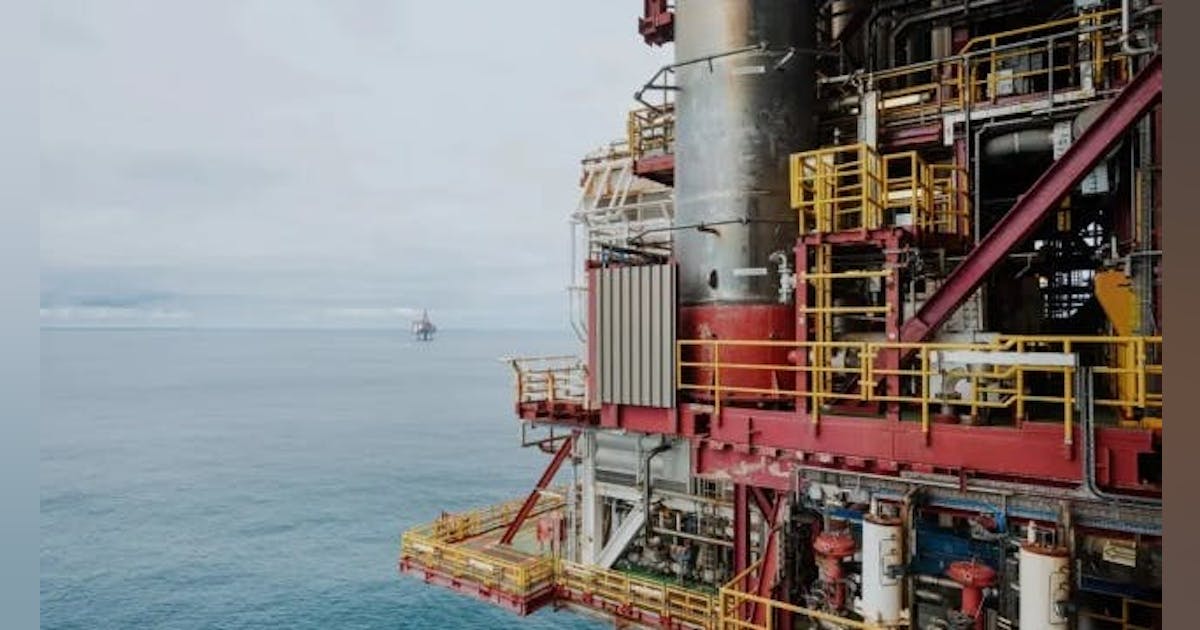
Equinor ASA and its partners have achieved two new natural gas and condensate discoveries in the Sleipner area on Norway’s side of the North Sea.
Preliminary estimates for Lofn (well 15/5-8 S) and Langemann (15/5-8 A), in production license 1140, indicate 5-18 million standard cubic meters oil-equivalent recoverable resources, or 30-110 million barrels, according to the Norwegian majority state-owned company.
“These are Equinor’s largest discoveries so far this year and can be developed for the European market through existing infrastructure”, it said in an online statement.
The discoveries sit between the Gudrun and Eirin fields and about 40 kilometers (24.85 miles) northwest of the Sleipner A processing, drilling and living quarters platform, according to Equinor. The platform is one of several installations serving the Sleipner gas and condensate fields Sleipner East (which started production 1993), Gungne (started up 1996) and Sleipner West (also put onstream 1996). Sleipner infrastructure also serves tie-in fields Sigyn (online since 2002), Volve (started up 2008), Gudrun (started up 2014) and Gina Krog (started up 2017).
Lofn and Langemann encountered gas and condensate in the Hugin Formation, which consists of sandstones with “good reservoir properties”, Equinor said.
“The discoveries reduce uncertainty in several nearby prospects, which will now be further evaluated”, it said.
Kjetil Hove, executive vice president for Norwegian exploration and production at Equinor, said, “This demonstrates the importance of maintaining exploration activity on the Norwegian continental shelf. There are still significant energy resources on the shelf, and Europe needs stable oil and gas deliveries”.
“Discoveries near existing fields can be developed quickly through subsea facilities, with limited environmental impact, very low CO2 emissions from production and strong profitability”, Hove said.
“Equinor plans to accelerate such developments on the Norwegian continental shelf”.
Karl Johnny Hersvik, chief executive of license co-owner Aker BP ASA, said separately the discoveries make 2025 Aker BP’s most successful year in exploration since the Johan Sverdrup field was discovered 2010.
“These results are key to sustaining production above 500,000 barrels per day into the 2030s”, Hersvik said in a statement on Aker BP’s website. “The progress achieved this year reinforces our confidence in delivering on that trajectory”.
“Across three major discoveries, we have added more than 100 million barrels net to the company, including Omega Alfa and Kjøttkake earlier this year”, Hersvik said.
Lofn was drilled 4,636 meters (15,209 feet) deep and Langemann 4,932 meters deep, according to Equinor.
These are the first exploration wells drilled in license 1140, awarded 2022, according to the Norwegian Offshore Directorate.
“The Deepsea Atlantic rig will now continue to the Sissel prospect for Equinor and partner ORLEN Upstream Norway, near the Utgard field in the Sleipner area”, Equinor said.
Equinor operates the license 1140 with a 60 percent stake through Equinor Energy AS. Aker BP ASA owns 40 percent.
To contact the author, email [email protected]
What do you think? We’d love to hear from you, join the conversation on the
Rigzone Energy Network.
The Rigzone Energy Network is a new social experience created for you and all energy professionals to Speak Up about our industry, share knowledge, connect with peers and industry insiders and engage in a professional community that will empower your career in energy.
MORE FROM THIS AUTHOR