Stay Ahead, Stay ONMINE

Hackers made death threats against this security researcher. Big mistake.

The threats started in spring.  In April 2024, a mysterious someone using the online handles “Waifu” and “Judische” began posting death threats on Telegram and Discord channels aimed at a cybersecurity researcher named Allison Nixon.  “Alison [sic] Nixon is gonna get necklaced with a tire filled with gasoline soon,” wrote Waifu/Judische, both of which are words with offensive connotations. “Decerebration is my fav type of brain death, thats whats gonna happen to alison Nixon.”  It wasn’t long before others piled on. Someone shared AI-generated nudes of Nixon. These anonymous personas targeted Nixon because she had become a formidable threat: As chief research officer at the cyber investigations firm Unit 221B, named after Sherlock Holmes’s apartment, she had built a career tracking cybercriminals and helping get them arrested. For years she had lurked quietly in online chat channels or used pseudonyms to engage with perpetrators directly while piecing together clues they’d carelessly drop about themselves and their crimes. This had helped her bring to justice a number of cybercriminals—especially members of a loosely affiliated subculture of anarchic hackers who call themselves the Com. But members of the Com aren’t just involved in hacking; some of them also engage in offline violence against researchers who track them. This includes bricking (throwing a brick through a victim’s window) and swatting (a dangerous type of hoax that involves reporting a false murder or hostage situation at someone’s home so SWAT teams will swarm it with guns drawn). Members of a Com offshoot known as 764 have been accused of even more violent acts—including animal torture, stabbings, and school shootings—or of inciting others in and outside the Com to commit these crimes. Nixon started tracking members of the community more than a decade ago, when other researchers and people in law enforcement were largely ignoring them because they were young—many in their teens. Her early attention allowed her to develop strategies for unmasking them. Ryan Brogan, a special agent with the FBI, says Nixon has helped him and colleagues identify and arrest more than two dozen members of the community since 2011, when he first began working with her, and that her skills in exposing them are unparalleled. “If you get on Allison’s and my radar, you’re going [down]. It’s just a matter of time,” he says. “No matter how much digital anonymity and tradecraft you try to apply, you’re done.” Though she’d done this work for more than a decade, Nixon couldn’t understand why the person behind the Waifu/Judische accounts was suddenly threatening her. She had given media interviews about the Com—most recently on 60 Minutes—but not about her work unmasking members to get them arrested, so the hostility seemed to come out of the blue. And although she had taken an interest in the Waifu persona in years past for crimes he boasted about committing, he hadn’t been on her radar for a while when the threats began, because she was tracking other targets.  Now Nixon resolved to unmask Waifu/Judische and others responsible for the death threats—and take them down for crimes they admitted to committing. “Prior to them death-threatening me, I had no reason to pay attention to them,” she says.  Com beginnings Most people have never heard of the Com, but its influence and threat are growing. It’s an online community comprising loosely affiliated groups of, primarily, teens and twentysomethings in North America and English-speaking parts of Europe who have become part of what some call a cybercrime youth movement.  International laws and norms, and fears of retaliation, prevent states from going all out in cyber operations. That doesn’t stop the anarchic Com. Over the last decade, its criminal activities have escalated from simple distributed denial-of-service (DDoS) attacks that disrupt websites to SIM-swapping hacks that hijack a victim’s phone service, as well as crypto theft, ransomware attacks, and corporate data theft. These crimes have affected AT&T, Microsoft, Uber, and others. Com members have also been involved in various forms of sextortion aimed at forcing victims to physically harm themselves or record themselves doing sexually explicit activities. The Com’s impact has also spread beyond the digital realm to kidnapping, beatings, and other violence.  One longtime cybercrime researcher, who asked to remain anonymous because of his work, says the Com is as big a threat in the cyber realm as Russia and China—for one unusual reason. “There’s only so far that China is willing to go; there’s only so far that Russia or North Korea is willing to go,” he says, referring to international laws and norms, and fears of retaliation, that prevent states from going all out in cyber operations. That doesn’t stop the anarchic Com, he says. FRANZISKA BARCZYK “It is a pretty significant threat, and people tend to … push it under the rug [because] it’s just a bunch of kids,” he says. “But look at the impact [they have].” Brogan says the amount of damage they do in terms of monetary losses “can become staggering very quickly.” There is no single site where Com members congregate; they spread across a number of web forums and Telegram and Discord channels. The group follows a long line of hacking and subculture communities that emerged online over the last two decades, gained notoriety, and then faded or vanished after prominent members were arrested or other factors caused their decline. They differed in motivation and activity, but all emerged from “the same primordial soup,” says Nixon. The Com’s roots can be traced to the Scene, which began as a community of various “warez” groups engaged in pirating computer games, music, and movies. When Nixon began looking at the Scene, in 2011, its members were hijacking gaming accounts, launching DDoS attacks, and running booter services. (DDoS attacks overwhelm a server or computer with traffic from bot-controlled machines, preventing legitimate traffic from getting through; booters are tools that anyone can rent to launch a DDoS attack against a target of choice.) While they made some money, their primary goal was notoriety. This changed around 2018. Cryptocurrency values were rising, and the Com—or the Community, as it sometimes called itself—emerged as a subgroup that ultimately took over the Scene. Members began to focus on financial gain—cryptocurrency theft, data theft, and extortion. The pandemic two years later saw a surge in Com membership that Nixon attributes to social isolation and the forced movement of kids online for schooling. But she believes economic conditions and socialization problems have also driven its growth. Many Com members can’t get jobs because they lack skills or have behavioral issues, she says. A number who have been arrested have had troubled home lives and difficulty adapting to school, and some have shown signs of mental illness. The Com provides camaraderie, support, and an outlet for personal frustrations. Since 2018, it has also offered some a solution to their money problems. Loose-knit cells have sprouted from the community—Star Fraud, ShinyHunters, Scattered Spider, Lapsus$—to collaborate on clusters of crime. They usually target high-profile crypto bros and tech giants and have made millions of dollars from theft and extortion, according to court records.  But dominance, power, and bragging rights are still motivators, even in profit operations, says the cybercrime researcher, which is partly why members target “big whales.” “There is financial gain,” he says, “but it’s also [sending a message that] I can reach out and touch the people that think they’re untouchable.” In fact, Nixon says, some members of the Com have overwhelming ego-driven motivations that end up conflicting with their financial motives. “Often their financial schemes fall apart because of their ego, and that phenomenon is also what I’ve made my career on,” she says. The hacker hunter emerges Nixon has straight dark hair, wears wire-rimmed glasses, and has a slight build and bookish demeanor that, on first impression, could allow her to pass for a teen herself. She talks about her work in rapid cadences, like someone whose brain is filled with facts that are under pressure to get out, and she exudes a sense of urgency as she tries to make people understand the threat the Com poses. She doesn’t suppress her happiness when someone she’s been tracking gets arrested. In 2011, when she first began investigating the communities from which the Com emerged, she was working the night shift in the security operations center of the security firm SecureWorks. The center responded to tickets and security alerts emanating from customer networks, but Nixon coveted a position on the company’s counter-threats team, which investigated and published threat-intelligence reports on mostly state-sponsored hacking groups from China and Russia. Without connections or experience, she had no path to investigative work. But Nixon is an intensely curious person, and this created its own path. Allison Nixon is chief research officer at the cybersecurity investigations firm Unit 221B, where she tracks cybercriminals and helps bring them to justice.YLVA EREVALL Where the threat team focused on the impact hackers had on customer networks—how they broke in, what they stole—Nixon was more interested in their motivations and the personality traits that drove their actions. She assumed there must be online forums where criminal hackers congregated, so she googled “hacking forums” and landed on a site called Hack Forums. “It was really stupid simple,” she says. She was surprised to see members openly discussing their crimes there. She reached out to someone on the SecureWorks threat team to see if he was aware of the site, and he dismissed it as a place for “script kiddies”—a pejorative term for unskilled hackers. This was a time when many cybersecurity pros were shifting their focus away from cybercrime to state-sponsored hacking operations, which were more sophisticated and getting a lot of attention. But Nixon likes to zig where others zag, and her colleague’s dismissiveness fueled her interest in the forums. Two other SecureWorks colleagues shared that interest, and the three studied the forums during downtime on their shifts. They focused on trying to identify the people running DDoS booters.  What Nixon loved about the forums was how accessible they were to a beginner like herself. Threat-intelligence teams require privileged access to a victim’s network to investigate breaches. But Nixon could access everything she needed in the public forums, where the hackers seemed to think no one was watching. Because of this, they often made mistakes in operational security, or OPSEC—letting slip little biographical facts such as the city where they lived, a school they attended, or a place they used to work. These details revealed in their chats, combined with other information, could help expose the real identities behind their anonymous masks.  “It was a shock to me that it was relatively easy to figure out who [they were],” she says.  She wasn’t bothered by the immature boasting and petty fights that dominated the forums. “A lot of people don’t like to do this work of reading chat logs. I realize that this is a very uncommon thing. And maybe my brain is built a little weird that I’m willing to do this,” she says. “I have a special talent that I can wade through garbage and it doesn’t bother me.”  Nixon soon realized that not all the members were script kiddies. Some exhibited real ingenuity and “powerful” skills, she says, but because they were applying these to frivolous purposes—hijacking gamer accounts instead of draining bank accounts—researchers and law enforcement were ignoring them. Nixon began tracking them, suspecting that they would eventually direct their skills at more significant targets—an intuition that proved to be correct. And when they did, she had already amassed a wealth of information about them.  She continued her DDoS research for two years until a turning point in 2013, when the cybersecurity journalist Brian Krebs, who made a career tracking cybercriminals, got swatted.  About a dozen people from the security community worked with Krebs to expose the perpetrator, and Nixon was invited to help. Krebs sent her pieces of the puzzle to investigate, and eventually the group identified the culprit (though it would take two years for him to be arrested). When she was invited to dinner with Krebs and the other investigators, she realized she’d found her people. “It was an amazing moment for me,” she says. “I was like, wow, there’s all these like-minded people that just want to help and are doing it just for the love of the game, basically.” Staying one step ahead It was porn stars who provided Nixon with her next big research focus—one that underscored her skill at spotting Com actors and criminal trends in their nascent stages, before they emerged as major threats. In 2018, someone was hijacking the social media accounts of certain adult-film stars and using those accounts to blast out crypto scams to their large follower bases. Nixon couldn’t figure out how the hackers had hijacked the social media profiles, but she promised to help the actors regain access to their accounts if they agreed to show her the private messages the hackers had sent or received during the time they controlled them. These messages led her to a forum where members were talking about how they stole the accounts. The hackers had tricked some of these actors into disclosing the mobile phone numbers of others. Then they used a technique called SIM swapping to reset passwords for social media accounts belonging to those other stars, locking them out.  In SIM swapping, fraudsters get a victim’s phone number assigned to a SIM card and phone they control, so that calls and messages intended for the victim go to them instead. This includes one-time security codes that sites text to account holders to verify themselves when accessing their account or changing its password. In some of the cases involving the porn stars, the hackers had manipulated telecom workers into making the SIM swaps for what they thought were legitimate reasons, and in other cases they bribed the workers to make the change. The hackers were then able to alter the password on the actors’ social media accounts, lock out the owners, and use the accounts to advertise their crypto scams.  SIM swapping is a powerful technique that can be used to hijack and drain entire cryptocurrency and bank accounts, so Nixon was surprised to see the fraudsters using it for relatively unprofitable schemes. But SIM swapping had rarely been used for financial fraud at that point, and like the earlier hackers Nixon had seen on Hack Forums, the ones hijacking porn star accounts didn’t seem to grasp the power of the technique they were using. Nixon suspected that this would change and SIM swapping would soon become a major problem, so she shifted her research focus accordingly. It didn’t take long for the fraudsters to pivot as well. Nixon’s skill at looking ahead in this way has served her throughout her career. On multiple occasions a hacker or hacking group would catch her attention—for using a novel hacking approach in some minor operation, for example—and she’d begin tracking their online posts and chats in the belief that they’d eventually do something significant with that skill.  They usually did. When they later grabbed headlines with a showy or impactful operation, these hackers would seem to others to have emerged from nowhere, sending researchers and law enforcement scrambling to understand who they were. But Nixon would already have a dossier compiled on them and, in some cases, had unmasked their real identity as well. Lizard Squad was an example of this. The group burst into the headlines in 2014 and 2015 with a series of high-profile DDoS campaigns, but Nixon and colleagues at the job where she worked at the time had already been watching its members as individuals for a while. So the FBI sought their assistance in identifying them. “The thing about these young hackers is that they … keep going until they get arrested, but it takes years for them to get arrested,” she says. “So a huge aspect of my career is just sitting on this information that has not been actioned [yet].” It was during the Lizard Squad years that Nixon began developing tools to scrape and record hacker communications online, though it would be years before she began using these concepts to scrape the Com chatrooms and forums. These channels held a wealth of data that might not seem useful during the nascent stage of a hacker’s career but could prove critical later, when law enforcement got around to investigating them; yet the contents were always at risk of being deleted by Com members or getting taken down by law enforcement when it seized websites and chat channels. Nixon’s work is unique because she engages with the actors in chat spaces to draw out information from them that “would not be otherwise normally available.” Over several years, she scraped and preserved whatever chatrooms she was investigating. But it wasn’t until early 2020, when she joined Unit 221B, that she got the chance to scrape the Telegram and Discord channels of the Com. She pulled all of this data together into a searchable platform that other researchers and law enforcement could use. The company hired two former hackers to help build scraping tools and infrastructure for this work; the result is eWitness, a community-driven, invitation-­only platform. It was initially seeded only with data Nixon had collected after she arrived at Unit 221B, but has since been augmented with data that other users of the platform have scraped from Com social spaces as well, some of which doesn’t exist in public forums anymore. Brogan, of the FBI, says it’s an incredibly valuable tool, made more so by Nixon’s own contributions. Other security firms scrape online criminal spaces as well, but they seldom share the content with outsiders, and Brogan says Nixon’s work is unique because she engages with the actors in chat spaces to draw out information from them that “would not be otherwise normally available.”  The preservation project she started when she got to Unit 221B could not have been better timed, because it coincided with the pandemic, the surge in new Com membership, and the emergence of two disturbing Com offshoots, CVLT and 764. She was able to capture their chats as these groups first emerged; after law enforcement arrested leaders of the groups and took control of the servers where their chats were posted, this material went offline. CVLT—pronounced “cult”—was reportedly founded around 2019 with a focus on sextortion and child sexual abuse material. 764 emerged from CVLT and was spearheaded by a 15-year-old in Texas named Bradley Cadenhead, who named it after the first digits of his zip code. Its focus was extremism and violence.  In 2021, because of what she observed in these groups, Nixon turned her attention to sextortion among Com members. The type of sextortion they engaged in has its roots in activity that began a decade ago as “fan signing.” Hackers would use the threat of doxxing to coerce someone, usually a young female, into writing the hacker’s handle on a piece of paper. The hacker would use a photo of it as an avatar on his online accounts—a kind of trophy. Eventually some began blackmailing victims into writing the hacker’s handle on their face, breasts, or genitals. With CVLT, this escalated even further; targets were blackmailed into carving a Com member’s name into their skin or engaging in sexually explicit acts while recording or livestreaming themselves. During the pandemic a surprising number of SIM swappers crossed into child sexual abuse material and sadistic sextortion, according to Nixon. She hates tracking this gruesome activity, but she saw an opportunity to exploit it for good. She had long been frustrated at how leniently judges treated financial fraudsters because of their crimes’ seemingly nonviolent nature. But she saw a chance to get harsher sentences for them if she could tie them to their sextortion and began to focus on these crimes.  At this point, Waifu still wasn’t on her radar. But that was about to change. Endgame Nixon landed in Waifu’s crosshairs after he and fellow members of the Com were involved in a large hack involving AT&T customer call records in April 2024. Waifu’s group gained access to dozens of cloud accounts with Snowflake, a company that provides online data storage for customers. One of those customers had more than 50 billion call logs of AT&T wireless subscribers stored in its Snowflake account.  They tried to re-extort the telecom, threatening on social media to leak the records. They tagged the FBI in the post. “It’s like they were begging to be investigated,” says Nixon. Among the subscriber records were call logs for FBI agents who were AT&T customers. Nixon and other researchers believe the hackers may have been able to identify the phone numbers of agents through other means. Then they may have used a reverse-lookup program to identify the owners of phone numbers that the agents called or that called them and found Nixon’s number among them. This is when they began harassing her. But then they got reckless. They allegedly extorted nearly $400,000 from AT&T in exchange for promising to delete the call records they’d stolen. Then they tried to re-extort the telecom, threatening on social media to leak the records they claimed to have deleted if it didn’t pay more. They tagged the FBI in the post. “It’s like they were begging to be investigated,” says Nixon. The Snowflake breaches and AT&T records theft were grabbing headlines at the time, but Nixon had no idea her number was in the stolen logs or that Waifu/Judische was a prime suspect in the breaches. So she was perplexed when he started taunting and threatening her online. FRANZISKA BARCZYK Over several weeks in May and June, a pattern developed. Waifu or one of his associates would post a threat against her and then post a message online inviting her to talk. She assumes now that they believed she was helping law enforcement investigate the Snowflake breaches and hoped to draw her into a dialogue to extract information from her about what authorities knew. But Nixon wasn’t helping the FBI investigate them yet. It was only after she began looking at Waifu for the threats that she became aware of his suspected role in the Snowflake hack. It wasn’t the first time she had studied him, though. Waifu had come to her attention in 2019 when he bragged about framing another Com member for a hoax bomb threat and later talked about his involvement in SIM-swapping operations. He made an impression on her. He clearly had technical skills, but Nixon says he also often appeared immature, impulsive, and emotionally unstable, and he was desperate for attention in his interactions with other members. He bragged about not needing sleep and using Adderall to hack through the night. He was also a bit reckless about protecting personal details. He wrote in private chats to another researcher that he would never get caught because he was good at OPSEC, but he also told the researcher that he lived in Canada—which turned out to be true. Nixon’s process for unmasking Waifu followed a general recipe she used to unmask Com members: She’d draw a large investigative circle around a target and all the personas that communicated with that person online, and then study their interactions to narrow the circle to the people with the most significant connections to the target. Some of the best leads came from a target’s enemies; she could glean a lot of information about their identity, personality, and activities from what the people they fought with online said about them. “The enemies and the ex-girlfriends, generally speaking, are the best [for gathering intelligence on a suspect],” she says. “I love them.” While she was doing this, Waifu and his group were reaching out to other security researchers, trying to glean information about Nixon and what she might be investigating. They also attempted to plant false clues with the researchers by dropping the names of other cybercriminals in Canada who could plausibly be Waifu. Nixon had never seen cybercriminals engage in counterintelligence tactics like this. Amid this subterfuge and confusion, Nixon and another researcher working with her did a lot of consulting and cross-checking with other researchers about the clues they were gathering to ensure they had the right name before they gave it to the FBI. By July she and the researcher were convinced they had their guy: Connor Riley Moucka, a 25-year-old high school dropout living with his grandfather in Ontario. On October 30, Royal Canadian Mounted Police converged on Moucka’s home and arrested him. According to an affidavit filed in Canadian court, a plainclothes Canadian police officer visited Moucka’s house under some pretense on the afternoon of October 21, nine days before the arrest, to secretly capture a photo of him and compare it with an image US authorities had provided. The officer knocked and rang the bell; Moucka opened the door looking disheveled and told the visitor: “You woke me up, sir.” He told the officer his name was Alex; Moucka sometimes used the alias Alexander Antonin Moucka. Satisfied that the person who answered the door was the person the US was seeking, the officer left. Waifu’s online rants against Nixon escalated at this point, as did his attempts at misdirection. She believes the visit to his door spooked him. Nixon won’t say exactly how they unmasked Moucka—only that he made a mistake. “I don’t want to train these people in how to not get caught [by revealing his error],” she says. The Canadian affidavit against Moucka reveals a number of other violent posts he’s alleged to have made online beyond the threats he made against her. Some involve musings about becoming a serial killer or mass-mailing sodium nitrate pills to Black people in Michigan and Ohio; in another, his online persona talks about obtaining firearms to “kill Canadians” and commit “suicide by cop.”  Prosecutors, who list Moucka’s online aliases as including Waifu, Judische, and two more in the indictment, say he and others extorted at least $2.5 million from at least three victims whose data they stole from Snowflake accounts. Moucka has been charged with nearly two dozen counts, including conspiracy, unauthorized access to computers, extortion, and wire fraud. He has pleaded not guilty and was extradited to the US last July. His trial is scheduled for October this year, though hacking cases usually end in plea agreements rather than going to trial.  It took months for authorities to arrest Moucka after Nixon and her colleague shared their findings with the authorities, but an alleged associate of his in the Snowflake conspiracy, a US Army soldier named Cameron John Wagenius (Kiberphant0m online), was arrested more quickly.  On November 10, 2024, Nixon and her team found a mistake Wagenius made that helped identify him, and on December 20 he was arrested. Wagenius has already pleaded guilty to two charges around the sale or attempted sale of confidential phone records and will be sentenced this March. These days Nixon continues to investigate sextortion among Com members. But she says that remaining members of Waifu’s group still taunt and threaten her. “They are continuing to persist in their nonsense, and they are getting taken out one by one,” she says. “And I’m just going to keep doing that until there’s no one left on that side.”  Kim Zetter is a journalist who covers cybersecurity and national security. She is the author of Countdown to Zero Day.

The threats started in spring. 

In April 2024, a mysterious someone using the online handles “Waifu” and “Judische” began posting death threats on Telegram and Discord channels aimed at a cybersecurity researcher named Allison Nixon. 

“Alison [sic] Nixon is gonna get necklaced with a tire filled with gasoline soon,” wrote Waifu/Judische, both of which are words with offensive connotations. “Decerebration is my fav type of brain death, thats whats gonna happen to alison Nixon.” 

It wasn’t long before others piled on. Someone shared AI-generated nudes of Nixon.

These anonymous personas targeted Nixon because she had become a formidable threat: As chief research officer at the cyber investigations firm Unit 221B, named after Sherlock Holmes’s apartment, she had built a career tracking cybercriminals and helping get them arrested. For years she had lurked quietly in online chat channels or used pseudonyms to engage with perpetrators directly while piecing together clues they’d carelessly drop about themselves and their crimes. This had helped her bring to justice a number of cybercriminals—especially members of a loosely affiliated subculture of anarchic hackers who call themselves the Com.

But members of the Com aren’t just involved in hacking; some of them also engage in offline violence against researchers who track them. This includes bricking (throwing a brick through a victim’s window) and swatting (a dangerous type of hoax that involves reporting a false murder or hostage situation at someone’s home so SWAT teams will swarm it with guns drawn). Members of a Com offshoot known as 764 have been accused of even more violent acts—including animal torture, stabbings, and school shootings—or of inciting others in and outside the Com to commit these crimes.

Nixon started tracking members of the community more than a decade ago, when other researchers and people in law enforcement were largely ignoring them because they were young—many in their teens. Her early attention allowed her to develop strategies for unmasking them.

Ryan Brogan, a special agent with the FBI, says Nixon has helped him and colleagues identify and arrest more than two dozen members of the community since 2011, when he first began working with her, and that her skills in exposing them are unparalleled. “If you get on Allison’s and my radar, you’re going [down]. It’s just a matter of time,” he says. “No matter how much digital anonymity and tradecraft you try to apply, you’re done.”

Though she’d done this work for more than a decade, Nixon couldn’t understand why the person behind the Waifu/Judische accounts was suddenly threatening her. She had given media interviews about the Com—most recently on 60 Minutes—but not about her work unmasking members to get them arrested, so the hostility seemed to come out of the blue. And although she had taken an interest in the Waifu persona in years past for crimes he boasted about committing, he hadn’t been on her radar for a while when the threats began, because she was tracking other targets. 

Now Nixon resolved to unmask Waifu/Judische and others responsible for the death threats—and take them down for crimes they admitted to committing. “Prior to them death-threatening me, I had no reason to pay attention to them,” she says. 

Com beginnings

Most people have never heard of the Com, but its influence and threat are growing.

It’s an online community comprising loosely affiliated groups of, primarily, teens and twentysomethings in North America and English-speaking parts of Europe who have become part of what some call a cybercrime youth movement. 

International laws and norms, and fears of retaliation, prevent states from going all out in cyber operations. That doesn’t stop the anarchic Com.

Over the last decade, its criminal activities have escalated from simple distributed denial-of-service (DDoS) attacks that disrupt websites to SIM-swapping hacks that hijack a victim’s phone service, as well as crypto theft, ransomware attacks, and corporate data theft. These crimes have affected AT&T, Microsoft, Uber, and others. Com members have also been involved in various forms of sextortion aimed at forcing victims to physically harm themselves or record themselves doing sexually explicit activities. The Com’s impact has also spread beyond the digital realm to kidnapping, beatings, and other violence. 

One longtime cybercrime researcher, who asked to remain anonymous because of his work, says the Com is as big a threat in the cyber realm as Russia and China—for one unusual reason.

“There’s only so far that China is willing to go; there’s only so far that Russia or North Korea is willing to go,” he says, referring to international laws and norms, and fears of retaliation, that prevent states from going all out in cyber operations. That doesn’t stop the anarchic Com, he says.

FRANZISKA BARCZYK

“It is a pretty significant threat, and people tend to … push it under the rug [because] it’s just a bunch of kids,” he says. “But look at the impact [they have].”

Brogan says the amount of damage they do in terms of monetary losses “can become staggering very quickly.”

There is no single site where Com members congregate; they spread across a number of web forums and Telegram and Discord channels. The group follows a long line of hacking and subculture communities that emerged online over the last two decades, gained notoriety, and then faded or vanished after prominent members were arrested or other factors caused their decline. They differed in motivation and activity, but all emerged from “the same primordial soup,” says Nixon. The Com’s roots can be traced to the Scene, which began as a community of various “warez” groups engaged in pirating computer games, music, and movies.

When Nixon began looking at the Scene, in 2011, its members were hijacking gaming accounts, launching DDoS attacks, and running booter services. (DDoS attacks overwhelm a server or computer with traffic from bot-controlled machines, preventing legitimate traffic from getting through; booters are tools that anyone can rent to launch a DDoS attack against a target of choice.) While they made some money, their primary goal was notoriety.

This changed around 2018. Cryptocurrency values were rising, and the Com—or the Community, as it sometimes called itself—emerged as a subgroup that ultimately took over the Scene. Members began to focus on financial gain—cryptocurrency theft, data theft, and extortion.

The pandemic two years later saw a surge in Com membership that Nixon attributes to social isolation and the forced movement of kids online for schooling. But she believes economic conditions and socialization problems have also driven its growth. Many Com members can’t get jobs because they lack skills or have behavioral issues, she says. A number who have been arrested have had troubled home lives and difficulty adapting to school, and some have shown signs of mental illness. The Com provides camaraderie, support, and an outlet for personal frustrations. Since 2018, it has also offered some a solution to their money problems.

Loose-knit cells have sprouted from the community—Star Fraud, ShinyHunters, Scattered Spider, Lapsus$—to collaborate on clusters of crime. They usually target high-profile crypto bros and tech giants and have made millions of dollars from theft and extortion, according to court records. 

But dominance, power, and bragging rights are still motivators, even in profit operations, says the cybercrime researcher, which is partly why members target “big whales.”

“There is financial gain,” he says, “but it’s also [sending a message that] I can reach out and touch the people that think they’re untouchable.” In fact, Nixon says, some members of the Com have overwhelming ego-driven motivations that end up conflicting with their financial motives.

“Often their financial schemes fall apart because of their ego, and that phenomenon is also what I’ve made my career on,” she says.

The hacker hunter emerges

Nixon has straight dark hair, wears wire-rimmed glasses, and has a slight build and bookish demeanor that, on first impression, could allow her to pass for a teen herself. She talks about her work in rapid cadences, like someone whose brain is filled with facts that are under pressure to get out, and she exudes a sense of urgency as she tries to make people understand the threat the Com poses. She doesn’t suppress her happiness when someone she’s been tracking gets arrested.

In 2011, when she first began investigating the communities from which the Com emerged, she was working the night shift in the security operations center of the security firm SecureWorks. The center responded to tickets and security alerts emanating from customer networks, but Nixon coveted a position on the company’s counter-threats team, which investigated and published threat-intelligence reports on mostly state-sponsored hacking groups from China and Russia. Without connections or experience, she had no path to investigative work. But Nixon is an intensely curious person, and this created its own path.

Allison Nixon
Allison Nixon is chief research officer at the cybersecurity investigations firm Unit 221B, where she tracks cybercriminals and helps bring them to justice.
YLVA EREVALL

Where the threat team focused on the impact hackers had on customer networks—how they broke in, what they stole—Nixon was more interested in their motivations and the personality traits that drove their actions. She assumed there must be online forums where criminal hackers congregated, so she googled “hacking forums” and landed on a site called Hack Forums.

“It was really stupid simple,” she says.

She was surprised to see members openly discussing their crimes there. She reached out to someone on the SecureWorks threat team to see if he was aware of the site, and he dismissed it as a place for “script kiddies”—a pejorative term for unskilled hackers.

This was a time when many cybersecurity pros were shifting their focus away from cybercrime to state-sponsored hacking operations, which were more sophisticated and getting a lot of attention. But Nixon likes to zig where others zag, and her colleague’s dismissiveness fueled her interest in the forums. Two other SecureWorks colleagues shared that interest, and the three studied the forums during downtime on their shifts. They focused on trying to identify the people running DDoS booters. 

What Nixon loved about the forums was how accessible they were to a beginner like herself. Threat-intelligence teams require privileged access to a victim’s network to investigate breaches. But Nixon could access everything she needed in the public forums, where the hackers seemed to think no one was watching. Because of this, they often made mistakes in operational security, or OPSEC—letting slip little biographical facts such as the city where they lived, a school they attended, or a place they used to work. These details revealed in their chats, combined with other information, could help expose the real identities behind their anonymous masks. 

“It was a shock to me that it was relatively easy to figure out who [they were],” she says. 

She wasn’t bothered by the immature boasting and petty fights that dominated the forums. “A lot of people don’t like to do this work of reading chat logs. I realize that this is a very uncommon thing. And maybe my brain is built a little weird that I’m willing to do this,” she says. “I have a special talent that I can wade through garbage and it doesn’t bother me.” 

Nixon soon realized that not all the members were script kiddies. Some exhibited real ingenuity and “powerful” skills, she says, but because they were applying these to frivolous purposes—hijacking gamer accounts instead of draining bank accounts—researchers and law enforcement were ignoring them. Nixon began tracking them, suspecting that they would eventually direct their skills at more significant targets—an intuition that proved to be correct. And when they did, she had already amassed a wealth of information about them. 

She continued her DDoS research for two years until a turning point in 2013, when the cybersecurity journalist Brian Krebs, who made a career tracking cybercriminals, got swatted. 

About a dozen people from the security community worked with Krebs to expose the perpetrator, and Nixon was invited to help. Krebs sent her pieces of the puzzle to investigate, and eventually the group identified the culprit (though it would take two years for him to be arrested). When she was invited to dinner with Krebs and the other investigators, she realized she’d found her people.

“It was an amazing moment for me,” she says. “I was like, wow, there’s all these like-minded people that just want to help and are doing it just for the love of the game, basically.”

Staying one step ahead

It was porn stars who provided Nixon with her next big research focus—one that underscored her skill at spotting Com actors and criminal trends in their nascent stages, before they emerged as major threats.

In 2018, someone was hijacking the social media accounts of certain adult-film stars and using those accounts to blast out crypto scams to their large follower bases. Nixon couldn’t figure out how the hackers had hijacked the social media profiles, but she promised to help the actors regain access to their accounts if they agreed to show her the private messages the hackers had sent or received during the time they controlled them. These messages led her to a forum where members were talking about how they stole the accounts. The hackers had tricked some of these actors into disclosing the mobile phone numbers of others. Then they used a technique called SIM swapping to reset passwords for social media accounts belonging to those other stars, locking them out. 

In SIM swapping, fraudsters get a victim’s phone number assigned to a SIM card and phone they control, so that calls and messages intended for the victim go to them instead. This includes one-time security codes that sites text to account holders to verify themselves when accessing their account or changing its password. In some of the cases involving the porn stars, the hackers had manipulated telecom workers into making the SIM swaps for what they thought were legitimate reasons, and in other cases they bribed the workers to make the change. The hackers were then able to alter the password on the actors’ social media accounts, lock out the owners, and use the accounts to advertise their crypto scams. 

SIM swapping is a powerful technique that can be used to hijack and drain entire cryptocurrency and bank accounts, so Nixon was surprised to see the fraudsters using it for relatively unprofitable schemes. But SIM swapping had rarely been used for financial fraud at that point, and like the earlier hackers Nixon had seen on Hack Forums, the ones hijacking porn star accounts didn’t seem to grasp the power of the technique they were using. Nixon suspected that this would change and SIM swapping would soon become a major problem, so she shifted her research focus accordingly. It didn’t take long for the fraudsters to pivot as well.

Nixon’s skill at looking ahead in this way has served her throughout her career. On multiple occasions a hacker or hacking group would catch her attention—for using a novel hacking approach in some minor operation, for example—and she’d begin tracking their online posts and chats in the belief that they’d eventually do something significant with that skill. 

They usually did. When they later grabbed headlines with a showy or impactful operation, these hackers would seem to others to have emerged from nowhere, sending researchers and law enforcement scrambling to understand who they were. But Nixon would already have a dossier compiled on them and, in some cases, had unmasked their real identity as well. Lizard Squad was an example of this. The group burst into the headlines in 2014 and 2015 with a series of high-profile DDoS campaigns, but Nixon and colleagues at the job where she worked at the time had already been watching its members as individuals for a while. So the FBI sought their assistance in identifying them.

“The thing about these young hackers is that they … keep going until they get arrested, but it takes years for them to get arrested,” she says. “So a huge aspect of my career is just sitting on this information that has not been actioned [yet].”

It was during the Lizard Squad years that Nixon began developing tools to scrape and record hacker communications online, though it would be years before she began using these concepts to scrape the Com chatrooms and forums. These channels held a wealth of data that might not seem useful during the nascent stage of a hacker’s career but could prove critical later, when law enforcement got around to investigating them; yet the contents were always at risk of being deleted by Com members or getting taken down by law enforcement when it seized websites and chat channels.

Nixon’s work is unique because she engages with the actors in chat spaces to draw out information from them that “would not be otherwise normally available.”

Over several years, she scraped and preserved whatever chatrooms she was investigating. But it wasn’t until early 2020, when she joined Unit 221B, that she got the chance to scrape the Telegram and Discord channels of the Com. She pulled all of this data together into a searchable platform that other researchers and law enforcement could use. The company hired two former hackers to help build scraping tools and infrastructure for this work; the result is eWitness, a community-driven, invitation-­only platform. It was initially seeded only with data Nixon had collected after she arrived at Unit 221B, but has since been augmented with data that other users of the platform have scraped from Com social spaces as well, some of which doesn’t exist in public forums anymore.

Brogan, of the FBI, says it’s an incredibly valuable tool, made more so by Nixon’s own contributions. Other security firms scrape online criminal spaces as well, but they seldom share the content with outsiders, and Brogan says Nixon’s work is unique because she engages with the actors in chat spaces to draw out information from them that “would not be otherwise normally available.” 

The preservation project she started when she got to Unit 221B could not have been better timed, because it coincided with the pandemic, the surge in new Com membership, and the emergence of two disturbing Com offshoots, CVLT and 764. She was able to capture their chats as these groups first emerged; after law enforcement arrested leaders of the groups and took control of the servers where their chats were posted, this material went offline.

CVLT—pronounced “cult”—was reportedly founded around 2019 with a focus on sextortion and child sexual abuse material. 764 emerged from CVLT and was spearheaded by a 15-year-old in Texas named Bradley Cadenhead, who named it after the first digits of his zip code. Its focus was extremism and violence. 

In 2021, because of what she observed in these groups, Nixon turned her attention to sextortion among Com members.

The type of sextortion they engaged in has its roots in activity that began a decade ago as “fan signing.” Hackers would use the threat of doxxing to coerce someone, usually a young female, into writing the hacker’s handle on a piece of paper. The hacker would use a photo of it as an avatar on his online accounts—a kind of trophy. Eventually some began blackmailing victims into writing the hacker’s handle on their face, breasts, or genitals. With CVLT, this escalated even further; targets were blackmailed into carving a Com member’s name into their skin or engaging in sexually explicit acts while recording or livestreaming themselves.

During the pandemic a surprising number of SIM swappers crossed into child sexual abuse material and sadistic sextortion, according to Nixon. She hates tracking this gruesome activity, but she saw an opportunity to exploit it for good. She had long been frustrated at how leniently judges treated financial fraudsters because of their crimes’ seemingly nonviolent nature. But she saw a chance to get harsher sentences for them if she could tie them to their sextortion and began to focus on these crimes. 

At this point, Waifu still wasn’t on her radar. But that was about to change.

Endgame

Nixon landed in Waifu’s crosshairs after he and fellow members of the Com were involved in a large hack involving AT&T customer call records in April 2024.

Waifu’s group gained access to dozens of cloud accounts with Snowflake, a company that provides online data storage for customers. One of those customers had more than 50 billion call logs of AT&T wireless subscribers stored in its Snowflake account. 

They tried to re-extort the telecom, threatening on social media to leak the records. They tagged the FBI in the post. “It’s like they were begging to be investigated,” says Nixon.

Among the subscriber records were call logs for FBI agents who were AT&T customers. Nixon and other researchers believe the hackers may have been able to identify the phone numbers of agents through other means. Then they may have used a reverse-lookup program to identify the owners of phone numbers that the agents called or that called them and found Nixon’s number among them. This is when they began harassing her.

But then they got reckless. They allegedly extorted nearly $400,000 from AT&T in exchange for promising to delete the call records they’d stolen. Then they tried to re-extort the telecom, threatening on social media to leak the records they claimed to have deleted if it didn’t pay more. They tagged the FBI in the post.

“It’s like they were begging to be investigated,” says Nixon.

The Snowflake breaches and AT&T records theft were grabbing headlines at the time, but Nixon had no idea her number was in the stolen logs or that Waifu/Judische was a prime suspect in the breaches. So she was perplexed when he started taunting and threatening her online.

FRANZISKA BARCZYK

Over several weeks in May and June, a pattern developed. Waifu or one of his associates would post a threat against her and then post a message online inviting her to talk. She assumes now that they believed she was helping law enforcement investigate the Snowflake breaches and hoped to draw her into a dialogue to extract information from her about what authorities knew. But Nixon wasn’t helping the FBI investigate them yet. It was only after she began looking at Waifu for the threats that she became aware of his suspected role in the Snowflake hack.

It wasn’t the first time she had studied him, though. Waifu had come to her attention in 2019 when he bragged about framing another Com member for a hoax bomb threat and later talked about his involvement in SIM-swapping operations. He made an impression on her. He clearly had technical skills, but Nixon says he also often appeared immature, impulsive, and emotionally unstable, and he was desperate for attention in his interactions with other members. He bragged about not needing sleep and using Adderall to hack through the night. He was also a bit reckless about protecting personal details. He wrote in private chats to another researcher that he would never get caught because he was good at OPSEC, but he also told the researcher that he lived in Canada—which turned out to be true.

Nixon’s process for unmasking Waifu followed a general recipe she used to unmask Com members: She’d draw a large investigative circle around a target and all the personas that communicated with that person online, and then study their interactions to narrow the circle to the people with the most significant connections to the target. Some of the best leads came from a target’s enemies; she could glean a lot of information about their identity, personality, and activities from what the people they fought with online said about them.

“The enemies and the ex-girlfriends, generally speaking, are the best [for gathering intelligence on a suspect],” she says. “I love them.”

While she was doing this, Waifu and his group were reaching out to other security researchers, trying to glean information about Nixon and what she might be investigating. They also attempted to plant false clues with the researchers by dropping the names of other cybercriminals in Canada who could plausibly be Waifu. Nixon had never seen cybercriminals engage in counterintelligence tactics like this.

Amid this subterfuge and confusion, Nixon and another researcher working with her did a lot of consulting and cross-checking with other researchers about the clues they were gathering to ensure they had the right name before they gave it to the FBI.

By July she and the researcher were convinced they had their guy: Connor Riley Moucka, a 25-year-old high school dropout living with his grandfather in Ontario. On October 30, Royal Canadian Mounted Police converged on Moucka’s home and arrested him.

According to an affidavit filed in Canadian court, a plainclothes Canadian police officer visited Moucka’s house under some pretense on the afternoon of October 21, nine days before the arrest, to secretly capture a photo of him and compare it with an image US authorities had provided. The officer knocked and rang the bell; Moucka opened the door looking disheveled and told the visitor: “You woke me up, sir.” He told the officer his name was Alex; Moucka sometimes used the alias Alexander Antonin Moucka. Satisfied that the person who answered the door was the person the US was seeking, the officer left. Waifu’s online rants against Nixon escalated at this point, as did his attempts at misdirection. She believes the visit to his door spooked him.

Nixon won’t say exactly how they unmasked Moucka—only that he made a mistake.

“I don’t want to train these people in how to not get caught [by revealing his error],” she says.

The Canadian affidavit against Moucka reveals a number of other violent posts he’s alleged to have made online beyond the threats he made against her. Some involve musings about becoming a serial killer or mass-mailing sodium nitrate pills to Black people in Michigan and Ohio; in another, his online persona talks about obtaining firearms to “kill Canadians” and commit “suicide by cop.” 

Prosecutors, who list Moucka’s online aliases as including Waifu, Judische, and two more in the indictment, say he and others extorted at least $2.5 million from at least three victims whose data they stole from Snowflake accounts. Moucka has been charged with nearly two dozen counts, including conspiracy, unauthorized access to computers, extortion, and wire fraud. He has pleaded not guilty and was extradited to the US last July. His trial is scheduled for October this year, though hacking cases usually end in plea agreements rather than going to trial. 

It took months for authorities to arrest Moucka after Nixon and her colleague shared their findings with the authorities, but an alleged associate of his in the Snowflake conspiracy, a US Army soldier named Cameron John Wagenius (Kiberphant0m online), was arrested more quickly. 

On November 10, 2024, Nixon and her team found a mistake Wagenius made that helped identify him, and on December 20 he was arrested. Wagenius has already pleaded guilty to two charges around the sale or attempted sale of confidential phone records and will be sentenced this March.

These days Nixon continues to investigate sextortion among Com members. But she says that remaining members of Waifu’s group still taunt and threaten her.

“They are continuing to persist in their nonsense, and they are getting taken out one by one,” she says. “And I’m just going to keep doing that until there’s no one left on that side.” 

Kim Zetter is a journalist who covers cybersecurity and national security. She is the author of Countdown to Zero Day.


Shape
Shape
Stay Ahead

Explore More Insights

Stay ahead with more perspectives on cutting-edge power, infrastructure, energy,  bitcoin and AI solutions. Explore these articles to uncover strategies and insights shaping the future of industries.

Shape

AI agent traffic drives first profitable year for Fastly

Fetcher bots, which retrieve content in real time when users make queries to AI assistants, show different concentration patterns. OpenAI’s ChatGPT and related bots generated 68% of fetcher bot requests. In some cases, fetcher bot request volumes exceeded 39,000 requests per minute to individual sites. AI agents check multiple websites

Read More »

Enbridge Q4 Profit Up YoY

Enbridge Inc has reported CAD 1.95 billion ($1.43 billion) in earnings and CAD 1.92 billion in adjusted earnings for the fourth quarter of 2025, up from CAD 493 million and CAD 1.64 billion for the same three-month period in 2024 respectively. Q4 2025 income per share of CAD 0.88 ($0.63), adjusted for extraordinary items, beat the Zacks Consensus Estimate of $0.6. Calgary-based Enbridge, which operates oil and gas pipelines in Canada and the United States, earlier bumped up its quarterly dividend by three percent against the prior rate to CAD 0.97. The annualized rate for 2026 is CAD 3.88 per share. Q4 2025 adjusted EBITDA rose 1.62 percent year-on-year to CAD 5.21 billion “due primarily to favorable gas transmission contracting and Venice Extension entering service, colder weather and higher rates and customer growth at Enbridge Gas Ontario, partially offset by the absence in 2025 of equity earnings related to investment tax credits from our investment in Fox Squirrel Solar”, Enbridge said in an online statement. United States gas transmission contributed CAD 997 million to segment adjusted EBITDA, down from CAD 1 billion for Q4 2024. The U.S. figure benefited from the startup of the Venice Extension Project, which expands the Texas Eastern system’s capacity to deliver gas to Gulf Coast markets, and Enbridge’s acquisition of a stake in the Matterhorn Express Pipeline. Enbridge also recognized “favorable contracting and successful rate case settlements on our U.S. Gas Transmission assets”, partially offset by the timing of operating costs. Adjusted EBITDA from Canadian gas transmission increased from CAD 157 million for Q4 2024 to CAD 190 million for Q4 2025, helped by “higher revenues at Aitken Creek due to favorable storage spreads”. Liquid pipelines logged CAD 2.45 billion in adjusted EBITDA, up from CAD 2.4 billion for Q4 2024. The Mainline System, which carries

Read More »

Analyst Highlights Focus of IEW Event

Focus at the London International Energy Week (IEW) last week was the balancing of geopolitics versus assessed surplus of oil globally in 2026. That’s what Skandinaviska Enskilda Banken AB (SEB) Chief Commodities Analyst Bjarne Schieldrop noted in a SEB report sent to Rigzone on Monday morning, adding that one delegate at the event stated that “if OPEC doesn’t cut, we’ll have $45 per barrel in June”. “That may be true,” Schieldrop said in the report. “But OPEC+ is meeting every month, taking a measure of the state of the global oil market and then decides what to do on the back of that. The group has been very explicit that they may cut, increase, or keep production steady depending on their findings,” he added. “We believe they will and thus we do not buy into $45 per barrel by June because, if need-be, they will trim production as they say they will,” he continued, pointing out that OPEC+ is next scheduled to meet on March 1 “to discuss production for April”. Schieldrop highlighted in the report that, in its February oil market report, the International Energy Agency (IEA) “restated its view that the world will only need 25.7 million barrels per day of crude from OPEC in 2026 versus a recent production by the group of 28.8 million barrels per day”. “I.e. that to keep the market balanced the group will need to cut production by some three million barrels per day,” he said. “Though strategic stock building around the world needs to be deducted from that. And the appetite for such stock building could be solid given elevated geopolitical risks. Thus what will flow to commercial stocks in the end remains to be seen,” he stated. Schieldrop went on to note in the report that increased Iranian tension could drive Brent

Read More »

Hungary Asks Croatia to Allow Russian Crude Shipments

Hungary requested that Croatia allow the shipment of Russian crude via the Adriatic pipeline while a key route through Ukraine remains blocked. Hungarian Foreign Minister Peter Szijjarto and Slovak Economy Minister Denisa Sakova jointly wrote to the Croatian government in Zagreb with the request, Szijjarto said in a statement Sunday. Oil transit along the Druzhba pipeline via Ukraine has been halted since late last month amid large-scale Russian attacks on Ukraine’s energy infrastructure, with the governments in Budapest and Kyiv in a standoff over the fallout. Budapest relies on the Druzhba pipeline connecting Hungary with Russia through war-torn Ukraine for most of its oil flows. Hungarian Prime Minister Viktor Orban, who has remained committed to buying Russian energy sources for his landlocked country, has also frequently engaged in debate with neighboring Croatia over the capacity of the Adriatic pipeline.  Energy policy is also likely to feature in Orban’s talks in Budapest with US Secretary of State Marco Rubio on Monday. Orban has found an ally in Slovak counterpart Robert Fico, who on Sunday echoed his views that Ukraine was using the Druzhba pipeline for political leverage, which officials in Kyiv have denied. What do you think? We’d love to hear from you, join the conversation on the Rigzone Energy Network. The Rigzone Energy Network is a new social experience created for you and all energy professionals to Speak Up about our industry, share knowledge, connect with peers and industry insiders and engage in a professional community that will empower your career in energy.

Read More »

Philippines Announces New Project Pipeline under 10-Year RE Auction

The Philippine Department of Energy (DOE) has announced new award plans under a 10-year auction for renewable energy development, with over 3,200 megawatts (MW) of non-floating solar capacity targeted to be built between 2027 and 2028. The DOE said in a press release it plans to hold the sixth to ninth rounds of the Green Energy Auction Program (GEAP) for project delivery within the next two years, toward the Southeast Asian archipelago’s target of adding at least 25 gigawatts (GW) of renewable power capacity by 2035. GEA-6 would offer onshore wind and floating solar capacities. GEA-7 covers rooftop solar and solar plus battery energy storage systems in collaboration with the Mindanao Development Authority. “GEA-8 will include solar on stilts with the Department of Agriculture, agri-solar with the Department of Agrarian Reform and the Department of Agriculture and canal-top solar with the National Irrigation Administration”, the DOE said. “GEA-9 will cover biomass, geothermal, solar, hydropower and onshore wind”. Besides the non-floating solar goal of 3,200 MW, the four rounds aim to install 5,565 MW of renewable generation capacity from other technologies between 2028 and 2035. “Succeeding auctions for the remaining capacities in the 25 GW target will be scheduled based on the availability of ready projects covered by RE Contracts or Certificates of Award, power-supply-demand scenarios, grid conditions among others”, the DOE said. Philippine Energy Secretary Sharon S. Garin said in the statement, “By preparing a clear, auction-backed pipeline, we are giving developers and financial institutions the market visibility they need to plan, mobilize capital and deliver projects on schedule”. “As the Philippines accelerates toward its targets of 35 percent renewable energy share by 2030 and 50 percent by 2040, clarity in how power is sold, priced and monetized becomes just as critical as how it is generated”, Garin said. The

Read More »

BP, Eni Discover More Oil offshore Angola

Azule Energy Holdings Ltd, an Angolan joint venture equally owned by Italy’s Eni SpA and Britain’s BP PLC, has declared a new oil discovery in Block 15/06 in the offshore Lower Congo Basin, with an initial estimate of about 500 million barrels. “The Algaita-01 results build on a long successful track record of 22 discoveries, once again confirming the exceptional effectiveness of the petroleum system in Block 15/06”, Azule Energy chief executive Joe Murphy said in an online statement by the company. “The presence of multiple nearby producing facilities further enhances the value of this new exploratory success”. The well sits approximately 18 kilometers (11.18 miles) from the Armada Olombendo floating production, storage and offloading facility in the same block, Italy’s state-backed energy major Eni noted in a separate online statement. The latest discovery showed oil-bearing sandstones in Upper Miocene reservoir intervals, Azule Energy said. “Preliminary interpretation of wireline logging and fluid sampling indicates the presence of multiple reservoir intervals with excellent petrophysical properties and fluid mobilities”, it said. The well had a water depth of 667 meters (2,188.32 feet), Azule Energy said. The discovery “reaffirms the high potential of the Lower Congo Basin and the consistency of the ongoing exploration strategy, creating favorable conditions for swift monetization, with positive impacts on national production and state revenues”, Paulino Jerónimo, chairman and chief executive of the Angolan National Agency of Petroleum, Gas and Biofuels, was quoted as saying in Azule Energy’s statement. “The ANPG encourages the continued identification of new opportunities under the existing incentive mechanisms, particularly Decree 8/24 on Incremental Production, as well as Decree 5/18, which establishes the legal framework that allows exploration within and near development areas”. Incorporated joint venture Azule Energy, based in the Central African country, operates Block 15/06 with a 36.84 percent stake. Sociedade Nacional

Read More »

Naftogaz Seeks USA Funds to Renovate Destroyed Plants

Ukraine’s state-run oil and gas company Naftogaz Group is seeking funds to restore and renovate its facilities after the destruction caused by constant Russian attacks, said its top executive. At least €3 billion ($3.5 billion) of damage has been done to the country’s facilities, with equipment needs exceeding €900 million, according to the company.  Naftogaz is particularly interested in Ukraine’s ongoing talks with partners such as the US Exim Bank and the US International Development Finance Corp., Chief Executive Officer Sergii Koretskyi told Bloomberg News in an interview at his office in Kyiv. He also stressed the importance of European assistance. Some $250 million in unspent Ukraine assistance funds remain with the US State Department, he said — part of which could be used to purchase US-made gas compressor units to allow Kyiv to repair production facilities. Their use would also be a boon to American companies, he added.  “Now we need funding for imports, investments and technologies. This is definitely a win-win situation for all parties — we’re not saying ‘help us’ but offering mutually beneficial cooperation,” said Koretskyi. Naftogaz, which provides gas to 12.5 million households, is a key element of Ukraine’s energy sector. Its infrastructure, as well as that of other power companies, has come under intense Russian bombardment in recent weeks, depriving many civilians of heating amid freezing temperatures. Since the start of this year, Naftogaz infrastructure has already faced 20 strikes, damaging oil and gas production and transportation systems, Koretskyi said.  He said that last year was the most destructive for Ukraine’s energy sector since Russian President Vladimir Putin began his full-scale invasion nearly four years ago, with hundreds of missiles and drones hitting facilities. Last February and October were the hardest months for Naftogaz specifically, the CEO added. The company’s biggest challenge is the unpredictable consequences

Read More »

Arista laments ‘horrendous’ memory situation

Digging in on campus Arista has been clear about its plans to grow its presence campus networking environments. Last Fall, Ullal said she expects Arista’s campus and WAN business would grow from the current $750 million-$800 million run rate to $1.25 billion, representing a 60% growth opportunity for the company. “We are committed to our aggressive goal of $1.25 billion for ’26 for the cognitive campus and branch. We have also successfully deployed in many routing edge, core spine and peering use cases,” Ullal said. “In Q4 2025, Arista launched our flagship 7800 R4 spine for many routing use cases, including DCI, AI spines with that massive 460 terabits of capacity to meet the demanding needs of multiservice routing, AI workloads and switching use cases. The combined campus and routing adjacencies together contribute approximately 18% of revenue.” Ethernet leads the way “In terms of annual 2025 product lines, our core cloud, AI and data center products built upon our highly differentiated Arista EOS stack is successfully deployed across 10 gig to 800 gigabit Ethernet speeds with 1.6 terabit migration imminent,” Ullal said. “This includes our portfolio of EtherLink AI and our 7000 series platforms for best-in-class performance, power efficiency, high availability, automation, agility for both the front and back-end compute, storage and all of the interconnect zones.” Ullal said she expects Ethernet will get even more of a boost later this year when the multivendor Ethernet for Scale-Up Networking (ESUN) specification is released.  “We have consistently described that today’s configurations are mostly a combination of scale out and scale up were largely based on 800G and smaller ratings. Now that the ESUN specification is well underway, we need a good solid spec. Otherwise, we’ll be shipping proprietary products like some people in the world do today. And so we will tie our

Read More »

From NIMBY to YIMBY: A Playbook for Data Center Community Acceptance

Across many conversations at the start of this year, at PTC and other conferences alike, the word on everyone’s lips seems to be “community.” For the data center industry, that single word now captures a turning point from just a few short years ago: we are no longer a niche, back‑of‑house utility, but a front‑page presence in local politics, school board budgets, and town hall debates. That visibility is forcing a choice in how we tell our story—either accept a permanent NIMBY-reactive framework, or actively build a YIMBY narrative that portrays the real value digital infrastructure brings to the markets and surrounding communities that host it. Speaking regularly with Ilissa Miller, CEO of iMiller Public Relations about this topic, there is work to be done across the ecosystem to build communications. Miller recently reflected: “What we’re seeing in communities isn’t a rejection of digital infrastructure, it’s a rejection of uncertainty driven by anxiety and fear. Most local leaders have never been given a framework to evaluate digital infrastructure developments the way they evaluate roads, water systems, or industrial parks. When there’s no shared planning language, ‘no’ becomes the safest answer.” A Brief History of “No” Community pushback against data centers is no longer episodic; it has become organized, media‑savvy, and politically influential in key markets. In Northern Virginia, resident groups and environmental organizations have mobilized against large‑scale campuses, pressing counties like Loudoun and Prince William to tighten zoning, question incentives, and delay or reshape projects.1 Loudoun County’s move in 2025 to end by‑right approvals for new facilities, requiring public hearings and board votes, marked a watershed moment as the world’s densest data center market signaled that communities now expect more say over where and how these campuses are built. Prince William County’s decision to sharply increase its tax rate on

Read More »

Nomads at the Frontier: PTC 2026 Signals the Digital Infrastructure Industry’s Moment of Execution

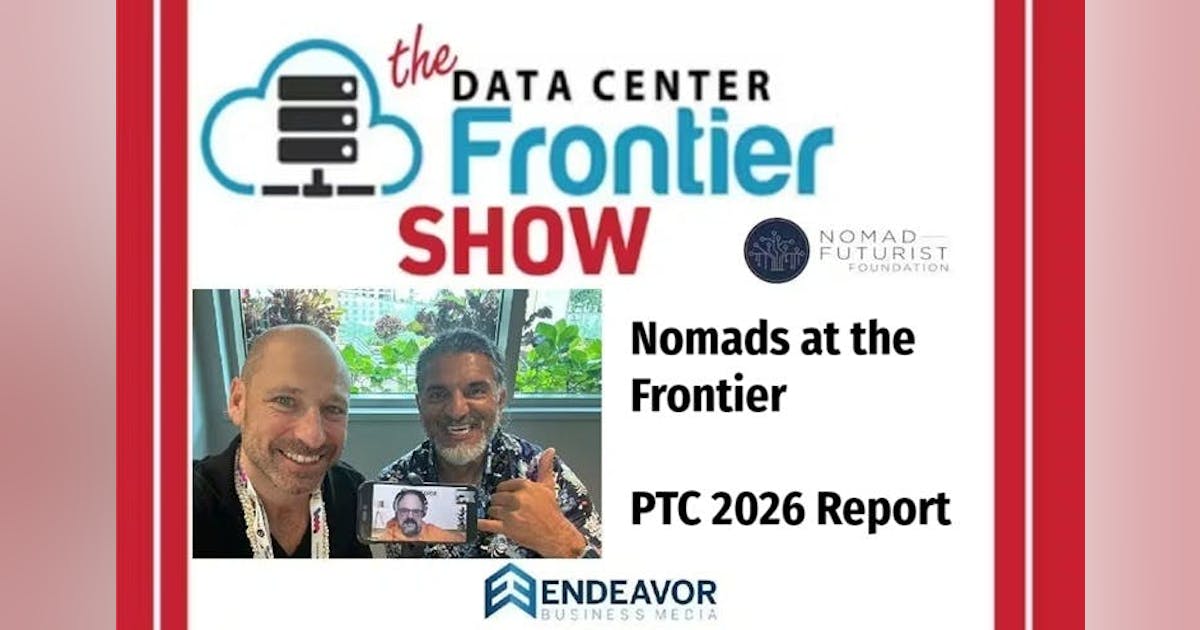
Each January, the Pacific Telecommunications Council conference serves as a barometer for where digital infrastructure is headed next. And according to Nomad Futurist founders Nabeel Mahmood and Phillip Koblence, the message from PTC 2026 was unmistakable: The industry has moved beyond hype. The hard work has begun. In the latest episode of The DCF Show Podcast, part of our ongoing ‘Nomads at the Frontier’ series, Mahmood and Koblence joined Data Center Frontier to unpack the tone shift emerging across the AI and data center ecosystem. Attendance continues to grow year over year. Conversations remain energetic. But the character of those conversations has changed. As Mahmood put it: “The hype that the market started to see is actually resulting a bit more into actions now, and those conversations are resulting into some good progress.” The difference from prior years? Less speculation. More execution. From Data Center Cowboys to Real Deployments Koblence offered perhaps the sharpest contrast between PTC conversations in 2024 and those in 2026. Two years ago, many projects felt speculative. Today, developers are arriving with secured power, customers, and construction underway. “If 2024’s PTC was data center cowboys — sites that in someone’s mind could be a data center — this year was: show me the money, show me the power, give me accurate timelines.” In other words, the market is no longer rewarding hypothetical capacity. It is demanding delivered capacity. Operators now speak in terms of deployments already underway, not aspirational campuses still waiting on permits and power commitments. And behind nearly every conversation sits the same gating factor. Power. Power Has Become the Industry’s Defining Constraint Whether discussions centered on AI factories, investment capital, or campus expansion, Mahmood and Koblence noted that every conversation eventually returned to energy availability. “All of those questions are power,” Koblence said.

Read More »

Cooling Consolidation Hits AI Scale: LiquidStack, Submer, and the Future of Data Center Thermal Strategy

As AI infrastructure scales toward ever-higher rack densities and gigawatt-class campuses, cooling has moved from a technical subsystem to a defining strategic issue for the data center industry. A trio of announcements in early February highlights how rapidly the cooling and AI infrastructure stack is consolidating and evolving: Trane Technologies’ acquisition of LiquidStack; Submer’s acquisition of Radian Arc, extending its reach from core data centers into telco edge environments; and Submer’s partnership with Anant Raj to accelerate sovereign AI infrastructure deployment across India. Layered atop these developments is fresh guidance from Oracle Cloud Infrastructure explaining why closed-loop, direct-to-chip cooling is becoming central to next-generation facility design, particularly in regions where water use has become a flashpoint in community discussions around data center growth. Taken together, these developments show how the industry is moving beyond point solutions toward integrated, scalable AI infrastructure ecosystems, where cooling, compute, and deployment models must work together across hyperscale campuses and distributed edge environments alike. Trane Moves to Own the Cooling Stack The most consequential development comes from Trane Technologies, which on February 10 announced it has entered into a definitive agreement to acquire LiquidStack, one of the pioneers and leading innovators in data center liquid cooling. The acquisition significantly strengthens Trane’s ambition to become a full-service thermal partner for data center operators, extending its reach from plant-level systems all the way down to the chip itself. LiquidStack, headquartered in Carrollton, Texas, built its reputation on immersion cooling and advanced direct-to-chip liquid solutions supporting high-density deployments across hyperscale, enterprise, colocation, edge, and blockchain environments. Under Trane, those technologies will now be scaled globally and integrated into a broader thermal portfolio. In practical terms, Trane is positioning itself to deliver cooling across the full thermal chain, including: • Central plant equipment and chillers.• Heat rejection and controls

Read More »

Infrastructure Maturity Defines the Next Phase of AI Deployment

The State of Data Infrastructure Global Report 2025 from Hitachi Vantara arrives at a moment when the data center industry is undergoing one of the most profound structural shifts in its history. The transition from enterprise IT to AI-first infrastructure has moved from aspiration to inevitability, forcing operators, developers, and investors to confront uncomfortable truths about readiness, resilience, and risk. Although framed around “AI readiness,” the report ultimately tells an infrastructure story: one that maps directly onto how data centers are designed, operated, secured, and justified economically. Drawing on a global survey of more than 1,200 IT leaders, the report introduces a proprietary maturity model that evaluates organizations across six dimensions: scalability, reliability, security, governance, sovereignty, and sustainability. Respondents are then grouped into three categories—Emerging, Defined, and Optimized—revealing a stark conclusion: most organizations are not constrained by access to AI models or capital, but by the fragility of the infrastructure supporting their data pipelines. For the data center industry, the implications are immediate, shaping everything from availability design and automation strategies to sustainability planning and evolving customer expectations. In short, extracting value from AI now depends less on experimentation and more on the strength and resilience of the underlying infrastructure. The Focus of the Survey: Infrastructure, Not Algorithms Although the report is positioned as a study of AI readiness, its primary focus is not models, training approaches, or application development, but rather the infrastructure foundations required to operate AI reliably at scale. Drawing on responses from more than 1,200 organizations, Hitachi Vantara evaluates how enterprises are positioned to support production AI workloads across six dimensions as stated above: scalability, reliability, security, governance, sovereignty, and sustainability. These factors closely reflect the operational realities shaping modern data center design and management. The survey’s central argument is that AI success is no longer

Read More »

AI’s New Land Grab: Meta’s Indiana Megaproject and the Rise of Europe’s Neocloud Challengers

While Meta’s Indiana campus anchors hyperscale expansion in the United States, Europe recorded its own major infrastructure milestone this week as Amsterdam-based AI infrastructure provider Nebius unveiled plans for a 240-megawatt data center campus in Béthune, France, near Lille in the country’s northern industrial corridor. When completed, the campus will rank among Europe’s largest AI-focused data center facilities and positions northern France as a growing node in the continent’s expanding AI infrastructure map. The development repurposes a former Bridgestone tire manufacturing site, reflecting a broader trend across Europe in which legacy industrial properties, already equipped with heavy power access, transport links, and industrial zoning, are being converted into large-scale digital infrastructure hubs. Located within reach of connectivity and enterprise corridors linking Paris, Brussels, London, and Amsterdam, the site allows Nebius to serve major European markets while avoiding the congestion and power constraints increasingly shaping Tier 1 data center hubs. Industrial Infrastructure Becomes Digital Infrastructure Developers increasingly view former industrial sites as ideal for AI campuses because they often provide: • Existing grid interconnection capacity built for heavy industry• Transport and logistics infrastructure already in place• Industrial zoning that reduces permitting friction• Large contiguous parcels suited to phased campus expansion For regions like Hauts-de-France, redevelopment projects also offer economic transition opportunities, replacing legacy manufacturing capacity with next-generation digital infrastructure investment. Local officials have positioned the project as part of broader efforts to reposition northern France as a logistics and technology hub within Europe. The Neocloud Model Gains Ground Beyond the site itself, Nebius’ expansion illustrates the rapid emergence of neocloud infrastructure providers, companies building GPU-intensive AI capacity without operating full hyperscale cloud ecosystems. These firms increasingly occupy a strategic middle ground: supplying AI compute capacity to enterprises, startups, and even hyperscalers facing short-term infrastructure constraints. Nebius’ rise over the past year

Read More »

Microsoft will invest $80B in AI data centers in fiscal 2025

And Microsoft isn’t the only one that is ramping up its investments into AI-enabled data centers. Rival cloud service providers are all investing in either upgrading or opening new data centers to capture a larger chunk of business from developers and users of large language models (LLMs).  In a report published in October 2024, Bloomberg Intelligence estimated that demand for generative AI would push Microsoft, AWS, Google, Oracle, Meta, and Apple would between them devote $200 billion to capex in 2025, up from $110 billion in 2023. Microsoft is one of the biggest spenders, followed closely by Google and AWS, Bloomberg Intelligence said. Its estimate of Microsoft’s capital spending on AI, at $62.4 billion for calendar 2025, is lower than Smith’s claim that the company will invest $80 billion in the fiscal year to June 30, 2025. Both figures, though, are way higher than Microsoft’s 2020 capital expenditure of “just” $17.6 billion. The majority of the increased spending is tied to cloud services and the expansion of AI infrastructure needed to provide compute capacity for OpenAI workloads. Separately, last October Amazon CEO Andy Jassy said his company planned total capex spend of $75 billion in 2024 and even more in 2025, with much of it going to AWS, its cloud computing division.

Read More »

John Deere unveils more autonomous farm machines to address skill labor shortage

Join our daily and weekly newsletters for the latest updates and exclusive content on industry-leading AI coverage. Learn More Self-driving tractors might be the path to self-driving cars. John Deere has revealed a new line of autonomous machines and tech across agriculture, construction and commercial landscaping. The Moline, Illinois-based John Deere has been in business for 187 years, yet it’s been a regular as a non-tech company showing off technology at the big tech trade show in Las Vegas and is back at CES 2025 with more autonomous tractors and other vehicles. This is not something we usually cover, but John Deere has a lot of data that is interesting in the big picture of tech. The message from the company is that there aren’t enough skilled farm laborers to do the work that its customers need. It’s been a challenge for most of the last two decades, said Jahmy Hindman, CTO at John Deere, in a briefing. Much of the tech will come this fall and after that. He noted that the average farmer in the U.S. is over 58 and works 12 to 18 hours a day to grow food for us. And he said the American Farm Bureau Federation estimates there are roughly 2.4 million farm jobs that need to be filled annually; and the agricultural work force continues to shrink. (This is my hint to the anti-immigration crowd). John Deere’s autonomous 9RX Tractor. Farmers can oversee it using an app. While each of these industries experiences their own set of challenges, a commonality across all is skilled labor availability. In construction, about 80% percent of contractors struggle to find skilled labor. And in commercial landscaping, 86% of landscaping business owners can’t find labor to fill open positions, he said. “They have to figure out how to do

Read More »

2025 playbook for enterprise AI success, from agents to evals

Join our daily and weekly newsletters for the latest updates and exclusive content on industry-leading AI coverage. Learn More 2025 is poised to be a pivotal year for enterprise AI. The past year has seen rapid innovation, and this year will see the same. This has made it more critical than ever to revisit your AI strategy to stay competitive and create value for your customers. From scaling AI agents to optimizing costs, here are the five critical areas enterprises should prioritize for their AI strategy this year. 1. Agents: the next generation of automation AI agents are no longer theoretical. In 2025, they’re indispensable tools for enterprises looking to streamline operations and enhance customer interactions. Unlike traditional software, agents powered by large language models (LLMs) can make nuanced decisions, navigate complex multi-step tasks, and integrate seamlessly with tools and APIs. At the start of 2024, agents were not ready for prime time, making frustrating mistakes like hallucinating URLs. They started getting better as frontier large language models themselves improved. “Let me put it this way,” said Sam Witteveen, cofounder of Red Dragon, a company that develops agents for companies, and that recently reviewed the 48 agents it built last year. “Interestingly, the ones that we built at the start of the year, a lot of those worked way better at the end of the year just because the models got better.” Witteveen shared this in the video podcast we filmed to discuss these five big trends in detail. Models are getting better and hallucinating less, and they’re also being trained to do agentic tasks. Another feature that the model providers are researching is a way to use the LLM as a judge, and as models get cheaper (something we’ll cover below), companies can use three or more models to

Read More »

OpenAI’s red teaming innovations define new essentials for security leaders in the AI era

Join our daily and weekly newsletters for the latest updates and exclusive content on industry-leading AI coverage. Learn More OpenAI has taken a more aggressive approach to red teaming than its AI competitors, demonstrating its security teams’ advanced capabilities in two areas: multi-step reinforcement and external red teaming. OpenAI recently released two papers that set a new competitive standard for improving the quality, reliability and safety of AI models in these two techniques and more. The first paper, “OpenAI’s Approach to External Red Teaming for AI Models and Systems,” reports that specialized teams outside the company have proven effective in uncovering vulnerabilities that might otherwise have made it into a released model because in-house testing techniques may have missed them. In the second paper, “Diverse and Effective Red Teaming with Auto-Generated Rewards and Multi-Step Reinforcement Learning,” OpenAI introduces an automated framework that relies on iterative reinforcement learning to generate a broad spectrum of novel, wide-ranging attacks. Going all-in on red teaming pays practical, competitive dividends It’s encouraging to see competitive intensity in red teaming growing among AI companies. When Anthropic released its AI red team guidelines in June of last year, it joined AI providers including Google, Microsoft, Nvidia, OpenAI, and even the U.S.’s National Institute of Standards and Technology (NIST), which all had released red teaming frameworks. Investing heavily in red teaming yields tangible benefits for security leaders in any organization. OpenAI’s paper on external red teaming provides a detailed analysis of how the company strives to create specialized external teams that include cybersecurity and subject matter experts. The goal is to see if knowledgeable external teams can defeat models’ security perimeters and find gaps in their security, biases and controls that prompt-based testing couldn’t find. What makes OpenAI’s recent papers noteworthy is how well they define using human-in-the-middle

Read More »