Stay Ahead, Stay ONMINE

HOLY SMOKES! A new, 200% faster DeepSeek R1-0528 variant appears from German lab TNG Technology Consulting GmbH

Want smarter insights in your inbox? Sign up for our weekly newsletters to get only what matters to enterprise AI, data, and security leaders. Subscribe Now It’s been a little more than a month since Chinese AI startup DeepSeek, an offshoot of Hong Kong-based High-Flyer Capital Management, released the latest version of its hit open […]

Want smarter insights in your inbox? Sign up for our weekly newsletters to get only what matters to enterprise AI, data, and security leaders. Subscribe Now


It’s been a little more than a month since Chinese AI startup DeepSeek, an offshoot of Hong Kong-based High-Flyer Capital Management, released the latest version of its hit open source model DeepSeek, R1-0528.

Like its predecessor, DeepSeek-R1 — which rocked the AI and global business communities with how cheaply it was trained and how well it performed on reasoning tasks, all available to developers and enterprises for free — R1-0528 is already being adapted and remixed by other AI labs and developers, thanks in large part to its permissive Apache 2.0 license.

This week, the 24-year-old German firm TNG Technology Consulting GmbH released one such adaptation: DeepSeek-TNG R1T2 Chimera, the latest model in its Chimera large language model (LLM) family. R1T2 delivers a notable boost in efficiency and speed, scoring at upwards of 90% of R1-0528’s intelligence benchmark scores, while generating answers with less than 40% of R1-0528’s output token count.

That means it produces shorter responses, translating directly into faster inference and lower compute costs. On the model card TNG released for its new R1T2 on the AI code sharing community Hugging Face, the company states that it is “about 20% faster than the regular R1” (the one released back in January) “and more than twice as fast as R1-0528” (the May official update from DeepSeek).

Already, the response has been incredibly positive from the AI developer community. “DAMN! DeepSeek R1T2 – 200% faster than R1-0528 & 20% faster than R1,” wrote Vaibhav (VB) Srivastav, a senior leader at Hugging Face, on X. “Significantly better than R1 on GPQA & AIME 24, made via Assembly of Experts with DS V3, R1 & R1-0528 — and it’s MIT-licensed, available on Hugging Face.”

This gain is made possible by TNG’s Assembly-of-Experts (AoE) method — a technique for building LLMs by selectively merging the weight tensors (internal parameters) from multiple pre-trained models that TNG described in a paper published in May on arXiv, the non-peer reviewed open access online journal.

A successor to the original R1T Chimera, R1T2 introduces a new “Tri-Mind” configuration that integrates three parent models: DeepSeek-R1-0528, DeepSeek-R1, and DeepSeek-V3-0324. The result is a model engineered to maintain high reasoning capability while significantly reducing inference cost.

R1T2 is constructed without further fine-tuning or retraining. It inherits the reasoning strength of R1-0528, the structured thought patterns of R1, and the concise, instruction-oriented behavior of V3-0324 — delivering a more efficient, yet capable model for enterprise and research use.

How Assembly-of-Experts (AoE) Differs from Mixture-of-Experts (MoE)

Mixture-of-Experts (MoE) is an architectural design in which different components, or “experts,” are conditionally activated per input. In MoE LLMs like DeepSeek-V3 or Mixtral, only a subset of the model’s expert layers (e.g., 8 out of 256) are active during any given token’s forward pass. This allows very large models to achieve higher parameter counts and specialization while keeping inference costs manageable — because only a fraction of the network is evaluated per token.

Assembly-of-Experts (AoE) is a model merging technique, not an architecture. It’s used to create a new model from multiple pre-trained MoE models by selectively interpolating their weight tensors.

The “experts” in AoE refer to the model components being merged — typically the routed expert tensors within MoE layers — not experts dynamically activated at runtime.

TNG’s implementation of AoE focuses primarily on merging routed expert tensors — the part of a model most responsible for specialized reasoning — while often retaining the more efficient shared and attention layers from faster models like V3-0324. This approach enables the resulting Chimera models to inherit reasoning strength without replicating the verbosity or latency of the strongest parent models.

Performance and Speed: What the Benchmarks Actually Show

According to benchmark comparisons presented by TNG, R1T2 achieves between 90% and 92% of the reasoning performance of its most intelligent parent, DeepSeek-R1-0528, as measured by AIME-24, AIME-25, and GPQA-Diamond test sets.
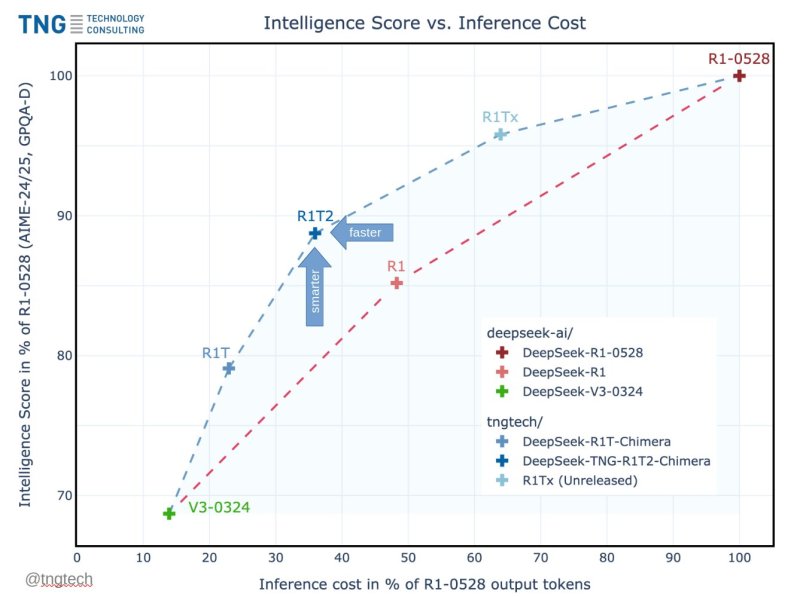
However, unlike DeepSeek-R1-0528 — which tends to produce long, detailed answers due to its extended chain-of-thought reasoning — R1T2 is designed to be much more concise. It delivers similarly intelligent responses while using significantly fewer words.

Rather than focusing on raw processing time or tokens-per-second, TNG measures “speed” in terms of output token count per answer — a practical proxy for both cost and latency. According to benchmarks shared by TNG, R1T2 generates responses using approximately 40% of the tokens required by R1-0528.

That translates to a 60% reduction in output length, which directly reduces inference time and compute load, speeding up responses by 2X, or 200%.

When compared to the original DeepSeek-R1, R1T2 is also around 20% more concise on average, offering meaningful gains in efficiency for high-throughput or cost-sensitive deployments.

This efficiency does not come at the cost of intelligence. As shown in the benchmark chart presented in TNG’s technical paper, R1T2 sits in a desirable zone on the intelligence vs. output cost curve. It preserves reasoning quality while minimizing verbosity — an outcome critical to enterprise applications where inference speed, throughput, and cost all matter.

Deployment Considerations and Availability

R1T2 is released under a permissive MIT License and is available now on Hugging Face, meaning it is open source and available to be used and built into commercial applications.

TNG notes that while the model is well-suited for general reasoning tasks, it is not currently recommended for use cases requiring function calling or tool use, due to limitations inherited from its DeepSeek-R1 lineage. These may be addressed in future updates.

The company also advises European users to assess compliance with the EU AI Act, which comes into effect on August 2, 2025.

Enterprises operating in the EU should review relevant provisions or consider halting model use after that date if requirements cannot be met.

However, U.S. companies operating domestically and servicing U.S.-based users, or those of other nations, are not subject to the terms of the EU AI Act, which should give them considerable flexibility when using and deploying this free, speedy open source reasoning model. If they service users in the E.U., some provisions of the EU Act will still apply.

TNG has already made prior Chimera variants available through platforms like OpenRouter and Chutes, where they reportedly processed billions of tokens daily. The release of R1T2 represents a further evolution in this public availability effort.

About TNG Technology Consulting GmbH

Founded in January 2001, TNG Technology Consulting GmbH is based in Bavaria, Germany, and employs over 900 people, with a high concentration of PhDs and technical specialists.

The company focuses on software development, artificial intelligence, and DevOps/cloud services, serving major enterprise clients across industries such as telecommunications, insurance, automotive, e-commerce, and logistics.

TNG operates as a values-based consulting partnership. Its unique structure, grounded in operational research and self-management principles, supports a culture of technical innovation.

It actively contributes to open-source communities and research, as demonstrated through public releases like R1T2 and the publication of its Assembly-of-Experts methodology.

What It Means for Enterprise Technical Decision-Makers

For CTOs, AI platform owners, engineering leads, and IT procurement teams, R1T2 introduces tangible benefits and strategic options:

  • Lower Inference Costs: With fewer output tokens per task, R1T2 reduces GPU time and energy consumption, translating directly into infrastructure savings — especially important in high-throughput or real-time environments.
  • High Reasoning Quality Without Overhead: It preserves much of the reasoning power of top-tier models like R1-0528, but without their long-windedness. This is ideal for structured tasks (math, programming, logic) where concise answers are preferable.
  • Open and Modifiable: The MIT License allows full deployment control and customization, enabling private hosting, model alignment, or further training within regulated or air-gapped environments.
  • Emerging Modularity: The AoE approach suggests a future where models are built modularly, allowing enterprises to assemble specialized variants by recombining strengths of existing models, rather than retraining from scratch.
  • Caveats: Enterprises relying on function-calling, tool use, or advanced agent orchestration should note current limitations, though future Chimera updates may address these gaps.

TNG encourages researchers, developers, and enterprise users to explore the model, test its behavior, and provide feedback. The R1T2 Chimera is available at huggingface.co/tngtech/DeepSeek-TNG-R1T2-Chimera, and technical inquiries can be directed to [email protected].

For technical background and benchmark methodology, TNG’s research paper is available at arXiv:2506.14794.


Shape
Shape
Stay Ahead

Explore More Insights

Stay ahead with more perspectives on cutting-edge power, infrastructure, energy,  bitcoin and AI solutions. Explore these articles to uncover strategies and insights shaping the future of industries.

Shape

Digital sovereignty options for on-prem deployments

IBM’s announcement differs from Cisco’s licensing-focused approach. “A fundamental architectural shift is required: one where sovereignty is an inherent property of the platform itself, not a contractual promise or deployment variant,” IBM says. The approach IBM espouses is based on three principles it laid out, beginning with the notion that

Read More »

Cato Networks brings adaptive threat defense to SASE

Cato Dynamic Prevention monitors network and security activity across users, devices, and sites over extended periods. When it identifies patterns consistent with malicious behavior, it automatically applies adaptive controls to block or restrict high-risk actions, without requiring manual intervention from IT or security teams. According to the company, this approach

Read More »

U.S. Department of Energy Brings Together Vertical Gas Corridor Countries to Strengthen Energy Coordination

WASHINGTON, DC — The U.S. Department of Energy (DOE) today hosted officials from Bulgaria, Greece, Romania, Moldova, Ukraine, and the European Commission to advance work on the Vertical Gas Corridor. The meeting built on progress made at the Partnership for Transatlantic Energy Cooperation Summit in Athens in November 2025 and the Transatlantic Gas Security Summit in Washington, D.C. in February 2026.  “By partnering with the countries of the Vertical Corridor, we are opening major opportunities to expand U.S. LNG exports to Central and Eastern Europe,” said Joshua Volz. “This effort is so important to our President and Secretary because it aligns with our nation’s strengths and commitment to supporting friends and allies across Europe.” The technical discussion brought together Energy Ministries, national regulators, and Transmission System Operators (TSOs) to address key objectives essential to unlocking the Vertical Gas Corridor’s capacity to enable the northbound flow of regasified U.S. LNG from Greece and expand access to European markets:  Resolving regulatory friction points that impact long-term planning Harmonizing tariffs to achieve cost competitiveness Reviewing strategic infrastructure investments necessary to enable full corridor capacity Today’s meeting reinforces DOE’s commitment to strengthening U.S. energy leadership and helping allies secure reliable alternatives to adversarial energy suppliers. By reducing barriers to U.S. LNG exports, DOE continues to support America’s role as a leading global energy provider.                                                                                               ###

Read More »

Equinor lets EPC contract for Gullfaks field

@import url(‘https://fonts.googleapis.com/css2?family=Inter:[email protected]&display=swap’); a { color: var(–color-primary-main); } .ebm-page__main h1, .ebm-page__main h2, .ebm-page__main h3, .ebm-page__main h4, .ebm-page__main h5, .ebm-page__main h6 { font-family: Inter; } body { line-height: 150%; letter-spacing: 0.025em; font-family: Inter; } button, .ebm-button-wrapper { font-family: Inter; } .label-style { text-transform: uppercase; color: var(–color-grey); font-weight: 600; font-size: 0.75rem; } .caption-style { font-size: 0.75rem; opacity: .6; } #onetrust-pc-sdk [id*=btn-handler], #onetrust-pc-sdk [class*=btn-handler] { background-color: #c19a06 !important; border-color: #c19a06 !important; } #onetrust-policy a, #onetrust-pc-sdk a, #ot-pc-content a { color: #c19a06 !important; } #onetrust-consent-sdk #onetrust-pc-sdk .ot-active-menu { border-color: #c19a06 !important; } #onetrust-consent-sdk #onetrust-accept-btn-handler, #onetrust-banner-sdk #onetrust-reject-all-handler, #onetrust-consent-sdk #onetrust-pc-btn-handler.cookie-setting-link { background-color: #c19a06 !important; border-color: #c19a06 !important; } #onetrust-consent-sdk .onetrust-pc-btn-handler { color: #c19a06 !important; border-color: #c19a06 !important; } Equinor Energy AS has let an engineering, procurement, and construction (EPC) contract to SLB to upgrade the subsea compression system for Gullfaks field in the Norwegian North Sea. Under the contract, SLB OneSubsea will deliver two next-generation compressor modules to replace the units originally supplied in 2015 as part of the world’s first multiphase subsea compression system. The upgraded modules will increase differential pressure and flow capacity, enhancing recovery and extending field life, SLB said, while installation within the existing subsea infrastructure will minimize downtime and reduce overall campaign costs, the company continued. Gullfaks field lies in block 34/10 in the northern part of the North Sea. Three large production platforms with concrete substructures make up the development solution for the main field.

Read More »

Oxy cutting oil-and-gas capex by $300 million, eyes 1% production growth

@import url(‘https://fonts.googleapis.com/css2?family=Inter:[email protected]&display=swap’); a { color: var(–color-primary-main); } .ebm-page__main h1, .ebm-page__main h2, .ebm-page__main h3, .ebm-page__main h4, .ebm-page__main h5, .ebm-page__main h6 { font-family: Inter; } body { line-height: 150%; letter-spacing: 0.025em; font-family: Inter; } button, .ebm-button-wrapper { font-family: Inter; } .label-style { text-transform: uppercase; color: var(–color-grey); font-weight: 600; font-size: 0.75rem; } .caption-style { font-size: 0.75rem; opacity: .6; } #onetrust-pc-sdk [id*=btn-handler], #onetrust-pc-sdk [class*=btn-handler] { background-color: #c19a06 !important; border-color: #c19a06 !important; } #onetrust-policy a, #onetrust-pc-sdk a, #ot-pc-content a { color: #c19a06 !important; } #onetrust-consent-sdk #onetrust-pc-sdk .ot-active-menu { border-color: #c19a06 !important; } #onetrust-consent-sdk #onetrust-accept-btn-handler, #onetrust-banner-sdk #onetrust-reject-all-handler, #onetrust-consent-sdk #onetrust-pc-btn-handler.cookie-setting-link { background-color: #c19a06 !important; border-color: #c19a06 !important; } #onetrust-consent-sdk .onetrust-pc-btn-handler { color: #c19a06 !important; border-color: #c19a06 !important; } Occidental Petroleum Corp., Houston, will spend $5.5-5.9 billion on capital projects this year, an 8% drop from 2025 and $800 million less than executives’ early forecast late last year, as the company continues to emphasize efficiency gains. Spending on oil-and-gas operations will be $300 million less than last year. Sunil Mathew, chief financial officer, late last week told investors and analysts that Occidental’s capital spending budget for 2026 (adjusted for the recently completed divestiture of OxyChem) will focus on short-cycle projects and be roughly 70% devoted to US onshore assets. Still, onshore capex will drop by $400 million from last year in part because of a drop in Permian basin activities and efficiency improvements. Other elements of Occidental’s spending plan include: A reduction of about $100 million compared to last year for exploration work A $250 million drop in spending at the company’s Low Carbon Ventures group housing Stratos Mathew said capex, which will be weighted a little to the first half, sets up Occidental’s production to average 1.45 MMboe/d for the full year, a tick up from 2025’s average of 1.434 MMboe/d but down from the roughly 1.48

Read More »

Diamondback’s Van’t Hof growing ‘more confident about the macro’

The early Barnett production will help Diamondback slightly increase its oil production this year from 2025’s average of 497,200 b/d. Van’t Hof and his team are eyeing 505,000 b/d this year with total expected production of 926,000-962,000 boe/d versus last year’s 921,000 boe/d. On a Feb. 24 conference call with analysts and investors, Van’t Hof said he’s feeling better than in recent quarters about that production number possibly moving up. The bigger picture for the oil-and-gas sector, he said, has grown a bit brighter. “Some people have been talking about [oversupplying the market] for 2 years. It just hasn’t seemed to happen as aggressively as some expected,” Van’t Hof said. “As we turn to higher demand in the summer and driving season […] people will start to find reasons to be less bearish […] In general, we just feel more confident about the macro after a couple of big shocks last year on the supply side and the demand side.” In the last 3 months of 2025, Diamondback posted a net loss of more than $1.4 billion due to a $3.6 billion impairment charge because of lower commodity prices’ effect on the company’s reserves. Adjusted EBITA fell to $2.0 billion from $2.5 billion in late 2024 and revenues during the quarter slipped to nearly $3.4 billion from $3.7 billion. Shares of Diamondback (Ticker: FANG) were essentially flat at $173.68 in early-afternoon trading on Feb. 24. Over the past 6 months, they are still up more than 20% and the company’s market value is now $50 billion.

Read More »

Vaalco Energy advances offshore drilling, development in Gabon and Ivory Coast

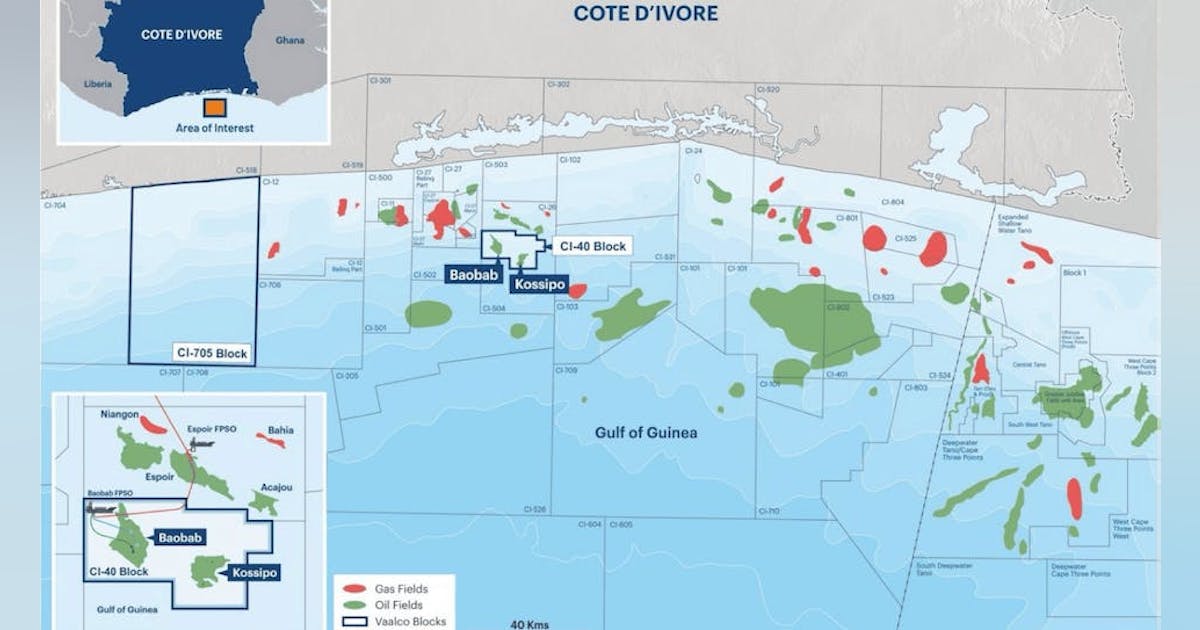
Vaalco Energy Inc. is drilling Etame field offshore Gabon and a preparing a field development plan (FDP) off Ivory Coast.  In Gabon, Vaalco drilled, completed, and placed Etame 15H-ST development well on production in Etame oil field in 1V block. The well has a 250 m lateral interval of net pay in high-quality Gamba sands near the top of the reservoir. The well had a stabilized flow rate of about 2,000 gross b/d of oil with a 38% water cut through a 42/64-in. choke and ESP at 54 Hz, confirming expectations from the ET-15P pilot well results. The company is working to stabilize pressure and manage the reservoir. West Etame step out exploration well spudded in mid-February. Drilling the well from the S1 slot on the Etame platform Etame West (ET-14P) exploration prospect has a 57% chance of geologic success and is expected to reach the target zone by mid-March. Etame Marin block lies in Congo basin about 32 km off the coast of Gabon. The license area is spread over five fields covering about 187 sq km. Vaalco is operator at the block with 58.8% interest. In Ivory Coast, Vaalco has been confirmed as operator (60%) of Kossipo field on the CI-40 Block southwest of Baobab field with partner PetroCI holding the remaining 40%. An FDP is expected to be completed in second-half 2026. New ocean bottom node (OBN) seismic data is expected to drive and derisk Vaalco’s updated evaluation and development plan. Estimated Gross 2C resources are 102-293 MMboe in place. The Baobab Ivorien (formerly MV10) floating production storage and offloading vessel (FPSO) is currently off the East coast of Africa and is expected to return to Ivory Coast by late March.  

Read More »

Ovintiv sets 2026 plan around Permian, Montney after declaring portfolio shift ‘complete’

2026 guidance For 2026, Ovintiv plans to invest $2.25–2.35 billion, up slightly from the $2.147 billion spent in 2025. McCracken said capital spend will be highest in first-quarter 2026 at about $625 million, “largely due to $50 million of capital allocated to the Anadarko and some drilling activity in the Montney that we inherited from NuVista.” The program is designed to deliver 205,000–212,000 b/d of oil and condensate, some 2 bcfd of natural gas, and 620,000–645,000 boe/d total company production. For full-year 2025, the company produced 614,500 boe/d.  The company is pursuing a “stay‑flat” oil strategy, maintaining liquids output through steady activity rather than aggressive volume growth.  Permian Ovintiv plans to run 5 rigs and 1-2 frac crews in the Permian basin this year, bringing 125–135 net wells online. Oil and condensate volumes are expected to average 117,000–123,000 b/d, with natural gas production of 270–295 MMcfd. The company projects 2026 drilling and completion costs below $600/ft, about $25/ft lower than 2025. Chief operating officer Gregory Givens credited faster cycle times and ongoing application of surfactant technology. Ovintiv has now deployed surfactants in about 300 Permian wells, generating a 9% uplift in oil productivity versus comparable control wells. Givens also reiterated that Ovintiv remains committed to its established cube‑development model. Responding to an analyst question, he said the company continues completing entire cubes at once, then returning “18 months later” to develop adjacent cubes—an approach that stabilizes well performance and reduces parent‑child degradation, he said. “We are getting the whole cube at the same time, and that is working quite well for us,” he said. The company plans to drill its first Barnett Woodford test well across Midland basin acreage in 2026. Ovintiv holds Barnett rights across roughly 100,000 acres and intends to move cautiously given the zone’s depth, higher pressure,

Read More »

Why network bandwidth matters a lot

One interesting point about VPNs is raised by fully a third of capacity-hungry enterprises: SD-WAN is the cheapest and easiest way to increase capacity to remote sites. Yes, service reliability of broadband Internet access for these sites is highly variable, so enterprises say they need to pilot test in a target area to determine whether even business-broadband Internet is reliable enough, but if it is, high capacity is both available and cheap. Clearly data center networking is taking the prime position in enterprise network planning, even without any contribution from AI. Will AI contribute? Enterprises generally believe that self-hosted AI will indeed require more network bandwidth, but again think this will be largely confined to the data center. AI, they say, has a broader and less predictable appetite for data, and business applications involving the data that’s subject to governance, or that’s already data-center hosted, are likely to be hosted proximate to the data. That was true for traditional software, and it’s likely just as true for AI. Yes, but…today, three times as many enterprises say that they’d use AI needs simply to boost justification for capacity expansion as think they currently need it. AI hype has entered, and perhaps even dominates, capital network project justifications. These capacity trends don’t impact enterprises alone, they also reshape the equipment space. Only 9% of enterprises say they have invested in white-box devices to build capacity and data center configuration flexibility, but the number that say they would evaluate them in 2026 is double that. This may be what’s behind Cisco’s decision to push its new G300 chip. AI’s role in capital project justifications may also be why Cisco positions the G300 so aggressively as an AI facilitator. Make no mistake, though; this is really all about capacity and QoE, even for AI.

Read More »

JLL: Hyperscale and AI Demand Push North American Data Centers Toward Industrial Scale

JLL’s North America Data Center Report Year-End 2025 makes a clear argument that the sector is no longer merely expanding but has shifted into a phase of industrial-scale acceleration driven by hyperscalers, AI platforms, and capital markets that increasingly treat digital infrastructure as core, bond-like collateral. The report’s central thesis is straightforward. Structural demand has overwhelmed traditional real estate cycles. JLL supports that claim with a set of reinforcing signals: Vacancy remains pinned near zero. Most new supply is pre-leased years ahead. Rents continue to climb. Debt markets remain highly liquid. Investors are engineering new financial structures to sustain growth. Author Andrew Batson notes that JLL’s Data Center Solutions team significantly expanded its methodology for this edition, incorporating substantially more hyperscale and owner-occupied capacity along with more than 40 additional markets. The subtitle — “The data center sector shifts into hyperdrive” — serves as an apt one-line summary of the report’s posture. The methodological change is not cosmetic. By incorporating hyper-owned infrastructure, total market size increases, vacancy compresses, and historical time series shift accordingly. JLL is explicit that these revisions reflect improved visibility into the market rather than a change in underlying fundamentals; and, if anything, suggest prior reports understated the sector’s true scale. The Market in Three Words: Tight, Pre-Leased, Relentless The report’s key highlights page serves as an executive brief for investors, offering a concise snapshot of market conditions that remain historically constrained. Vacancy stands at just 1%, unchanged year over year, while 92% of capacity currently under construction is already pre-leased. At the same time, geographic diversification continues to accelerate, with 64% of new builds now occurring in so-called frontier markets. JLL also notes that Texas, when viewed as a unified market, could surpass Northern Virginia as the top data center market by 2030, even as capital

Read More »

7×24 Exchange’s Dennis Cronin on the Data Center Workforce Crisis: The Talent Cliff Is Already Here

The data center industry has spent the past two years obsessing over power constraints, AI density, and supply chain pressure. But according to longtime mission critical leader Dennis Cronin, the sector’s most consequential bottleneck may be far more human. In a recent episode of the Data Center Frontier Show Podcast, Cronin — a founding member of 7×24 Exchange International and board member of the Mission Critical Global Alliance (MCGA) — delivered a stark message: the workforce “talent cliff” the industry keeps discussing as a future risk is already impacting operations today. A Million-Job Gap Emerging Cronin’s assessment reframes the workforce conversation from a routine labor shortage to what he describes as a structural and demographic challenge. Based on recent analysis of open roles, he estimates the industry is currently short between 467,000 and 498,000 workers across core operational positions including facilities managers, operations engineers, electricians, generator technicians, and HVAC specialists. Layer in emerging roles tied to AI infrastructure, sustainability, and cyber-physical security, and the potential demand rises to roughly one million jobs. “The coming talent cliff is not coming,” Cronin said. “It’s here, here and now.” With data center capacity expanding at roughly 30% annually, the workforce pipeline is not keeping pace with physical buildout. The Five-Year Experience Trap One of the industry’s most persistent self-inflicted wounds, Cronin argues, is the widespread requirement for five years of experience in roles that are effectively entry level. The result is a closed-loop hiring dynamic: New workers can’t get hired without experience They can’t gain experience without being hired Operators end up poaching from each other Workers may benefit from the resulting 10–20% salary jumps, but the overall talent pool remains stagnant. “It’s not helping us grow the industry,” Cronin said. In a market defined by rapid expansion and increasing system complexity, that

Read More »

Aeroderivative Turbines Move to the Center of AI Data Center Power Strategy

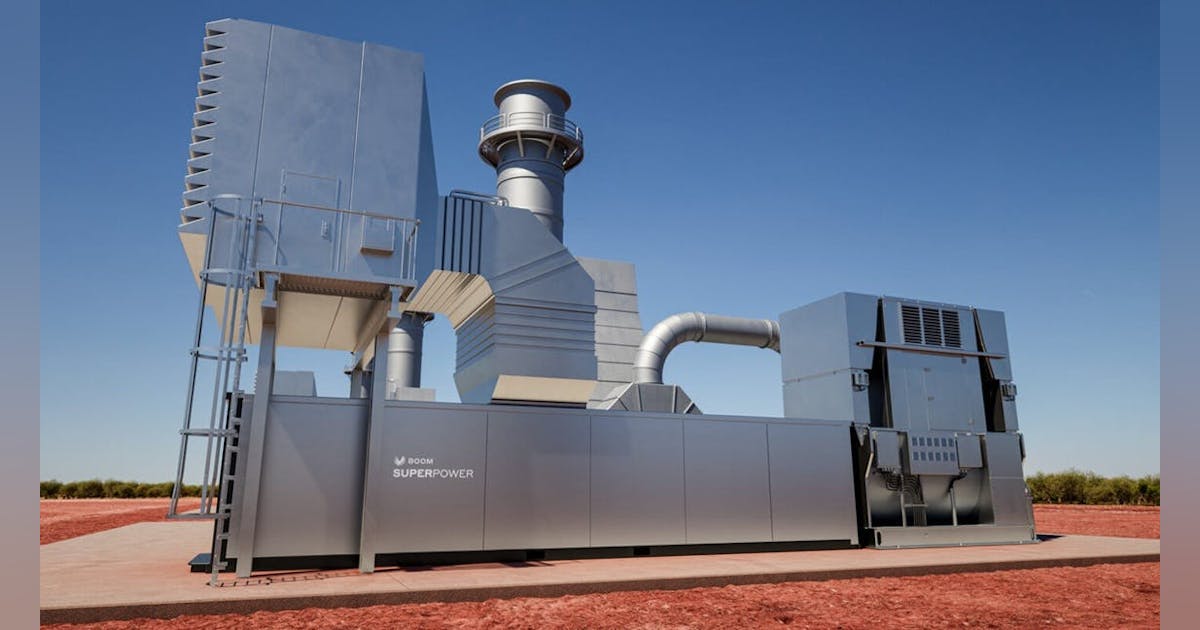
From “Backup” to “Bridging” to Behind-the-Meter Power Plants The most important shift is conceptual: these systems are increasingly blurring the boundary between emergency backup and primary power supply. Traditionally, data center electrical architecture has been clearly tiered: UPS (seconds to minutes) to ride through utility disturbances and generator start. Diesel gensets (minutes to hours or days) for extended outages. Utility grid as the primary power source. What’s changing is the rise of bridging power:  generation deployed to energize a site before the permanent grid connection is ready, or before sufficient utility capacity becomes available. Providers such as APR Energy now explicitly market turbine-based solutions to data centers seeking behind-the-meter capacity while awaiting utility build-out. That framing matters because it fundamentally changes expected runtime. A generator that operates for a few hours per year is one regulatory category. A turbine that runs continuously for weeks or months while a campus ramps is something very different; and it is drawing increased scrutiny from regulators who are beginning to treat these installations as material generation assets rather than temporary backup systems. The near-term driver is straightforward. AI workloads are arriving faster than grid infrastructure can keep pace. Data Center Frontier and other industry observers have documented the growing scramble for onsite generation as interconnection queues lengthen and critical equipment lead times expand. Mainstream financial and business media have taken notice. The Financial Times has reported on data centers turning to aeroderivative turbines and diesel fleets to bypass multi-year power delays. Reuters has likewise covered large gas-turbine-centric strategies tied to hyperscale campuses, underscoring how quickly the co-located generation model is moving into the mainstream. At the same time, demand pressure is tightening turbine supply chains. Industry reporting points to extended waits for new units, one reason repurposed engine cores and mobile aeroderivative packages are gaining

Read More »

Cooling’s New Reality: It’s Not Air vs. Liquid Anymore. It’s Architecture.

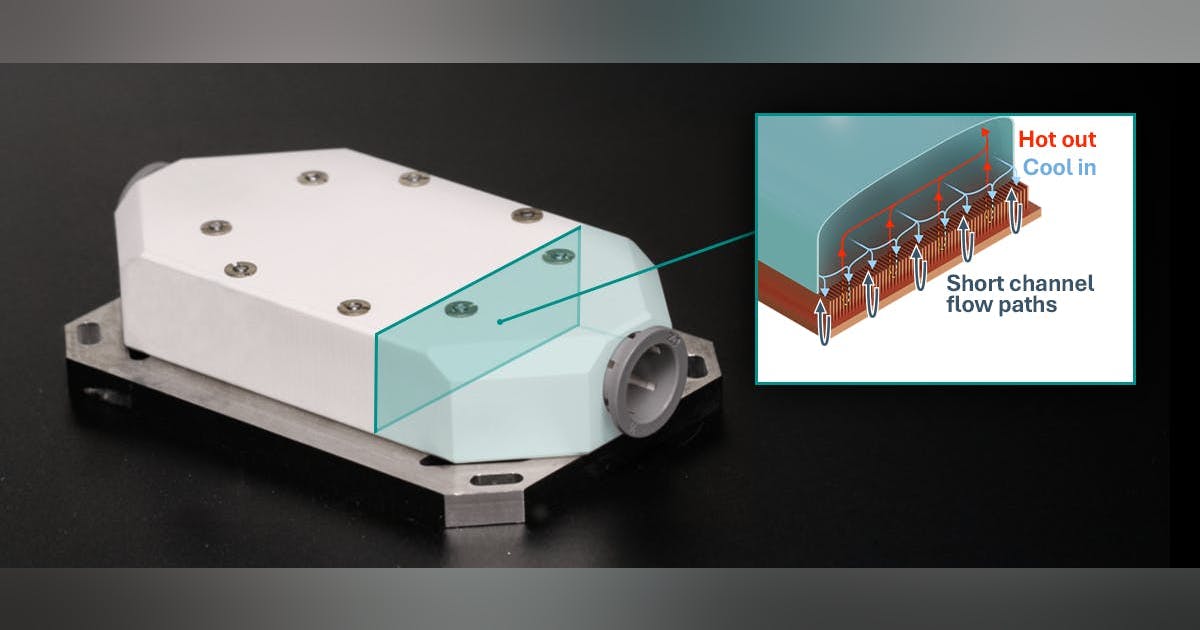
By early 2026, the data center cooling conversation has started to sound less like a product catalog and more like a systems engineering summit. The old framing – air cooling versus liquid cooling – still matters, but it increasingly misses the point. AI-era facilities are being defined by thermal constraints that run from chip-level cold plates to facility heat rejection, with critical decisions now shaped by pumping power, fluid selection, reliability under ambient extremes, water availability, and manufacturing throughput. That full-stack shift is written all over a grab bag of recent cooling announcements. On one end of the spectrum we see a Department of Energy-funded breakthrough aimed directly at next-generation GPU heat flux. On the other, it’s OEM product launches built to withstand –20°F to 140°F operating conditions and recover full cooling capacity within minutes of a power interruption. In between we find a major acquisition move for advanced liquid cooling IP, a manufacturing expansion that more than doubles footprint, and the quiet rise of refrigerants and heat-transfer fluids as design-level considerations. What’s emerging is a new reality. Cooling is becoming one of the primary constraints on AI deployment technically, economically, and geographically. The winners will be the players that can integrate the whole stack and scale it. 1) The Chip-level Arms Race: Single-phase Fights for More Runway The most “pure engineering” signal in this news batch comes from HRL Laboratories, which on Feb. 24, 2026 unveiled details of a single-phase direct liquid cooling approach called Low-Chill™. HRL’s framing is pointed: the industry wants higher GPU and rack power densities, but many operators are wary of the cost and operational complexity of two-phase cooling. HRL says Low-Chill was developed under the U.S. Department of Energy’s ARPA-E COOLERCHIPS program, and claims a leap that goes straight at the bottleneck. It can increase

Read More »

Policy Shock: Big Tech Told to Power Its Own AI Buildout

The AI data center boom has been colliding with grid reality for more than two years. This week, the issue moved closer to the policy front lines. The White House is advancing a “ratepayer protection” framework that has gained visibility in recent days, aimed at ensuring large AI data center projects do not shift grid upgrade costs onto residential customers. It’s a signal widely interpreted by industry observers as encouraging hyperscalers to bring dedicated power solutions to the table. The Power Question Moves to Center Stage Washington now appears poised to push the industry toward a structural response to the data center power conundrum. The new federal impetus for major technology companies to shoulder the cost of their own power infrastructure is quickly emerging as one of the most consequential policy developments for the digital infrastructure sector in 2026. If formalized, the initiative would effectively codify a shift already underway which has found hyperscale and AI developers moving aggressively toward behind-the-meter generation and dedicated energy strategies. For an industry already grappling with interconnection delays, utility pushback, and mounting community scrutiny, the signal is unmistakable. The era of relying primarily on shared grid capacity for large AI campuses may be ending. From Market Trend to Policy Direction Large tech firms, including the biggest cloud and AI players, have been under increasing pressure from regulators and utilities concerned about ratepayer exposure and grid reliability. Policymakers are now signaling that future large-load approvals may hinge on whether developers can demonstrate energy self-sufficiency or dedicated supply. The logic is straightforward. AI campuses are arriving at hundreds of megawatts to gigawatt scale. Transmission upgrades are measured in multi-year timelines. Utilities face growing political pressure to protect residential customers. In that context, the emerging federal posture does not create a new trend so much as accelerate

Read More »

Microsoft will invest $80B in AI data centers in fiscal 2025

And Microsoft isn’t the only one that is ramping up its investments into AI-enabled data centers. Rival cloud service providers are all investing in either upgrading or opening new data centers to capture a larger chunk of business from developers and users of large language models (LLMs).  In a report published in October 2024, Bloomberg Intelligence estimated that demand for generative AI would push Microsoft, AWS, Google, Oracle, Meta, and Apple would between them devote $200 billion to capex in 2025, up from $110 billion in 2023. Microsoft is one of the biggest spenders, followed closely by Google and AWS, Bloomberg Intelligence said. Its estimate of Microsoft’s capital spending on AI, at $62.4 billion for calendar 2025, is lower than Smith’s claim that the company will invest $80 billion in the fiscal year to June 30, 2025. Both figures, though, are way higher than Microsoft’s 2020 capital expenditure of “just” $17.6 billion. The majority of the increased spending is tied to cloud services and the expansion of AI infrastructure needed to provide compute capacity for OpenAI workloads. Separately, last October Amazon CEO Andy Jassy said his company planned total capex spend of $75 billion in 2024 and even more in 2025, with much of it going to AWS, its cloud computing division.

Read More »

John Deere unveils more autonomous farm machines to address skill labor shortage

Join our daily and weekly newsletters for the latest updates and exclusive content on industry-leading AI coverage. Learn More Self-driving tractors might be the path to self-driving cars. John Deere has revealed a new line of autonomous machines and tech across agriculture, construction and commercial landscaping. The Moline, Illinois-based John Deere has been in business for 187 years, yet it’s been a regular as a non-tech company showing off technology at the big tech trade show in Las Vegas and is back at CES 2025 with more autonomous tractors and other vehicles. This is not something we usually cover, but John Deere has a lot of data that is interesting in the big picture of tech. The message from the company is that there aren’t enough skilled farm laborers to do the work that its customers need. It’s been a challenge for most of the last two decades, said Jahmy Hindman, CTO at John Deere, in a briefing. Much of the tech will come this fall and after that. He noted that the average farmer in the U.S. is over 58 and works 12 to 18 hours a day to grow food for us. And he said the American Farm Bureau Federation estimates there are roughly 2.4 million farm jobs that need to be filled annually; and the agricultural work force continues to shrink. (This is my hint to the anti-immigration crowd). John Deere’s autonomous 9RX Tractor. Farmers can oversee it using an app. While each of these industries experiences their own set of challenges, a commonality across all is skilled labor availability. In construction, about 80% percent of contractors struggle to find skilled labor. And in commercial landscaping, 86% of landscaping business owners can’t find labor to fill open positions, he said. “They have to figure out how to do

Read More »

2025 playbook for enterprise AI success, from agents to evals

Join our daily and weekly newsletters for the latest updates and exclusive content on industry-leading AI coverage. Learn More 2025 is poised to be a pivotal year for enterprise AI. The past year has seen rapid innovation, and this year will see the same. This has made it more critical than ever to revisit your AI strategy to stay competitive and create value for your customers. From scaling AI agents to optimizing costs, here are the five critical areas enterprises should prioritize for their AI strategy this year. 1. Agents: the next generation of automation AI agents are no longer theoretical. In 2025, they’re indispensable tools for enterprises looking to streamline operations and enhance customer interactions. Unlike traditional software, agents powered by large language models (LLMs) can make nuanced decisions, navigate complex multi-step tasks, and integrate seamlessly with tools and APIs. At the start of 2024, agents were not ready for prime time, making frustrating mistakes like hallucinating URLs. They started getting better as frontier large language models themselves improved. “Let me put it this way,” said Sam Witteveen, cofounder of Red Dragon, a company that develops agents for companies, and that recently reviewed the 48 agents it built last year. “Interestingly, the ones that we built at the start of the year, a lot of those worked way better at the end of the year just because the models got better.” Witteveen shared this in the video podcast we filmed to discuss these five big trends in detail. Models are getting better and hallucinating less, and they’re also being trained to do agentic tasks. Another feature that the model providers are researching is a way to use the LLM as a judge, and as models get cheaper (something we’ll cover below), companies can use three or more models to

Read More »

OpenAI’s red teaming innovations define new essentials for security leaders in the AI era

Join our daily and weekly newsletters for the latest updates and exclusive content on industry-leading AI coverage. Learn More OpenAI has taken a more aggressive approach to red teaming than its AI competitors, demonstrating its security teams’ advanced capabilities in two areas: multi-step reinforcement and external red teaming. OpenAI recently released two papers that set a new competitive standard for improving the quality, reliability and safety of AI models in these two techniques and more. The first paper, “OpenAI’s Approach to External Red Teaming for AI Models and Systems,” reports that specialized teams outside the company have proven effective in uncovering vulnerabilities that might otherwise have made it into a released model because in-house testing techniques may have missed them. In the second paper, “Diverse and Effective Red Teaming with Auto-Generated Rewards and Multi-Step Reinforcement Learning,” OpenAI introduces an automated framework that relies on iterative reinforcement learning to generate a broad spectrum of novel, wide-ranging attacks. Going all-in on red teaming pays practical, competitive dividends It’s encouraging to see competitive intensity in red teaming growing among AI companies. When Anthropic released its AI red team guidelines in June of last year, it joined AI providers including Google, Microsoft, Nvidia, OpenAI, and even the U.S.’s National Institute of Standards and Technology (NIST), which all had released red teaming frameworks. Investing heavily in red teaming yields tangible benefits for security leaders in any organization. OpenAI’s paper on external red teaming provides a detailed analysis of how the company strives to create specialized external teams that include cybersecurity and subject matter experts. The goal is to see if knowledgeable external teams can defeat models’ security perimeters and find gaps in their security, biases and controls that prompt-based testing couldn’t find. What makes OpenAI’s recent papers noteworthy is how well they define using human-in-the-middle

Read More »