Stay Ahead, Stay ONMINE

Inside Chicago’s surveillance panopticon

Early on the morning of September 2, 2024, a Chicago Transit Authority Blue Line train was the scene of a random and horrific mass shooting. Four people were shot and killed on a westbound train as it approached the suburb of Forest Park.  The police swiftly activated a digital dragnet—a surveillance network that connects thousands of cameras in the city.  The process began with a quick review of the transit agency’s surveillance cameras, which captured the alleged gunman shooting the victims execution style. Law enforcement followed the suspect, through real-time footage, across the rapid-­transit system. Police officials circulated the images to transit staff and to thousands of officers. An officer in the adjacent suburb of Riverdale recognized the suspect from a previous arrest. By the time he was captured at another train station, just 90 minutes after the shooting, authorities already had his name, address, and previous arrest history. Little of this process would come as much surprise to Chicagoans. The city has tens of thousands of surveillance cameras—up to 45,000, by some estimates. That’s among the highest numbers per capita in the US. Chicago boasts one of the largest license plate reader systems in the country, and the ability to access audio and video surveillance from independent agencies such as the Chicago Public Schools, the Chicago Park District, and the public transportation system as well as many residential and commercial security systems such as Ring doorbell cameras.  Law enforcement and security advocates say this vast monitoring system protects public safety and works well. But activists and many residents say it’s a surveillance panopticon that creates a chilling effect on behavior and violates guarantees of privacy and free speech.  Black and Latino communities in Chicago have historically been targeted by excessive policing and surveillance, says Lance Williams, a scholar of urban violence at Northeastern Illinois University. That scrutiny has created new problems without delivering the promised safety, he suggests. In order to “solve the problem of crime or violence and make these communities safer,” he says, “you have to deal with structural problems,” such as the shortage of livable-wage jobs, affordable housing, and mental-health services across the city. Recent years have seen some effective pushback against the surveillance. Until recently, for example, the city was the largest customer of ShotSpotter acoustic sensors, which are designed to detect gunfire and alert police. The system was introduced in a small area on the South Side in 2012. By 2018, an area of about 136 square miles—some 60% of the city—was covered by the acoustic surveillance network. Critics questioned ShotSpotter’s effectiveness and objected that the sensors were installed largely in Black and Latino neighborhoods. Those critiques gained urgency with the fatal shooting in March 2021 of a 13-year-old, Adam Toledo, by police responding to a ShotSpotter alert. The tragedy became the touchstone of the #StopShotSpotter protest movement and one of the major issues in Brandon Johnson’s successful mayoral campaign in 2023. When he reached office, Johnson followed through, ending the city’s contract with SoundThinking, the San Francisco Bay Area company behind ShotSpotter. In total, it’s estimated the city paid more than $53 million for the system.  In response to a request for comment, SoundThinking said that ShotSpotter enables law enforcement “to reach the scene faster, render aid to victims, and locate evidence more effectively.” It stated the company “plays no part in the selection of deployment areas” but added: “We believe communities experiencing the highest levels of gun violence deserve the same rapid emergency response as any other neighborhood.”  While there has been successful resistance to police surveillance in the nation’s third-largest city, there are also countervailing forces: governments and officials in Chicago and the surrounding suburbs are moving to expand the use of surveillance, also in response to public pressure. Even the victory against acoustic surveillance might be short-lived. Early last year, the city issued a request for proposals for gun violence detection technology.  Many people in and around Chicago—digital privacy and surveillance activists, defense attorneys, law enforcement officials, and ordinary citizens—are part of this push and pull. Here are some of their stories.  Alejandro Ruizesparza and Freddy MartinezCofounders, Lucy Parsons Labs Oak Park, a quiet suburb at Chicago’s western border, is the birthplace of Ernest Hemingway. It includes the world’s largest collection of Frank Lloyd Wright–designed buildings and homes.  Until recently, the village of Oak Park was also the center of a three-year-long campaign against an unwelcome addition to its manicured lawns and Prairie-style architecture: automated license plate readers from a company called Flock Safety. These are high-speed cameras that automatically scan license plates to look for stolen or wanted vehicles, or for drivers with outstanding warrants.  Freddy Martinez (left) and Alejandro Ruizesparza (right) direct Lucy Parsons Labs, a charitable organization focused on digital rights.AKILAH TOWNSEND An Oak Park group called Freedom to Thrive—made up of parents, activists, lawyers, data scientists, and many others—suspected that this technology was not a good or equitable addition to their neighborhood. So the group engaged the Chicago-based nonprofit Lucy Parsons Labs to help navigate the often intimidating process of requesting license plate reader data under the Illinois Freedom of Information Act. Lucy Parsons Labs, which is named for a turn-of-the-century Chicago labor organizer, investigates technologies such as license plate readers, gunshot detection systems, and police bodycams.  LPL provides digital security and public records training to a variety of groups and is frequently called on to help community members audit and analyze surveillance systems that are targeting their neighborhoods. It’s led by two first-­generation Mexican-Americans from the city’s Southwest Side. Alejandro Ruizesparza has a background in community organizing and data science. Freddy Martinez was also a community organizer and has a background in physics.  The group is now approaching its 10th year, but it was an all-volunteer effort until 2022. That’s when LPL received its first unrestricted, multi-year operational grant from a large foundation: the Chicago-based John D. and Catherine T. MacArthur Foundation, known worldwide for its so-called “genius grants.” A grant from the Ford Foundation followed the next year.  The additional resources—a significant amount compared with the previous all-volunteer budget, acknowledges Ruizesparza—meant the two cofounders and two volunteers became full-time employees. But the group is determined not to become “too comfortable” and lose its edge. There is a tenacity to Lucy Parsons Labs’ work—a “sense of scrappiness,” they say—because “we did so much of this work with no money.”  One of LPL’s primary strategies is filing extensive FOIA requests for raw data sets of police surveillance. The process can take a while, but it often reveals issues.  In the case of Oak Park, the FOIA requests were just one tool that Freedom to Thrive and LPL used to sort out what was going on. The data revealed that in the first 10 months of operation, the eight Flock license plate readers the town had deployed scanned 3,000,000 plates. But only 42 scans led to an alert—an infinitesimal yield of 0.000014%.  At the same time, the impacts of those few flagged license plates were disproportionate. While Oak Park’s population of about 53,000 is only 19% Black, Black drivers made up 85% of those flagged by the Flock cameras, seemingly amplifying what were already concerning racial disparities in the village’s traffic stops. Flock did not respond to a request for comment. “We became almost de facto experts in navigating the process and the law. I think that sort of speaks to some of the DIY punk aesthetic.” Freddy Martinez, cofounder, Lucy Parsons Labs LPL brings a mix of radical politics and critical theory to its mission. Most surveillance technologies are “largely extensions of the plantation systems,” says Ruizesparza.  The comparison makes sense: Many slaveholding communities required enslaved persons to carry signed documents to leave plantations and wear badges with numbers sewn to their clothing. The group says it aims to empower local communities to push back against biased policing technologies through technical assistance, training, and litigation—and to de­mystify algorithms and surveillance tools in the process. “When we talk to people, they realize that you don’t need to know how to run a regression to understand that a technology has negative implications on your life,” says Ruizesparza. “You don’t need to understand how circuits work to understand that you probably shouldn’t have all of these cameras embedded in only Black and brown regions of a city.” The group came by some of its techniques through experimentation. “When LPL was first getting started, we didn’t really feel like FOIA would have been a good way of getting information. We didn’t know anything about it,” says Martinez. “Along the way, we were very successful in uncovering a lot of surveillance practices.”  One of the covert surveillance practices uncovered by those aggressive FOIA requests, for example, was the Chicago Police Department’s use of “Stingray” equipment, portable surveillance devices deployed to track and monitor mobile phones.  The contentious issue of Oak Park’s license plate readers was finally put to a vote in late August. The village trustees voted 5–2 to terminate the contract with Flock Safety.  Since then, community-­based groups from across the country—as far away as California—have contacted LPL to say the Chicago collective’s work has inspired their own efforts, says Martinez: “We became almost de facto experts in navigating the process and the law. I think that sort of speaks to some of the DIY punk aesthetic.” Brian Strockis Chief, Oak Brook Police Department If you drive about 20 miles west of Chicago, you’ll find Oakbrook Center, one of the nation’s leading luxury shopping destinations. The open-air mall includes Neiman-Marcus, Louis Vuitton, and Gucci and attracts high-end shoppers from across the region. It’s also become a destination for retail theft crews that coordinate “smash and grabs” and often escape with thousands of dollars’ worth of inventory that can be quickly sold, such as sunglasses or luxury handbags.  In early December, police say, a Chicago man tried to lead officers on what could have been a dangerous high-speed chase from the mall. Patrol cars raced to the scene. So did a “first responder drone,” built by Flock Safety and deployed by the Oak Brook Police Department.   The drone identified the suspect vehicle from the mall parking lot using its license plate reader and snapped high-definition photos that were texted to officers on the ground. The suspect was later tracked to Chicago, where he was arrested.  Brian Strockis, chief of the Oak Brook Police Department, led the way in introducing drones as first responders in the state of Illinois.AKILAH TOWNSEND This was the type of outcome that Brian Strockis, chief of the Oak Brook Police Department, hoped for when he pioneered the “drone as first responder,” or DFR, program in Illinois. A longtime member of the force, he joined the department almost 25 years ago as a patrol officer, worked his way up the brass ladder, and was awarded the top job in 2022.  Oak Brook was the first municipality in Illinois to deploy a drone as a first responder. One of the main reasons, says Strockis, was to reduce the number of high-speed chases, which are potentially dangerous to officers, suspects, and civilians. A drone is also a more effective and cost-efficient way to deal with suspects in fleeing vehicles, says Strockis. Police say there was the potential for a dangerous high-speed chase. Patrol cars raced to the scene. But the first unit to arrive was a drone. “It’s a force multiplier in that we’re able to do more with less,” says the chief, who spoke with me in his office at Oak Brook’s Village Hall.  The department’s drone autonomously launches from the roof of the building and responds to about 10 to 12 service calls per day, at speeds up to 45 miles per hour. It arrives at crime scenes before patrol officers in nine out of every 10 cases. Next door to Village Hall is the Oak Brook Police Department’s real-time crime center, a large room with two video walls that integrates livestreams from the first-responder drone, handheld drones, traffic cameras, license plate readers, and about a thousand private security cameras. When I visited, the two DFR operators demonstrated how the machine can fly itself or be directed to locations from a destination entered on Google Maps. They sent it off to a nearby forest preserve and then directed it to return to the rooftop base, where it docks automatically, changes batteries, and charges. After the demo, one of the drone operators logged the flight, as required by state law. Strockis says he is aware of the privacy concerns around using this technology but that protections are in place.  For example, the drone cannot be used for random or mass surveillance, he says, because the camera is always pointed straight ahead during flight and does not angle down until it reaches its desired location. The drone’s payload does not include facial recognition technology, which is restricted by state law, he says.  The drone video footage is invaluable, he adds, because “you are seeing the events as they’re transpiring from an angle that you wouldn’t otherwise be privy to.”  It’s an extra layer of protection for the public as well as for the officers, says the chief: “For every incident that an officer responds to now, you have squad car and bodycam video. You likely have cell-phone video from the public, officers, complainants, from offenders. So adding this element is probably the best video source on a scene that the police are going to anyway.” Mark Wallace Executive director, Citizens to Abolish Red Light Cameras Mark Wallace wears several hats. By day he is a real estate investor and mortgage lender. But he is probably best known to many Chicagoans—especially across the city’s largely African-American communities on the South and West Sides—as a talk radio host for the station WVON and one of the leading voices against the city’s extensive network of red-light and speed cameras.  For the past two decades, city officials have maintained that the cameras—which are officially known as “automated enforcement”—are a crucial safety measure. They are also a substantial revenue stream, generating around $150 million a year and a total of some $2.5 billion since they were installed. Urged on by a radio listener, Mark Wallace started organizing against Chicago’s red-light and speed cameras, a substantial revenue stream for the city that has been found to disproportionately burden majority Black and Latino areas.AKILAH TOWNSEND “The one thing that the cameras have the ability to do is generate a lot of money,” Wallace says. He describes the tickets as a “cash grab” that disproportionately affects Black and Latino communities. A groundbreaking 2022 analysis by ProPublica found, in fact, that households in majority Black and Latino zip codes were ticketed at much higher rates than others, in part because the cameras in those areas were more likely to be installed near expressway ramps and on wider streets, which encouraged faster speeds. The tickets, which can quickly rack up late fees, were also found to cause more of a financial burden in such communities, the report found. These were some of the same concerns that many people expressed on the radio and in meetings, Wallace says.  Chicago’s automated traffic enforcement began in 2003, and it became the most extensive—and most lucrative—such program in the country. About 300 red-light cameras and 200 speed cameras are set up near schools and parks. The cost of the tickets can quickly double if they are not paid or contested—providing a windfall for the city.   Wallace began his advocacy against the cameras soon after arriving at the radio station in the early 2010s. A younger listener called in and said, he recalls, “that he enjoyed the information that came from WVON but that we didn’t do anything.” The comment stuck with him, especially in light of WVON’s storied history. The station was closely involved in the civil rights movement of the 1960s and broadcast Martin Luther King Jr.’s speeches during his Chicago campaign. Wallace hoped to change the caller’s perception about the station. He had firsthand experience with red-light cameras,  having been ticketed himself, and decided to take them on as a cause. He scheduled a meeting at his church for a Friday night, promoting it on his show. “More than 300 people showed up,” he remembers, chatting with me in the spacious project studio and office in the basement of his townhouse on the city’s South Side. “That said to me there are a lot of people who see this in­equity and injustice.”  Wallace began using his platform on WVON—The People’s Show—to mobilize communities around social and economic justice, and many discussions revolved around the automated enforcement program. The cause gained traction after city and state officials were found to have taken thousands of dollars from technology and surveillance companies to make sure their cameras remained on the streets. Wallace and his group, Citizens to Abolish Red Light Cameras, want to repeal the ordinances authorizing the city’s camera programs. That hasn’t happened so far, but political pressure from the group paved the way for a Chicago City Council ordinance that required public meetings before any red-light cameras are installed, removed, or relocated. The group hopes for more restrictions for speed cameras, too. “It was never about me personally. It was about ensuring that we could demonstrate to people that you have power,” says Wallace. “If you don’t like something, as Barack Obama would say, get a pen and clipboard and go to work to fight to make these changes.”  Jonathan Manes Senior counsel, MacArthur Justice Center Derick Scruggs, a 30-year-old father and licensed armed security guard, was working in the parking lot of an AutoZone on Chicago’s Southwest Side on April 19, 2021. That’s when he was detained, interrogated, and subjected to a “humiliating body search” by two Chicago police officers, Scruggs later attested. “I was just doing my job when police officers came at me, handcuffed me, and treated me like a criminal—just because I was near a ShotSpotter alert,” he says. The officers found no evidence of a shooting and released Scruggs. But the next day, the police returned and arrested him for an alleged violation related to his security guard paperwork. Prosecutors later dismissed the charges, but he was held in custody overnight and was then fired from his job. “Because of what they did,” he says, “I lost my job, couldn’t work for months, and got evicted from my apartment.” Jonathan Manes litigated cases related to detentions at Guantanamo Bay and the legality of drone strikes before turning his attention to Chicago’s implementation of gunshot detection technology.AKILAH TOWNSEND Scruggs is believed to be among thousands of Chicagoans who’ve been questioned, detained, or arrested by police because they were near the location of a ShotSpotter alert, according to an analysis by the City of Chicago Office of Inspector General. The case caught the attention of Jonathan Manes, a law professor at Northwestern and senior counsel at the MacArthur Justice Center, a public interest law firm.  Manes previously worked in national security law, but when he joined the justice center about six years ago, he chose to focus squarely on the intersection of civil rights with police surveillance and technology. “My goal was to identify areas that weren’t well covered by other civil rights organizations but were a concern for people here in Chicago,” he says.  “There is a need for much broader structural change to how the city chooses to use surveillance technology and then deploys it.” Jonathan Manes, senior counsel, MacArthur Justice Center And when he and his colleagues looked into ShotSpotter, they revealed a disturbing problem: The system generated alerts that yielded no evidence of gun-­related crimes but were used by police as a pretext for other actions. There seemed to be “a pattern of people being stopped, detained, questioned, sometimes arrested, in response to a ShotSpotter alert—often resulting in charges that have nothing to do with guns,” Manes says.  The system also directed a “massive number of police deployments onto the South and West Sides of the city,” Manes says. Those regions are home to most of Chicago’s Black and Latino residents. The research showed that 80% of the city’s Black population but only 30% of its white population lived in districts covered by the system.  Manes brought Scruggs’s case into a lawsuit that he was already developing against the city’s use of ShotSpotter. In late 2025, he and his colleagues reached a settlement that prohibits police officers from doing what they did in Scruggs’s case—stopping or searching people simply because they are near the location of a gunshot detection alert.  Chicago had already decommissioned ShotSpotter in 2024, but the agreement will cover any future gunshot detection systems. Manes is carefully watching to see what happens next. Though Manes is pleased with the settlement, he points out that it narrowly focused on how police resources were used after the gunshot detection system was operational. “There is a need for much broader structural change to how the city chooses to use surveillance technology and then deploys it,” he adds. He supports laws that require disclosure from local officials and law enforcement about what technologies are being proposed and how civil rights could be affected.   More than two dozen jurisdictions nationwide have adopted surveillance transparency laws, including San Francisco, Seattle, Boston, and New York City. But so far Chicago is not on that list.  Rod McCullom is a Chicago-based science and technology writer whose focus areas include AI, biometrics, cognition, and the science of crime and violence.  


Early on the morning of September 2, 2024, a Chicago Transit Authority Blue Line train was the scene of a random and horrific mass shooting. Four people were shot and killed on a westbound train as it approached the suburb of Forest Park. 

The police swiftly activated a digital dragnet—a surveillance network that connects thousands of cameras in the city. 

The process began with a quick review of the transit agency’s surveillance cameras, which captured the alleged gunman shooting the victims execution style. Law enforcement followed the suspect, through real-time footage, across the rapid-­transit system. Police officials circulated the images to transit staff and to thousands of officers. An officer in the adjacent suburb of Riverdale recognized the suspect from a previous arrest. By the time he was captured at another train station, just 90 minutes after the shooting, authorities already had his name, address, and previous arrest history.

Little of this process would come as much surprise to Chicagoans. The city has tens of thousands of surveillance cameras—up to 45,000, by some estimates. That’s among the highest numbers per capita in the US. Chicago boasts one of the largest license plate reader systems in the country, and the ability to access audio and video surveillance from independent agencies such as the Chicago Public Schools, the Chicago Park District, and the public transportation system as well as many residential and commercial security systems such as Ring doorbell cameras. 

Law enforcement and security advocates say this vast monitoring system protects public safety and works well. But activists and many residents say it’s a surveillance panopticon that creates a chilling effect on behavior and violates guarantees of privacy and free speech. 

Black and Latino communities in Chicago have historically been targeted by excessive policing and surveillance, says Lance Williams, a scholar of urban violence at Northeastern Illinois University. That scrutiny has created new problems without delivering the promised safety, he suggests. In order to “solve the problem of crime or violence and make these communities safer,” he says, “you have to deal with structural problems,” such as the shortage of livable-wage jobs, affordable housing, and mental-health services across the city.

Recent years have seen some effective pushback against the surveillance. Until recently, for example, the city was the largest customer of ShotSpotter acoustic sensors, which are designed to detect gunfire and alert police. The system was introduced in a small area on the South Side in 2012. By 2018, an area of about 136 square miles—some 60% of the city—was covered by the acoustic surveillance network.

Critics questioned ShotSpotter’s effectiveness and objected that the sensors were installed largely in Black and Latino neighborhoods. Those critiques gained urgency with the fatal shooting in March 2021 of a 13-year-old, Adam Toledo, by police responding to a ShotSpotter alert. The tragedy became the touchstone of the #StopShotSpotter protest movement and one of the major issues in Brandon Johnson’s successful mayoral campaign in 2023. When he reached office, Johnson followed through, ending the city’s contract with SoundThinking, the San Francisco Bay Area company behind ShotSpotter. In total, it’s estimated the city paid more than $53 million for the system. 

In response to a request for comment, SoundThinking said that ShotSpotter enables law enforcement “to reach the scene faster, render aid to victims, and locate evidence more effectively.” It stated the company “plays no part in the selection of deployment areas” but added: “We believe communities experiencing the highest levels of gun violence deserve the same rapid emergency response as any other neighborhood.” 

While there has been successful resistance to police surveillance in the nation’s third-largest city, there are also countervailing forces: governments and officials in Chicago and the surrounding suburbs are moving to expand the use of surveillance, also in response to public pressure. Even the victory against acoustic surveillance might be short-lived. Early last year, the city issued a request for proposals for gun violence detection technology. 

Many people in and around Chicago—digital privacy and surveillance activists, defense attorneys, law enforcement officials, and ordinary citizens—are part of this push and pull. Here are some of their stories. 


Alejandro Ruizesparza and Freddy Martinez
Cofounders, Lucy Parsons Labs

Oak Park, a quiet suburb at Chicago’s western border, is the birthplace of Ernest Hemingway. It includes the world’s largest collection of Frank Lloyd Wright–designed buildings and homes. 

Until recently, the village of Oak Park was also the center of a three-year-long campaign against an unwelcome addition to its manicured lawns and Prairie-style architecture: automated license plate readers from a company called Flock Safety. These are high-speed cameras that automatically scan license plates to look for stolen or wanted vehicles, or for drivers with outstanding warrants. 

Freddy Martinez (left) and Alejandro Ruizesparza (right) direct Lucy Parsons Labs, a charitable organization focused on digital rights.
AKILAH TOWNSEND

An Oak Park group called Freedom to Thrive—made up of parents, activists, lawyers, data scientists, and many others—suspected that this technology was not a good or equitable addition to their neighborhood. So the group engaged the Chicago-based nonprofit Lucy Parsons Labs to help navigate the often intimidating process of requesting license plate reader data under the Illinois Freedom of Information Act.

Lucy Parsons Labs, which is named for a turn-of-the-century Chicago labor organizer, investigates technologies such as license plate readers, gunshot detection systems, and police bodycams. 

LPL provides digital security and public records training to a variety of groups and is frequently called on to help community members audit and analyze surveillance systems that are targeting their neighborhoods. It’s led by two first-­generation Mexican-Americans from the city’s Southwest Side. Alejandro Ruizesparza has a background in community organizing and data science. Freddy Martinez was also a community organizer and has a background in physics. 

The group is now approaching its 10th year, but it was an all-volunteer effort until 2022. That’s when LPL received its first unrestricted, multi-year operational grant from a large foundation: the Chicago-based John D. and Catherine T. MacArthur Foundation, known worldwide for its so-called “genius grants.” A grant from the Ford Foundation followed the next year. 

The additional resources—a significant amount compared with the previous all-volunteer budget, acknowledges Ruizesparza—meant the two cofounders and two volunteers became full-time employees. But the group is determined not to become “too comfortable” and lose its edge. There is a tenacity to Lucy Parsons Labs’ work—a “sense of scrappiness,” they say—because “we did so much of this work with no money.” 

One of LPL’s primary strategies is filing extensive FOIA requests for raw data sets of police surveillance. The process can take a while, but it often reveals issues. 

In the case of Oak Park, the FOIA requests were just one tool that Freedom to Thrive and LPL used to sort out what was going on. The data revealed that in the first 10 months of operation, the eight Flock license plate readers the town had deployed scanned 3,000,000 plates. But only 42 scans led to an alert—an infinitesimal yield of 0.000014%. 

At the same time, the impacts of those few flagged license plates were disproportionate. While Oak Park’s population of about 53,000 is only 19% Black, Black drivers made up 85% of those flagged by the Flock cameras, seemingly amplifying what were already concerning racial disparities in the village’s traffic stops. Flock did not respond to a request for comment.

“We became almost de facto experts in navigating the process and the law. I think that sort of speaks to some of the DIY punk aesthetic.”

Freddy Martinez, cofounder, Lucy Parsons Labs

LPL brings a mix of radical politics and critical theory to its mission. Most surveillance technologies are “largely extensions of the plantation systems,” says Ruizesparza. 

The comparison makes sense: Many slaveholding communities required enslaved persons to carry signed documents to leave plantations and wear badges with numbers sewn to their clothing. The group says it aims to empower local communities to push back against biased policing technologies through technical assistance, training, and litigation—and to de­mystify algorithms and surveillance tools in the process.

“When we talk to people, they realize that you don’t need to know how to run a regression to understand that a technology has negative implications on your life,” says Ruizesparza. “You don’t need to understand how circuits work to understand that you probably shouldn’t have all of these cameras embedded in only Black and brown regions of a city.”

The group came by some of its techniques through experimentation. “When LPL was first getting started, we didn’t really feel like FOIA would have been a good way of getting information. We didn’t know anything about it,” says Martinez. “Along the way, we were very successful in uncovering a lot of surveillance practices.” 

One of the covert surveillance practices uncovered by those aggressive FOIA requests, for example, was the Chicago Police Department’s use of “Stingray” equipment, portable surveillance devices deployed to track and monitor mobile phones. 

The contentious issue of Oak Park’s license plate readers was finally put to a vote in late August. The village trustees voted 5–2 to terminate the contract with Flock Safety. 

Since then, community-­based groups from across the country—as far away as California—have contacted LPL to say the Chicago collective’s work has inspired their own efforts, says Martinez: “We became almost de facto experts in navigating the process and the law. I think that sort of speaks to some of the DIY punk aesthetic.”


Brian Strockis
Chief, Oak Brook Police Department

If you drive about 20 miles west of Chicago, you’ll find Oakbrook Center, one of the nation’s leading luxury shopping destinations. The open-air mall includes Neiman-Marcus, Louis Vuitton, and Gucci and attracts high-end shoppers from across the region. It’s also become a destination for retail theft crews that coordinate “smash and grabs” and often escape with thousands of dollars’ worth of inventory that can be quickly sold, such as sunglasses or luxury handbags. 

In early December, police say, a Chicago man tried to lead officers on what could have been a dangerous high-speed chase from the mall. Patrol cars raced to the scene. So did a “first responder drone,” built by Flock Safety and deployed by the Oak Brook Police Department.  

The drone identified the suspect vehicle from the mall parking lot using its license plate reader and snapped high-definition photos that were texted to officers on the ground. The suspect was later tracked to Chicago, where he was arrested. 

Brian Strockis, chief of the Oak Brook Police Department, led the way in introducing drones as first responders in the state of Illinois.
AKILAH TOWNSEND

This was the type of outcome that Brian Strockis, chief of the Oak Brook Police Department, hoped for when he pioneered the “drone as first responder,” or DFR, program in Illinois. A longtime member of the force, he joined the department almost 25 years ago as a patrol officer, worked his way up the brass ladder, and was awarded the top job in 2022. 

Oak Brook was the first municipality in Illinois to deploy a drone as a first responder. One of the main reasons, says Strockis, was to reduce the number of high-speed chases, which are potentially dangerous to officers, suspects, and civilians. A drone is also a more effective and cost-efficient way to deal with suspects in fleeing vehicles, says Strockis.

Police say there was the potential for a dangerous high-speed chase. Patrol cars raced to the scene. But the first unit to arrive was a drone.

“It’s a force multiplier in that we’re able to do more with less,” says the chief, who spoke with me in his office at Oak Brook’s Village Hall. 

The department’s drone autonomously launches from the roof of the building and responds to about 10 to 12 service calls per day, at speeds up to 45 miles per hour. It arrives at crime scenes before patrol officers in nine out of every 10 cases.

Next door to Village Hall is the Oak Brook Police Department’s real-time crime center, a large room with two video walls that integrates livestreams from the first-responder drone, handheld drones, traffic cameras, license plate readers, and about a thousand private security cameras. When I visited, the two DFR operators demonstrated how the machine can fly itself or be directed to locations from a destination entered on Google Maps. They sent it off to a nearby forest preserve and then directed it to return to the rooftop base, where it docks automatically, changes batteries, and charges. After the demo, one of the drone operators logged the flight, as required by state law.

Strockis says he is aware of the privacy concerns around using this technology but that protections are in place. 

For example, the drone cannot be used for random or mass surveillance, he says, because the camera is always pointed straight ahead during flight and does not angle down until it reaches its desired location. The drone’s payload does not include facial recognition technology, which is restricted by state law, he says. 

The drone video footage is invaluable, he adds, because “you are seeing the events as they’re transpiring from an angle that you wouldn’t otherwise be privy to.” 

It’s an extra layer of protection for the public as well as for the officers, says the chief: “For every incident that an officer responds to now, you have squad car and bodycam video. You likely have cell-phone video from the public, officers, complainants, from offenders. So adding this element is probably the best video source on a scene that the police are going to anyway.”


Mark Wallace
Executive director, Citizens to Abolish Red Light Cameras

Mark Wallace wears several hats. By day he is a real estate investor and mortgage lender. But he is probably best known to many Chicagoans—especially across the city’s largely African-American communities on the South and West Sides—as a talk radio host for the station WVON and one of the leading voices against the city’s extensive network of red-light and speed cameras. 

For the past two decades, city officials have maintained that the cameras—which are officially known as “automated enforcement”—are a crucial safety measure. They are also a substantial revenue stream, generating around $150 million a year and a total of some $2.5 billion since they were installed.
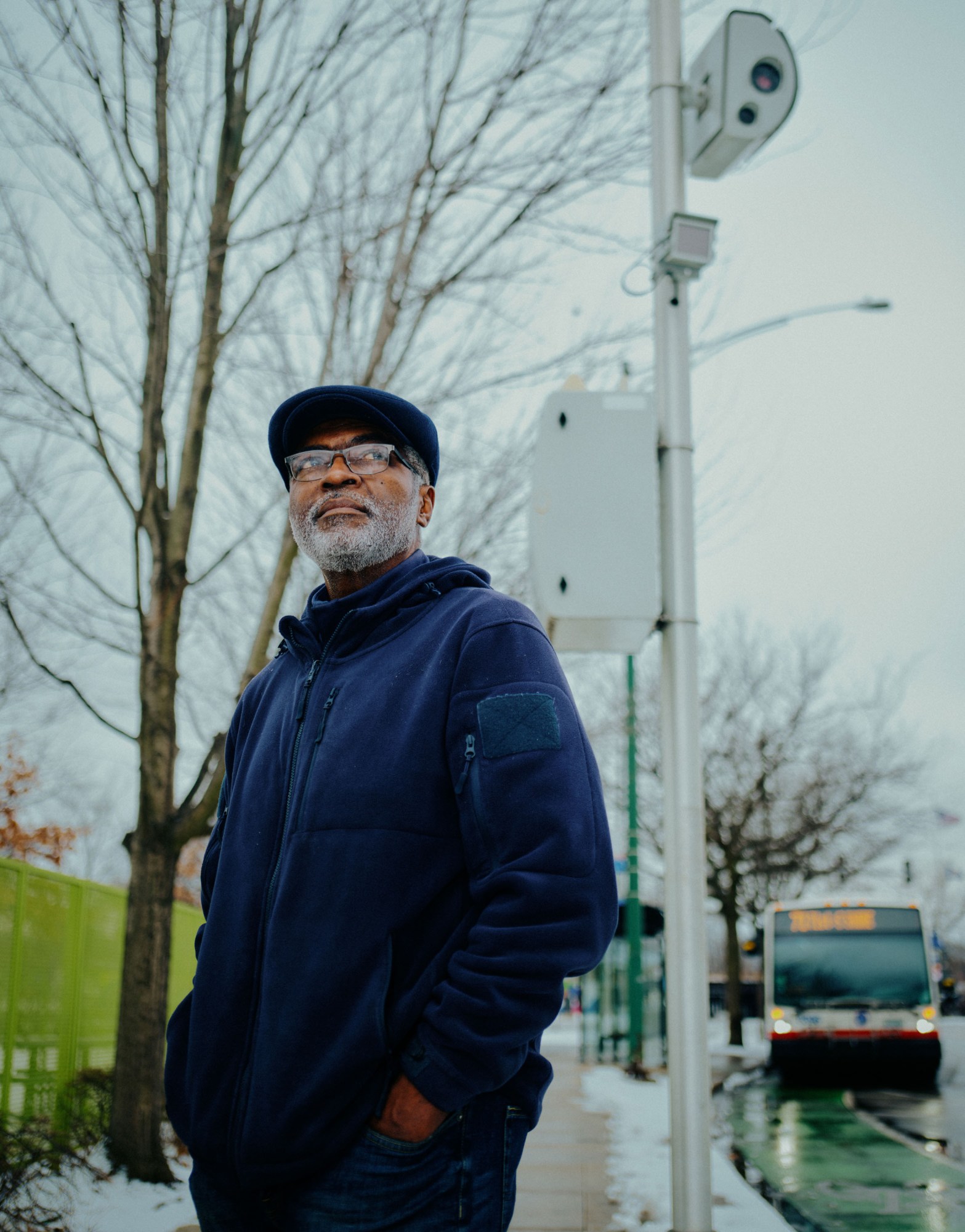
Urged on by a radio listener, Mark Wallace started organizing against Chicago’s red-light and speed cameras, a substantial revenue stream for the city that has been found to disproportionately burden majority Black and Latino areas.
AKILAH TOWNSEND

“The one thing that the cameras have the ability to do is generate a lot of money,” Wallace says. He describes the tickets as a “cash grab” that disproportionately affects Black and Latino communities.

A groundbreaking 2022 analysis by ProPublica found, in fact, that households in majority Black and Latino zip codes were ticketed at much higher rates than others, in part because the cameras in those areas were more likely to be installed near expressway ramps and on wider streets, which encouraged faster speeds. The tickets, which can quickly rack up late fees, were also found to cause more of a financial burden in such communities, the report found.

These were some of the same concerns that many people expressed on the radio and in meetings, Wallace says. 

Chicago’s automated traffic enforcement began in 2003, and it became the most extensive—and most lucrative—such program in the country. About 300 red-light cameras and 200 speed cameras are set up near schools and parks. The cost of the tickets can quickly double if they are not paid or contested—providing a windfall for the city.  

Wallace began his advocacy against the cameras soon after arriving at the radio station in the early 2010s. A younger listener called in and said, he recalls, “that he enjoyed the information that came from WVON but that we didn’t do anything.” The comment stuck with him, especially in light of WVON’s storied history. The station was closely involved in the civil rights movement of the 1960s and broadcast Martin Luther King Jr.’s speeches during his Chicago campaign.

Wallace hoped to change the caller’s perception about the station. He had firsthand experience with red-light cameras,  having been ticketed himself, and decided to take them on as a cause. He scheduled a meeting at his church for a Friday night, promoting it on his show. “More than 300 people showed up,” he remembers, chatting with me in the spacious project studio and office in the basement of his townhouse on the city’s South Side. “That said to me there are a lot of people who see this in­equity and injustice.” 

Wallace began using his platform on WVON—The People’s Show—to mobilize communities around social and economic justice, and many discussions revolved around the automated enforcement program. The cause gained traction after city and state officials were found to have taken thousands of dollars from technology and surveillance companies to make sure their cameras remained on the streets.

Wallace and his group, Citizens to Abolish Red Light Cameras, want to repeal the ordinances authorizing the city’s camera programs. That hasn’t happened so far, but political pressure from the group paved the way for a Chicago City Council ordinance that required public meetings before any red-light cameras are installed, removed, or relocated. The group hopes for more restrictions for speed cameras, too.

“It was never about me personally. It was about ensuring that we could demonstrate to people that you have power,” says Wallace. “If you don’t like something, as Barack Obama would say, get a pen and clipboard and go to work to fight to make these changes.” 


Jonathan Manes
Senior counsel, MacArthur Justice Center

Derick Scruggs, a 30-year-old father and licensed armed security guard, was working in the parking lot of an AutoZone on Chicago’s Southwest Side on April 19, 2021. That’s when he was detained, interrogated, and subjected to a “humiliating body search” by two Chicago police officers, Scruggs later attested. “I was just doing my job when police officers came at me, handcuffed me, and treated me like a criminal—just because I was near a ShotSpotter alert,” he says.

The officers found no evidence of a shooting and released Scruggs. But the next day, the police returned and arrested him for an alleged violation related to his security guard paperwork. Prosecutors later dismissed the charges, but he was held in custody overnight and was then fired from his job. “Because of what they did,” he says, “I lost my job, couldn’t work for months, and got evicted from my apartment.”

Jonathan Manes litigated cases related to detentions at Guantanamo Bay and the legality of drone strikes before turning his attention to Chicago’s implementation of gunshot detection technology.
AKILAH TOWNSEND

Scruggs is believed to be among thousands of Chicagoans who’ve been questioned, detained, or arrested by police because they were near the location of a ShotSpotter alert, according to an analysis by the City of Chicago Office of Inspector General. The case caught the attention of Jonathan Manes, a law professor at Northwestern and senior counsel at the MacArthur Justice Center, a public interest law firm. 

Manes previously worked in national security law, but when he joined the justice center about six years ago, he chose to focus squarely on the intersection of civil rights with police surveillance and technology. “My goal was to identify areas that weren’t well covered by other civil rights organizations but were a concern for people here in Chicago,” he says. 

“There is a need for much broader structural change to how the city chooses to use surveillance technology and then deploys it.”

Jonathan Manes, senior counsel, MacArthur Justice Center

And when he and his colleagues looked into ShotSpotter, they revealed a disturbing problem: The system generated alerts that yielded no evidence of gun-­related crimes but were used by police as a pretext for other actions. There seemed to be “a pattern of people being stopped, detained, questioned, sometimes arrested, in response to a ShotSpotter alert—often resulting in charges that have nothing to do with guns,” Manes says. 

The system also directed a “massive number of police deployments onto the South and West Sides of the city,” Manes says. Those regions are home to most of Chicago’s Black and Latino residents. The research showed that 80% of the city’s Black population but only 30% of its white population lived in districts covered by the system. 

Manes brought Scruggs’s case into a lawsuit that he was already developing against the city’s use of ShotSpotter. In late 2025, he and his colleagues reached a settlement that prohibits police officers from doing what they did in Scruggs’s case—stopping or searching people simply because they are near the location of a gunshot detection alert. 

Chicago had already decommissioned ShotSpotter in 2024, but the agreement will cover any future gunshot detection systems. Manes is carefully watching to see what happens next.

Though Manes is pleased with the settlement, he points out that it narrowly focused on how police resources were used after the gunshot detection system was operational. “There is a need for much broader structural change to how the city chooses to use surveillance technology and then deploys it,” he adds. He supports laws that require disclosure from local officials and law enforcement about what technologies are being proposed and how civil rights could be affected.  

More than two dozen jurisdictions nationwide have adopted surveillance transparency laws, including San Francisco, Seattle, Boston, and New York City. But so far Chicago is not on that list. 

Rod McCullom is a Chicago-based science and technology writer whose focus areas include AI, biometrics, cognition, and the science of crime and violence.  

Shape
Shape
Stay Ahead

Explore More Insights

Stay ahead with more perspectives on cutting-edge power, infrastructure, energy,  bitcoin and AI solutions. Explore these articles to uncover strategies and insights shaping the future of industries.

Shape

Western Digital wants to ramp-up hard disk drive speeds

Most enterprises are not using SATA drives, at least not with hot data. Perhaps cold storage but not frequently accessed data. They are using PCI Express based drives and those are considerably faster than anything Western Digital can engineer in a hard disk. Capacity aside, Western Digital is also aiming

Read More »

LoRaWAN reaches 125 million devices as industrial IoT expands

Satellite integration is set to grow Terrestrial LoRaWAN networks cannot achieve complete geographic coverage. Yegin cited Swisscom’s nationwide Switzerland deployment, which covers 97.2% of the population but cannot reach remote alpine terrain. Two LoRa Alliance members, Lacuna Space and Plan-S, already operate commercial LoRaWAN services from low Earth orbit. Standard

Read More »

Insights: Venezuela – new legal frameworks vs. the inertia of history

@import url(‘https://fonts.googleapis.com/css2?family=Inter:[email protected]&display=swap’); a { color: var(–color-primary-main); } .ebm-page__main h1, .ebm-page__main h2, .ebm-page__main h3, .ebm-page__main h4, .ebm-page__main h5, .ebm-page__main h6 { font-family: Inter; } body { line-height: 150%; letter-spacing: 0.025em; font-family: Inter; } button, .ebm-button-wrapper { font-family: Inter; } .label-style { text-transform: uppercase; color: var(–color-grey); font-weight: 600; font-size: 0.75rem; } .caption-style { font-size: 0.75rem; opacity: .6; } #onetrust-pc-sdk [id*=btn-handler], #onetrust-pc-sdk [class*=btn-handler] { background-color: #c19a06 !important; border-color: #c19a06 !important; } #onetrust-policy a, #onetrust-pc-sdk a, #ot-pc-content a { color: #c19a06 !important; } #onetrust-consent-sdk #onetrust-pc-sdk .ot-active-menu { border-color: #c19a06 !important; } #onetrust-consent-sdk #onetrust-accept-btn-handler, #onetrust-banner-sdk #onetrust-reject-all-handler, #onetrust-consent-sdk #onetrust-pc-btn-handler.cookie-setting-link { background-color: #c19a06 !important; border-color: #c19a06 !important; } #onetrust-consent-sdk .onetrust-pc-btn-handler { color: #c19a06 !important; border-color: #c19a06 !important; } In this Insights episode of the Oil & Gas Journal ReEnterprised podcast, Head of Content Chris Smith updates the evolving situation in Venezuela as the industry attempts to navigate the best path forward while the two governments continue to hammer out the details. The discussion centers on the new legal frameworks being established in both countries within the context of fraught relations stretching back for decades. Want to hear more? Listen in on a January episode highlighting industry’s initial take following the removal of Nicholas Maduro from power. References Politico podcast Monaldi Substack Baker webinar Washington, Caracas open Venezuela to allow more oil sales 

Read More »

Eni makes Calao South discovery offshore Ivory Coast

@import url(‘https://fonts.googleapis.com/css2?family=Inter:[email protected]&display=swap’); a { color: var(–color-primary-main); } .ebm-page__main h1, .ebm-page__main h2, .ebm-page__main h3, .ebm-page__main h4, .ebm-page__main h5, .ebm-page__main h6 { font-family: Inter; } body { line-height: 150%; letter-spacing: 0.025em; font-family: Inter; } button, .ebm-button-wrapper { font-family: Inter; } .label-style { text-transform: uppercase; color: var(–color-grey); font-weight: 600; font-size: 0.75rem; } .caption-style { font-size: 0.75rem; opacity: .6; } #onetrust-pc-sdk [id*=btn-handler], #onetrust-pc-sdk [class*=btn-handler] { background-color: #c19a06 !important; border-color: #c19a06 !important; } #onetrust-policy a, #onetrust-pc-sdk a, #ot-pc-content a { color: #c19a06 !important; } #onetrust-consent-sdk #onetrust-pc-sdk .ot-active-menu { border-color: #c19a06 !important; } #onetrust-consent-sdk #onetrust-accept-btn-handler, #onetrust-banner-sdk #onetrust-reject-all-handler, #onetrust-consent-sdk #onetrust-pc-btn-handler.cookie-setting-link { background-color: #c19a06 !important; border-color: #c19a06 !important; } #onetrust-consent-sdk .onetrust-pc-btn-handler { color: #c19a06 !important; border-color: #c19a06 !important; } Eni SPA discovered gas and condensate in the Murene South-1X exploration well in Block CI-501, Ivory Coast. The well is the first exploration in the block and was drilled by the Saipem Santorini drilling ship about 8 km southwest of the Murene-1X discovery well in adjacent CI-205 block. The well was drilled to about 5,000 m TD in 2,200 m of water. Extensive data acquisition confirmed a main hydrocarbon bearing interval in high-quality Cenomanian sands with a gross thickness of about 50 m with excellent petrophysical properties, the operator said. Murene South-1X will undergo a full conventional drill stem test (DST) to assess the production capacity of this discovery, named Calao South. Calao South confirms the potential of the Calao channel complex that also includes the Calao discovery. It is the second largest discovery in the country after Baleine, with estimated volumes of up to 5.0 tcf of gas and 450 million bbl of condensate (about 1.4 billion bbl of oil). Eni is operator of Block CI-501 (90%) with partner Petroci Holding (10%).

Read More »

CFEnergía to supply natural gas to low-carbon methanol plant in Mexico

CFEnergía, a subsidiary of Mexico’s Federal Electricity Commission (CFE), has agreed to supply natural gas to Transition Industries LLC for its Pacifico Mexinol project near Topolobampo, Sinaloa, Mexico. Under the signed agreement, which enables the start of Pacifico Mexinol’s construction phase, CFEnergía will supply about 160 MMcfd of natural gas for an unspecified timeframe noted as “long term,” Transition Industries said in a release Feb. 16. The natural gas—to be sourced from the US and supplied at market prices via existing infrastructure—will be used as “critical input for Mexinol’s production of ultra-low carbon methanol,” the company said. Pacifico Mexinol The $3.3-billion Mexinol project, when it begins operations in late 2029 to early 2030, is expected to be the world’s largest ultra-low carbon chemicals plant with production of about 1.8 million tonnes of blue methanol and 350,000 tonnes of green methanol annually. Supply is aimed at markets in Asia, including Japan, while also boosting the development of the domestic market and the Mexican chemical industry. Mitsubishi Gas Chemical has committed to purchasing about 1 million tonnes/year of methanol from the project, about 50% of the project’s planned production. Transition Industries is jointly developing Pacifico Mexinol with the International Finance Corporation (IFC), a member of the World Bank Group. Last year, the company signed a contingent engineering, procurement, and construction (EPC) contract with the consortium of Samsung E&A Co., Ltd., Grupo Samsung E&A Mexico SA de CV, and Techint Engineering and Construction for the project. MAIRE group’s technology division NextChem, through its subsidiary KT TECH SpA, also signed a basic engineering, critical and proprietary equipment supply agreement with Samsung E&A in connection with its proprietary NX AdWinMethanol®Zero technology supply to the project.

Read More »

North Atlantic’s Gravenchon refinery scheduled for major turnaround

Canada-based North Atlantic Refining Ltd. France-based subsidiary North Atlantic France SAS is undertaking planned maintenance in March at its North Atlantic Energies-operated 230,000-b/d Notre-Dame-de-Gravenchon refinery in Port-Jérôme-sur-Seine, Normandy. Scheduled to begin on Mar. 3 with the phased shutdown of unidentified units at the refinery, the upcoming turnaround will involve thorough inspections of associated equipment designed for continuous operation, as well as unspecified works to improve energy efficiency, environmental performance, and overall competitiveness of the site, North Atlantic Energies said on Feb. 16. Part of the operator’s routine maintenance program aimed at meeting regulatory requirements to ensure the safety, compliance, and long-term performance of the refinery, North Atlantic Energies said the scheduled turnaround will not interrupt product supplies to customers during the shutdown period. While the company confirmed the phased shutdown of units slated for work during the maintenance event would last for several days, the operator did not reveal a definitive timeline for the entire duration of the turnaround. Further details regarding specific works to be carried out during the major maintenance event were not revealed. The upcoming turnaround will be the first to be executed under North Atlantic Group’s ownership, which completed its purchase of the formerly majority-owned ExxonMobil Corp. refinery and associated petrochemical assets at the site in November 2025.

Read More »

Azule Energy starts Ndungu full field production offshore Angola

Azule Energy has started full field production from Ndungu, part of the Agogo Integrated West Hub Project (IWH) in the western area of Block 15/06, offshore Angola. Ndungo full field lies about 10 km from the NGOMA FPSO in a water depth of around 1,100 m and comprises seven production wells and four injection wells, with an expected production peak of 60,000 b/d of oil. The National Agency for Petroleum, Gas and Biofuels (ANPG) and Azule Energy noted the full field start-up with first oil of three production wells. The phased integration of IWH, with Ndungu full field producing first via N’goma FPSO and later via Agogo FPSO, is expected to reach a peak output of about 175,000 b/d across the two fields. The fields have combined estimated reserves of about 450 million bbl. The Agogo IWH project is operated by Azule Energy with a 36.84% stake alongside partners Sonangol E&P (36.84%) and Sinopec International (26.32%).   

Read More »

Ovintiv to divest Anadarko assets for $3 billion

In a release Feb. 17, Brendan McCracken, Ovintiv president and chief executive officer, said the company has “built one of the deepest premium inventory positions in our industry in the two most valuable plays in North America, the Permian and the Montney,” and that the Anadarko assets sale “positions [Ovintiv] to deliver superior returns for our shareholders for many years to come.” Ovintiv in 2025 had noted plans to sell the asset to help offset the cost of its acquisition of NuVista Energy Ltd. That $2.7-billion cash and stock deal, which closed earlier this month, added about 930 net 10,000-ft equivalent well locations and about 140,000 net acres (70% undeveloped) in the core of the oil-rich Alberta Montney.  Proceeds from the Anadarko assets sale are earmarked for accelerated debt reduction, the company said.  Ovintiv’s sale of its Anadarko assets is expected to close early in this year’s second quarter, subject to customary conditions, with an effective date of Jan. 1, 2026.

Read More »

Raising the temp on liquid cooling

IBM isn’t the only one. “We’ve been doing liquid cooling since 2012 on our supercomputers,” says Scott Tease, vice president and general manager of AI and high-performance computing at Lenovo’s infrastructure solutions group. “And we’ve been improving it ever since—we’re now on the sixth generation of that technology.” And the liquid Lenovo uses in its Neptune liquid cooling solution is warm water. Or, more precisely, hot water: 45 degrees Celsius. And when the water leaves the servers, it’s even hotter, Tease says. “I don’t have to chill that water, even if I’m in a hot climate,” he says. Even at high temperatures, the water still provides enough cooling to the chips that it has real value. “Generally, a data center will use evaporation to chill water down,” Tease adds. “Since we don’t have to chill the water, we don’t have to use evaporation. That’s huge amounts of savings on the water. For us, it’s almost like a perfect solution. It delivers the highest performance possible, the highest density possible, the lowest power consumption. So, it’s the most sustainable solution possible.” So, how is the water cooled down? It gets piped up to the roof, Tease says, where there are giant radiators with massive amounts of surface area. The heat radiates away, and then all the water flows right back to the servers again. Though not always. The hot water can also be used to, say, heat campus or community swimming pools. “We have data centers in the Nordics who are giving the heat to the local communities’ water systems,” Tease says.

Read More »

Vertiv’s AI Infrastructure Surge: Record Orders, Liquid Cooling Expansion, and Grid-Scale Power Reflect Data Center Growth

2) “Units of compute”: OneCore and SmartRun On the earnings call, Albertazzi highlighted Vertiv OneCore, an end-to-end data center solution designed to accelerate “time to token,” scaling in 12.5 MW building blocks; and Vertiv SmartRun, a prefabricated white space infrastructure solution aimed at rapidly accelerating fit-out and readiness. He pointed to collaborations (including Hut 8 and Compass Data Centers) as proof points of adoption, emphasizing that SmartRun can stand alone or plug into OneCore. 3) Cooling evolution: hybrid thermal chains and the “trim cooler” Asked how cooling architectures may change (amid industry chatter about warmer-temperature operations and shifting mixes of chillers, CDUs, and other components) Albertazzi leaned into complexity as a feature, not a bug. He argued heat rejection doesn’t disappear, even if some GPU loads can run at higher temperatures. Instead, the future looks hybrid, with mixed loads and resiliency requirements forcing more nuanced thermal chains. Vertiv’s strategic product anchor here is its “trim cooler” concept: a chiller optimized for higher-temperature operation while retaining flexibility for lower-temperature requirements in the same facility, maximizing free cooling where climate and design allow. And importantly, Albertazzi dismissed the idea that CDUs are going away: “We are pretty sure that CDUs in various shapes and forms are a long-term element of the thermal chain.” 4) Edge densification: CoolPhase Ceiling + CoolPhase Row (Feb. 3) Vertiv also expanded its thermal portfolio for edge and small IT environments with the: Vertiv CoolPhase Ceiling (launching Q2 2026): ceiling-mounted, 3.5 kW to 28 kW, designed to preserve floor space. Vertiv CoolPhase Row (available now in North America) for row-based cooling up to 30 kW (300 mm width) or 40 kW (600 mm width). Vertiv Director of Edge Thermal Michal Podmaka tied the products directly to AI-driven edge densification and management consistency, saying the new systems “integrate seamlessly

Read More »

Execution, Power, and Public Trust: Rich Miller on 2026’s Data Center Reality and Why He Built Data Center Richness

DCF founder Rich Miller has spent much of his career explaining how the data center industry works. Now, with his latest venture, Data Center Richness, he’s also examining how the industry learns. That thread provided the opening for the latest episode of The DCF Show Podcast, where Miller joined present Data Center Frontier Editor in Chief Matt Vincent and Senior Editor David Chernicoff for a wide-ranging discussion that ultimately landed on a simple conclusion: after two years of unprecedented AI-driven announcements, 2026 will be the year reality asserts itself. Projects will either get built, or they won’t. Power will either materialize, or it won’t. Communities will either accept data center expansion – or they’ll stop it. In other words, the industry is entering its execution phase. Why Data Center Richness Matters Now Miller launched Data Center Richness as both a podcast and a Substack publication, an effort to experiment with formats and better understand how professionals now consume industry information. Podcasts have become a primary way many practitioners follow the business, while YouTube’s discovery advantages increasingly make video versions essential. At the same time, Miller remains committed to written analysis, using Substack as a venue for deeper dives and format experimentation. One example is his weekly newsletter distilling key industry developments into just a handful of essential links rather than overwhelming readers with volume. The approach reflects a broader recognition: the pace of change has accelerated so much that clarity matters more than quantity. The topic of how people learn about data centers isn’t separate from the industry’s trajectory; it’s becoming part of it. Public perception, regulatory scrutiny, and investor expectations are now shaped by how stories are told as much as by how facilities are built. That context sets the stage for the conversation’s core theme. Execution Defines 2026 After

Read More »

Utah’s 4 GW AI Campus Tests the Limits of Speed-to-Power

Back in September 2025, we examined an ambitious proposal from infrastructure developer Joule Capital Partners – often branding the effort as “Joule Power” – in partnership with Caterpillar. The concept is straightforward but consequential: acquire a vast rural tract in Millard County, Utah, and pair an AI-focused data center campus with large-scale, on-site “behind-the-meter” generation to bypass the interconnection queues, transmission constraints, and substation bottlenecks slowing projects nationwide. The appeal is clear: speed-to-power and greater control over delivery timelines. But that speed shifts the project’s risk profile. Instead of navigating traditional utility procurement, the development begins to resemble a distributed power plant subject to industrial permitting, fuel supply logistics, air emissions scrutiny, noise controls, and groundwater governance. These are issues communities typically associate with generation facilities, not hyperscale data centers. Our earlier coverage focused on the technical and strategic logic of pairing compute with on-site generation. Now the story has evolved. Community opposition is emerging as a material variable that could influence schedule and scope. Although groundbreaking was held in November 2025, final site plans and key conditional use permits remain pending at the time of publication. What Is Actually Being Proposed? Public records from Millard County show Joule pursuing a zone change for approximately 4,000 acres (about 6.25 square miles), converting agricultural land near 11000 N McCornick Road to Heavy Industrial use. At a July 2025 public meeting, residents raised familiar concerns that surface when a rural landscape is targeted for hyperscale development: labor influx and housing strain, water use, traffic, dust and wildfire risk, wildlife disruption, and the broader loss of farmland and local character. What has proven less clear is the precise scale and sequencing of the buildout. Local reporting describes an initial phase of six data center buildings, each supported by a substantial fleet of Caterpillar

Read More »

From Lab to Gigawatt: CoreWeave’s ARENA and the AI Validation Imperative

The Production Readiness Gap AI teams continue to confront a familiar challenge: moving from experimentation to predictable production performance. Models that train successfully on small clusters or sandbox environments often behave very differently when deployed at scale. Performance characteristics shift. Data pipelines strain under sustained load. Cost assumptions unravel. Synthetic benchmarks and reduced test sets rarely capture the complex interactions between compute, storage, networking, and orchestration that define real-world AI systems. The result can be an expensive “Day One” surprise:  unexpected infrastructure costs, bottlenecks across distributed components, and delays that ripple across product timelines. CoreWeave’s view is that benchmarking and production launch can no longer be treated as separate phases. Instead, validation must occur in environments that replicate the architectural, operational, and economic realities of live deployment. ARENA is designed around that premise. The platform allows customers to run full workloads on CoreWeave’s production-grade GPU infrastructure, using standardized compute stacks, network configurations, data paths, and service integrations that mirror actual deployment environments. Rather than approximating production behavior, the goal is to observe it directly. Key capabilities include: Running real workloads on GPU clusters that match production configurations. Benchmarking both performance and cost under realistic operational conditions. Diagnosing bottlenecks and scaling behavior across compute, storage, and networking layers. Leveraging standardized observability tools and guided engineering support. CoreWeave positions ARENA as an alternative to traditional demo or sandbox environments; one informed by its own experience operating large-scale AI infrastructure. By validating workloads under production conditions early in the lifecycle, teams gain empirical insight into performance dynamics and cost curves before committing capital and operational resources. Why Production-Scale Validation Has Become Strategic The demand for environments like ARENA reflects how fundamentally AI workloads have changed. Several structural shifts are driving the need for production-scale validation: Continuous, Multi-Layered Workloads AI systems are no longer

Read More »

GenAI Pushes Cloud to $119B Quarter as AI Networking Race Intensifies

Cisco Targets the AI Fabric Bottleneck Cisco introduced its Silicon One G300, a new switching ASIC delivering 102.4 Tbps of throughput and designed specifically for large-scale AI cluster deployments. The chip will power next-generation Cisco Nexus 9000 and 8000 systems aimed at hyperscalers, neocloud providers, sovereign cloud operators, and enterprises building AI infrastructure. The company is positioning the platform around a simple premise: at AI-factory scale, the network becomes part of the compute plane. According to Cisco, the G300 architecture enables: 33% higher network utilization 28% reduction in AI job completion time Support for emerging 1.6T Ethernet environments Integrated telemetry and path-based load balancing Martin Lund, EVP of Cisco’s Common Hardware Group, emphasized the growing centrality of data movement. “As AI training and inference continues to scale, data movement is the key to efficient AI compute; the network becomes part of the compute itself,” Lund said. The new systems also reflect another emerging trend in AI infrastructure: the spread of liquid cooling beyond servers and into the networking layer. Cisco says its fully liquid-cooled switch designs can deliver nearly 70% energy efficiency improvement compared with prior approaches, while new 800G linear pluggable optics aim to reduce optical power consumption by up to 50%. Ethernet’s Next Big Test Industry analysts increasingly view AI networking as one of the most consequential battlegrounds in the current infrastructure cycle. Alan Weckel, founder of 650 Group, noted that backend AI networks are rapidly moving toward 1.6T architectures, a shift that could push the Ethernet data center switch market above $100 billion annually. SemiAnalysis founder Dylan Patel was even more direct in framing the stakes. “Networking has been the fundamental constraint to scaling AI,” Patel said. “At this scale, networking directly determines how much AI compute can actually be utilized.” That reality is driving intense innovation

Read More »

Microsoft will invest $80B in AI data centers in fiscal 2025

And Microsoft isn’t the only one that is ramping up its investments into AI-enabled data centers. Rival cloud service providers are all investing in either upgrading or opening new data centers to capture a larger chunk of business from developers and users of large language models (LLMs).  In a report published in October 2024, Bloomberg Intelligence estimated that demand for generative AI would push Microsoft, AWS, Google, Oracle, Meta, and Apple would between them devote $200 billion to capex in 2025, up from $110 billion in 2023. Microsoft is one of the biggest spenders, followed closely by Google and AWS, Bloomberg Intelligence said. Its estimate of Microsoft’s capital spending on AI, at $62.4 billion for calendar 2025, is lower than Smith’s claim that the company will invest $80 billion in the fiscal year to June 30, 2025. Both figures, though, are way higher than Microsoft’s 2020 capital expenditure of “just” $17.6 billion. The majority of the increased spending is tied to cloud services and the expansion of AI infrastructure needed to provide compute capacity for OpenAI workloads. Separately, last October Amazon CEO Andy Jassy said his company planned total capex spend of $75 billion in 2024 and even more in 2025, with much of it going to AWS, its cloud computing division.

Read More »

John Deere unveils more autonomous farm machines to address skill labor shortage

Join our daily and weekly newsletters for the latest updates and exclusive content on industry-leading AI coverage. Learn More Self-driving tractors might be the path to self-driving cars. John Deere has revealed a new line of autonomous machines and tech across agriculture, construction and commercial landscaping. The Moline, Illinois-based John Deere has been in business for 187 years, yet it’s been a regular as a non-tech company showing off technology at the big tech trade show in Las Vegas and is back at CES 2025 with more autonomous tractors and other vehicles. This is not something we usually cover, but John Deere has a lot of data that is interesting in the big picture of tech. The message from the company is that there aren’t enough skilled farm laborers to do the work that its customers need. It’s been a challenge for most of the last two decades, said Jahmy Hindman, CTO at John Deere, in a briefing. Much of the tech will come this fall and after that. He noted that the average farmer in the U.S. is over 58 and works 12 to 18 hours a day to grow food for us. And he said the American Farm Bureau Federation estimates there are roughly 2.4 million farm jobs that need to be filled annually; and the agricultural work force continues to shrink. (This is my hint to the anti-immigration crowd). John Deere’s autonomous 9RX Tractor. Farmers can oversee it using an app. While each of these industries experiences their own set of challenges, a commonality across all is skilled labor availability. In construction, about 80% percent of contractors struggle to find skilled labor. And in commercial landscaping, 86% of landscaping business owners can’t find labor to fill open positions, he said. “They have to figure out how to do

Read More »

2025 playbook for enterprise AI success, from agents to evals

Join our daily and weekly newsletters for the latest updates and exclusive content on industry-leading AI coverage. Learn More 2025 is poised to be a pivotal year for enterprise AI. The past year has seen rapid innovation, and this year will see the same. This has made it more critical than ever to revisit your AI strategy to stay competitive and create value for your customers. From scaling AI agents to optimizing costs, here are the five critical areas enterprises should prioritize for their AI strategy this year. 1. Agents: the next generation of automation AI agents are no longer theoretical. In 2025, they’re indispensable tools for enterprises looking to streamline operations and enhance customer interactions. Unlike traditional software, agents powered by large language models (LLMs) can make nuanced decisions, navigate complex multi-step tasks, and integrate seamlessly with tools and APIs. At the start of 2024, agents were not ready for prime time, making frustrating mistakes like hallucinating URLs. They started getting better as frontier large language models themselves improved. “Let me put it this way,” said Sam Witteveen, cofounder of Red Dragon, a company that develops agents for companies, and that recently reviewed the 48 agents it built last year. “Interestingly, the ones that we built at the start of the year, a lot of those worked way better at the end of the year just because the models got better.” Witteveen shared this in the video podcast we filmed to discuss these five big trends in detail. Models are getting better and hallucinating less, and they’re also being trained to do agentic tasks. Another feature that the model providers are researching is a way to use the LLM as a judge, and as models get cheaper (something we’ll cover below), companies can use three or more models to

Read More »

OpenAI’s red teaming innovations define new essentials for security leaders in the AI era

Join our daily and weekly newsletters for the latest updates and exclusive content on industry-leading AI coverage. Learn More OpenAI has taken a more aggressive approach to red teaming than its AI competitors, demonstrating its security teams’ advanced capabilities in two areas: multi-step reinforcement and external red teaming. OpenAI recently released two papers that set a new competitive standard for improving the quality, reliability and safety of AI models in these two techniques and more. The first paper, “OpenAI’s Approach to External Red Teaming for AI Models and Systems,” reports that specialized teams outside the company have proven effective in uncovering vulnerabilities that might otherwise have made it into a released model because in-house testing techniques may have missed them. In the second paper, “Diverse and Effective Red Teaming with Auto-Generated Rewards and Multi-Step Reinforcement Learning,” OpenAI introduces an automated framework that relies on iterative reinforcement learning to generate a broad spectrum of novel, wide-ranging attacks. Going all-in on red teaming pays practical, competitive dividends It’s encouraging to see competitive intensity in red teaming growing among AI companies. When Anthropic released its AI red team guidelines in June of last year, it joined AI providers including Google, Microsoft, Nvidia, OpenAI, and even the U.S.’s National Institute of Standards and Technology (NIST), which all had released red teaming frameworks. Investing heavily in red teaming yields tangible benefits for security leaders in any organization. OpenAI’s paper on external red teaming provides a detailed analysis of how the company strives to create specialized external teams that include cybersecurity and subject matter experts. The goal is to see if knowledgeable external teams can defeat models’ security perimeters and find gaps in their security, biases and controls that prompt-based testing couldn’t find. What makes OpenAI’s recent papers noteworthy is how well they define using human-in-the-middle

Read More »