Stay Ahead, Stay ONMINE

Mitigating emissions from air freight: Unlocking the potential of SAF with book and claim

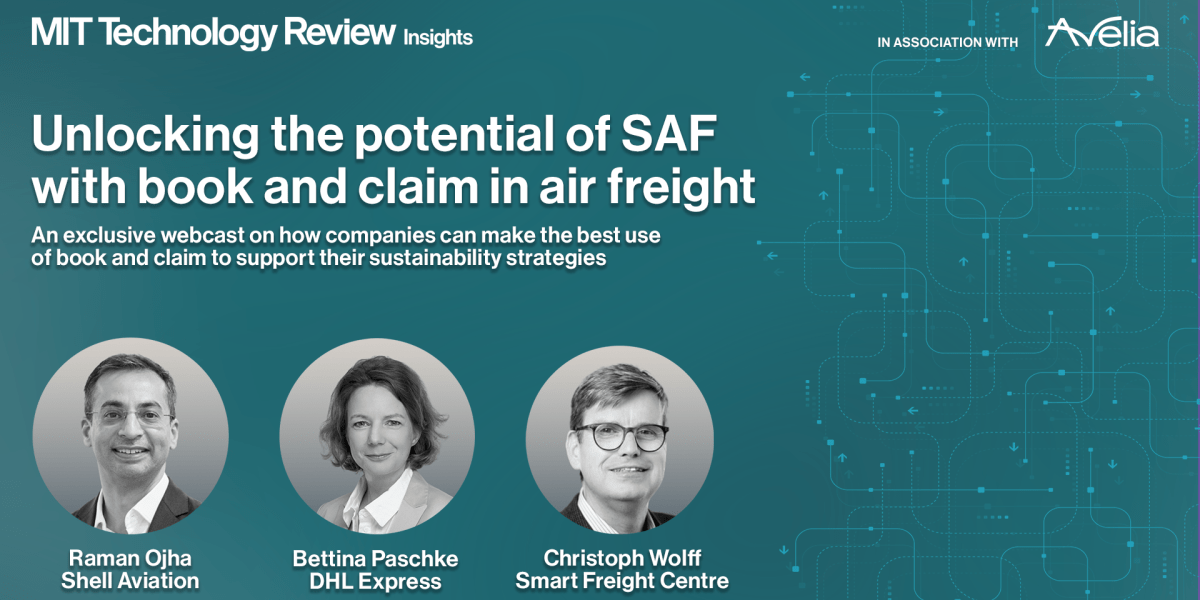
In association withAvelia Emissions from air freight have increased by 25% since 2019, according to a 2024 analysis by environmental advocacy organization Stand.Earth. The researchers found that the expansion of cargo-only fleets to transport goods during the pandemic — as air travel halted, slower freight modes faced disruption, but demand for rapid delivery soared — has led to a yearly increase of almost 20 million tons of carbon dioxide, making up 93.8m tonnes from air freight overall. [embedded content] And though fleet modernization and operational improvements by freight operators have contributed to ongoing decarbonization efforts, sustainable aviation fuel (SAF) looks set to be instrumental in helping the sector achieve its ambitions to reduce environmental footprint in the long-term. When used neat, or pure and unblended, SAF can help reduce the life cycle of greenhouse gas emissions from aviation by as much as 80% relative to conventional fuel. It’s why the International Air Transport Association (IATA) estimates that SAF could account for as much as 65% of total reduction of emissions. For Christoph Wolff, CEO of the Smart Freight Centre, “SAF is the main pathway” to decarbonization across both freight and the wider aviation ecosystem. “The great thing about SAF is it’s chemically identical to Jet A fuel,” he says. “You can blend it [which means] you have a pathway to ramp it up. You can start small and you can scale it. By scaling it there is the promise or the hope that the price comes down.” At at least twice the price of conventional jet fuel, cost is a significant barrier hindering broader adoption. And it isn’t the only one standing between SAF and wider penetration. Bridging the gap between a concentrated supply of SAF and global demand also remains a major hurdle. Though the number of verified SAF outlets has increased from fewer than 20 locations in 2021 to 114 as of April 2025, according to sustainability solutions framework 4Air, that accounts for only 92 airports worldwide out of more than 40,000. “SAF is central to the decarbonization of the aviation sector,” believes Raman Ojha, president of Shell Aviation. “Having said that, adoption and penetration of SAF hasn’t really picked up massively. It’s not due to lack of production capacity, but there are lots of things that are at play. And book and claim in that context helps to bridge that gap.” Bridging the gap with book and claim Book and claim is a chain of custody model, where the flow of administrative records is not necessarily connected to the physical product through the supply chain (source: ISO 22095:2020). Book and claim potentially enables airlines and corporations to access the life cycle GHG emissions reduction benefits of SAF relative to conventional jet fuel even when SAF is not physically available at their location; this model helps bridge the gap between that concentrated supply and global demand, until SAF’s availability improves. “To be bold, without book and claim, no short-term science-based target will be achieved,” says Bettina Paschke, vice president of ESG accounting, reporting and controlling at DHL Express. “Book and claim is essential to achieving science-based targets.” “SAF production facilities are not everywhere,” she reiterates. “They’re very focused on one location, and if a customer wants to fulfil a mass balance obligation, SAF would need to be shipped around the world just to be at that airport for that customer. That would be very complicated, and very unrealistic.” It would also, counterintuitively, increase total emissions. By using book and claim instead, air freight operators can unlock the life cycle greenhouse gas emissions reduction benefits of SAF relative to conventional jet fuel now, without waiting for supply to broaden. “It might no longer be needed when we have SAF product facilities at each airport in the future,” she points out. “But at the moment, that’s not the case.” At DHL itself, the mechanism has become central to achieving its own three interconnected sustainability pillars, which focus on decarbonizing logistics supply chains, supporting customers toward their decarbonization goals, and ensuring credible emission claims can be shared along the value chain. Demonstrating the importance of a credible and viable framework for book and claim systems is also what inspired the 2022 launch of Shell’s Avelia, one of the first blockchain-powered digital SAF book and claim solutions for aviation, which expanded in 2024 to encompass air freight in addition to business travel. Depending on the offering, Avelia offers freight forwarders the opportunity to share the life cycle greenhouse gas emissions reduction benefits of SAF relative to conventional jet fuel across the value chain with shippers using their services. “It’s also backed by a physical supply chain, which gives our customers — whether those be corporates or freight forwarders or even airlines — a peace of mind that the SAF has been injected at a certain airport, it’s been used and environmental attributes, with the help of blockchain, have been tracked to where they’re getting retired,” says Ojha. He adds: “The most important or critical part is the transparency that it’s providing to our customers to be sure that they’re not saying something which they can’t confidently stand behind.” Moving beyond early adoption To scale up SAF via book and claim and help make it a more commercially viable lower-carbon solution, its adoption will need to be a coordinated “ecosystem play,” says Wolff. That includes early adopters, such as DHL, inspiring action from peers, solution providers such as Shell, working with various stakeholders to drive joint advocacy, and industry associations, like the Smart Freight Centre creating the required frameworks, educational resources, and industry alignment. An active book and claim community made up of many forward-thinking advocates is already driving much of this work forward with a common goal to develop greater standardization and consensus, Wolff points out. “It helps to make sure all definitions on the system are compatible and they can talk to one another, provide educational support, and [also that] there’s a repository of transactions so that it can be documented in a way that people can see and think, ‘oh this is how we do it.’ There are some early adopters that are very experienced, but it needs a lot more people for it to get comfortable.” In early 2024, discussions were held with a diverse group of expert book and claim stakeholders to develop and refine 11 key principles and best practices book and claim models. These represent an aligned set of principles informed by practical successes and challenges faced by practitioners working to decarbonize the heavy transport sector. Adherence to such a framework is crucial given that book and claim is not yet accepted by the Greenhouse Gas (GHG) Protocol nor the Science Based Targets Initiative (SBTi) as a recognized model for reducing greenhouse gas emissions — though there are hopes that might change. “The industrialization of book and claim delivery systems is key to credibility and recognition,” says Wolff. “The Greenhouse Gas Protocol and the Science Based Targets Initiative are making steps in recognizing that. There’s a pathway that the Smart Freight Centre is very closely involved in the technical working groups for [looking]to build such a system where, in addition to physical inventory, you also pursue market-based inventories.” Paschke urges companies not to sit back and wait for policy to change before taking action, though. “The solution is there,” she says. “There are companies like DHL that are making huge upfront investments, and every single contribution helps to scale the industry and give a strong signal to the eco-space.” As pressure to accelerate decarbonization gains pace, it’s critical that air freight operators consider this now, agrees Ojha. “Don’t wait for perfection in guidelines, regulations, or platforms — act now,” he says. “That’s very, very critical. Second, learn by doing and join hands with others. Don’t try to do everything independently or in-house. “Third, make use of registries and platforms, such as Avelia, that can give credibility. Join them, utilize them, and leverage them so that you won’t have to establish auditability from scratch. “And fourth, don’t look at scope book and claim as a means for acquiring a certificate for environmental attributes. Think in terms of your decarbonisation commitment and think of this as a tool for exposure management. Think in terms of the bigger picture.” That bigger picture being a significant sector-wide push toward faster decarbonization — and turning the tide on emissions’ steep upward ascent. Watch the full webcast. This content was produced by Insights, the custom content arm of MIT Technology Review. It was not written by MIT Technology Review’s editorial staff. It was researched, designed, and written by human writers, editors, analysts, and illustrators. This includes the writing of surveys and collection of data for surveys. AI tools that may have been used were limited to secondary production processes that passed thorough human review. This content is produced by MIT Technology Review Insights in association with Avelia. Avelia is a Shell owned solution and brand that was developed with support from Amex GBT, Accenture and Energy Web Foundation. The views from individuals not affiliated with Shell are their own and not those of Shell PLC or its affiliates. Cautionary note | Shell Global

In association withAvelia

Emissions from air freight have increased by 25% since 2019, according to a 2024 analysis by environmental advocacy organization Stand.Earth.

The researchers found that the expansion of cargo-only fleets to transport goods during the pandemic — as air travel halted, slower freight modes faced disruption, but demand for rapid delivery soared — has led to a yearly increase of almost 20 million tons of carbon dioxide, making up 93.8m tonnes from air freight overall.

[embedded content]

And though fleet modernization and operational improvements by freight operators have contributed to ongoing decarbonization efforts, sustainable aviation fuel (SAF) looks set to be instrumental in helping the sector achieve its ambitions to reduce environmental footprint in the long-term.

When used neat, or pure and unblended, SAF can help reduce the life cycle of greenhouse gas emissions from aviation by as much as 80% relative to conventional fuel. It’s why the International Air Transport Association (IATA) estimates that SAF could account for as much as 65% of total reduction of emissions.

For Christoph Wolff, CEO of the Smart Freight Centre, “SAF is the main pathway” to decarbonization across both freight and the wider aviation ecosystem.

“The great thing about SAF is it’s chemically identical to Jet A fuel,” he says. “You can blend it [which means] you have a pathway to ramp it up. You can start small and you can scale it. By scaling it there is the promise or the hope that the price comes down.”

At at least twice the price of conventional jet fuel, cost is a significant barrier hindering broader adoption.

And it isn’t the only one standing between SAF and wider penetration.

Bridging the gap between a concentrated supply of SAF and global demand also remains a major hurdle.

Though the number of verified SAF outlets has increased from fewer than 20 locations in 2021 to 114 as of April 2025, according to sustainability solutions framework 4Air, that accounts for only 92 airports worldwide out of more than 40,000.

“SAF is central to the decarbonization of the aviation sector,” believes Raman Ojha, president of Shell Aviation. “Having said that, adoption and penetration of SAF hasn’t really picked up massively. It’s not due to lack of production capacity, but there are lots of things that are at play. And book and claim in that context helps to bridge that gap.”

Bridging the gap with book and claim

Book and claim is a chain of custody model, where the flow of administrative records is not necessarily connected to the physical product through the supply chain (source: ISO 22095:2020).

Book and claim potentially enables airlines and corporations to access the life cycle GHG emissions reduction benefits of SAF relative to conventional jet fuel even when SAF is not physically available at their location; this model helps bridge the gap between that concentrated supply and global demand, until SAF’s availability improves.

“To be bold, without book and claim, no short-term science-based target will be achieved,” says Bettina Paschke, vice president of ESG accounting, reporting and controlling at DHL Express. “Book and claim is essential to achieving science-based targets.”

“SAF production facilities are not everywhere,” she reiterates. “They’re very focused on one location, and if a customer wants to fulfil a mass balance obligation, SAF would need to be shipped around the world just to be at that airport for that customer. That would be very complicated, and very unrealistic.” It would also, counterintuitively, increase total emissions. By using book and claim instead, air freight operators can unlock the life cycle greenhouse gas emissions reduction benefits of SAF relative to conventional jet fuel now, without waiting for supply to broaden. “It might no longer be needed when we have SAF product facilities at each airport in the future,” she points out. “But at the moment, that’s not the case.”

At DHL itself, the mechanism has become central to achieving its own three interconnected sustainability pillars, which focus on decarbonizing logistics supply chains, supporting customers toward their decarbonization goals, and ensuring credible emission claims can be shared along the value chain.

Demonstrating the importance of a credible and viable framework for book and claim systems is also what inspired the 2022 launch of Shell’s Avelia, one of the first blockchain-powered digital SAF book and claim solutions for aviation, which expanded in 2024 to encompass air freight in addition to business travel. Depending on the offering, Avelia offers freight forwarders the opportunity to share the life cycle greenhouse gas emissions reduction benefits of SAF relative to conventional jet fuel across the value chain with shippers using their services.

“It’s also backed by a physical supply chain, which gives our customers — whether those be corporates or freight forwarders or even airlines — a peace of mind that the SAF has been injected at a certain airport, it’s been used and environmental attributes, with the help of blockchain, have been tracked to where they’re getting retired,” says Ojha.

He adds: “The most important or critical part is the transparency that it’s providing to our customers to be sure that they’re not saying something which they can’t confidently stand behind.”

Moving beyond early adoption

To scale up SAF via book and claim and help make it a more commercially viable lower-carbon solution, its adoption will need to be a coordinated “ecosystem play,” says Wolff. That includes early adopters, such as DHL, inspiring action from peers, solution providers such as Shell, working with various stakeholders to drive joint advocacy, and industry associations, like the Smart Freight Centre creating the required frameworks, educational resources, and industry alignment.

An active book and claim community made up of many forward-thinking advocates is already driving much of this work forward with a common goal to develop greater standardization and consensus, Wolff points out. “It helps to make sure all definitions on the system are compatible and they can talk to one another, provide educational support, and [also that] there’s a repository of transactions so that it can be documented in a way that people can see and think, ‘oh this is how we do it.’ There are some early adopters that are very experienced, but it needs a lot more people for it to get comfortable.”

In early 2024, discussions were held with a diverse group of expert book and claim stakeholders to develop and refine 11 key principles and best practices book and claim models. These represent an aligned set of principles informed by practical successes and challenges faced by practitioners working to decarbonize the heavy transport sector.

Adherence to such a framework is crucial given that book and claim is not yet accepted by the Greenhouse Gas (GHG) Protocol nor the Science Based Targets Initiative (SBTi) as a recognized model for reducing greenhouse gas emissions — though there are hopes that might change.

“The industrialization of book and claim delivery systems is key to credibility and recognition,” says Wolff. “The Greenhouse Gas Protocol and the Science Based Targets Initiative are making steps in recognizing that. There’s a pathway that the Smart Freight Centre is very closely involved in the technical working groups for [looking]to build such a system where, in addition to physical inventory, you also pursue market-based inventories.”

Paschke urges companies not to sit back and wait for policy to change before taking action, though. “The solution is there,” she says. “There are companies like DHL that are making huge upfront investments, and every single contribution helps to scale the industry and give a strong signal to the eco-space.”

As pressure to accelerate decarbonization gains pace, it’s critical that air freight operators consider this now, agrees Ojha. “Don’t wait for perfection in guidelines, regulations, or platforms — act now,” he says. “That’s very, very critical. Second, learn by doing and join hands with others. Don’t try to do everything independently or in-house.

“Third, make use of registries and platforms, such as Avelia, that can give credibility. Join them, utilize them, and leverage them so that you won’t have to establish auditability from scratch.

“And fourth, don’t look at scope book and claim as a means for acquiring a certificate for environmental attributes. Think in terms of your decarbonisation commitment and think of this as a tool for exposure management. Think in terms of the bigger picture.”

That bigger picture being a significant sector-wide push toward faster decarbonization — and turning the tide on emissions’ steep upward ascent.

Watch the full webcast.

This content was produced by Insights, the custom content arm of MIT Technology Review. It was not written by MIT Technology Review’s editorial staff. It was researched, designed, and written by human writers, editors, analysts, and illustrators. This includes the writing of surveys and collection of data for surveys. AI tools that may have been used were limited to secondary production processes that passed thorough human review.

This content is produced by MIT Technology Review Insights in association with Avelia. Avelia is a Shell owned solution and brand that was developed with support from Amex GBT, Accenture and Energy Web Foundation. The views from individuals not affiliated with Shell are their own and not those of Shell PLC or its affiliates. Cautionary note | Shell Global

Shape
Shape
Stay Ahead

Explore More Insights

Stay ahead with more perspectives on cutting-edge power, infrastructure, energy,  bitcoin and AI solutions. Explore these articles to uncover strategies and insights shaping the future of industries.

Shape

Scattered network data impedes automation efforts

Solution: Proof-of-concept mindset Smaller companies and deep network engineering teams can often succeed with a homegrown or open-source NSoT solution, at least at in the early stages of a network automation strategy. As complexity, scale, and diversity of use cases grow, many network teams will need to partner with a

Read More »

Cisco routers knocked out due to Cloudflare DNS change

Exposes architectural fragility Networking consultant Yvette Schmitter, CEO of the Fusion Collective consulting firm, said the Cloudflare change “exposed Cisco’s architectural fragility when [some Cisco] switches worldwide entered fatal reboot loops every 10-30 minutes.” What happened? “Cloudflare changed record ordering. Cisco’s firmware, instead of handling unexpected DNS responses gracefully, treated

Read More »

North America Adds Almost 100 Rigs Week on Week

North America added 94 rigs week on week, according to Baker Hughes’ latest North America rotary rig count, which was published on January 9. Although the total U.S. rig count dropped by two week on week, the total Canada rig count increased by 96 during the same period, pushing the total North America rig count up to 741, comprising 544 rigs from the U.S. and 197 rigs from Canada, the count outlined. Of the total U.S. rig count of 544, 525 rigs are categorized as land rigs, 16 are categorized as offshore rigs, and three are categorized as inland water rigs. The total U.S. rig count is made up of 409 oil rigs, 124 gas rigs, and 11 miscellaneous rigs, according to Baker Hughes’ count, which revealed that the U.S. total comprises 475 horizontal rigs, 57 directional rigs, and 12 vertical rigs. Week on week, the U.S. land rig count dropped by two, and its offshore and inland water rig counts remained unchanged, Baker Hughes highlighted. The U.S. oil rig count dropped by three week on week, its gas rig count dropped by one, and its miscellaneous rig count increased by two week on week, the count showed. The U.S. horizontal rig count dropped by one, its vertical rig count dropped by two, and its directional rig count increased by one, week on week, the count revealed. A major state variances subcategory included in the rig count showed that, week on week, Louisiana dropped three rigs, and New Mexico, North Dakota, Texas, and Wyoming each dropped one rig. Utah added four rigs and Colorado added one rig week on week, the count highlighted. A major basin variances subcategory included in the rig count showed that, week on week, the Permian basin dropped three rigs, the Haynesville, Mississippian, and Williston basins

Read More »

Intensity, Rainbow Near FID on North Dakota Gas Pipeline

Intensity Infrastructure Partners LLC and power producer Rainbow Energy Center LLC have indicated they are nearing a positive final investment decision (FID) on a new pipeline project to bring Bakken natural gas to eastern North Dakota. “[T]he firm transportation commitments contained in executed precedent agreements are sufficient to underpin the decision to advance Phase I of their 36-inch natural gas pipeline in North Dakota, reflecting growing confidence in the region’s long-term power and industrial demand outlook”, the companies said in a joint statement. “This approach establishes a scalable, dispatchable power and gas delivery hub capable of adapting to evolving market conditions, supporting sustained data center growth, grid reliability needs and long-term industrial development across North Dakota”. “The system will provide reliable natural gas supply through multiple receipt points, including Northern Border Pipeline, WBI Energy’s existing transmission and storage network, and direct connections to six Bakken natural gas processing plants, creating a highly integrated supply platform from Bakken and Canadian production”, the online statement added. “The pipeline is designed to operate without compression fuel surcharges, reducing operational complexity while enhancing reliability and tariff transparency for shippers. “Uncommitted capacity on phase I supports incremental gas-fired generation along the planned pipeline corridor and at Coal Creek Station, leveraging existing power transmission infrastructure, a strategic geographic location and a proven operating platform. “The 36-inch pipeline enables future throughput increases without the need for duplicative greenfield infrastructure as demand continues to develop”. Rainbow chief executive Stacy Tschider said, “By leveraging established assets like Coal Creek and integrating directly with basin supply and interstate systems, this project is positioned to meet near-term needs while remaining expandable for the next generation of load growth”. The project would proceed in two phases. Phase 1 would build a 136-mile, 36-inch pipeline with a capacity of about 1.1 million dekatherms a day (Dthd). The phase 1 line would

Read More »

WoodMac Sees USA Tight Oil Output Shrinking in 2026

In an insight report released recently, analysts at Wood Mackenzie outlined that U.S. tight oil production “will shrink without a crash event for the first time” in 2026. “Holding oil production flat in the U.S. today requires over two million barrels per day of new supply,” the analysts said in the report. “We expect output to fall by 200,000 barrels per day in 2026 with WTI prices 20 percent lower than 2025,” they added. “This signal could change market mentality and bolster international conventional investment plans. But caution is still needed. That 2026 tight oil deficit is filled by Guyana alone, and U.S. liquids will return to growth in 2028,” the Wood Mackenzie analysts continued. In its latest short term energy outlook (STEO) at the time of writing, which was released back in December 2025, the U.S. Energy Information Administration (EIA) showed that Lower 48 States crude oil production, including lease condensate and excluding the Gulf of America, would drop from an average of 11.29 million barrels per day in 2025 to an average of 11.11 million barrels per day in 2026. This production came in at 11.03 million barrels per day in 2024, the EIA’s December STEO highlighted. Total U.S. crude oil production, including lease condensate, was projected to drop from an average of 13.61 million barrels per day in 2025 to an average of 13.53 million barrels per day in 2026 in that STEO. Total U.S. crude oil output, including lease condensate, averaged 13.23 million barrels per day in 2024, the EIA’s latest STEO at the time of writing showed. The EIA’s next STEO is scheduled to be released on January 13. In the Wood Mackenzie report, the analysts also predicted a shale gas “renaissance” in the U.S. this year. “As LNG FIDs have come thick and fast,

Read More »

Tamboran Names New CEO

Tamboran Resources Corp has appointed Todd Abbott, former chief operating officer (COO) of Seneca Resources Co LLC, as chief executive officer (CEO) effective January 15. Abbott takes over from interim CEO Richard Stoneburner, who remains chair. Stoneburner assumed the role of interim CEO in the third quarter of 2025 following Joe Riddle’s resignation. “Abbott has over 25 years’ upstream oil and gas experience spanning unconventional shale operations, business planning, corporate finance and strategy”, Tamboran said in an online statement. Before becoming COO of Seneca Resources, where he gained Appalachian Basin experience, Abbott was part of Marathon Oil Corp and Pioneer Natural Resources Co. At Marathon and Pioneer, Abbott had oversight of Permian Basin, Eagle Ford and Alaskan operations, Tamboran noted. “His background at Seneca, Marathon and Pioneer demonstrates an ability to improve productivity while lowering costs, which aligns with our focus on safe and efficient execution and delivering value for shareholders from our Beetaloo Basin development”, Stoneburner said. Abbott said, “The scale and opportunity that Tamboran has in the Beetaloo Basin, supported by the quality of the board and management team, is what has attracted me to the CEO role”. Abbott takes over what would be an enlarged Tamboran, which is in the process of completing the acquisition of Falcon Oil & Gas Ltd. On September 30, 2025, Sydney-based Tamboran and British Columbia-incorporated Falcon announced a definitive merger agreement that they said would create a leading position of about 2.9 million net acres in the Beetaloo sub-basin onshore Australia’s Northern Territory. “The acquisition is accretive to Tamboran stockholders given the implied acreage value of $169 per acre reflects a four percent discount to Tamboran’s current implied acreage value of $176 per acre”, a joint statement said. Tamboran and Falcon are already partners through the Beetaloo Joint Venture, which last year sanctioned the

Read More »

Distributed load flexibility: The overlooked relief valve for the grid

Utility leaders are managing a hard reality. Load is growing faster than the grid was built to handle, increasing the likelihood of costly upgrades and rate pressure. AI-driven data center development is making headlines as a major source of load growth. These projects are large, fast-moving and highly visible, drawing public attention and political scrutiny. Utilities and commissions are now facing the question: “How do we add capacity quickly, without overbuilding the grid and pushing costs into rates?” One of the most promising answers is leveraging distributed load flexibility. With distribution-level orchestration, this flexibility can enable utilities to serve growing loads on existing distribution infrastructure, supporting affordability for all customers. Bottom-up load growth requires bottom-up solutions Distributed load flexibility refers to the growing share of new electricity demand that is spatially distributed across the grid and can be shifted temporally. The flexibility opportunity now includes electric vehicles, batteries, heat pumps, smart water heaters and connected building systems. These grid-edge devices are distributed across homes, workplaces and commercial zones. Adoption of these resources is accelerating and many already respond to price signals and automation. Managed EV charging is a common example. A vehicle may be plugged in overnight but only needs a few hours of charging. When charging is scheduled to avoid bottlenecks, that flexibility becomes a real capacity tool for the utility. However, many programs, price signals and planning tools were designed for bulk system needs. Time-of-use rates and demand response reduce system peaks by telling every device to do the same thing: shift away from the bulk system peak. The “just shift it off-peak” solution misses a significant risk. Flexibility without orchestration simply moves the problem rather than solving it. EV charging can synchronize around the same low-cost hours. Batteries can do the same if they charge in identical

Read More »

What lies below? Beneath our streets lies treasure — and trouble.

For decades, municipalities and utility companies have buried water mains, gas lines, fiber optic conduits, power cables and other vital infrastructure under streets and sidewalks. Burying these systems improves safety, reliability and aesthetics, but it also creates a long-term problem: once installed, many of these utilities become practically invisible. The ground protects and hides them, but over time the memory of where they run becomes foggy. Records age, streets are widened or rerouted and even highly accurate GPS coordinates can drift or lose relevance as the surface infrastructure changes. The result? What was once a known network of pipes and cables becomes a metaphorical “lost treasure.” When crews dig — for maintenance, upgrades or new construction — that invisibility can turn into a disaster. Minor incidents are common: broken lines that cause service disruptions and headaches. But sometimes the consequences are far worse: ruptured gas mains, flooding from damaged water or sewer lines, or severed fiber cables; all capable of causing serious safety hazards, costly repairs and major public inconvenience. The limitations of “traditional” locating Historically, locating buried plant often relied on conductive materials (metal pipes, conduits or tracer wires). These can be detected with standard locating equipment. But since the 1970s, many new installations, especially gas, water and fiber optic conduits, have been built using nonconductive materials such as PVC or HDPE. When utilities are nonconductive, conventional electromagnetic locators often fail. In blind trials (McMahon, 2000) using standard survey methods, as much as half of all subsurface utilities were missed. [AC1] Additionally, PHMSA (Pipeline Hazardous Materials Safety Administration) has reported (PHMSA, 2025) an average cost of $594,218,469 over the past three years for gas utility pipeline incidents with an average of 11 deaths and 30 injuries. More expensive and specialized methods exist such as ground penetrating radar (GPR), but these have

Read More »

AI, edge, and security: Shaping the need for modern infrastructure management

The rapidly evolving IT landscape, driven by artificial intelligence (AI), edge computing, and rising security threats, presents unprecedented challenges in managing compute infrastructure. Traditional management tools struggle to provide the necessary scalability, visibility, and automation to keep up with business demand, leading to inefficiencies and increased business risk. Yet organizations need their IT departments to be strategic business partners that enable innovation and drive growth. To realize that goal, IT leaders should rethink the status quo and free up their teams’ time by adopting a unified approach to managing infrastructure that supports both traditional and AI workloads. It’s a strategy that enables companies to simplify IT operations and improve IT job satisfaction. 5 IT management challenges of the AI era Cisco recently commissioned Forrester Consulting to conduct a Total Economic Impact™ analysis of Cisco Intersight. This IT operations platform provides visibility, control, and automation capabilities for the Cisco Unified Computing System (Cisco UCS), including Cisco converged, hyperconverged, and AI-ready infrastructure solutions across data centers, colocation facilities, and edge environments. Intersight uses a unified policy-driven approach to infrastructure management and integrates with leading operating systems, storage providers, hypervisors, and third-party IT service management and security tools. The Forrester study first uncovered the issues IT groups are facing: Difficulty scaling: Manual, repetitive processes cause lengthy IT compute infrastructure build and deployment times. This challenge is particularly acute for organizations that need to evolve infrastructure to support traditional and AI workloads across data centers and distributed edge environments. Architectural specialization and AI workloads: AI is altering infrastructure requirements, Forrester found.  Companies design systems to support specific AI workloads — such as data preparation, model training, and inferencing — and each demands specialized compute, storage, and networking capabilities. Some require custom chip sets and purpose-built infrastructure, such as for edge computing and low-latency applications.

Read More »

DCF Poll: Analyzing AI Data Center Growth

@import url(‘https://fonts.googleapis.com/css2?family=Inter:[email protected]&display=swap’); a { color: var(–color-primary-main); } .ebm-page__main h1, .ebm-page__main h2, .ebm-page__main h3, .ebm-page__main h4, .ebm-page__main h5, .ebm-page__main h6 { font-family: Inter; } body { line-height: 150%; letter-spacing: 0.025em; font-family: Inter; } button, .ebm-button-wrapper { font-family: Inter; } .label-style { text-transform: uppercase; color: var(–color-grey); font-weight: 600; font-size: 0.75rem; } .caption-style { font-size: 0.75rem; opacity: .6; } #onetrust-pc-sdk [id*=btn-handler], #onetrust-pc-sdk [class*=btn-handler] { background-color: #1796c1 !important; border-color: #1796c1 !important; } #onetrust-policy a, #onetrust-pc-sdk a, #ot-pc-content a { color: #1796c1 !important; } #onetrust-consent-sdk #onetrust-pc-sdk .ot-active-menu { border-color: #1796c1 !important; } #onetrust-consent-sdk #onetrust-accept-btn-handler, #onetrust-banner-sdk #onetrust-reject-all-handler, #onetrust-consent-sdk #onetrust-pc-btn-handler.cookie-setting-link { background-color: #1796c1 !important; border-color: #1796c1 !important; } #onetrust-consent-sdk .onetrust-pc-btn-handler { color: #1796c1 !important; border-color: #1796c1 !important; } Coming out of 2025, AI data center development remains defined by momentum. But momentum is not the same as certainty. Behind the headlines, operators, investors, utilities, and policymakers are all testing the assumptions that carried projects forward over the past two years, from power availability and capital conditions to architecture choices and community response. Some will hold. Others may not. To open our 2026 industry polling, we’re taking a closer look at which pillars of AI data center growth are under the most pressure. What assumption about AI data center growth feels most fragile right now?

Read More »

JLL’s 2026 Global Data Center Outlook: Navigating the AI Supercycle, Power Scarcity and Structural Market Transformation

Sovereign AI and National Infrastructure Policy JLL frames artificial intelligence infrastructure as an emerging national strategic asset, with sovereign AI initiatives representing an estimated $8 billion in cumulative capital expenditure by 2030. While modest relative to hyperscale investment totals, this segment carries outsized strategic importance. Data localization mandates, evolving AI regulation, and national security considerations are increasingly driving governments to prioritize domestic compute capacity, often with pricing premiums reaching as high as 60%. Examples cited across Europe, the Middle East, North America, and Asia underscore a consistent pattern: digital sovereignty is no longer an abstract policy goal, but a concrete driver of data center siting, ownership structures, and financing models. In practice, sovereign AI initiatives are accelerating demand for locally controlled infrastructure, influencing where capital is deployed and how assets are underwritten. For developers and investors, this shift introduces a distinct set of considerations. Sovereign projects tend to favor jurisdictional alignment, long-term tenancy, and enhanced security requirements, while also benefiting from regulatory tailwinds and, in some cases, direct state involvement. As AI capabilities become more tightly linked to economic competitiveness and national resilience, policy-driven demand is likely to remain a durable (if specialized) component of global data center growth. Energy and Sustainability as the Central Constraint Energy availability emerges as the report’s dominant structural constraint. In many major markets, average grid interconnection timelines now extend beyond four years, effectively decoupling data center development schedules from traditional utility planning cycles. As a result, operators are increasingly pursuing alternative energy strategies to maintain project momentum, including: Behind-the-meter generation Expanded use of natural gas, particularly in the United States Private-wire renewable energy projects Battery energy storage systems (BESS) JLL points to declining battery costs, seen falling below $90 per kilowatt-hour in select deployments, as a meaningful enabler of grid flexibility, renewable firming, and

Read More »

SoftBank, DigitalBridge, and Stargate: The Next Phase of OpenAI’s Infrastructure Strategy

OpenAI framed Stargate as an AI infrastructure platform; a mechanism to secure long-duration, frontier-scale compute across both training and inference by coordinating capital, land, power, and supply chain with major partners. When OpenAI announced Stargate in January 2025, the headline commitment was explicit: an intention to invest up to $500 billion over four to five years to build new AI infrastructure in the U.S., with $100 billion targeted for near-term deployment. The strategic backdrop in 2025 was straightforward. OpenAI’s model roadmap—larger models, more agents, expanded multimodality, and rising enterprise workloads—was driving a compute curve increasingly difficult to satisfy through conventional cloud procurement alone. Stargate emerged as a form of “control plane” for: Capacity ownership and priority access, rather than simply renting GPUs. Power-first site selection, encompassing grid interconnects, generation, water access, and permitting. A broader partner ecosystem beyond Microsoft, while still maintaining a working relationship with Microsoft for cloud capacity where appropriate. 2025 Progress: From Launch to Portfolio Buildout January 2025: Stargate Launches as a National-Scale Initiative OpenAI publicly launched Project Stargate on Jan. 21, 2025, positioning it as a national-scale AI infrastructure initiative. At this early stage, the work was less about construction and more about establishing governance, aligning partners, and shaping a public narrative in which compute was framed as “industrial policy meets real estate meets energy,” rather than simply an exercise in buying more GPUs. July 2025: Oracle Partnership Anchors a 4.5-GW Capacity Step On July 22, 2025, OpenAI announced that Stargate had advanced through a partnership with Oracle to develop 4.5 gigawatts of additional U.S. data center capacity. The scale of the commitment marked a clear transition from conceptual ambition to site- and megawatt-level planning. A figure of this magnitude reshaped the narrative. At 4.5 GW, Stargate forced alignment across transformers, transmission upgrades, switchgear, long-lead cooling

Read More »

Lenovo unveils purpose-built AI inferencing servers

There is also the Lenovo ThinkSystem SR650i, which offers high-density GPU computing power for faster AI inference and is intended for easy installation in existing data centers to work with existing systems. Finally, there is the Lenovo ThinkEdge SE455i for smaller, edge locations such as retail outlets, telecom sites, and industrial facilities. Its compact design allows for low-latency AI inference close to where data is generated and is rugged enough to operate in temperatures ranging from -5°C to 55°C. All of the servers include Lenovo’s Neptune air- and liquid-cooling technology and are available through the TruScale pay-as-you-go pricing model. In addition to the new hardware, Lenovo introduced new AI Advisory Services with AI Factory Integration. This service gives access to professionals for identifying, deploying, and managing best-fit AI Inferencing servers. It also launched Premier Support Plus, a service that gives professional assistance in data center management, freeing up IT resources for more important projects.

Read More »

Samsung warns of memory shortages driving industry-wide price surge in 2026

SK Hynix reported during its October earnings call that its HBM, DRAM, and NAND capacity is “essentially sold out” for 2026, while Micron recently exited the consumer memory market entirely to focus on enterprise and AI customers. Enterprise hardware costs surge The supply constraints have translated directly into sharp price increases across enterprise hardware. Samsung raised prices for 32GB DDR5 modules to $239 from $149 in September, a 60% increase, while contract pricing for DDR5 has surged more than 100%, reaching $19.50 per unit compared to around $7 earlier in 2025. DRAM prices have already risen approximately 50% year to date and are expected to climb another 30% in Q4 2025, followed by an additional 20% in early 2026, according to Counterpoint Research. The firm projected that DDR5 64GB RDIMM modules, widely used in enterprise data centers, could cost twice as much by the end of 2026 as they did in early 2025. Gartner forecast DRAM prices to increase by 47% in 2026 due to significant undersupply in both traditional and legacy DRAM markets, Chauhan said. Procurement leverage shifts to hyperscalers The pricing pressures and supply constraints are reshaping the power dynamics in enterprise procurement. For enterprise procurement, supplier size no longer guarantees stability. “As supply becomes more contested in 2026, procurement leverage will hinge less on volume and more on strategic alignment,” Rawat said. Hyperscale cloud providers secure supply through long-term commitments, capacity reservations, and direct fab investments, obtaining lower costs and assured availability. Mid-market firms rely on shorter contracts and spot sourcing, competing for residual capacity after large buyers claim priority supply.

Read More »

Microsoft will invest $80B in AI data centers in fiscal 2025

And Microsoft isn’t the only one that is ramping up its investments into AI-enabled data centers. Rival cloud service providers are all investing in either upgrading or opening new data centers to capture a larger chunk of business from developers and users of large language models (LLMs).  In a report published in October 2024, Bloomberg Intelligence estimated that demand for generative AI would push Microsoft, AWS, Google, Oracle, Meta, and Apple would between them devote $200 billion to capex in 2025, up from $110 billion in 2023. Microsoft is one of the biggest spenders, followed closely by Google and AWS, Bloomberg Intelligence said. Its estimate of Microsoft’s capital spending on AI, at $62.4 billion for calendar 2025, is lower than Smith’s claim that the company will invest $80 billion in the fiscal year to June 30, 2025. Both figures, though, are way higher than Microsoft’s 2020 capital expenditure of “just” $17.6 billion. The majority of the increased spending is tied to cloud services and the expansion of AI infrastructure needed to provide compute capacity for OpenAI workloads. Separately, last October Amazon CEO Andy Jassy said his company planned total capex spend of $75 billion in 2024 and even more in 2025, with much of it going to AWS, its cloud computing division.

Read More »

John Deere unveils more autonomous farm machines to address skill labor shortage

Join our daily and weekly newsletters for the latest updates and exclusive content on industry-leading AI coverage. Learn More Self-driving tractors might be the path to self-driving cars. John Deere has revealed a new line of autonomous machines and tech across agriculture, construction and commercial landscaping. The Moline, Illinois-based John Deere has been in business for 187 years, yet it’s been a regular as a non-tech company showing off technology at the big tech trade show in Las Vegas and is back at CES 2025 with more autonomous tractors and other vehicles. This is not something we usually cover, but John Deere has a lot of data that is interesting in the big picture of tech. The message from the company is that there aren’t enough skilled farm laborers to do the work that its customers need. It’s been a challenge for most of the last two decades, said Jahmy Hindman, CTO at John Deere, in a briefing. Much of the tech will come this fall and after that. He noted that the average farmer in the U.S. is over 58 and works 12 to 18 hours a day to grow food for us. And he said the American Farm Bureau Federation estimates there are roughly 2.4 million farm jobs that need to be filled annually; and the agricultural work force continues to shrink. (This is my hint to the anti-immigration crowd). John Deere’s autonomous 9RX Tractor. Farmers can oversee it using an app. While each of these industries experiences their own set of challenges, a commonality across all is skilled labor availability. In construction, about 80% percent of contractors struggle to find skilled labor. And in commercial landscaping, 86% of landscaping business owners can’t find labor to fill open positions, he said. “They have to figure out how to do

Read More »

2025 playbook for enterprise AI success, from agents to evals

Join our daily and weekly newsletters for the latest updates and exclusive content on industry-leading AI coverage. Learn More 2025 is poised to be a pivotal year for enterprise AI. The past year has seen rapid innovation, and this year will see the same. This has made it more critical than ever to revisit your AI strategy to stay competitive and create value for your customers. From scaling AI agents to optimizing costs, here are the five critical areas enterprises should prioritize for their AI strategy this year. 1. Agents: the next generation of automation AI agents are no longer theoretical. In 2025, they’re indispensable tools for enterprises looking to streamline operations and enhance customer interactions. Unlike traditional software, agents powered by large language models (LLMs) can make nuanced decisions, navigate complex multi-step tasks, and integrate seamlessly with tools and APIs. At the start of 2024, agents were not ready for prime time, making frustrating mistakes like hallucinating URLs. They started getting better as frontier large language models themselves improved. “Let me put it this way,” said Sam Witteveen, cofounder of Red Dragon, a company that develops agents for companies, and that recently reviewed the 48 agents it built last year. “Interestingly, the ones that we built at the start of the year, a lot of those worked way better at the end of the year just because the models got better.” Witteveen shared this in the video podcast we filmed to discuss these five big trends in detail. Models are getting better and hallucinating less, and they’re also being trained to do agentic tasks. Another feature that the model providers are researching is a way to use the LLM as a judge, and as models get cheaper (something we’ll cover below), companies can use three or more models to

Read More »

OpenAI’s red teaming innovations define new essentials for security leaders in the AI era

Join our daily and weekly newsletters for the latest updates and exclusive content on industry-leading AI coverage. Learn More OpenAI has taken a more aggressive approach to red teaming than its AI competitors, demonstrating its security teams’ advanced capabilities in two areas: multi-step reinforcement and external red teaming. OpenAI recently released two papers that set a new competitive standard for improving the quality, reliability and safety of AI models in these two techniques and more. The first paper, “OpenAI’s Approach to External Red Teaming for AI Models and Systems,” reports that specialized teams outside the company have proven effective in uncovering vulnerabilities that might otherwise have made it into a released model because in-house testing techniques may have missed them. In the second paper, “Diverse and Effective Red Teaming with Auto-Generated Rewards and Multi-Step Reinforcement Learning,” OpenAI introduces an automated framework that relies on iterative reinforcement learning to generate a broad spectrum of novel, wide-ranging attacks. Going all-in on red teaming pays practical, competitive dividends It’s encouraging to see competitive intensity in red teaming growing among AI companies. When Anthropic released its AI red team guidelines in June of last year, it joined AI providers including Google, Microsoft, Nvidia, OpenAI, and even the U.S.’s National Institute of Standards and Technology (NIST), which all had released red teaming frameworks. Investing heavily in red teaming yields tangible benefits for security leaders in any organization. OpenAI’s paper on external red teaming provides a detailed analysis of how the company strives to create specialized external teams that include cybersecurity and subject matter experts. The goal is to see if knowledgeable external teams can defeat models’ security perimeters and find gaps in their security, biases and controls that prompt-based testing couldn’t find. What makes OpenAI’s recent papers noteworthy is how well they define using human-in-the-middle

Read More »