
Stay Ahead, Stay ONMINE

Power First: AI Data Centers Become Energy Systems

For decades, data centers consumed electricity much like other large commercial customers: power arrived from the utility, while batteries and diesel generators stood behind it to protect the load. AI is starting to break that model. As data center campuses grow toward hundreds of megawatts and, in some cases, gigawatt scale, developers are increasingly taking […]

For decades, data centers consumed electricity much like other large commercial customers: power arrived from the utility, while batteries and diesel generators stood behind it to protect the load. AI is starting to break that model.

As data center campuses grow toward hundreds of megawatts and, in some cases, gigawatt scale, developers are increasingly taking responsibility for an energy system that once sat largely outside the data center boundary. Natural gas supply, onsite generation, fuel cells, batteries, controls and the behavior of the compute load itself are increasingly becoming parts of the same infrastructure system.

That was the central thread running through “Power First: The New Playbook for Delivering AI Data Centers,” an Aug. 4 session at the Data Center Frontier Trends Summit 2026 in Reston, Virginia.

Moderated by Fengrong Li, Senior Managing Director at FTI Consulting, the panel brought together Jim Summers, CEO of GPC Infrastructure; Shankar Achanta, EVP and Chief Product and Technology Officer at FuelCell Energy; Judith Judson, Executive Vice President at Calibrant Energy; and Yuval Bachar, Founder and CEO of EdgeCloudLink.

The discussion began with the immediate constraint — the grid cannot deliver capacity on the timetable AI developers increasingly require — but quickly moved beyond the familiar concept of “bridge power.”

The larger question was what happens when the data center itself becomes an energy system.

From Backup Power to Prime Power

Behind-the-meter generation is not new. What has changed is its role and scale.

“Traditionally, behind-the-meter generation has been for backup and the sizes were smaller,” Achanta said. “But what they’re seeing is the demand for the power is growing rapidly due to the data center load.”

Interconnection queues, transmission limitations and equipment supply constraints are pushing onsite generation into what Achanta called the “front seat,” supplying primary power rather than waiting behind the utility.

FuelCell Energy, for example, builds around modular 2.5 MW units and adds capacity incrementally. Achanta said customer discussions that once centered on roughly 10 MW are now reaching into the hundreds of megawatts.

That modularity changes more than plant size. Developers can energize portions of a campus while additional generation is still being installed, giving them another tool for managing schedule risk.

Li said she had recently toured a behind-the-meter project under construction in Texas at gigawatt scale, illustrating how far the concept has moved from its earlier role as a niche alternative.

But Achanta pushed against one increasingly common label for these projects: bridge power. “We don’t see it that way,” he said.

Once customers have operationalized onsite generation, he argued, those assets are unlikely simply to disappear when grid service arrives. They become part of the permanent power portfolio.

Bachar made the argument more starkly. The growth rate of the grid, he said, is no longer synchronized with either data center construction or the pace at which companies such as NVIDIA are changing the underlying compute technology.

In California, he said, developers can face utility-power timelines measured in years. “In seven years, this is not a relevant discussion,” Bachar said. “It’s just meaningless for us.”

His distinction was between two emerging versions of behind-the-meter infrastructure. At very large campuses, operators may effectively build a power station alongside the data center. At smaller facilities, generation can instead be distributed across isolated blocks, reducing the consequence of a failure in any single portion of the system.

That second model could become increasingly important as AI infrastructure expands beyond giant training campuses.

Bachar argued that the industry ultimately needs to solve not only the 1 GW campus in a rural power market, but the 25 MW to 35 MW inference site closer to cities and users. Those locations introduce their own constraints — air permits, noise, natural gas access and scarce utility capacity — while leaving developers less room to solve them.

The harder behind-the-meter problem may eventually be not just how to power a gigawatt campus in Texas, but how to deliver several dozen megawatts of AI capacity close to the markets where inference demand emerges.

Reliability Changes With the Load

Moving generation behind the meter also changes the reliability equation. Achanta noted that utility service is generally engineered to a lower availability level than the four or five nines expected from critical data center infrastructure.

Traditionally, operators have closed that gap with UPS systems and diesel backup. But simply reproducing every layer of the traditional architecture behind the meter could become prohibitively expensive.

“If you design your prime generation to meet all five nines, it’ll be extremely expensive,” Achanta said.

His preferred approach is what FuelCell Energy calls a layered architecture: handle the fastest load transients close to the compute through UPS systems or batteries, then work backward through generation and redundancy rather than overbuilding every component independently.

“Creating a grid behind the meter with all the Lego blocks that you have,” Achanta said.

Summers divided the reliability problem into two separate categories. The first is familiar: a forced outage in the generation fleet. The second is increasingly specific to AI: transient load management.

In a conventional environment, power consumption moves within reasonably predictable boundaries. AI training workloads can behave very differently.

“In an AI training scenario, that power may go from hundreds of megawatts to zero within milliseconds,” Summers said.

That creates a challenge not merely for utility infrastructure, but for turbines, reciprocating engines, batteries and the controls tying them together. It also changes how developers think about equipment size.

“If I put a 300-megawatt GE Frame 7 turbine, when that thing goes offline, half my data center just went out,” Summers said. “If I’m putting small reciprocating engines, and I lose one, you’re not going to notice.”

Upstream fuel reliability becomes another part of the same calculation. A natural-gas plant may be technically redundant yet still vulnerable if the project has not secured sufficiently firm gas transportation.

The result is a much broader definition of reliability encompassing prime mover selection, fuel contracts, transient management, controls, maintenance and physical redundancy.

Bachar argued that the industry now has an opportunity to reconsider the backup model entirely.

EdgeCloudLink favors what he described as an active-active architecture, in which generation and storage resources are continuously operating rather than leaving major assets idle until an outage occurs.

That approach also addresses one of the emerging implications of gigawatt-scale campuses: gigawatt-scale backup.

“If you have one gigawatt site and it drops it for eight hours, and let’s say you have a diesel gen backup, you activate the backup system,” Bachar said. “You know how long it’s gonna take to refuel eight hours of diesel?”

The question is increasingly whether the industry should maintain the traditional hierarchy of primary power followed by dormant backup, or design a system in which multiple resources continuously share the job.

Summers similarly left the diesel question open. “If you have a gigawatt campus, are you going to have a gigawatt of diesel generation?” he asked. “Is that logistically feasible?”

For now, he said, the industry is still wrestling with the answer.

Between the Grid and the Island

Yet the panel did not arrive at a simple conclusion that data centers should abandon the grid. In practice, the more likely architecture appears to sit somewhere between complete utility dependence and full islanding.

Li pushed the hybrid concept a step further, asking whether large data center operators could eventually function as a kind of “grid healing agent” — using behind-the-meter generation, storage and flexible load not only to protect their own operations, but to support the wider power system when capacity is available. In that model, onsite infrastructure becomes more than insurance against a constrained grid; it becomes a dispatchable resource that can help manage peaks, provide demand response and potentially create additional economic value for the data center.

Summers described the notion of complete utility dependence vs. full islanding as opposite ends of a spectrum.

Utility-only development remains constrained by aging transmission and generation infrastructure colliding with demand growth the system was not designed to absorb. Fully islanded infrastructure can solve time-to-power, but it creates an energy asset that may ultimately have value to the grid as well.

Summers argued that data centers are moving from being retail electricity customers toward behaving more like major industrial energy consumers. Historically, data centers could simply buy electricity through the local utility. As facilities have grown larger, he said, they have begun to resemble refineries, pulp and paper facilities and other major industrial users that have long managed substantial portions of their own energy supply.

That transition reaches far upstream. Developers must increasingly understand where fuel comes from, how it is transported and treated, how generation technology is selected, how equipment is financed, and how capital can be committed before a tenant is secured.

Projects GPC is working on, Summers said, range from roughly 50 MW to more than a gigawatt, and “there’s always an element of a grid component.”

“It may not be on day one,” he said. “We may not be entirely clear how it integrates, but it’s part of the solution.”

Summers compared the emerging model with cogeneration at refineries, chemical plants and other large industrial facilities, where onsite generation has long operated alongside the bulk power system.

The harder problem may be regulation. Rules being written today are largely attempts to manage reliability problems created by unprecedented load growth.

Summers argued that those rules will eventually need to evolve so onsite power can both meet the operational needs of the data center and become a useful resource to the broader grid.

“It’s going to be painful, I think, before we get all that sorted,” he said. “But I think that’s where we’re headed, is a fully integrated system.”

Judson said the economics of hybrid systems are already moving beyond conventional demand-response revenue. Calibrant worked on a Pacific Northwest data center project where onsite battery capacity allowed the facility to connect to the grid four years earlier than would otherwise have been possible.

That acceleration can be worth considerably more than payments earned by occasionally reducing demand. “Speed means revenue more quickly for that compute capacity,” Judson said.

Consider a 500 MW campus that can initially secure only 300 MW from the utility. If batteries or onsite generation allow the site to reduce consumption to 300 MW during constrained periods, it may be able to operate closer to its full 500 MW capacity through much of the year. Demand flexibility, in that case, becomes a capacity-development tool.

Achanta offered another version of the hybrid case. Even if a 100 MW project receives only 25 MW from the utility and builds the remaining 75 MW behind the meter, that modest grid connection can materially simplify the architecture. Batteries can be smaller. The grid connection itself can absorb some of the variability. Load shifting and energy-management software can coordinate the pieces.

“You use the grid as a battery,” Achanta said. That increasingly requires cooperation far beyond the generation vendor. FuelCell Energy recently announced work with Siemens intended to integrate the electrical architecture from prime generation toward the rack.

“We need to solve this as a whole, not just individual silos,” Achanta said.

AI Can Stress the Grid in Reverse

Hybrid systems introduce another complication. Data centers are commonly discussed as a threat to grid reliability because of how much power they consume. Bachar emphasized the opposite problem: what happens when an enormous load suddenly stops consuming?

Bachar pointed to a recent Virginia grid disturbance, saying data centers rapidly shifted away from utility power and removed hundreds of megawatts of load.

“What will happen if you’re on ERCOT, which is an island, and suddenly there is a fluctuation on the power and like 5 gigawatts gets off the grid in like milliseconds?” Bachar asked.

The point was less the exact hypothetical than the behavior it describes. A data center designed to protect its service-level agreements may switch away from troubled utility power almost instantly. At sufficient scale, that protective action itself becomes something grid operators must plan around.

More transmission and generation alone will not solve that problem, Bachar argued. Grid operations and the coordination between large computational loads and generation will also have to change.

That makes hybrid architecture more complicated than simply connecting an onsite plant to a utility feed. “You have to be very smart on how you do the hybrid,” Bachar said.

Judson similarly framed large computational loads as something that increasingly has to be managed as part of the power system rather than simply attached to it.

The emerging question is not just how the grid provides reliable service to the data center, but how the data center behaves when the grid itself is under stress.

Power, Cooling and Water Become One Design Problem

The same systems approach extends into cooling and water. Bachar argued that many new AI facilities are moving toward closed-loop liquid cooling systems with much lower operational water requirements than older evaporative designs.

Achanta said some fuel-cell technologies can even produce water through their electrochemical process, and suggested that onsite generation should be compared with the water consumed upstream by utility generation rather than considered in isolation.

Judson added that batteries themselves consume essentially no operational water, making storage-plus-generation architectures another option for reducing water use across the power system.

Summers urged a more nuanced calculation. Before founding GPC, he helped build H2O Midstream, which managed water infrastructure in the Permian Basin. His experience made him wary of treating water use as a simple technology scorecard.

Combined-cycle power plants use water to make steam, he noted, but they also extract more electricity from their fuel. A system selected primarily to avoid water may therefore introduce other efficiency tradeoffs.

“If we’re making choices from an optics perspective because it looks like it’s a sustainable solution, but we’re actually doing something so much less efficiently that we’re causing more energy to be used elsewhere, is that really the right balance?” Summers said.

The answer, he argued, requires examining water, energy efficiency, reuse and environmental impact across the full system.

The Last Constraint May Be Dependency

The panel closed with a problem familiar to developers attempting to turn ambitious power strategies into financed projects.

Major infrastructure must often be committed before a hyperscaler is willing to sign. Yet the interconnection work, gas laterals and generation equipment needed to establish a credible path to power can require hundreds of millions of dollars.

That creates a circular problem: developers need customer credit to finance the power, while customers want to see a credible power path before committing. Summers reduced the solution to one word: transparency.

“Laying your cards on the table, working alongside to solve these problems,” he said. “These are complex problems. They’re evolving. They require trust. They require partnership.”

If a hyperscaler wants to manage that complexity itself, Summers said, it needs to build an experienced team capable of understanding the full energy value chain. Otherwise, the better path may be to find partners willing to develop technical and commercial structures collaboratively.

Achanta similarly argued that developers and providers have to expose the full system requirements early: grid availability, generation, load characteristics and the actual use case. “This is a system solution,” he said.

Judson added the capital structure. Energy-as-a-service and tolling arrangements can help prevent a developer from carrying all of the stranded-asset risk before a tenant is secured.

Bachar put the lesson another way: reduce external dependencies wherever possible. “The lower number you have over there, the higher chances to succeed,” he said of the contractors, suppliers and organizations involved in a data center build.

That may ultimately be the defining feature of the power-first model. AI infrastructure has pushed power upstream in the development process, but simply securing generation is not enough. Fuel, electrical architecture, storage, cooling, compute behavior, regulation, capital and grid interaction increasingly have to be considered together.

What is emerging behind the meter is not a substitute utility so much as a new kind of data center architecture. The projects most likely to reach operation may be the ones that treat power not as another utility connection to procure, but as part of the data center architecture itself.


Shape
Shape
Stay Ahead

Explore More Insights

Stay ahead with more perspectives on cutting-edge power, infrastructure, energy,  bitcoin and AI solutions. Explore these articles to uncover strategies and insights shaping the future of industries.

Shape

It’s not your model — AI has a data movement problem

But that can be the wrong lever. When you examine the full end-to-end transaction, the model usually isn’t the problem. Take the extraordinary scale of AI traffic as it moves from a branch office to a centralized security stack, then to a cloud region, then to a data-hosted backend somewhere

Read More »

Energy Department Announces 2026 Ernest Orlando Lawrence Award Winners

WASHINGTON—U.S. Secretary of Energy Chris Wright today announced nine recipients of the prestigious Ernest Orlando Lawrence Award for their exceptional contributions to research and development supporting the U.S. Department of Energy’s (DOE) missions in science, energy, and national security. “This year’s Lawrence Award recipients exemplify the ingenuity and determination that drive America’s leadership in science and technology,” said U.S. Secretary of Energy Chris Wright. “From achieving fusion ignition to advancing critical materials and high-performance computing, these scientists and engineers are tackling some of our nation’s most complex challenges and translating groundbreaking research into real-world capabilities. Their work strengthens our nation’s energy security, drives American innovation, and ensures the United States remains at the forefront of scientific discovery.” Established in 1959, the Lawrence Award recognizes mid-career U.S. scientists and engineers for groundbreaking achievements across nine scientific and engineering categories. The award is among the longest-running and most prestigious science and technology honors bestowed by the U.S. government. The 2026 Ernest O. Lawrence Award recipients are: Eric J. Schelter, Ph.D. (University of Pennsylvania) – Atomic, Molecular, and Chemical Sciences – Honored for his “fundamental chemical studies of energy-critical metals leading to new methods for their selective and sustainable separations.”  Patrick Chain, Ph.D. (Los Alamos National Laboratory and New Mexico Consortium) – Biological and Environmental Sciences – Honored for his “pioneering work in genomics and microbiome science, including discoveries of new bacterial-fungal interactions and revolutionizing the field by democratizing access to advanced bioinformatics tools.”  Samuel W. Williams, Ph.D. (Lawrence Berkeley National Laboratory) – Computer, Information, and Knowledge Sciences – Honored for his “pioneering contributions in performance modeling, hardware/software design optimization, and novel computer architecture for high-performance computing, enabling modeling of complex computational solutions, and increasing analysis speed, simulation accuracy, and computational efficiency.”  Thomas Epps, III, Ph.D. (University of Delaware) – Condensed Matter and

Read More »

Energy Department Backs Major Grid Expansion Across Eight States to Strengthen Reliability and Lower Electricity Costs

WASHINGTON—The U.S. Department of Energy (DOE) today announced plans to lower electricity costs and strengthen grid reliability by supporting the Tennessee Valley Authority (TVA) in funding 84 transmission and distribution projects across eight states. The projects are expected to add approximately 2.5 gigawatts (GW) of grid capacity to help mitigate outages and create greater grid resilience. The TVA award is for approximately $581 million in total, including $250 million in federal funding and about $331 million in applicant cost-share funding. As part of the Resilience Amplified: Multi-Market Grid Interconnection Initiative funding award under the Grid Resilience and Innovation Partnerships (GRIP) project, the investments will help ensure 2.58 million families and businesses have access to the affordable, reliable, and secure power they need. The project is estimated to support about 800 jobs. “Since day one, President Trump has recognized that years of misguided energy policies under the previous administration left our bulk power system less robust than it should be,” said U.S. Deputy Secretary of Energy James P. Danly. “America is blessed with an abundance of natural resources and some of the most advanced technology in the world, but we must have the generation and transmission infrastructure necessary to support our rapidly growing economy and its electricity needs. These investments with TVA will help reduce congestion, improve efficiency, and make better use of our existing transmission system to lower costs for ratepayers while delivering affordable, reliable, and secure energy essential to American prosperity.” “America’s electric grid cannot become a roadblock to economic growth,” said Office of Electricity (OE) Assistant Secretary Katie Jereza. “By bringing TVA and local utilities together, we’re helping reduce costly outages and deliver more power where it’s needed. That means fewer disruptions for families, more opportunities for businesses, and a stronger foundation for American jobs.” The award builds

Read More »

Texas Eastern launches open season for 2-bcfd Katy to Gillis Expansion Project

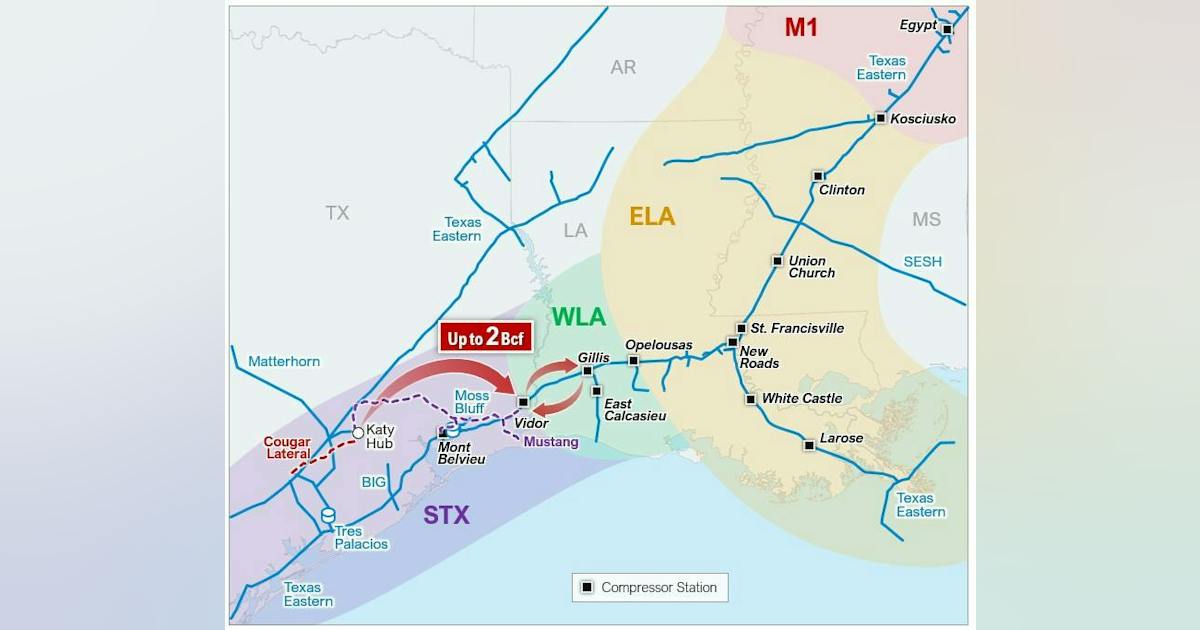
Texas Eastern Transmission LP has launched a non-binding open season for its proposed Katy to Gillis Expansion Project, designed to connect the Katy Hub in Texas with markets in southwest Louisiana by early 2031. Developed in collaboration with Mustang Express Pipeline LLC, the project would create a seamless transportation path between Katy and Gillis, La., by combining transportation services on the Mustang Express and Texas Eastern systems. Texas Eastern parent company Enbridge Inc. expects the project to provide up to an additional 2 bcfd of transportation capacity, enhancing access to LNG plants, industrial customers, electric generation markets, and pipeline interconnections along the US Gulf Coast. The Mustang Express Pipeline is owned and developed by ARM Energy Holdings LLC. Final capacity, receipt and delivery points, design, and service structures will be informed by market interest received during the open season, Enbridge said. Its completion and timing are subject to securing sufficient commercial support and obtaining required approvals. The open season will close Oct. 30, 2026. ARM Energy last year took final investment decision to develop the 236-mile, 2.5-bcfd Mustang Express Pipeline, expected to be complete in late 2028 or early 2029.

Read More »

OPEC+ warns soaring shipping, insurance costs impede oil flows

Disruptions to international energy flows have pushed shipping and insurance costs to unprecedented levels of more than one-third of commodity value, impeding the movement of crude oil and petroleum products and adding inflationary pressure, OPEC+ ministers said following an Oct. 12 meeting in Riyadh. The ministers met on the sidelines of the 17th International Energy Forum (IEF) ministerial meeting and the 25th WPC Energy Congress to review market conditions. They stressed the need to safeguard international maritime routes. Elevated transportation and insurance costs are being passed through the oil value chain, prolonging the financial burden on producing and consuming countries and weighing on global economic growth, they said. The statement, as reported, did not identify the routes or commodities behind the cost estimate or explain how it was calculated. Separately, Russian Deputy Prime Minister Alexander Novak said costs had risen five- to tenfold on some routes, citing vessel shortages, military risks, and the closure of the Strait of Hormuz. Ministers reaffirmed their commitment to decisions adopted at the June 7, 2026, OPEC and non-OPEC ministerial meeting. The group said consultations with all OPEC+ countries would continue through existing mechanisms, including the Joint Ministerial Monitoring Committee and ministerial meetings. Ministers also said they would monitor the situation and work with governments, industry stakeholders, and international organizations, including the IEF and International Energy Agency (IEA), to improve global shipping conditions.

Read More »

Insights: US shale maturity and the future of North American supply

North America’s oil supply outlook is entering a new phase, according to Enverus’ latest long-term analysis. In this Insights episode of the Oil & Gas Journal ReEnterprised podcast, Mikaila Adams, content strategist and managing editor, speaks with Dane Gregoris, managing director at Enverus, and discusses the firm’s conclusion that US shale is “aging, not broken.” While the United States is expected to remain the continent’s dominant producer, Enverus sees growth slowing markedly compared with the past two decades as operators work through increasingly mature inventories and confront geological constraints that are becoming harder to offset through efficiency gains alone. The conversation examines the data behind that assessment, including declining productivity per lateral foot, changing inventory quality, and the methodology Enverus uses to estimate remaining drilling locations across North America’s major basins. Gregoris explains why the firm expects US production to remain relatively stable over the next decade rather than continue the rapid expansion that defined the shale revolution, and why rising marginal supply costs could become an increasingly important market signal. A significant portion of the discussion focuses on the Permian basin, which Enverus still views as the cornerstone of North American oil supply well into the 2040s. At the same time, the report suggests that even the Permian is experiencing the effects of resource maturation. Gregoris discusses evidence that operators are moving down the quality curve and shares his perspective on emerging technologies, including ultra-long laterals, lightweight proppants, and advanced surfactants, that could improve recoveries and alter the industry’s long-term outlook. The report’s second major theme is the growing strategic importance of Canada. As US shale growth moderates, Enverus sees Canada’s oil sands and liquids-rich plays as increasingly important sources of future supply. Gregoris explains why Canada’s resource base offers substantially longer inventory duration than most US plays and

Read More »

Energy Secretary Secures Mid-Atlantic Grid Ahead of Anticipated Stressed System Conditions

WASHINGTON—U.S. Secretary of Energy Chris Wright issued an emergency order to mitigate blackout risks in the mid-Atlantic ahead of a period of elevated demand, a high rate of planned generator outages during the autumn maintenance season, and numerous planned transmission outages. The order directs PJM Interconnection, L.L.C. (PJM) to dispatch specified units and to order their operation as needed to maintain reliability and authorizes PJM to direct backup generation resources to operate as a last resort before declaring an Energy Emergency Alert (EEA) 3 or during an EEA 3.  PJM is authorized to call upon its Transmission Owners and Electric Distribution Companies to implement the order as needed. The order was issued pursuant to an application from PJM submitted on October 11, 2026.  “This order will help ensure millions of American families and businesses across the mid-Atlantic have access to affordable, reliable, and secure electricity by making additional power generation, including backup power, available to use as needed,” said U.S. Secretary of Energy Chris Wright. “While past leaders’ energy subtraction policies have made the grid more vulnerable to the risk of blackouts when the sun doesn’t shine or the wind doesn’t blow, this administration remains committed to using every available tool to prevent blackouts.”  DOE estimates more than 35 GW of unused backup generation remains available nationwide.  The order is effective October 13, 2026, through October 16, 2026. 

Read More »

OCP 2026: Agentic AI Drives the Data Center’s Chip-to-Grid Transformation

NVIDIA Opens More of the AI Factory Architecture NVIDIA’s Ian Buck closed the opening keynote program with an extensive presentation covering Vera Rubin systems, open rack designs, networking, power delivery and AI factory software. The company announced additional contributions to OCP based on its third-generation MGX 1.2 reference architecture. The specification includes high-density liquid-cooled computing systems, improved cooling connections, standardized power interfaces and modular mechanical designs. Buck emphasized that these developments are as much about manufacturing and serviceability as they are about computational performance. He described how NVIDIA reduced the assembly time for a compute tray from approximately 90 minutes in the Grace Blackwell generation to roughly one minute for Vera Rubin through simplified mechanical construction and more automated assembly. At the scale of thousands of racks, those manufacturing improvements can materially influence deployment schedules. NVIDIA also previewed its next-generation Vera Rubin Ultra architecture, designed to interconnect 576 GPUs using an advanced NVLink fabric with co-packaged optics. Open Data Center and Grid Resilience Specifications For data center developers and operators, however, NVIDIA’s most consequential OCP contributions may lie outside the computing rack. NVIDIA, AMD, Google and Meta have published an Open Data Center Specification, currently at version 0.7, intended to establish common design principles for AI factory facilities. The specification addresses power architecture, cooling infrastructure and physical layout, helping equipment suppliers and developers coordinate around shared infrastructure requirements. That shared facilities work unfolds alongside vendor-specific programs such as NVIDIA’s DSX Ready, which establishes qualification requirements for battery energy storage and liquid cooling equipment supporting its AI factory designs. NVIDIA also joined Google, Meta and Microsoft in publishing an OCP Grid Resilience Specification addressing the behavior of large AI installations during grid disturbances. The specification establishes expectations for facilities to remain connected, respond automatically to disturbances and recover toward normal operating

Read More »

NetBox Labs adds network design templates and AI agents to streamline infrastructure operations

“This is infrastructure, and so if an agent does the wrong thing, it breaks the company,” Beevers said. NetBox Designs turns repeatable infrastructure into templates AI data centers are full of racks that are almost all identical in design. Teams do not want to lay out each one by hand. The same applies to a retail chain with small, medium, and large store formats, where the IT footprint needs to line up. NetBox Designs, now in public preview, targets that repetition. Designs work like “templatized Lego bricks for infrastructure,” Beevers said. A team defines a site, rack or IP plan once and sets its parameters. NetBox then renders the plan as many times as needed, down to the low-level components and their configuration. That includes assigning IP addresses, prefixes, and virtual LANs across a fabric. The goal is to speed design down to the component level, reduce manual error and compress time to market.

Read More »

AMD unveils Helion as agentic AI fuels demand for data center CPUs

AMD has introduced Helion, an open blueprint for data center racks that aims to give CPUs a larger role in running AI agents while allowing customers to configure GPU resources around their inference requirements. Based on Open Compute Project (OCP) specifications, the architecture supports different combinations of computing hardware. AMD cited examples including CPU-only racks for hyperscalers, powered by sixth-generation EPYC processors with up to 32,768 cores, and all-in-one enterprise racks accommodating up to 16 Instinct MI350P GPUs. AMD has listed networking bandwidth of up to 102 Tbps for Helion, although the company has not specified how that figure is calculated. The specification represents a planned rack capability rather than demonstrated performance in customer environments.

Read More »

Land & Expand: North America’s Data Center Pipeline Expands Under Pressure

Land & Expand is Data Center Frontier’s periodic look at the latest data center development news, including new sites, land acquisitions and campus expansions across North America. This latest installment finds the development pipeline continuing to expand, even as the requirements for bringing large-scale projects online grow more complicated. Developers are securing land, planning new power infrastructure and advancing campuses measured in hundreds of megawatts or more. At the same time, local governments and residents are demanding greater clarity on electricity costs, water consumption, noise, tax incentives and the long-term effects of industrial-scale computing facilities. A succession of development disclosures and project milestones through September and early October 2026 illustrates both the geographical reach of North America’s expanding data center pipeline and the growing difficulty of measuring how much proposed capacity will ultimately be delivered. The projects range from preliminary discussions and newly secured development sites to campuses already under construction. Some are advancing through formal permitting and power studies; others remain contingent on customers, financing or local approvals. Together, they reveal an industry still expanding aggressively, but operating under increasingly complex development conditions. Fluidstack: Cameron County, Texas — Up to 1.5 GW One of the largest newly disclosed projects is Fluidstack’s AI data center development in Cameron County in the Rio Grande Valley. The project surfaced publicly September 10 when Cameron County announced that it had issued Fluidstack a worksite permit for property near Harlingen. The permit authorizes preliminary site work, including grading, utilities and related infrastructure, rather than construction of the data center buildings themselves. Fluidstack subsequently disclosed considerably more detail on September 21, saying construction had begun on a $4 billion first phase capable of supporting as much as 1.5 GW. Fluidstack expects the project to generate more than 2,500 construction jobs and several hundred permanent positions. 

Read More »

DCF Global: Five Markets Redrawing the AI Infrastructure Map

The Global Constraint Is Execution These five markets demonstrate that the worldwide AI infrastructure buildout is no longer organized around a single development model. Spain is using permitting reform to attract investment. China is concentrating construction around energy resources. India is translating enormous capital commitments into an expanding development pipeline. Latin America is combining hyperscale growth with national industrial objectives. And Southeast Asia is creating interconnected infrastructure markets whose boundaries increasingly extend beyond individual cities and countries. Not every market is competing for the same business. Sovereign cloud services, enterprise applications, AI training clusters, and large-scale inference platforms carry different requirements involving power, connectivity, latency, data residency, and operating economics. But the infrastructure questions remain remarkably consistent. Can a project obtain enough electricity? Can transmission and supporting networks be delivered on schedule? Will the supply chain provide the required equipment? Can the facility be constructed and commissioned efficiently? And will the development retain the regulatory certainty and community acceptance required to operate for decades? The gap between announced development and actual capacity is becoming a defining measurement of the industry. Cushman & Wakefield estimates that Asia-Pacific alone had approximately 26.5 GW of data center capacity in its development pipeline during H1 2026. Of that total, roughly 4.8 GW was under construction, with another 21.7 GW in planning. Those figures reveal both the extraordinary scale of the opportunity and the considerable infrastructure work still required to realize it. What the Global Buildout Means for North America For U.S. data center operators, developers, engineering firms, equipment suppliers, and investors, international expansion is not a separate story. It is increasingly part of the same global competition for capital, equipment, power infrastructure, and specialized expertise. The transformers, switchgear, generators, advanced cooling systems, fiber networks, and electrical distribution equipment required by a major AI campus

Read More »

Bidding war over key component could eliminate third hard disk maker

What if the three remaining hard disk manufacturers became two? Seagate Technology and Western Digital control 90% of the market, according to market researcher TrendForce, with Toshiba picking up the crumbs. Seagate and WD both make their own magnetic drive heads, but Toshiba relies on a third party, TDK, which also sells to Seagate and WD when they need extra capacity. Seeking to guarantee supplies of this critical component, Toshiba made a bid for TDK’s drive head business earlier this year, according to Bloomberg. Concerned that this could affect its ability to meet the growing demand for hard disks from AI data centers, Seagate made a counteroffer, Bloomberg reported. TDK is staying mum.

Read More »

Microsoft will invest $80B in AI data centers in fiscal 2025

And Microsoft isn’t the only one that is ramping up its investments into AI-enabled data centers. Rival cloud service providers are all investing in either upgrading or opening new data centers to capture a larger chunk of business from developers and users of large language models (LLMs).  In a report published in October 2024, Bloomberg Intelligence estimated that demand for generative AI would push Microsoft, AWS, Google, Oracle, Meta, and Apple would between them devote $200 billion to capex in 2025, up from $110 billion in 2023. Microsoft is one of the biggest spenders, followed closely by Google and AWS, Bloomberg Intelligence said. Its estimate of Microsoft’s capital spending on AI, at $62.4 billion for calendar 2025, is lower than Smith’s claim that the company will invest $80 billion in the fiscal year to June 30, 2025. Both figures, though, are way higher than Microsoft’s 2020 capital expenditure of “just” $17.6 billion. The majority of the increased spending is tied to cloud services and the expansion of AI infrastructure needed to provide compute capacity for OpenAI workloads. Separately, last October Amazon CEO Andy Jassy said his company planned total capex spend of $75 billion in 2024 and even more in 2025, with much of it going to AWS, its cloud computing division.

Read More »

John Deere unveils more autonomous farm machines to address skill labor shortage

Join our daily and weekly newsletters for the latest updates and exclusive content on industry-leading AI coverage. Learn More Self-driving tractors might be the path to self-driving cars. John Deere has revealed a new line of autonomous machines and tech across agriculture, construction and commercial landscaping. The Moline, Illinois-based John Deere has been in business for 187 years, yet it’s been a regular as a non-tech company showing off technology at the big tech trade show in Las Vegas and is back at CES 2025 with more autonomous tractors and other vehicles. This is not something we usually cover, but John Deere has a lot of data that is interesting in the big picture of tech. The message from the company is that there aren’t enough skilled farm laborers to do the work that its customers need. It’s been a challenge for most of the last two decades, said Jahmy Hindman, CTO at John Deere, in a briefing. Much of the tech will come this fall and after that. He noted that the average farmer in the U.S. is over 58 and works 12 to 18 hours a day to grow food for us. And he said the American Farm Bureau Federation estimates there are roughly 2.4 million farm jobs that need to be filled annually; and the agricultural work force continues to shrink. (This is my hint to the anti-immigration crowd). John Deere’s autonomous 9RX Tractor. Farmers can oversee it using an app. While each of these industries experiences their own set of challenges, a commonality across all is skilled labor availability. In construction, about 80% percent of contractors struggle to find skilled labor. And in commercial landscaping, 86% of landscaping business owners can’t find labor to fill open positions, he said. “They have to figure out how to do

Read More »

2025 playbook for enterprise AI success, from agents to evals

Join our daily and weekly newsletters for the latest updates and exclusive content on industry-leading AI coverage. Learn More 2025 is poised to be a pivotal year for enterprise AI. The past year has seen rapid innovation, and this year will see the same. This has made it more critical than ever to revisit your AI strategy to stay competitive and create value for your customers. From scaling AI agents to optimizing costs, here are the five critical areas enterprises should prioritize for their AI strategy this year. 1. Agents: the next generation of automation AI agents are no longer theoretical. In 2025, they’re indispensable tools for enterprises looking to streamline operations and enhance customer interactions. Unlike traditional software, agents powered by large language models (LLMs) can make nuanced decisions, navigate complex multi-step tasks, and integrate seamlessly with tools and APIs. At the start of 2024, agents were not ready for prime time, making frustrating mistakes like hallucinating URLs. They started getting better as frontier large language models themselves improved. “Let me put it this way,” said Sam Witteveen, cofounder of Red Dragon, a company that develops agents for companies, and that recently reviewed the 48 agents it built last year. “Interestingly, the ones that we built at the start of the year, a lot of those worked way better at the end of the year just because the models got better.” Witteveen shared this in the video podcast we filmed to discuss these five big trends in detail. Models are getting better and hallucinating less, and they’re also being trained to do agentic tasks. Another feature that the model providers are researching is a way to use the LLM as a judge, and as models get cheaper (something we’ll cover below), companies can use three or more models to

Read More »

OpenAI’s red teaming innovations define new essentials for security leaders in the AI era

Join our daily and weekly newsletters for the latest updates and exclusive content on industry-leading AI coverage. Learn More OpenAI has taken a more aggressive approach to red teaming than its AI competitors, demonstrating its security teams’ advanced capabilities in two areas: multi-step reinforcement and external red teaming. OpenAI recently released two papers that set a new competitive standard for improving the quality, reliability and safety of AI models in these two techniques and more. The first paper, “OpenAI’s Approach to External Red Teaming for AI Models and Systems,” reports that specialized teams outside the company have proven effective in uncovering vulnerabilities that might otherwise have made it into a released model because in-house testing techniques may have missed them. In the second paper, “Diverse and Effective Red Teaming with Auto-Generated Rewards and Multi-Step Reinforcement Learning,” OpenAI introduces an automated framework that relies on iterative reinforcement learning to generate a broad spectrum of novel, wide-ranging attacks. Going all-in on red teaming pays practical, competitive dividends It’s encouraging to see competitive intensity in red teaming growing among AI companies. When Anthropic released its AI red team guidelines in June of last year, it joined AI providers including Google, Microsoft, Nvidia, OpenAI, and even the U.S.’s National Institute of Standards and Technology (NIST), which all had released red teaming frameworks. Investing heavily in red teaming yields tangible benefits for security leaders in any organization. OpenAI’s paper on external red teaming provides a detailed analysis of how the company strives to create specialized external teams that include cybersecurity and subject matter experts. The goal is to see if knowledgeable external teams can defeat models’ security perimeters and find gaps in their security, biases and controls that prompt-based testing couldn’t find. What makes OpenAI’s recent papers noteworthy is how well they define using human-in-the-middle

Read More »

Gemini 4 Argon for Robotics

Gemini 4 Argon marks a step change in physical understanding, code generation, and visual-semantic reasoning—unlocking new workflows across the robotics stack and accelerating progress toward

Read More »