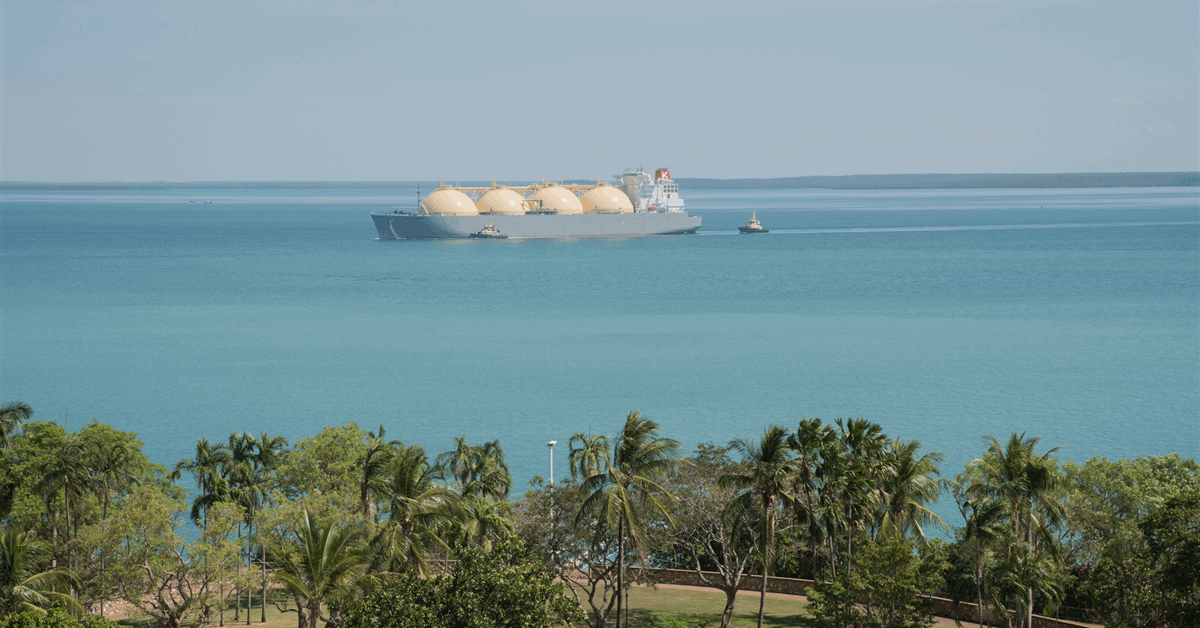
Santos Ltd and its partners have shipped the first cargo from the Darwin LNG life extension project in Australia’s Northern Territory.
The inaugural volume will be delivered to the Sakai terminal in Japan on an ex-ship basis, the Adelaide-based natural gas-focused producer said in an online statement Tuesday.
The life extension project, or the Barossa Gas Project, involves the development of the Barossa field as a new source for the liquefaction plant in Darwin, which began producing liquefied natural gas (LNG) 2006 and has an LNG capacity of about 3.7 million metric tons a year, according to Santos.
Darwin LNG’s previous source field, Timor-Leste’s Bayu-Undan, stopped exporting gas to the facility late 2023 due to depletion, though Santos said 2024 Bayu-Undan would continue sending gas to the Northern Territory until the end of that year. In its quarterly report July 16, 2025 Santos confirmed Bayu-Undan ceased production May 2025.
The life extension project started up approximately six months earlier than planned and within budget, said Santos, which announced a final investment decision (FID) on the Barossa Gas Project March 30, 2021. The FID announcement pegged costs at $3.6 billion, making Barossa LNG the biggest investment in Australia’s oil and gas sector then, according to Santos. According to a Santos update June 18, 2025 investment in the project reached $3.95 billion.
The early startup “is an outstanding achievement for a project of this scale and complexity in the global offshore upstream sector”, said Santos managing director and chief executive Kevin Gallagher.
Gallagher noted Barossa LNG had “navigated through the impacts of the COVID-19 pandemic, regulatory approvals, legal challenges and supply chain disruptions during the construction phase”.
Japanese power utility JERA Co Inc, one of the partners, said separately on Tuesday about the restart of Darwin LNG, “As energy demand continues to rise across Asia, securing reliable and competitively priced LNG has become essential for ongoing regional energy stability. With the geographic proximity to Asia and a proven track record as a reliable supplier, Australia remains a strategic source of LNG for the region”.
Ryosuke Tsugaru, JERA chief for low-carbon fuels, said, “This milestone reinforces JERA’s position in the upstream LNG value chain and underscores our role as a reliable energy provider for Japan and Asia”.
Santos announced September 22, 2025 Barossa had started producing natural gas through floating production, storage and offloading vessel BW Opal and that Darwin LNG had received reauthorization from Australia’s Northern Territory.
Santos is operator in the Barossa Gas Project with a 50 percent stake. PRISM Energy International Australia owns 37.5 percent. Japanese power utility JERA Co Inc has 12.5 percent.
In another project, Santos said in its quarterly report January 22 that phase 1 of the Pikka oilfield development in Alaska in the United States was 98 percent complete, on track to start production this quarter.
Santos expects its production this year to grow to 101-111 million barrels of oil equivalent (MMboe) compared to 87.7 MMboe in 2025.
In the last three months of 2025 Santos’ output totaled 22.3 MMboe, up five percent quarter-on-quarter. Full-year production was up one percent from 2024, the quarterly report said.
To contact the author, email [email protected]
What do you think? We’d love to hear from you, join the conversation on the
Rigzone Energy Network.
The Rigzone Energy Network is a new social experience created for you and all energy professionals to Speak Up about our industry, share knowledge, connect with peers and industry insiders and engage in a professional community that will empower your career in energy.
MORE FROM THIS AUTHOR