Stay Ahead, Stay ONMINE

She died at the San Diego border. A surveillance camera was in plain sight

She had only walked for a couple of hours, and already she was lost.  It was early afternoon on Sept. 14, 2025, when 30-year-old Graciela Gómez Hernández crossed the border from the eastern edge of Tijuana into Southern California, sending voice messages to her mother and sister as she walked.  This story is part of Dying on Camera, a collaboration between MIT Technology Review and Times of San Diego. Journalists in both newsrooms spent the past year examining the failures of border surveillance technology and uncovering the stories of the people who die in the borderlands. Gómez Hernández did not tell her family about her plan until the day before. Once she arrived in California, she hoped to work and send money back to her three children and her parents in southern Mexico. Her oldest son, age 11, had asked for a bicycle.   She either climbed a ladder over the border wall or slipped through a section in steep terrain where fencing has yet to be built. Dozens of game trails cut through the dust on hillsides of sagebrush and manzanita. It was the first segment of a hike through the Otay Mountain Wilderness.  The eastern edge of San Diego is just a mile away, but countless migrants hike 10 or 20 miles north through the mountains to evade the Border Patrol, emerging in smaller towns and on distant highways with fewer checkpoints. A border agent rides an ATV along the U.S.-Mexico border outside San Diego, September 2026. While the mountainous terrain makes some areas difficult to access, the area is blanketed with interconnected surveillance technology.ANNIE BARKER/TIMES OF SAN DIEGO/CATCHLIGHT LOCAL/REPORT FOR AMERICA Between 2 and 3 p.m., her sister said, Gómez Hernández sent a final message to her mother. “I can’t do it anymore,” she whispered into her phone. By the time a forensic crew came to collect her, two weeks later, most of her body had disappeared into the earth.  She died on her own, but she was not, strictly speaking, alone. She was in one of the most heavily surveilled strips of land in the world. Before she died, Gómez Hernández told her family in a WhatsApp message that she could see helicopters overhead and white Border Patrol trucks making periodic laps on the road below. And even if none of those agents saw her or knew she was in distress, something else had a clear view. Supervising the whole territory, from a nearby hilltop, was a slender gray surveillance tower.  That tower, made by General Dynamics and in place since 2019, boasts two sets of electro-optical and infrared cameras with long-range lenses that can track targets 5 to 7 miles away. Gómez Hernández was just one mile away.  Surveillance towers have proliferated in recent years, as contractors added newer camera systems that use artificial intelligence to distinguish border-crossers from other people and animals, and track their movements, at an overall cost of more than a billion dollars.  Yet as the cameras scan the terrain, migrants continue to die in plain sight.  Thousands of migrants have died while crossing the border in the past two decades, many of them near to Border Patrol surveillance installations. But the phenomenon is especially pronounced in the Otay Mountain Wilderness, just outside San Diego.  A Times of San Diego analysis counted hundreds of cases along the California border—including at least 138 in the past four years—where migrants’ remains were found within the range of the very cameras designed to help track and intercept them.  A topographical analysis conducted as part of an MIT Technology Review investigation estimated that more than half of these remains were found in a spot where a camera would have a clear view of a person, without terrain blocking the line of sight.  Some of these migrants died swiftly, falling from the border wall or drowning in a canal or river. But dozens suffered slow deaths of exposure in the wilderness, deaths that might have been averted with emergency aid.  People who died in Southern California came from just across the border, or from as far away as Africa. They were as old as 70 and as young as 5. They died in the heat or the cold. But they all died within range of a surveillance camera. Found in July 2023: Marcia Dutra, a 36-year-old woman from Brazil who likely died of heat exposure next to a border fence. According to a medical examiner’s report, a group of migrants told the Border Patrol about her body when they were apprehended. An AI-equipped surveillance tower sits 2,000 feet northeast above the edge of a plateau, out of sight of the slope where she was found.  Found in February 2024: Elvi Vasquez Bortolon, a 28-year-old Mexican man who died of suspected hypothermia on a ridge near the border wall. He had been dead for more than five days when a Border Patrol agent in a helicopter spotted his body from above. A remote video tower stands about 1,400 feet away, hidden from view by the ridge above the canyon.  Found in August 2024: Ramón Montenegro, a 51-year-old man from Mexico who died of possible heatstroke in the mountains near Dulzura. An AI surveillance tower, invisible on the other side of a hill, sits 1,300 feet away — roughly the length of the parking lot at the San Diego Zoo.  More than 120 surveillance towers stand along the California border, according to documents and live observations collected by the Electronic Frontier Foundation.  The towers are not the only form of surveillance in the region. The border is blanketed by an interconnected network of trail cameras, underground movement detectors, radar, infrared sensors, drones, and even blimps. In March 2025, the Trump administration directed the Department of Defense to use satellites to watch the border as well.  Even when mountains or vegetation block a tower’s view, other devices may pick up the trail. Local advocates say surveillance technology in the Otay Mountain Wilderness is almost unavoidable.  Agents in Border Patrol gear hike a ridge in the Otay Mountain Wilderness, September 2026. Agents said the group was on a training hike.ANNIE BARKER/TIMES OF SAN DIEGO/CATCHLIGHT LOCAL/REPORT FOR AMERICA Officials say the towers particularly excel at tracking passing migrants.  Anduril, the company that makes about half the towers now installed at the U.S.-Mexico border, said in a news release in 2024 that their towers “directly contributed to saving lives and stopping illicit drugs from entering the U.S.” In June 2026, the company said its installations had “autonomously identified hundreds of thousands of border crossings.” John Morris, a Border Patrol sector chief in Arizona, told media at a convention in May 2026 that “We’re dang close to pretty much knowing everything that comes across.”  The proximity of so many deaths to high-resolution cameras leaves two distinct possibilities: Either the system didn’t detect these people in distress, or it did detect them—and officials offered no response.  Anduril, the defense contracting company that manufactures the AI-enabled towers, did not respond to questions from Times of San Diego about the towers’ performance in mountainous terrain. A representative of General Dynamics, which made the tower closest to Gómez Hernández’s body, referred all questions to the Border Patrol.  The Border Patrol did not respond to questions from Times of San Diego regarding whether surveillance towers spotted Gómez Hernández prior to her death, or about how surveillance cameras in general are used to detect people in emergency situations.  Rafael Hernández Larraenza, the leader of a search and rescue group, Desert Angels, says he believes some of the towers are “just adornment,” and are not actually effective at tracking migrants. He also says that Border Patrol agents, in occasional meetings with his search group, “say they don’t have the opportunity to do searches, that they don’t have enough time.” People in need of rescue “are not a priority,” said Bryce Peterson, who compiles research on migrant remains for the advocacy group No More Deaths.  A wilderness, heavily watched   From the spot where Graciela Gómez Hernández’s body was found, a surveillance tower stands in clear view.  That tower is one mile away. A second, newer tower, on the other side of a hill, sits 1.4 miles away. Both are equipped with slow-spinning, long-range cameras.  The closer of these two towers is situated between two layers of border fencing, a long pole, over 100 feet tall, reaching into the sky. It peers not only onto hillsides where migrants walk, but into the brightly-colored cinderblock homes of a Tijuana neighborhood.  The second tower is much shorter, just 33 feet tall, surveying the canyon where Gómez Hernández would most likely have arrived if she had kept walking.  This new tower, built by a company called Anduril, decides for itself whether a moving object in the field is relevant. The two dark, round cameras on the pole give the impression of eyes, rotating slowly, and then locking in on a target, before swiveling elsewhere. Federal cameras seen at Friendship Park in San Diego, September 2026.ANNIE BARKER/TIMES OF SAN DIEGO/CATCHLIGHT LOCAL/REPORT FOR AMERICA Osvaldo Ruiz, the volunteer coordinator for the Border Angels, a group that leaves water and supplies along migrant trails near San Diego, says the Otay Mountain wilderness has “beacons throughout the mountains” that “can see over a lot of the mountains facing the border.” “At entry sites that migrants or travelers may come through, there are also hidden cameras inside of rocks or inside of bushes that are camouflaged for you not to see. And then there’s also the cameras that you see on the road. They have license plate readers that are stuck on the back of a safety cone, so (it detects) as you’re driving away from it.” Surveillance towers have been in the area since 2011, with frequent new installations, including the introduction of AI-directed towers in 2018. Many of the AI-equipped towers currently overseeing the California borderlands appeared in 2021, and were updated with longer ranges in 2026.   Officials from the Government Accountability Office wrote in a report in June 2026 that the Border Patrol currently has 803 fielded towers “and plans to deliver another 175,” across the southwestern border, an initiative that would cost $1.4 billion. The report also notes that the agency expects a billion dollars in funding from the One Big Beautiful Bill Act in 2025. By 2034, the number of towers is expected to rise to 2,300. “What we are building along the southwest border is a smart system. There’s technology embedded in it, plus the physical infrastructure,” border czar Tom Homan said at a press conference in San Diego in December 2025. “It makes every single agent and officer more effective.” A secretive hike north  Like so many migrants, Graciela’s hike into the U.S. began in desperation. Her husband, who had already crossed the border to find work, had stopped sending money for the children.  “There were moments when they didn’t have enough money even for a bag of detergent, or to eat,” her sister, Irma, told Times of San Diego. “She would call me crying.”  Gómez Hernández decided she needed to come to the United States, if only temporarily, to make money. Her family was uniformly against the decision, so she kept her plan a secret until she was already at the border, preparing to cross.  “She was a very humble person,” Irma said. “She was kind to people, and loving with her children.” Gómez Hernández paid 20,000 pesos, about $1,150, for smugglers to help her cross the border, much lower than the current average, which sits at $12,000. But she would need to travel on her own without a guide, paying only for the knowledge of where and when to start, and which direction to walk. As part of their deal, her phone would send location pings back to the smugglers’ hiding spot in Tijuana.  Cesar Ortigoza, a leader of a search group known as the Armadillos, has been locating migrant remains in the region since 2010.  A discarded card shows advice that advocates give to migrants about what to say if they are apprehended. ANNIE BARKER/TIMES OF SAN DIEGO/CATCHLIGHT LOCAL/REPORT FOR AMERICA “Most people don’t understand the magnitude of this territory, and all the work it’s going to cost them to arrive at their destination. They get to the top of this mountain and realize there’s miles and miles and miles left to walk,” Ortigoza said.  In addition, they need to avoid capture. “They go really fast,” he said, “and there’s a lot of pressure.” On the afternoon of September 14, 2025, Gómez Hernández told her mother and sister through WhatsApp voice messages that she had successfully crossed the border into the United States. These short snippets of audio would be their only clues to what happened next.  The hillside where Gómez Hernández walked that afternoon is exposed on all sides, with a panoramic view of the border wall just a couple hundred yards away. But on the other side of the hill is a daunting, mountainous wilderness, covered in low trees and rocky ravines, with hidden, winding trails, stretching into the distance. It is possible she saw this and turned around, convinced she was lost. Wandering the hillsides in the afternoon heat without sufficient water, she could succumb to dehydration within hours.  “Because of the heat, there are places where you can’t move forward even half a mile in an hour,” said Larraenza, the search and rescue leader.  By 2 p.m., “She told me she felt very tired and couldn’t go any further,” Irma said. “I told her to give it her all, to think of her children, keep them in her mind so she could get out of there.” Irma says 4 p.m. was the last time her sister’s location was transmitted to the smugglers.  After hearing about Gómez Hernández’s case, Ortigoza said it “seemed strange,” because she was “so close to the border” at her last known location.  But Bryce Peterson, the No More Deaths volunteer who collects autopsy reports on migrant remains border-wide, said “There’s a million ways that somebody could be already on the verge of death that close to the wall. Like if you’re going north and then you decide to go south again because you get lost or something.” “The only thing we’re certain of is that she suffered in her last moments,” Ortigoza said. “Just knowing that you’re alone.” Walking on the hillside, Gómez Hernández encountered a man also traversing the trails, lined with dry shrubs. “In one of the messages sent, where she told me to pray for her, the man spoke and said ‘there isn’t time,’” Irma said.  After that, Graciela’s phone still received messages, but she did not respond.  Cameras rise, questions remain  Even though the federal surveillance tower was just a mile away, it is possible the cameras did not see Gómez Hernández. It is possible they did not see much of anything.  An internal memo obtained by NBC News in October 2024 revealed that 30% of the older-style towers, the kind that require agents in control rooms to review footage, were broken. Most were missing parts, or their equipment was outdated and unusable. These 150 broken towers still stood at the border, acting as million-dollar scarecrows.  Officials from the Government Accountability Office wrote in a report in September 2025 that the Customs and Border Protection had begun to fix the towers with spare parts and revamp them with new technology, but did not list how many remained out of commission.  The Border Patrol did not respond to questions from Times of San Diego about whether the tower in view of where Gómez Hernández died was operational at the time of her death.  Dave Maass, the director of investigations for the Electronic Frontier Foundation, the organization that maps surveillance towers at the border, questions the functionality of all types of towers. “None of these systems have been effective. There’s no independent evaluation of how many things they’re capturing,” he said.  In a report published in March 2026, a representative of the US Military notes that a mission to place 7 G-BOSS(E) towers in the Otay Mountain Wilderness, an installation that took place in the months prior to Gómez Hernández’s death, faced operational challenges.  The combat-grade military surveillance towers were vulnerable to tipping over, damage from rodents, exhaust blowouts, and running out of battery. On a dirt road in the mountains, a truck carrying a surveillance tower bounced around, which led to the tower’s cameras “becoming stuck in a zoomed-in position.”  Despite descriptions from manufacturers claiming dominance in “rugged terrain,” Osvaldo Ruíz, the Border Angels coordinator, said it would still be difficult for a surveillance tower to track migrants moving through the Otay Mountain Wilderness. “With all that surveillance that’s out in the mountains, there’s still a lot of brush and high covered areas that would make it easy [to stay undercover].” Analysts from the RAND Corporation, a foreign policy think tank, wrote in a report in 2020 that “outcomes and outputs” that would indicate the success of surveillance towers “are not directly observable.”  The analysts conceded that the towers’ presence would urge migrants to stay out of the area and funnel into undetected routes. “The likely deterrent effect on migrant crossings through surveilled areas overwhelms any boost to situational awareness,” that the towers provide, the analysts wrote. In this way, the surveillance towers’ most useful quality was the threat conveyed through their technology, rather than the merit of the technology itself.  Due to increased surveillance, “People are crossing through areas that are further out and more extreme, where we have very little hope of finding them in a search,” Larraenza said.  A portable surveillance tower rises from a pickup truck in the Otay Mountain Wilderness outside San Diego, September 2026.ANNIE BARKER/TIMES OF SAN DIEGO/CATCHLIGHT LOCAL/REPORT FOR AMERICA And though the manufacturer says the AI-enabled towers, which now make up over half of the total, can identify migrants on their own, apprehensions still require human labor. A CBP official told the RAND analysts that smugglers began sending migrants across the border alone, rather than in groups, to overwhelm the surveillance towers with many individual targets, leading to more alerts than agents capable of following them.  So it is possible the towers in the vicinity did capture footage of Gómez Hernández, but agents decided not to apprehend her. Just hours before her death, she sent a message saying that there were “police” nearby, possibly referring to Border Patrol agents in trucks.  “Even one person who’s not sick, one person who is just hiking on their own, often Border Patrol will just ignore them because it’s not worth their time to just only catch one person,” said Peterson of No More Deaths. “They want to be able to catch a whole group of people.” Larraenza said he’s found dehydrated people on migrant trails who say they called out to Border Patrol, and the agents failed to stop. “But there are also cases where agents do the impossible to find someone,” he said.  On one occasion in September 2024, while rescuing a family of five in the Otay Mountain Wilderness, Larraenza met a person wearing a vest labeled “SHERIFF” on the trail. In a video that Larraenza posted to his Facebook account, when asked if the Border Patrol would arrive to take the family into custody, the deputy says, “Oh, they don’t come out here.” On a recent visit to the spot where Gómez Hernández died, multiple Border Patrol trucks were visible just hundreds of yards away, rolling slowly along the wall, or parked on the hill next to the surveillance tower.  “If we hadn’t sent the Border Patrol the coordinates, they never would have bothered to go [find Gómez Hernández’s body],” Ortigoza said. Finding Graciela  Irma sent her sister a barrage of messages that afternoon and evening, pleading with her to send her location, but there was no response. Irma believes it’s possible her sister was killed or abandoned by the other migrant she was traveling with during her final hours, because she was not walking fast enough.  It took Irma two weeks to make contact with the coyotes. When she told the smugglers that her sister was missing, “they didn’t move a single finger,” she said. She threatened to send one coyote’s phone number to the police, until he sent her a screenshot of Graciela’s last known location.  Almost three weeks after Graciela Gómez Hernández’s final message to her mother, on October 3, 2025, the Armadillo search group sent the last known GPS coordinates of her phone to the Border Patrol.  The medical investigator’s report states that Gómez Hernández sent her location to her family, and her relatives sent the coordinates to a search group while she remained alive, but both Irma and Ortigoza said they did not know her location for weeks, and neither was interviewed for the examiner’s report.  “On 10/04/2025 at 11:16 hours, I arrived on a dirt path approximately 100 yards north of the United States/Mexico International border. The area consisted of shrubs and dried brush with steep hills and declines,” Jennifer Wright, the medical examiner, wrote in an autopsy report. “Upon further review, I viewed the skeletonized remains of an apparent female lying supine in the dirt.” The body had decomposed quickly with the help of the sun and animals, so it was impossible to tell whether Gómez Hernández was the victim of murder or dehydration. But the medical examiner noted that there was no water or food in the vicinity. “In a pile next to the decedent was a purple bra, black pants, a black floral shirt, and a dark colored long sleeve shirt. The bra was hooked closed and intact,” Wright, the medical examiner, wrote in her report. “In the rear pants pockets were Mexican paper currency, Mexican coins, bobby pins, and tweezers.” The body was naked, but it was unclear whether someone else removed Gómez Hernández’s clothes, or whether she took them off herself in the final throes of dehydration delirium, a common symptom immediately preceding organ failure.  Several yards from the place where she died, Ortigoza found a backpack with a bottle of women’s spray deodorant, and a small glass container of perfume.  “When you get to one of these sites, and you see the situation, the loneliness, the environment, you start wondering, what was this person thinking in their last moments?” Larraenza said.  Once a DNA test confirmed the identity of the remains, Irma paid over $4,000 to send her sister’s bones home to Mexico, where the family held a funeral nine months after her death. “Sometimes her oldest son, he just sits there thinking and when we ask what’s wrong, he says he misses his mom,” Irma said. Though the family is heartbroken, everyone has pitched in to care for Graciela’s children. “I don’t let my parents see me cry,” Irma said.  The Border Patrol gave permission to Ortigoza and a group of searchers to place a cross next to where Gómez Hernández was discovered. On a recent trip to the memorial to leave flowers, Ortigoza played a voice message that Irma sent to her sister, the sound vibrating into the dirt of the hillside, where the imprint of Gómez Hernández’s body is still visible nearly a year after its removal. Rosaries hang on a memorial for Graciela Gómez Hernández. The mountains east of San Diego continue to be a risky crossing spot. One migrant advocate said in mid-September that at least two more people had gone missing in the area in the past few weeks.ANNIE BARKER/TIMES OF SAN DIEGO/CATCHLIGHT LOCAL/REPORT FOR AMERICA “I know that in the place you’re in, there isn’t suffering, like how you suffered here on this earth,” Irma said. “I know you left thinking about your children. I know you wanted to give them a better life. I feel you here, and I feel you alive.” Cesar Ortigoza says every day he gets as many as five calls from people looking for their missing family members at the border. Though numbers of border crossings, and numbers of reported deaths, have decreased since Donald Trump took office in January 2025, “There are still a lot of people on the other side trying to get here. Because the problems in their countries persist,” Ortigoza said.  In the first half of 2026, fewer people have consumed the water bottles, Gatorade and cans of food left by Border Angels volunteers in the Otay Mountain Wilderness. But supplies left on other routes by different groups have seen increased consumption, evidence that migration patterns are constantly evolving.  “It’s hard for me to really understand how people are crossing, but I know they are,” Ruíz said. Peterson, the No More Deaths map-maker, said more migrants could die in the coming months and years, as a result of increased surveillance. In the past, after surveillance towers were installed, migrants would try to go around them, leading to longer and more dangerous routes through stretches of remote wilderness. With the installation of hundreds of new towers, the spaces outside the range of detection have thinned, leading some migrants to attempt to go through surveilled territory, rather than around it.  “We’ve seen people do things that to me seem terrifying or crazy, like going past an area where they know there are sensors and then trying to really quickly get to the next safe-ish place before Border Patrol shows up to get them, because it takes 15 minutes for them to show up,” Peterson said. “It seems like people aren’t stopping to drink water. People are going really fast, often running even, moving much more quickly, not being able to take the time to take care of themselves.” Larraenza says for this same reason, migrants often choose to cross the border in the hottest weeks of the year, when they believe fewer agents will be on patrol, but there is a greater risk of death. In an interview in mid-September, Larraenza said at least two people had gone missing in the Otay Mountain wilderness in the past few weeks, and he had not yet been able to find their remains.  Ortigoza says Gómez Hernández’s story is an example of a decades-long trend of people putting their lives at risk to cross the border out of necessity. The surveillance towers, whether or not they were functional, did not stop Gómez Hernández from crossing the border in that area, and did not stop her from dying. “If the riches of the world were distributed more equitably, we wouldn’t have to do things like this to reach a better life,” he said.  While placing flowers in July at the site of Gómez Hernández’s death, Ortigoza noticed a Border Patrol truck parked under the surveillance tower on the hilltop a mile to the east. An agent stood on a power lift, working on the tower’s cameras.  This year, agents replaced dozens of these cameras with new, AI models.  About Times of San Diego’s report Times of San Diego’s analysis relied on publicly available data from various sources, starting with records that document the deaths of border-crossers.  No More Deaths, a longstanding border activist group, has compiled information on such deaths for years. In California, their efforts use data from the San Diego County Medical Examiner’s Office and the Imperial County Coroner’s Office.  In San Diego County, the group says, it obtained lists and narratives for “all deaths related to border-crossings.” The data was detailed, but it was unclear how the medical examiner’s office ensured it had identified all cases involving border-crossers.  In Imperial County, the group said, its requests were disregarded, and it ultimately brought a legal claim. In response, the county provided a list of deaths “with minimal data and no explanation for how the records custodian had compiled the data.” Since then, the group says, it has been adding details by requesting coroner’s reports for each individual case.  Even if both counties’ records are complete, the remains of other missing migrants have yet to be found, so the list is very likely an undercount. Times of San Diego focused on migrant deaths starting in 2022, just after a dramatic increase in the number of towers installed in California.  Electronic Frontier Foundation, which advocates for human and constitutional rights, catalogs each surveillance tower with in-person and satellite image verification. Times of San Diego analyzed the location data for each death and the nearest surveillance tower. Each pairing of a death location and a tower within surveillance range was confirmed by hand on maps of each location. The analysis also examined time-stamped satellite imagery to verify each tower was in place at the time each body was found.  From 2022 through 2025, Times of San Diego’s analysis found that at least 138 people died within the nominal range of a nearby surveillance tower.  Proximity to a tower isn’t necessarily a guarantee that a migrant was on camera at the time. Much of the area is mountainous, and terrain may block a camera’s view. A separate MIT Technology Review analysis concluded that of the deaths we tallied in the past four years, at least 81 of those people were most likely within the field of view of a surveillance tower—not blocked by a hill or other terrain. Lillian Perlmutter is an investigative reporter covering immigration across California for Times of San Diego and NEWSWELL. Previously based in Mexico City, she has written for more than 25 outlets including the L.A. Times, Rolling Stone, The Guardian, and The New Republic.

She had only walked for a couple of hours, and already she was lost. 

It was early afternoon on Sept. 14, 2025, when 30-year-old Graciela Gómez Hernández crossed the border from the eastern edge of Tijuana into Southern California, sending voice messages to her mother and sister as she walked. 


This story is part of Dying on Camera, a collaboration between MIT Technology Review and Times of San Diego. Journalists in both newsrooms spent the past year examining the failures of border surveillance technology and uncovering the stories of the people who die in the borderlands.


Gómez Hernández did not tell her family about her plan until the day before. Once she arrived in California, she hoped to work and send money back to her three children and her parents in southern Mexico. Her oldest son, age 11, had asked for a bicycle.  

She either climbed a ladder over the border wall or slipped through a section in steep terrain where fencing has yet to be built. Dozens of game trails cut through the dust on hillsides of sagebrush and manzanita. It was the first segment of a hike through the Otay Mountain Wilderness. 

The eastern edge of San Diego is just a mile away, but countless migrants hike 10 or 20 miles north through the mountains to evade the Border Patrol, emerging in smaller towns and on distant highways with fewer checkpoints.
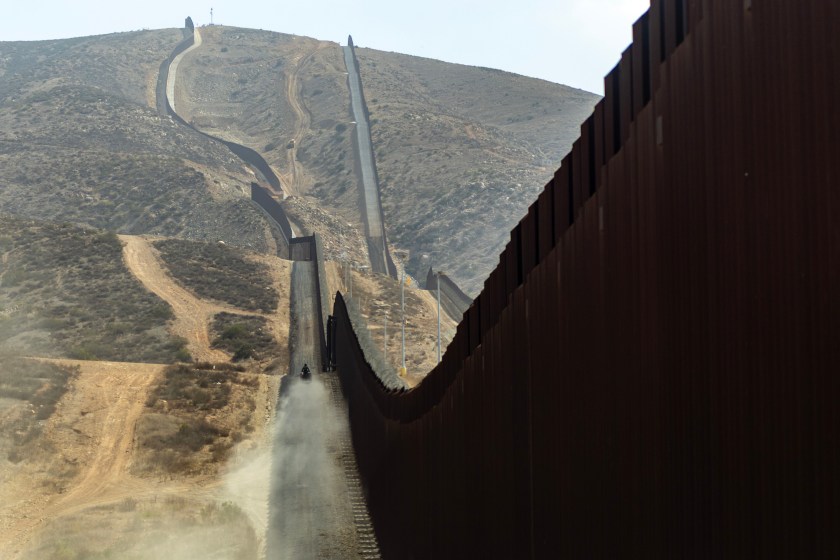
A border agent rides an ATV along the U.S.-Mexico border outside San Diego, September 2026. While the mountainous terrain makes some areas difficult to access, the area is blanketed with interconnected surveillance technology.
ANNIE BARKER/TIMES OF SAN DIEGO/CATCHLIGHT LOCAL/REPORT FOR AMERICA

Between 2 and 3 p.m., her sister said, Gómez Hernández sent a final message to her mother. “I can’t do it anymore,” she whispered into her phone. By the time a forensic crew came to collect her, two weeks later, most of her body had disappeared into the earth. 

She died on her own, but she was not, strictly speaking, alone. She was in one of the most heavily surveilled strips of land in the world.

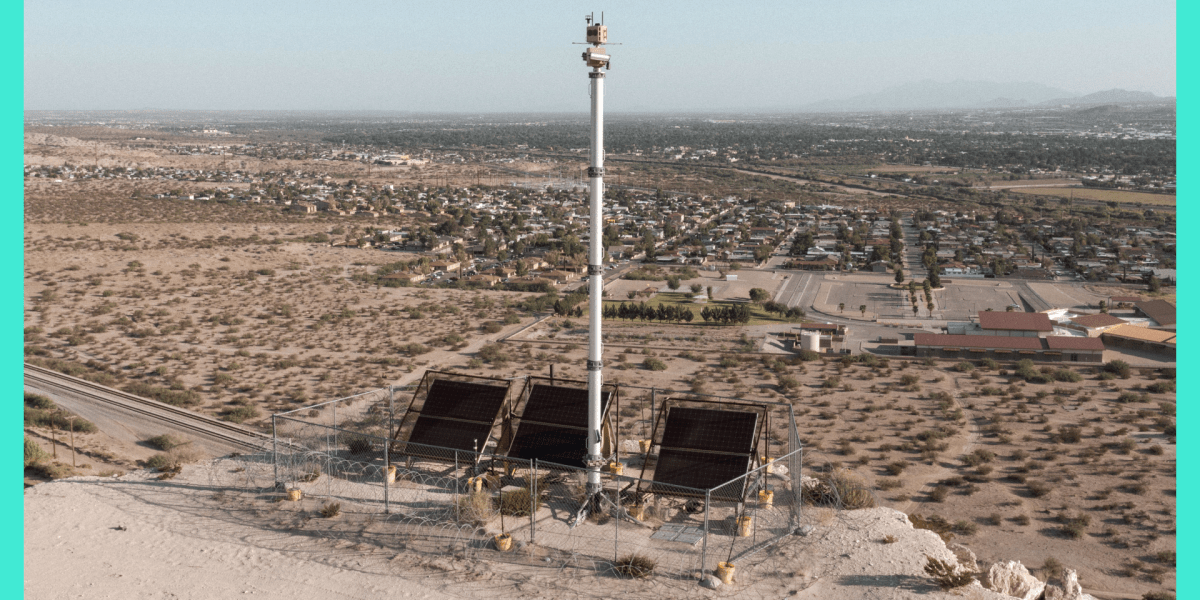
Before she died, Gómez Hernández told her family in a WhatsApp message that she could see helicopters overhead and white Border Patrol trucks making periodic laps on the road below. And even if none of those agents saw her or knew she was in distress, something else had a clear view. Supervising the whole territory, from a nearby hilltop, was a slender gray surveillance tower. 

That tower, made by General Dynamics and in place since 2019, boasts two sets of electro-optical and infrared cameras with long-range lenses that can track targets 5 to 7 miles away. Gómez Hernández was just one mile away. 

Surveillance towers have proliferated in recent years, as contractors added newer camera systems that use artificial intelligence to distinguish border-crossers from other people and animals, and track their movements, at an overall cost of more than a billion dollars. 

Yet as the cameras scan the terrain, migrants continue to die in plain sight. 

Thousands of migrants have died while crossing the border in the past two decades, many of them near to Border Patrol surveillance installations. But the phenomenon is especially pronounced in the Otay Mountain Wilderness, just outside San Diego. 

A Times of San Diego analysis counted hundreds of cases along the California border—including at least 138 in the past four years—where migrants’ remains were found within the range of the very cameras designed to help track and intercept them. 

A topographical analysis conducted as part of an MIT Technology Review investigation estimated that more than half of these remains were found in a spot where a camera would have a clear view of a person, without terrain blocking the line of sight. 

Some of these migrants died swiftly, falling from the border wall or drowning in a canal or river. But dozens suffered slow deaths of exposure in the wilderness, deaths that might have been averted with emergency aid. 

People who died in Southern California came from just across the border, or from as far away as Africa. They were as old as 70 and as young as 5. They died in the heat or the cold. But they all died within range of a surveillance camera.


Found in July 2023: Marcia Dutra, a 36-year-old woman from Brazil who likely died of heat exposure next to a border fence. According to a medical examiner’s report, a group of migrants told the Border Patrol about her body when they were apprehended. An AI-equipped surveillance tower sits 2,000 feet northeast above the edge of a plateau, out of sight of the slope where she was found. 

Found in February 2024: Elvi Vasquez Bortolon, a 28-year-old Mexican man who died of suspected hypothermia on a ridge near the border wall. He had been dead for more than five days when a Border Patrol agent in a helicopter spotted his body from above. A remote video tower stands about 1,400 feet away, hidden from view by the ridge above the canyon. 

Found in August 2024: Ramón Montenegro, a 51-year-old man from Mexico who died of possible heatstroke in the mountains near Dulzura. An AI surveillance tower, invisible on the other side of a hill, sits 1,300 feet away — roughly the length of the parking lot at the San Diego Zoo. 

More than 120 surveillance towers stand along the California border, according to documents and live observations collected by the Electronic Frontier Foundation. 

The towers are not the only form of surveillance in the region. The border is blanketed by an interconnected network of trail cameras, underground movement detectors, radar, infrared sensors, drones, and even blimps. In March 2025, the Trump administration directed the Department of Defense to use satellites to watch the border as well. 

Even when mountains or vegetation block a tower’s view, other devices may pick up the trail. Local advocates say surveillance technology in the Otay Mountain Wilderness is almost unavoidable. 
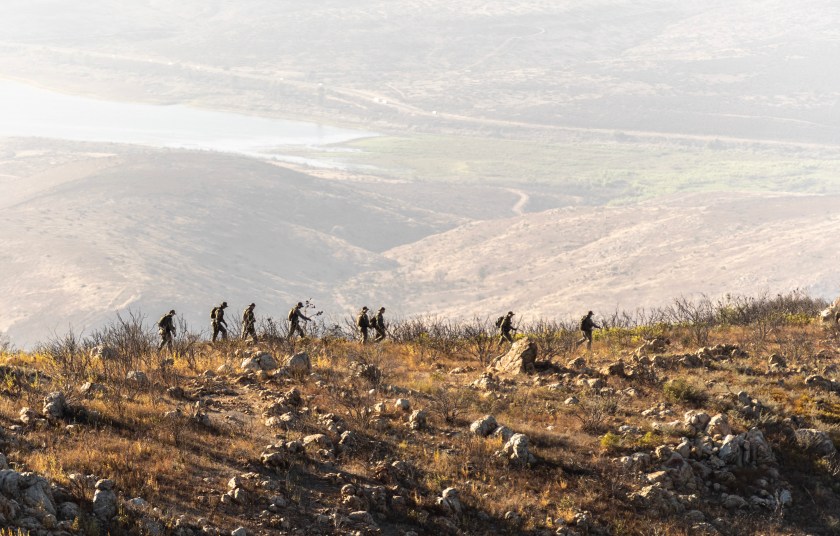
Agents in Border Patrol gear hike a ridge in the Otay Mountain Wilderness, September 2026. Agents said the group was on a training hike.
ANNIE BARKER/TIMES OF SAN DIEGO/CATCHLIGHT LOCAL/REPORT FOR AMERICA

Officials say the towers particularly excel at tracking passing migrants. 

Anduril, the company that makes about half the towers now installed at the U.S.-Mexico border, said in a news release in 2024 that their towers “directly contributed to saving lives and stopping illicit drugs from entering the U.S.” In June 2026, the company said its installations had “autonomously identified hundreds of thousands of border crossings.”

John Morris, a Border Patrol sector chief in Arizona, told media at a convention in May 2026 that “We’re dang close to pretty much knowing everything that comes across.” 

The proximity of so many deaths to high-resolution cameras leaves two distinct possibilities: Either the system didn’t detect these people in distress, or it did detect them—and officials offered no response. 

Anduril, the defense contracting company that manufactures the AI-enabled towers, did not respond to questions from Times of San Diego about the towers’ performance in mountainous terrain.

A representative of General Dynamics, which made the tower closest to Gómez Hernández’s body, referred all questions to the Border Patrol. 

The Border Patrol did not respond to questions from Times of San Diego regarding whether surveillance towers spotted Gómez Hernández prior to her death, or about how surveillance cameras in general are used to detect people in emergency situations. 

Rafael Hernández Larraenza, the leader of a search and rescue group, Desert Angels, says he believes some of the towers are “just adornment,” and are not actually effective at tracking migrants. He also says that Border Patrol agents, in occasional meetings with his search group, “say they don’t have the opportunity to do searches, that they don’t have enough time.”

People in need of rescue “are not a priority,” said Bryce Peterson, who compiles research on migrant remains for the advocacy group No More Deaths. 

A wilderness, heavily watched  

From the spot where Graciela Gómez Hernández’s body was found, a surveillance tower stands in clear view. 

That tower is one mile away. A second, newer tower, on the other side of a hill, sits 1.4 miles away. Both are equipped with slow-spinning, long-range cameras. 

The closer of these two towers is situated between two layers of border fencing, a long pole, over 100 feet tall, reaching into the sky. It peers not only onto hillsides where migrants walk, but into the brightly-colored cinderblock homes of a Tijuana neighborhood. 

The second tower is much shorter, just 33 feet tall, surveying the canyon where Gómez Hernández would most likely have arrived if she had kept walking. 

This new tower, built by a company called Anduril, decides for itself whether a moving object in the field is relevant. The two dark, round cameras on the pole give the impression of eyes, rotating slowly, and then locking in on a target, before swiveling elsewhere.
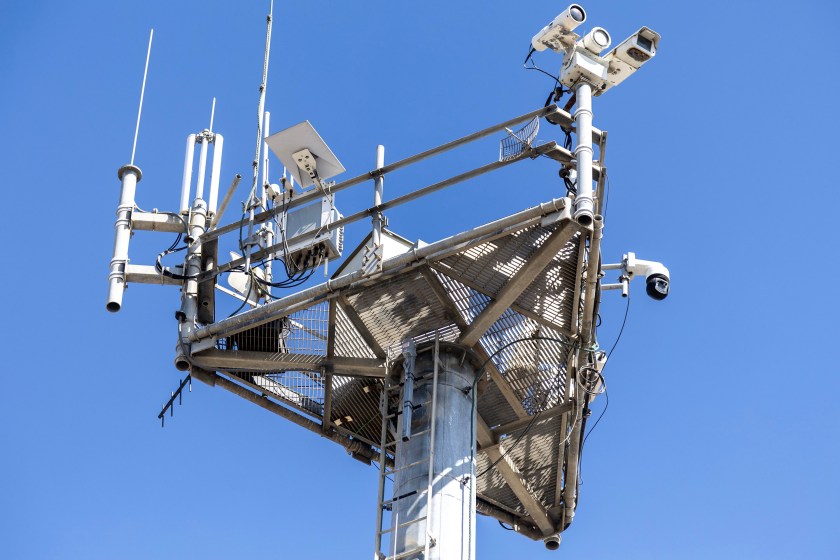
Federal cameras seen at Friendship Park in San Diego, September 2026.
ANNIE BARKER/TIMES OF SAN DIEGO/CATCHLIGHT LOCAL/REPORT FOR AMERICA

Osvaldo Ruiz, the volunteer coordinator for the Border Angels, a group that leaves water and supplies along migrant trails near San Diego, says the Otay Mountain wilderness has “beacons throughout the mountains” that “can see over a lot of the mountains facing the border.”

“At entry sites that migrants or travelers may come through, there are also hidden cameras inside of rocks or inside of bushes that are camouflaged for you not to see. And then there’s also the cameras that you see on the road. They have license plate readers that are stuck on the back of a safety cone, so (it detects) as you’re driving away from it.”

Surveillance towers have been in the area since 2011, with frequent new installations, including the introduction of AI-directed towers in 2018. Many of the AI-equipped towers currently overseeing the California borderlands appeared in 2021, and were updated with longer ranges in 2026.  

Officials from the Government Accountability Office wrote in a report in June 2026 that the Border Patrol currently has 803 fielded towers “and plans to deliver another 175,” across the southwestern border, an initiative that would cost $1.4 billion. The report also notes that the agency expects a billion dollars in funding from the One Big Beautiful Bill Act in 2025. By 2034, the number of towers is expected to rise to 2,300.

“What we are building along the southwest border is a smart system. There’s technology embedded in it, plus the physical infrastructure,” border czar Tom Homan said at a press conference in San Diego in December 2025. “It makes every single agent and officer more effective.”

A secretive hike north 

Like so many migrants, Graciela’s hike into the U.S. began in desperation. Her husband, who had already crossed the border to find work, had stopped sending money for the children. 

“There were moments when they didn’t have enough money even for a bag of detergent, or to eat,” her sister, Irma, told Times of San Diego. “She would call me crying.” 

Gómez Hernández decided she needed to come to the United States, if only temporarily, to make money. Her family was uniformly against the decision, so she kept her plan a secret until she was already at the border, preparing to cross. 

“She was a very humble person,” Irma said. “She was kind to people, and loving with her children.”

Gómez Hernández paid 20,000 pesos, about $1,150, for smugglers to help her cross the border, much lower than the current average, which sits at $12,000. But she would need to travel on her own without a guide, paying only for the knowledge of where and when to start, and which direction to walk. As part of their deal, her phone would send location pings back to the smugglers’ hiding spot in Tijuana. 

Cesar Ortigoza, a leader of a search group known as the Armadillos, has been locating migrant remains in the region since 2010. 
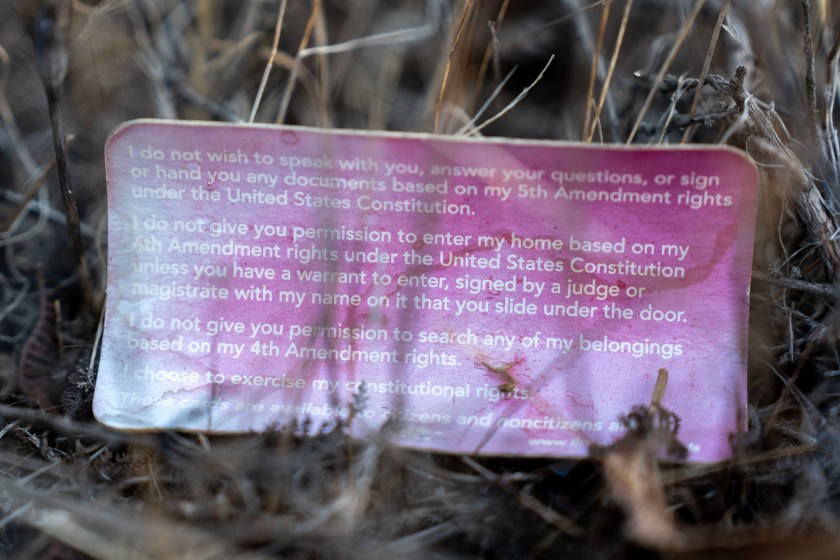
A discarded card shows advice that advocates give to migrants about what to say if they are apprehended. 
ANNIE BARKER/TIMES OF SAN DIEGO/CATCHLIGHT LOCAL/REPORT FOR AMERICA

“Most people don’t understand the magnitude of this territory, and all the work it’s going to cost them to arrive at their destination. They get to the top of this mountain and realize there’s miles and miles and miles left to walk,” Ortigoza said. 

In addition, they need to avoid capture. “They go really fast,” he said, “and there’s a lot of pressure.”

On the afternoon of September 14, 2025, Gómez Hernández told her mother and sister through WhatsApp voice messages that she had successfully crossed the border into the United States.

These short snippets of audio would be their only clues to what happened next. 


The hillside where Gómez Hernández walked that afternoon is exposed on all sides, with a panoramic view of the border wall just a couple hundred yards away. But on the other side of the hill is a daunting, mountainous wilderness, covered in low trees and rocky ravines, with hidden, winding trails, stretching into the distance. It is possible she saw this and turned around, convinced she was lost. Wandering the hillsides in the afternoon heat without sufficient water, she could succumb to dehydration within hours. 

“Because of the heat, there are places where you can’t move forward even half a mile in an hour,” said Larraenza, the search and rescue leader. 

By 2 p.m., “She told me she felt very tired and couldn’t go any further,” Irma said. “I told her to give it her all, to think of her children, keep them in her mind so she could get out of there.” Irma says 4 p.m. was the last time her sister’s location was transmitted to the smugglers. 


After hearing about Gómez Hernández’s case, Ortigoza said it “seemed strange,” because she was “so close to the border” at her last known location. 

But Bryce Peterson, the No More Deaths volunteer who collects autopsy reports on migrant remains border-wide, said “There’s a million ways that somebody could be already on the verge of death that close to the wall. Like if you’re going north and then you decide to go south again because you get lost or something.”

“The only thing we’re certain of is that she suffered in her last moments,” Ortigoza said. “Just knowing that you’re alone.”

Walking on the hillside, Gómez Hernández encountered a man also traversing the trails, lined with dry shrubs. “In one of the messages sent, where she told me to pray for her, the man spoke and said ‘there isn’t time,’” Irma said. 

After that, Graciela’s phone still received messages, but she did not respond. 

Cameras rise, questions remain 

Even though the federal surveillance tower was just a mile away, it is possible the cameras did not see Gómez Hernández. It is possible they did not see much of anything. 

An internal memo obtained by NBC News in October 2024 revealed that 30% of the older-style towers, the kind that require agents in control rooms to review footage, were broken. Most were missing parts, or their equipment was outdated and unusable. These 150 broken towers still stood at the border, acting as million-dollar scarecrows. 

Officials from the Government Accountability Office wrote in a report in September 2025 that the Customs and Border Protection had begun to fix the towers with spare parts and revamp them with new technology, but did not list how many remained out of commission. 

The Border Patrol did not respond to questions from Times of San Diego about whether the tower in view of where Gómez Hernández died was operational at the time of her death. 

Dave Maass, the director of investigations for the Electronic Frontier Foundation, the organization that maps surveillance towers at the border, questions the functionality of all types of towers. “None of these systems have been effective. There’s no independent evaluation of how many things they’re capturing,” he said. 

In a report published in March 2026, a representative of the US Military notes that a mission to place 7 G-BOSS(E) towers in the Otay Mountain Wilderness, an installation that took place in the months prior to Gómez Hernández’s death, faced operational challenges. 

The combat-grade military surveillance towers were vulnerable to tipping over, damage from rodents, exhaust blowouts, and running out of battery. On a dirt road in the mountains, a truck carrying a surveillance tower bounced around, which led to the tower’s cameras “becoming stuck in a zoomed-in position.” 

Despite descriptions from manufacturers claiming dominance in “rugged terrain,” Osvaldo Ruíz, the Border Angels coordinator, said it would still be difficult for a surveillance tower to track migrants moving through the Otay Mountain Wilderness. “With all that surveillance that’s out in the mountains, there’s still a lot of brush and high covered areas that would make it easy [to stay undercover].”

Analysts from the RAND Corporation, a foreign policy think tank, wrote in a report in 2020 that “outcomes and outputs” that would indicate the success of surveillance towers “are not directly observable.” 

The analysts conceded that the towers’ presence would urge migrants to stay out of the area and funnel into undetected routes. “The likely deterrent effect on migrant crossings through surveilled areas overwhelms any boost to situational awareness,” that the towers provide, the analysts wrote. In this way, the surveillance towers’ most useful quality was the threat conveyed through their technology, rather than the merit of the technology itself. 

Due to increased surveillance, “People are crossing through areas that are further out and more extreme, where we have very little hope of finding them in a search,” Larraenza said. 
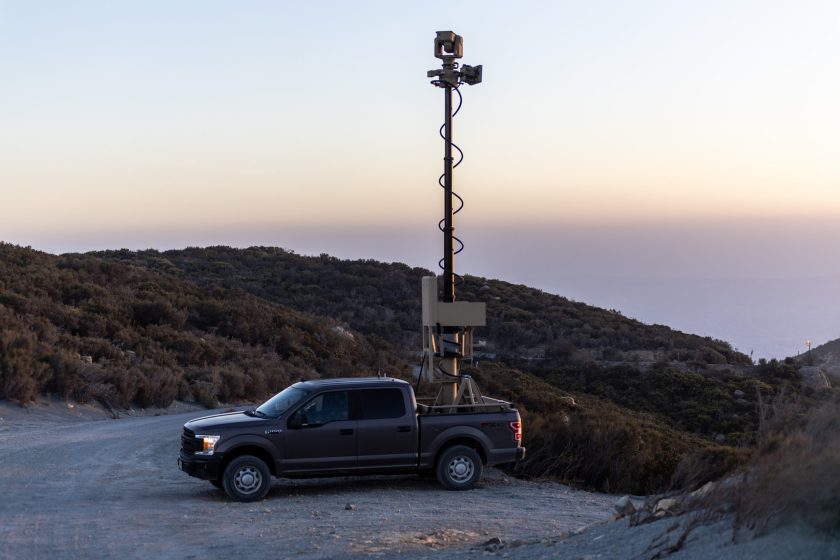
A portable surveillance tower rises from a pickup truck in the Otay Mountain Wilderness outside San Diego, September 2026.
ANNIE BARKER/TIMES OF SAN DIEGO/CATCHLIGHT LOCAL/REPORT FOR AMERICA

And though the manufacturer says the AI-enabled towers, which now make up over half of the total, can identify migrants on their own, apprehensions still require human labor. A CBP official told the RAND analysts that smugglers began sending migrants across the border alone, rather than in groups, to overwhelm the surveillance towers with many individual targets, leading to more alerts than agents capable of following them. 

So it is possible the towers in the vicinity did capture footage of Gómez Hernández, but agents decided not to apprehend her. Just hours before her death, she sent a message saying that there were “police” nearby, possibly referring to Border Patrol agents in trucks. 

“Even one person who’s not sick, one person who is just hiking on their own, often Border Patrol will just ignore them because it’s not worth their time to just only catch one person,” said Peterson of No More Deaths. “They want to be able to catch a whole group of people.”

Larraenza said he’s found dehydrated people on migrant trails who say they called out to Border Patrol, and the agents failed to stop. “But there are also cases where agents do the impossible to find someone,” he said. 

On one occasion in September 2024, while rescuing a family of five in the Otay Mountain Wilderness, Larraenza met a person wearing a vest labeled “SHERIFF” on the trail. In a video that Larraenza posted to his Facebook account, when asked if the Border Patrol would arrive to take the family into custody, the deputy says, “Oh, they don’t come out here.”


On a recent visit to the spot where Gómez Hernández died, multiple Border Patrol trucks were visible just hundreds of yards away, rolling slowly along the wall, or parked on the hill next to the surveillance tower. 

“If we hadn’t sent the Border Patrol the coordinates, they never would have bothered to go [find Gómez Hernández’s body],” Ortigoza said.

Finding Graciela 

Irma sent her sister a barrage of messages that afternoon and evening, pleading with her to send her location, but there was no response.

Irma believes it’s possible her sister was killed or abandoned by the other migrant she was traveling with during her final hours, because she was not walking fast enough. 

It took Irma two weeks to make contact with the coyotes. When she told the smugglers that her sister was missing, “they didn’t move a single finger,” she said. She threatened to send one coyote’s phone number to the police, until he sent her a screenshot of Graciela’s last known location. 

Almost three weeks after Graciela Gómez Hernández’s final message to her mother, on October 3, 2025, the Armadillo search group sent the last known GPS coordinates of her phone to the Border Patrol. 

The medical investigator’s report states that Gómez Hernández sent her location to her family, and her relatives sent the coordinates to a search group while she remained alive, but both Irma and Ortigoza said they did not know her location for weeks, and neither was interviewed for the examiner’s report. 

“On 10/04/2025 at 11:16 hours, I arrived on a dirt path approximately 100 yards north of the United States/Mexico International border. The area consisted of shrubs and dried brush with steep hills and declines,” Jennifer Wright, the medical examiner, wrote in an autopsy report. “Upon further review, I viewed the skeletonized remains of an apparent female lying supine in the dirt.”

The body had decomposed quickly with the help of the sun and animals, so it was impossible to tell whether Gómez Hernández was the victim of murder or dehydration. But the medical examiner noted that there was no water or food in the vicinity.

“In a pile next to the decedent was a purple bra, black pants, a black floral shirt, and a dark colored long sleeve shirt. The bra was hooked closed and intact,” Wright, the medical examiner, wrote in her report. “In the rear pants pockets were Mexican paper currency, Mexican coins, bobby pins, and tweezers.”

The body was naked, but it was unclear whether someone else removed Gómez Hernández’s clothes, or whether she took them off herself in the final throes of dehydration delirium, a common symptom immediately preceding organ failure. 

Several yards from the place where she died, Ortigoza found a backpack with a bottle of women’s spray deodorant, and a small glass container of perfume. 

“When you get to one of these sites, and you see the situation, the loneliness, the environment, you start wondering, what was this person thinking in their last moments?” Larraenza said. 

Once a DNA test confirmed the identity of the remains, Irma paid over $4,000 to send her sister’s bones home to Mexico, where the family held a funeral nine months after her death.

“Sometimes her oldest son, he just sits there thinking and when we ask what’s wrong, he says he misses his mom,” Irma said. Though the family is heartbroken, everyone has pitched in to care for Graciela’s children. “I don’t let my parents see me cry,” Irma said. 

The Border Patrol gave permission to Ortigoza and a group of searchers to place a cross next to where Gómez Hernández was discovered. On a recent trip to the memorial to leave flowers, Ortigoza played a voice message that Irma sent to her sister, the sound vibrating into the dirt of the hillside, where the imprint of Gómez Hernández’s body is still visible nearly a year after its removal.

Rosaries hang on a memorial for Graciela Gómez Hernández. The mountains east of San Diego continue to be a risky crossing spot. One migrant advocate said in mid-September that at least two more people had gone missing in the area in the past few weeks.
ANNIE BARKER/TIMES OF SAN DIEGO/CATCHLIGHT LOCAL/REPORT FOR AMERICA

“I know that in the place you’re in, there isn’t suffering, like how you suffered here on this earth,” Irma said. “I know you left thinking about your children. I know you wanted to give them a better life. I feel you here, and I feel you alive.”

Cesar Ortigoza says every day he gets as many as five calls from people looking for their missing family members at the border. Though numbers of border crossings, and numbers of reported deaths, have decreased since Donald Trump took office in January 2025, “There are still a lot of people on the other side trying to get here. Because the problems in their countries persist,” Ortigoza said. 

In the first half of 2026, fewer people have consumed the water bottles, Gatorade and cans of food left by Border Angels volunteers in the Otay Mountain Wilderness. But supplies left on other routes by different groups have seen increased consumption, evidence that migration patterns are constantly evolving. 

“It’s hard for me to really understand how people are crossing, but I know they are,” Ruíz said.

Peterson, the No More Deaths map-maker, said more migrants could die in the coming months and years, as a result of increased surveillance. In the past, after surveillance towers were installed, migrants would try to go around them, leading to longer and more dangerous routes through stretches of remote wilderness. With the installation of hundreds of new towers, the spaces outside the range of detection have thinned, leading some migrants to attempt to go through surveilled territory, rather than around it. 

“We’ve seen people do things that to me seem terrifying or crazy, like going past an area where they know there are sensors and then trying to really quickly get to the next safe-ish place before Border Patrol shows up to get them, because it takes 15 minutes for them to show up,” Peterson said. “It seems like people aren’t stopping to drink water. People are going really fast, often running even, moving much more quickly, not being able to take the time to take care of themselves.”

Larraenza says for this same reason, migrants often choose to cross the border in the hottest weeks of the year, when they believe fewer agents will be on patrol, but there is a greater risk of death. In an interview in mid-September, Larraenza said at least two people had gone missing in the Otay Mountain wilderness in the past few weeks, and he had not yet been able to find their remains. 

Ortigoza says Gómez Hernández’s story is an example of a decades-long trend of people putting their lives at risk to cross the border out of necessity. The surveillance towers, whether or not they were functional, did not stop Gómez Hernández from crossing the border in that area, and did not stop her from dying. “If the riches of the world were distributed more equitably, we wouldn’t have to do things like this to reach a better life,” he said. 

While placing flowers in July at the site of Gómez Hernández’s death, Ortigoza noticed a Border Patrol truck parked under the surveillance tower on the hilltop a mile to the east. An agent stood on a power lift, working on the tower’s cameras. 

This year, agents replaced dozens of these cameras with new, AI models. 


About Times of San Diegos report

Times of San Diego’s analysis relied on publicly available data from various sources, starting with records that document the deaths of border-crossers. 

No More Deaths, a longstanding border activist group, has compiled information on such deaths for years. In California, their efforts use data from the San Diego County Medical Examiner’s Office and the Imperial County Coroner’s Office. 

In San Diego County, the group says, it obtained lists and narratives for “all deaths related to border-crossings.” The data was detailed, but it was unclear how the medical examiner’s office ensured it had identified all cases involving border-crossers. 

In Imperial County, the group said, its requests were disregarded, and it ultimately brought a legal claim. In response, the county provided a list of deaths “with minimal data and no explanation for how the records custodian had compiled the data.” Since then, the group says, it has been adding details by requesting coroner’s reports for each individual case. 

Even if both counties’ records are complete, the remains of other missing migrants have yet to be found, so the list is very likely an undercount.

Times of San Diego focused on migrant deaths starting in 2022, just after a dramatic increase in the number of towers installed in California. 

Electronic Frontier Foundation, which advocates for human and constitutional rights, catalogs each surveillance tower with in-person and satellite image verification.

Times of San Diego analyzed the location data for each death and the nearest surveillance tower. Each pairing of a death location and a tower within surveillance range was confirmed by hand on maps of each location. The analysis also examined time-stamped satellite imagery to verify each tower was in place at the time each body was found. 

From 2022 through 2025, Times of San Diego’s analysis found that at least 138 people died within the nominal range of a nearby surveillance tower. 

Proximity to a tower isn’t necessarily a guarantee that a migrant was on camera at the time. Much of the area is mountainous, and terrain may block a camera’s view. A separate MIT Technology Review analysis concluded that of the deaths we tallied in the past four years, at least 81 of those people were most likely within the field of view of a surveillance tower—not blocked by a hill or other terrain.


Lillian Perlmutter is an investigative reporter covering immigration across California for Times of San Diego and NEWSWELL. Previously based in Mexico City, she has written for more than 25 outlets including the L.A. Times, Rolling Stone, The Guardian, and The New Republic.


Shape
Shape
Stay Ahead

Explore More Insights

Stay ahead with more perspectives on cutting-edge power, infrastructure, energy,  bitcoin and AI solutions. Explore these articles to uncover strategies and insights shaping the future of industries.

Shape

Lenovo expands virtualization portfolio for AI

On the services front, Lenovo is restructuring its infrastructure deployment offerings around three defined service levels: Standard Deploy, Premier Deploy, and Premier Deploy Plus. The options are designed to allow customers to select a deployment model based on multiple factors, including project complexity, business criticality, internal IT capabilities and the

Read More »

Practical quantum computers are over a decade away, says NEC

A practical, commercial quantum computer is over a decade away, executives at Japanese IT services company NEC are reported as saying. That’s why, according to Japanese news publication The Mainichi, company has pulled the plug on its plans to develop a quantum computer — although it will still continue research

Read More »

Huawei aims to deliver faster AI chips, faster

Huawei is accelerating its AI chips development, bringing forward the release of the next two models in the family powering its AI computing clusters by three to nine months. Its Ascend 960 chip family is a major component of supercomputing portfolio. It now plans to release the Ascend 960DT in

Read More »

QatarEnergy NFE LNG Train 1 to start 1H 2027; Ras Laffan repairs to take 3 years

QatarEnergy expects the 8-million tonne/year (tpy) first train of its 32-million tpy North Field East (NFE) LNG expansion project to begin operations in first-half 2027, Reuters reported, noting that the timing of additional trains would depend on ​the Strait of Hormuz crisis. Speaking at the Qatar Economic Forum Special Edition in New York, QatarEnergy chief executive officer (CEO) and Qatari minister of energy affairs, Saad al-Kaabi, attributed the uncertainty to delays in delivering equipment needed for the expansion caused by the Strait of Hormuz disruption. Regarding damage to Qatar’s natural gas infrastructure sustained during the Iran war and its possible return, al-Kaabi said that repairs to the two LNG trains damaged at Ras Laffan (17% of its production capacity) would take 3 years. A damaged gas-to-liquids (GTL) train is expected to return to service first-quarter 2027. Al-Kaabi expects “a few” NFE trains to start production as 2027 progresses, and output from the 16-million tpy North Field South (NFS) expansion to begin in 2028, according to Reuters. The NFE and NFS projects are part of the overall North Field expansion program that also includes the North Field West project, which together will raise Qatar’s LNG production capacity to 142 million tpy from the current 77 million tpy. Al-Kaabi also thanked Qatar’s neighbors for being willing to allow construction of a gas pipeline across their territories to bypass Hormuz, while noting that doing so would be “redundant” and made “no economic sense” in light of the already underway North Field expansion project. “As for resuming operations,” he added, “Qatar is ready to resume normal operations within a few weeks of the reopening of the Strait of Hormuz.” More generally, al-Kaabi rejected the notion that the Strait of Hormuz was obsolete, saying that it “carries trade in all products, not only oil and

Read More »

ESENTIA to acquire Guadalajara-Manzanillo natural gas pipeline system

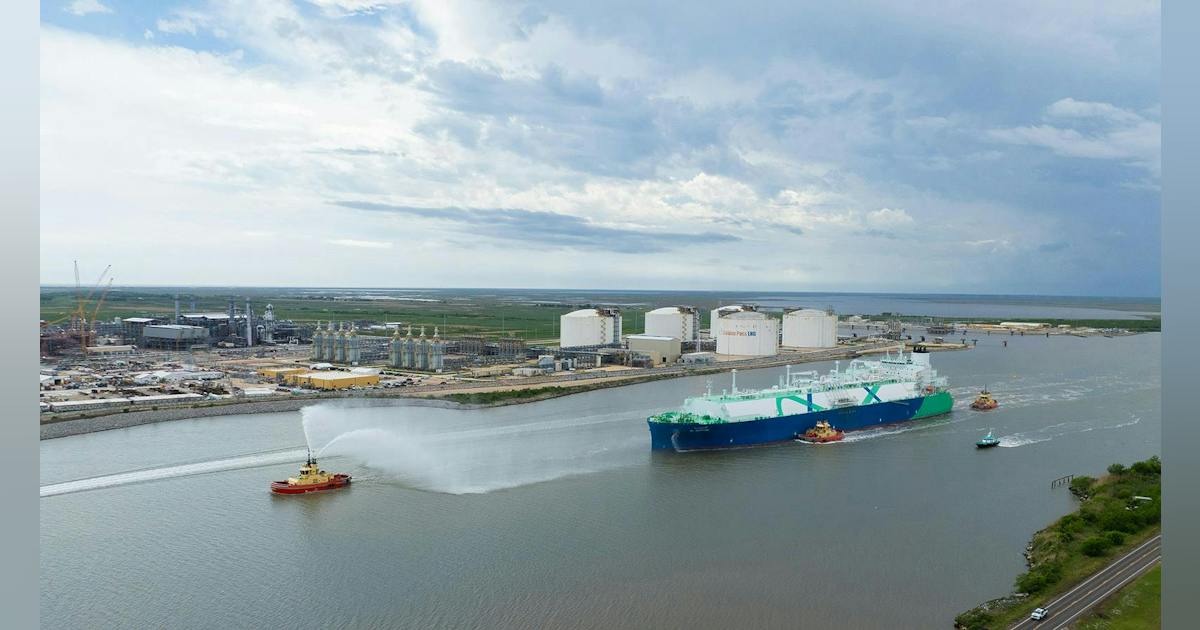
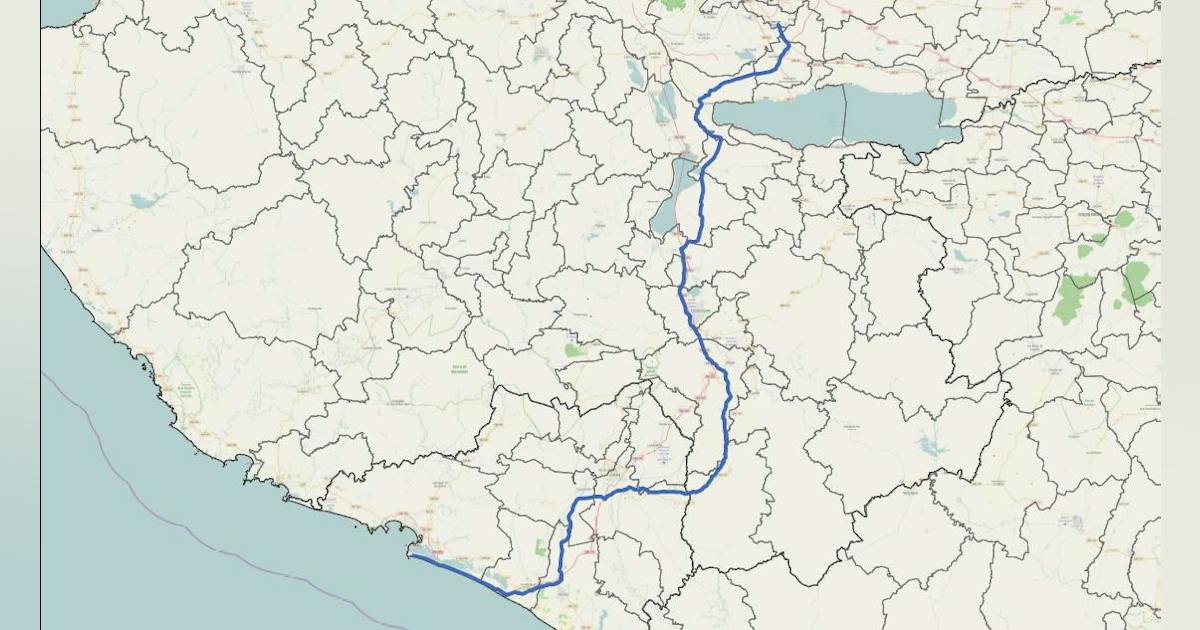
ESENTIA Energy Development SAB de CV, Mexico City, has agreed to acquire 100% of the equity interests of Energía Occidente de México S de RL de CV (EOM) from TC Energy Corp., Calgary, for a gross purchase price of $400 million. EOM owns and operates the 313-km Guadalajara-Manzanillo natural gas pipeline system, which runs from the Guadalajara area in Jalisco to Manzanillo, Colima, and is directly interconnected with ESENTIA’s Villa de Reyes-Aguascalientes-Guadalajara (VAG) pipeline system operated by Esentia Pipeline de Occidente S de RL de CV, an indirect subsidiary of ESENTIA. The pipeline transports up to 500 MMcfd of natural gas, connecting imported LNG supply near Manzanillo and continental gas supply near Guadalajara to power plants and industrial customers in Colima and Jalisco. Upon closing, the acquisition will extend ESENTIA’s pipeline network to the Port of Manzanillo on Mexico’s Pacific coast, making the company the only private operator with an integrated natural gas pipeline system connecting the Permian basin in Texas to Mexico’s Pacific coast, the company said in a release Sept. 21. The deal is part of ESENTIA’s strategy to build a cross-border transportation system and would “expand ESENTIA’s ability to serve existing and prospective customers within the combined system’s area of influence, including demand from power generation, industrial customers and potential LNG-related projects,” said Daniel Bustos, chief executive officer. ESENTIA also highlighted construction of its Aguascalientes Compression Station, which is expected to increase capacity on the VAG pipeline system beginning in early 2027. The project is part of the company’s three-phase expansion plan, which includes a total estimated investment of $680 million and an increase of 660 MMcfd in natural gas transportation capacity. For TC Energy, the transaction creates “optionality to redeploy proceeds from a mature asset towards high-value growth opportunities across our North American footprint,” said François

Read More »

Energy Department Announces $99 Million for 21 Projects to Advance U.S. Geothermal Energy Development

WASHINGTON—The U.S. Department of Energy (DOE) today announced more than $99 million for 21 projects selected to advance geothermal energy development across the United States. The projects will conduct field-scale tests of next-generation geothermal technologies and exploration drilling to characterize and potentially confirm promising geothermal resources.  Thanks to President Trump’s leadership, the Energy Department is advancing American geothermal innovation to unlock the nation’s abundant domestic energy resources. Geothermal can provide reliable, around-the-clock power to help meet growing demand while strengthening U.S. energy security. “These projects will empower American innovators to unlock the tremendous geothermal resources beneath our feet,” said DOE Under Secretary of Energy Kyle Haustveit. “Under President Trump’s leadership, we’re advancing next-generation geothermal technologies that can lower costs, strengthen American energy dominance, and turn more of our vast domestic geothermal resources into reliable and affordable power.” The 21 projects will advance geothermal development in two key areas. Five projects will conduct field-scale enhanced geothermal systems (EGS) tests to validate technologies under real-world conditions, while 16 additional projects will conduct exploration drilling to identify and characterize promising next-generation geothermal resources. Together, these efforts will help reduce technical and development risk and provide the information needed to support future commercial projects and investment.   Data generated by these projects will be publicly available through DOE’s Geothermal Data Repository (GDR), giving industry, researchers, and other stakeholders access to information from the field tests and geothermal exploration activities. Making these data available can extend the value of the projects beyond individual sites by helping inform future technology development and geothermal exploration across the industry.  Learn more about the selected projects here.  Selection for award negotiations is not a commitment by DOE to issue an award or provide funding. Before funding is issued, DOE and the applicants will undergo a negotiation process, and DOE may cancel negotiations and rescind the

Read More »

INA commissions new delayed coker at Rijeka refinery

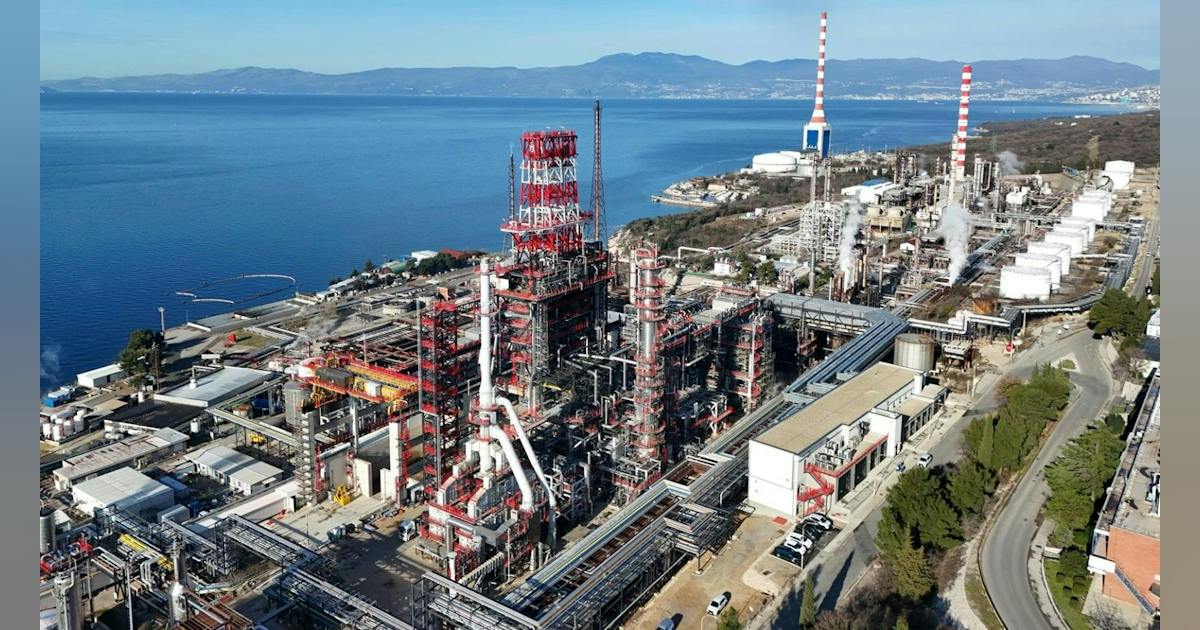
Croatia’s INA Industrija Nafte DD has started up a new delayed coking unit (DCU) at its 90,000-b/d Rijeka refinery along the northern part of the Adriatic Sea, marking a major milestone in the refinery’s upgrading project. Following mechanical completion and commissioning, INA introduced feedstock into the DCU on Sept. 1, beginning production, majority owner MOL Group said in a release Sept. 21. The unit has operated continuously since startup and has reached about 70% of design capacity, the company said. The DCU—which  converts heavy refinery residues into higher-value products—has produced all key products at required quality and is anticipated to increase diesel production by as much as 30% from the same crude volume. MOL Group said the new DCU unit—once fully operable—also will eliminate Croatia’s need to import vacuum gas oil (VGO). The Rijeka refinery upgrade represents an investment of nearly €700 million, which is included in a combined €1.3-billion joint investment by INA and MOL Group in refining and logistics modernization during the past 12 years. “The start-up of the new unit went really well,” said Zsuzsanna Ortutay, president of INA’s management board, adding that the DCU would improve the sustainability and profitability of INA’s refining business while supporting energy supply in Croatia and the surrounding region. INA  plans to increase throughput and optimize process performance at the new unit gradually, with stable operation anticipated by yearend, followed by final plant performance testing and project closeout activities. Rijeka DCU project background INA awarded a lump-sum, turnkey engineering, procurement, and construction contract for the project to Maire Tecnimont SPA subsidiary KT-Kinetics Technology SPA in December 2019. The contract covered a new delayed coking complex with coke handling and ship-loading facilities, a sour-water stripper, and amine recovery units. It also included modifications to the existing hydrocracker, sulfur recovery unit, utilities, and

Read More »

Oil prices retreat as Middle East supply concerns ease amid diplomatic talks

Oil prices fell on Monday, Sept.21, with Brent extending its retreat from recent highs, as recovering Saudi crude exports and hopes for renewed US-Iran diplomacy eased fears of an immediate Middle East supply crunch. Brent crude futures and US West Texas Intermediate (WTI) crude dipped below $100/bbl to their lowest since Sept. 9. The move extends a four-session retreat from the recent surge in crude prices as traders reassess how severely regional conflict is constraining physical oil flows. Despite the continued uncertainty in the Middle East, news of a major rebound in Saudi crude oil exports in September weighed on prices. Saudi Arabia has increased shipments through the Strait of Hormuz to compensate for disruptions to its East-West pipeline following Houthi attacks on Saudi energy infrastructure. Saudi crude flows through the strait have averaged roughly 2.9 million b/d over the past 6 days, compared with about 700,000 b/d in August, according to satellite data cited by JPMorgan analysts. US Central Command Commander Admiral Brad Cooper confirmed on Sept.19 that, thanks to US naval escorts and mine-clearance efforts, oil and LNG shipments through the Strait of Hormuz in the past 2 weeks reached the highest level in 6 months. The recovery in Gulf exports has helped ease fears that attacks on Saudi infrastructure would translate into a prolonged loss of barrels from the global market. Meanwhile, investors are closely monitoring signs of potential diplomatic progress between Washington and Tehran during this week’s UN General Assembly. US President Donald Trump has expressed a willingness to meet with Iranian President Masoud Pezeshkian, while Iran has reportedly conveyed the conditions for resuming negotiations. Expectations that talks could eventually reduce regional tensions have removed some of the geopolitical risk premium that pushed crude prices higher earlier this month. Still, physical oil markets remain strained. Middle Eastern producers

Read More »

Trump Administration Moves to Keep Indiana Coal Plants Operating to Support Grid Reliability

WASHINGTON—U.S. Secretary of Energy Chris Wright issued emergency orders to keep two Indiana coal plants operational to ensure Americans in the Midwest region of the United States have continued access to affordable, reliable, and secure electricity. The orders direct the Northern Indiana Public Service Company (NIPSCO), CenterPoint Energy, and the Midcontinent Independent System Operator, Inc. (MISO) to take all measures necessary to ensure specified generation units at both the R.M. Schahfer and F.B. Culley generating stations in Indiana are available to operate. Certain generation units at these coal plants were scheduled to shut down at the end of 2025.  The orders will minimize the risk of unnecessary blackouts for the American people. Since the U.S. Department of Energy’s (DOE) original orders were issued on December 23, 2025, the Schahfer and Culley coal plants have proven critical to MISO’s operations, operating during periods of high energy demand and low levels of intermittent energy production, including during Winter Storm Fern.   “Forcing reliable, dispatchable coal generation off the grid would compromise energy reliability and needlessly raises energy costs for Americans,” said Energy Secretary Wright. “Midwestern families should not be forced to pay the price for the misguided energy subtraction policies of the past. They deserve affordable, reliable, and secure energy, regardless of the wind blowing or the sun shining.” Thanks to President Trump’s leadership, coal generating plants across the country are being saved from premature retirement. For example, in 2025, more than 17 gigawatts of coal power electricity generation were saved from going offline.  The availability of R.M. Schahfer and F.B. Culley generating stations to operate will continue to be an asset to maintain reliability in the MISO region and is necessary to address elevated reliability risks in that region during extreme weather and reduce the risk of power outages that could threaten public health and safety. As

Read More »

How Communities Can Plan for AI Data Centers Before the Projects Arrive

The collision between AI infrastructure development and community opposition has become one of the defining data center stories of 2026. Developers are pursuing larger campuses, more power and compressed delivery schedules as AI accelerates demand for computing capacity. Meanwhile, local planning boards, elected officials and residents are increasingly being asked to make decisions about facilities whose scale, energy requirements and technological purpose may be unlike anything previously contemplated in their comprehensive plans. That gap is where Ilissa Miller believes much of the conflict begins. Miller, founder and CEO of iMiller Public Relations and a board member of the Open Infrastructure Exchange (OIX), joined the Data Center Frontier Show to discuss the OIX Digital Infrastructure Framework, an effort designed to give municipalities a more systematic way to think about data centers and other digital infrastructure before an individual development application lands in front of them. The idea is straightforward: communities routinely create long-range plans defining where homes, commercial development, industry and other land uses should go. Digital infrastructure should be part of that process as well. “Our vision for the framework was to help solve the problem by empowering communities to think about digital infrastructure,” Miller said, so municipalities can incorporate it into their comprehensive master plans and maintain control over how land is ultimately used. That distinction is key. The framework is not intended to convince communities to approve data centers. Nor does it prescribe what a town or county should decide. Instead, Miller said, it is meant to help public officials ask the right questions early enough to make those decisions deliberately. The Data Center May Not Be in the Plan One of the industry’s recurring problems is deceptively basic: many municipalities never anticipated data centers when writing their zoning codes and comprehensive plans. A parcel might already be

Read More »

Executive Roundtable: AI Infrastructure Under Pressure

Matt Vincent is Editor in Chief of Data Center Frontier, where he leads editorial strategy and coverage focused on the infrastructure powering cloud computing, artificial intelligence, and the digital economy. A veteran B2B technology journalist with more than two decades of experience, Vincent specializes in the intersection of data centers, power, cooling, and emerging AI-era infrastructure. Since assuming the EIC role in 2023, he has helped guide Data Center Frontier’s coverage of the industry’s transition into the gigawatt-scale AI era, with a focus on hyperscale development, behind-the-meter power strategies, liquid cooling architectures, and the evolving energy demands of high-density compute, while working closely with the Digital Infrastructure Group at Endeavor Business Media to expand the brand’s analytical and multimedia footprint. Vincent also hosts The Data Center Frontier Show podcast, where he interviews industry leaders across hyperscale, colocation, utilities, and the data center supply chain to examine the technologies and business models reshaping digital infrastructure. Since its inception he serves as Head of Content for the Data Center Frontier Trends Summit. Before becoming Editor in Chief, he served in multiple senior editorial roles across Endeavor Business Media’s digital infrastructure portfolio, with coverage spanning data centers and hyperscale infrastructure, structured cabling and networking, telecom and datacom, IP physical security, and wireless and Pro AV markets. He began his career in 2005 within PennWell’s Advanced Technology Division and later held senior editorial positions supporting brands such as Cabling Installation & Maintenance, Lightwave Online, Broadband Technology Report, and Smart Buildings Technology. Vincent is a frequent moderator, interviewer, and keynote speaker at industry events including the HPC Forum, where he delivers forward-looking analysis on how AI and high-performance computing are reshaping digital infrastructure. He graduated with honors from Indiana University Bloomington with a B.A. in English Literature and Creative Writing and lives in southern New Hampshire with

Read More »

California joins US states clamping down on data center gold rush

“Dismissing fears around water consumption, for example, by showing a spreadsheet at a local planning committee meeting, doesn’t resolve concerns for a community that is already suspicious,” he said. Community opposition “is real, and it’s everywhere,” and the new strategic pillar for data center builders and operators is social outreach, Kimball noted. Those proposing data centers must be able to provide credible answers about usage and community impacts, listen to concerns, and commit to transparency. Most enterprises aren’t building gigawatt campuses, he pointed out, but they are paying the price downstream in colocation availability, lead times, pricing, and other factors. Predictability is the big question, supply is already tight, and every delayed project removes capacity factored into forecasts.

Read More »

Communities are blocking data centers before they’re even proposed

“Dismissing fears around water consumption, for example, by showing a spreadsheet at a local planning committee meeting, doesn’t resolve concerns for a community that is already suspicious,” he said. Community opposition “is real, and it’s everywhere,” and the new strategic pillar for data center builders and operators is social outreach, Kimball noted. Those proposing data centers must be able to provide credible answers about usage and community impacts, listen to concerns, and commit to transparency. Most enterprises aren’t building gigawatt campuses, he pointed out, but they are paying the price downstream in colocation availability, lead times, pricing, and other factors. Predictability is the big question, supply is already tight, and every delayed project removes capacity factored into forecasts.

Read More »

Data Centre West 2026: Alberta Moves From Data Center Ambition to Execution

Firm Power Is an Architecture That brought the morning back to its recurring problem: What counts as available power? During the “Solving for Power” panel, moderator Lillian Kasa of Metlen Energy & Metals argued that data centers cannot operate on announcements. They need reliable electricity delivered on a schedule and backed by a commercial structure that can be financed. Margarita Patria of Charles River Associates made the distinction even sharper. Firm power is not merely generation. It is generation, transmission and fuel availability working together. Todd Detling of FortisAlberta added an important Alberta-specific qualification. Despite perceptions that the province had substantial transmission capacity available for new development, FortisAlberta is encountering constraints, particularly around the Edmonton and Calgary fringes. At the distribution level, the demand is already material. Detling said FortisAlberta has connected nearly 80 MW of data center load over the past several years, has approximately another 80 MW in the build queue, and has received roughly 300 MW in additional requests. Those smaller increments matter in a market dominated rhetorically by gigawatt announcements. They are another indication that developers are searching for power pathways they can execute now. AI Is Not Just a Bigger Load Tesla’s Sean Jones added another technical wrinkle: AI training loads can change extremely quickly. Data center power planning traditionally focuses heavily on annual consumption, peak demand and hourly load. GPU clusters can create significant changes at the second or even sub-second level. Jones described AI training demand falling from full load to around 30% in less than a second. That kind of movement can be difficult for onsite turbines and reciprocating generators to follow and potentially disruptive to the grid. Battery energy storage is therefore taking on a different role. The familiar data center battery story is backup power. The emerging AI story is

Read More »

Local AI is getting small enough to make every app multilingual

On-device translation used to mean a separate model for every language you wanted to support. English to French, English to German, and so on. However, that becomes unsustainable at a global scale when you’re talking about thousands of possible language pairs. Add to that the fact that most developers have to either send translation requests to the cloud to get fast, accurate results, or keep it local with restricted language support. Tether’s AI Research team has developed a family of multilingual translation models, TranslatePsy-EuroNano, that each support nine European languages, with deployment built around a pair of multilingual models rather than separate bilingual models for every language pair. What makes this possible Supporting a full European market on-device has previously meant bundling dozens of separate model files, but this is impractical for mobile apps and those building them. Tether AI’s multilingual open‑source edge translation models set the standard for efficiency, quality, and speed. For developers, the possibilities are endless. Using English as a pivot, the models remain comparable to Mozilla Firefox’s Bergamot-based translation system while dramatically reducing the size of on-device translation. At its smallest tier, Tether’s deployment is 17.6 times smaller while maintaining comparable translation quality. Tether’s deployment takes up 36MB to 89MB, depending on the tier you use. By comparison, the equivalent Firefox setup requires 18 separate bilingual models totaling 633MB to provide the same language coverage. The models are small enough to run efficiently on edge devices while supporting nine European languages from a single multilingual deployment, making multilingual experiences practical for a much wider range of software. Potential applications include travel and navigation apps, educational platforms that present lessons and resources on-device. The models are also designed for academics and researchers. Because the weights are openly available, researchers can fine-tune them for specialized domains, like customer

Read More »

Microsoft will invest $80B in AI data centers in fiscal 2025

And Microsoft isn’t the only one that is ramping up its investments into AI-enabled data centers. Rival cloud service providers are all investing in either upgrading or opening new data centers to capture a larger chunk of business from developers and users of large language models (LLMs).  In a report published in October 2024, Bloomberg Intelligence estimated that demand for generative AI would push Microsoft, AWS, Google, Oracle, Meta, and Apple would between them devote $200 billion to capex in 2025, up from $110 billion in 2023. Microsoft is one of the biggest spenders, followed closely by Google and AWS, Bloomberg Intelligence said. Its estimate of Microsoft’s capital spending on AI, at $62.4 billion for calendar 2025, is lower than Smith’s claim that the company will invest $80 billion in the fiscal year to June 30, 2025. Both figures, though, are way higher than Microsoft’s 2020 capital expenditure of “just” $17.6 billion. The majority of the increased spending is tied to cloud services and the expansion of AI infrastructure needed to provide compute capacity for OpenAI workloads. Separately, last October Amazon CEO Andy Jassy said his company planned total capex spend of $75 billion in 2024 and even more in 2025, with much of it going to AWS, its cloud computing division.

Read More »

John Deere unveils more autonomous farm machines to address skill labor shortage

Join our daily and weekly newsletters for the latest updates and exclusive content on industry-leading AI coverage. Learn More Self-driving tractors might be the path to self-driving cars. John Deere has revealed a new line of autonomous machines and tech across agriculture, construction and commercial landscaping. The Moline, Illinois-based John Deere has been in business for 187 years, yet it’s been a regular as a non-tech company showing off technology at the big tech trade show in Las Vegas and is back at CES 2025 with more autonomous tractors and other vehicles. This is not something we usually cover, but John Deere has a lot of data that is interesting in the big picture of tech. The message from the company is that there aren’t enough skilled farm laborers to do the work that its customers need. It’s been a challenge for most of the last two decades, said Jahmy Hindman, CTO at John Deere, in a briefing. Much of the tech will come this fall and after that. He noted that the average farmer in the U.S. is over 58 and works 12 to 18 hours a day to grow food for us. And he said the American Farm Bureau Federation estimates there are roughly 2.4 million farm jobs that need to be filled annually; and the agricultural work force continues to shrink. (This is my hint to the anti-immigration crowd). John Deere’s autonomous 9RX Tractor. Farmers can oversee it using an app. While each of these industries experiences their own set of challenges, a commonality across all is skilled labor availability. In construction, about 80% percent of contractors struggle to find skilled labor. And in commercial landscaping, 86% of landscaping business owners can’t find labor to fill open positions, he said. “They have to figure out how to do

Read More »

2025 playbook for enterprise AI success, from agents to evals

Join our daily and weekly newsletters for the latest updates and exclusive content on industry-leading AI coverage. Learn More 2025 is poised to be a pivotal year for enterprise AI. The past year has seen rapid innovation, and this year will see the same. This has made it more critical than ever to revisit your AI strategy to stay competitive and create value for your customers. From scaling AI agents to optimizing costs, here are the five critical areas enterprises should prioritize for their AI strategy this year. 1. Agents: the next generation of automation AI agents are no longer theoretical. In 2025, they’re indispensable tools for enterprises looking to streamline operations and enhance customer interactions. Unlike traditional software, agents powered by large language models (LLMs) can make nuanced decisions, navigate complex multi-step tasks, and integrate seamlessly with tools and APIs. At the start of 2024, agents were not ready for prime time, making frustrating mistakes like hallucinating URLs. They started getting better as frontier large language models themselves improved. “Let me put it this way,” said Sam Witteveen, cofounder of Red Dragon, a company that develops agents for companies, and that recently reviewed the 48 agents it built last year. “Interestingly, the ones that we built at the start of the year, a lot of those worked way better at the end of the year just because the models got better.” Witteveen shared this in the video podcast we filmed to discuss these five big trends in detail. Models are getting better and hallucinating less, and they’re also being trained to do agentic tasks. Another feature that the model providers are researching is a way to use the LLM as a judge, and as models get cheaper (something we’ll cover below), companies can use three or more models to

Read More »

OpenAI’s red teaming innovations define new essentials for security leaders in the AI era

Join our daily and weekly newsletters for the latest updates and exclusive content on industry-leading AI coverage. Learn More OpenAI has taken a more aggressive approach to red teaming than its AI competitors, demonstrating its security teams’ advanced capabilities in two areas: multi-step reinforcement and external red teaming. OpenAI recently released two papers that set a new competitive standard for improving the quality, reliability and safety of AI models in these two techniques and more. The first paper, “OpenAI’s Approach to External Red Teaming for AI Models and Systems,” reports that specialized teams outside the company have proven effective in uncovering vulnerabilities that might otherwise have made it into a released model because in-house testing techniques may have missed them. In the second paper, “Diverse and Effective Red Teaming with Auto-Generated Rewards and Multi-Step Reinforcement Learning,” OpenAI introduces an automated framework that relies on iterative reinforcement learning to generate a broad spectrum of novel, wide-ranging attacks. Going all-in on red teaming pays practical, competitive dividends It’s encouraging to see competitive intensity in red teaming growing among AI companies. When Anthropic released its AI red team guidelines in June of last year, it joined AI providers including Google, Microsoft, Nvidia, OpenAI, and even the U.S.’s National Institute of Standards and Technology (NIST), which all had released red teaming frameworks. Investing heavily in red teaming yields tangible benefits for security leaders in any organization. OpenAI’s paper on external red teaming provides a detailed analysis of how the company strives to create specialized external teams that include cybersecurity and subject matter experts. The goal is to see if knowledgeable external teams can defeat models’ security perimeters and find gaps in their security, biases and controls that prompt-based testing couldn’t find. What makes OpenAI’s recent papers noteworthy is how well they define using human-in-the-middle

Read More »