Renewables can reduce carbon intensity, but they cannot independently meet the need for continuous, multi-gigawatt firm capacity without large-scale storage and balancing resources. For developers targeting guaranteed availability within this decade, natural gas remains the most readily deployable option, despite the political and environmental tradeoffs it introduces.
AEP and the Cost Allocation Model
If the generation plan explains the engineering logic, the AEP structure speaks to the political one. At the center is one of the most contested questions in the data center market: who pays for the transmission and grid upgrades required to serve large new loads?
Utilities, regulators, consumer advocates, and large-load customers are increasingly divided on this issue. Data center developers point to economic development benefits, including jobs and tax revenue. Consumer advocates counter that residential ratepayers should not subsidize infrastructure built primarily to serve hyperscale demand.
The Ohio arrangement is being positioned as a response to that conflict. DOE states that SB Energy and AEP Ohio are partnering on $4.2 billion in new transmission infrastructure, with SB Energy committing to fund those investments rather than passing costs through to ratepayers. AEP has echoed that position, indicating the structure is intended to avoid upward pressure on transmission rates for Ohio customers.
Whether that outcome holds will depend on regulatory review and execution. But the structure itself is significant. It frames a model in which large-load developers directly fund the transmission infrastructure required to support their projects, rather than relying on broader cost recovery mechanisms.
That makes the project more than a construction milestone. It positions it as a potential policy template. If validated, this approach could influence how utilities and regulators across the U.S. address cost allocation for AI-scale infrastructure, particularly as similar disputes intensify in constrained grid regions.
Why 765-kV Transmission Signals Scale
AEP says the project will require new 765-kV transmission infrastructure. This is not conventional distribution or even routine bulk-power expansion. Lines at this voltage class can carry significantly more capacity than standard 345-kV transmission, and AEP is one of the nation’s largest operators of 765-kV systems. Route planning is already underway, with the Ohio Power Siting Board overseeing permitting, including public input, environmental review, and land-use approvals.
The implications are substantial. First, the use of 765-kV transmission reflects the scale and credibility of the underlying load. Infrastructure of this class is not planned for speculative demand; it is built to support sustained, multi-gigawatt consumption.
Second, it highlights where the real complexity of the project resides. The challenge is not the construction of data halls. It is the coordination of transmission, substations, pipelines, permitting, environmental review, and large-scale generation within a tightly sequenced development program.
At this level, AI infrastructure becomes an exercise in system orchestration. The Ohio project is as much an infrastructure choreography problem as it is a computing deployment.
SoftBank as Infrastructure Orchestrator
Data Center Frontier has previously reported on SoftBank’s collaboration with OpenAI and Oracle on Stargate, a long-term U.S. AI infrastructure initiative that has been associated with investment projections approaching $500 billion. While the Piketon project has not been formally identified as part of that effort, the alignment in scale, participants, and regional focus is notable.
More broadly, SoftBank’s role in Ohio reflects a shift in posture. The company is not operating as a passive capital provider. It is positioning itself as an orchestrator across compute demand, international financing, and energy infrastructure.
Reuters reported that SoftBank CEO Masayoshi Son described the project as strengthening U.S. AI leadership while securing long-term energy and compute capacity. In remarks reported by The Register, Son added:
“AI will transform every industry, and the PORTS Technology Campus will help deliver the next-generation infrastructure needed to unlock those breakthroughs.”
The structure of the financing reinforces that positioning. The gas-generation component is tied to Japanese-backed capital under the U.S.-Japan Strategic Trade and Investment Agreement, linking the project to a broader framework of bilateral economic cooperation.
That dynamic moves the Ohio development beyond a conventional project-finance model. It places it within the context of coordinated industrial policy, where capital, energy, and compute infrastructure are aligned across national boundaries. In that sense, AI infrastructure is increasingly being treated as a strategic asset class, with investment decisions extending beyond technology into energy security and geopolitical positioning.
Economic Promise and Regional Reality
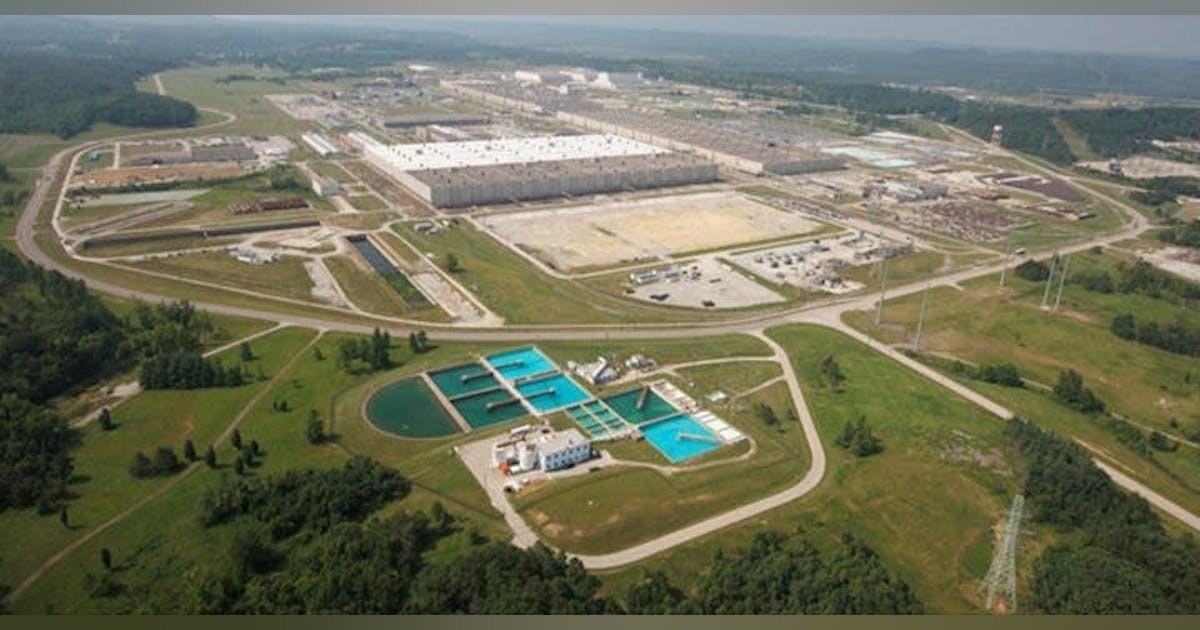
For Ohio, and particularly Appalachian Ohio, the project is being framed as redevelopment on a historic scale. It represents more than the cleanup of a decommissioned nuclear-era site. DOE states that the Portsmouth redevelopment could generate more than 10,000 construction jobs over four years, more than 2,000 operational roles, and tens of thousands of additional indirect jobs across manufacturing and service sectors. Ohio is already an established data center market, with AWS, Google, Vantage, Aligned, and other operators expanding their presence in the state.
That economic narrative carries weight, especially in a region shaped by industrial decline, long-term remediation work, and the search for durable reinvestment. The transformation of a former uranium enrichment site into a large-scale AI and energy hub aligns with a broader policy goal: positioning AI not only as a software-driven industry, but as a catalyst for physical and industrial renewal.
At the same time, the headline numbers warrant scrutiny. Job creation estimates tied to projects of this scale are often concentrated in the construction phase and diffused across indirect categories. The long-term regional impact will depend on how much of the operational, technical, and supply chain activity remains anchored locally once the initial buildout phase subsides.
The Social and Political Constraint
This points to the project’s most immediate fault line: not whether it is ambitious, but whether public acceptance can keep pace with that ambition.
The Associated Press reported that the announcement came just days after rural Ohio residents filed a petition seeking a statewide constitutional ban on large-scale data centers. That timing is significant. The project is entering a landscape where opposition to data center development is no longer limited to isolated zoning disputes. Concerns now extend to energy consumption, electricity pricing, land use, water resources, emissions, and the broader societal value of AI infrastructure.
The Portsmouth model addresses one dimension of that debate by structuring transmission costs to be borne by the developer rather than ratepayers. But that does not resolve the full set of issues. Questions remain around air emissions, expanded gas infrastructure, permitting impacts, and the broader justification for a project of this scale.
In that sense, the development may serve as a test case. Not only for a new model of AI infrastructure delivery, but for the industry’s ability to sustain public support as projects move into the multi-gigawatt era. The outcome will likely shape how developers, policymakers, and communities engage on future AI deployments of similar scale.
A Threshold Moment for AI Infrastructure
The Piketon announcement marks a threshold moment. What SoftBank, SB Energy, AEP Ohio, and the U.S. Department of Energy have outlined is not simply a large-scale campus. It is a working model of what AI infrastructure becomes when power constraints, political scrutiny, and geopolitical priorities converge.
At this scale, data centers are no longer discrete facilities. They are evolving into integrated energy-and-compute systems, where land, generation, substations, transmission corridors, and regulatory structures carry as much strategic weight as processors and networks.
If the project advances, its significance will extend beyond a single site. It has the potential to shape how the next generation of AI infrastructure is financed, powered, and approved. It points toward a model built on dedicated energy supply, direct investment in transmission, and the reuse of federally controlled or industrial land.
It also raises a parallel question. Whether that model can scale without triggering sustained public resistance. Shielding ratepayers from infrastructure costs addresses one dimension of the challenge, but it does not resolve broader concerns around environmental impact, land use, and the societal footprint of AI development.
The PORTS Technology Campus places a marker on the landscape. The next phase of AI will not be constrained by demand or innovation. It will be constrained by execution at the intersection of power, infrastructure, and public acceptance.
And in Piketon, the industry may be seeing one of the first full-scale attempts to build that system from the ground up.