One day this fall, I watched an electronic sign outside the Broadway-Lafayette subway station in Manhattan switch seamlessly between an ad for makeup and one promoting the website Pickyourbaby.com, which promises a way for potential parents to use genetic tests to influence their baby’s traits, including eye color, hair color, and IQ.
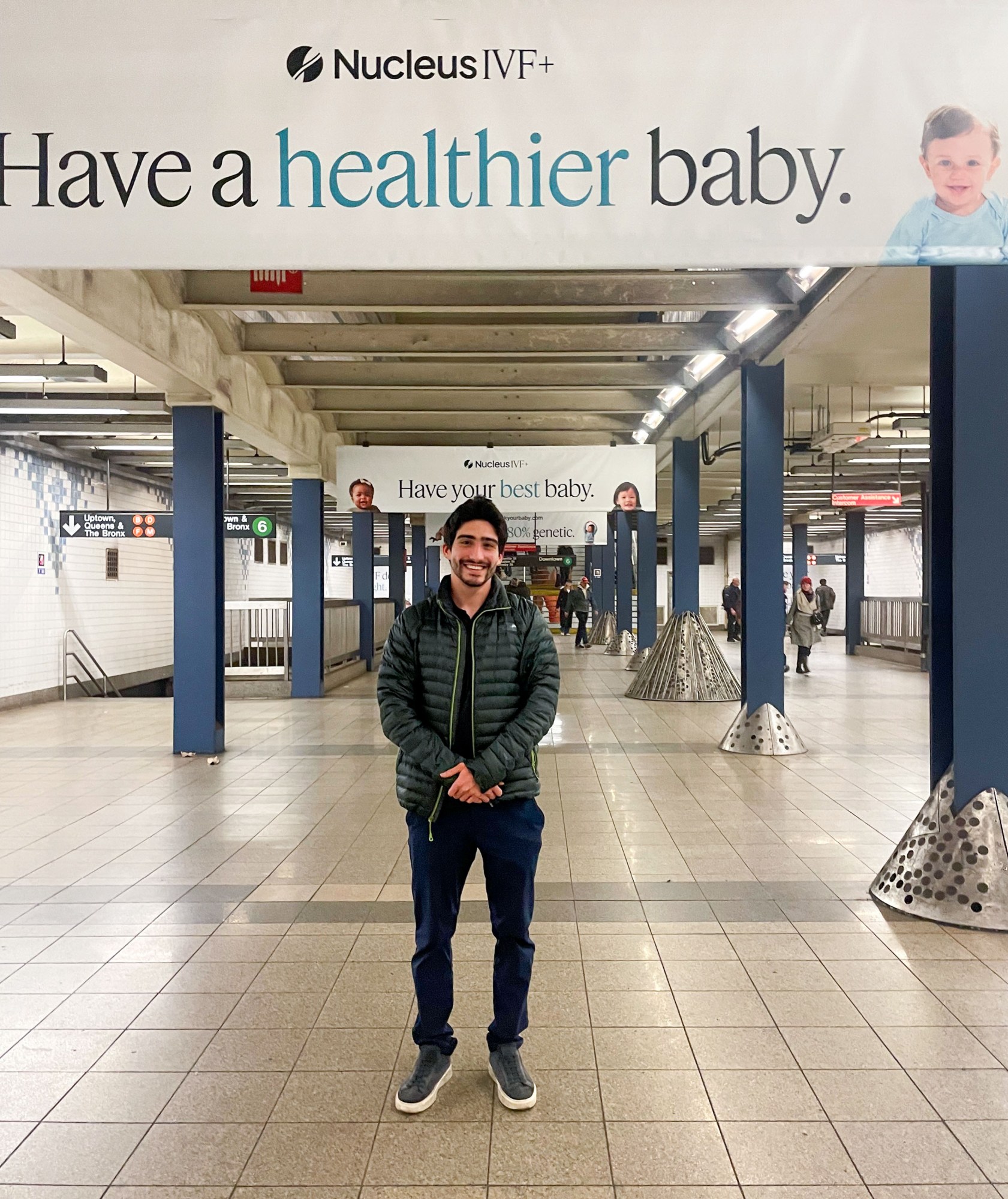
Inside the station, every surface was wrapped with more of its ads—babies on turnstiles, on staircases, on banners overhead. “Think about it. Makeup and then genetic optimization,” exulted Kian Sadeghi, the 26-year-old founder of Nucleus Genomics, the startup running the ads. To his mind, one should be as accessible as the other.
Nucleus is a young, attention-seeking genetic software company that says it can analyze genetic tests on IVF embryos to score them for 2,000 traits and disease risks, letting parents pick some and reject others. This is possible because of how our DNA shapes us, sometimes powerfully. As one of the subway banners reminded the New York riders: “Height is 80% genetic.”
The day after the campaign launched, Sadeghi and I had briefly sparred online. He’d been on X showing off a phone app where parents can click through traits like eye color and hair color. I snapped back that all this sounded a lot like Uber Eats—another crappy, frictionless future invented by entrepreneurs, but this time you’d click for a baby.
I agreed to meet Sadeghi that night in the station under a banner that read, “IQ is 50% genetic.” He appeared in a puffer jacket and told me the campaign would soon spread to 1,000 train cars. Not long ago, this was a secretive technology to whisper about at Silicon Valley dinner parties. But now? “Look at the stairs. The entire subway is genetic optimization. We’re bringing it mainstream,” he said. “I mean, like, we are normalizing it, right?”
Normalizing what, exactly? The ability to choose embryos on the basis of predicted traits could lead to healthier people. But the traits mentioned in the subway—height and IQ—focus the public’s mind toward cosmetic choices and even naked discrimination. “I think people are going to read this and start realizing: Wow, it is now an option that I can pick. I can have a taller, smarter, healthier baby,” says Sadeghi.
Nucleus got its seed funding from Founders Fund, an investment firm known for its love of contrarian bets. And embryo scoring fits right in—it’s an unpopular concept, and professional groups say the genetic predictions aren’t reliable. So far, leading IVF clinics still refuse to offer these tests. Doctors worry, among other things, that they’ll create unrealistic parental expectations. What if little Johnny doesn’t do as well on the SAT as his embryo score predicted?
The ad blitz is a way to end-run such gatekeepers: If a clinic won’t agree to order the test, would-be parents can take their business elsewhere. Another embryo testing company, Orchid, notes that high consumer demand emboldened Uber’s early incursions into regulated taxi markets. “Doctors are essentially being shoved in the direction of using it, not because they want to, but because they will lose patients if they don’t,” Orchid founder Noor Siddiqui said during an online event this past August.
Sadeghi prefers to compare his startup to Airbnb. He hopes it can link customers to clinics, becoming a digital “funnel” offering a “better experience” for everyone. He notes that Nucleus ads don’t mention DNA or any details of how the scoring technique works. That’s not the point. In advertising, you sell the sizzle, not the steak. And in Nucleus’s ad copy, what sizzles is height, smarts, and light-colored eyes.
It makes you wonder if the ads should be permitted. Indeed, I learned from Sadeghi that the Metropolitan Transportation Authority had objected to parts of the campaign. The metro agency, for instance, did not let Nucleus run ads saying “Have a girl” and “Have a boy,” even though it’s very easy to identify the sex of an embryo using a genetic test. The reason was an MTA policy that forbids using government-owned infrastructure to promote “invidious discrimination” against protected classes, which include race, religion and biological sex.
Since 2023, New York City has also included height and weight in its anti-discrimination law, the idea being to “root out bias” related to body size in housing and in public spaces. So I’m not sure why the MTA let Nucleus declare that height is 80% genetic. (The MTA advertising department didn’t respond to questions.) Perhaps it’s because the statement is a factual claim, not an explicit call to action. But we all know what to do: Pick the tall one and leave shorty in the IVF freezer, never to be born.
This article first appeared in The Checkup, MIT Technology Review’s weekly biotech newsletter. To receive it in your inbox every Thursday, and read articles like this first, sign up here.