Stay Ahead, Stay ONMINE

The Download: AI co-creativity, and what Trump’s tariffs mean for batteries

This is today’s edition of The Download, our weekday newsletter that provides a daily dose of what’s going on in the world of technology. How AI can help supercharge creativity Existing generative tools can automate a striking range of creative tasks and offer near-instant gratification—but at what cost? Some artists and researchers fear that such technology could turn us into passive consumers of yet more AI slop.And so they are looking for ways to inject human creativity back into the process: working on what’s known as co-­creativity or more-than-human creativity. The idea is that AI can be used to inspire or critique creative projects, helping people make things that they would not have made by themselves.The aim is to develop AI tools that augment our creativity rather than strip it from us—pushing us to be better at composing music, developing games, designing toys, and much more—and lay the groundwork for a future in which humans and machines create things together.Ultimately, generative models could offer artists and designers a whole new medium, pushing them to make things that couldn’t have been made before, and give everyone creative superpowers. Read the full story. —Will Douglas Heaven This story is from the next edition of our print magazine, which is all about creativity. Subscribe now to read it and get a copy of the magazine when it lands! Tariffs are bad news for batteries Since Donald Trump announced his plans for sweeping tariffs last week, the vibes have been, in a word, chaotic. Markets have seen one of the quickest drops in the last century, and it’s widely anticipated that the global economic order may be forever changed.   These tariffs could be particularly rough on the battery industry. China dominates the entire supply chain and is subject to monster tariff rates, and even US battery makers won’t escape the effects. Read the full story. —Casey Crownhart This article is from The Spark, MIT Technology Review’s weekly climate newsletter. To receive it in your inbox every Wednesday, sign up here. The must-reads I’ve combed the internet to find you today’s most fun/important/scary/fascinating stories about technology. 1 Donald Trump has announced a 90-day tariff pause for some countries He’s decided that all the countries that didn’t retaliate against the severe tariffs would receive a reprieve. (The Guardian)+ China, however, is now subject to a whopping 125% tariff. (CNBC)+ Chinese sellers on Amazon are preparing to hike their prices in response. (Reuters)+ Trump’s advisors have claimed the pivot was always part of the plan. (Vox)2 DOGE has fired driverless car safety assessorsMany of whom were in charge of regulating Tesla, among other companies. (FT $)+ The department is being audited by the Government Accountability Office. (Wired $)+ Can AI help DOGE slash government budgets? It’s complex. (MIT Technology Review) 3 The cost of a US-made iPhone could rise by 90%Bank of America has crunched the numbers. (Bloomberg $)+ Even so, an American-made iPhone could be inferior quality. (WSJ $)+ Apple has chartered 600 tons of iPhones to India. (Reuters) 4 The EU wants to build its own AI gigafactoriesIn a bid to catch up with the US and China. (WSJ $) 5 Amazon was forced to cancel its satellite internet launchA rocket carrying a few thousands satellites was unable to take off due to bad weather. (NYT $) 6 America’s air quality is likely to get worseThe Trump administration is rolling back the environmental rules that helped lower air pollution. (The Atlantic $)+ The world’s next big environmental problem could come from space. (MIT Technology Review) 7 Spammers exploited OpenAI’s tech to blast customized spamThe unwanted messages were distributed over four months. (Ars Technica) 8 Chinese social media is filled with memes mocking Trump’s tariffsFeaturing finance bros and JD Vance unhappily laboring in factories. (Insider $) 9 Do you have a Fortnite accent?Players of the popular game tend to speak in a highly specific way. (Wired $) 10 An em dash is not a giveaway something has been written by AIHumans use it too—and love it. (WP $)+ Not all AI-generated writing is bad. (New Yorker $)+ AI-text detection tools are really easy to fool. (MIT Technology Review) Quote of the day “Entering a group chat is like leaving your front door unlocked and letting strangers wander in.” —Author LM Chilton reflects on the innate dangers of trusting that what you say in a group chat stays in the group chat to Wired. The big story Digital twins of human organs are here. They’re set to transform medical treatment. Steven Niederer, a biomedical engineer at the Alan Turing Institute and Imperial College London, has a cardboard box filled with 3D-printed hearts. Each of them is modeled on the real heart of a person with heart failure, but Niederer is more interested in creating detailed replicas of people’s hearts using computers.These “digital twins” are the same size and shape as the real thing. They work in the same way. But they exist only virtually. Scientists can do virtual surgery on these virtual hearts, figuring out the best course of action for a patient’s condition.After decades of research, models like these are now entering clinical trials and starting to be used for patient care. The eventual goal is to create digital versions of our bodies—computer copies that could help researchers and doctors figure out our risk of developing various diseases and determine which treatments might work best.But the budding technology will need to be developed very carefully. Read the full story to learn why. —Jessica Hamzelou We can still have nice things A place for comfort, fun and distraction to brighten up your day. (Got any ideas? Drop me a line or skeet ’em at me.) + Good news pop fans: Madonna and Elton John have ended their decades-long feud.+ It’s time to take a trip to all 15 of these top restaurants across the world.+ These tales of cross-generational friendships are truly heartwarming.+ I’d love to know the secret behind America’s mystery mounds.

This is today’s edition of The Download, our weekday newsletter that provides a daily dose of what’s going on in the world of technology.

How AI can help supercharge creativity

Existing generative tools can automate a striking range of creative tasks and offer near-instant gratification—but at what cost? Some artists and researchers fear that such technology could turn us into passive consumers of yet more AI slop.

And so they are looking for ways to inject human creativity back into the process: working on what’s known as co-­creativity or more-than-human creativity. The idea is that AI can be used to inspire or critique creative projects, helping people make things that they would not have made by themselves.

The aim is to develop AI tools that augment our creativity rather than strip it from us—pushing us to be better at composing music, developing games, designing toys, and much more—and lay the groundwork for a future in which humans and machines create things together.

Ultimately, generative models could offer artists and designers a whole new medium, pushing them to make things that couldn’t have been made before, and give everyone creative superpowers. Read the full story.

—Will Douglas Heaven

This story is from the next edition of our print magazine, which is all about creativity. Subscribe now to read it and get a copy of the magazine when it lands!

Tariffs are bad news for batteries

Since Donald Trump announced his plans for sweeping tariffs last week, the vibes have been, in a word, chaotic. Markets have seen one of the quickest drops in the last century, and it’s widely anticipated that the global economic order may be forever changed.  

These tariffs could be particularly rough on the battery industry. China dominates the entire supply chain and is subject to monster tariff rates, and even US battery makers won’t escape the effects. Read the full story.

—Casey Crownhart

This article is from The Spark, MIT Technology Review’s weekly climate newsletter. To receive it in your inbox every Wednesday, sign up here.

The must-reads

I’ve combed the internet to find you today’s most fun/important/scary/fascinating stories about technology.

1 Donald Trump has announced a 90-day tariff pause for some countries 
He’s decided that all the countries that didn’t retaliate against the severe tariffs would receive a reprieve. (The Guardian)
+ China, however, is now subject to a whopping 125% tariff. (CNBC)
+ Chinese sellers on Amazon are preparing to hike their prices in response. (Reuters)
+ Trump’s advisors have claimed the pivot was always part of the plan. (Vox)

2 DOGE has fired driverless car safety assessors
Many of whom were in charge of regulating Tesla, among other companies. (FT $)
+ The department is being audited by the Government Accountability Office. (Wired $)
+ Can AI help DOGE slash government budgets? It’s complex. (MIT Technology Review)

3 The cost of a US-made iPhone could rise by 90%
Bank of America has crunched the numbers. (Bloomberg $)
+ Even so, an American-made iPhone could be inferior quality. (WSJ $)
+ Apple has chartered 600 tons of iPhones to India. (Reuters)

4 The EU wants to build its own AI gigafactories
In a bid to catch up with the US and China. (WSJ $)

5 Amazon was forced to cancel its satellite internet launch
A rocket carrying a few thousands satellites was unable to take off due to bad weather. (NYT $)

6 America’s air quality is likely to get worse
The Trump administration is rolling back the environmental rules that helped lower air pollution. (The Atlantic $)
+ The world’s next big environmental problem could come from space. (MIT Technology Review)

7 Spammers exploited OpenAI’s tech to blast customized spam
The unwanted messages were distributed over four months. (Ars Technica)

8 Chinese social media is filled with memes mocking Trump’s tariffs
Featuring finance bros and JD Vance unhappily laboring in factories. (Insider $)

9 Do you have a Fortnite accent?
Players of the popular game tend to speak in a highly specific way. (Wired $)

10 An em dash is not a giveaway something has been written by AI
Humans use it too—and love it. (WP $)
+ Not all AI-generated writing is bad. (New Yorker $)
+ AI-text detection tools are really easy to fool. (MIT Technology Review)

Quote of the day

“Entering a group chat is like leaving your front door unlocked and letting strangers wander in.”


—Author LM Chilton reflects on the innate dangers of trusting that what you say in a group chat stays in the group chat to Wired.

The big story

Digital twins of human organs are here. They’re set to transform medical treatment.

Steven Niederer, a biomedical engineer at the Alan Turing Institute and Imperial College London, has a cardboard box filled with 3D-printed hearts. Each of them is modeled on the real heart of a person with heart failure, but Niederer is more interested in creating detailed replicas of people’s hearts using computers.

These “digital twins” are the same size and shape as the real thing. They work in the same way. But they exist only virtually. Scientists can do virtual surgery on these virtual hearts, figuring out the best course of action for a patient’s condition.

After decades of research, models like these are now entering clinical trials and starting to be used for patient care. The eventual goal is to create digital versions of our bodies—computer copies that could help researchers and doctors figure out our risk of developing various diseases and determine which treatments might work best.

But the budding technology will need to be developed very carefully. Read the full story to learn why.

—Jessica Hamzelou

We can still have nice things

A place for comfort, fun and distraction to brighten up your day. (Got any ideas? Drop me a line or skeet ’em at me.)

+ Good news pop fans: Madonna and Elton John have ended their decades-long feud.
+ It’s time to take a trip to all 15 of these top restaurants across the world.
+ These tales of cross-generational friendships are truly heartwarming.
+ I’d love to know the secret behind America’s mystery mounds.


Shape
Shape
Stay Ahead

Explore More Insights

Stay ahead with more perspectives on cutting-edge power, infrastructure, energy,  bitcoin and AI solutions. Explore these articles to uncover strategies and insights shaping the future of industries.

Shape

How AWS is reinventing the telco revenue model

Consider what that means for the mobile operator and its relationship with its customers. Instead of selling a generic 5G pipe with a static SLA, a telco can now sell a dynamic, guaranteed slice for a specific use case—say, a remote robotic surgery setup or a high-density, low-latency industrial IoT

Read More »

What’s the biggest barrier to AI success?

AI’s challenge starts with definition. We hear all the time about how AI raises productivity, and many have experienced that themselves. But what, exactly, does “productivity” mean? To the average person, it means they can do things with less effort, which they like, so it generates a lot of favorable

Read More »

IBM proposes unified architecture for hybrid quantum-classical computing

Quantum computers and classical HPC are traditionally “disparate systems [that] operate in isolation,” IBM researchers explain in a new paper. This can be “cumbersome,” because users have to manually orchestrate workflows, coordinate scheduling, and transfer data between systems, thus hindering productivity and “severely” limiting algorithmic exploration. But a hybrid approach

Read More »

Energy Department Announces $500 Million to Strengthen Domestic Critical Materials Processing and Manufacturing

 Funding will expand domestic manufacturing of battery supply chains for defense, grid resilience, transportation, manufacturing and other industries WASHINGTON—The U.S. Department of Energy’s (DOE) Office of Critical Minerals and Energy Innovation (CMEI) today announced a Notice of Funding Opportunity (NOFO) for up to $500 million to expand U.S. critical mineral and materials processing and derivative battery manufacturing and recycling. Assistant Secretary of Energy (EERE) Audrey Robertson is currently in Japan meeting with regional allies at the Indo-Pacific Energy Security Ministerial and Business Forum (IPEM) to advance shared efforts on supply chain resilience and energy security issues. Her engagements at IPEM underscore the importance of close cooperation with partners as the United States strengthens its supply chain through this NOFO. “For too long, the United States has relied on hostile foreign actors to supply and process the critical materials that are essential in battery manufacturing and materials processing,” said U.S. Energy Secretary Chris Wright. “Thanks to President Trump’s leadership, the Department of Energy is playing a leading role in strengthening these domestic industries that will position the U.S. to win the AI race, meeting rising energy demand, and achieve energy dominance.” “I am delighted to be in Japan meeting with our allies, underscoring the important connection between critical materials and energy security,” said Assistant Secretary of Energy (EERE) Audrey Robertson. “Critical minerals processing is a vital component of our nation’s critical minerals supply base. Boosting domestic production, including through recycling, will bolster national security and ensure the United States and our partners are prepared to meet the energy challenges of the 21st century.” Funding awarded through this NOFO will support demonstration and/or commercial facilities for processing, recycling, or utilizing for manufacturing of critical materials which may include traditional battery minerals such as lithium, graphite, nickel, copper, aluminum, as well as other

Read More »

Energy Department Announces $1.9B Investment in Critical Grid Infrastructure to Reduce Electricity Costs

WASHINGTON—The U.S. Department of Energy’s Office of Electricity (OE) today announced an approximately $1.9 billion funding opportunity to accelerate urgently needed upgrades to the nation’s power grid. These investments will meet rising electricity demand and resource adequacy needs, while lowering electricity costs for American households and businesses. Projects selected through the Speed to Power through Accelerated Reconductoring and other Key Advanced Transmission Technology Upgrades (SPARK) funding opportunity will deliver fast and durable upgrades to the grid with real results. In line with President Trump’s Executive Order, Unleashing American Energy, selected projects will demonstrate how reconductoring—replacing existing power lines with higher‑capacity conductors—paired with other Advanced Transmission Technologies (ATTs) can expand grid capacity, increase operational efficiency, lower prices for consumers, and improve overall system reliability and security of the nation’s electric grid. “For too long, important grid modernization and energy addition efforts were not prioritized by past leaders,” said U.S. Secretary of Energy Chris Wright. “Thanks to President Trump, we are doing the important work of modernizing our grid so electricity costs will be lowered for American families and businesses.” “The United States must increase grid capacity to meet demand, and ensure the grid provides reliable power—day-in and day-out,” said OE Assistant Secretary Katie Jereza. “Through this SPARK funding opportunity, we will stabilize and optimize grid operations to strengthen it for rapid growth.” The SPARK opportunity builds on the Grid Resilience and Innovation Partnerships (GRIP) Program, which provided up to $10.5 billion in competitive funding over five years to states, tribes, electric utilities, and other eligible recipients to strengthen grid resilience and innovation. The previous two GRIP funding rounds covered FY 2022-2023 and FY 2023-2024 funding. Today’s announcement continues the mission of the GRIP Program under the SPARK funding opportunity, focusing on the rapid deployment of reconductoring and other ATTs that expand transfer capability, strengthen reliability

Read More »

United States to Release 172 Million Barrels of Oil From the Strategic Petroleum Reserve

WASHINGTON—U.S. Secretary of Energy Chris Wright released the following statement regarding the International Energy Agency (IEA) and the U.S. Strategic Petroleum Reserve (SPR): “Earlier today, 32 member nations of the International Energy Agency unanimously agreed to President Trump’s request to lower energy prices with a coordinated release of 400 million barrels of oil and refined products from their respective reserves.  “As part of this effort, President Trump authorized the Department of Energy to release 172 million barrels from the Strategic Petroleum Reserve, beginning next week. This will take approximately 120 days to deliver based on planned discharge rates.  “President Trump promised to protect America’s energy security by managing the Strategic Petroleum Reserve responsibly and this action demonstrates his commitment to that promise. Unlike the previous administration, which left America’s oil reserves drained and damaged, the United States has arranged to more than replace these strategic reserves with approximately 200 million barrels within the next year—20% more barrels than will be drawn down—and at no cost to the taxpayer.  “For 47 years, Iran and its terrorist proxies have been intent on killing Americans. They have manipulated and threatened the energy security of America and its allies. Under President Trump, those days are coming to an end.  “Rest assured, America’s energy security is as strong as ever.”                                                                                         ###

Read More »

Occidental Petroleum, 1PointFive STRATOS DAC plant nears startup in Texas Permian basin

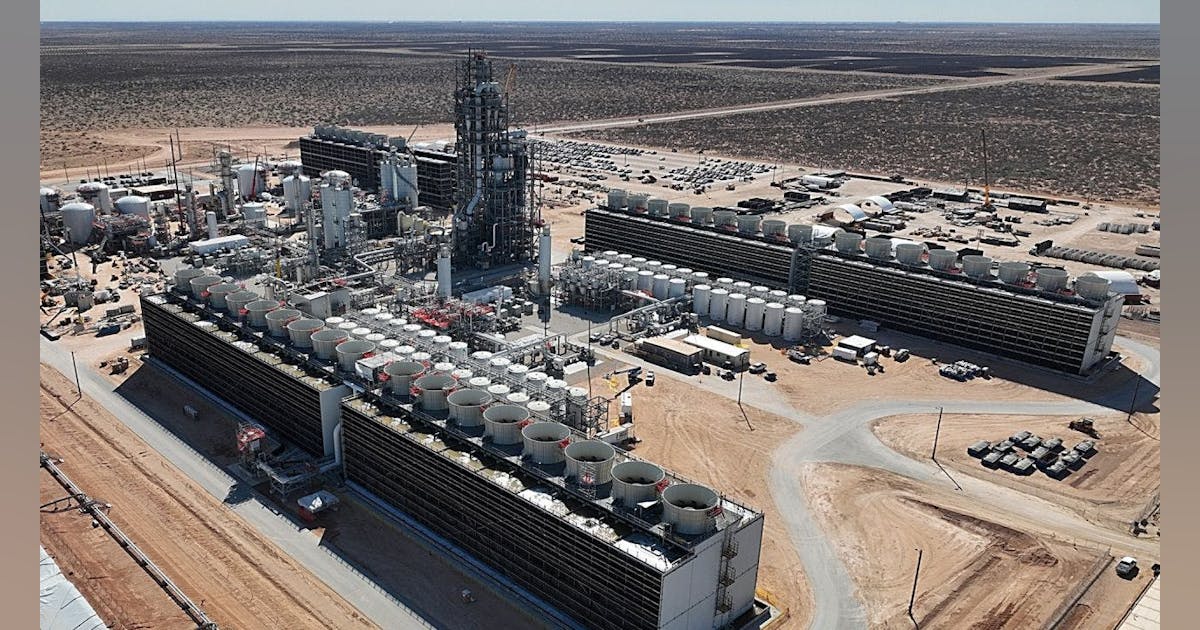
Occidental Petroleum Corp. and its subsidiary 1PointFive expect Phase 1 of the STRATOS direct air capture (DAC) plant in Texas’ Permian basin to come online in this year’s second quarter. In a post to LinkedIn, 1PointFive said Phase 1 “is in the final stage of startup” and that Phase 2, which incorporates learnings from research and development and Phase 1 construction activities, “will also begin commissioning in Q2, with operational ramp-up continuing through the rest of the year.” Once fully operational, STRATOS is designed to capture up to 500,000 tonnes/year (tpy) of CO2. As part of the US Environmental Protection Agency (EPA) Class VI permitting process and approval, it was reported that STRATOS is expected to include three wells to store about 722,000 tpy of CO2 in saline formations at a depth of about 4,400 ft. The company said a few activities before start-up remain, including ramping up remaining pellet reactors, completing calciner final commissioning in parallel, and beginning CO2 injection. Start-up milestones achieved include: Completed wet commissioning with water circulation. Received Class VI permits to sequester CO2. Ran CO2 compression system at design pressure. Added potassium hydroxide (KOH) to capture CO2 from the atmosphere. Building pellet inventory. Burners tested on calciner.  

Read More »

Brava Energia weighs Phase 3 at Atlanta to extend production plateau

Just 2 months after bringing its flagship Atlanta field onstream with the new FPSO Atlanta, Brazil’s independent operator Brava Energia SA is evaluating a potential third development phase that could add roughly 25 million bbl of reserves and help sustain peak production longer than originally planned. The Phase 3 project, still at an early technical and economic evaluation stage, focuses on the Atlanta Nordeste area; a separate, shallower reservoir discovered in 2006 by Shell’s 9-SHEL-19D-RJS well. According to André Fagundes, vice-president of research (Brazil) at Welligence Energy Analytics, Phase 2 has four wells still to be developed: two expected in 2027 and two in 2029. Phase 3 would involve drilling two additional wells in 2031, bringing total development to 12 producing wells. Until recently, full-field development was understood to comprise 10 wells, but Brava has since updated guidance to reflect a 12-well development concept. Atlanta field upside The primary objective is clear. “We believe its main objective is to extend the production plateau,” Fagundes said. Welligence estimates incremental recovery could reach 25 MMbbl, increasing the field’s overall recovery factor by roughly 1.5%. Lying outside Atlanta’s main Cretaceous reservoir, Atlanta Nordeste represents a genuine upside opportunity, Fagundes explained. The field benefits from strong natural aquifer support, and no water or gas injection is anticipated. Water-handling constraints that affected early production using the Petrojarl I—limited to 11,500 b/d of water treatment—are no longer a bottleneck. FPSO Atlanta can process up to 140,000 b/d of water. Reservoir performance to date has been solid, albeit with difficulties. Recurrent electric submersible pump (ESP) failures and processing limits on the previous FPSO complicated full validation of original reservoir models. With the new 50,000-b/d FPSO in operation since late 2024, reservoir deliverability has become the main constraint. Phase 3 wells would also use ESPs and require additional subsea

Read More »

California Resources eyes ‘measured’ capex ramp on way to 12% production growth thanks to Berry buy

@import url(‘https://fonts.googleapis.com/css2?family=Inter:[email protected]&display=swap’); a { color: var(–color-primary-main); } .ebm-page__main h1, .ebm-page__main h2, .ebm-page__main h3, .ebm-page__main h4, .ebm-page__main h5, .ebm-page__main h6 { font-family: Inter; } body { line-height: 150%; letter-spacing: 0.025em; font-family: Inter; } button, .ebm-button-wrapper { font-family: Inter; } .label-style { text-transform: uppercase; color: var(–color-grey); font-weight: 600; font-size: 0.75rem; } .caption-style { font-size: 0.75rem; opacity: .6; } #onetrust-pc-sdk [id*=btn-handler], #onetrust-pc-sdk [class*=btn-handler] { background-color: #c19a06 !important; border-color: #c19a06 !important; } #onetrust-policy a, #onetrust-pc-sdk a, #ot-pc-content a { color: #c19a06 !important; } #onetrust-consent-sdk #onetrust-pc-sdk .ot-active-menu { border-color: #c19a06 !important; } #onetrust-consent-sdk #onetrust-accept-btn-handler, #onetrust-banner-sdk #onetrust-reject-all-handler, #onetrust-consent-sdk #onetrust-pc-btn-handler.cookie-setting-link { background-color: #c19a06 !important; border-color: #c19a06 !important; } #onetrust-consent-sdk .onetrust-pc-btn-handler { color: #c19a06 !important; border-color: #c19a06 !important; } The leaders of California Resources Corp., Long Beach, plan to have the company’s total production average 152,000-157,000 boe/d in 2026, with each quarter expected to be in that range. That output would equate to an increase of more than 12% from the operator’s 137,000 boe/d during fourth-quarter 2025, due mostly to the mid-December acquisition of Berry Corp. Fourth-quarter results folded in 14 days of Berry production and included 109,000 b/d of oil, with the company’s assets in the San Joaquin and Los Angeles basins accounting for 99,000 b/d of that total. The company dilled 31 new wells during the quarter and 76 in all of 2025—all in the San Joaquin—but that number will grow significantly to about 260 this year as state officials have resumed issuing permits following the passage last fall of a bill focused on Kern County production. Speaking to analysts after CRC reported fourth-quarter net income of $12 million on $924 million in revenues, president and chief executive officer Francisco Leon and chief financial officer Clio Crespy said the goal is to manage 2026 output decline to roughly 0.5% per quarter while operating four rigs and

Read More »

Data mining? Old servers could become new source of rare earths

For decades, he said, “the retirement of data center equipment was treated almost entirely as a compliance and disposal issue. Enterprises focused on secure decommissioning, certified recycling, and documented destruction of sensitive hardware. Once equipment left production environments, its economic life was assumed to be largely finished.” That assumption, he pointed out, “is beginning to change, because the hardware inside modern data centres contains a wide range of strategically important materials. Servers, storage systems, networking equipment, and power components contain copper, aluminum, silver, gold, and increasingly small but significant quantities of rare earth elements and other critical minerals.” These materials play a vital role in the manufacturing of semiconductors, energy systems, defense electronics, and advanced computing infrastructure, he explained, noting, “as global demand for digital infrastructure continues to expand, the volume of retired hardware entering disposal channels is rising quickly.” Electronic waste has already become one of the fastest growing waste streams in the world. “Global volumes now exceed 60 million tonnes annually and are projected to move toward eighty million tonnes by the end of the decade if current trends continue,” he said. “Data center infrastructure represents only a portion of that total, but it is a particularly important portion because it is concentrated, professionally managed, and replaced in structured cycles.” For a metals producer, he said, data center infrastructure represents a highly attractive feedstock, because unlike consumer electronics, enterprise hardware is replaced in large batches and flows through professional asset management channels. That predictability, said Gogia, “allows recyclers to design specialized processes that target specific components and materials. Over time, this creates the foundation for an industrial scale circular supply chain in which retired electronics feed back into the production of new materials.”

Read More »

Meta is developing more AI chips for itself

With demand for AI chips rising and supplies tightening, Meta is taking its AI computing needs into its own hands and developing more of its own chips: It will produce four new generations of chips over the next two years. Cloud computing giants including Meta, AWS, and Google have been keen to develop their own chips to improve the performance of their own data centers. Meta started its own chip program in 2023, when it implemented the Meta Training and Inference Accelerator (MTIA), a family of custom-built silicon chips to power its AI workloads efficiently. The MTIA 300, which Meta will use for ranking and recommendations training, is already  in production, Meta said. It will use the other planned chips, the MTIA 400, 450, and 500, mainly for generative AI inference production, it said.

Read More »

Arista targets AI data centers with new liquid cooled pluggable optic module

To prove their point, the authors imagined a 400 MW AI datacenter with 1024 GPU racks of 128 GPUs each for a total of 128,000 GPUs. “Assume 12.8T scale-up and 1.6T scale-out bandwidth per GPU. With OSFP switch racks that have a density of 1.6 Pbps per rack, this would require more than 1,400 switch racks for scale-up and scale-out fabrics. With XPO, this would require 75% fewer racks, saving over 1,050 racks or 44 % of the floor space,” Bechtolsheim and Vusirikala stated in the blog.  “Eliminating 75% of switch racks translates to massive reductions in construction and infrastructure costs, including power distribution, plumbing and installation costs, while accelerating deployment timelines,” Bechtolsheim and Vusirikala stated. Arista said the water-cooling capability of XPO is also an important feature. “All large AI data centers will be liquid cooled and the switches that go into these data centers also need to be liquid cooled,” Bechtolsheim and Vusirikala stated.  “While one can add liquid cooled cold plates on flat-top OSFP modules, this does not substantially improve thermal performance.” XPO solves this problem by integrating a liquid cold plate inside the module, with two 32-channel paddle cards sharing the common cold plate which can cool both low power as well as high-power optics such as 8x1600G-ZR/ZR+ with up to 400W of power, Bechtolsheim and Vusirikala stated. XPO modules are much simpler than OSPF modules which improves reliability as well. “Each 32-channel paddle card has only one microcontroller and one set of voltage converters, a 75% reduction in common components versus 4 OSFPs,” Bechtolsheim and Vusirikala wrote. 

Read More »

Cisco grows high-end optical support for AI clusters

Cisco has also upgraded its Network Conversion System (NCS) with a 1RU, 800GE line card offering 12.8T capacity, with 32 OSFP-based ports for 100GE, 400GE, and 800GE clients and 800ZR/ZR+ WDM trunks. The NCS 1014  doubles the density of previous-generation NCS versions and now includes MACsec encryption (IEEE 802.1AE) to secure point-to-point links with hardware-based encryption, data integrity, and authentication for Ethernet traffic, Ghioni stated. It supports enhanced capacity and performance with C&L-band support and NCS 1014 systems with the 2.4T WDM line card based on the Coherent Interconnect Module 8 and now supports 800 GE clients, which can be mapped directly to a wavelength or inverse multiplexed across two wavelengths to maximize reach, Ghioni wrote.  In the pluggable optic arena, Cisco is now offering a Quad Small Form Factor Pluggable Double Density (QSFP-DD) Pluggable Protection Switch Module that can monitor the optical link and switch traffic if it detects a fault in less than 50 milliseconds. The module occupies a quarter of the rack space compared to traditional protection devices—offering 90% rack space saving over available options, Ghioni wrote.  It is aimed at Metro and DCI network customers where sub-50 ms failure recovery is essential and data centers needing fiber protection without bulky hardware, Ghioni stated.  Cisco also added its Acacia developed Bright QSFP28 100ZR 0 dBm coherent optical pluggable in a standard QSFP28 form factor.  It is aimed at edge, access, enterprise, and campus network deployment. Cisco has been actively growing its optical portfolio  recently adding the Cisco Silicon One G300, which powers 102.4T N9000 and Cisco 8000 systems, as well as advanced 1.6T OSFP optics and 800G Linear Pluggable Optics. 

Read More »

Datalec targets rapid infrastructure deployment with new modular data centers

“We are engineering the data center with a new lens bringing pre-engineered system designs that are flexible and adaptable that enables a tailored solution for clients,” said John Lever, director of modular solutions at Datalec. The systems are flexible enough that these solutions cater for all types of data center, from standard server technology to AI and high-density compute. Datalec also provides “bolt-on” solutions, including a ‘digital wrapper’ including digital twinning and lifecycle and global support, Lever says. Another way Datalec says it differentiates from competing modular designs is a larger share of work is done offsite in a controlled manufacturing environment, which cuts onsite construction time, improves safety and limits disruption to live facilities, Lever says. The company competes with other modular data center vendors including Schneider Electric, Vertiv, Flex many others. DPI’s says its services are aimed at colocation providers, hyperscale and AI infrastructure teams, and large enterprises that need to add capacity quickly, safely and cost effectively across multiple regions.

Read More »

Study finds significant savings from direct current power for AI workloads

The result is a 50% to 80% reduction in copper usage, due to fewer conductors and less parallel cabling, and an 8% to 12% reduction in annual energy-related OpEx through lower conversion and distribution losses. By reducing conductor count, cabling, and redundant power components, 800VDC enables meaningful savings at both build-out and operational stages. AI-first facilities can see a $4 million to $8 million in CapEx savings per 10 MW build by reducing upstream AC. For a one-gigawatt data center, you’re saving a couple million pounds of copper wire, he said. Burke says an all-DC data center is best done with a whole new facility rather than retrofitting old facilities. “[DC] is going to be in a lot of greenfield data centers that are going to be built, and data centers that are going to go to higher compute power are also going to DC,” he said. He did recommend all-DC retrofits for existing data centers that are going to employ high power computing with GPUs. Enteligent’s unnamed and as yet unreleased product is a converter that takes 800 volts and partitions it to 50 volts for the computing servers. The company will provide a new power supply, power shelf that converts 800 volts DC to 50 volts DC much more efficiently than any current power supplies. Burke said the company is doing NDA level testing and pilot programs now with its product, but it will be making a formal announcement within the next few weeks. There are a number of players in the DC arena focusing on different parts of the power supply market including Vertiv, Rutherford, Siemens, Eaton and many more.

Read More »

Microsoft will invest $80B in AI data centers in fiscal 2025

And Microsoft isn’t the only one that is ramping up its investments into AI-enabled data centers. Rival cloud service providers are all investing in either upgrading or opening new data centers to capture a larger chunk of business from developers and users of large language models (LLMs).  In a report published in October 2024, Bloomberg Intelligence estimated that demand for generative AI would push Microsoft, AWS, Google, Oracle, Meta, and Apple would between them devote $200 billion to capex in 2025, up from $110 billion in 2023. Microsoft is one of the biggest spenders, followed closely by Google and AWS, Bloomberg Intelligence said. Its estimate of Microsoft’s capital spending on AI, at $62.4 billion for calendar 2025, is lower than Smith’s claim that the company will invest $80 billion in the fiscal year to June 30, 2025. Both figures, though, are way higher than Microsoft’s 2020 capital expenditure of “just” $17.6 billion. The majority of the increased spending is tied to cloud services and the expansion of AI infrastructure needed to provide compute capacity for OpenAI workloads. Separately, last October Amazon CEO Andy Jassy said his company planned total capex spend of $75 billion in 2024 and even more in 2025, with much of it going to AWS, its cloud computing division.

Read More »

John Deere unveils more autonomous farm machines to address skill labor shortage

Join our daily and weekly newsletters for the latest updates and exclusive content on industry-leading AI coverage. Learn More Self-driving tractors might be the path to self-driving cars. John Deere has revealed a new line of autonomous machines and tech across agriculture, construction and commercial landscaping. The Moline, Illinois-based John Deere has been in business for 187 years, yet it’s been a regular as a non-tech company showing off technology at the big tech trade show in Las Vegas and is back at CES 2025 with more autonomous tractors and other vehicles. This is not something we usually cover, but John Deere has a lot of data that is interesting in the big picture of tech. The message from the company is that there aren’t enough skilled farm laborers to do the work that its customers need. It’s been a challenge for most of the last two decades, said Jahmy Hindman, CTO at John Deere, in a briefing. Much of the tech will come this fall and after that. He noted that the average farmer in the U.S. is over 58 and works 12 to 18 hours a day to grow food for us. And he said the American Farm Bureau Federation estimates there are roughly 2.4 million farm jobs that need to be filled annually; and the agricultural work force continues to shrink. (This is my hint to the anti-immigration crowd). John Deere’s autonomous 9RX Tractor. Farmers can oversee it using an app. While each of these industries experiences their own set of challenges, a commonality across all is skilled labor availability. In construction, about 80% percent of contractors struggle to find skilled labor. And in commercial landscaping, 86% of landscaping business owners can’t find labor to fill open positions, he said. “They have to figure out how to do

Read More »

2025 playbook for enterprise AI success, from agents to evals

Join our daily and weekly newsletters for the latest updates and exclusive content on industry-leading AI coverage. Learn More 2025 is poised to be a pivotal year for enterprise AI. The past year has seen rapid innovation, and this year will see the same. This has made it more critical than ever to revisit your AI strategy to stay competitive and create value for your customers. From scaling AI agents to optimizing costs, here are the five critical areas enterprises should prioritize for their AI strategy this year. 1. Agents: the next generation of automation AI agents are no longer theoretical. In 2025, they’re indispensable tools for enterprises looking to streamline operations and enhance customer interactions. Unlike traditional software, agents powered by large language models (LLMs) can make nuanced decisions, navigate complex multi-step tasks, and integrate seamlessly with tools and APIs. At the start of 2024, agents were not ready for prime time, making frustrating mistakes like hallucinating URLs. They started getting better as frontier large language models themselves improved. “Let me put it this way,” said Sam Witteveen, cofounder of Red Dragon, a company that develops agents for companies, and that recently reviewed the 48 agents it built last year. “Interestingly, the ones that we built at the start of the year, a lot of those worked way better at the end of the year just because the models got better.” Witteveen shared this in the video podcast we filmed to discuss these five big trends in detail. Models are getting better and hallucinating less, and they’re also being trained to do agentic tasks. Another feature that the model providers are researching is a way to use the LLM as a judge, and as models get cheaper (something we’ll cover below), companies can use three or more models to

Read More »

OpenAI’s red teaming innovations define new essentials for security leaders in the AI era

Join our daily and weekly newsletters for the latest updates and exclusive content on industry-leading AI coverage. Learn More OpenAI has taken a more aggressive approach to red teaming than its AI competitors, demonstrating its security teams’ advanced capabilities in two areas: multi-step reinforcement and external red teaming. OpenAI recently released two papers that set a new competitive standard for improving the quality, reliability and safety of AI models in these two techniques and more. The first paper, “OpenAI’s Approach to External Red Teaming for AI Models and Systems,” reports that specialized teams outside the company have proven effective in uncovering vulnerabilities that might otherwise have made it into a released model because in-house testing techniques may have missed them. In the second paper, “Diverse and Effective Red Teaming with Auto-Generated Rewards and Multi-Step Reinforcement Learning,” OpenAI introduces an automated framework that relies on iterative reinforcement learning to generate a broad spectrum of novel, wide-ranging attacks. Going all-in on red teaming pays practical, competitive dividends It’s encouraging to see competitive intensity in red teaming growing among AI companies. When Anthropic released its AI red team guidelines in June of last year, it joined AI providers including Google, Microsoft, Nvidia, OpenAI, and even the U.S.’s National Institute of Standards and Technology (NIST), which all had released red teaming frameworks. Investing heavily in red teaming yields tangible benefits for security leaders in any organization. OpenAI’s paper on external red teaming provides a detailed analysis of how the company strives to create specialized external teams that include cybersecurity and subject matter experts. The goal is to see if knowledgeable external teams can defeat models’ security perimeters and find gaps in their security, biases and controls that prompt-based testing couldn’t find. What makes OpenAI’s recent papers noteworthy is how well they define using human-in-the-middle

Read More »