Stay Ahead, Stay ONMINE

The Download: sodium-ion batteries and China’s bright tech future

This is today’s edition of The Download, our weekday newsletter that provides a daily dose of what’s going on in the world of technology. Sodium-ion batteries are making their way into cars—and the grid For decades, lithium-ion batteries have powered our phones, laptops, and electric vehicles. But lithium’s limited supply and volatile price have led the industry to seek more resilient alternatives. Enter: sodium-ion batteries.  They work much like lithium-ion ones: they store and release energy by shuttling ions between two electrodes. But unlike lithium, a somewhat rare element that is currently mined in only a handful of countries, sodium is cheap and found everywhere. Read why it’s poised to become more important to our energy future. —Caiwei Chen Sodium-ion batteries are one of MIT Technology Review’s 10 Breakthrough Technologies this year. Take a look at what else made the list.  CES showed me why Chinese tech companies feel so optimistic —Caiwei Chen I decided to go to CES kind of at the last minute. Over the holiday break, contacts from China kept messaging me about their travel plans. After the umpteenth “See you in Vegas?” I caved. As a China tech writer based in the US, I have one week a year when my entire beat seems to come to me—no 20-hour flights required. CES, the Consumer Electronics Show, is the world’s biggest tech show, where companies launch new gadgets and announce new developments, and it happens every January. China has long had a presence at CES, but this year it showed up in a big way. Chinese companies showcased everything from AI gadgets to household appliances to robots, and the overall mood among them was upbeat. Here’s why.This story was first featured in The Algorithm, our weekly newsletter giving you the inside story of what’s going on in AI. Sign up to receive it in your inbox every Monday. This company is developing gene therapies for muscle growth, erectile dysfunction, and “radical longevity”   At some point this month, a handful of volunteers will be injected with experimental gene therapies as part of an unusual clinical trial. The drugs are potential longevity therapies, says Ivan Morgunov, the CEO of Unlimited Bio, the company behind the trial.   The volunteers—who are covering their own travel and treatment costs—will receive a series of injections in their arms and legs. One of the therapies is designed to increase the blood supply to those muscles. The other is designed to support muscle growth. The company hopes to see improvements in strength, endurance, and recovery. It also plans to eventually trial similar therapies in the scalp (for baldness) and penis (for erectile dysfunction).  However, some experts warn the trial is too small, and likely won’t reveal anything useful. Read the full story.  —Jessica Hamzelou The must-reads I’ve combed the internet to find you today’s most fun/important/scary/fascinating stories about technology. 1 Apple is teaming up with Google to give Siri an AI revamp That’s a giant win for Google, and a blow for OpenAI. (CNBC)2 Trump wants Elon Musk to help break Iran’s internet blackoutHe’s appealing to Musk to let Iranians circumvent it with Starlink. (WP $)+ Smuggled tech is Iran’s last link to the outside world. (The Guardian) 3 Right-wing influencers have flocked to Minneapolis Their goal is to paint it as a lawless city, and justify ICE’s shooting of Renee Nicole Good. (Wired $)4 The Pentagon is adopting Musk’s Grok AI chatbot Just as it faces a backlash across the world for making non-consensual deepfakes. (NPR)+ The UK is launching a formal probe into X. (The Guardian)+ It’s also bringing in a new law which will make it illegal to make these sorts of images. (BBC) 5 The push to power AI is devastating coastal villages in TaiwanA rapid expansion of wind energy is hurting farmers and fishers. (Rest of World)+ Stop worrying about your AI footprint. Look at the big picture instead. (MIT Technology Review) 6 Don’t hold your breath for robots’ ChatGPT momentAI has unlocked impressive advances in robotics, but we’re a very long way from human-level capabilities. (FT $)+ Will we ever trust humanoid robots in our homes? (MIT Technology Review)7 Meta is about to lay off hundreds of metaverse employeesReality Labs is yesterday’s news—now it’s all about AI. (NYT $)8 We could eradicate flu A “universal” flu vaccine could be far better at protecting us than any existing option. (Vox $) 9 You can now reserve a hotel room on the moonIt’s all yours, for just $250,000. (Ars Technica)+ This astronaut is training tourists to fly in the world’s first commercial space station. (MIT Technology Review)10 AI images are complicating efforts to find some monkeys in Missouri For real. 🙈 (AP)  Quote of the day “In big cities, everyone is an isolated, atomized individual. People live in soundproof apartments, not knowing the surname of their neighbors.” —A user on social media platform RedNote explains why a new app called ‘Are you dead’ has become popular in China, Business Insider reports.  One more thing STUART BRADFORD AI is coming for music, too While large language models that generate text have exploded in the last three years, a different type of AI, based on what are called diffusion models, is having an unprecedented impact on creative domains.  By transforming random noise into coherent patterns, diffusion models can generate new images, videos, or speech, guided by text prompts or other input data. The best ones can create outputs indistinguishable from the work of people. Now these models are marching into a creative field that is arguably more vulnerable to disruption than any other: music. And their output encapsulates how difficult it’s becoming to define authorship and originality in the age of AI. Read the full story. —James O’Donnell We can still have nice things A place for comfort, fun and distraction to brighten up your day. (Got any ideas? Drop me a line or skeet ’em at me.) + Bricking your phone is the new Dry January. + If you’re hankering for an adventure this year, check out this National Geographic list.+ There are few people more furiously punk than women going through the menopause, as this new TV show demonstrates ($).+ Aww, look how Pallas cats keep their paws warm in winter.

This is today’s edition of The Download, our weekday newsletter that provides a daily dose of what’s going on in the world of technology.

Sodium-ion batteries are making their way into cars—and the grid

For decades, lithium-ion batteries have powered our phones, laptops, and electric vehicles. But lithium’s limited supply and volatile price have led the industry to seek more resilient alternatives. Enter: sodium-ion batteries. 

They work much like lithium-ion ones: they store and release energy by shuttling ions between two electrodes. But unlike lithium, a somewhat rare element that is currently mined in only a handful of countries, sodium is cheap and found everywhere. Read why it’s poised to become more important to our energy future.

—Caiwei Chen

Sodium-ion batteries are one of MIT Technology Review’s 10 Breakthrough Technologies this year. Take a look at what else made the list

CES showed me why Chinese tech companies feel so optimistic

—Caiwei Chen

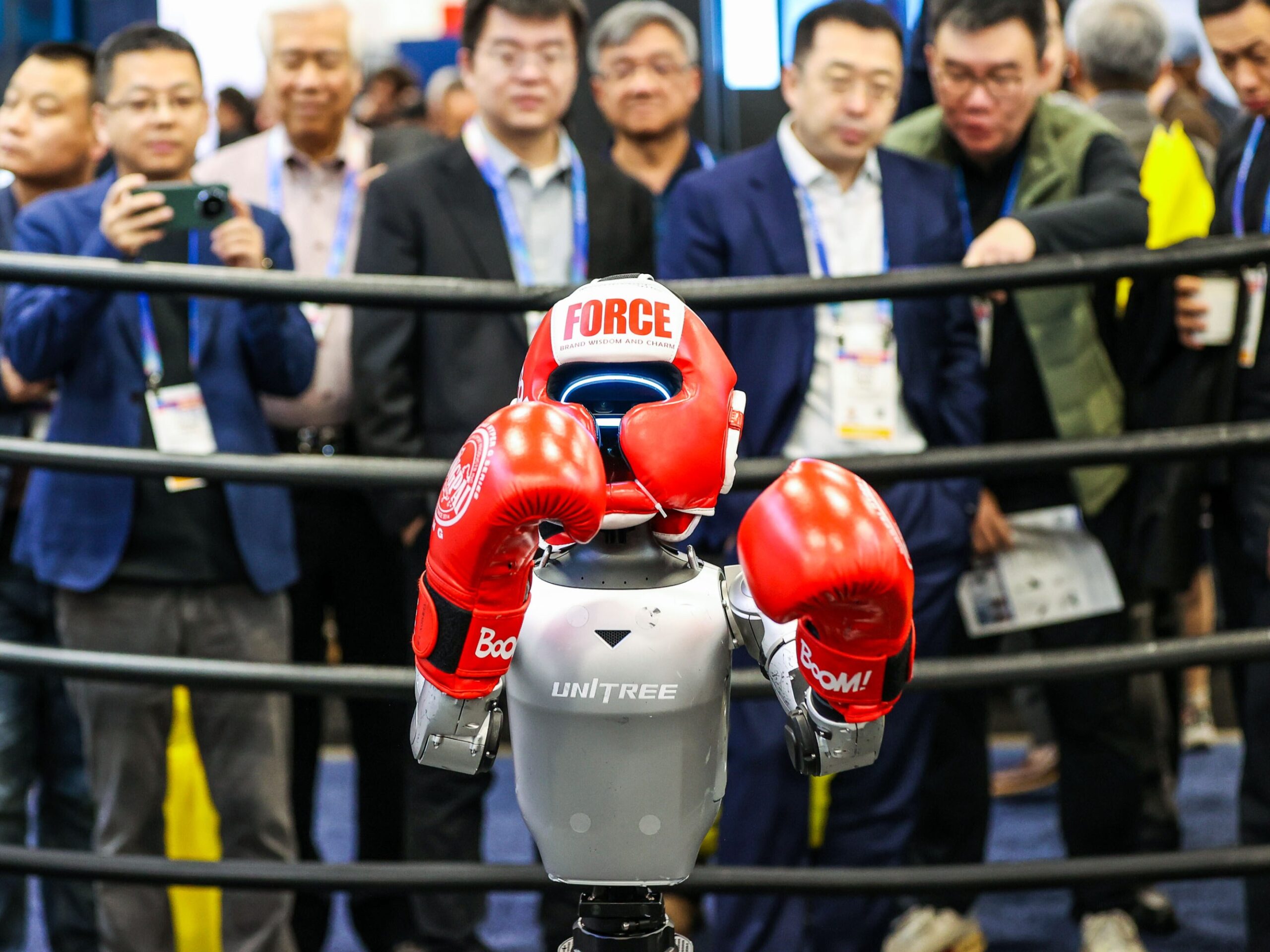
I decided to go to CES kind of at the last minute. Over the holiday break, contacts from China kept messaging me about their travel plans. After the umpteenth “See you in Vegas?” I caved. As a China tech writer based in the US, I have one week a year when my entire beat seems to come to me—no 20-hour flights required.

CES, the Consumer Electronics Show, is the world’s biggest tech show, where companies launch new gadgets and announce new developments, and it happens every January. China has long had a presence at CES, but this year it showed up in a big way. Chinese companies showcased everything from AI gadgets to household appliances to robots, and the overall mood among them was upbeat. Here’s why.

This story was first featured in The Algorithm, our weekly newsletter giving you the inside story of what’s going on in AI. Sign up to receive it in your inbox every Monday.

This company is developing gene therapies for muscle growth, erectile dysfunction, and “radical longevity”  

At some point this month, a handful of volunteers will be injected with experimental gene therapies as part of an unusual clinical trial. The drugs are potential longevity therapies, says Ivan Morgunov, the CEO of Unlimited Bio, the company behind the trial.  

The volunteers—who are covering their own travel and treatment costs—will receive a series of injections in their arms and legs. One of the therapies is designed to increase the blood supply to those muscles. The other is designed to support muscle growth. The company hopes to see improvements in strength, endurance, and recovery. It also plans to eventually trial similar therapies in the scalp (for baldness) and penis (for erectile dysfunction). 

However, some experts warn the trial is too small, and likely won’t reveal anything useful. Read the full story

—Jessica Hamzelou

The must-reads

I’ve combed the internet to find you today’s most fun/important/scary/fascinating stories about technology.

1 Apple is teaming up with Google to give Siri an AI revamp 
That’s a giant win for Google, and a blow for OpenAI. (CNBC)

2 Trump wants Elon Musk to help break Iran’s internet blackout
He’s appealing to Musk to let Iranians circumvent it with Starlink. (WP $)
Smuggled tech is Iran’s last link to the outside world. (The Guardian)

3 Right-wing influencers have flocked to Minneapolis 
Their goal is to paint it as a lawless city, and justify ICE’s shooting of Renee Nicole Good. (Wired $)

4 The Pentagon is adopting Musk’s Grok AI chatbot 
Just as it faces a backlash across the world for making non-consensual deepfakes. (NPR)
The UK is launching a formal probe into X. (The Guardian)
It’s also bringing in a new law which will make it illegal to make these sorts of images. (BBC)

5 The push to power AI is devastating coastal villages in Taiwan
A rapid expansion of wind energy is hurting farmers and fishers. (Rest of World)
Stop worrying about your AI footprint. Look at the big picture instead. (MIT Technology Review)

6 Don’t hold your breath for robots’ ChatGPT moment
AI has unlocked impressive advances in robotics, but we’re a very long way from human-level capabilities. (FT $)
Will we ever trust humanoid robots in our homes? (MIT Technology Review)

7 Meta is about to lay off hundreds of metaverse employees
Reality Labs is yesterday’s news—now it’s all about AI. (NYT $)

8 We could eradicate flu 
A “universal” flu vaccine could be far better at protecting us than any existing option. (Vox $)

9 You can now reserve a hotel room on the moon
It’s all yours, for just $250,000. (Ars Technica)
This astronaut is training tourists to fly in the world’s first commercial space station. (MIT Technology Review)

10 AI images are complicating efforts to find some monkeys in Missouri 
For real. 🙈 (AP

Quote of the day

“In big cities, everyone is an isolated, atomized individual. People live in soundproof apartments, not knowing the surname of their neighbors.”

—A user on social media platform RedNote explains why a new app called ‘Are you dead’ has become popular in China, Business Insider reports. 

One more thing

STUART BRADFORD

AI is coming for music, too

While large language models that generate text have exploded in the last three years, a different type of AI, based on what are called diffusion models, is having an unprecedented impact on creative domains. 

By transforming random noise into coherent patterns, diffusion models can generate new images, videos, or speech, guided by text prompts or other input data. The best ones can create outputs indistinguishable from the work of people.

Now these models are marching into a creative field that is arguably more vulnerable to disruption than any other: music. And their output encapsulates how difficult it’s becoming to define authorship and originality in the age of AI. Read the full story.

—James O’Donnell

We can still have nice things

A place for comfort, fun and distraction to brighten up your day. (Got any ideas? Drop me a line or skeet ’em at me.)

+ Bricking your phone is the new Dry January. 
+ If you’re hankering for an adventure this year, check out this National Geographic list.
+ There are few people more furiously punk than women going through the menopause, as this new TV show demonstrates ($).
+ Aww, look how Pallas cats keep their paws warm in winter.

Shape
Shape
Stay Ahead

Explore More Insights

Stay ahead with more perspectives on cutting-edge power, infrastructure, energy,  bitcoin and AI solutions. Explore these articles to uncover strategies and insights shaping the future of industries.

Shape

NRF 2026: HPE expands network, server products for retailers

The package also integrates information from HPE Aruba Networking User Experience Insight sensors and agents, which now include support for WiFi 7 networks. The combination can measure end-user activity and allow IT teams to baseline network performance, continuously test network health, track trends, and plan for device growth and AI-native

Read More »

Italy fines Cloudflare for refusing to block pirate sites

Italy’s communications authority AGCOM has fined Cloudflare €14.2 million for refusing to block pirate sites via its public DNS service 1.1.1.1, in accordance with the country’s controversial Piracy Shield law, reports Ars Technica. The law, which was introduced in 2024, requires network operators and DNS services to block websites and

Read More »

Global tech-sector layoffs surpass 244,000 in 2025

The RationalFX report summarizes the U.S. states with the highest tech layoffs in 2025: California: 73,499 jobs (43.08%) Washington: 42,221 jobs (24.74%) New York: 26,900 jobs (15.8%) Texas: 9,816 jobs (6%) Massachusetts: 3,477 jobs Intel leads workforce reductions Intel contributed the single largest number of layoffs in 2025, according to

Read More »

What enterprises think about quantum computing

And speaking of chips, our third point is that the future of quantum computing depends on improvement of the chips. There are already some heady advances claimed by chip startups, but the hype is going to outrun the reality for some time. Eventually, quantum computing will be, like digital computing,

Read More »

USA Compression Seals Acquisition of J-W Power

USA Compression Partners LP said Monday it had completed the acquisition of J-W Power Co for around $860 million. “The acquired assets add over 0.8 million active horsepower across key regions, including the Northeast, Mid-Continent, Rockies, Gulf Coast and Permian Basin, creating a combined fleet of approximately 4.4 million active horsepower”, Dallas, Texas-based USA Compression said in an online statement. “This acquisition also brings a diversified, high-quality customer base to USA Compression’s commercial portfolio while further strengthening its position in mid-to-large horsepower compression”. According to the companies’ joint announcement of the deal December 1, 2025, the acquisition includes “aftermarket services and parts distribution, as well as additional optionality associated with specialized manufacturing services”. USA Compression expects “attractive ~5.8x 2026 estimated adjusted EBITDA multiple before expected synergies”, the December statement said. According to the December statement, the J-W Power team was to transfer to USA Compression. USA Compression said it had drawn $430 million from its revolving credit facility to help pay the acquisition. For the remainder of the purchase price, USA Compression said it had issued about 18.2 million common units “based on an effective price at signing of $23.5 per common unit (the 10-day volume-weighted average price as of November 26, 2025 with a collar of $23.25-23.5, resulting in an effective price utilized of $23.5), subject to certain purchase price adjustments”. USA Compression had a revenue of $250.26 million for the third quarter of 2025, according to its latest results published November 5, 2025. That was up from $239.96 million for Q3 2024, despite average horsepower utilization slipping from 94.6 percent to 94 percent. Net profit totaled $34.49 million, while adjusted EBITDA landed at $160.27 million – up from $19.33 million and $145.69 million for Q3 2024 respectively. Distributable cash flow was $103.85 million, compared to $86.61 million for Q3

Read More »

IPAA Boss Highlights ‘Challenging Price Environment’

In a statement sent to Rigzone on Friday by the Independent Petroleum Association of America (IPAA), the organization’s president and CEO, Edith Naegele, highlighted that America’s independent producers are experiencing “a challenging price environment”. “America’s independent oil and natural gas producers ushered in the shale revolution and have a proven record of delivering energy securely and competitively,” Naegele said in the statement. “America’s independent producers are committed to producing the energy that powers American lives and competitiveness. IPAA’s member companies support American energy dominance and are the backbone of communities throughout the producing states, providing jobs and economic security in regions across the country,” Naegele added. “This is a challenging price environment for America’s independent producers. America’s independents are known for taking risks, and no matter the basin they desire stability as they make capital allocation decisions,” the IPAA President continued. “As global markets continue to develop and change, and as production opportunities present themselves around the world, IPAA’s member companies will continue to evaluate all prospects to produce oil and natural gas safely and securely,” Naegele went on to state. Rigzone has contacted the U.S. Department of Energy (DOE) for comment on the IPAA statement. At the time of writing, the DOE has not responded to Rigzone. In a J.P. Morgan research note sent to Rigzone by the JPM Commodities Research team on Friday, J.P. Morgan highlighted that the WTI crude price averaged $59 per barrel in the fourth quarter of last year and $65 per barrel overall in 2025. The company showed that the Brent crude price averaged $63 per barrel in the fourth quarter of last year and $68 per barrel overall in 2025. J.P. Morgan projected in the report that the WTI crude price will average $56 per barrel in the first quarter of 2026 and

Read More »

Masdar Secures First Power Offtake for 500 MW Angolan Portfolio

Abu Dhabi Future Energy Co PJSC (Masdar) has signed an agreement with Angola’s state-owned offtaker Rede Nacional de Transporte de Electricidade for the 150-megawatt (MW) Quipungo photovoltaic project in Huila province. “The Quipungo project represents the first contracted site under Project Royal Sable, a planned 500 MW renewable energy program across three sites that will strengthen Angola’s southern power grid and support the country’s sustainable development objectives”, Masdar said in a press release. It also marks Masdar’s first power purchase agreement (PPA) in the Central African country, according to the company. Project Royal Sable, expected to power around 300,000 homes and offer over 2,000 jobs, “reflects Masdar’s commitment to developing large-scale, bankable renewable energy infrastructure in emerging markets, supporting national energy strategies while expanding access to reliable, affordable clean power”, Masdar said. “Masdar is now the largest operator of renewables on the continent through its joint venture, Infinity Power, which currently operates 1.3 GW of solar and onshore wind power projects in South Africa, Egypt and Senegal, and has a 13.8-GW project pipeline, including battery storage and green hydrogen facilities, in various stages of development”, it added. “The addition of Project Royal Sable will contribute to Masdar’s target of 100 GW portfolio capacity by 2030”. The offtake deal was signed at the International Renewable Energy Agency assembly in Abu Dhabi, which closed Monday. Recently Masdar also signed its first PPA in Malaysia, agreeing to build what it said is Southeast Asia’s biggest floating solar plant. The 200-MW project will be installed at the Chereh Dam in Pahang state. It would be developed with Malaysian partners Citaglobal and Tiza Global, while the PPA was signed with national utility Tenaga Nasional Bhd, Masdar said in an online statement December 23, 2025. The Chereh project launches the 10-gigawatt renewable energy roadmap agreed between Masdar

Read More »

Strategists Forecast 5MM Barrel WoW USA Crude Inventory Build

In an oil and gas report sent to Rigzone late Monday by the Macquarie team, Macquarie strategists, including Walt Chancellor, revealed that they are forecasting that U.S. crude inventories will be up by 5.0 million barrels for the week ending January 9. “This follows a 3.8 million barrel draw in the prior week, with the crude balance realizing relatively close to our expectations,” the strategists said in the report. “For the week ending 1/9, from refineries, we look for a modest reduction in crude runs (-0.1 million barrels per day). Among net imports, we model a healthy increase, with exports sharply lower (-0.9 million barrels per day) and imports up slightly (+0.1 million barrels per day) on a nominal basis,” they added. The strategists stated in the report that timing of cargoes remains a source of potential volatility in the weekly crude balance. They also noted in the report that they “see some lingering potential for noise from year-end effects”. “From implied domestic supply (prod.+adj.+transfers), we look for a small nominal increase (+0.1 million barrels per day),” the Macquarie strategists went on to note. “Rounding out the picture, we anticipate another small increase (+0.2 million barrels) in SPR [Strategic Petroleum Reserve] stocks for the week ending 1/9,” they said. The Macquarie strategists also highlighted in the report that, “among products”, they “again look for another large build led by gasoline (+7.1 million barrels), with distillate (+2.4 million barrels) and jet stocks (+0.7 million barrels) also higher”. “We model implied demand for these three products at ~13.6 million barrels per day for the week ending January 9,” the strategists went on to state. In its latest weekly petroleum status report at the time of writing, which was released on January 7 and included data for the week ending January 2, the

Read More »

Trading Giants Seek Big Asia Buyers for Venezuelan Oil

Vitol Group and Trafigura Group are in talks with large Indian and Chinese refiners over potential sales of Venezuelan crude, days after they obtained a preliminary green light from the US to market the oil. The traders contacted leading Asian buyers over the weekend, according to people familiar with the matter, who asked not to be identified because they are not authorized to speak publicly. Conversations are at an early stage and no formal offers have been made, they added. Indicative price levels for the touted Venezuelan volumes, for arrival to Asia in March, were pegged at about an $8 a barrel discount to the Brent benchmark, said traders in the spot market who track regional crude flows. The global oil market is on alert for a redirection of exports from Venezuela following the US intervention earlier this month, when forces seized leader Nicolás Maduro and President Donald Trump asserted control over the nation’s energy industry. The country has the world’s largest proven crude reserves. The two trading houses, among the world’s largest, are also in talks with US refiners to gauge interest. Vitol and Trafigura declined to comment. Asia has been a vital market for Venezuela’s Merey crude through years of US sanctions and restrictions. China took the lion’s share, usually sold at a discount. After Washington’s move, Energy Secretary Chris Wright told Fox News that the US would not cut the country off from accessing Venezuelan oil. India’s Reliance Industries Ltd., meanwhile, has taken cargoes after securing a waiver, only to pause purchases last year when US President Donald Trump announced a 25 percent tariff on nations buying from the Latin American producer. Processors in India and China are now eager to explore renewed access to Venezuelan crude, potentially another source of supply in an already plentiful market. State-owned

Read More »

Uniper Places Long-Term Order for Indian Green Ammonia

Uniper SE and AM Green Ammonia India Pvt Ltd have signed a “long-term” offtake agreement for the German power and gas utility to buy up to 500,000 metric tons a year of renewable energy-produced ammonia from AM Green Ammonia’s projects. AM Green Ammonia – a consortium of India’s AM Green, Gentari of Malaysia’s Petroliam Nasional Bhd, Singaporean sovereign wealth fund GIC and the Abu Dhabi Investment Authority – is developing several plants in the Indian cities of Kakinada and Tuticorin and the Indian town of Kandla, according to a joint statement between AM Green Ammonia and Uniper. The first was sanctioned by the consortium in 2024 and will rise in Kakinada in Andhra Pradesh state. “First shipment is expected to happen as early as 2028 from AM Green Ammonia’s first 1 MTPA, under-construction plant in Kakinada, Andhra Pradesh”, the joint statement said. AM Green founder Anil Kumar Chalamalasetty said the deal represents “one of the first large-scale supply corridors between India and Europe”. “For Uniper, the agreement represents a significant step forward in developing a diversified portfolio of renewable and low-carbon molecules for European customers”, the joint statement said. “As a feedstock and a potential hydrogen carrier, renewable ammonia will help decarbonize industrial sectors such as chemicals, fertilizers, refining, and, over time, shipping”. The ammonia would be certified as a Renewable Fuel of Non-Biological Origin according to European Union standards, according to the joint statement. “Uniper and AM Green Ammonia will continue working with certification bodies to ensure traceability and high integrity reporting for European end-users”, the companies said. At home, Uniper recently partnered with thyssenkrupp Uhde GmbH for the construction of six commercial ammonia plants toward the establishment of a scalable hydrogen import terminal in Wilhelmshaven. On November 26, 2025, the German multinationals announced a “framework agreement” with thyssenkrupp Uhde building

Read More »

What exactly is an AI factory?

Others, however, seem to use the word to mean something smaller than a data center, referring more to the servers, software, and other systems used to run AI. For example, the AWS AI Factory is a combination of hardware and software that runs on-premises but is managed by AWS and comes with AWS services such as Bedrock, networking, storage and databases, and security.  At Lenovo, AI factories appear to be packaged servers designed to be used for AI. “We’re looking at the architecture being a fixed number of racks, all working together as one design,” said Scott Tease, vice president and general manager of AI and high-performance computing at Lenovo’s infrastructure solutions group. That number of racks? Anything from a single rack to hundreds, he told Computerworld. Each rack is a little bigger than a refrigerator, comes fully assembled, and is often fully preconfigured for the customer’s use case. “Once it arrives at the customer site, we’ll have service personnel connect power and networking,” Tease said. For others, the AI factory concept is more about the software.

Read More »

Meta establishes Meta Compute to lead AI infrastructure buildout

At that scale, infrastructure constraints are becoming a binding limit on AI expansion, influencing decisions like where new data centers can be built and how they are interconnected. The announcement follows Meta’s recent landmark agreements with Vistra, TerraPower, and Oklo aimed at supporting access to up to 6.6 gigawatts of nuclear energy to fuel its Ohio and Pennsylvania data center clusters. Implications for hyperscale networking Analysts say Meta’s approach indicates how hyperscalers are increasingly treating networking and interconnect strategy as first-order concerns in the AI race. Tulika Sheel, senior vice president at Kadence International, said that Meta’s initiative signals that hyperscale networking will need to evolve rapidly to handle massive internal data flows with high bandwidth and ultra-low latency. “As data centers grow in size and GPU density, pressure on networking and optical supply chains will intensify, driving demand for more advanced interconnects and faster fiber,” Sheel added. Others pointed to the potential architectural shifts from this. “Meta is using Disaggregated Scheduled Fabric and Non-Scheduled Fabric, along with new 51 Tbps switches and Ethernet for Scale-Up Networking, which is intensifying pressure on switch silicon, optical modules, and open rack standards,” said Biswajeet Mahapatra, principal analyst at Forrester. “This shift is forcing the ecosystem to deliver faster optical interconnects and greater fiber capacity, as Meta targets significant backbone growth and more specialized short-reach and coherent optical technologies to support cluster expansion.” The network is no longer a secondary pipe but a primary constraint. Next-generation connectivity, Sheel said, is becoming as critical as access to compute itself, as hyperscalers look to avoid network bottlenecks in large-scale AI deployments.

Read More »

AI, edge, and security: Shaping the need for modern infrastructure management

The rapidly evolving IT landscape, driven by artificial intelligence (AI), edge computing, and rising security threats, presents unprecedented challenges in managing compute infrastructure. Traditional management tools struggle to provide the necessary scalability, visibility, and automation to keep up with business demand, leading to inefficiencies and increased business risk. Yet organizations need their IT departments to be strategic business partners that enable innovation and drive growth. To realize that goal, IT leaders should rethink the status quo and free up their teams’ time by adopting a unified approach to managing infrastructure that supports both traditional and AI workloads. It’s a strategy that enables companies to simplify IT operations and improve IT job satisfaction. 5 IT management challenges of the AI era Cisco recently commissioned Forrester Consulting to conduct a Total Economic Impact™ analysis of Cisco Intersight. This IT operations platform provides visibility, control, and automation capabilities for the Cisco Unified Computing System (Cisco UCS), including Cisco converged, hyperconverged, and AI-ready infrastructure solutions across data centers, colocation facilities, and edge environments. Intersight uses a unified policy-driven approach to infrastructure management and integrates with leading operating systems, storage providers, hypervisors, and third-party IT service management and security tools. The Forrester study first uncovered the issues IT groups are facing: Difficulty scaling: Manual, repetitive processes cause lengthy IT compute infrastructure build and deployment times. This challenge is particularly acute for organizations that need to evolve infrastructure to support traditional and AI workloads across data centers and distributed edge environments. Architectural specialization and AI workloads: AI is altering infrastructure requirements, Forrester found.  Companies design systems to support specific AI workloads — such as data preparation, model training, and inferencing — and each demands specialized compute, storage, and networking capabilities. Some require custom chip sets and purpose-built infrastructure, such as for edge computing and low-latency applications.

Read More »

DCF Poll: Analyzing AI Data Center Growth

@import url(‘https://fonts.googleapis.com/css2?family=Inter:[email protected]&display=swap’); a { color: var(–color-primary-main); } .ebm-page__main h1, .ebm-page__main h2, .ebm-page__main h3, .ebm-page__main h4, .ebm-page__main h5, .ebm-page__main h6 { font-family: Inter; } body { line-height: 150%; letter-spacing: 0.025em; font-family: Inter; } button, .ebm-button-wrapper { font-family: Inter; } .label-style { text-transform: uppercase; color: var(–color-grey); font-weight: 600; font-size: 0.75rem; } .caption-style { font-size: 0.75rem; opacity: .6; } #onetrust-pc-sdk [id*=btn-handler], #onetrust-pc-sdk [class*=btn-handler] { background-color: #1796c1 !important; border-color: #1796c1 !important; } #onetrust-policy a, #onetrust-pc-sdk a, #ot-pc-content a { color: #1796c1 !important; } #onetrust-consent-sdk #onetrust-pc-sdk .ot-active-menu { border-color: #1796c1 !important; } #onetrust-consent-sdk #onetrust-accept-btn-handler, #onetrust-banner-sdk #onetrust-reject-all-handler, #onetrust-consent-sdk #onetrust-pc-btn-handler.cookie-setting-link { background-color: #1796c1 !important; border-color: #1796c1 !important; } #onetrust-consent-sdk .onetrust-pc-btn-handler { color: #1796c1 !important; border-color: #1796c1 !important; } Coming out of 2025, AI data center development remains defined by momentum. But momentum is not the same as certainty. Behind the headlines, operators, investors, utilities, and policymakers are all testing the assumptions that carried projects forward over the past two years, from power availability and capital conditions to architecture choices and community response. Some will hold. Others may not. To open our 2026 industry polling, we’re taking a closer look at which pillars of AI data center growth are under the most pressure. What assumption about AI data center growth feels most fragile right now?

Read More »

JLL’s 2026 Global Data Center Outlook: Navigating the AI Supercycle, Power Scarcity and Structural Market Transformation

Sovereign AI and National Infrastructure Policy JLL frames artificial intelligence infrastructure as an emerging national strategic asset, with sovereign AI initiatives representing an estimated $8 billion in cumulative capital expenditure by 2030. While modest relative to hyperscale investment totals, this segment carries outsized strategic importance. Data localization mandates, evolving AI regulation, and national security considerations are increasingly driving governments to prioritize domestic compute capacity, often with pricing premiums reaching as high as 60%. Examples cited across Europe, the Middle East, North America, and Asia underscore a consistent pattern: digital sovereignty is no longer an abstract policy goal, but a concrete driver of data center siting, ownership structures, and financing models. In practice, sovereign AI initiatives are accelerating demand for locally controlled infrastructure, influencing where capital is deployed and how assets are underwritten. For developers and investors, this shift introduces a distinct set of considerations. Sovereign projects tend to favor jurisdictional alignment, long-term tenancy, and enhanced security requirements, while also benefiting from regulatory tailwinds and, in some cases, direct state involvement. As AI capabilities become more tightly linked to economic competitiveness and national resilience, policy-driven demand is likely to remain a durable (if specialized) component of global data center growth. Energy and Sustainability as the Central Constraint Energy availability emerges as the report’s dominant structural constraint. In many major markets, average grid interconnection timelines now extend beyond four years, effectively decoupling data center development schedules from traditional utility planning cycles. As a result, operators are increasingly pursuing alternative energy strategies to maintain project momentum, including: Behind-the-meter generation Expanded use of natural gas, particularly in the United States Private-wire renewable energy projects Battery energy storage systems (BESS) JLL points to declining battery costs, seen falling below $90 per kilowatt-hour in select deployments, as a meaningful enabler of grid flexibility, renewable firming, and

Read More »

SoftBank, DigitalBridge, and Stargate: The Next Phase of OpenAI’s Infrastructure Strategy

OpenAI framed Stargate as an AI infrastructure platform; a mechanism to secure long-duration, frontier-scale compute across both training and inference by coordinating capital, land, power, and supply chain with major partners. When OpenAI announced Stargate in January 2025, the headline commitment was explicit: an intention to invest up to $500 billion over four to five years to build new AI infrastructure in the U.S., with $100 billion targeted for near-term deployment. The strategic backdrop in 2025 was straightforward. OpenAI’s model roadmap—larger models, more agents, expanded multimodality, and rising enterprise workloads—was driving a compute curve increasingly difficult to satisfy through conventional cloud procurement alone. Stargate emerged as a form of “control plane” for: Capacity ownership and priority access, rather than simply renting GPUs. Power-first site selection, encompassing grid interconnects, generation, water access, and permitting. A broader partner ecosystem beyond Microsoft, while still maintaining a working relationship with Microsoft for cloud capacity where appropriate. 2025 Progress: From Launch to Portfolio Buildout January 2025: Stargate Launches as a National-Scale Initiative OpenAI publicly launched Project Stargate on Jan. 21, 2025, positioning it as a national-scale AI infrastructure initiative. At this early stage, the work was less about construction and more about establishing governance, aligning partners, and shaping a public narrative in which compute was framed as “industrial policy meets real estate meets energy,” rather than simply an exercise in buying more GPUs. July 2025: Oracle Partnership Anchors a 4.5-GW Capacity Step On July 22, 2025, OpenAI announced that Stargate had advanced through a partnership with Oracle to develop 4.5 gigawatts of additional U.S. data center capacity. The scale of the commitment marked a clear transition from conceptual ambition to site- and megawatt-level planning. A figure of this magnitude reshaped the narrative. At 4.5 GW, Stargate forced alignment across transformers, transmission upgrades, switchgear, long-lead cooling

Read More »

Microsoft will invest $80B in AI data centers in fiscal 2025

And Microsoft isn’t the only one that is ramping up its investments into AI-enabled data centers. Rival cloud service providers are all investing in either upgrading or opening new data centers to capture a larger chunk of business from developers and users of large language models (LLMs).  In a report published in October 2024, Bloomberg Intelligence estimated that demand for generative AI would push Microsoft, AWS, Google, Oracle, Meta, and Apple would between them devote $200 billion to capex in 2025, up from $110 billion in 2023. Microsoft is one of the biggest spenders, followed closely by Google and AWS, Bloomberg Intelligence said. Its estimate of Microsoft’s capital spending on AI, at $62.4 billion for calendar 2025, is lower than Smith’s claim that the company will invest $80 billion in the fiscal year to June 30, 2025. Both figures, though, are way higher than Microsoft’s 2020 capital expenditure of “just” $17.6 billion. The majority of the increased spending is tied to cloud services and the expansion of AI infrastructure needed to provide compute capacity for OpenAI workloads. Separately, last October Amazon CEO Andy Jassy said his company planned total capex spend of $75 billion in 2024 and even more in 2025, with much of it going to AWS, its cloud computing division.

Read More »

John Deere unveils more autonomous farm machines to address skill labor shortage

Join our daily and weekly newsletters for the latest updates and exclusive content on industry-leading AI coverage. Learn More Self-driving tractors might be the path to self-driving cars. John Deere has revealed a new line of autonomous machines and tech across agriculture, construction and commercial landscaping. The Moline, Illinois-based John Deere has been in business for 187 years, yet it’s been a regular as a non-tech company showing off technology at the big tech trade show in Las Vegas and is back at CES 2025 with more autonomous tractors and other vehicles. This is not something we usually cover, but John Deere has a lot of data that is interesting in the big picture of tech. The message from the company is that there aren’t enough skilled farm laborers to do the work that its customers need. It’s been a challenge for most of the last two decades, said Jahmy Hindman, CTO at John Deere, in a briefing. Much of the tech will come this fall and after that. He noted that the average farmer in the U.S. is over 58 and works 12 to 18 hours a day to grow food for us. And he said the American Farm Bureau Federation estimates there are roughly 2.4 million farm jobs that need to be filled annually; and the agricultural work force continues to shrink. (This is my hint to the anti-immigration crowd). John Deere’s autonomous 9RX Tractor. Farmers can oversee it using an app. While each of these industries experiences their own set of challenges, a commonality across all is skilled labor availability. In construction, about 80% percent of contractors struggle to find skilled labor. And in commercial landscaping, 86% of landscaping business owners can’t find labor to fill open positions, he said. “They have to figure out how to do

Read More »

2025 playbook for enterprise AI success, from agents to evals

Join our daily and weekly newsletters for the latest updates and exclusive content on industry-leading AI coverage. Learn More 2025 is poised to be a pivotal year for enterprise AI. The past year has seen rapid innovation, and this year will see the same. This has made it more critical than ever to revisit your AI strategy to stay competitive and create value for your customers. From scaling AI agents to optimizing costs, here are the five critical areas enterprises should prioritize for their AI strategy this year. 1. Agents: the next generation of automation AI agents are no longer theoretical. In 2025, they’re indispensable tools for enterprises looking to streamline operations and enhance customer interactions. Unlike traditional software, agents powered by large language models (LLMs) can make nuanced decisions, navigate complex multi-step tasks, and integrate seamlessly with tools and APIs. At the start of 2024, agents were not ready for prime time, making frustrating mistakes like hallucinating URLs. They started getting better as frontier large language models themselves improved. “Let me put it this way,” said Sam Witteveen, cofounder of Red Dragon, a company that develops agents for companies, and that recently reviewed the 48 agents it built last year. “Interestingly, the ones that we built at the start of the year, a lot of those worked way better at the end of the year just because the models got better.” Witteveen shared this in the video podcast we filmed to discuss these five big trends in detail. Models are getting better and hallucinating less, and they’re also being trained to do agentic tasks. Another feature that the model providers are researching is a way to use the LLM as a judge, and as models get cheaper (something we’ll cover below), companies can use three or more models to

Read More »

OpenAI’s red teaming innovations define new essentials for security leaders in the AI era

Join our daily and weekly newsletters for the latest updates and exclusive content on industry-leading AI coverage. Learn More OpenAI has taken a more aggressive approach to red teaming than its AI competitors, demonstrating its security teams’ advanced capabilities in two areas: multi-step reinforcement and external red teaming. OpenAI recently released two papers that set a new competitive standard for improving the quality, reliability and safety of AI models in these two techniques and more. The first paper, “OpenAI’s Approach to External Red Teaming for AI Models and Systems,” reports that specialized teams outside the company have proven effective in uncovering vulnerabilities that might otherwise have made it into a released model because in-house testing techniques may have missed them. In the second paper, “Diverse and Effective Red Teaming with Auto-Generated Rewards and Multi-Step Reinforcement Learning,” OpenAI introduces an automated framework that relies on iterative reinforcement learning to generate a broad spectrum of novel, wide-ranging attacks. Going all-in on red teaming pays practical, competitive dividends It’s encouraging to see competitive intensity in red teaming growing among AI companies. When Anthropic released its AI red team guidelines in June of last year, it joined AI providers including Google, Microsoft, Nvidia, OpenAI, and even the U.S.’s National Institute of Standards and Technology (NIST), which all had released red teaming frameworks. Investing heavily in red teaming yields tangible benefits for security leaders in any organization. OpenAI’s paper on external red teaming provides a detailed analysis of how the company strives to create specialized external teams that include cybersecurity and subject matter experts. The goal is to see if knowledgeable external teams can defeat models’ security perimeters and find gaps in their security, biases and controls that prompt-based testing couldn’t find. What makes OpenAI’s recent papers noteworthy is how well they define using human-in-the-middle

Read More »