This is today’s edition of The Download, our weekday newsletter that provides a daily dose of what’s going on in the world of technology.
What it’s like to be banned from the US for fighting online hate
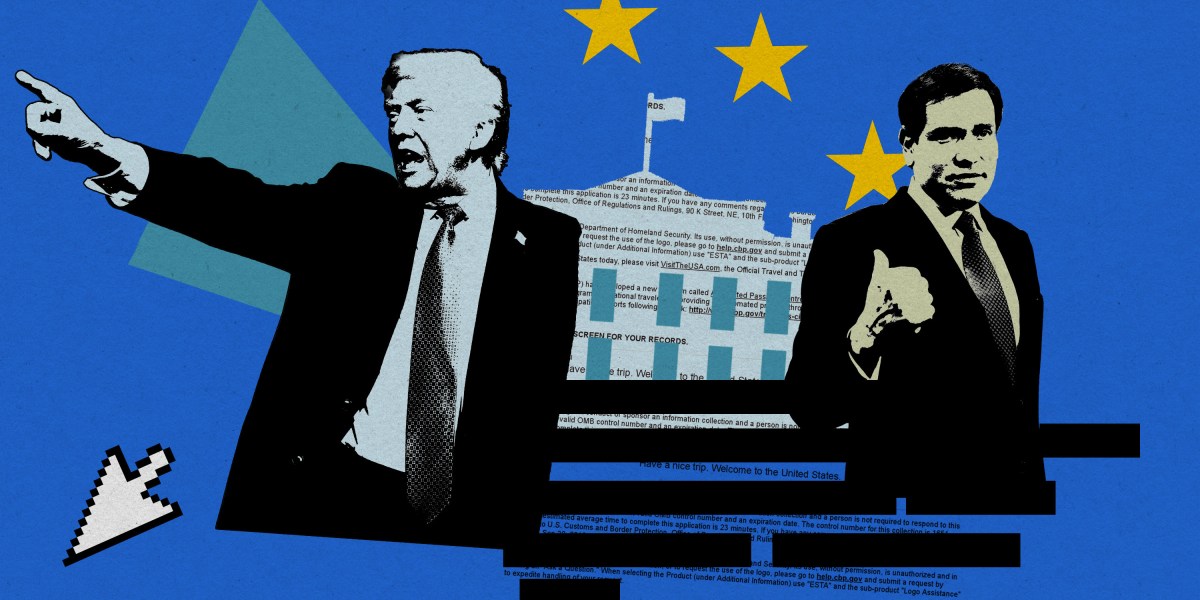
Just before Christmas the Trump administration dramatically escalated its war on digital rights by banning five people from entering the US. One of them, Josephine Ballon, is a director of HateAid, a small German nonprofit founded to support the victims of online harassment and violence. The organization is a strong advocate of EU tech regulations, and so finds itself attacked in campaigns from right-wing politicians and provocateurs who claim that it engages in censorship.
EU officials, freedom of speech experts, and the five people targeted all flatly reject these accusations. Ballon told us that their work is fundamentally about making people feel safer online. But their experiences over the past few weeks show just how politicized and besieged their work in online safety has become. Read the full story.
—Eileen Guo
TR10: AI companions
Chatbots are skilled at crafting sophisticated dialogue and mimicking empathetic behavior. They never get tired of chatting. It’s no wonder, then, that so many people now use them for companionship—forging friendships or even romantic relationships.
72% of US teenagers have used AI for companionship, according to a study from the nonprofit Common Sense Media. But while chatbots can provide much-needed emotional support and guidance for some people, they can exacerbate underlying problems in others—especially vulnerable people or those with mental health issues.
Although some early attempts to regulate this space are underway, AI companionship is going nowhere. Read why we made it one of our 10 Breakthrough Technologies this year, and check out the rest of the list.
And, if you want to learn more about what we predict for AI this year, sign up to join me for our free LinkedIn Live event tomorrow at 12.30pm ET.
Why inventing new emotions feels so good
Have you ever felt “velvetmist”?
It’s a “complex and subtle emotion that elicits feelings of comfort, serenity, and a gentle sense of floating.” It’s peaceful, but more ephemeral and intangible than contentment. It might be evoked by the sight of a sunset or a moody, low-key album.
If you haven’t ever felt this sensation—or even heard of it—that’s not surprising. A Reddit user generated it with ChatGPT, along with advice on how to evoke the feeling. Don’t scoff: Researchers say more and more terms for these “neo-emotions” are showing up online, describing new dimensions and aspects of feeling. Read our story to learn more about why.
—Anya Kamenetz
This story is from the latest print issue of MIT Technology Review. If you haven’t already, subscribe now to receive the next edition as soon as it lands (and benefit from some hefty seasonal discounts too!)
The must-reads
I’ve combed the internet to find you today’s most fun/important/scary/fascinating stories about technology.
1 Ads are coming to ChatGPT
For American users initially, with plans to expand soon. (CNN)
+ Here’s how they’ll work. (Wired $)
2 What will we be able to salvage after the AI bubble bursts?
It will be ugly, but there are plenty of good uses for AI that we’ll want to keep. (The Guardian)
+ What even is the AI bubble? (MIT Technology Review)
3 It’s almost impossible to mine Greenland’s natural resources
It has vast supplies of rare earth elements, but its harsh climate and environment make them very hard to access. (The Week)
4 Iran is now 10 days into its internet shutdown
It’s one of the longest and most extreme we’ve ever witnessed. (BBC)
+ Starlink isn’t proving as helpful as hoped as the regime finds ways to jam it. (Reuters $)
+ Battles are raging online about what’s really going on inside Iran. (NYT $)
5 America is heading for a polymarket disaster
Prediction markets are getting out of control, and some people are losing a lot of money. (The Atlantic $)
+ They were first embraced by political junkies, but now they’re everywhere. (NYT $)
6 How to fireproof a city
Californians are starting to fight fires before they can even start. (The Verge $)
+ How AI can help spot wildfires. (MIT Technology Review)
7 Stoking ‘deep state’ conspiracy theories can be dangerous
Especially if you’re then given the task of helping run one of those state institutions, as Dan Bongino is now learning. (WP $)
+ Why everything is a conspiracy now. (MIT Technology Review)
8 Why we’re suddenly all having a ‘Very Chinese Time’ 🇨🇳
It’s a fun, flippant trend—but it also shows how China’s soft power is growing around the globe. (Wired $)
9 Why there’s no one best way to store information
Each one involves trade-offs between space and time. (Quanta $)
10 Meat may play a surprising role in helping people reach 100
Perhaps because it can assist with building stronger muscles and bones. (New Scientist $)
Quote of the day
“That’s the level of anxiety now – people watching the skies and the seas themselves because they don’t know what else to do.”
—A Greenlander tells The Guardian just how seriously she and her fellow compatriots are taking Trump’s threat to invade their country.
One more thing

Inside a romance scam compound—and how people get tricked into being there
Gavesh’s journey started, seemingly innocently, with a job ad on Facebook promising work he desperately needed.
Instead, he found himself trafficked into a business commonly known as “pig butchering”—a form of fraud in which scammers form close relationships with targets online and extract money from them. The Chinese crime syndicates behind the scams have netted billions of dollars, and they have used violence and coercion to force their workers, many of them trafficked like Gavesh, to carry out the frauds from large compounds, several of which operate openly in the quasi-lawless borderlands of Myanmar.
Big Tech may hold the key to breaking up the scam syndicates—if these companies can be persuaded or compelled to act. Read the full story.
—Peter Guest & Emily Fishbein
We can still have nice things
A place for comfort, fun and distraction to brighten up your day. (Got any ideas? Drop me a line or skeet ’em at me.)
+ Blue Monday isn’t real (but it is an absolute banger of a track.)
+ Some great advice here about how to be productive during the working day.
+ Twelfth Night is one of Shakespeare’s most fun plays—as these top actors can attest.
+ If the cold and dark gets to you, try making yourself a delicious bowl of soup.