Stay Ahead, Stay ONMINE

The fast and the future-focused are revolutionizing motorsport

In partnership withInfosys When the ABB FIA Formula E World Championship launched its first race through Beijing’s Olympic Park in 2014, the idea of all-electric motorsport still bordered on experimental. Batteries couldn’t yet last a full race, and drivers had to switch cars mid-competition. Just over a decade later, Formula E has evolved into a global entertainment brand broadcast in 150 countries, driving both technological innovation and cultural change in sport.   “Gen4, that’s to come next year,” says Dan Cherowbrier, Formula E’s chief technology and information officer. “You will see a really quite impressive car that starts us to question whether EV is there. It’s actually faster—it’s actually more than traditional [internal combustion engines] ICE.”  That acceleration isn’t just happening on the track. Formula E’s digital transformation, powered by its partnership with Infosys, is redefining what it means to be a fan. “It’s a movement to make motor sport accessible and exciting for the new generation,” says principal technologist at Infosys, Rohit Agnihotri.  From real-time leaderboards and predictive tools to personalized storylines that adapt to what individual fans care most about—whether it’s a driver rivalry or battery performance—Formula E and Infosys are using AI-powered platforms to create fan experiences as dynamic as the races themselves. “Technology is not just about meeting expectations; it’s elevating the entire fan experience and making the sport more inclusive,” says Agnihotri.   AI is also transforming how the organization itself operates. “Historically, we would be going around the company, banging on everyone’s doors and dragging them towards technology, making them use systems, making them move things to the cloud,” Cherowbrier notes. “What AI has done is it’s turned that around on its head, and we now have people turning up, banging on our door because they want to use this tool, they want to use that tool.”  As audiences diversify and expectations evolve, Formula E is also a case study in sustainable innovation. Machine learning tools now help determine the most carbon-optimal way to ship batteries across continents, while remote broadcast production has sharply reduced travel emissions and democratized the company’s workforce. These advances show how digital intelligence can expand reach without deepening carbon footprints.  For Cherowbrier, this convergence of sport, sustainability, and technology is just the beginning. With its data-driven approach to performance, experience, and impact, Formula E is offering a glimpse into how entertainment, innovation, and environmental responsibility can move forward in tandem.  “Our goal is clear,” says Agnihotri. “Help Formula E be the most digital and sustainable motor sport in the world. The future is electric, and with AI, it’s more engaging than ever.”  This episode of Business Lab is produced in partnership with Infosys.  Full Transcript:   Megan Tatum: From MIT Technology Review, I’m Megan Tatum, and this is Business Lab, the show that helps business leaders make sense of new technologies coming out of the lab, and into the marketplace.   The ABB FIA Formula E World Championship, the world’s first all-electric racing series, made its debut in the grounds of the Olympic Park in Beijing in 2014. A little more than 10 years later, it’s a global entertainment brand with 10 teams, 20 drivers, and broadcasts in 150 countries. Technology is central to how Formula E is navigating that scale and to how it’s delivering more powerful personalized experiences.   Two words for you: elevated fandom.   My guests today are Rohit Agnihotri, principal technologist at Infosys, and Dan Cherowbrier, CTIO of Formula E.   This episode is produced in partnership with Infosys.   Welcome, Rohit and Dan.  Dan Cherowbrier: Hi. Thanks for having us.  Megan: Dan, as I mentioned there, the first season of the ABB FIA Formula E World Championship launched in 2014. Can you talk us through how the first all-electric motor sport has evolved in the last decade? How has it changed in terms of its scale, the markets it operates in, and also, its audiences, of course?  Dan: When Formula E launched back in 2014, there were hardly any domestic EVs on the road. And probably if you’re from London, the ones you remember are the hybrid Priuses; that was what we knew of really. And at the time, they were unable to get a battery big enough for a car to do a full race. So the first generation of car, the first couple of seasons, the driver had to do a pit stop midway through the race, get out of one car, and get in another car, and then carry on, which sounds almost farcical now, but it’s what you had to do then to drive innovation, is to do that in order to go to the next stage.  Then in Gen2, that came up four years later, they had a battery big enough to start full races and start to actually make it a really good sport. Gen3, they’re going for some real speeds and making it happen. Gen4, that’s to come next year, you’ll see acceleration in line with Formula One. I’ve been fortunate enough to see some of the testing. You will see a really quite impressive car that starts us to question whether EV is there. It’s actually faster, it’s actually more than traditional ICE.  That’s the tech of the car. But then, if you also look at the sport and how people have come to it and the fans and the demographic of the fans, a lot has changed in the last 11 years. We were out to enter season 12. In the last 11 years, we’ve had a complete democratization of how people access content and what people want from content. And as a new generation of fan coming through. This new generation of fan is younger. They’re more gender diverse. We have much closer to 50-50 representation in our fan base. And they want things personalized, and they’re very demanding about how they want it and the experience they expect. No longer are you just able to give them one race and everybody watches the same thing. We need to make things for them. You see that sort of change that’s come through in the last 11 years.  Megan: It’s a huge amount of change in just over a decade, isn’t it? To navigate. And I wonder, Rohit, what was the strategic plan for Infosys when associating with Formula E? What did Infosys see in partnering with such a young sport?  Rohit: Yeah. That’s a great question, Megan. When we looked at Formula E, we didn’t just see a racing championship. We saw the future. A sport, that’s electric, sustainable, and digital first. That’s exactly where Infosys wants to be, at the intersection of technology, innovation, and purpose. Our plan has three big goals. First, grow the fan base. Formula E wants to reach 500 million fans by 2030. That is not just a number. It’s a movement to make motor sport accessible and exciting for the new generation. To make that happen, we are building an AI-powered platform that gives personalized content to the fans, so that every fan feels connected and valued. Imagine a fan in Tokyo getting race insights tailored for their favorite driver, while another in London gets a sustainability story that matters to him. That’s the level of personalization we are aiming for.  Second, bringing technology innovation. We have already launched the Stats Centre, which turns race data into interactive stories. And soon, Race Centre will take this to the next level with real time leaderboards to the race or tracks, overtakes, attack mode timelines, and even AI generated live commentary. Fans will not just watch, they will interact, predict podium finishes, and share their views globally. And third, supports sustainability. Formula E is already net-zero, but now their goal is to cut carbon by 45% by 2030. We’ll be enabling that through AI-driven sustainability, data management, tracking every watt of energy, every logistics decision. and modeling scenarios to make racing even greener. Partnering with a young sport gives us a chance to shape its digital future and show how technology can make racing exciting and responsible. For us, Formula E is not just a sport, it’s a statement about where the world is headed.  Megan: Fantastic. 500 million fans, that’s a huge number, isn’t it? And with more scale often comes a kind of greater expectation. Dan, I know you touched on this a little in your first question, but what is it that your fans now really want from their interactions? Can you talk a bit more about what experiences they’re looking for? And also, how complex that really is to deliver that as well?  Dan: I think a really telling thing about the modern day fan is I probably can’t tell you what they want from their experiences, because it’s individual and it’s unique for each of them.  Megan: Of course.  Dan: And it’s changing and it’s changing so fast. What somebody wants this month is going to be different from what they want in a couple of months’ time. And we’re having to learn to adapt to that. My CTO title, we often put focus on the technology in the middle of it. That’s what the T is. Actually, if you think about it, it’s continual transformation officer. You are constantly trying to change what you deliver and how you deliver it. Because if fans come through, they find new experiences, they find that in other sports. Sometimes not in sports, they find it outside, and then they’re coming in, and they expect that from you. So how can we make them more part of the sport, more personalized experience, get to know the athletes and the personalities and the characters within it? We’re a very technology centric sport. A lot of motor sport is, but really, people want to see people, right? And even when it’s technology, they want to see people interacting with technology, and it’s how do you get that out to show people.  Megan: Yeah, it’s no mean feat. Rohit, you’ve worked with brands on delivering these sort of fan experiences across different sports. Is motor sports perhaps more complicated than others, given that fans watch racing for different reasons than just a win? They could be focused on team dynamics, a particular driver, the way the engine is built, and so on and so forth. How does motor sports compare and how important is it therefore, that Formula E has embraced technology to manage expectations?  Rohit: Yeah, that’s an interesting point. Motor sports are definitely more complex than other sports. Fans don’t just care about who wins, they care about how some follow team strategies, others love driver rivalries, and many are fascinated by the car technology. Formula E adds another layer, sustainability and electric innovation. This makes personalization really important. Fans want more than results. They want stories and insights. Formula E understood this early and embraced technology.  Think about the data behind a single race, lap times, energy usage, battery performance, attack mode activation, pit strategies, it’s a lot of data. If you just show the raw numbers, it’s overwhelming. But with Infosys Topaz, we turn that into simple and engaging stories. Fans can see how a driver fought back from 10th place to finish on the podium, or how a team managed energy better to gain an edge. And for new fans, we are adding explainer videos and interactive tools in the Race Center, so that they can learn about their sport easily. This is important because Formula E is still young, and many fans are discovering it for the first time. Technology is not just about meeting expectations; it’s elevating the entire fan experience and making the sport more inclusive.  Megan: There’s an awful lot going on there. What are some of the other ways that Formula E has already put generative AI and other emerging technologies to use? Dan, when we’ve spoken about the demand for more personalized experiences, for example.  Dan: I see the implementation of AI for us in three areas. We have AI within the sport. That’s in our DNA of the sport. Now, each team is using that, but how can we use that as a championship as well? How do we make it a competitive landscape? Now, we have AI that is in the fan-facing product. That’s what we’re working heavily on Infosys with, but we also have it in our broadcast product. As an example, you might have heard of a super slow-mo camera. A super slow-mo camera is basically, by taking three cameras and having them in exactly the same place so that you get three times the frame rate, and then you can do a slow-motion shot from that. And they used to be really expensive. Quite bulky cameras to put in. We are now using AI to take a traditional camera and interpolate between two frames to make it into a super slow image, and you wouldn’t really know the difference. Now, the joy of that, it means every camera can now be a super slow-mo camera.  Megan: Wow.  Dan: In other ways, we use it a little bit in our graphics products, and we iterate and we use it for things like showing driver audio. When the driver is speaking to his engineer or her engineer in the garage, we show that text now on screen. We do that using AI. We use AI to pick out the difference between the driver and another driver and the team engineer or the team principal and show that in a really good way.  And we wouldn’t be able to do that. We’re not big enough to have a team of 24 people on stenographers typing. We have to use AI to be able to do that. That’s what’s really helped us grow. And then the last one is, how we use it in our business. Because ultimately, as we’ve got the fans, we’ve got the sport, but we also are running a business and we have to pick up these racetracks and move them around the world, and we have all these staff who have to get places. We have insurance who has to do all that kind of stuff, and we use it heavily in that area, particularly when it comes to what has a carbon impact for us.  So things like our freight and our travel. And we are using the AI tools to tell us, a battery for instance, should we fly it? Should we send it by sea freight? Should we send it by row freight? Or should we just have lots of them? And that sort of depends. Now, a battery, if it was heavy, you’d think you probably wouldn’t fly it. But actually, because of the materials in it, because of the source materials that make it, we’re better off flying it. We’ve used AI to work through all those different machinations of things that would be too difficult to do at speed for a person.  Megan: Well, sounds like there’s some fascinating things going on. I mean, of course, for a global brand, there is also the challenge of working in different markets. You mentioned moving everything around the world there. Each market with its own legal frameworks around data privacy, AI. How has technology also helped you navigate all of that, Dan?  Dan: The other really interesting thing about AI is… I’ve worked in technology leadership roles for some time now. And historically, we would be going around the company, banging on everyone’s doors and dragging them towards technology, making them use systems, making them move things to the cloud and things like that. What AI has done is it’s turned that around on its head, and we now have people turning up, banging on our door because they want to use this tool, they want to use that tool. And we’re trying to accommodate all of that and it’s a great pleasure to see people that are so keen. AI is driving the tech adoption in general, which really helps the business.  Megan: Dan, as the world’s first all-electric motor sport series, sustainability is obviously a real cornerstone of what Formula E is looking to do. Can you share with us how technology is helping you to achieve some of your ambitions when it comes to sustainability?  Dan: We’ve been the only sport with a certified net-zero pathway, and we have to stay that part. It’s a really core fundamental part of our DNA. I sit on our management team here. There is a sustainability VP that sits there as well, who checks and challenges everything we do. She looks at the data centers we use, why we use them, why we’ve made the decisions we’ve made, to make sure that we’re making them all for the right reasons and the right ways. We specifically embed technology in a couple of ways. One is, we mentioned a little bit earlier, on our freight. Formula E’s freight for the whole championship is probably akin to one Formula One team, but it’s still by far, our biggest contributor to our impact. So we look about how we can make sure that we’ve refined that to get the minimum amount of air freight and sea freight, and use local wherever we can. That’s also part of our pledge about investing in the communities that we race in.  The second then is about our staff travel. And we’ve done a really big piece of work over the last four to five years, partly accelerated through the covid-19 era actually, of doing remote working and remote TV production. Used to be traditionally, you would fly a hundred plus people out to racetracks, and then they would make the television all on site in trucks, and then they would be satellite distributed out of the venue. Now, what we do is we put in some internet connections, dual and diverse internet connections, and we stream every single camera back.  Megan: Right.  Dan: That means on site, we only need camera operators. Some of them actually, are remotely operated anyway, but we need camera operators, and then some engineering teams to just keep everything running. And then back in our home base, which is in London, in the UK, we have our remote production center where we layer on direction, graphics, audio, replay, team radio, all of those bits that break the color and make the program and add to that significant body of people. We do that all remotely now. Really interesting actually, a bit. So that’s the carbon sustainability story, but there is a further ESG piece that comes out of it and we haven’t really accommodated when we went into it, is the diversity in our workforce by doing that. We were discovering that we had quite a young, equally diverse workforce until around the age of 30. And then once that happened, then we were finding we were losing women, and that’s really because they didn’t want to travel.  Megan: Right.  Dan: And that’s the age of people starting to have children, and things were starting to change. And then we had some men that were traveling instead, and they weren’t seeing their children and it was sort of dividing it unnecessarily. But by going remote, by having so much of our people able to remotely… Or even if they do have to travel, they’re not traveling every single week. They’re now doing that one in three. They’re able to maintain the careers and the jobs they want to do, whilst having a family lifestyle. And it also just makes a better product by having people in that environment.  Megan: That’s such an interesting perspective, isn’t it? It’s a way of environmental sustainability intersects with social sustainability. And Rohit, and your work are so interesting. And Rohit, can you share any of the ways that Infosys has worked with Formula E, in terms of the role of technology as we say, in furthering those ambitions around sustainability?  Rohit: Yeah. Infosys understands that sustainability is at the heart of Formula E, and it’s a big part of why this partnership matters. Formula E is already net-zero certified, but now, they have an ambitious goal to cut carbon emissions by 45%. Infosys is helping in two ways. First, we have built AI-powered sustainability data tools that make carbon reporting accurate and traceable. Every watt of energy, every logistic decision, every material use can be tracked. Second, we use predictive analytics to model scenarios, like how changing race logistics or battery technology impact emissions so Formula E can make smarter, greener decisions. For us, it’s about turning sustainability from a report into an action plan, and making Formula E a global leader in green motor sport.  Megan: And in April 2025, Formula E working with Infosys launched its Stats Centre, which provides fans with interactive access to the performances of their drivers and teams, key milestones and narratives. I know you touched on this before, but I wonder if you could tell us a bit more about the design of that platform, Rohit, and how it fits into Formula E’s wider plans to personalize that fan experience?  Rohit: Sure. The Stats Centre was a big step forward. Before this, fans had access to basic statistics on the website and the mobile app, but nothing told the full story and we wanted to change that. Built on Infosys Topaz, the Stats Centre uses AI to turn race data into interactive stories. Fans can explore key stat cards that adapt to race timelines, and even chat with an AI companion to get instant answers. It’s like having a person race analyst at your fingertips. And we are going further. Next year, we’ll launch Race Centre. It’ll have live data boards, 2D track maps showing every driver’s position, overtakes and more attack timelines, and AI-generated commentary. Fans can predict podium finishes, vote for the driver of the race, and share their views on social media. Plus, we are adding video explainers for new fans, covering rules, strategies, and car technology. Our goal is simple: make every moment exciting and easy to understand. Whether you are a hardcore fan or someone watching Formula E for the first time, you’ll feel connected and informed.  Megan: Fantastic. Sounds brilliant. And as you’ve explained, Dan, leveraging data and AI can come with these huge benefits when it comes to the depth of fan experience that you can deliver, but it can also expose you to some challenges. How are you navigating those at Formula E?  Dan: The AI generation has presented two significant challenges to us. One is that traditional SEO, traditional search engine optimization, goes out the window. Right? You are now looking at how do we design and build our systems and how do we populate them with the right content and the right data, so that the engines are picking it up correctly and displaying it? The way that the foundational models are built and the speed and the cadence of which they’re updated, means quite often… We’re a very fast-changing organization. We’re a fast-changing product. Often, the models don’t keep up. And that’s because they are a point in time when they were trained. And that’s something that the big organizations, the big tech organizations will fix with time. But for now, what we have to do is we have to learn about how we can present our fan-facing, web-facing products to show that correctly. That’s all about having really accurate first-party content, effectively earned media. That’s the piece we need to do.  Then the second sort of challenge is sadly, whilst these tools are available to all of us, and we are using them effectively, so are another part of the technology landscape, and that is the cybersecurity basically they come with. If you look at the speed of the cadence and severity of hacks that are happening now, it’s just growing and growing and growing, and that’s because they have access to these tools too. And we’re having to really up our game and professionalize. And that’s really hard for an innovative organization. You don’t want to shut everything down. You don’t want to protect everything too much because you want people to be able to try new things. Right? If I block everything to only things that the IT team had heard of, we’d never get anything new in, and it’s about getting that balance right.  Megan: Right.  Dan: Rohit, you probably have similar experiences?  Megan: How has Infosys worked with Formula E to help it navigate some of that, Rohit?  Rohit: Yeah. Infosys has helped Formula E tackle some of the challenges in three key ways, simplify complex race data into engaging fan experience through platforms like Stats Centre, building a secure and scalable cloud data backbone for the real-time insights, and enabling sustainability goals with AI-driven carbon tracking and predictive analytics. This solution makes the sport interactive, more digital, and more responsible.  Megan: Fantastic. I wondered if we could close with a bit of a future forward look. Can you share with us any innovations on the horizon at Formula E that you are really excited about, Dan?  Dan: We have mentioned the Race Centre is going to launch in the next couple of months, but the really exciting thing for me is we’ve got an amazing season ahead of us. It’s the last season of our Gen3 car, with 10 really exciting teams on the grid. We are going at speed with our tech innovation roadmap and what our fans want. And we’re building up towards our Gen4 car, which will come out for season 13 in a year’s time. That will get launched in 2026, and I think it will be a game changer in how people perceive electric motor sport and electric cars in general.  Megan: It sounds like there’s all sorts of exciting things going on. And Rohit too, what’s coming up via this partnership that you are really looking forward to sharing with everyone?  Rohit: Two things stand out for me. First is the AI-powered fan data platform that I’ve already spoken about. Second is the launch of Race Centre. It’s going to change how fans experience live racing. And beyond final engagement, we are helping Formula E lead in sustainability with AI tools that model carbon impact and optimize logistics. This means every race can be smarter and greener. Our goal is clear: help Formula E be the most digital and sustainable motor sport in the world. The future is electric, and with AI, it’s more engaging than ever.  Megan: Fantastic. Thank you so much, both. That was Rohit Agnihotri, principal technologist at Infosys, and Dan Cherowbrier, CITO of Formula E, whom I spoke with from Brighton, England.   That’s it for this episode of Business Lab. I’m your host, Megan Tatum. I’m a contributing editor and host for Insights, the custom publishing division of MIT Technology Review. We were founded in 1899 at the Massachusetts Institute of Technology, and you can find us in print, on the web and at events each year around the world. For more information about us and the show, please check out our website at technologyreview.com.   This show is available wherever you get your podcasts. And if you enjoyed this episode, we hope you’ll take a moment to rate and review us. Business Lab is a production of MIT Technology Review and this episode was produced by Giro Studios. Thanks for listening.  This content was produced by Insights, the custom content arm of MIT Technology Review. It was not written by MIT Technology Review’s editorial staff. It was researched, designed, and written by human writers, editors, analysts, and illustrators. This includes the writing of surveys and collection of data for surveys. AI tools that may have been used were limited to secondary production processes that passed thorough human review.
In partnership withInfosys

When the ABB FIA Formula E World Championship launched its first race through Beijing’s Olympic Park in 2014, the idea of all-electric motorsport still bordered on experimental. Batteries couldn’t yet last a full race, and drivers had to switch cars mid-competition. Just over a decade later, Formula E has evolved into a global entertainment brand broadcast in 150 countries, driving both technological innovation and cultural change in sport.  

“Gen4, that’s to come next year,” says Dan Cherowbrier, Formula E’s chief technology and information officer. “You will see a really quite impressive car that starts us to question whether EV is there. It’s actually faster—it’s actually more than traditional [internal combustion engines] ICE.” 

That acceleration isn’t just happening on the track. Formula E’s digital transformation, powered by its partnership with Infosys, is redefining what it means to be a fan. “It’s a movement to make motor sport accessible and exciting for the new generation,” says principal technologist at Infosys, Rohit Agnihotri. 

From real-time leaderboards and predictive tools to personalized storylines that adapt to what individual fans care most about—whether it’s a driver rivalry or battery performance—Formula E and Infosys are using AI-powered platforms to create fan experiences as dynamic as the races themselves. “Technology is not just about meeting expectations; it’s elevating the entire fan experience and making the sport more inclusive,” says Agnihotri.  

AI is also transforming how the organization itself operates. “Historically, we would be going around the company, banging on everyone’s doors and dragging them towards technology, making them use systems, making them move things to the cloud,” Cherowbrier notes. “What AI has done is it’s turned that around on its head, and we now have people turning up, banging on our door because they want to use this tool, they want to use that tool.” 

As audiences diversify and expectations evolve, Formula E is also a case study in sustainable innovation. Machine learning tools now help determine the most carbon-optimal way to ship batteries across continents, while remote broadcast production has sharply reduced travel emissions and democratized the company’s workforce. These advances show how digital intelligence can expand reach without deepening carbon footprints. 

For Cherowbrier, this convergence of sport, sustainability, and technology is just the beginning. With its data-driven approach to performance, experience, and impact, Formula E is offering a glimpse into how entertainment, innovation, and environmental responsibility can move forward in tandem. 

“Our goal is clear,” says Agnihotri. “Help Formula E be the most digital and sustainable motor sport in the world. The future is electric, and with AI, it’s more engaging than ever.” 

This episode of Business Lab is produced in partnership with Infosys. 

Full Transcript:  

Megan Tatum: From MIT Technology Review, I’m Megan Tatum, and this is Business Lab, the show that helps business leaders make sense of new technologies coming out of the lab, and into the marketplace.  

The ABB FIA Formula E World Championship, the world’s first all-electric racing series, made its debut in the grounds of the Olympic Park in Beijing in 2014. A little more than 10 years later, it’s a global entertainment brand with 10 teams, 20 drivers, and broadcasts in 150 countries. Technology is central to how Formula E is navigating that scale and to how it’s delivering more powerful personalized experiences.  

Two words for you: elevated fandom.  

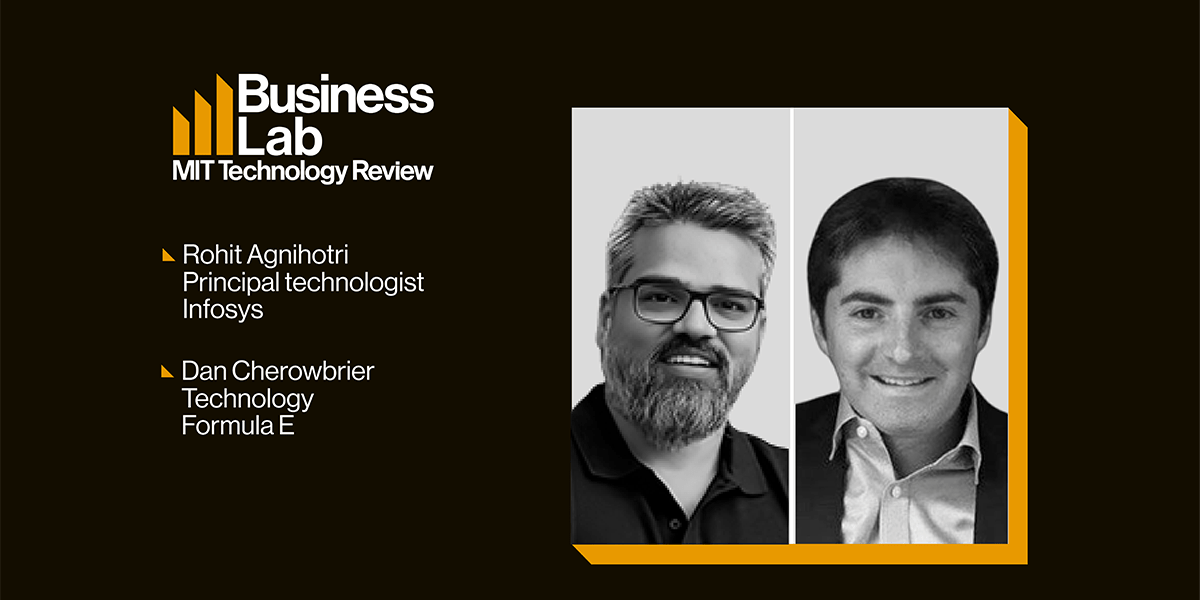
My guests today are Rohit Agnihotri, principal technologist at Infosys, and Dan Cherowbrier, CTIO of Formula E.  

This episode is produced in partnership with Infosys.  

Welcome, Rohit and Dan. 

Dan Cherowbrier: Hi. Thanks for having us. 

Megan: Dan, as I mentioned there, the first season of the ABB FIA Formula E World Championship launched in 2014. Can you talk us through how the first all-electric motor sport has evolved in the last decade? How has it changed in terms of its scale, the markets it operates in, and also, its audiences, of course? 

Dan: When Formula E launched back in 2014, there were hardly any domestic EVs on the road. And probably if you’re from London, the ones you remember are the hybrid Priuses; that was what we knew of really. And at the time, they were unable to get a battery big enough for a car to do a full race. So the first generation of car, the first couple of seasons, the driver had to do a pit stop midway through the race, get out of one car, and get in another car, and then carry on, which sounds almost farcical now, but it’s what you had to do then to drive innovation, is to do that in order to go to the next stage. 

Then in Gen2, that came up four years later, they had a battery big enough to start full races and start to actually make it a really good sport. Gen3, they’re going for some real speeds and making it happen. Gen4, that’s to come next year, you’ll see acceleration in line with Formula One. I’ve been fortunate enough to see some of the testing. You will see a really quite impressive car that starts us to question whether EV is there. It’s actually faster, it’s actually more than traditional ICE. 

That’s the tech of the car. But then, if you also look at the sport and how people have come to it and the fans and the demographic of the fans, a lot has changed in the last 11 years. We were out to enter season 12. In the last 11 years, we’ve had a complete democratization of how people access content and what people want from content. And as a new generation of fan coming through. This new generation of fan is younger. They’re more gender diverse. We have much closer to 50-50 representation in our fan base. And they want things personalized, and they’re very demanding about how they want it and the experience they expect. No longer are you just able to give them one race and everybody watches the same thing. We need to make things for them. You see that sort of change that’s come through in the last 11 years. 

Megan: It’s a huge amount of change in just over a decade, isn’t it? To navigate. And I wonder, Rohit, what was the strategic plan for Infosys when associating with Formula E? What did Infosys see in partnering with such a young sport? 

Rohit: Yeah. That’s a great question, Megan. When we looked at Formula E, we didn’t just see a racing championship. We saw the future. A sport, that’s electric, sustainable, and digital first. That’s exactly where Infosys wants to be, at the intersection of technology, innovation, and purpose. Our plan has three big goals. First, grow the fan base. Formula E wants to reach 500 million fans by 2030. That is not just a number. It’s a movement to make motor sport accessible and exciting for the new generation. To make that happen, we are building an AI-powered platform that gives personalized content to the fans, so that every fan feels connected and valued. Imagine a fan in Tokyo getting race insights tailored for their favorite driver, while another in London gets a sustainability story that matters to him. That’s the level of personalization we are aiming for. 

Second, bringing technology innovation. We have already launched the Stats Centre, which turns race data into interactive stories. And soon, Race Centre will take this to the next level with real time leaderboards to the race or tracks, overtakes, attack mode timelines, and even AI generated live commentary. Fans will not just watch, they will interact, predict podium finishes, and share their views globally. And third, supports sustainability. Formula E is already net-zero, but now their goal is to cut carbon by 45% by 2030. We’ll be enabling that through AI-driven sustainability, data management, tracking every watt of energy, every logistics decision. and modeling scenarios to make racing even greener. Partnering with a young sport gives us a chance to shape its digital future and show how technology can make racing exciting and responsible. For us, Formula E is not just a sport, it’s a statement about where the world is headed. 

Megan: Fantastic. 500 million fans, that’s a huge number, isn’t it? And with more scale often comes a kind of greater expectation. Dan, I know you touched on this a little in your first question, but what is it that your fans now really want from their interactions? Can you talk a bit more about what experiences they’re looking for? And also, how complex that really is to deliver that as well? 

Dan: I think a really telling thing about the modern day fan is I probably can’t tell you what they want from their experiences, because it’s individual and it’s unique for each of them. 

Megan: Of course. 

Dan: And it’s changing and it’s changing so fast. What somebody wants this month is going to be different from what they want in a couple of months’ time. And we’re having to learn to adapt to that. My CTO title, we often put focus on the technology in the middle of it. That’s what the T is. Actually, if you think about it, it’s continual transformation officer. You are constantly trying to change what you deliver and how you deliver it. Because if fans come through, they find new experiences, they find that in other sports. Sometimes not in sports, they find it outside, and then they’re coming in, and they expect that from you. So how can we make them more part of the sport, more personalized experience, get to know the athletes and the personalities and the characters within it? We’re a very technology centric sport. A lot of motor sport is, but really, people want to see people, right? And even when it’s technology, they want to see people interacting with technology, and it’s how do you get that out to show people. 

Megan: Yeah, it’s no mean feat. Rohit, you’ve worked with brands on delivering these sort of fan experiences across different sports. Is motor sports perhaps more complicated than others, given that fans watch racing for different reasons than just a win? They could be focused on team dynamics, a particular driver, the way the engine is built, and so on and so forth. How does motor sports compare and how important is it therefore, that Formula E has embraced technology to manage expectations? 

Rohit: Yeah, that’s an interesting point. Motor sports are definitely more complex than other sports. Fans don’t just care about who wins, they care about how some follow team strategies, others love driver rivalries, and many are fascinated by the car technology. Formula E adds another layer, sustainability and electric innovation. This makes personalization really important. Fans want more than results. They want stories and insights. Formula E understood this early and embraced technology. 

Think about the data behind a single race, lap times, energy usage, battery performance, attack mode activation, pit strategies, it’s a lot of data. If you just show the raw numbers, it’s overwhelming. But with Infosys Topaz, we turn that into simple and engaging stories. Fans can see how a driver fought back from 10th place to finish on the podium, or how a team managed energy better to gain an edge. And for new fans, we are adding explainer videos and interactive tools in the Race Center, so that they can learn about their sport easily. This is important because Formula E is still young, and many fans are discovering it for the first time. Technology is not just about meeting expectations; it’s elevating the entire fan experience and making the sport more inclusive. 

Megan: There’s an awful lot going on there. What are some of the other ways that Formula E has already put generative AI and other emerging technologies to use? Dan, when we’ve spoken about the demand for more personalized experiences, for example. 

Dan: I see the implementation of AI for us in three areas. We have AI within the sport. That’s in our DNA of the sport. Now, each team is using that, but how can we use that as a championship as well? How do we make it a competitive landscape? Now, we have AI that is in the fan-facing product. That’s what we’re working heavily on Infosys with, but we also have it in our broadcast product. As an example, you might have heard of a super slow-mo camera. A super slow-mo camera is basically, by taking three cameras and having them in exactly the same place so that you get three times the frame rate, and then you can do a slow-motion shot from that. And they used to be really expensive. Quite bulky cameras to put in. We are now using AI to take a traditional camera and interpolate between two frames to make it into a super slow image, and you wouldn’t really know the difference. Now, the joy of that, it means every camera can now be a super slow-mo camera. 

Megan: Wow. 

Dan: In other ways, we use it a little bit in our graphics products, and we iterate and we use it for things like showing driver audio. When the driver is speaking to his engineer or her engineer in the garage, we show that text now on screen. We do that using AI. We use AI to pick out the difference between the driver and another driver and the team engineer or the team principal and show that in a really good way. 

And we wouldn’t be able to do that. We’re not big enough to have a team of 24 people on stenographers typing. We have to use AI to be able to do that. That’s what’s really helped us grow. And then the last one is, how we use it in our business. Because ultimately, as we’ve got the fans, we’ve got the sport, but we also are running a business and we have to pick up these racetracks and move them around the world, and we have all these staff who have to get places. We have insurance who has to do all that kind of stuff, and we use it heavily in that area, particularly when it comes to what has a carbon impact for us. 

So things like our freight and our travel. And we are using the AI tools to tell us, a battery for instance, should we fly it? Should we send it by sea freight? Should we send it by row freight? Or should we just have lots of them? And that sort of depends. Now, a battery, if it was heavy, you’d think you probably wouldn’t fly it. But actually, because of the materials in it, because of the source materials that make it, we’re better off flying it. We’ve used AI to work through all those different machinations of things that would be too difficult to do at speed for a person. 

Megan: Well, sounds like there’s some fascinating things going on. I mean, of course, for a global brand, there is also the challenge of working in different markets. You mentioned moving everything around the world there. Each market with its own legal frameworks around data privacy, AI. How has technology also helped you navigate all of that, Dan? 

Dan: The other really interesting thing about AI is… I’ve worked in technology leadership roles for some time now. And historically, we would be going around the company, banging on everyone’s doors and dragging them towards technology, making them use systems, making them move things to the cloud and things like that. What AI has done is it’s turned that around on its head, and we now have people turning up, banging on our door because they want to use this tool, they want to use that tool. And we’re trying to accommodate all of that and it’s a great pleasure to see people that are so keen. AI is driving the tech adoption in general, which really helps the business. 

Megan: Dan, as the world’s first all-electric motor sport series, sustainability is obviously a real cornerstone of what Formula E is looking to do. Can you share with us how technology is helping you to achieve some of your ambitions when it comes to sustainability? 

Dan: We’ve been the only sport with a certified net-zero pathway, and we have to stay that part. It’s a really core fundamental part of our DNA. I sit on our management team here. There is a sustainability VP that sits there as well, who checks and challenges everything we do. She looks at the data centers we use, why we use them, why we’ve made the decisions we’ve made, to make sure that we’re making them all for the right reasons and the right ways. We specifically embed technology in a couple of ways. One is, we mentioned a little bit earlier, on our freight. Formula E’s freight for the whole championship is probably akin to one Formula One team, but it’s still by far, our biggest contributor to our impact. So we look about how we can make sure that we’ve refined that to get the minimum amount of air freight and sea freight, and use local wherever we can. That’s also part of our pledge about investing in the communities that we race in. 

The second then is about our staff travel. And we’ve done a really big piece of work over the last four to five years, partly accelerated through the covid-19 era actually, of doing remote working and remote TV production. Used to be traditionally, you would fly a hundred plus people out to racetracks, and then they would make the television all on site in trucks, and then they would be satellite distributed out of the venue. Now, what we do is we put in some internet connections, dual and diverse internet connections, and we stream every single camera back. 

Megan: Right. 

Dan: That means on site, we only need camera operators. Some of them actually, are remotely operated anyway, but we need camera operators, and then some engineering teams to just keep everything running. And then back in our home base, which is in London, in the UK, we have our remote production center where we layer on direction, graphics, audio, replay, team radio, all of those bits that break the color and make the program and add to that significant body of people. We do that all remotely now. Really interesting actually, a bit. So that’s the carbon sustainability story, but there is a further ESG piece that comes out of it and we haven’t really accommodated when we went into it, is the diversity in our workforce by doing that. We were discovering that we had quite a young, equally diverse workforce until around the age of 30. And then once that happened, then we were finding we were losing women, and that’s really because they didn’t want to travel. 

Megan: Right. 

Dan: And that’s the age of people starting to have children, and things were starting to change. And then we had some men that were traveling instead, and they weren’t seeing their children and it was sort of dividing it unnecessarily. But by going remote, by having so much of our people able to remotely… Or even if they do have to travel, they’re not traveling every single week. They’re now doing that one in three. They’re able to maintain the careers and the jobs they want to do, whilst having a family lifestyle. And it also just makes a better product by having people in that environment. 

Megan: That’s such an interesting perspective, isn’t it? It’s a way of environmental sustainability intersects with social sustainability. And Rohit, and your work are so interesting. And Rohit, can you share any of the ways that Infosys has worked with Formula E, in terms of the role of technology as we say, in furthering those ambitions around sustainability? 

Rohit: Yeah. Infosys understands that sustainability is at the heart of Formula E, and it’s a big part of why this partnership matters. Formula E is already net-zero certified, but now, they have an ambitious goal to cut carbon emissions by 45%. Infosys is helping in two ways. First, we have built AI-powered sustainability data tools that make carbon reporting accurate and traceable. Every watt of energy, every logistic decision, every material use can be tracked. Second, we use predictive analytics to model scenarios, like how changing race logistics or battery technology impact emissions so Formula E can make smarter, greener decisions. For us, it’s about turning sustainability from a report into an action plan, and making Formula E a global leader in green motor sport. 

Megan: And in April 2025, Formula E working with Infosys launched its Stats Centre, which provides fans with interactive access to the performances of their drivers and teams, key milestones and narratives. I know you touched on this before, but I wonder if you could tell us a bit more about the design of that platform, Rohit, and how it fits into Formula E’s wider plans to personalize that fan experience? 

Rohit: Sure. The Stats Centre was a big step forward. Before this, fans had access to basic statistics on the website and the mobile app, but nothing told the full story and we wanted to change that. Built on Infosys Topaz, the Stats Centre uses AI to turn race data into interactive stories. Fans can explore key stat cards that adapt to race timelines, and even chat with an AI companion to get instant answers. It’s like having a person race analyst at your fingertips. And we are going further. Next year, we’ll launch Race Centre. It’ll have live data boards, 2D track maps showing every driver’s position, overtakes and more attack timelines, and AI-generated commentary. Fans can predict podium finishes, vote for the driver of the race, and share their views on social media. Plus, we are adding video explainers for new fans, covering rules, strategies, and car technology. Our goal is simple: make every moment exciting and easy to understand. Whether you are a hardcore fan or someone watching Formula E for the first time, you’ll feel connected and informed. 

Megan: Fantastic. Sounds brilliant. And as you’ve explained, Dan, leveraging data and AI can come with these huge benefits when it comes to the depth of fan experience that you can deliver, but it can also expose you to some challenges. How are you navigating those at Formula E? 

Dan: The AI generation has presented two significant challenges to us. One is that traditional SEO, traditional search engine optimization, goes out the window. Right? You are now looking at how do we design and build our systems and how do we populate them with the right content and the right data, so that the engines are picking it up correctly and displaying it? The way that the foundational models are built and the speed and the cadence of which they’re updated, means quite often… We’re a very fast-changing organization. We’re a fast-changing product. Often, the models don’t keep up. And that’s because they are a point in time when they were trained. And that’s something that the big organizations, the big tech organizations will fix with time. But for now, what we have to do is we have to learn about how we can present our fan-facing, web-facing products to show that correctly. That’s all about having really accurate first-party content, effectively earned media. That’s the piece we need to do. 

Then the second sort of challenge is sadly, whilst these tools are available to all of us, and we are using them effectively, so are another part of the technology landscape, and that is the cybersecurity basically they come with. If you look at the speed of the cadence and severity of hacks that are happening now, it’s just growing and growing and growing, and that’s because they have access to these tools too. And we’re having to really up our game and professionalize. And that’s really hard for an innovative organization. You don’t want to shut everything down. You don’t want to protect everything too much because you want people to be able to try new things. Right? If I block everything to only things that the IT team had heard of, we’d never get anything new in, and it’s about getting that balance right. 

Megan: Right. 

Dan: Rohit, you probably have similar experiences? 

Megan: How has Infosys worked with Formula E to help it navigate some of that, Rohit? 

Rohit: Yeah. Infosys has helped Formula E tackle some of the challenges in three key ways, simplify complex race data into engaging fan experience through platforms like Stats Centre, building a secure and scalable cloud data backbone for the real-time insights, and enabling sustainability goals with AI-driven carbon tracking and predictive analytics. This solution makes the sport interactive, more digital, and more responsible. 

Megan: Fantastic. I wondered if we could close with a bit of a future forward look. Can you share with us any innovations on the horizon at Formula E that you are really excited about, Dan? 

Dan: We have mentioned the Race Centre is going to launch in the next couple of months, but the really exciting thing for me is we’ve got an amazing season ahead of us. It’s the last season of our Gen3 car, with 10 really exciting teams on the grid. We are going at speed with our tech innovation roadmap and what our fans want. And we’re building up towards our Gen4 car, which will come out for season 13 in a year’s time. That will get launched in 2026, and I think it will be a game changer in how people perceive electric motor sport and electric cars in general. 

Megan: It sounds like there’s all sorts of exciting things going on. And Rohit too, what’s coming up via this partnership that you are really looking forward to sharing with everyone? 

Rohit: Two things stand out for me. First is the AI-powered fan data platform that I’ve already spoken about. Second is the launch of Race Centre. It’s going to change how fans experience live racing. And beyond final engagement, we are helping Formula E lead in sustainability with AI tools that model carbon impact and optimize logistics. This means every race can be smarter and greener. Our goal is clear: help Formula E be the most digital and sustainable motor sport in the world. The future is electric, and with AI, it’s more engaging than ever. 

Megan: Fantastic. Thank you so much, both. That was Rohit Agnihotri, principal technologist at Infosys, and Dan Cherowbrier, CITO of Formula E, whom I spoke with from Brighton, England.  

That’s it for this episode of Business Lab. I’m your host, Megan Tatum. I’m a contributing editor and host for Insights, the custom publishing division of MIT Technology Review. We were founded in 1899 at the Massachusetts Institute of Technology, and you can find us in print, on the web and at events each year around the world. For more information about us and the show, please check out our website at technologyreview.com.  

This show is available wherever you get your podcasts. And if you enjoyed this episode, we hope you’ll take a moment to rate and review us. Business Lab is a production of MIT Technology Review and this episode was produced by Giro Studios. Thanks for listening. 

This content was produced by Insights, the custom content arm of MIT Technology Review. It was not written by MIT Technology Review’s editorial staff. It was researched, designed, and written by human writers, editors, analysts, and illustrators. This includes the writing of surveys and collection of data for surveys. AI tools that may have been used were limited to secondary production processes that passed thorough human review.

Shape
Shape
Stay Ahead

Explore More Insights

Stay ahead with more perspectives on cutting-edge power, infrastructure, energy,  bitcoin and AI solutions. Explore these articles to uncover strategies and insights shaping the future of industries.

Shape

ExxonMobil bumps up 2030 target for Permian production

ExxonMobil Corp., Houston, is looking to grow production in the Permian basin to about 2.5 MMboe/d by 2030, an increase of 200,000 boe/d from executives’ previous forecasts and a jump of more than 45% from this year’s output. Helping drive that higher target is an expected 2030 cost profile that

Read More »

Finnish Refiner Says It Won’t Meet 2035 Oil Exit Goal

Finland’s Neste Oyj is scaling back some of its climate targets and doesn’t expect to stop using crude at its only oil refinery by 2035 as previously guided.  Neste had pledged a “very ambitious” target for achieve carbon neutral production by that year, but it now expects to reduce greenhouse gas emissions in its own operations — known as Scope 1 and 2 — by 80% by 2040, according to a statement on its website. Neste’s share rose.  Reaching the original climate targets and schedule “would have required significant investments that are currently not realistic,” the company said. “The timeline for transitioning from crude oil to processing renewable and circular raw materials will be determined in line with the actual fuel market demand.” The bulk of Neste’s climate goals were put in place under the company’s previous chief executive officer. Heikki Malinen, who took over in 2024, had already said that a target on using waste plastics in the Porvoo refinery had been put on hold.  Neste’s share advanced as much as 3.9% to €19.03 as of 12:36 p.m. local time. Neste is set to benefit from decisions taken last week by the German government that are expected to boost demand for renewable diesel, one of its main products.  WHAT DO YOU THINK? Generated by readers, the comments included herein do not reflect the views and opinions of Rigzone. All comments are subject to editorial review. Off-topic, inappropriate or insulting comments will be removed.

Read More »

Tribal nations regroup after loss of federal funding for clean energy

Tribal nations looking to build clean energy projects are exploring new funding pathways after the Trump administration’s cuts to clean energy grants like Solar for All, which earmarked more than $500 million for solar development on tribal lands.  The Tribal Renewable Energy Coalition, an organization of 14 tribes which received a grant for more than $135 million in now-cancelled Solar for All funding, is continuing to use the solar project plans it developed but will seek funding sources like loans and philanthropy, Indigenized Energy CEO Cody Two Bears said during a November press call. “I think that’s the positive side of what we get out of Solar for All, is we had over a year to plan this out, and now we have some things teed up for tribes to go after and start to leverage some of these dollars,” Two Bears said. “And I think that’s the plan for what we’re going to do moving forward.” After the Trump administration took office and began to cancel grants associated with the Inflation Reduction Act, “the large utility scale projects that we were working on suddenly became a lot more difficult to finance,” said Chéri Smith, CEO of the Alliance for Tribal Clean Energy. “And yet, there are still opportunities there.” Earlier this year, the alliance launched a suite of project finance and planning tools called the Weaver Platform, and is helping tribes “to use that tool to build their capital stacks,” at the same time that they’re “engaging with networks of investors of all flavors to try and take projects and fund them with private dollars instead of public,” Smith said. The Trump administration’s grant clawback has rescinded a great deal of federal funding for clean energy from tribes, Smith said, noting that the alliance’s grant-writing team got $484 million

Read More »

Texas Oil, Gas Upstream Jobs Fall in September

Texas oil and gas upstream jobs fell by 1,300 in September, industry body the Texas Oil & Gas Association (TXOGA) said in a statement sent to Rigzone recently. “The Texas Workforce Commission, having skipped data releases during the federal shutdown that included the Bureau of Labor Statistics, has resumed job data publication,” TXOGA noted in the statement. “Today [December 11] the Commission released September 2025 data, indicating that upstream oil and gas employment fell by 1,300 in September compared to August,” it added. In the statement, TXOGA noted that, “despite recent flat performance”, growth for this year through September “remains a positive 3,900 upstream jobs”. “At 204,800 upstream jobs, compared to the same month in the prior year, September 2025 jobs were up by 1,900, or 0.9 percent,” TXOGA highlighted. A chart included in the statement, which displayed Texas oil and gas upstream job figures from January 2021 to September 2025, showed that, despite the monthly dip from August to September 2025, these job figures in September still stood well above the figures in January 2021.  “The recent downward cycle of the upstream job count confirms Texas is not immune to circumstances facing global oil markets,” TXOGA President Todd Staples warned in the statement. “As a major oil exporter for the United States, the Lone Star State must remain competitive on the worldwide stage,” he added. “To remain the global leader, our industry depends on Texas legislative, regulatory, and business climate certainty that is favorable to investment and job creation even when supply and demand factors present uncertainty and instability,” he continued. The White House website highlights that the U.S. government was recently shut down “for a record 43 days”. August Figures, 2025 Analysis In a statement posted on its site back in September, TXOGA stated that data from the

Read More »

Strategists Say Oil’s Fermi Paradox Nearing an End

In an oil and gas report sent to Rigzone recently by the Macquarie team, Macquarie strategists, including Vikas Dwivedi, noted that oil’s “Fermi Paradox [is] nearing an end”, adding that “onshore stocks [are] starting to build”. “We continue to expect a heavily oversupplied market,” the strategists said in the report. “We estimate a 1Q26 peak supply-demand surplus of over four million barrels per day. Signs of the surplus are showing with continued offshore builds, increasing onshore builds, and extremely strong freight rates,” they added. “We estimate that approximately one-third of the offshore build is long-haul shipments from the Americas to Asia,” they continued. In the report, the strategists revealed that they expect onshore builds to accelerate through year-end 2025 and into early 2026, a process which they said “should drive Brent towards the low $50 range, with a possibility of reaching $45 per barrel”. “Since the end of August, offshore inventories have increased by roughly 250 million barrels and onshore storage up by ~30 million barrels,” the strategists highlighted in the report. “In the past month, the trend has accelerated with onshore … [plus] offshore stocks building by ~ three million barrels per day. Yet, structure remains backwardated, as AB barrels continued clearing East,” they added. A separate report sent to Rigzone by the Macquarie team on December 5 showed that Macquarie was projecting that the Brent price will average $68.21 per barrel overall in 2025 and $60.75 per barrel overall in 2026. According to that report, Macquarie expects the Brent price to average $63.00 per barrel in the fourth quarter of this year, $57.00 per barrel in the first quarter of 2026, $59.00 per barrel in the second quarter, $60.00 per barrel in the third quarter, and $67.00 per barrel in the fourth quarter.   In that report, Macquarie

Read More »

Uniper Approves Its First Scottish Solar Project

Uniper SE said it has decided to proceed constructing its first solar project in Scotland, the 45-megawatt (MW) Berryhill Solar Farm just north of Dundee. The German power and gas utility expects to start construction “early 2026” and fire up the facility later in the year. Berryhill’s output, from about 150,000 solar panels, would be enough “to power the equivalent of over 12,500 UK households each year, 1/5th the population of Angus – contributing to the UK’s net zero targets”, Uniper said in an online statement. “The project has been developed jointly with partner Solar2 and Uniper plans to start the construction process as its sole owner”, Uniper said. Scottish and Southern Electricity Networks, the district network operator, is responsible for installing the nine-kilometer (5.59 miles) medium-voltage cable to connect the solar farm to the grid’s point of connection at the Charleston substation on the Kingsway in Dundee, according to Uniper. The project had obtained planning permission from the Angus Council in 2022, which was modified 2024, it said. “Once operational, there will be a community benefit fund associated with the project which will be agreed with the applicable local community council – Muirhead, Birkhill and Liff Council”, Uniper said. In another Scottish renewable project, Uniper earlier this year greenlighted the construction of a 46.2-MW wind farm in East Ayrshire. It expects to put the facility into production 2028 with enough generation for 66,000 United Kingdom homes each year, it said in a press release June 11. Uniper had announced two other UK renewable power projects in 2025: the Tamworth Solar Farm with a capacity of around 44.2 MWp and the 21.33-MWp Totmonslow Solar Farm. The two projects’ combined capacity can power about 23,300 homes a year, according to Uniper. Uniper aims to connect the projects, which received approval from local

Read More »

BP, Eni Exit Two Angola Producing Assets

A consortium between BW Energy Ltd and Maurel & Prom SA has signed an agreement with Azule Energy Holdings Ltd, a 50-50 venture between BP PLC and Eni SpA, to acquire Azule’s non-operating stakes in Block 14 and Block 14K offshore Angola. Chevron Corp-operated Block 14, a mature deepwater area, produces about 40,000 barrels of oil per day (bopd) gross from nine fields, while Block 14K is a tieback to Block 14 with current production of 2,000 bopd gross, BW Energy and Maurel & Prom noted in separate press releases. BW Energy, part of Singapore-based energy shipping operator BW Group Ltd, and Maurel & Prom, a Paris-based exploration and production company majority-owned by Indonesia’s national oil and gas company PT Pertamina (Persero), will each acquire 10 percent in Block 14 and five percent in Block 14K. Azule said separately its combined share from the blocks averaged 9,600 bopd in 2024. “This transaction is aligned with Azule Energy’s strategy to concentrate our efforts on our core assets in Angola”, said Azule chief executive Joseph Murphy. Last year in Angola, Azule sold its 12 percent interest in Block 3/05 and 16 percent stake in Lower Congo Basin to Afentra, as confirmed by Azule May 23, 2024. The transaction with BW Energy and Maurel & Prom is valued up to $310 million including up to $115 million of deferred payments, Azule said. BW Energy said of the assets, “Current producing reserves are estimated at 9.3 million barrels net to BW Energy, with several identified opportunities to further increase recoverable volumes”. It added, “Abandonment and decommissioning costs are covered by existing provisions”. BW Energy chief executive Carl K. Arnet said, “The entry to Angola is a key step in BW Energy’s West Africa growth strategy and provides further diversification of our resource base”. “Angola is a mature hydrocarbon basin

Read More »

Executive Roundtable: Converging Disciplines in the AI Buildout

At Data Center Frontier, we rely on industry leaders to help us understand the most urgent challenges facing digital infrastructure. And in the fourth quarter of 2025, the data center industry is adjusting to a new kind of complexity.  AI-scale infrastructure is redefining what “mission critical” means, from megawatt density and modular delivery to the chemistry of cooling fluids and the automation of energy systems. Every project has arguably in effect now become an ecosystem challenge, demanding that electrical, mechanical, construction, and environmental disciplines act as one.  For this quarter’s Executive Roundtable, DCF convened subject matter experts from Ecolab, EdgeConneX, Rehlko and Schneider Electric – leaders spanning the full chain of facilities design, deployment, and operation. Their insights illuminate how liquid cooling, energy management, and sustainable process design in data centers are now converging to set the pace for the AI era. Our distinguished executive panelists for this quarter include: Rob Lowe, Director RD&E – Global High Tech, Ecolab Phillip Marangella, Chief Marketing and Product Officer, EdgeConneX Ben Rapp, Manager, Strategic Project Development, Rehlko Joe Reele, Vice President, Datacenter Solution Architects, Schneider Electric Today: Engineering the New Normal – Liquid Cooling at Scale  Today’s kickoff article grapples with how, as liquid cooling technology transitions to default hyperscale design, the challenge is no longer if, but how to scale builds safely, repeatably, and globally.  Cold plates, immersion, dielectric fluids, and liquid-to-chip loops are converging into factory-integrated building blocks, yet variability in chemistry, serviceability, materials, commissioning practices, and long-term maintenance threatens to fragment adoption just as demand accelerates.  Success now hinges on shared standards and tighter collaboration across OEMs, builders, and process specialists worldwide. So how do developers coordinate across the ecosystem to make liquid cooling a safe, maintainable global default? What’s Ahead in the Roundtable Over the coming days, our panel

Read More »

DCF Trends Summit 2025: AI for Good – How Operators, Vendors and Cooling Specialists See the Next Phase of AI Data Centers

At the 2025 Data Center Frontier Trends Summit (Aug. 26-28) in Reston, Va., the conversation around AI and infrastructure moved well past the hype. In a panel sponsored by Schneider Electric—“AI for Good: Building for AI Workloads and Using AI for Smarter Data Centers”—three industry leaders explored what it really means to design, cool and operate the new class of AI “factories,” while also turning AI inward to run those facilities more intelligently. Moderated by Data Center Frontier Editor in Chief Matt Vincent, the session brought together: Steve Carlini, VP, Innovation and Data Center Energy Management Business, Schneider Electric Sudhir Kalra, Chief Data Center Operations Officer, Compass Datacenters Andrew Whitmore, VP of Sales, Motivair Together, they traced both sides of the “AI for Good” equation: building for AI workloads at densities that would have sounded impossible just a few years ago, and using AI itself to reduce risk, improve efficiency and minimize environmental impact. From Bubble Talk to “AI Factories” Carlini opened by acknowledging the volatility surrounding AI investments, citing recent headlines and even Sam Altman’s public use of the word “bubble” to describe the current phase of exuberance. “It’s moving at an incredible pace,” Carlini noted, pointing out that roughly half of all VC money this year has flowed into AI, with more already spent than in all of the previous year. Not every investor will win, he said, and some companies pouring in hundreds of billions may not recoup their capital. But for infrastructure, the signal is clear: the trajectory is up and to the right. GPU generations are cycling faster than ever. Densities are climbing from high double-digits per rack toward hundreds of kilowatts. The hyperscale “AI factories,” as NVIDIA calls them, are scaling to campus capacities measured in gigawatts. Carlini reminded the audience that in 2024,

Read More »

FinOps Foundation sharpens FOCUS to reduce cloud cost chaos

“The big change that’s really started to happen in late 2024 early 2025 is that the FinOps practice started to expand past the cloud,” Storment said. “A lot of organizations got really good at using FinOps to manage the value of cloud, and then their organizations went, ‘oh, hey, we’re living in this happily hybrid state now where we’ve got cloud, SaaS, data center. Can you also apply the FinOps practice to our SaaS? Or can you apply it to our Snowflake? Can you apply it to our data center?’” The FinOps Foundation’s community has grown to approximately 100,000 practitioners. The organization now includes major cloud vendors, hardware providers like Nvidia and AMD, data center operators and data cloud platforms like Snowflake and Databricks. Some 96 of the Fortune 100 now participate in FinOps Foundation programs. The practice itself has shifted in two directions. It has moved left into earlier architectural and design processes, becoming more proactive rather than reactive. It has also moved up organizationally, from director-level cloud management roles to SVP and COO positions managing converged technology portfolios spanning multiple infrastructure types. This expansion has driven the evolution of FOCUS beyond its original cloud billing focus. Enterprises are implementing FOCUS as an internal standard for chargeback reporting even when their providers don’t generate native FOCUS data. Some newer cloud providers, particularly those focused on AI infrastructure, are using the FOCUS specification to define their billing data structures from the ground up rather than retrofitting existing systems. The FOCUS 1.3 release reflects this maturation, addressing technical gaps that have emerged as organizations apply cost management practices across increasingly complex hybrid environments. FOCUS 1.3 exposes cost allocation logic for shared infrastructure The most significant technical enhancement in FOCUS 1.3 addresses a gap in how shared infrastructure costs are allocated and

Read More »

Aetherflux joins the race to launch orbital data centers by 2027

Enterprises will connect to and manage orbital workloads “the same way they manage cloud workloads today,” using optical links, the spokesperson added. The company’s approach is to “continuously launch new hardware and quickly integrate the latest architectures,” with older systems running lower-priority tasks to serve out the full useful lifetime of their high-end GPUs. The company declined to disclose pricing. Aetherflux plans to launch about 30 satellites at a time on SpaceX Falcon 9 rockets. Before the data center launch, the company will launch a power-beaming demonstration satellite in 2026 to test transmission of one kilowatt of energy from orbit to ground stations, using infrared lasers. Competition in the sector has intensified in recent months. In November, Starcloud launched its Starcloud-1 satellite carrying an Nvidia H100 GPU, which is 100 times more powerful than any previous GPU flown in space, according to the company, and demonstrated running Google’s Gemma AI model in orbit. In the same month, Google announced Project Suncatcher, with a 2027 demonstration mission planned. Analysts see limited near-term applications Despite the competitive activity, orbital data centers won’t replace terrestrial cloud regions for general hosting through 2030, said Ashish Banerjee, senior principal analyst at Gartner. Instead, they suit specific workloads, including meeting data sovereignty requirements for jurisdictionally complex scenarios, offering disaster recovery immune to terrestrial risks, and providing asynchronous high-performance computing, he said. “Orbital centers are ideal for high-compute, low-I/O batch jobs,” Banerjee said. “Think molecular folding simulations for pharma, massive Monte Carlo financial simulations, or training specific AI model weights. If the job takes 48 hours, the 500ms latency penalty of LEO is irrelevant.” One immediate application involves processing satellite-generated data in orbit, he said. Earth observation satellites using synthetic aperture radar generate roughly 10 gigabytes per second, but limited downlink bandwidth creates bottlenecks. Processing data in

Read More »

Here’s what Oracle’s soaring infrastructure spend could mean for enterprises

He said he had earlier told analysts in a separate call that margins for AI workloads in these data centers would be in the 30% to 40% range over the life of a customer contract. Kehring reassured that there would be demand for the data centers when they were completed, pointing to Oracle’s increasing remaining performance obligations, or services contracted but not yet delivered, up $68 billion on the previous quarter, saying that Oracle has been seeing unprecedented demand for AI workloads driven by the likes of Meta and Nvidia. Rising debt and margin risks raise flags for CIOs For analysts, though, the swelling debt load is hard to dismiss, even with Oracle’s attempts to de-risk its spend and squeeze more efficiency out of its buildouts. Gogia sees Oracle already under pressure, with the financial ecosystem around the company pricing the risk — one of the largest debts in corporate history, crossing $100 billion even before the capex spend this quarter — evident in the rising cost of insuring the debt and the shift in credit outlook. “The combination of heavy capex, negative free cash flow, increasing financing cost and long-dated revenue commitments forms a structural pressure that will invariably finds its way into the commercial posture of the vendor,” Gogia said, hinting at an “eventual” increase in pricing of the company’s offerings. He was equally unconvinced by Magouyrk’s assurances about the margin profile of AI workloads as he believes that AI infrastructure, particularly GPU-heavy clusters, delivers significantly lower margins in the early years because utilisation takes time to ramp.

Read More »

New Nvidia software gives data centers deeper visibility into GPU thermals and reliability

Addressing the challenge Modern AI accelerators now draw more than 700W per GPU, and multi-GPU nodes can reach 6kW, creating concentrated heat zones, rapid power swings, and a higher risk of interconnect degradation in dense racks, according to Manish Rawat, semiconductor analyst at TechInsights. Traditional cooling methods and static power planning increasingly struggle to keep pace with these loads. “Rich vendor telemetry covering real-time power draw, bandwidth behavior, interconnect health, and airflow patterns shifts operators from reactive monitoring to proactive design,” Rawat said. “It enables thermally aware workload placement, faster adoption of liquid or hybrid cooling, and smarter network layouts that reduce heat-dense traffic clusters.” Rawat added that the software’s fleet-level configuration insights can also help operators catch silent errors caused by mismatched firmware or driver versions. This can improve training reproducibility and strengthen overall fleet stability. “Real-time error and interconnect health data also significantly accelerates root-cause analysis, reducing MTTR and minimizing cluster fragmentation,” Rawat said. These operational pressures can shape budget decisions and infrastructure strategy at the enterprise level.

Read More »

Microsoft will invest $80B in AI data centers in fiscal 2025

And Microsoft isn’t the only one that is ramping up its investments into AI-enabled data centers. Rival cloud service providers are all investing in either upgrading or opening new data centers to capture a larger chunk of business from developers and users of large language models (LLMs).  In a report published in October 2024, Bloomberg Intelligence estimated that demand for generative AI would push Microsoft, AWS, Google, Oracle, Meta, and Apple would between them devote $200 billion to capex in 2025, up from $110 billion in 2023. Microsoft is one of the biggest spenders, followed closely by Google and AWS, Bloomberg Intelligence said. Its estimate of Microsoft’s capital spending on AI, at $62.4 billion for calendar 2025, is lower than Smith’s claim that the company will invest $80 billion in the fiscal year to June 30, 2025. Both figures, though, are way higher than Microsoft’s 2020 capital expenditure of “just” $17.6 billion. The majority of the increased spending is tied to cloud services and the expansion of AI infrastructure needed to provide compute capacity for OpenAI workloads. Separately, last October Amazon CEO Andy Jassy said his company planned total capex spend of $75 billion in 2024 and even more in 2025, with much of it going to AWS, its cloud computing division.

Read More »

John Deere unveils more autonomous farm machines to address skill labor shortage

Join our daily and weekly newsletters for the latest updates and exclusive content on industry-leading AI coverage. Learn More Self-driving tractors might be the path to self-driving cars. John Deere has revealed a new line of autonomous machines and tech across agriculture, construction and commercial landscaping. The Moline, Illinois-based John Deere has been in business for 187 years, yet it’s been a regular as a non-tech company showing off technology at the big tech trade show in Las Vegas and is back at CES 2025 with more autonomous tractors and other vehicles. This is not something we usually cover, but John Deere has a lot of data that is interesting in the big picture of tech. The message from the company is that there aren’t enough skilled farm laborers to do the work that its customers need. It’s been a challenge for most of the last two decades, said Jahmy Hindman, CTO at John Deere, in a briefing. Much of the tech will come this fall and after that. He noted that the average farmer in the U.S. is over 58 and works 12 to 18 hours a day to grow food for us. And he said the American Farm Bureau Federation estimates there are roughly 2.4 million farm jobs that need to be filled annually; and the agricultural work force continues to shrink. (This is my hint to the anti-immigration crowd). John Deere’s autonomous 9RX Tractor. Farmers can oversee it using an app. While each of these industries experiences their own set of challenges, a commonality across all is skilled labor availability. In construction, about 80% percent of contractors struggle to find skilled labor. And in commercial landscaping, 86% of landscaping business owners can’t find labor to fill open positions, he said. “They have to figure out how to do

Read More »

2025 playbook for enterprise AI success, from agents to evals

Join our daily and weekly newsletters for the latest updates and exclusive content on industry-leading AI coverage. Learn More 2025 is poised to be a pivotal year for enterprise AI. The past year has seen rapid innovation, and this year will see the same. This has made it more critical than ever to revisit your AI strategy to stay competitive and create value for your customers. From scaling AI agents to optimizing costs, here are the five critical areas enterprises should prioritize for their AI strategy this year. 1. Agents: the next generation of automation AI agents are no longer theoretical. In 2025, they’re indispensable tools for enterprises looking to streamline operations and enhance customer interactions. Unlike traditional software, agents powered by large language models (LLMs) can make nuanced decisions, navigate complex multi-step tasks, and integrate seamlessly with tools and APIs. At the start of 2024, agents were not ready for prime time, making frustrating mistakes like hallucinating URLs. They started getting better as frontier large language models themselves improved. “Let me put it this way,” said Sam Witteveen, cofounder of Red Dragon, a company that develops agents for companies, and that recently reviewed the 48 agents it built last year. “Interestingly, the ones that we built at the start of the year, a lot of those worked way better at the end of the year just because the models got better.” Witteveen shared this in the video podcast we filmed to discuss these five big trends in detail. Models are getting better and hallucinating less, and they’re also being trained to do agentic tasks. Another feature that the model providers are researching is a way to use the LLM as a judge, and as models get cheaper (something we’ll cover below), companies can use three or more models to

Read More »

OpenAI’s red teaming innovations define new essentials for security leaders in the AI era

Join our daily and weekly newsletters for the latest updates and exclusive content on industry-leading AI coverage. Learn More OpenAI has taken a more aggressive approach to red teaming than its AI competitors, demonstrating its security teams’ advanced capabilities in two areas: multi-step reinforcement and external red teaming. OpenAI recently released two papers that set a new competitive standard for improving the quality, reliability and safety of AI models in these two techniques and more. The first paper, “OpenAI’s Approach to External Red Teaming for AI Models and Systems,” reports that specialized teams outside the company have proven effective in uncovering vulnerabilities that might otherwise have made it into a released model because in-house testing techniques may have missed them. In the second paper, “Diverse and Effective Red Teaming with Auto-Generated Rewards and Multi-Step Reinforcement Learning,” OpenAI introduces an automated framework that relies on iterative reinforcement learning to generate a broad spectrum of novel, wide-ranging attacks. Going all-in on red teaming pays practical, competitive dividends It’s encouraging to see competitive intensity in red teaming growing among AI companies. When Anthropic released its AI red team guidelines in June of last year, it joined AI providers including Google, Microsoft, Nvidia, OpenAI, and even the U.S.’s National Institute of Standards and Technology (NIST), which all had released red teaming frameworks. Investing heavily in red teaming yields tangible benefits for security leaders in any organization. OpenAI’s paper on external red teaming provides a detailed analysis of how the company strives to create specialized external teams that include cybersecurity and subject matter experts. The goal is to see if knowledgeable external teams can defeat models’ security perimeters and find gaps in their security, biases and controls that prompt-based testing couldn’t find. What makes OpenAI’s recent papers noteworthy is how well they define using human-in-the-middle

Read More »