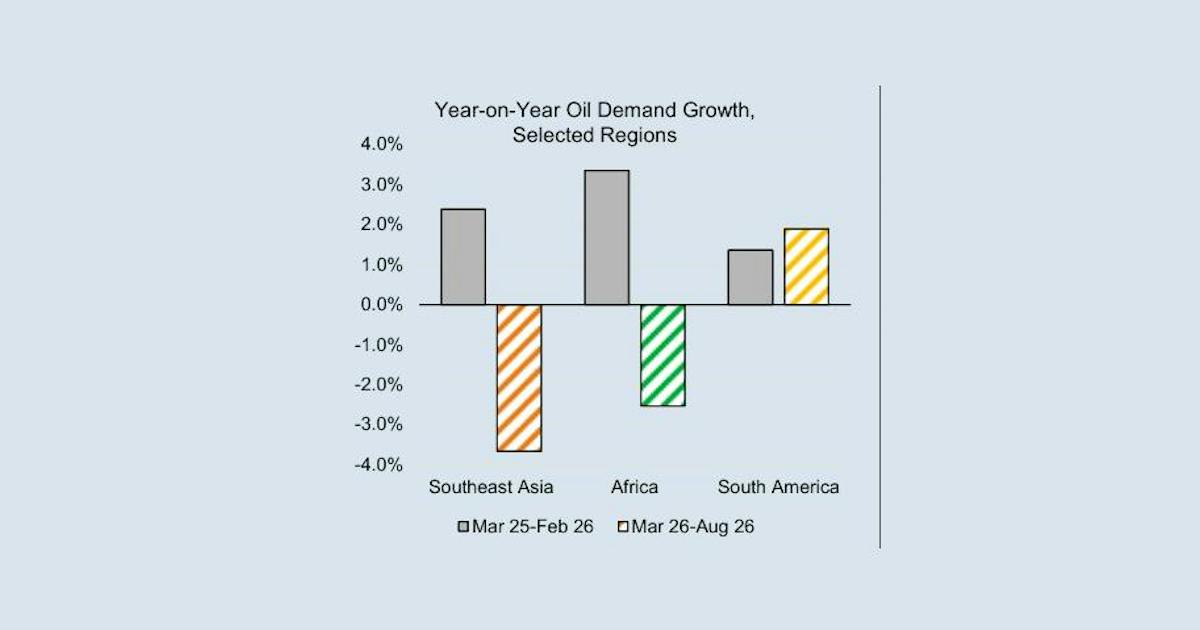
Oil demand in Southeast Asia and Africa has fallen sharply since the outbreak of the Middle East war, as disrupted trade flows, tighter fuel supplies, and higher prices weigh on consumption, according to the International Energy Agency (IEA). South America, by contrast, has remained relatively resilient, benefiting from its lower dependence on Middle Eastern oil supplies. In its October Oil Market Report, IEA said Southeast Asia, Africa, and South America together accounted for about 17.8 million b/d of oil demand in 2025. Assessing consumption trends remains challenging because timely reporting is limited across many emerging economies. Southeast Asian oil demand declined by an estimated 260,000 b/d, or 3.7%, year-on-year (y-o-y) during March-August 2026, compared with prewar expectations for 2.3% growth. The roughly 6-percentage-point deterioration reflects the region’s exposure to disruptions through the Strait of Hormuz. Apparent demand fell by an even steeper 6.3%, suggesting substantial unobserved draws from product inventories. IEA expects Southeast Asian demand to decline by 160,000 b/d, or 2%, in 2026 before rebounding by 270,000 b/d in 2027, supported by economic growth in Indonesia, Vietnam, Malaysia, the Philippines, and Thailand. African demand reverses Africa experienced a similarly sharp reversal. Following estimated demand growth of 3.4% in the 12 months before the war, regional consumption contracted by 2.5% y-o-y during March-August. Apparent demand fell by about 6%. The region’s dependence on imported refined products, particularly diesel and gasoline, has increased its vulnerability to supply disruptions and higher prices. Trade patterns have shifted toward lower imports and increased product exports, including middle distillate shipments from Nigeria. Nigerian oil demand fell by 150,000 b/d, or nearly 30%, y-o-y in July. IEA expects consumption to decline by almost 60,000 b/d in 2026 to 470,000 b/d before recovering by a similar amount in 2027. Egypt, Africa’s largest oil consumer, recorded a demand