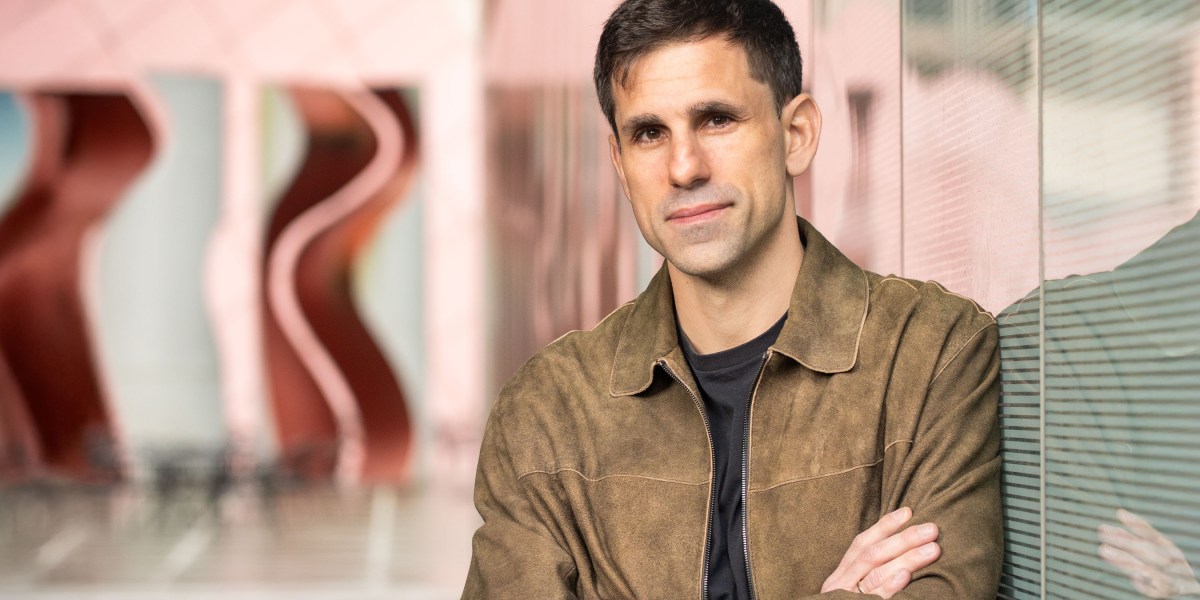
When he was just a teenager trying to decide what to do with his life, César de la Fuente compiled a list of the world’s biggest problems. He ranked them inversely by how much money governments were spending to solve them. Antimicrobial resistance topped the list.
Twenty years on, the problem has not gone away. If anything, it’s gotten worse. Infections caused by bacteria, fungi, and viruses that have evolved ways to evade treatments are now associated with more than 4 million deaths per year, and a recent analysis, published in the Lancet, predicts that number could surge past 8 million by 2050. In a July 2025 essay in Physical Review Letters, de la Fuente, now a bioengineer and computational biologist, and synthetic biologist James Collins warned of a looming “postantibiotic” era in which infections from drug-resistant strains of common bacteria like Escherichia coli or Staphylococcus aureus, which can often still be treated by our current arsenal of medications, become fatal. “The antibiotic discovery pipeline remains perilously thin,” they wrote, “impeded by high development costs, lengthy timelines, and low returns on investment.”
But de la Fuente is using artificial intelligence to bring about a different future. His team at the University of Pennsylvania is training AI tools to search genomes far and deep for peptides with antibiotic properties. His vision is to assemble those peptides—molecules made of up to 50 amino acids linked together—into various configurations, including some never seen in nature. The results, he hopes, could defend the body against microbes that withstand traditional treatments.
His quest has unearthed promising candidates in unexpected places. In August 2025 his team, which includes 16 scientists in Penn’s Machine Biology Group, described peptides hiding in the genetic code of ancient single-celled organisms called archaea. Before that, they’d excavated a list of candidates from the venom of snakes, wasps, and spiders. And in an ongoing project de la Fuente calls “molecular de-extinction,” he and his collaborators have been scanning published genetic sequences of extinct species for potentially functional molecules. Those species include hominids like Neanderthals and Denisovans and charismatic megafauna like woolly mammoths, as well as ancient zebras and penguins. In the history of life on Earth, de la Fuente reasons, maybe some organism evolved an antimicrobial defense that could be helpful today. Those long-gone codes have given rise to resurrected compounds with names like mammuthusin-2 (from woolly mammoth DNA), mylodonin-2 (from the giant sloth), and hydrodamin-1 (from the ancient sea cow). Over the last few years, this molecular binge has enabled de la Fuente to amass a library of more than a million genetic recipes.
At 40 years old, de la Fuente has also collected a trophy case of awards from the American Society for Microbiology, the American Chemical Society, and other organizations. (In 2019, this magazine named him one of “35 Innovators Under 35” for bringing computational approaches to antibiotic discovery.) He’s widely recognized as a leader in the effort to harness AI for real-world problems. “He’s really helped pioneer that space,” says Collins, who is at MIT. (The two have not collaborated in the laboratory, but Collins has long been at the forefront of using AI for drug discovery, including the search for antibiotics. In 2020, Collins’s team used an AI model to predict a broad-spectrum antibiotic, halicin, that is now in preclinical development.)
The world of antibiotic development needs as much creativity and innovation as researchers can muster, says Collins. And de la Fuente’s work on peptides has pushed the field forward: “César is marvelously talented, very innovative.”
A messy, noisy endeavor
De la Fuente describes antimicrobial resistance as an “almost impossible” problem, but he sees plenty of room for exploration in the word almost. “I like challenges,” he says, “and I think this is the ultimate challenge.”
The use, overuse, and misuse of antibiotics, he says, drives antimicrobial resistance. And the problem is growing unchecked because conventional ways to find, make, and test the drugs are prohibitively expensive and often lead to dead ends. “A lot of the companies that have attempted to do antibiotic development in the past have ended up folding because there’s no good return on investment at the end of the day,” he says.
Antibiotic discovery has always been a messy, noisy endeavor, driven by serendipity and fraught with uncertainty and misdirection. For decades, researchers have largely relied on brute-force mechanical methods. “Scientists dig into soil, they dig into water,” says de la Fuente. “And then from that complex organic matter they try to extract antimicrobial molecules.”
But molecules can be extraordinarily complex. Researchers have estimated the number of possible organic combinations that could be synthesized at somewhere around 1060. For reference, Earth contains an estimated 1018 grains of sand. “Drug discovery in any domain is a statistics game,” says Jonathan Stokes, a chemical biologist at McMaster University in Canada, who has been using generative AI to design potential new antibiotics that can be synthesized in a lab, and who worked with Collins on halicin. “You need enough shots on goal to happen to get one.”
Those have to be good shots, though. And AI seems well suited to improving researchers’ aim. Biology is an information source, de la Fuente explains: “It’s like a bunch of code.” The code of DNA has four letters; proteins and peptides have 20, where each “letter” represents an amino acid. De la Fuente says his work amounts to training AI models to recognize sequences of letters that encode antimicrobial peptides, or AMPs. “If you think about it that way,” he says, “you can devise algorithms to mine the code and identify functional molecules, which can be antimicrobials. Or antimalarials. Or anticancer agents.”
Practically speaking, we’re still not there: These peptides haven’t yet been transformed into usable drugs that help people, and there are plenty of details—dosage, delivery, specific targets—that need to be sorted out, says de la Fuente. But AMPs are appealing because the body already uses them.They’re a critical part of the immune system and often the first line of defense against pathogenic infections. Unlike conventional antibiotics, which typically have one trick for killing bacteria, AMPs often exhibit a multimodal approach. They may disrupt the cell wall and the genetic material inside as well as a variety of cellular processes. A bacterial pathogen may evolve resistance to a conventional drug’s single mode of action, but maybe not to a multipronged AMP attack.
From discovery to delivery
De la Fuente’s group is one of many pushing the boundaries of using AI for antibiotics. Where he focuses primarily on peptides, Collins works on small-molecule discovery. So does Stokes, at McMaster, whose models identify promising new molecules and predict whether they can be synthesized. “It’s only been a few years since folks have been using AI meaningfully in drug discovery,” says Collins.
Even in that short time the tools have changed, says James Zou, a computer scientist at Stanford University, who has worked with Stokes and Collins. Researchers have moved from using predictive models to developing generative approaches. With a predictive approach, Zou says, researchers screen large libraries of candidates that are known to be promising. Generative approaches offer something else: the appeal of designing a new molecule from scratch. Last year, for example, de la Fuente’s team used one generative AI model to design a suite of synthetic peptides and another to assess them. The group tested two of the resulting compounds on mice infected with a drug-resistant strain of Acinetobacter baumannii, a germ that the World Health Organization has identified as a “critical priority” in research on antimicrobial resistance. Both successfully and safely treated the infection.
But the field is still in the discovery phase. In his current work, de la Fuente is trying to get candidates closer to clinical testing. To that end, his team is developing an ambitious multimodal model called ApexOracle that’s designed to analyze a new pathogen, pinpoint its genetic weaknesses, match it to antimicrobial peptides that might work against it, and then predict how an antibiotic, built from those peptides, would fare in lab tests. It “converges understanding in chemistry, genomics, and language,” he says. It’s preliminary, he adds, but even if it doesn’t work perfectly, it will help steer the next generation of AI models toward the ultimate goal of resisting resistance.
Using AI, he believes, human researchers now have a fighting chance at catching up to the giant threat before them. The technology has already saved decades of human research time. Now he wants it to save lives, too: “This is the world that we live in today, and it’s incredible.”
Stephen Ornes is a science writer in Nashville, Tennessee.