EVs are getting cheaper and more common all over the world. But the technology still faces major challenges in some markets, including many countries in Africa.
Some regions across the continent still have limited grid and charging infrastructure, and those that do have widespread electricity access sometimes face reliability issues—a problem for EV owners, who require a stable electricity source to charge up and get around.
But there are some signs of progress. I just finished up a story about the economic case: A recent study in Nature Energy found that EVs from scooters to minibuses could be cheaper to own than gas-powered vehicles in Africa by 2040.
If there’s one thing to know about EVs in Africa, it’s that each of the 54 countries on the continent faces drastically different needs, challenges, and circumstances. There’s also a wide range of reasons to be optimistic about the prospects for EVs in the near future, including developing policies, a growing grid, and an expansion of local manufacturing.
Even the world’s leading EV markets fall short of Ethiopia’s aggressively pro-EV policies. In 2024, the country became the first in the world to ban the import of non-electric private vehicles.
The case is largely an economic one: Gasoline is expensive there, and the country commissioned Africa’s largest hydropower dam in September 2025, providing a new source of cheap and abundant clean electricity. The nearly $5 billion project has a five-gigawatt capacity, doubling the grid’s peak power in the country.
Much of Ethiopia’s vehicle market is for used cars, and some drivers are still opting for older gas-powered vehicles. But this nudge could help increase the market for EVs there.
Other African countries are also pushing some drivers toward electrification. Rwanda banned new registrations for commercial gas-powered motorbikes in the capital city of Kigali last year, encouraging EVs as an alternative. These motorbike taxis can make up over half the vehicles on the city’s streets, so the move is a major turning point for transportation there.
Smaller two- and three-wheelers are a bright spot for EVs globally: In 2025, EVs made up about 45% of new sales for such vehicles. (For cars and trucks, the share was about 25%.)
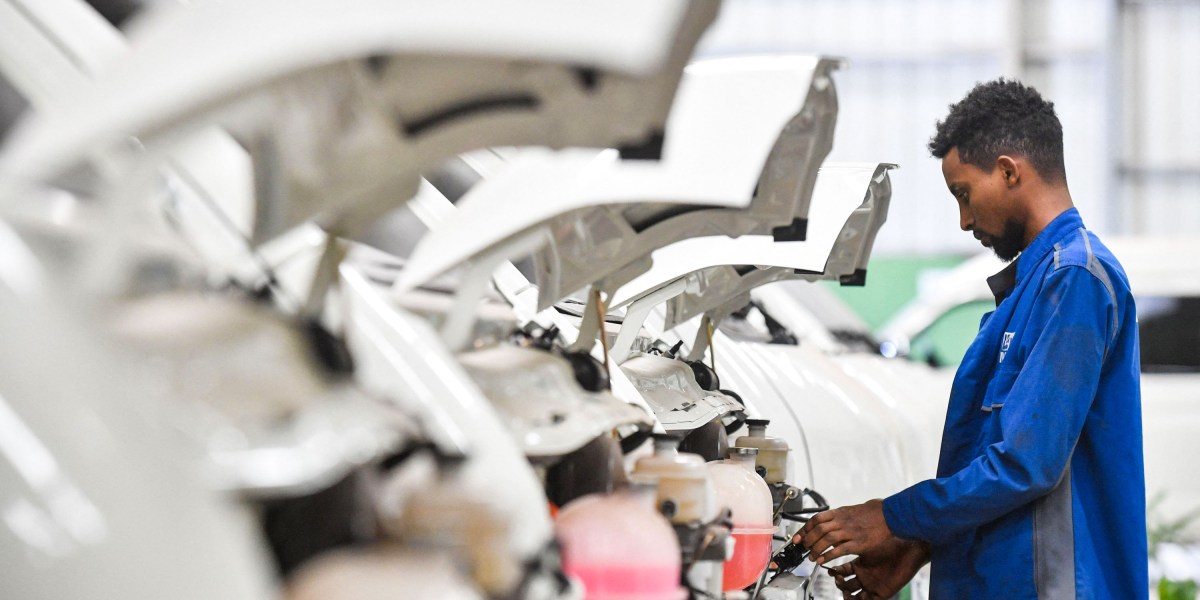
And Africa’s local market is starting to really take off. There’s already some local assembly of electric two-wheelers in countries including Morocco, Kenya, and Rwanda, says Nelson Nsitem, lead Africa energy transition analyst at BloombergNEF, an energy consultancy.
Spiro, a Dubai-based electric motorbike company, recently raised $100 million in funding to expand operations in Africa. The company currently assembles its bikes in Uganda, Kenya, Nigeria, and Rwanda, and as of October it has over 60,000 bikes deployed and 1,500 battery swap stations operating.
Assembly and manufacturing for larger EVs and batteries is also set to expand. Gotion High-Tech, a Chinese battery company, is currently building Africa’s first battery gigafactory. It’s a $5.6 billion project that could produce 20 gigawatt-hours of batteries annually, starting in 2026. (That’s enough for hundreds of thousands of EVs each year.)
Chinese EV companies are looking to growing markets like Southeast Asia and Africa as they attempt to expand beyond an oversaturated domestic scene. BYD, the world’s largest EV company, is aggressively expanding across South Africa and plans to have as many as 70 dealerships in the country by the end of this year. That will mean more options for people in Africa looking to buy electric.
“You have very high-quality, very affordable vehicles coming onto the market that are benefiting from the economies of scale in China. These countries stand to benefit from that,” says Kelly Carlin, a manager in the program on carbon-free transportation at the Rocky Mountain Institute, an energy think tank. “It’s a game changer,” he adds.
This article is from The Spark, MIT Technology Review’s weekly climate newsletter. To receive it in your inbox every Wednesday, sign up here.