Stay Ahead, Stay ONMINE

Utah’s 4 GW AI Campus Tests the Limits of Speed-to-Power

Back in September 2025, we examined an ambitious proposal from infrastructure developer Joule Capital Partners – often branding the effort as “Joule Power” – in partnership with Caterpillar. The concept is straightforward but consequential: acquire a vast rural tract in Millard County, Utah, and pair an AI-focused data center campus with large-scale, on-site “behind-the-meter” generation […]

Back in September 2025, we examined an ambitious proposal from infrastructure developer Joule Capital Partners – often branding the effort as “Joule Power” – in partnership with Caterpillar. The concept is straightforward but consequential: acquire a vast rural tract in Millard County, Utah, and pair an AI-focused data center campus with large-scale, on-site “behind-the-meter” generation to bypass the interconnection queues, transmission constraints, and substation bottlenecks slowing projects nationwide.

The appeal is clear: speed-to-power and greater control over delivery timelines. But that speed shifts the project’s risk profile. Instead of navigating traditional utility procurement, the development begins to resemble a distributed power plant subject to industrial permitting, fuel supply logistics, air emissions scrutiny, noise controls, and groundwater governance. These are issues communities typically associate with generation facilities, not hyperscale data centers.

Our earlier coverage focused on the technical and strategic logic of pairing compute with on-site generation. Now the story has evolved. Community opposition is emerging as a material variable that could influence schedule and scope. Although groundbreaking was held in November 2025, final site plans and key conditional use permits remain pending at the time of publication.

What Is Actually Being Proposed?

Public records from Millard County show Joule pursuing a zone change for approximately 4,000 acres (about 6.25 square miles), converting agricultural land near 11000 N McCornick Road to Heavy Industrial use. At a July 2025 public meeting, residents raised familiar concerns that surface when a rural landscape is targeted for hyperscale development: labor influx and housing strain, water use, traffic, dust and wildfire risk, wildlife disruption, and the broader loss of farmland and local character.

What has proven less clear is the precise scale and sequencing of the buildout.

Local reporting describes an initial phase of six data center buildings, each supported by a substantial fleet of Caterpillar natural-gas generators, with construction beginning “this spring.” Other accounts reference a significantly larger first phase, with entitlement discussions including as many as 32 buildings of roughly one million square feet each, even if only a portion would be constructed in the near term.

These descriptions are not necessarily contradictory. Developers often seek entitlements for a maximum buildout while actual construction proceeds in phased increments based on financing and customer commitments. But the distinction matters. Community impact (particularly around noise, emissions, traffic, and water) will be evaluated based on what is permitted and installed in the near term, not on long-range conceptual buildout plans.

What is clear is that the project’s critical path is not simply data center construction. It is prime power generation.

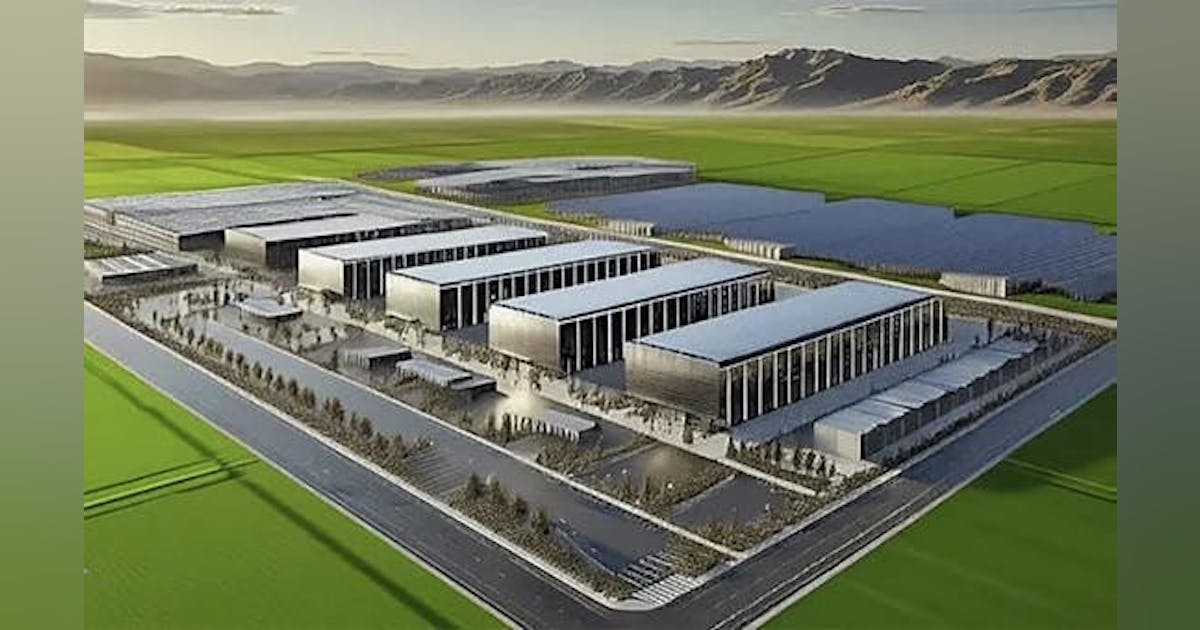
The Salt Lake Tribune reported that early plans pair each of six buildings with 69 Caterpillar natural-gas generators. At that scale, the site would require hundreds of engines, with community members describing projected sound levels as comparable to “more than 400 semi-trucks idling.” Joule and Caterpillar’s own materials position the campus as a 4-gigawatt development featuring combined cooling, heat and power (CCHP), liquid cooling by design, and a fleet of Caterpillar G3520K generator sets.

This is not a conventional hyperscale construction program. It is the development of a distributed generation campus: foundations for large engine arrays, exhaust and aftertreatment systems, high-voltage switchyards, synchronization controls, fire and life-safety systems, fuel interconnections, and a commissioning process that resembles a utility-scale plant more than a colocation facility.

That shift introduces additional long-lead and integration risks, including:

  • Generator manufacturing capacity and delivery sequencing.

  • Emissions-control configuration and regulatory compliance.

  • Synchronization and islanding controls.

  • Black-start capability and ride-through design.

  • Commissioning under load, particularly before full tenant occupancy.

In short, the engineering challenge extends well beyond compute density. It centers on whether a modular, engine-based generation strategy can be permitted, delivered, and synchronized at multi-gigawatt scale without triggering schedule friction from the very industrial systems that make the project possible.

Construction Logistics: When Rural Scale Meets Industrial Volume

County proceedings reflect immediate concern about the practical realities of building at this scale. Residents raised questions about labor influx, temporary housing, traffic, and the strain placed on a rural road network not designed for sustained heavy industrial movement.

On a 4,000-acre site, construction logistics become a program of their own. Hundreds of large generator units, transformers, switchgear lineups, cooling systems, and potentially battery containers must be delivered, staged, installed, and commissioned. That translates into prolonged heavy trucking, haul-route coordination, road upgrades, laydown yards, pre-assembly zones, and ongoing dust management across miles of internal access roads.

Rural land availability is often cited as an advantage in hyperscale siting. But the same locations frequently lack depth in supporting infrastructure, from workforce housing and emergency response capacity to medical services and road maintenance budgets. That imbalance surfaced directly in public meetings, where residents asked whether the community is equipped to absorb the scale and duration of construction activity being proposed.

Dust and fire risk were raised explicitly in the record. In arid regions, dust affects more than local quality of life; it can degrade construction productivity and equipment reliability, increasing filtration and maintenance requirements for cooling and electrical systems. Fire risk, meanwhile, introduces questions about defensible space, fire-water supply, response times, and whether local emergency services would require expansion to support an industrial campus of this magnitude.

For a traditional data center, these concerns are manageable extensions of site work. For a multi-gigawatt campus anchored by engine-based generation, they become material schedule and community-relations variables.

Emissions Strategy Shapes the Site Plan

County meeting minutes note that the buildings are intentionally spread across the property “due to the emissions and not dispersing them all in one area.” That single comment reveals a great deal about the permitting strategy behind the layout.

At multi-gigawatt scale, particularly with engine-based generation, site geometry becomes an emissions-management tool. Distributing buildings and associated generator blocks across thousands of acres may help manage:

  • Localized pollutant concentration modeling results.

  • Noise contours and setback compliance.

  • Stack and exhaust dispersion dynamics.

  • Regulatory thresholds that can shift when large numbers of emission sources are co-located.

In other words, the physical layout is not driven solely by operational efficiency or campus aesthetics. It may also be structured to navigate air-quality modeling and permitting categories.

There is a trade-off. Spreading structures across a large footprint increases civil and electrical complexity: longer internal roads, extended medium-voltage distribution runs, more trenching, additional switchgear segmentation, and greater redundancy requirements. That raises both capital cost and coordination demands.

But concentration carries its own risk. Clustering large generator arrays can intensify modeled emission “hot spots,” tighten setback constraints, and elevate the regulatory classification of the project.

In this case, the master plan appears to reflect a calculated balance between construction efficiency and emissions dispersion; a reminder that, at this scale, environmental modeling is influencing not just equipment selection, but the geography of the campus itself.

Water Rights vs. Water Reality

Joule’s public case for the project emphasizes water independence. The company has reportedly secured rights to more than 10,000 acre-feet of groundwater annually (over 3 billion gallons) and has stressed that the campus will not rely on a municipal system.

Project materials also point to a closed-loop, direct-to-chip cooling architecture designed to minimize evaporative losses. According to Trellis, engineers estimate the data center would use significantly less water than the alfalfa farming currently supported on the land — potentially as much as 75% less on an annual basis.

In arid regions, however, possessing legal rights does not automatically resolve public concern.

Opposition tends to focus less on annual totals and more on long-term basin health: aquifer drawdown over time, impacts on neighboring wells, drought-cycle variability, and the transparency of monitoring and reporting regimes. There is also a precedent question. If one multi-gigawatt industrial campus can rely on privately controlled groundwater at this scale, others may attempt to follow.

At the state level, scrutiny is increasing. Utah lawmakers have signaled interest in expanding water-use reporting requirements for data centers, reflecting broader concern about transparency and sustainability in water-constrained regions.

The core issue is not simply consumption. It is governance, verification, and public trust in how withdrawals will be measured and managed over decades of operation.

Air Permitting: The Project’s Central Flashpoint

The defining feature of the Utah campus — large-scale, on-site gas-fired generation — is also its most direct environmental vulnerability.

According to Trellis, air permit applications filed with Utah regulators indicate that the initial six-building phase could emit approximately 4,380 tons per year of regulated pollutants (excluding CO₂), including roughly 1,380 tons annually of nitrogen oxides (NOx). Trellis further reports that the projected NOx rate is materially higher than that of Utah’s gas-fueled Lake Side Power Plant, based on EPA data comparisons.

Those figures shift the conversation. This is no longer simply a data center debate; it is an air-quality and industrial-generation discussion.

The Salt Lake Tribune has highlighted a broader concern emerging statewide: when utility interconnection timelines stretch too long, some data center developers are choosing to build generation on-site, effectively relocating power plant emissions closer to new industrial campuses. For environmental advocates, that raises questions about cumulative air-quality impacts and regulatory precedent.

From a construction and delivery standpoint, the risk becomes schedule-driven. Air permitting — including dispersion modeling and determinations around Best Available Control Technology (BACT) or, if triggered, Lowest Achievable Emissions Rate (LAER) requirements — can materially influence equipment configuration. If regulators tighten emissions controls or modeling assumptions late in the process, engine specifications, aftertreatment systems, or operating limits may need to be revised after procurement decisions have been made.

At multi-gigawatt scale, those revisions are not minor adjustments. They can mean redesign, additional capital expenditure, extended lead times, and commissioning delays.

In effect, the project’s speed-to-power advantage hinges on successfully navigating a regulatory pathway more commonly associated with utility-scale generation than with hyperscale data halls.

Noise: Operational Reality, Not Rhetoric

Noise concerns surfaced directly in county proceedings, including discussion of projected decibel levels. The Salt Lake Tribune characterized the anticipated generator output as comparable to “hundreds of idling semi-trucks,” a description vivid enough to resonate well beyond technical modeling.

At the scale proposed, acoustic mitigation becomes a core design requirement, not a secondary engineering detail. Engine enclosures, exhaust mufflers, sound walls, berming, building orientation, and setback distances all influence both compliance and community acceptance.

Noise also carries enforcement implications. Even where permitted limits are met on paper, persistent complaints can lead to additional monitoring, operational restrictions, or pressure to retrofit mitigation measures. For a campus built around continuous engine-based generation, acoustic performance becomes an operational variable with both regulatory and reputational consequences.

From Farmland to Industrial Power Campus

Beyond engineering metrics lies a broader land-use shift. Residents have voiced concern about the conversion of agricultural land, described by Trellis as a family alfalfa operation, into a multi-gigawatt industrial complex.

Even if the data center ultimately consumes less water than the existing agricultural activity, the transformation is not simply volumetric. It represents a permanent change in landscape function: new road networks, fencing, lighting, substations, and generation yards replacing open farmland.

That transition introduces habitat fragmentation, construction disturbance, and long-term industrialization of a rural corridor. For some in the community, the question is not only environmental impact but identity, i.e. whether the region is prepared to redefine itself from agricultural base to energy-intensive digital infrastructure hub.

Power at Utility Scale

Caterpillar’s announcement frames the project as a 4-gigawatt campus incorporating 1.1 GWh of grid-forming battery energy storage, combined cooling, heat and power (CCHP), and what it describes as “diverse fuel sources.” Our earlier coverage reflected those figures. Subsequent reporting from Trellis suggests the broader site could ultimately scale toward 12 gigawatts, depending on entitlement and demand.

Even at the lower bound, 4 GW is not simply a large substation. It is utility-scale generation.

If a meaningful portion of that capacity is installed in early phases, fuel logistics, emissions permitting, and operational oversight become regional planning issues rather than purely site-level considerations.

The design direction outlined publicly includes:

  • Large fleets of Caterpillar natural-gas generator sets.

  • A planned pipeline interconnection (with county minutes referencing the Kern River system and Trellis citing nearby gas infrastructure).

  • Battery storage positioned for load smoothing, firming, and grid-forming capability, with the system described as “permitted to accept cleaner electricity” in the future, including potential fuel cells, geothermal, or small modular reactors.

This approach reflects a broader pattern emerging in AI-oriented campus development: deploy modular gas generation and storage to secure immediate power availability, then pursue incremental decarbonization as alternative supply chains mature.

Trellis cites Utah Clean Energy describing the engine-based approach as less efficient than combined-cycle turbine plants, and therefore potentially more emissions-intensive, while acknowledging that reciprocating engines are deployable today.

That is the central trade-off.

Modular engines and battery systems offer speed, sequencing flexibility, and independence from grid interconnection timelines.

But they also anchor the project in an industrial permitting regime defined by air quality, fuel supply, noise, and long-term emissions intensity; considerations that diverge from the renewables-backed narrative often associated with hyperscale data center expansion.

What Must Be Resolved

For community support to solidify, several questions need clear, enforceable answers.

First, what precisely constitutes Phase I? Whether the near-term build is limited to six buildings or represents the leading edge of a much larger sequence materially changes projected impacts on traffic, emissions, water, and noise. Entitlement scale and construction scale must align transparently.

Second, what are the binding air-permit limits and monitoring protocols? The reported tonnage and NOx comparisons suggest the air program will sit at the center of regulatory scrutiny. Modeling assumptions, control technologies, and compliance verification will define both schedule and public confidence.

Third, what noise mitigation commitments are contractually embedded in the design, and how will compliance be validated over time? Acoustic performance is not theoretical at this scale; it is measurable and enforceable.

Fourth, how will groundwater withdrawals be metered, reported, and made publicly auditable? Legal rights alone do not guarantee community trust in a drought-sensitive basin.

Finally, who absorbs the cost of ancillary impacts, i.e. road upgrades, emergency-response expansion, workforce housing strain? County proceedings suggest these concerns are already embedded in local discourse.

A Test Case for the AI Power Model

In many respects, Joule’s 4,000-acre Utah campus represents more than a single development proposal. It is a case study in the next phase of AI-era infrastructure strategy.

When grid interconnection timelines stretch beyond acceptable delivery windows, developers are increasingly bringing the power plant to the servers.

That shift changes the development equation. The core question is no longer simply whether a data center can be constructed on time and on budget. It becomes whether a utility-scale distributed generation system can be entitled, financed, built, and operated without sustained opposition over air emissions, noise, water use, and land conversion.

Scale does not eliminate local scrutiny. Even in rural settings, multi-gigawatt projects introduce industrial impacts that communities recognize and evaluate accordingly. In that sense, the Utah proposal may foreshadow a broader industry reality: as AI campuses grow to industrial dimensions, they inherit industrial politics.


Shape
Shape
Stay Ahead

Explore More Insights

Stay ahead with more perspectives on cutting-edge power, infrastructure, energy,  bitcoin and AI solutions. Explore these articles to uncover strategies and insights shaping the future of industries.

Shape

Western Digital wants to ramp-up hard disk drive speeds

Most enterprises are not using SATA drives, at least not with hot data. Perhaps cold storage but not frequently accessed data. They are using PCI Express based drives and those are considerably faster than anything Western Digital can engineer in a hard disk. Capacity aside, Western Digital is also aiming

Read More »

LoRaWAN reaches 125 million devices as industrial IoT expands

Satellite integration is set to grow Terrestrial LoRaWAN networks cannot achieve complete geographic coverage. Yegin cited Swisscom’s nationwide Switzerland deployment, which covers 97.2% of the population but cannot reach remote alpine terrain. Two LoRa Alliance members, Lacuna Space and Plan-S, already operate commercial LoRaWAN services from low Earth orbit. Standard

Read More »

Data stored in glass could last over 10,000 years, Microsoft says

Magnetic tape, the most widely deployed archival medium today, reflects those constraints. An LTO-10 (Linear Tape-Open) cartridge, the current enterprise benchmark, holds 30TB to 40TB native at 400MB/s, but its rated shelf life is just 30 years. It requires climate-controlled storage between 16°C and 25°C and migration roughly every five

Read More »

Insights: Venezuela – new legal frameworks vs. the inertia of history

@import url(‘https://fonts.googleapis.com/css2?family=Inter:[email protected]&display=swap’); a { color: var(–color-primary-main); } .ebm-page__main h1, .ebm-page__main h2, .ebm-page__main h3, .ebm-page__main h4, .ebm-page__main h5, .ebm-page__main h6 { font-family: Inter; } body { line-height: 150%; letter-spacing: 0.025em; font-family: Inter; } button, .ebm-button-wrapper { font-family: Inter; } .label-style { text-transform: uppercase; color: var(–color-grey); font-weight: 600; font-size: 0.75rem; } .caption-style { font-size: 0.75rem; opacity: .6; } #onetrust-pc-sdk [id*=btn-handler], #onetrust-pc-sdk [class*=btn-handler] { background-color: #c19a06 !important; border-color: #c19a06 !important; } #onetrust-policy a, #onetrust-pc-sdk a, #ot-pc-content a { color: #c19a06 !important; } #onetrust-consent-sdk #onetrust-pc-sdk .ot-active-menu { border-color: #c19a06 !important; } #onetrust-consent-sdk #onetrust-accept-btn-handler, #onetrust-banner-sdk #onetrust-reject-all-handler, #onetrust-consent-sdk #onetrust-pc-btn-handler.cookie-setting-link { background-color: #c19a06 !important; border-color: #c19a06 !important; } #onetrust-consent-sdk .onetrust-pc-btn-handler { color: #c19a06 !important; border-color: #c19a06 !important; } In this Insights episode of the Oil & Gas Journal ReEnterprised podcast, Head of Content Chris Smith updates the evolving situation in Venezuela as the industry attempts to navigate the best path forward while the two governments continue to hammer out the details. The discussion centers on the new legal frameworks being established in both countries within the context of fraught relations stretching back for decades. Want to hear more? Listen in on a January episode highlighting industry’s initial take following the removal of Nicholas Maduro from power. References Politico podcast Monaldi Substack Baker webinar Washington, Caracas open Venezuela to allow more oil sales 

Read More »

Eni makes Calao South discovery offshore Ivory Coast

@import url(‘https://fonts.googleapis.com/css2?family=Inter:[email protected]&display=swap’); a { color: var(–color-primary-main); } .ebm-page__main h1, .ebm-page__main h2, .ebm-page__main h3, .ebm-page__main h4, .ebm-page__main h5, .ebm-page__main h6 { font-family: Inter; } body { line-height: 150%; letter-spacing: 0.025em; font-family: Inter; } button, .ebm-button-wrapper { font-family: Inter; } .label-style { text-transform: uppercase; color: var(–color-grey); font-weight: 600; font-size: 0.75rem; } .caption-style { font-size: 0.75rem; opacity: .6; } #onetrust-pc-sdk [id*=btn-handler], #onetrust-pc-sdk [class*=btn-handler] { background-color: #c19a06 !important; border-color: #c19a06 !important; } #onetrust-policy a, #onetrust-pc-sdk a, #ot-pc-content a { color: #c19a06 !important; } #onetrust-consent-sdk #onetrust-pc-sdk .ot-active-menu { border-color: #c19a06 !important; } #onetrust-consent-sdk #onetrust-accept-btn-handler, #onetrust-banner-sdk #onetrust-reject-all-handler, #onetrust-consent-sdk #onetrust-pc-btn-handler.cookie-setting-link { background-color: #c19a06 !important; border-color: #c19a06 !important; } #onetrust-consent-sdk .onetrust-pc-btn-handler { color: #c19a06 !important; border-color: #c19a06 !important; } Eni SPA discovered gas and condensate in the Murene South-1X exploration well in Block CI-501, Ivory Coast. The well is the first exploration in the block and was drilled by the Saipem Santorini drilling ship about 8 km southwest of the Murene-1X discovery well in adjacent CI-205 block. The well was drilled to about 5,000 m TD in 2,200 m of water. Extensive data acquisition confirmed a main hydrocarbon bearing interval in high-quality Cenomanian sands with a gross thickness of about 50 m with excellent petrophysical properties, the operator said. Murene South-1X will undergo a full conventional drill stem test (DST) to assess the production capacity of this discovery, named Calao South. Calao South confirms the potential of the Calao channel complex that also includes the Calao discovery. It is the second largest discovery in the country after Baleine, with estimated volumes of up to 5.0 tcf of gas and 450 million bbl of condensate (about 1.4 billion bbl of oil). Eni is operator of Block CI-501 (90%) with partner Petroci Holding (10%).

Read More »

CFEnergía to supply natural gas to low-carbon methanol plant in Mexico

CFEnergía, a subsidiary of Mexico’s Federal Electricity Commission (CFE), has agreed to supply natural gas to Transition Industries LLC for its Pacifico Mexinol project near Topolobampo, Sinaloa, Mexico. Under the signed agreement, which enables the start of Pacifico Mexinol’s construction phase, CFEnergía will supply about 160 MMcfd of natural gas for an unspecified timeframe noted as “long term,” Transition Industries said in a release Feb. 16. The natural gas—to be sourced from the US and supplied at market prices via existing infrastructure—will be used as “critical input for Mexinol’s production of ultra-low carbon methanol,” the company said. Pacifico Mexinol The $3.3-billion Mexinol project, when it begins operations in late 2029 to early 2030, is expected to be the world’s largest ultra-low carbon chemicals plant with production of about 1.8 million tonnes of blue methanol and 350,000 tonnes of green methanol annually. Supply is aimed at markets in Asia, including Japan, while also boosting the development of the domestic market and the Mexican chemical industry. Mitsubishi Gas Chemical has committed to purchasing about 1 million tonnes/year of methanol from the project, about 50% of the project’s planned production. Transition Industries is jointly developing Pacifico Mexinol with the International Finance Corporation (IFC), a member of the World Bank Group. Last year, the company signed a contingent engineering, procurement, and construction (EPC) contract with the consortium of Samsung E&A Co., Ltd., Grupo Samsung E&A Mexico SA de CV, and Techint Engineering and Construction for the project. MAIRE group’s technology division NextChem, through its subsidiary KT TECH SpA, also signed a basic engineering, critical and proprietary equipment supply agreement with Samsung E&A in connection with its proprietary NX AdWinMethanol®Zero technology supply to the project.

Read More »

North Atlantic’s Gravenchon refinery scheduled for major turnaround

Canada-based North Atlantic Refining Ltd. France-based subsidiary North Atlantic France SAS is undertaking planned maintenance in March at its North Atlantic Energies-operated 230,000-b/d Notre-Dame-de-Gravenchon refinery in Port-Jérôme-sur-Seine, Normandy. Scheduled to begin on Mar. 3 with the phased shutdown of unidentified units at the refinery, the upcoming turnaround will involve thorough inspections of associated equipment designed for continuous operation, as well as unspecified works to improve energy efficiency, environmental performance, and overall competitiveness of the site, North Atlantic Energies said on Feb. 16. Part of the operator’s routine maintenance program aimed at meeting regulatory requirements to ensure the safety, compliance, and long-term performance of the refinery, North Atlantic Energies said the scheduled turnaround will not interrupt product supplies to customers during the shutdown period. While the company confirmed the phased shutdown of units slated for work during the maintenance event would last for several days, the operator did not reveal a definitive timeline for the entire duration of the turnaround. Further details regarding specific works to be carried out during the major maintenance event were not revealed. The upcoming turnaround will be the first to be executed under North Atlantic Group’s ownership, which completed its purchase of the formerly majority-owned ExxonMobil Corp. refinery and associated petrochemical assets at the site in November 2025.

Read More »

Azule Energy starts Ndungu full field production offshore Angola

Azule Energy has started full field production from Ndungu, part of the Agogo Integrated West Hub Project (IWH) in the western area of Block 15/06, offshore Angola. Ndungo full field lies about 10 km from the NGOMA FPSO in a water depth of around 1,100 m and comprises seven production wells and four injection wells, with an expected production peak of 60,000 b/d of oil. The National Agency for Petroleum, Gas and Biofuels (ANPG) and Azule Energy noted the full field start-up with first oil of three production wells. The phased integration of IWH, with Ndungu full field producing first via N’goma FPSO and later via Agogo FPSO, is expected to reach a peak output of about 175,000 b/d across the two fields. The fields have combined estimated reserves of about 450 million bbl. The Agogo IWH project is operated by Azule Energy with a 36.84% stake alongside partners Sonangol E&P (36.84%) and Sinopec International (26.32%).   

Read More »

Ovintiv to divest Anadarko assets for $3 billion

In a release Feb. 17, Brendan McCracken, Ovintiv president and chief executive officer, said the company has “built one of the deepest premium inventory positions in our industry in the two most valuable plays in North America, the Permian and the Montney,” and that the Anadarko assets sale “positions [Ovintiv] to deliver superior returns for our shareholders for many years to come.” Ovintiv in 2025 had noted plans to sell the asset to help offset the cost of its acquisition of NuVista Energy Ltd. That $2.7-billion cash and stock deal, which closed earlier this month, added about 930 net 10,000-ft equivalent well locations and about 140,000 net acres (70% undeveloped) in the core of the oil-rich Alberta Montney.  Proceeds from the Anadarko assets sale are earmarked for accelerated debt reduction, the company said.  Ovintiv’s sale of its Anadarko assets is expected to close early in this year’s second quarter, subject to customary conditions, with an effective date of Jan. 1, 2026.

Read More »

Vertiv’s AI Infrastructure Surge: Record Orders, Liquid Cooling Expansion, and Grid-Scale Power Reflect Data Center Growth

2) “Units of compute”: OneCore and SmartRun On the earnings call, Albertazzi highlighted Vertiv OneCore, an end-to-end data center solution designed to accelerate “time to token,” scaling in 12.5 MW building blocks; and Vertiv SmartRun, a prefabricated white space infrastructure solution aimed at rapidly accelerating fit-out and readiness. He pointed to collaborations (including Hut 8 and Compass Data Centers) as proof points of adoption, emphasizing that SmartRun can stand alone or plug into OneCore. 3) Cooling evolution: hybrid thermal chains and the “trim cooler” Asked how cooling architectures may change (amid industry chatter about warmer-temperature operations and shifting mixes of chillers, CDUs, and other components) Albertazzi leaned into complexity as a feature, not a bug. He argued heat rejection doesn’t disappear, even if some GPU loads can run at higher temperatures. Instead, the future looks hybrid, with mixed loads and resiliency requirements forcing more nuanced thermal chains. Vertiv’s strategic product anchor here is its “trim cooler” concept: a chiller optimized for higher-temperature operation while retaining flexibility for lower-temperature requirements in the same facility, maximizing free cooling where climate and design allow. And importantly, Albertazzi dismissed the idea that CDUs are going away: “We are pretty sure that CDUs in various shapes and forms are a long-term element of the thermal chain.” 4) Edge densification: CoolPhase Ceiling + CoolPhase Row (Feb. 3) Vertiv also expanded its thermal portfolio for edge and small IT environments with the: Vertiv CoolPhase Ceiling (launching Q2 2026): ceiling-mounted, 3.5 kW to 28 kW, designed to preserve floor space. Vertiv CoolPhase Row (available now in North America) for row-based cooling up to 30 kW (300 mm width) or 40 kW (600 mm width). Vertiv Director of Edge Thermal Michal Podmaka tied the products directly to AI-driven edge densification and management consistency, saying the new systems “integrate seamlessly

Read More »

Execution, Power, and Public Trust: Rich Miller on 2026’s Data Center Reality and Why He Built Data Center Richness

DCF founder Rich Miller has spent much of his career explaining how the data center industry works. Now, with his latest venture, Data Center Richness, he’s also examining how the industry learns. That thread provided the opening for the latest episode of The DCF Show Podcast, where Miller joined present Data Center Frontier Editor in Chief Matt Vincent and Senior Editor David Chernicoff for a wide-ranging discussion that ultimately landed on a simple conclusion: after two years of unprecedented AI-driven announcements, 2026 will be the year reality asserts itself. Projects will either get built, or they won’t. Power will either materialize, or it won’t. Communities will either accept data center expansion – or they’ll stop it. In other words, the industry is entering its execution phase. Why Data Center Richness Matters Now Miller launched Data Center Richness as both a podcast and a Substack publication, an effort to experiment with formats and better understand how professionals now consume industry information. Podcasts have become a primary way many practitioners follow the business, while YouTube’s discovery advantages increasingly make video versions essential. At the same time, Miller remains committed to written analysis, using Substack as a venue for deeper dives and format experimentation. One example is his weekly newsletter distilling key industry developments into just a handful of essential links rather than overwhelming readers with volume. The approach reflects a broader recognition: the pace of change has accelerated so much that clarity matters more than quantity. The topic of how people learn about data centers isn’t separate from the industry’s trajectory; it’s becoming part of it. Public perception, regulatory scrutiny, and investor expectations are now shaped by how stories are told as much as by how facilities are built. That context sets the stage for the conversation’s core theme. Execution Defines 2026 After

Read More »

Utah’s 4 GW AI Campus Tests the Limits of Speed-to-Power

Back in September 2025, we examined an ambitious proposal from infrastructure developer Joule Capital Partners – often branding the effort as “Joule Power” – in partnership with Caterpillar. The concept is straightforward but consequential: acquire a vast rural tract in Millard County, Utah, and pair an AI-focused data center campus with large-scale, on-site “behind-the-meter” generation to bypass the interconnection queues, transmission constraints, and substation bottlenecks slowing projects nationwide. The appeal is clear: speed-to-power and greater control over delivery timelines. But that speed shifts the project’s risk profile. Instead of navigating traditional utility procurement, the development begins to resemble a distributed power plant subject to industrial permitting, fuel supply logistics, air emissions scrutiny, noise controls, and groundwater governance. These are issues communities typically associate with generation facilities, not hyperscale data centers. Our earlier coverage focused on the technical and strategic logic of pairing compute with on-site generation. Now the story has evolved. Community opposition is emerging as a material variable that could influence schedule and scope. Although groundbreaking was held in November 2025, final site plans and key conditional use permits remain pending at the time of publication. What Is Actually Being Proposed? Public records from Millard County show Joule pursuing a zone change for approximately 4,000 acres (about 6.25 square miles), converting agricultural land near 11000 N McCornick Road to Heavy Industrial use. At a July 2025 public meeting, residents raised familiar concerns that surface when a rural landscape is targeted for hyperscale development: labor influx and housing strain, water use, traffic, dust and wildfire risk, wildlife disruption, and the broader loss of farmland and local character. What has proven less clear is the precise scale and sequencing of the buildout. Local reporting describes an initial phase of six data center buildings, each supported by a substantial fleet of Caterpillar

Read More »

From Lab to Gigawatt: CoreWeave’s ARENA and the AI Validation Imperative

The Production Readiness Gap AI teams continue to confront a familiar challenge: moving from experimentation to predictable production performance. Models that train successfully on small clusters or sandbox environments often behave very differently when deployed at scale. Performance characteristics shift. Data pipelines strain under sustained load. Cost assumptions unravel. Synthetic benchmarks and reduced test sets rarely capture the complex interactions between compute, storage, networking, and orchestration that define real-world AI systems. The result can be an expensive “Day One” surprise:  unexpected infrastructure costs, bottlenecks across distributed components, and delays that ripple across product timelines. CoreWeave’s view is that benchmarking and production launch can no longer be treated as separate phases. Instead, validation must occur in environments that replicate the architectural, operational, and economic realities of live deployment. ARENA is designed around that premise. The platform allows customers to run full workloads on CoreWeave’s production-grade GPU infrastructure, using standardized compute stacks, network configurations, data paths, and service integrations that mirror actual deployment environments. Rather than approximating production behavior, the goal is to observe it directly. Key capabilities include: Running real workloads on GPU clusters that match production configurations. Benchmarking both performance and cost under realistic operational conditions. Diagnosing bottlenecks and scaling behavior across compute, storage, and networking layers. Leveraging standardized observability tools and guided engineering support. CoreWeave positions ARENA as an alternative to traditional demo or sandbox environments; one informed by its own experience operating large-scale AI infrastructure. By validating workloads under production conditions early in the lifecycle, teams gain empirical insight into performance dynamics and cost curves before committing capital and operational resources. Why Production-Scale Validation Has Become Strategic The demand for environments like ARENA reflects how fundamentally AI workloads have changed. Several structural shifts are driving the need for production-scale validation: Continuous, Multi-Layered Workloads AI systems are no longer

Read More »

GenAI Pushes Cloud to $119B Quarter as AI Networking Race Intensifies

Cisco Targets the AI Fabric Bottleneck Cisco introduced its Silicon One G300, a new switching ASIC delivering 102.4 Tbps of throughput and designed specifically for large-scale AI cluster deployments. The chip will power next-generation Cisco Nexus 9000 and 8000 systems aimed at hyperscalers, neocloud providers, sovereign cloud operators, and enterprises building AI infrastructure. The company is positioning the platform around a simple premise: at AI-factory scale, the network becomes part of the compute plane. According to Cisco, the G300 architecture enables: 33% higher network utilization 28% reduction in AI job completion time Support for emerging 1.6T Ethernet environments Integrated telemetry and path-based load balancing Martin Lund, EVP of Cisco’s Common Hardware Group, emphasized the growing centrality of data movement. “As AI training and inference continues to scale, data movement is the key to efficient AI compute; the network becomes part of the compute itself,” Lund said. The new systems also reflect another emerging trend in AI infrastructure: the spread of liquid cooling beyond servers and into the networking layer. Cisco says its fully liquid-cooled switch designs can deliver nearly 70% energy efficiency improvement compared with prior approaches, while new 800G linear pluggable optics aim to reduce optical power consumption by up to 50%. Ethernet’s Next Big Test Industry analysts increasingly view AI networking as one of the most consequential battlegrounds in the current infrastructure cycle. Alan Weckel, founder of 650 Group, noted that backend AI networks are rapidly moving toward 1.6T architectures, a shift that could push the Ethernet data center switch market above $100 billion annually. SemiAnalysis founder Dylan Patel was even more direct in framing the stakes. “Networking has been the fundamental constraint to scaling AI,” Patel said. “At this scale, networking directly determines how much AI compute can actually be utilized.” That reality is driving intense innovation

Read More »

Meta scoops up more of Nvidia’s AI chip output

“No one deploys AI at Meta’s scale,” Nvidia CEO Jensen Huang said in a news release. Meta plans capital expenditure, mostly on data centers and the computing infrastructure they contain, of $115 billion-$135 billion this year — more than some hyperscalers, which rent their computing capacity to others. Meta is keeping it all for itself. This could be bad news for other enterprises, as the demands of the hyperscalers and big customers like Meta is leading to a decrease in the availability of chips to train and run AI models. IDC is predicting that the broader AI-driven chip shortage will have a significant effect on the IT market over the next two years as companies struggle to replace everything from laptops to servers. In particular, businesses looking for Nvidia processors may be forced to look elsewhere.

Read More »

Microsoft will invest $80B in AI data centers in fiscal 2025

And Microsoft isn’t the only one that is ramping up its investments into AI-enabled data centers. Rival cloud service providers are all investing in either upgrading or opening new data centers to capture a larger chunk of business from developers and users of large language models (LLMs).  In a report published in October 2024, Bloomberg Intelligence estimated that demand for generative AI would push Microsoft, AWS, Google, Oracle, Meta, and Apple would between them devote $200 billion to capex in 2025, up from $110 billion in 2023. Microsoft is one of the biggest spenders, followed closely by Google and AWS, Bloomberg Intelligence said. Its estimate of Microsoft’s capital spending on AI, at $62.4 billion for calendar 2025, is lower than Smith’s claim that the company will invest $80 billion in the fiscal year to June 30, 2025. Both figures, though, are way higher than Microsoft’s 2020 capital expenditure of “just” $17.6 billion. The majority of the increased spending is tied to cloud services and the expansion of AI infrastructure needed to provide compute capacity for OpenAI workloads. Separately, last October Amazon CEO Andy Jassy said his company planned total capex spend of $75 billion in 2024 and even more in 2025, with much of it going to AWS, its cloud computing division.

Read More »

John Deere unveils more autonomous farm machines to address skill labor shortage

Join our daily and weekly newsletters for the latest updates and exclusive content on industry-leading AI coverage. Learn More Self-driving tractors might be the path to self-driving cars. John Deere has revealed a new line of autonomous machines and tech across agriculture, construction and commercial landscaping. The Moline, Illinois-based John Deere has been in business for 187 years, yet it’s been a regular as a non-tech company showing off technology at the big tech trade show in Las Vegas and is back at CES 2025 with more autonomous tractors and other vehicles. This is not something we usually cover, but John Deere has a lot of data that is interesting in the big picture of tech. The message from the company is that there aren’t enough skilled farm laborers to do the work that its customers need. It’s been a challenge for most of the last two decades, said Jahmy Hindman, CTO at John Deere, in a briefing. Much of the tech will come this fall and after that. He noted that the average farmer in the U.S. is over 58 and works 12 to 18 hours a day to grow food for us. And he said the American Farm Bureau Federation estimates there are roughly 2.4 million farm jobs that need to be filled annually; and the agricultural work force continues to shrink. (This is my hint to the anti-immigration crowd). John Deere’s autonomous 9RX Tractor. Farmers can oversee it using an app. While each of these industries experiences their own set of challenges, a commonality across all is skilled labor availability. In construction, about 80% percent of contractors struggle to find skilled labor. And in commercial landscaping, 86% of landscaping business owners can’t find labor to fill open positions, he said. “They have to figure out how to do

Read More »

2025 playbook for enterprise AI success, from agents to evals

Join our daily and weekly newsletters for the latest updates and exclusive content on industry-leading AI coverage. Learn More 2025 is poised to be a pivotal year for enterprise AI. The past year has seen rapid innovation, and this year will see the same. This has made it more critical than ever to revisit your AI strategy to stay competitive and create value for your customers. From scaling AI agents to optimizing costs, here are the five critical areas enterprises should prioritize for their AI strategy this year. 1. Agents: the next generation of automation AI agents are no longer theoretical. In 2025, they’re indispensable tools for enterprises looking to streamline operations and enhance customer interactions. Unlike traditional software, agents powered by large language models (LLMs) can make nuanced decisions, navigate complex multi-step tasks, and integrate seamlessly with tools and APIs. At the start of 2024, agents were not ready for prime time, making frustrating mistakes like hallucinating URLs. They started getting better as frontier large language models themselves improved. “Let me put it this way,” said Sam Witteveen, cofounder of Red Dragon, a company that develops agents for companies, and that recently reviewed the 48 agents it built last year. “Interestingly, the ones that we built at the start of the year, a lot of those worked way better at the end of the year just because the models got better.” Witteveen shared this in the video podcast we filmed to discuss these five big trends in detail. Models are getting better and hallucinating less, and they’re also being trained to do agentic tasks. Another feature that the model providers are researching is a way to use the LLM as a judge, and as models get cheaper (something we’ll cover below), companies can use three or more models to

Read More »

OpenAI’s red teaming innovations define new essentials for security leaders in the AI era

Join our daily and weekly newsletters for the latest updates and exclusive content on industry-leading AI coverage. Learn More OpenAI has taken a more aggressive approach to red teaming than its AI competitors, demonstrating its security teams’ advanced capabilities in two areas: multi-step reinforcement and external red teaming. OpenAI recently released two papers that set a new competitive standard for improving the quality, reliability and safety of AI models in these two techniques and more. The first paper, “OpenAI’s Approach to External Red Teaming for AI Models and Systems,” reports that specialized teams outside the company have proven effective in uncovering vulnerabilities that might otherwise have made it into a released model because in-house testing techniques may have missed them. In the second paper, “Diverse and Effective Red Teaming with Auto-Generated Rewards and Multi-Step Reinforcement Learning,” OpenAI introduces an automated framework that relies on iterative reinforcement learning to generate a broad spectrum of novel, wide-ranging attacks. Going all-in on red teaming pays practical, competitive dividends It’s encouraging to see competitive intensity in red teaming growing among AI companies. When Anthropic released its AI red team guidelines in June of last year, it joined AI providers including Google, Microsoft, Nvidia, OpenAI, and even the U.S.’s National Institute of Standards and Technology (NIST), which all had released red teaming frameworks. Investing heavily in red teaming yields tangible benefits for security leaders in any organization. OpenAI’s paper on external red teaming provides a detailed analysis of how the company strives to create specialized external teams that include cybersecurity and subject matter experts. The goal is to see if knowledgeable external teams can defeat models’ security perimeters and find gaps in their security, biases and controls that prompt-based testing couldn’t find. What makes OpenAI’s recent papers noteworthy is how well they define using human-in-the-middle

Read More »

Community service

The bird is a beautiful silver-gray, and as she dies twitching in the lasernet I’m grateful for two things: First, that she didn’t make a

Read More »