Stay Ahead, Stay ONMINE

The Download: murderous ‘mirror’ bacteria, and Chinese workers fighting AI doubles

This is today’s edition of The Download, our weekday newsletter that provides a daily dose of what’s going on in the world of technology. No one’s sure if synthetic mirror life will kill us all In February 2019, a group of scientists proposed a high-risk, cutting-edge, irresistibly exciting idea that the National Science Foundation should fund: making “mirror” bacteria. These lab-created microbes would be organized like ordinary bacteria, but their proteins and sugars would be mirror images of those found in nature. Researchers believed they could reveal new insights into building cells, designing drugs, and even the origins of life. But now, many of them have reversed course. They’ve become convinced that mirror organisms could trigger a catastrophic event threatening every form of life on Earth. Find out why they’re ringing alarm bells. —Stephen Ornes This story is from the next issue of our print magazine, which is all about nature. Subscribe now to read it when it lands this Wednesday. Chinese tech workers are starting to train their AI doubles—and pushing back Earlier this month, a GitHub project called Colleague Skill struck a nerve by claiming to “distill” a worker’s skills and personality—and replicate them with an AI agent. Though the project was a spoof, it prompted a wave of soul-searching among otherwise enthusiastic early adopters. A number of tech workers told MIT Technology Review that their bosses are already encouraging them to document their workflows for automation via tools like OpenClaw. Many now fear that they are being flattened into code and losing their professional identity. In response, some are fighting back with tools designed to sabotage the automation process. Read the full story. —Caiwei Chen The must-reads I’ve combed the internet to find you today’s most fun/important/scary/fascinating stories about technology. 1 The White House and Anthropic are working toward a compromiseThe Trump administration says they had a “productive meeting.” (Reuters $)+ Trump had ordered US agencies to phase out Anthropic’s tech. (Guardian)+ Despite the blacklist, the NSA is using Anthropic’s new Mythos model. (Axios) 2 Palantir has unveiled a manifesto calling for universal national serviceWhile denouncing inclusivity and “regressive” cultures. (TechCrunch)+ It’s a summary of CEO Alex Karp’s book “The Technological Republic.” (Engadget)+ One critic called the book “a piece of corporate sales material.“ (Bloomberg $) 3 Germany’s chancellor and largest company want looser AI rules Chancellor Merz said industrial AI needs ‌more regulatory freedom. (Reuters $)+ Siemens says it plans to shift investments to the US if EU rules don’t change. (Bloomberg $)+ Fractures over AI regulation are also emerging in the US. (MIT Technology Review)   4 Nvidia’s once-tight bond with gamers is cracking over AI  Consumer graphics cards are no longer the priority. (CNBC)+ But generative AI could reinvent what it means to play. (MIT Technology Review) 5 Insurers are trying to exclude AI-related harms from their coverageAnd escape legal liability for AI’s mistakes. (FT $)+ AI images are being used in insurance scams. (BBC) 6 AI is about to make the global e-waste crisis much worseAnd most of the trash will end up in non-Western countries. (Rest of World)+ Here’s what we can do about it. (MIT Technology Review) 7 Tinder and Zoom have partnered with Sam Altman’s eye-scanning firmTo offer a “proof of humanity” badge to users. (BBC) 8 Islamist insurgents in West Africa are driving surging demand for dronesA Nigerian UAV startup is opening its first factory abroad in Ghana. (Bloomberg $) 9 Hundreds of fake pro-Trump AI influencers are flooding social mediaIn an apparent bid to hook conservative voters. (NYT) 10 A Chinese humanoid has smashed the human half-marathon recordDespite crashing into a railing near the end of the race. (NBC News)+ Chinese tech firm Honor swept the podium spots. (Engadget)+ Last year, humans won the race by a mile. (CNN) Quote of the day “This is the only issue where you’ve got Steve Bannon and Ralph Nader, Glenn Beck and Bernie Sanders fighting for the same thing.” —Ben Cumming, head of communications at the AI safety nonprofit Future of Life Institute, tells the Washington Post that diverse public figures are endorsing a declaration of AI policy priorities. One More Thing The great commercial takeover of low Earth orbit The International Space Station will be decommissioned as soon as 2030, but the story of America in low Earth orbit (LEO) will continue.  Using lessons from the ISS, NASA has partnered with private companies to develop new commercial space stations for research, manufacturing, and tourism. If they are successful, these businesses will bring about a new era of space exploration: private rockets flying to private destinations. They will also demonstrate a new model in which NASA builds infrastructure and the private sector takes it from there—freeing the agency to explore deeper and deeper into space. Read the full story. —David W. Brown We can still have nice things A place for comfort, fun and distraction to brighten up your day. (Got any ideas? Drop me a line.) + Bask in thisadorable test of a dog’s devotion.+ This vocal pitch trainer improves your singing straight from your browser.+ Master international etiquette with this interactive guide to the world’s cultures.+ Explore the networks of public figures with this intriguing interactive graph. 


This is today’s edition of The Download, our weekday newsletter that provides a daily dose of what’s going on in the world of technology.

No one’s sure if synthetic mirror life will kill us all

In February 2019, a group of scientists proposed a high-risk, cutting-edge, irresistibly exciting idea that the National Science Foundation should fund: making “mirror” bacteria.

These lab-created microbes would be organized like ordinary bacteria, but their proteins and sugars would be mirror images of those found in nature. Researchers believed they could reveal new insights into building cells, designing drugs, and even the origins of life.

But now, many of them have reversed course. They’ve become convinced that mirror organisms could trigger a catastrophic event threatening every form of life on Earth. Find out why they’re ringing alarm bells.

—Stephen Ornes

This story is from the next issue of our print magazine, which is all about nature. Subscribe now to read it when it lands this Wednesday.

Chinese tech workers are starting to train their AI doubles—and pushing back

Earlier this month, a GitHub project called Colleague Skill struck a nerve by claiming to “distill” a worker’s skills and personality—and replicate them with an AI agent. Though the project was a spoof, it prompted a wave of soul-searching among otherwise enthusiastic early adopters.

A number of tech workers told MIT Technology Review that their bosses are already encouraging them to document their workflows for automation via tools like OpenClaw. Many now fear that they are being flattened into code and losing their professional identity.

In response, some are fighting back with tools designed to sabotage the automation process.

Read the full story.

—Caiwei Chen

The must-reads

I’ve combed the internet to find you today’s most fun/important/scary/fascinating stories about technology.

1 The White House and Anthropic are working toward a compromise
The Trump administration says they had a “productive meeting.” (Reuters $)
+ Trump had ordered US agencies to phase out Anthropic’s tech. (Guardian)
+ Despite the blacklist, the NSA is using Anthropic’s new Mythos model. (Axios)

2 Palantir has unveiled a manifesto calling for universal national service
While denouncing inclusivity and “regressive” cultures. (TechCrunch)
+ It’s a summary of CEO Alex Karp’s book “The Technological Republic.” (Engadget)
+ One critic called the book “a piece of corporate sales material.“ (Bloomberg $)

3 Germany’s chancellor and largest company want looser AI rules
Chancellor Merz said industrial AI needs ‌more regulatory freedom. (Reuters $)
+ Siemens says it plans to shift investments to the US if EU rules don’t change. (Bloomberg $)
+ Fractures over AI regulation are also emerging in the US. (MIT Technology Review)  

4 Nvidia’s once-tight bond with gamers is cracking over AI  
Consumer graphics cards are no longer the priority. (CNBC)
+ But generative AI could reinvent what it means to play. (MIT Technology Review)

5 Insurers are trying to exclude AI-related harms from their coverage
And escape legal liability for AI’s mistakes. (FT $)
+ AI images are being used in insurance scams. (BBC)

6 AI is about to make the global e-waste crisis much worse
And most of the trash will end up in non-Western countries. (Rest of World)
+ Here’s what we can do about it. (MIT Technology Review)

7 Tinder and Zoom have partnered with Sam Altman’s eye-scanning firm
To offer a “proof of humanity” badge to users. (BBC)

8 Islamist insurgents in West Africa are driving surging demand for drones
A Nigerian UAV startup is opening its first factory abroad in Ghana. (Bloomberg $)

9 Hundreds of fake pro-Trump AI influencers are flooding social media
In an apparent bid to hook conservative voters. (NYT)

10 A Chinese humanoid has smashed the human half-marathon record
Despite crashing into a railing near the end of the race. (NBC News)
+ Chinese tech firm Honor swept the podium spots. (Engadget)
+ Last year, humans won the race by a mile. (CNN)

Quote of the day

“This is the only issue where you’ve got Steve Bannon and Ralph Nader, Glenn Beck and Bernie Sanders fighting for the same thing.”

—Ben Cumming, head of communications at the AI safety nonprofit Future of Life Institute, tells the Washington Post that diverse public figures are endorsing a declaration of AI policy priorities.

One More Thing

International Space Station photographed from space with Earth in the distance


The great commercial takeover of low Earth orbit

The International Space Station will be decommissioned as soon as 2030, but the story of America in low Earth orbit (LEO) will continue. 

Using lessons from the ISS, NASA has partnered with private companies to develop new commercial space stations for research, manufacturing, and tourism. If they are successful, these businesses will bring about a new era of space exploration: private rockets flying to private destinations.

They will also demonstrate a new model in which NASA builds infrastructure and the private sector takes it from there—freeing the agency to explore deeper and deeper into space. Read the full story.


—David W. Brown

We can still have nice things

A place for comfort, fun and distraction to brighten up your day. (Got any ideas? Drop me a line.)

+ Bask in thisadorable test of a dog’s devotion.
+ This vocal pitch trainer improves your singing straight from your browser.
+ Master international etiquette with this interactive guide to the world’s cultures.
+ Explore the networks of public figures with this intriguing interactive graph

Shape
Shape
Stay Ahead

Explore More Insights

Stay ahead with more perspectives on cutting-edge power, infrastructure, energy,  bitcoin and AI solutions. Explore these articles to uncover strategies and insights shaping the future of industries.

Shape

AI fuels wireless talent shortage

Among organizations struggling to hire, 85% expect wireless security failures to increase over the next two years, compared to 59% of those without hiring difficulty. According to Cisco, “85% of organizations experienced a wireless security incident in the past year, and 54% report that threats are increasing in frequency and

Read More »

Energy Department Awards New Contracts from Strategic Petroleum Reserve, Advancing Emergency Exchange

WASHINGTON—The U.S. Department of Energy’s (DOE) Hydrocarbons and Geothermal Energy Office (HGEO) today announced awards of contracts to exchange 26 million barrels of crude oil from the Strategic Petroleum Reserve (SPR) at the West Hackberry site, marking the next phase of DOE’s execution of the United States’ 172-million-barrel contribution to the International Energy Agency’s collective action to stabilize global oil supply. These awards follow DOE’s recent Request for Proposal (RFP) for this portion of the emergency exchange, with deliveries beginning immediately as the Department continues to move quickly to address short-term supply disruptions and strengthen energy security for the United States. “Through this emergency exchange, the Department is taking swift action to support near‑term supply needs while strengthening the Strategic Petroleum Reserve for the long term,” said Kyle Haustveit, Assistant Secretary of the Hydrocarbons and Geothermal Energy Office. “By returning additional premium barrels at no cost to taxpayers, this exchange reinforces market reliability today and delivers meaningful value to the American people when those barrels are returned.” Under these awards, DOE will move forward with an exchange of 26 million barrels of crude oil, which will be returned with additional premium barrels by next year—supporting energy security and delivering value for the American people at no cost to taxpayers. This action builds on earlier exchange actions, which have already awarded approximately 55 million barrels from the Bayou Choctaw, Bryan Mound, and West Hackberry sites, demonstrating the reserve’s ability to deliver crude efficiently under emergency conditions. To date, more than 10 million barrels have already been delivered to market. The exchange also allows participating companies to take advantage of the President’s limited Jones Act waiver, helping accelerate critical near-term oil flows into the market. Companies can begin scheduling deliveries immediately. DOE will continue to evaluate market conditions and operational capacity as it advances

Read More »

Apply Now: 2026 Waste to Energy and Materials Technical Assistance for State, Local, and Tribal Governments

The U.S. Department of Energy’s Alternative Fuels and Feedstocks Office (AFFO), formerly known as the Bioenergy Technologies Office, and the National Laboratory of the Rockies (NLR) are launching the 2026 Waste to Energy and Materials Technical Assistance Program for state, local, and Tribal governments. The scope of this year’s program has been expanded to include additional municipal solid waste materials such as electronics, industrial wastewater, and other byproducts.  U.S. waste streams present significant logistical and economic challenges for states, counties, municipalities, and Tribal governments. However, waste is also a resource that can be used as an unconventional additional source of energy, advanced materials, and critical minerals. This program provides no-cost technical assistance to states, counties, municipalities, and Tribal governments with the most relevant data to guide decision-making—providing local solutions to the various aspects of waste management, taking into consideration current handling practices, costs, and infrastructure. It is designed to help officials evaluate the most sensible end uses for their waste, whether repurposing it for on-site heat and power, upgrading it into transportation fuels, or using it for material and mineral recovery. Program technical assistance includes: Waste resource information Infrastructure considerations Techno-economic comparison of energy, material, and mineral recovery options Evaluation and sharing of case studies (to the extent possible) from similar communities/projects The 2026 Waste to Energy and Materials Technical Assistance application portal is now open and applications will be accepted through May 30, 2026. For information on applicant eligibility and how to apply, please visit NLR’s technical assistance webpage. Timeline for Technical Assistance Opportunity Date Action April 15, 2026 Application Portal Opens May 30, 2026 Application Portal Closes  July – August 2026 Selections Made and Recipients Informed  Learn more about AFFO-supported waste to energy and materials technical assistance. If you have further questions, please see frequently asked questions or contact the Waste to

Read More »

Energy Deputy Secretary Danly Commends FERC Action on Large Load Interconnection Reform

WASHINGTON—U.S. Deputy Secretary of Energy James P. Danly issued the following statement after the Federal Energy Regulatory Commission (FERC or Commission) announced it will take action by June 2026 on the large load interconnection proceeding initiated at the direction of U.S. Secretary of Energy Chris Wright: “FERC’s announcement today demonstrates Chairman Swett’s commitment to implement Secretary Wright’s directive that the Commission ensure the timely and orderly integration of large electric loads that deliver on President Trump’s goal of American energy dominance. “I expect that the Commission will act quickly and decisively to improve interconnection processes, support the co-location of load and generation, and accelerate the addition of new generation to ensure that supply is built alongside demand—delivering affordable, reliable, and secure energy for all Americans. “Having served at FERC as commissioner and chairman, I understand FERC’s role in ensuring the reliability of the nation’s bulk power system, and I commend Chairman Swett for focusing on affordability and reliability.”                                                                                               ###  

Read More »

Petrobras discovers hydrocarbons in Campos basin presalt offshore Brazil

@import url(‘https://fonts.googleapis.com/css2?family=Inter:[email protected]&display=swap’); .ebm-page__main h1, .ebm-page__main h2, .ebm-page__main h3, .ebm-page__main h4, .ebm-page__main h5, .ebm-page__main h6 { font-family: Inter; } body { line-height: 150%; letter-spacing: 0.025em; } button, .ebm-button-wrapper { font-family: Inter; } .label-style { text-transform: uppercase; color: var(–color-grey); font-weight: 600; font-size: 0.75rem; } .caption-style { font-size: 0.75rem; opacity: .6; } #onetrust-pc-sdk [id*=btn-handler], #onetrust-pc-sdk [class*=btn-handler] { background-color: #c19a06 !important; border-color: #c19a06 !important; } #onetrust-policy a, #onetrust-pc-sdk a, #ot-pc-content a { color: #c19a06 !important; } #onetrust-consent-sdk #onetrust-pc-sdk .ot-active-menu { border-color: #c19a06 !important; } #onetrust-consent-sdk #onetrust-accept-btn-handler, #onetrust-banner-sdk #onetrust-reject-all-handler, #onetrust-consent-sdk #onetrust-pc-btn-handler.cookie-setting-link { background-color: #c19a06 !important; border-color: #c19a06 !important; } #onetrust-consent-sdk .onetrust-pc-btn-handler { color: #c19a06 !important; border-color: #c19a06 !important; } Petrobras has discovered presence in the Campos basin presalt offshore Brazil during exploration in sector SC-AP4, block CM-477. Samples taken from the well, 1-BRSA-1404DC-RJS, will be sent for laboratory analysis with the aim of characterizing the conditions of the reservoirs and fluids found to enable continued evaluation of the area’s potential, the company said in a release Apr. 13. The discovery well was drilled 201 km off the coast of the state of Rio de Janeiro in water depth of 2,984 m. The hydrocarbon-bearing interval was confirmed through electrical profiles, gas evidence, and fluid sampling. Petrobras is the operator of block CM-477 with 70% interest. bp plc holds the remaining 30%.

Read More »

bp to operate blocks offshore Namibia through acquisition

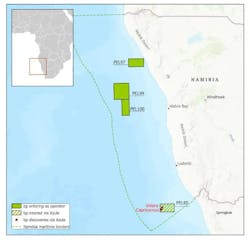
@import url(‘https://fonts.googleapis.com/css2?family=Inter:[email protected]&display=swap’); .ebm-page__main h1, .ebm-page__main h2, .ebm-page__main h3, .ebm-page__main h4, .ebm-page__main h5, .ebm-page__main h6 { font-family: Inter; } body { line-height: 150%; letter-spacing: 0.025em; } button, .ebm-button-wrapper { font-family: Inter; } .label-style { text-transform: uppercase; color: var(–color-grey); font-weight: 600; font-size: 0.75rem; } .caption-style { font-size: 0.75rem; opacity: .6; } #onetrust-pc-sdk [id*=btn-handler], #onetrust-pc-sdk [class*=btn-handler] { background-color: #c19a06 !important; border-color: #c19a06 !important; } #onetrust-policy a, #onetrust-pc-sdk a, #ot-pc-content a { color: #c19a06 !important; } #onetrust-consent-sdk #onetrust-pc-sdk .ot-active-menu { border-color: #c19a06 !important; } #onetrust-consent-sdk #onetrust-accept-btn-handler, #onetrust-banner-sdk #onetrust-reject-all-handler, #onetrust-consent-sdk #onetrust-pc-btn-handler.cookie-setting-link { background-color: #c19a06 !important; border-color: #c19a06 !important; } #onetrust-consent-sdk .onetrust-pc-btn-handler { color: #c19a06 !important; border-color: #c19a06 !important; } Map from bp plc <!–> –> bp plc aims to become operator of three exploration blocks offshore Namibia through acquisition of a 60% interest from Eco Atlantic Oil & Gas. Subject to Namibian government and joint venture partner approvals, bp will operate blocks PEL97, PEL99, and PEL100 in Walvis basin.   In a release Apr. 13, bp said entering the blocks builds on its recent exploration successes in Namibia through Azule Energy, a 50-50 joint venture between bp and Eni. Eco Atlantic will remain a partner, along with Namibia’s national oil company NAMCOR, following the deal’s closing, which is subject to closing conditions.

Read More »

ConocoPhillips sends team to Venezuela to evaluate oil, gas opportunities

ConocoPhillips sent a team to Venezuela to evaluate oil and gas opportunities, the company confirmed to Oil & Gas Journal Apr. 13. In an email to OGJ, a company spokesperson said “ConocoPhillips can confirm that we sent a small evaluation team to Venezuela during the week of Apr. 6 to better understand the potential for in-country oil and gas opportunities.” Asked what clarity the company seeks, the spokesperson said the team “will evaluate Venezuela against other international opportunities as part of our disciplined investment framework.” The operator left Venezuela in 2007 after then-President Hugo Chavez’s government reverted privately run oil fields to state control. ConocoPhillips, along with ExxonMobil, refused the government’s terms and took claims to the World Bank’s International Centre for the Settlement of Investment Disputes (ICSID). ConocoPhillips is owed about $12 billion following two judgements, an amount still sought by the company, which, prior to the expropriation of its interests, held a 50.1% interest in Petrozuata, a 40% interest in Hamaca, and a 32.5% interest in Corocoro heavy oil projects in Venezuela. In January, following the removal of Venezuela’s leader Nicolas Maduro, US President Donald Trump urged oil and gas companies to spend billions to rebuild Venezuela’s energy sector. ExxonMobil, which also exited the country in 2007, ​sent a technical team to Venezuela in March to ⁠evaluate the infrastructure and investment opportunities. In a discussion at CERAWeek by S&P Global in Houston in March, ConocoPhillips’ chief executive officer, Ryan Lance, said Venezuela needs to “completely rewire” ​its fiscal system to attract new ‌investment. The South American country holds a large cache of proven oil reserves, but has faced decades of production challenges due to mismanagement, underinvestment, and sanctions.

Read More »

Data centers are costing local governments billions

Tax benefits for hyperscalers and other data center operators are costing local administrations billions of dollars. In the US, three states are already giving away more than $1 billion in potential tax revenue, while 14 are failing to declare how much data center subsidies are costing taxpayers, according to Good Jobs First. The campaign group said the failure to declare the tax subsidies goes against US Generally Accepted Accounting Principles (GAAP) and that they should, since 2017, be declared as lost revenue. “Tax-abatement laws written long ago for much smaller data centers, predating massive artificial intelligence (AI) facilities, are now unexpectedly costing governments billions of dollars in lost tax revenue,” Good Jobs First said. “Three states, Georgia, Virginia, and Texas, already lose $1 billion or more per year,” it reported in its new study, “Data Center Tax Abatements: Why States and Localities Must Disclose These Soaring Revenue Losses.”

Read More »

Equinix offering targets automated AI-centric network operations

Another component, Fabric Application Connect, functions as a private, dedicated connectivity marketplace for AI services. It lets enterprises access inference, training, storage, and security providers over private connections, bypassing the public Internet and limiting data exposure during AI development and deployment. Operational visibility is provided through Fabric Insights, an AI-powered monitoring layer that analyzes real-time network telemetry to detect anomalies and predict potential issues before they impact workloads. Fabric Insights integrates with security information and event management (SIEM) platforms such as Splunk and Datadog and feeds data directly into Fabric Super-Agent to support automated remediation. Fabric Intelligence operates on top of Equinix’s global infrastructure footprint, which includes hundreds of data centers across dozens of metropolitan markets. The platform is positioned as part of Equinix Fabric, a connectivity portfolio used by thousands of customers worldwide to link cloud providers, enterprises, and network services. Fabric Intelligence is available now to preview.

Read More »

Blue Owl Builds a Capital Platform for the Hyperscale AI Era

Capital as a Service: The Hyperscaler Shift This is not just another project financing. It points to a model in which hyperscalers can externalize a significant portion of the capital required for AI campuses while retaining operational control. Under the Hyperion structure, Meta provides construction and property management, while Blue Owl supplies capital at scale alongside infrastructure expertise. Reuters described the transaction as Meta’s largest private capital deal to date, with the campus projected to exceed 2 gigawatts of capacity. For Blue Owl, it marks a shift in role: from backing developers serving hyperscalers to working directly with a hyperscaler to structure ownership more efficiently at scale. Hyperion also helps explain why this model is gaining traction. Hyperscalers are now deploying capital at a pace that makes flexibility a strategic priority. Structures like the Meta–Blue Owl JV allow them to continue expanding infrastructure without fully absorbing the balance-sheet impact of each new campus. Analyst commentary cited by Reuters suggested the arrangement could help Meta mitigate risk and avoid concentrating too much capital in land, buildings, and long-lived infrastructure, preserving capacity for additional facilities and ongoing AI investment. That is the service Blue Owl is effectively providing. Not just capital, but balance-sheet flexibility at a time when AI infrastructure demand is stretching even the largest technology companies. With major tech firms projected to spend hundreds of billions annually on AI infrastructure, that capability is becoming central to how the next generation of campuses gets built. The Capital Baseline Resets In early 2026, hyperscalers effectively reset the capital baseline for the sector. Alphabet projected $175 billion to $185 billion in annual capex, citing continued constraints across servers, data centers, and networking. Amazon pointed to roughly $200 billion, up from $131 billion the prior year, while noting persistent demand pressure in AWS. Meta

Read More »

OpenAI pulls out of a second Stargate data center deal

“OpenAI is embattled on several fronts. Anthropic has been doing very well in the enterprise, and OpenAI’s cash burn might be a problem if it wants to go public at an astronomical $800 billion+ valuation. This is especially true with higher energy prices due to geopolitics, and the public and regulators increasingly skeptical of AI companies, especially outside of the United States,” Roberts said. “I see these moves as OpenAI tightening its belt a bit and being more deliberate about spending as it moves past the interesting tech demo stage of its existence and is expected to provide a real return for investors.” He added, “I expect it’s a symptom of a broader problem, which is that OpenAI has thrown some good money after bad in bets that didn’t work out, like the Sora platform it just shut down, and it’s under increasing pressure to translate its first-mover advantage into real upside for its investors. Spending operational money instead of capital money might give it some flexibility in the short term, and perhaps that’s what this is about.” All in all, he noted, “on a scale of business-ending event to nothingburger, I would put it somewhere in the middle, maybe a little closer to nothingburger.” Acceligence CIO Yuri Goryunov agreed with Roberts, and said, “OpenAI has a problem with commercialization and runaway operating costs, for sure. They are trying to rightsize their commitments and make sure that they deliver on their core products before they run out of money.” Goryunov described OpenAI’s arrangement with Microsoft in Norway as “prudent financial engineering” that allows it to access the data center resources without having to tie up too much capital. “It’s financial discipline. OpenAI [executives] are starting to behave like grownups.” Forrester senior analyst Alvin Nguyen echoed those thoughts. 

Read More »

DCF Tours: SDC Manhattan, 375 Pearl St.

Power: Redundant utility design in a power-constrained market The tour made equally clear that in Manhattan, power is still the central gating factor. The brochure describes SDC Manhattan as offering 18MW of aggregate power delivered to the building, backed by redundant electrical and mechanical systems, backup generators, and Tier III-type concurrent maintainability. The December 2025 press release updated that picture in a more market-facing way, noting that Sabey is one of the only colocation providers in Manhattan with available power, including nearly a megawatt of turnkey power and 7MW of utility power across two powered shell spaces. Bajrushi’s explanation of the electrical topology helped show how Sabey has made that possible. Standing on the third floor, he described a ring bus tying together four Con Edison feeds. Bajrushi said the feeds all originate from the same substation but take different paths into the building, creating redundancy outside the building as well as within it. He added that if one feed fails, the ring bus remains unaffected, and that only one feed is needed to power everything currently in operation. He also noted that Sabey has the ability to add two more feeds in the future if expansion calls for it. That matters in a city where available utility capacity is hard to come by and where many data center conversations end not with square footage but with a megawatt number. Bajrushi also noted that physical space is not the core constraint at 375 Pearl. He said the building still has plenty of room for future buildouts, including open areas that could become additional white space, chiller capacity, or other infrastructure. The bigger question, he suggested, is how and when power and supporting systems get installed. That observation aligns neatly with Sabey’s press release. The company is effectively arguing that SDC

Read More »

Maine to put brakes on big data centers as AI expansion collides with power limits

Mills has pushed for an exemption protecting a proposed $550 million project at the former Androscoggin paper mill in Jay, arguing it would reuse existing infrastructure without straining the grid. Lawmakers rejected that exemption. Mills’ office did not immediately respond to a request for comment. A national wave, an unanswered federal question Maine is one of at least 12 states now weighing moratorium or restraint legislation, alongside more than 300 data center bills filed across 30-plus states in the current session, according to legislative tracking firm MultiState. The shared concern is energy cost. Data centers could consume up to 12% of total US electricity by 2028, according to the US Department of Energy. On March 25, Senator Bernie Sanders and Alexandria Ocasio-Cortez introduced the AI Data Center Moratorium Act in Congress, which would impose a nationwide freeze on all new data center construction until Congress passes AI safety legislation. The Trump administration has pursued a different path from the legislative approach being taken in states. On March 4, Amazon, Google, Meta, Microsoft, OpenAI, Oracle, and xAI signed the White House’s Ratepayer Protection Pledge, a voluntary commitment by hyperscalers to fund their own power generation rather than pass grid costs to ratepayers. The pledge, published in the Federal Register on March 9, carries no penalties for noncompliance or auditing requirements.

Read More »

Microsoft will invest $80B in AI data centers in fiscal 2025

And Microsoft isn’t the only one that is ramping up its investments into AI-enabled data centers. Rival cloud service providers are all investing in either upgrading or opening new data centers to capture a larger chunk of business from developers and users of large language models (LLMs).  In a report published in October 2024, Bloomberg Intelligence estimated that demand for generative AI would push Microsoft, AWS, Google, Oracle, Meta, and Apple would between them devote $200 billion to capex in 2025, up from $110 billion in 2023. Microsoft is one of the biggest spenders, followed closely by Google and AWS, Bloomberg Intelligence said. Its estimate of Microsoft’s capital spending on AI, at $62.4 billion for calendar 2025, is lower than Smith’s claim that the company will invest $80 billion in the fiscal year to June 30, 2025. Both figures, though, are way higher than Microsoft’s 2020 capital expenditure of “just” $17.6 billion. The majority of the increased spending is tied to cloud services and the expansion of AI infrastructure needed to provide compute capacity for OpenAI workloads. Separately, last October Amazon CEO Andy Jassy said his company planned total capex spend of $75 billion in 2024 and even more in 2025, with much of it going to AWS, its cloud computing division.

Read More »

John Deere unveils more autonomous farm machines to address skill labor shortage

Join our daily and weekly newsletters for the latest updates and exclusive content on industry-leading AI coverage. Learn More Self-driving tractors might be the path to self-driving cars. John Deere has revealed a new line of autonomous machines and tech across agriculture, construction and commercial landscaping. The Moline, Illinois-based John Deere has been in business for 187 years, yet it’s been a regular as a non-tech company showing off technology at the big tech trade show in Las Vegas and is back at CES 2025 with more autonomous tractors and other vehicles. This is not something we usually cover, but John Deere has a lot of data that is interesting in the big picture of tech. The message from the company is that there aren’t enough skilled farm laborers to do the work that its customers need. It’s been a challenge for most of the last two decades, said Jahmy Hindman, CTO at John Deere, in a briefing. Much of the tech will come this fall and after that. He noted that the average farmer in the U.S. is over 58 and works 12 to 18 hours a day to grow food for us. And he said the American Farm Bureau Federation estimates there are roughly 2.4 million farm jobs that need to be filled annually; and the agricultural work force continues to shrink. (This is my hint to the anti-immigration crowd). John Deere’s autonomous 9RX Tractor. Farmers can oversee it using an app. While each of these industries experiences their own set of challenges, a commonality across all is skilled labor availability. In construction, about 80% percent of contractors struggle to find skilled labor. And in commercial landscaping, 86% of landscaping business owners can’t find labor to fill open positions, he said. “They have to figure out how to do

Read More »

2025 playbook for enterprise AI success, from agents to evals

Join our daily and weekly newsletters for the latest updates and exclusive content on industry-leading AI coverage. Learn More 2025 is poised to be a pivotal year for enterprise AI. The past year has seen rapid innovation, and this year will see the same. This has made it more critical than ever to revisit your AI strategy to stay competitive and create value for your customers. From scaling AI agents to optimizing costs, here are the five critical areas enterprises should prioritize for their AI strategy this year. 1. Agents: the next generation of automation AI agents are no longer theoretical. In 2025, they’re indispensable tools for enterprises looking to streamline operations and enhance customer interactions. Unlike traditional software, agents powered by large language models (LLMs) can make nuanced decisions, navigate complex multi-step tasks, and integrate seamlessly with tools and APIs. At the start of 2024, agents were not ready for prime time, making frustrating mistakes like hallucinating URLs. They started getting better as frontier large language models themselves improved. “Let me put it this way,” said Sam Witteveen, cofounder of Red Dragon, a company that develops agents for companies, and that recently reviewed the 48 agents it built last year. “Interestingly, the ones that we built at the start of the year, a lot of those worked way better at the end of the year just because the models got better.” Witteveen shared this in the video podcast we filmed to discuss these five big trends in detail. Models are getting better and hallucinating less, and they’re also being trained to do agentic tasks. Another feature that the model providers are researching is a way to use the LLM as a judge, and as models get cheaper (something we’ll cover below), companies can use three or more models to

Read More »

OpenAI’s red teaming innovations define new essentials for security leaders in the AI era

Join our daily and weekly newsletters for the latest updates and exclusive content on industry-leading AI coverage. Learn More OpenAI has taken a more aggressive approach to red teaming than its AI competitors, demonstrating its security teams’ advanced capabilities in two areas: multi-step reinforcement and external red teaming. OpenAI recently released two papers that set a new competitive standard for improving the quality, reliability and safety of AI models in these two techniques and more. The first paper, “OpenAI’s Approach to External Red Teaming for AI Models and Systems,” reports that specialized teams outside the company have proven effective in uncovering vulnerabilities that might otherwise have made it into a released model because in-house testing techniques may have missed them. In the second paper, “Diverse and Effective Red Teaming with Auto-Generated Rewards and Multi-Step Reinforcement Learning,” OpenAI introduces an automated framework that relies on iterative reinforcement learning to generate a broad spectrum of novel, wide-ranging attacks. Going all-in on red teaming pays practical, competitive dividends It’s encouraging to see competitive intensity in red teaming growing among AI companies. When Anthropic released its AI red team guidelines in June of last year, it joined AI providers including Google, Microsoft, Nvidia, OpenAI, and even the U.S.’s National Institute of Standards and Technology (NIST), which all had released red teaming frameworks. Investing heavily in red teaming yields tangible benefits for security leaders in any organization. OpenAI’s paper on external red teaming provides a detailed analysis of how the company strives to create specialized external teams that include cybersecurity and subject matter experts. The goal is to see if knowledgeable external teams can defeat models’ security perimeters and find gaps in their security, biases and controls that prompt-based testing couldn’t find. What makes OpenAI’s recent papers noteworthy is how well they define using human-in-the-middle

Read More »