Power: Redundant utility design in a power-constrained market
The tour made equally clear that in Manhattan, power is still the central gating factor.
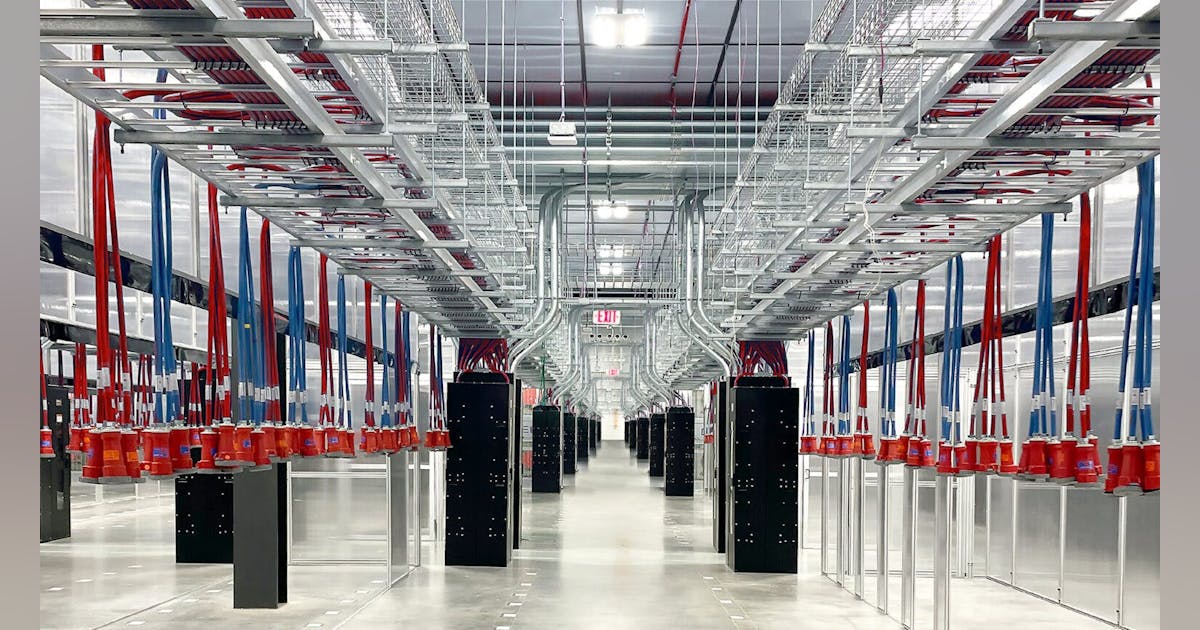
The brochure describes SDC Manhattan as offering 18MW of aggregate power delivered to the building, backed by redundant electrical and mechanical systems, backup generators, and Tier III-type concurrent maintainability. The December 2025 press release updated that picture in a more market-facing way, noting that Sabey is one of the only colocation providers in Manhattan with available power, including nearly a megawatt of turnkey power and 7MW of utility power across two powered shell spaces.
Bajrushi’s explanation of the electrical topology helped show how Sabey has made that possible.
Standing on the third floor, he described a ring bus tying together four Con Edison feeds. Bajrushi said the feeds all originate from the same substation but take different paths into the building, creating redundancy outside the building as well as within it. He added that if one feed fails, the ring bus remains unaffected, and that only one feed is needed to power everything currently in operation. He also noted that Sabey has the ability to add two more feeds in the future if expansion calls for it.
That matters in a city where available utility capacity is hard to come by and where many data center conversations end not with square footage but with a megawatt number.
Bajrushi also noted that physical space is not the core constraint at 375 Pearl. He said the building still has plenty of room for future buildouts, including open areas that could become additional white space, chiller capacity, or other infrastructure. The bigger question, he suggested, is how and when power and supporting systems get installed.
That observation aligns neatly with Sabey’s press release. The company is effectively arguing that SDC Manhattan has crossed an important threshold: it is not just connected and secure, but one of the few Manhattan sites with enough available capacity to support the next wave of digital infrastructure demand.
Generators, fuel, and maintainability
If the utility side of the story is about redundancy, the backup power story is about preparedness.
Walking the fourth floor, Bajrushi pointed out the building’s large mission critical generators, describing them as the biggest generators at any Sabey site. He explained that the facility maintains multiple fuel tanks in the cellar, with about 72 hours of on-site fuel, fuel polishing capability, and the ability to transfer fuel between tanks if needed. Bajrushi added that Sabey also has delivery contracts in place for emergency refueling.
He described the generator testing regime in similarly matter-of-fact terms. Bajrushi noted that the site performs monthly load testing and an annual “pull-the-plug” test in which the generators are forced to carry the building load. He also walked through the sequence in which the UPS shifts to battery, generators are called to start, and the system remains on generator until operators are comfortable moving back to utility power.
That is the kind of unglamorous operational discipline that tends to separate serious facilities from merely well-marketed ones.
Cooling: Efficiency, economization, and future flexibility
Cooling is another area where the site’s brochure claims and field reality match up well.
Sabey’s materials say the building supports hot aisle containment, new efficient chilled-water CRAH units, and water-side economization. The brochure also says new buildouts can support any rack density, including GPU farm and HPC environments, with liquid-cooling-ready and hybrid cooling options.
Bajrushi’s walkthrough showed the current cooling backbone behind those claims. He pointed to the site’s five York chillers, including a newer unit that had to be craned into the building because it was too large for the elevator. He also highlighted the plate-frame heat exchangers used for pre-chilling in cold weather. Bajrushi explained that when outside conditions are favorable, the chillers can be shut off entirely and the heat exchangers can handle the load rejection needed to maintain temperature.
He also described the major project Sabey undertook to tie the chillers together in a way that allows each one to be isolated individually without disrupting the loop. Bajrushi noted that this was part of making the system concurrently maintainable and said the work had been completed within roughly the last year and a half.
That is an important detail because it shows the building is not static. SDC Manhattan is being actively upgraded, not simply maintained.
The AI angle enters here too. Sabey’s December release says the building’s liquid-cooling-ready infrastructure can support hybrid cooling configurations for GPUs and custom accelerators while maintaining the company’s energy-efficiency standards. Bajrushi was more measured in discussing AI directly, but he confirmed that inference use cases have been discussed internally and that the idea is viewed as a real possibility for the site.
Inside the colo floors
On the colocation floors, the building looks more familiar to data center operators, though even there the vertical context never disappears.
Bajrushi described the room-level cooling approach as a flooded cold-air design with hot air rejected into the ceiling plenum. He noted that customers can choose either full hot aisle containment or chimney-based configurations, depending on workload and design preference. He also pointed out future project space taped off on the floor, indicating that additional capacity is already being prepared for new customer deployments.
The brochure emphasizes that SDC Manhattan is suitable for retail customers, private suites, and powered shell users alike. Bajrushi’s tour reinforced that flexibility. He discussed how one customer had started in a relatively small footprint and later expanded significantly, using that progression as an example of how long-term customers can grow within the building rather than having to leave it.
That customer growth story matters because it suggests the building’s appeal is not just about initial deployment. It is about continuity.