Scaling AI Safety Research for a Multi-Agent World
For the past decade, we’ve focused on making individual AI models more capable, helpful and safe. Today, Google DeepMind — together with Schmidt Sciences, the Cooperative AI Foundation, the Advanced Research and Invention Agency, and supported by Google.org — is announcing a new technical research funding call of up to $10M for researchers worldwide.
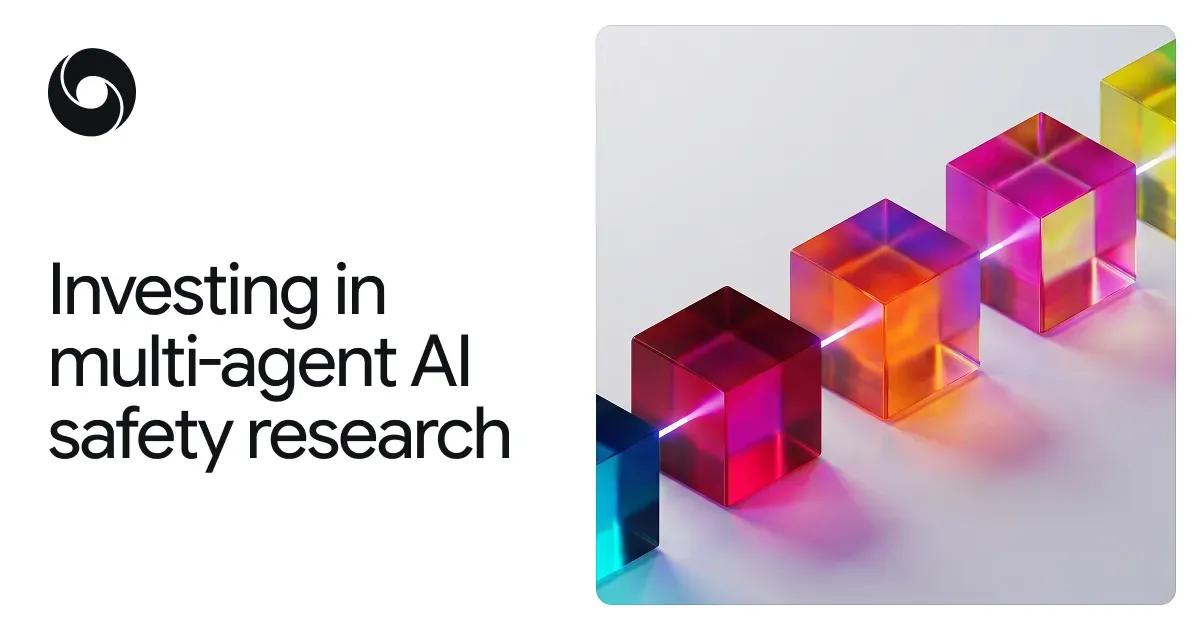
As AI technology scales, we’re entering a new era. Soon, millions of AI agents — built by different organizations — will interact across digital environments, communicating, negotiating and transacting with one another.
When these systems interact, they must do so safely and predictably. This shift creates a vital opportunity: we can strengthen the safety and stability of the entire AI ecosystem from the very beginning.
The funding call focuses on the study of how large-scale multi-agent AI systems behave as a group, and how we can provide frameworks to understand and mitigate against potential risks. By empowering researchers globally, we aim to solve the “invisible” safety risks that arise when independent systems interact across different networks.
Why the agent ecosystem matters
When large groups of AI agents interact, new collective behaviors and capabilities can emerge suddenly. Currently, we lack the tools to predict, measure and monitor these transitions. Most safety evaluations analyze models in isolation. However, as we and others have previously argued, interacting autonomous agents can produce complex, “emergent” behaviors that are difficult to anticipate.
Because this is a new area of research, it is critical to understand how these shifts occur. For example, could they cause an unpredictable flurry of economic activity or lead to new security challenges? Understanding how to manage these system-wide behaviors is our core objective.
Scaling the frontier of multi-agent safety research
Although foundational frameworks for multi-agent safety exist, the rapid evolution of these systems requires an immediate, large-scale expansion of research.
Our 2025 research established a framework for understanding these interactions, while our recent work on AI Agent Traps explores vulnerabilities agents face in adversarial environments. Now, we must move faster. We are at a critical juncture where the complexity of multi-agent interactions is outpacing existing safety models.
This funding call aims to accelerate progress by supporting a global network of independent researchers. A diverse community is essential to ensure safety standards are transparent and robust for everyone.
This effort also advances the mission of Schmidt Sciences’ Science of Trustworthy AI and AI Agents programs, which support foundational work on understanding and mitigating risks from frontier AI systems, as well as ARIA’s Scaling Trust programme, which seeks to unlock new forms of cyber-physical multi-agent coordination.
A collaborative call to action
No single lab can solve multi-agent safety alone. We invite academic and independent researchers to submit proposals in four priority areas:
- Sandboxes and testbeds: Building realistic, reproducible environments to evaluate, compare and accelerate progress across all areas of multi-agent safety. This includes virtual marketplaces, simulated ecosystems and multi-organisation workflows.
- The science of agent networks: Understanding the safety-relevant properties of interacting agent populations, including investigating how collective capabilities emerge and scale, how networks fail or become volatile and how to detect dangerous, unexpected population-level properties.
- Strengthening agent infrastructure: Stress-testing the protocols for identity, reputation and commitment that are secure cross-platform agent interactions.
- Oversight and control: Developing methods to monitor deployed agent populations and mitigate collective harms at scale.
How to participate
We invite researchers to review our call for proposals and join us in building a safe foundation for a multi-agent future.
The deadline to apply is August 8, 2026, with awardees expected to be announced in Autumn 2026.
For more details on technical requirements and the application process, visit our application portal.