Stay Ahead, Stay ONMINE

Bayesian Guardrails for AI Decisions: Measuring Uncertainty Before Automating Decisions

Most AI systems in production are optimized to provide an answer.A classifier identifies a high-risk customer. A forecasting model predicts demand. An analytics agent might recommend reallocating a marketing budget. The result usually appears as a number or category. Sometimes it becomes an action straight away.This format can make the model seem more certain than it actually is. A growth forecast of 8 percent looks accurate, even when realistic outcomes range from a decline to a much larger increase. A high-risk customer may be just above an arbitrarily set threshold. A seemingly unprofitable campaign may still be waiting for delayed conversions.As soon as a prediction triggers an automated action, hidden uncertainty becomes operational risk.Bayesian methods, on the other hand, map uncertainty via probability distributions and not via a single estimated value. But a wider interval on a dashboard is not enough. The system should use the uncertainty to decide when it can act alone, when it needs scrutiny, and when it should abstain.Automation changes the cost of uncertaintyUncertainty exists in every analytical system, whether it is measured or ignored.When a human analyst reviews a dashboard, they can pause and take a closer look at the data before taking action. They notice an unusual value and check whether the data is complete. They might compare it to historical patterns and get context from another team.Automation eliminates many of these pauses.An AI system can evaluate thousands of cases and act within seconds. This speed is useful if the model is reliable. But if it is confidently wrong, it multiplies the errors. The NIST AI Risk Management Framework treats AI risks as contextual and recommends organizations capture and measure risks so that they remain manageable throughout the system lifecycle.This means that the risk of the same prediction can be different. A recommendation shown to an analyst may have little impact. The same recommendation can have a high impact if it directly changes prices, inventory, credit, marketing spending, or workforce planning.Accuracy alone is not enough. The remaining uncertainty must be low enough for the system to responsibly execute the proposed action.Point estimates hide decision-relevant informationConsider a composite scenario based on patterns I have encountered in multi-source marketing analytics. A company uses an AI model to recommend daily adjustments to campaign budgets. The model estimates that a budget increase for a given campaign will increase conversions by 7 percent.With a point estimate, the decision initially seems straightforward. The budget is increased.However, the model may assign substantial probability to several outcomes. Maybe it shows a small chance of a big improvement and at the same time a moderate chance of little change. Likewise, there may be a real possibility that profitability will decline. So the average forecast can remain positive, although the risk of loss is too high to automatically increase the budget.The point estimate answers exactly one question: What is the central prediction of the model?This means that the plausible range of results and the probability of a negative outcome are not visible. Nor does it show whether the model has enough relevant data or what the company will lose if the recommendation is wrong.These are precisely the questions that are important when a prediction immediately triggers an action.Bayesian models ask a different questionA Bayesian model combines a prior with the observed data to produce a posterior distribution over the values that the model estimates.For future values, the posterior predictive distribution is usually the crucial output. It combines the uncertainty about the model parameters with the variability that remains in future observations. A posterior predictive interval therefore describes the range of values ​​that the model actually expects, and not just the uncertainty of a parameter.In my research on economic policy uncertainty using Bayesian hierarchical modeling and Markov Chain Monte Carlo, the goal was not to produce one policy estimate. The model quantified uncertainty and showed how predictions change under different economic conditions.The same principle applies when companies automate decisions with AI. Demand models should provide posterior predictive intervals for future demand. Churn systems should show whether probability estimates remain stable across the customer segments that inform the decision. Analytics agents should disclose how robust the evidence is for each recommendation.Aleatoric and epistemic uncertaintyIn practice, teams often divide prediction uncertainty into two types: aleatoric and epistemic.Aleatoric uncertainty reflects variation in the data itself or in the process that produces it. Customer behavior fluctuates, sensors provide noise, and conversion events arrive with a delay. Even similar users can react differently to the same ad.More samples from the same source often do not eliminate this variation. The prediction should therefore include them and the decision must take them into account.Epistemic uncertainty represents limited knowledge about the model, its parameters, or the cases it is intended to assess. A model may have little evidence for a customer segment or new market. The same applies to a product or a particular economic regime.The influential Kendall & Gal framework uses this distinction in Bayesian deep learning. In practice, the two components cannot always be clearly separated from each other. Epistemic uncertainty may decrease as more relevant evidence becomes available if the model type & assumptions match the process being modeled.The distinction is still useful because it helps teams take next steps. High aleatoric uncertainty means that the situation under consideration is difficult to predict. High epistemic uncertainty indicates a lack of knowledge: the system may need data from exactly this type of case, technical testing before it acts, or a better-fitting model.Confidence is not automatically a guardrailMany AI systems already output confidence scores. These values ​​should not be treated as probabilities unless they are calibrated.A classifier can report 90 percent confidence without actually being correct 90 percent of the time in comparable cases. Research into the calibration of modern neural networks has shown that even very accurate networks can be poorly calibrated.Even Bayesian models are not inherently safe.A posterior distribution depends on the prior, the model structure, the likelihood, the data, and the inference procedure. Incorrect assumptions can lead to misleading estimates of uncertainty. A narrow posterior predictive interval can arise from a model that is too restrictive and not from data that actually supports this narrow range.A guardrail begins by estimating uncertainty and then checks calibration and model quality. The organization must also determine which actions are permissible at which level of uncertainty.Without such rules of action, uncertainty remains a number on the dashboard that does not influence the behavior of the system.From the posterior distribution to a guideline for decisionsFrom uncertainty to action (image by author)Bayesian guardrails translate uncertainty into rules for which decisions can be automated.The system should not just ask whether the expected result is positive. It also has to weigh up possible outcomes and the costs of a wrong decision.The Stan User’s Guide to Bayesian Decision Analysis describes the Bayesian optimal action as the one that maximizes the expected utility or, equivalently, minimizes the expected loss under the posterior predictive distribution.This is important because the most likely outcome is not always the best reason for an action.Decision thresholds should reflect the consequencesLet’s say a model predicts that increasing campaign budget is likely to improve conversions.If the proposed adjustment is small, reversible, and has an upper limit, the organization can accept more uncertainty. On the other hand, if the recommendation moves a large budget during a major launch, the same uncertainty should trigger human review before execution.A guardrail can define three decision zones.Automate if the expected benefit is positive, the posterior predictive interval is within the allowable width, and the probability of an unacceptable loss remains below an approved threshold.Forward for review if the forecast continues to look positive but uncertainty is high, the input is poorly represented in the historical data, or the decision would move a large budget.Stop if evidence is insufficient, downside risk is above the acceptable limit, the request is outside the supported use case, or required data is incomplete.The thresholds should be derived from business loss and reversibility, not from a single confidence score that is used the same everywhere.Tail risks can be more important than averageExpectations can mask serious negative outcomes.A strategy can have the highest average predicted return and at the same time have a non-trivial probability of a large loss. Another might deliver a slightly lower expected return but have a much narrower downside spread.An automation system that only optimizes for the mean would probably choose the first strategy. A Bayesian guardrail can incorporate both the probability and cost of negative tail events.This is particularly relevant for decisions involving financial exposure, regulatory consequences, possible customer harm, or operational disruptions. It’s not about eliminating risk. It is crucial to make visible which risks the organization consciously accepts.A Practical Bayesian Guardrail ArchitectureProduction guardrail operations should sit between prediction and execution.The Predictive LayerThe prediction layer produces a posterior predictive distribution and not just a point estimate. Depending on the use case, it can come from Bayesian hierarchical modeling, probabilistic programming, probabilistic regression, Bayesian approximations for neural networks, or from ensembles associated with an explicit probabilistic model.The specific method is less important. What matters is whether its prediction uncertainty has been validated for the respective decision.The Decision and Policy LayersThe decision layer translates the predictive distribution into metrics that the business can work with. It can calculate the probability of a negative outcome, the expected loss, the probability of exceeding a critical threshold, or how the decision changes under different assumptions.The policy layer compares these quantities with approved limits. It decides whether the system is allowed to automate, must request an audit, or should abstain.The model should not determine its own risk tolerance. This threshold is the responsibility of the organization and must reflect the potential harm of an action, whether it can be reversed, and what approvals it requires.The Execution and Observability LayersThe execution layer remains separate from the prediction model. It only performs an action after the policy check is successful and the required approval is received.The observability layer logs the prediction, the posterior predictive interval, the chosen threshold, the decision metric, the policy result, human intervention, and the final output.This traceability helps teams determine if the failure is due to the model, uncertainty estimate, data, policy, or execution process.A Campaign Automation ExamplePoint estimation vs. Bayesian guardrail (Image by author)Let’s consider an AI system that recommends moving budget between campaigns.The model predicts that shifting 15 percent of the budget from Campaign A to Campaign B will increase the total number of conversions. The following values ​​are illustrative only.The expected lift is 6 percent, but the 90 percent posterior predictive interval ranges from a 4 percent decrease to a 17 percent increase. In addition, the model assigns a non-negligible probability to a negative lift.A conventional system might act because the expected value is positive.A Bayesian guardrail would compare the downside probability with the approved tolerance, verify that the most recent attribution windows are complete, and check that there is sufficient relevant history for Campaign B.The recommendation may still be useful even if it’s not safe to automate. The system could suggest a smaller & reversible adjustment or forward the decision for review. Likewise, it can wait until additional conversion data is available.As results are observed, the posterior can be updated. If subsequent data supports the recommendation and uncertainty decreases, the system can automate a similar action.So the guardrail adapts to the evidence rather than relying on a rigid threshold.Abstention Is a Production CapabilityMany AI systems are rewarded for answering every request. In high-impact automations, it may be safer not to act than to act based on weak evidence.Selective prediction allows a model to abstain if its certainty is not sufficient. As a result, the accepted predictions perform better. Research on calibrated selective classification also shows why the uncertainty used for this selection must itself be assessed.A Bayesian guardrail may abstain if the posterior predictive interval is too wide or the probability of a harmful outcome exceeds the tolerance. It may also abstain if a change in the prior significantly alters the result, required data are incomplete, the input is outside the conditions reflected in the data, or plausible model specifications lead to conflicting recommendations.Abstention should not be seen as a system failure. It is a conscious outcome that prevents insufficient evidence from triggering action.Monitoring Uncertainty After DeploymentA Bayesian guardrail cannot be validated only before launch.Economic conditions & customer behavior may change after the launch. New products appear. Data pipelines get modified. A previously useful uncertainty estimate can thereby become overconfident.Compare Predictive Intervals With Real OutcomesOne useful calibration diagnostic is whether approximately 90% of realized outcomes fall within nominal 90% posterior predictive intervals on representative evaluation data. Persistent undercoverage suggests that the predictive distribution is too narrow or otherwise misspecified. Sustained overcoverage may mean that the intervals are too wide for the system to meaningfully trade on.Coverage should be evaluated along with interval width, abstention rate, and decision loss. Teams should also examine performance by segment, particularly for high-risk groups. A model can achieve its overall coverage goal and still fail in a high-risk subgroup.Use Posterior Predictive ChecksPosterior predictive checks produce replicated data from the fitted model and compare the features on which the decision relies with the observed data.This makes it possible to see whether the model reproduces the patterns on which the decision depends.A campaign model can hit average conversion rates well and still not reflect delayed attribution or extreme volatility. It may also miss regional differences. If these very patterns determine downside risk, the model is not yet ready for automation, even if it explains the aggregated data well overall.Posterior predictive checks are diagnostics, not proof that a model is correct. Teams must choose trials based on how the decision could fail.Monitor the Guardrail, Not Only the ModelThe decision-making guidelines must also be reviewed regularly.A threshold that worked in a small pilot may become unsafe once automated actions move more value. A high abstention rate may indicate insufficient data or a model with too much uncertainty to justify automation. A low abstention rate may show that the policy allows for too many actions.Evaluate the guardrail as a decision-making system and not just a statistical model.Where Bayesian Guardrails Can FailBayesian methods provide a mathematically consistent basis for making decisions under uncertainty, but they do not eliminate model risk.When evidence is limited, poorly chosen priors can distort the results. An incorrectly specified likelihood can make predictive distributions appear too confident even though they are unrealistic. Markov Chain Monte Carlo diagnostics can indicate successful sampling even though an important variable or relationship is missing from the model.Computational overhead can also limit full Bayesian inference in low-latency systems. Approximate methods can help, but their uncertainty estimates must be validated separately.Bayesian uncertainty does not automatically protect against adversarial inputs, distribution shift, or poor data quality. Conformal Prediction as a ComplementUnder exchangeability or a suitable variant thereof, standard methods of conformal prediction for prediction sets or intervals can provide marginal coverage guarantees for finite samples. However, this marginal guarantee does not promise correct coverage for each case or subgroup.In marketing and other time-dependent systems, platform changes & seasonality can violate simple interchangeability assumptions. Delayed conversions and distribution shift can do this too.Bayesian and conformal methods answer different questions. Bayesian analysis maps uncertainty using a probabilistic model and thus makes it usable for decision analysis. Conformal prediction uses observed errors to calibrate prediction sets or intervals under specified assumptions.In practice, a guardrail rarely relies on just one statistical technique. It combines uncertainty estimation, calibration, clear decision rules, and technical tests. In addition, the system needs human checking as well as continuous monitoring.The Real Guardrail Is the Decision BoundaryAI systems do not become trustworthy simply by outputting a confidence level.A guardrail only works if it links uncertainty with a decision boundary. It determines when the model is allowed to act, when it should only recommend, and when it must stop. Bayesian methods allow you to reflect uncertainty and update your estimates as the evidence changes. Decision analysis then connects these distributions to the consequences of possible actions.Many automation systems skip exactly this step. They go straight from prediction to action, treating a score as if it were already a decision.A safer approach keeps an eye on the full distribution of plausible outcomes and balances them against the organization’s risk tolerance. Automation only occurs when the evidence is strong enough to support the impact of the action.An AI system should be judged by how often it makes the right decision and whether it recognizes when its knowledge is insufficient to make a decision.

Most AI systems in production are optimized to provide an answer.

A classifier identifies a high-risk customer. A forecasting model predicts demand. An analytics agent might recommend reallocating a marketing budget. The result usually appears as a number or category. Sometimes it becomes an action straight away.

This format can make the model seem more certain than it actually is. A growth forecast of 8 percent looks accurate, even when realistic outcomes range from a decline to a much larger increase. A high-risk customer may be just above an arbitrarily set threshold. A seemingly unprofitable campaign may still be waiting for delayed conversions.

As soon as a prediction triggers an automated action, hidden uncertainty becomes operational risk.

Bayesian methods, on the other hand, map uncertainty via probability distributions and not via a single estimated value. 

But a wider interval on a dashboard is not enough. The system should use the uncertainty to decide when it can act alone, when it needs scrutiny, and when it should abstain.

Automation changes the cost of uncertainty

Uncertainty exists in every analytical system, whether it is measured or ignored.

When a human analyst reviews a dashboard, they can pause and take a closer look at the data before taking action. They notice an unusual value and check whether the data is complete. They might compare it to historical patterns and get context from another team.

Automation eliminates many of these pauses.

An AI system can evaluate thousands of cases and act within seconds. This speed is useful if the model is reliable. But if it is confidently wrong, it multiplies the errors. The NIST AI Risk Management Framework treats AI risks as contextual and recommends organizations capture and measure risks so that they remain manageable throughout the system lifecycle.

This means that the risk of the same prediction can be different. A recommendation shown to an analyst may have little impact. The same recommendation can have a high impact if it directly changes prices, inventory, credit, marketing spending, or workforce planning.

Accuracy alone is not enough. The remaining uncertainty must be low enough for the system to responsibly execute the proposed action.

Point estimates hide decision-relevant information

Consider a composite scenario based on patterns I have encountered in multi-source marketing analytics. 

A company uses an AI model to recommend daily adjustments to campaign budgets. The model estimates that a budget increase for a given campaign will increase conversions by 7 percent.

With a point estimate, the decision initially seems straightforward. The budget is increased.

However, the model may assign substantial probability to several outcomes. Maybe it shows a small chance of a big improvement and at the same time a moderate chance of little change. Likewise, there may be a real possibility that profitability will decline. So the average forecast can remain positive, although the risk of loss is too high to automatically increase the budget.

The point estimate answers exactly one question: What is the central prediction of the model?

This means that the plausible range of results and the probability of a negative outcome are not visible. Nor does it show whether the model has enough relevant data or what the company will lose if the recommendation is wrong.

These are precisely the questions that are important when a prediction immediately triggers an action.

Bayesian models ask a different question

A Bayesian model combines a prior with the observed data to produce a posterior distribution over the values that the model estimates.

For future values, the posterior predictive distribution is usually the crucial output. It combines the uncertainty about the model parameters with the variability that remains in future observations. A posterior predictive interval therefore describes the range of values ​​that the model actually expects, and not just the uncertainty of a parameter.

In my research on economic policy uncertainty using Bayesian hierarchical modeling and Markov Chain Monte Carlo, the goal was not to produce one policy estimate. The model quantified uncertainty and showed how predictions change under different economic conditions.

The same principle applies when companies automate decisions with AI. Demand models should provide posterior predictive intervals for future demand. Churn systems should show whether probability estimates remain stable across the customer segments that inform the decision. Analytics agents should disclose how robust the evidence is for each recommendation.

Aleatoric and epistemic uncertainty

In practice, teams often divide prediction uncertainty into two types: aleatoric and epistemic.

Aleatoric uncertainty reflects variation in the data itself or in the process that produces it. Customer behavior fluctuates, sensors provide noise, and conversion events arrive with a delay. Even similar users can react differently to the same ad.

More samples from the same source often do not eliminate this variation. The prediction should therefore include them and the decision must take them into account.

Epistemic uncertainty represents limited knowledge about the model, its parameters, or the cases it is intended to assess. A model may have little evidence for a customer segment or new market. The same applies to a product or a particular economic regime.

The influential Kendall & Gal framework uses this distinction in Bayesian deep learning. In practice, the two components cannot always be clearly separated from each other. Epistemic uncertainty may decrease as more relevant evidence becomes available if the model type & assumptions match the process being modeled.

The distinction is still useful because it helps teams take next steps. High aleatoric uncertainty means that the situation under consideration is difficult to predict. High epistemic uncertainty indicates a lack of knowledge: the system may need data from exactly this type of case, technical testing before it acts, or a better-fitting model.

Confidence is not automatically a guardrail

Many AI systems already output confidence scores. These values ​​should not be treated as probabilities unless they are calibrated.

A classifier can report 90 percent confidence without actually being correct 90 percent of the time in comparable cases. Research into the calibration of modern neural networks has shown that even very accurate networks can be poorly calibrated.

Even Bayesian models are not inherently safe.

A posterior distribution depends on the prior, the model structure, the likelihood, the data, and the inference procedure. Incorrect assumptions can lead to misleading estimates of uncertainty. A narrow posterior predictive interval can arise from a model that is too restrictive and not from data that actually supports this narrow range.

A guardrail begins by estimating uncertainty and then checks calibration and model quality. The organization must also determine which actions are permissible at which level of uncertainty.

Without such rules of action, uncertainty remains a number on the dashboard that does not influence the behavior of the system.

From the posterior distribution to a guideline for decisions
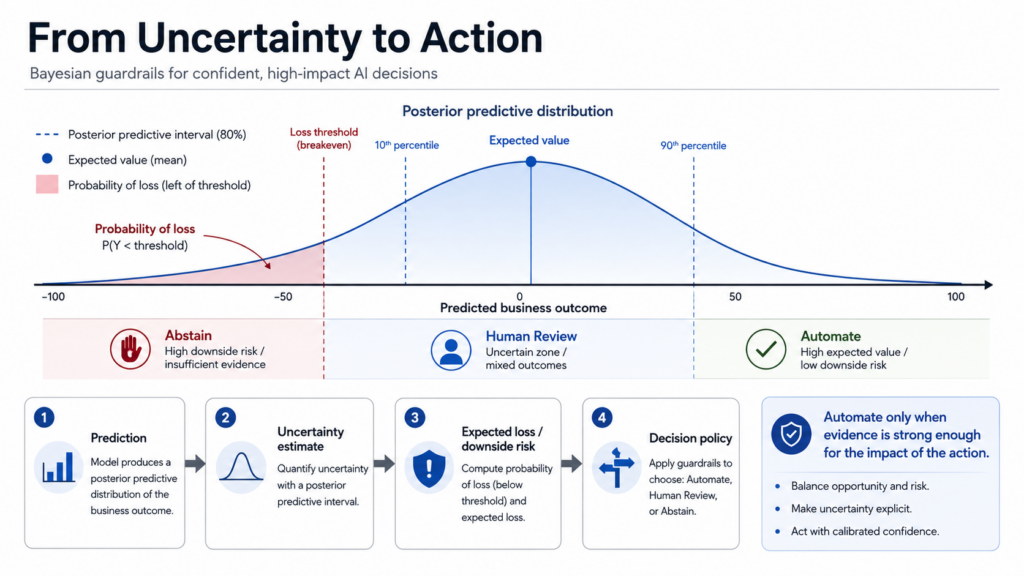
From uncertainty to action (image by author)

Bayesian guardrails translate uncertainty into rules for which decisions can be automated.

The system should not just ask whether the expected result is positive. It also has to weigh up possible outcomes and the costs of a wrong decision.

The Stan User’s Guide to Bayesian Decision Analysis describes the Bayesian optimal action as the one that maximizes the expected utility or, equivalently, minimizes the expected loss under the posterior predictive distribution.

This is important because the most likely outcome is not always the best reason for an action.

Decision thresholds should reflect the consequences

Let’s say a model predicts that increasing campaign budget is likely to improve conversions.

If the proposed adjustment is small, reversible, and has an upper limit, the organization can accept more uncertainty. On the other hand, if the recommendation moves a large budget during a major launch, the same uncertainty should trigger human review before execution.

A guardrail can define three decision zones.

  • Automate if the expected benefit is positive, the posterior predictive interval is within the allowable width, and the probability of an unacceptable loss remains below an approved threshold.

  • Forward for review if the forecast continues to look positive but uncertainty is high, the input is poorly represented in the historical data, or the decision would move a large budget.

  • Stop if evidence is insufficient, downside risk is above the acceptable limit, the request is outside the supported use case, or required data is incomplete.

The thresholds should be derived from business loss and reversibility, not from a single confidence score that is used the same everywhere.

Tail risks can be more important than average

Expectations can mask serious negative outcomes.

A strategy can have the highest average predicted return and at the same time have a non-trivial probability of a large loss. Another might deliver a slightly lower expected return but have a much narrower downside spread.

An automation system that only optimizes for the mean would probably choose the first strategy. A Bayesian guardrail can incorporate both the probability and cost of negative tail events.

This is particularly relevant for decisions involving financial exposure, regulatory consequences, possible customer harm, or operational disruptions. It’s not about eliminating risk. It is crucial to make visible which risks the organization consciously accepts.

A Practical Bayesian Guardrail Architecture

Production guardrail operations should sit between prediction and execution.

The Predictive Layer

The prediction layer produces a posterior predictive distribution and not just a point estimate. Depending on the use case, it can come from Bayesian hierarchical modeling, probabilistic programming, probabilistic regression, Bayesian approximations for neural networks, or from ensembles associated with an explicit probabilistic model.

The specific method is less important. What matters is whether its prediction uncertainty has been validated for the respective decision.

The Decision and Policy Layers

The decision layer translates the predictive distribution into metrics that the business can work with. It can calculate the probability of a negative outcome, the expected loss, the probability of exceeding a critical threshold, or how the decision changes under different assumptions.

The policy layer compares these quantities with approved limits. It decides whether the system is allowed to automate, must request an audit, or should abstain.

The model should not determine its own risk tolerance. This threshold is the responsibility of the organization and must reflect the potential harm of an action, whether it can be reversed, and what approvals it requires.

The Execution and Observability Layers

The execution layer remains separate from the prediction model. It only performs an action after the policy check is successful and the required approval is received.

The observability layer logs the prediction, the posterior predictive interval, the chosen threshold, the decision metric, the policy result, human intervention, and the final output.

This traceability helps teams determine if the failure is due to the model, uncertainty estimate, data, policy, or execution process.

A Campaign Automation Example
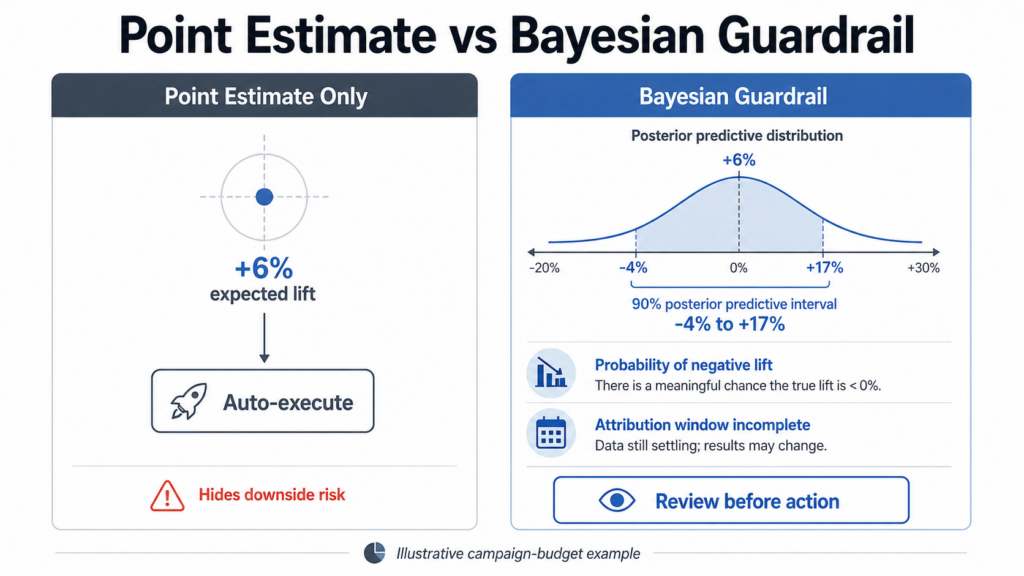
Point estimation vs. Bayesian guardrail (Image by author)

Let’s consider an AI system that recommends moving budget between campaigns.

The model predicts that shifting 15 percent of the budget from Campaign A to Campaign B will increase the total number of conversions. The following values ​​are illustrative only.

The expected lift is 6 percent, but the 90 percent posterior predictive interval ranges from a 4 percent decrease to a 17 percent increase. In addition, the model assigns a non-negligible probability to a negative lift.

A conventional system might act because the expected value is positive.

A Bayesian guardrail would compare the downside probability with the approved tolerance, verify that the most recent attribution windows are complete, and check that there is sufficient relevant history for Campaign B.

The recommendation may still be useful even if it’s not safe to automate. The system could suggest a smaller & reversible adjustment or forward the decision for review. Likewise, it can wait until additional conversion data is available.

As results are observed, the posterior can be updated. If subsequent data supports the recommendation and uncertainty decreases, the system can automate a similar action.

So the guardrail adapts to the evidence rather than relying on a rigid threshold.

Abstention Is a Production Capability

Many AI systems are rewarded for answering every request. In high-impact automations, it may be safer not to act than to act based on weak evidence.

Selective prediction allows a model to abstain if its certainty is not sufficient. As a result, the accepted predictions perform better. Research on calibrated selective classification also shows why the uncertainty used for this selection must itself be assessed.

A Bayesian guardrail may abstain if the posterior predictive interval is too wide or the probability of a harmful outcome exceeds the tolerance. It may also abstain if a change in the prior significantly alters the result, required data are incomplete, the input is outside the conditions reflected in the data, or plausible model specifications lead to conflicting recommendations.

Abstention should not be seen as a system failure. It is a conscious outcome that prevents insufficient evidence from triggering action.

Monitoring Uncertainty After Deployment

A Bayesian guardrail cannot be validated only before launch.

Economic conditions & customer behavior may change after the launch. New products appear. Data pipelines get modified. A previously useful uncertainty estimate can thereby become overconfident.

Compare Predictive Intervals With Real Outcomes

One useful calibration diagnostic is whether approximately 90% of realized outcomes fall within nominal 90% posterior predictive intervals on representative evaluation data. 

Persistent undercoverage suggests that the predictive distribution is too narrow or otherwise misspecified. Sustained overcoverage may mean that the intervals are too wide for the system to meaningfully trade on.

Coverage should be evaluated along with interval width, abstention rate, and decision loss. Teams should also examine performance by segment, particularly for high-risk groups. A model can achieve its overall coverage goal and still fail in a high-risk subgroup.

Use Posterior Predictive Checks

Posterior predictive checks produce replicated data from the fitted model and compare the features on which the decision relies with the observed data.

This makes it possible to see whether the model reproduces the patterns on which the decision depends.

A campaign model can hit average conversion rates well and still not reflect delayed attribution or extreme volatility. It may also miss regional differences. If these very patterns determine downside risk, the model is not yet ready for automation, even if it explains the aggregated data well overall.

Posterior predictive checks are diagnostics, not proof that a model is correct. Teams must choose trials based on how the decision could fail.

Monitor the Guardrail, Not Only the Model

The decision-making guidelines must also be reviewed regularly.

A threshold that worked in a small pilot may become unsafe once automated actions move more value. A high abstention rate may indicate insufficient data or a model with too much uncertainty to justify automation. A low abstention rate may show that the policy allows for too many actions.

Evaluate the guardrail as a decision-making system and not just a statistical model.

Where Bayesian Guardrails Can Fail

Bayesian methods provide a mathematically consistent basis for making decisions under uncertainty, but they do not eliminate model risk.

When evidence is limited, poorly chosen priors can distort the results. An incorrectly specified likelihood can make predictive distributions appear too confident even though they are unrealistic. Markov Chain Monte Carlo diagnostics can indicate successful sampling even though an important variable or relationship is missing from the model.

Computational overhead can also limit full Bayesian inference in low-latency systems. Approximate methods can help, but their uncertainty estimates must be validated separately.

Bayesian uncertainty does not automatically protect against adversarial inputs, distribution shift, or poor data quality. 

Conformal Prediction as a Complement

Under exchangeability or a suitable variant thereof, standard methods of conformal prediction for prediction sets or intervals can provide marginal coverage guarantees for finite samples. However, this marginal guarantee does not promise correct coverage for each case or subgroup.

In marketing and other time-dependent systems, platform changes & seasonality can violate simple interchangeability assumptions. Delayed conversions and distribution shift can do this too.

Bayesian and conformal methods answer different questions. Bayesian analysis maps uncertainty using a probabilistic model and thus makes it usable for decision analysis. Conformal prediction uses observed errors to calibrate prediction sets or intervals under specified assumptions.

In practice, a guardrail rarely relies on just one statistical technique. It combines uncertainty estimation, calibration, clear decision rules, and technical tests. In addition, the system needs human checking as well as continuous monitoring.

The Real Guardrail Is the Decision Boundary

AI systems do not become trustworthy simply by outputting a confidence level.

A guardrail only works if it links uncertainty with a decision boundary. It determines when the model is allowed to act, when it should only recommend, and when it must stop. 

Bayesian methods allow you to reflect uncertainty and update your estimates as the evidence changes. Decision analysis then connects these distributions to the consequences of possible actions.

Many automation systems skip exactly this step. They go straight from prediction to action, treating a score as if it were already a decision.

A safer approach keeps an eye on the full distribution of plausible outcomes and balances them against the organization’s risk tolerance. Automation only occurs when the evidence is strong enough to support the impact of the action.

An AI system should be judged by how often it makes the right decision and whether it recognizes when its knowledge is insufficient to make a decision.


Shape
Shape
Stay Ahead

Explore More Insights

Stay ahead with more perspectives on cutting-edge power, infrastructure, energy,  bitcoin and AI solutions. Explore these articles to uncover strategies and insights shaping the future of industries.

Shape

Cisco taps Teleport for infrastructure identity management tech

Cisco is continuing to embed identity management capabilities deeper into its product portfolio by teaming with Teleport, a security vendor headquartered in Oakland, Calif., that’s focused on identity-based infrastructure access management. Cisco is investing in and partnering with Teleport as part of its efforts to bring infrastructure identity everywhere, Matt Caulfield,

Read More »

DOE and SBA Launch SBIC-E Initiative to Unleash Private Capital for American Innovation and Small Businesses

WASHINGTON—The U.S. Department of Energy (DOE) and the U.S. Small Business Administration (SBA) today signed a Memorandum of Agreement establishing the Small Business Investment Company-Energy (SBIC-E) Initiative, a new strategic partnership advancing President Trump’s commitment to supporting America’s small businesses, strengthening domestic manufacturing and supply chains, and ensuring the United States leads in the technologies critical to our national and economic security. The new SBIC-E Initiative brings together DOE’s scientific and technical expertise with SBA’s proven Small Business Investment Company (SBIC) Program, which currently has $58 billion in combined portfolio value. Since 1958, the SBIC Program has invested $147 billion in American small businesses, and since 1995, SBIC-backed businesses have created or supported 10.6 million jobs. “America’s small businesses drive American innovation and affordable, reliable energy access,” said U.S. Secretary of Energy Chris Wright. “By partnering with the Small Business Administration, the Energy Department is committing to invest its resources in American small businesses that will create jobs, strengthen our domestic manufacturing base, and unleash American energy production.” Through DOE’s Office of Technology Commercialization (OTC), the Department will identify strategic technology priorities, provide technical and commercialization expertise, and help engage the investment community. SBA, through its Office of Investment and Innovation, will administer the initiative and encourage the formation and growth of investment funds focused on those priorities. SBIC-E adds another tool to that effort by connecting innovators with private capital to help promising technologies grow, scale, and build here at home. “President Trump is establishing American energy dominance, ending the Green New Scam, and putting our nations’ producers and innovators back in control at the dawn of a new era of energy reliability and abundance,” said SBA Administrator Kelly Loeffler. “Through this partnership, the SBA and Department of Energy are strengthening access to capital in the private sector to

Read More »

Energy Department Announces $500 Million Award to Revitalize American Steelmaking

WASHINGTON—The U.S. Department of Energy (DOE) today announced a $500 million award to support a $1 billion investment at Cleveland-Cliffs’ Middletown Works facility in Middletown, Ohio. Vice President JD Vance and U.S. Energy Secretary Chris Wright visited Middletown Works today to highlight the Trump Administration’s commitment to American steelworkers and the resurgence of American manufacturing. The investment will modernize American steelmaking, protect 2,300 American jobs, and strengthen the domestic steel supply chain. The project advances President Trump’s commitment to put American workers first, bring investment back to American communities, and strengthen the industries critical to America’s economic and national security. Cleveland-Cliffs determined that the business case for the original project scope no longer made sense given customers’ unwillingness to pay a “green premium” for steel. Working with DOE, Cleveland-Cliffs identified a viable alternative that will upgrade and improve the efficiency of the existing coal-fired blast furnace while also capturing and commercializing co-product blast furnace gas (BFG). “President Trump is rebuilding America’s industrial base,” said Secretary Wright. “This investment puts American workers and American manufacturing first. It will modernize one of our nation’s critical steelmaking facilities, protect thousands of jobs, and strengthen our domestic steel production—keeping Ohio at the heart of American manufacturing and strengthening our national security.” The investment will modernize critical steelmaking operations at Middletown Works by rebuilding and upgrading the plant’s main coal-fired ironmaking furnace, deploying AI to optimize furnace operations and improve energy efficiency, and building an on-site facility to convert steel mill process gases into electricity. Follow-on investments will turn industrial byproducts into materials for concrete used in regional infrastructure. “This landmark investment at Middletown Works will secure a reliable domestic supply of high-purity steel while protecting thousands of quality jobs in Ohio,” said Assistant Secretary of Energy Audrey Robertson. “DOE is proud to partner with Cleveland-Cliffs to reduce America’s dependence on foreign products

Read More »

Energy Secretary Keeps Critical Generation Available in Mid-Atlantic

WASHINGTON—U.S. Secretary of Energy Chris Wright today issued an emergency order to address critical grid reliability issues facing the Mid-Atlantic region of the United States. The emergency order directs PJM Interconnection L.L.C. (PJM), in coordination with Constellation Energy Corporation, to ensure Units 3 and 4 of the Eddystone Generating Station in Pennsylvania remain available to operate and to employ economic dispatch to minimize costs for the American people. The units were originally slated to shut down on May 31, 2025. “The energy sources that perform when you need them most are the most valuable,” Secretary Wright said. “During recent Mid-Atlantic heat waves, coal, natural gas, and nuclear kept the lights and air conditioners on. President Trump and the Energy Department are committed to keeping critical generation available when demand is highest, reducing the risk of blackouts and ensuring Americans have affordable, reliable, and secure power—regardless of whether the wind is blowing or the sun is shining.” As outlined in DOE’s Resource Adequacy Report, power outages could increase by 100 times in 2030 if the U.S. continues to take reliable power offline. This order is in effect beginning on August 23, 2026, through November 20, 2026.                                                                                             ###

Read More »

Energy Department Announces $500 Million to Secure America’s Critical Mineral and Battery Supply Chains

WASHINGTON—The U.S. Department of Energy’s (DOE) Office of Critical Minerals and Energy Innovation (CMEI) today announced $500 million for seven selected projects to expand critical mineral and material processing, battery manufacturing, and recycling capacity in the United States. In accordance with President Trump’s Executive Order, Unleashing American Energy, the selected projects advance the President’s agenda to strengthen America’s domestic critical minerals and materials supply chains, reduce reliance on foreign sources, bolster national security, and advance American energy dominance. “For too long, America has depended on foreign actors for critical materials essential to modern life that underpin our economy, energy security, and national security,” said U.S. Secretary of Energy Chris Wright. “President Trump is reversing that dependence by securing our critical supply chains, unleashing American industry, and bringing critical materials production and processing back to the United States.” “DOE is taking decisive action to secure the critical supply chains necessary to power our nation,” said Assistant Secretary of Energy Audrey Robertson. “These projects underscore DOE’s commitment to driving innovation, reducing reliance on foreign sources, and promoting American energy dominance.” This is the third round of funding from DOE’s Battery Materials Processing and Battery Manufacturing and Recycling programs, which support battery materials processing, recycling, and manufacturing projects. These include demonstration projects, construction of commercial-scale facilities, and retrofitting or retooling existing facilities.  Critical minerals and materials are essential to American industry, energy production, and national security. Expanding domestic capacity will help ensure the resources America needs are processed, manufactured, and recycled in the United States.  Information on the selected projects is available here and here.

Read More »

bp lets Shah Deniz compression automation contract

bp has let a contract to Emerson to deliver automation technologies for the Shah Deniz Compression project offshore Azerbaijan. Emerson will provide integrated control and safety systems aimed at enhancing production, safety, and reliability on the new offshore compression platform. The contract includes systems to provide process control, safety shutdown, fire and gas detection, and power management. Together, these systems deliver real-time visibility and remote control of critical operations, Emerson said. The $2.9 billion Shah Deniz Compression project, which includes an electrically powered, normally unattended offshore production platform, is a next stage development of the Caspian Sea Shah Deniz field. Designed to access low-pressure gas reserves and maximize overall recovery, the platform will be equipped with four 11 Mw compressors and serve as the central compression hub for gas from the Shah Deniz Alpha and Bravo platforms. The platform will operate remotely from bp’s onshore Sangachal terminal 55 km south of Baku. The project is expected to enable about 50 billion cu m of additional gas and about 25 million bbl of condensate production and export. Construction is scheduled to be completed in 2029, with first gas compression expected from the Shah Deniz Alpha platform in 2029 and from the Shah Deniz Bravo platform in 2030. The agreement follows a previous automation contract bp signed with Emerson for the Azeri Central East and Shah Deniz Stage 2 developments. bp is operator at Shah Deniz (29.99%) with partners Lukoil (19.99%), TPAO (19%), Cenub Qaz Dehlizi (16.02%), NICO (10%), and MVM (5%).

Read More »

Federal court voids Texas GulfLink license over agency’s ‘serious procedural errors’

The ruling voids the license, halting all construction or progress. Sentinel Midstream declined comment on the ruling and would not answer questions about the status of construction. GulfLink, sited about 30 miles offshore Freeport, Tex., is designed to export up to 1 million b/d via Very Large Crude Carriers (VLCCs) to the government of Japan and Freeport Commodities. The project involves a 44-mile, 42-in. OD pipeline and was scheduled to begin operations around 2028. The estimated $2.1 billion investment was funded as part of a broader trade agreement between the US and Japan. The legal battle stems from a specific rule in the Deepwater Port Act of 1974 that dictates that the federal government can only permit one crude oil deepwater port, including any supporting infrastructure, within a single designated “application area.” Because the competing SPOT project’s pipeline route physically overlaps and intersects GulfLink’s lines, the plaintiff—Citizens for Clean Air & Clean Water in Brazoria County (Better Brazoria), represented by Earthjustice—successfully argued that MARAD violated the “one port” rule when issuing GulfLink’s license in February. The three-judge panel found that MARAD “improperly drew” the map designing the project’s official boundaries to exclude the pipelines and approved two overlapping projects in the same zone instead of only licensing one. The court wrote that the scope of the error made vacatur, not the less serious remand without vacatur, the appropriate remedy. Vacatur deems the license invalid and is used when the court finds “serious procedural errors” that cannot be easily explained or fixed with minor changes. Remand without vacatur sends the decision back to the agency for corrections but leaves the current license in place in the meantime. SPOT project status The $2.5-3-billion SPOT project, developed by Enterprise Products Partners in partnership with Enbridge Inc., also lies about 30 miles from Freeport. Designed to handle VLCCs,

Read More »

IBM unveils dual-architecture processor to run Arm-native apps on Z mainframes

“These caches have enormously low latency, and that is one of the key reasons and key engineering choices to support the performance and scalability of enterprise workloads, very data-intensive workloads like databases and transactions,” Jacobi said. “In addition, we have an on-chip data processing unit for IO acceleration and dedicated AI accelerators as well as accelerators for data compression, cryptography and data sorting.” One of the biggest takeaways from this processor announcement is that the enormous catalog of software already built for Arm becomes accessible on a mainframe without anyone having to port it first, notes Matt Kimball, senior datacenter analyst at Moor Insights & Strategy, in a research note about the news. Still, “this is a 2027 conversation, and with no date, supported software list, or Arm licensing treatment, the work now is inventory and scenario planning rather than financial modeling,” Kimball wrote.

Read More »

PJM’s New Data Center Power Equation

PJM Interconnection has now filed one of the most consequential proposed changes yet in the relationship between data centers and the electric grid. Rather than simply treating a new hyperscale or AI facility like any other customer whose demand will be backed through regional capacity procurement, PJM is proposing a framework under which the largest new loads would need to be supported by new capacity, have their needs covered through the Reliability Backstop Procurement, or face potential curtailment when the regional power system is short of supply. The approach has been developing since PJM launched its Critical Issue Fast Path process for large loads in 2025, but it became substantially more concrete in late July and August 2026. PJM filed its proposed Reliability Backstop Procurement with FERC on July 31 and began accepting applications that day for its FERC-approved Expedited Interconnection Track. On Aug. 13, PJM filed its proposed Interim Resource Adequacy Service, or IRAS, along with the Large Load Registry that would support it. The immediate numbers explain the urgency. PJM’s July 2026 capacity auction for the 2028/2029 delivery year procured 138,318 MW of unforced capacity through the centralized auction. Even after including Fixed Resource Requirement resources, however, PJM came up 6,831 MW short of its reliability requirement. The auction cleared at the FERC-approved $325/MW-day price cap. It was the second consecutive auction in which the PJM region failed to procure its full reliability requirement, something that had not happened before these two auctions. That gap is occurring while demand continues to accelerate. PJM’s 2026 long-term forecast projects summer peak demand growing at an average 3.6% annually over the next decade, compared with just 0.3% in the comparable forecast issued in 2021. Summer peak demand is projected to rise by nearly 66 GW over 10 years. Data centers are

Read More »

Zayo, NVIDIA Build the Long-Haul Backbone for Distributed AI

The data center industry’s increasingly power-first approach to site selection has created a follow-on question: Once the megawatts are found, is there enough network infrastructure to make the site useful at AI scale? Zayo and NVIDIA are putting real infrastructure behind that question. Zayo said it is working with NVIDIA to expand network capacity supporting AI factories across North America, including an 8,000-route-mile program targeting some of the fastest-growing AI corridors in the United States. The project encompasses six new long-haul routes along with overbuilds of existing network across 10 high-demand corridors. The announcement arrives as AI data center development moves beyond the largest established hubs toward markets where power and land may be more readily available, but fiber capacity cannot necessarily be taken for granted. That geography is increasingly important. NVIDIA has separately developed “scale-across” networking technology designed to allow AI infrastructure distributed among different buildings — or even data centers separated by hundreds of kilometers — to operate as a more unified computing environment. Put together, the developments suggest that networking is becoming inseparable from the AI factory buildout itself. Power may determine where the next generation of AI infrastructure can be built. Fiber will increasingly determine how effectively those sites can participate in the larger AI ecosystem. Fiber Follows the Power Zayo CEO Steve Smith said AI demand is changing both where network infrastructure is needed and how aggressively capacity must be deployed ahead of development. “AI is fundamentally reshaping where and how network infrastructure needs to be built across the U.S.,” Smith said. The company’s 8,000-mile program is more nuanced than that top-line number might suggest. Zayo disclosed in April that the expansion includes approximately 3,000 route miles across six new long-haul routes, plus more than 5,000 route miles of overbuilds across 10 existing corridors. Zayo

Read More »

Southern’s 17 GW Pipeline Puts AI Power Demand Into Utility Math

The headline number from Southern Company’s latest earnings report is hard to miss: electricity use by data centers across the utility’s system increased 55% in the second quarter compared with a year earlier. But the more consequential numbers may be the ones sitting behind it. Southern now has more than 1.2 GW of operating data center load, up by more than 500 MW from a year ago. At the same time, its electric utilities have signed contracts and large-load agreements totaling more than 17 GW by the mid-2030s, with another 8 GW in late-stage development and a prospective pipeline of large industrial and data center projects exceeding 75 GW. That leaves an enormous gap between the data center megawatts consuming electricity today and the load Southern has contractually positioned itself to serve during the next decade. For the data center industry, that gap may be the most important part of Southern’s second-quarter story. It offers a look at how utilities are beginning to convert the AI infrastructure boom from forecasts and campus announcements into contracts, generation procurement, transmission investment and eventually energized capacity. From Contracts to Megawatts Southern added roughly 6 GW of contracted large load during the quarter alone. Alabama Power signed three projects representing about 3 GW, while Georgia Power reached a 25-year agreement to serve OpenAI’s planned project in Effingham County near Savannah. That facility is expected to require approximately 3.2 GW and begin taking electric service in phases in 2028. The numbers nevertheless require an important distinction. Seventeen gigawatts contracted does not mean 17 GW will suddenly appear on Southern’s grid. Large data center campuses ramp gradually, often over several years, and Southern executives acknowledged that actual customer ramp schedules do not always match the assumptions made when projects are first approved. CEO Chris Womack said

Read More »

PORTS-Pike Takes Shape as an 8-GW AI Infrastructure Model

Back on March 31, 2026, we discussed we discussed SoftBank and SB Energy’s plans to redevelop the former Portsmouth Gaseous Diffusion Plant site near Piketon as a 10-GW artificial intelligence data center campus supported by almost an equal amount of new power generation. At the time, the plan called for as much as 10 GW of new generation, including 9.2 GW of natural gas capacity, along with approximately $4.2 billion of high-voltage transmission infrastructure developed with AEP Ohio. An initial 800-MW data center phase was targeted for service in 2028. The March story was notable because Pike County appeared to offer a preview of a new model for building hyperscale infrastructure: develop the generation, transmission and data center simultaneously rather than wait for an increasingly congested regional grid to deliver multiple gigawatts of capacity. Not to mention the reuse of a brownfield site with the encouragement of the federal government. Since then, almost every important part of the project has moved forward, and on August 17, the most consequential missing pieces fell into place. NVIDIA announced that it will become the exclusive AI compute infrastructure provider for the PORTS-Pike Technology Campus. OpenAI will be the data center customer, signing a 20-year lease with SB Energy for approximately 8 GW of IT capacity. NVIDIA will invest another $1.5 billion in SB Energy and provide credit support for the land, power and shell infrastructure behind an initial 4.25 GW of IT load, with an option covering approximately another 3.75 GW. The Securities and Exchange Commission filing accompanying the announcement makes the financial commitment even more significant. NVIDIA disclosed that its aggregate payment obligation associated with its initial commitment is capped at $105 billion. That is not a conventional capital commitment to spend $105 billion building the campus, nor is it simply a

Read More »

Nvidia scales back financing guarantee for OpenAI data center

Nvidia is scaling back a proposed financial guarantee tied to a massive OpenAI data center project in Ohio, reducing its initial commitment from as much as $250 billion to less than $120 billion, according to report in the Wall Street Journal. Earlier this month, Nvidia announced partnerships with major financial firms including Apollo Global Management, BlackRock, Blackstone, Brookfield Asset Management, Goldman Sachs and KKR, aimed at mobilizing more than $500 billion in capital for AI computing infrastructure. The change represents a significant restructuring of Nvidia’s role in financing the planned facility, which is being developed by SB Energy, a subsidiary of SoftBank. Under the revised arrangement, Nvidia would guarantee financing for the project’s first phase, representing roughly 5 gigawatts of capacity, or half of the total proposed capacity. Financing for the remaining capacity would be considered separately at a later stage.

Read More »

Microsoft will invest $80B in AI data centers in fiscal 2025

And Microsoft isn’t the only one that is ramping up its investments into AI-enabled data centers. Rival cloud service providers are all investing in either upgrading or opening new data centers to capture a larger chunk of business from developers and users of large language models (LLMs).  In a report published in October 2024, Bloomberg Intelligence estimated that demand for generative AI would push Microsoft, AWS, Google, Oracle, Meta, and Apple would between them devote $200 billion to capex in 2025, up from $110 billion in 2023. Microsoft is one of the biggest spenders, followed closely by Google and AWS, Bloomberg Intelligence said. Its estimate of Microsoft’s capital spending on AI, at $62.4 billion for calendar 2025, is lower than Smith’s claim that the company will invest $80 billion in the fiscal year to June 30, 2025. Both figures, though, are way higher than Microsoft’s 2020 capital expenditure of “just” $17.6 billion. The majority of the increased spending is tied to cloud services and the expansion of AI infrastructure needed to provide compute capacity for OpenAI workloads. Separately, last October Amazon CEO Andy Jassy said his company planned total capex spend of $75 billion in 2024 and even more in 2025, with much of it going to AWS, its cloud computing division.

Read More »

John Deere unveils more autonomous farm machines to address skill labor shortage

Join our daily and weekly newsletters for the latest updates and exclusive content on industry-leading AI coverage. Learn More Self-driving tractors might be the path to self-driving cars. John Deere has revealed a new line of autonomous machines and tech across agriculture, construction and commercial landscaping. The Moline, Illinois-based John Deere has been in business for 187 years, yet it’s been a regular as a non-tech company showing off technology at the big tech trade show in Las Vegas and is back at CES 2025 with more autonomous tractors and other vehicles. This is not something we usually cover, but John Deere has a lot of data that is interesting in the big picture of tech. The message from the company is that there aren’t enough skilled farm laborers to do the work that its customers need. It’s been a challenge for most of the last two decades, said Jahmy Hindman, CTO at John Deere, in a briefing. Much of the tech will come this fall and after that. He noted that the average farmer in the U.S. is over 58 and works 12 to 18 hours a day to grow food for us. And he said the American Farm Bureau Federation estimates there are roughly 2.4 million farm jobs that need to be filled annually; and the agricultural work force continues to shrink. (This is my hint to the anti-immigration crowd). John Deere’s autonomous 9RX Tractor. Farmers can oversee it using an app. While each of these industries experiences their own set of challenges, a commonality across all is skilled labor availability. In construction, about 80% percent of contractors struggle to find skilled labor. And in commercial landscaping, 86% of landscaping business owners can’t find labor to fill open positions, he said. “They have to figure out how to do

Read More »

2025 playbook for enterprise AI success, from agents to evals

Join our daily and weekly newsletters for the latest updates and exclusive content on industry-leading AI coverage. Learn More 2025 is poised to be a pivotal year for enterprise AI. The past year has seen rapid innovation, and this year will see the same. This has made it more critical than ever to revisit your AI strategy to stay competitive and create value for your customers. From scaling AI agents to optimizing costs, here are the five critical areas enterprises should prioritize for their AI strategy this year. 1. Agents: the next generation of automation AI agents are no longer theoretical. In 2025, they’re indispensable tools for enterprises looking to streamline operations and enhance customer interactions. Unlike traditional software, agents powered by large language models (LLMs) can make nuanced decisions, navigate complex multi-step tasks, and integrate seamlessly with tools and APIs. At the start of 2024, agents were not ready for prime time, making frustrating mistakes like hallucinating URLs. They started getting better as frontier large language models themselves improved. “Let me put it this way,” said Sam Witteveen, cofounder of Red Dragon, a company that develops agents for companies, and that recently reviewed the 48 agents it built last year. “Interestingly, the ones that we built at the start of the year, a lot of those worked way better at the end of the year just because the models got better.” Witteveen shared this in the video podcast we filmed to discuss these five big trends in detail. Models are getting better and hallucinating less, and they’re also being trained to do agentic tasks. Another feature that the model providers are researching is a way to use the LLM as a judge, and as models get cheaper (something we’ll cover below), companies can use three or more models to

Read More »

OpenAI’s red teaming innovations define new essentials for security leaders in the AI era

Join our daily and weekly newsletters for the latest updates and exclusive content on industry-leading AI coverage. Learn More OpenAI has taken a more aggressive approach to red teaming than its AI competitors, demonstrating its security teams’ advanced capabilities in two areas: multi-step reinforcement and external red teaming. OpenAI recently released two papers that set a new competitive standard for improving the quality, reliability and safety of AI models in these two techniques and more. The first paper, “OpenAI’s Approach to External Red Teaming for AI Models and Systems,” reports that specialized teams outside the company have proven effective in uncovering vulnerabilities that might otherwise have made it into a released model because in-house testing techniques may have missed them. In the second paper, “Diverse and Effective Red Teaming with Auto-Generated Rewards and Multi-Step Reinforcement Learning,” OpenAI introduces an automated framework that relies on iterative reinforcement learning to generate a broad spectrum of novel, wide-ranging attacks. Going all-in on red teaming pays practical, competitive dividends It’s encouraging to see competitive intensity in red teaming growing among AI companies. When Anthropic released its AI red team guidelines in June of last year, it joined AI providers including Google, Microsoft, Nvidia, OpenAI, and even the U.S.’s National Institute of Standards and Technology (NIST), which all had released red teaming frameworks. Investing heavily in red teaming yields tangible benefits for security leaders in any organization. OpenAI’s paper on external red teaming provides a detailed analysis of how the company strives to create specialized external teams that include cybersecurity and subject matter experts. The goal is to see if knowledgeable external teams can defeat models’ security perimeters and find gaps in their security, biases and controls that prompt-based testing couldn’t find. What makes OpenAI’s recent papers noteworthy is how well they define using human-in-the-middle

Read More »