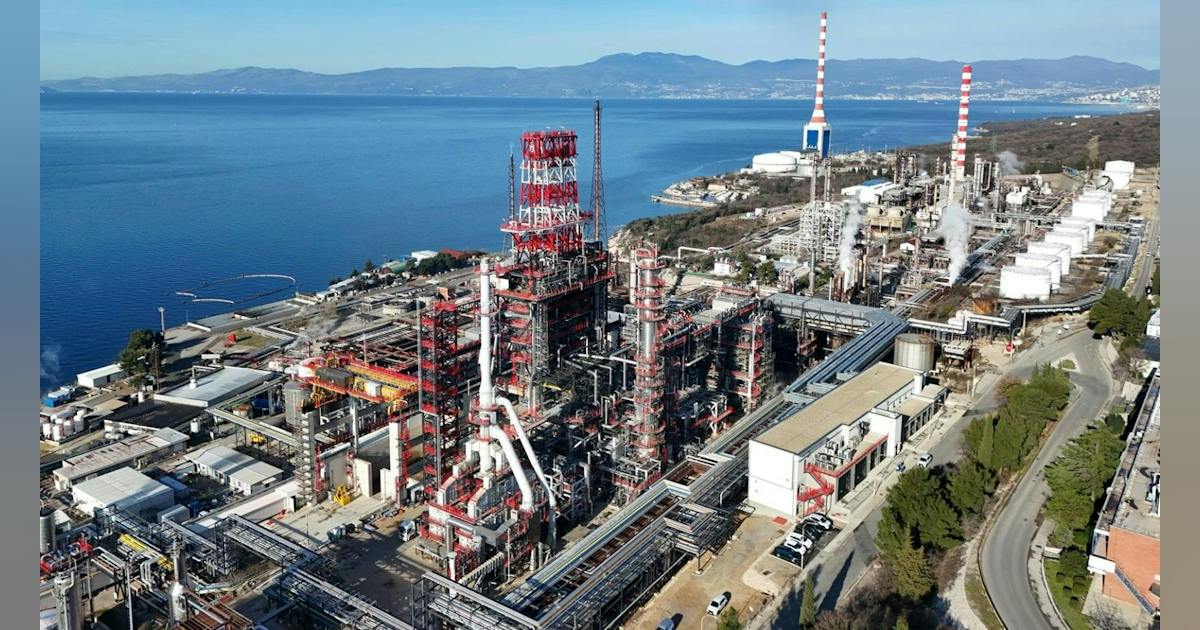
Croatia’s INA Industrija Nafte DD has started up a new delayed coking unit (DCU) at its 90,000-b/d Rijeka refinery along the northern part of the Adriatic Sea, marking a major milestone in the refinery’s upgrading project.
Following mechanical completion and commissioning, INA introduced feedstock into the DCU on Sept. 1, beginning production, majority owner MOL Group said in a release Sept. 21.
The unit has operated continuously since startup and has reached about 70% of design capacity, the company said.
The DCU—which converts heavy refinery residues into higher-value products—has produced all key products at required quality and is anticipated to increase diesel production by as much as 30% from the same crude volume.
MOL Group said the new DCU unit—once fully operable—also will eliminate Croatia’s need to import vacuum gas oil (VGO).
The Rijeka refinery upgrade represents an investment of nearly €700 million, which is included in a combined €1.3-billion joint investment by INA and MOL Group in refining and logistics modernization during the past 12 years.
“The start-up of the new unit went really well,” said Zsuzsanna Ortutay, president of INA’s management board, adding that the DCU would improve the sustainability and profitability of INA’s refining business while supporting energy supply in Croatia and the surrounding region.
INA plans to increase throughput and optimize process performance at the new unit gradually, with stable operation anticipated by yearend, followed by final plant performance testing and project closeout activities.
Rijeka DCU project background
INA awarded a lump-sum, turnkey engineering, procurement, and construction contract for the project to Maire Tecnimont SPA subsidiary KT-Kinetics Technology SPA in December 2019.
The contract covered a new delayed coking complex with coke handling and ship-loading facilities, a sour-water stripper, and amine recovery units. It also included modifications to the existing hydrocracker, sulfur recovery unit, utilities, and offsite systems.
The project was also to include coke storage and construction of a marine jetty. More than 60% of the existing refinery was expected to undergo work, according to Maire Tecnimont, which valued the contract at about €450 million and initially scheduled completion for 2023.
The delayed coking project formed part of INA’s broader Downstream 2023 New Course program. The strategy called for concentrating crude processing at Rijeka while converting INA’s 44,000-b/d Sisak refinery into a site for bitumen, renewable, and potentially lubricant production, as well as a logistics hub.
INA is owned by MOL Group subsidiary MOL PLC, with a 49.1% stake; the Republic of Croatia, with 44.8%; and private and institutional investors, with 6.1%.