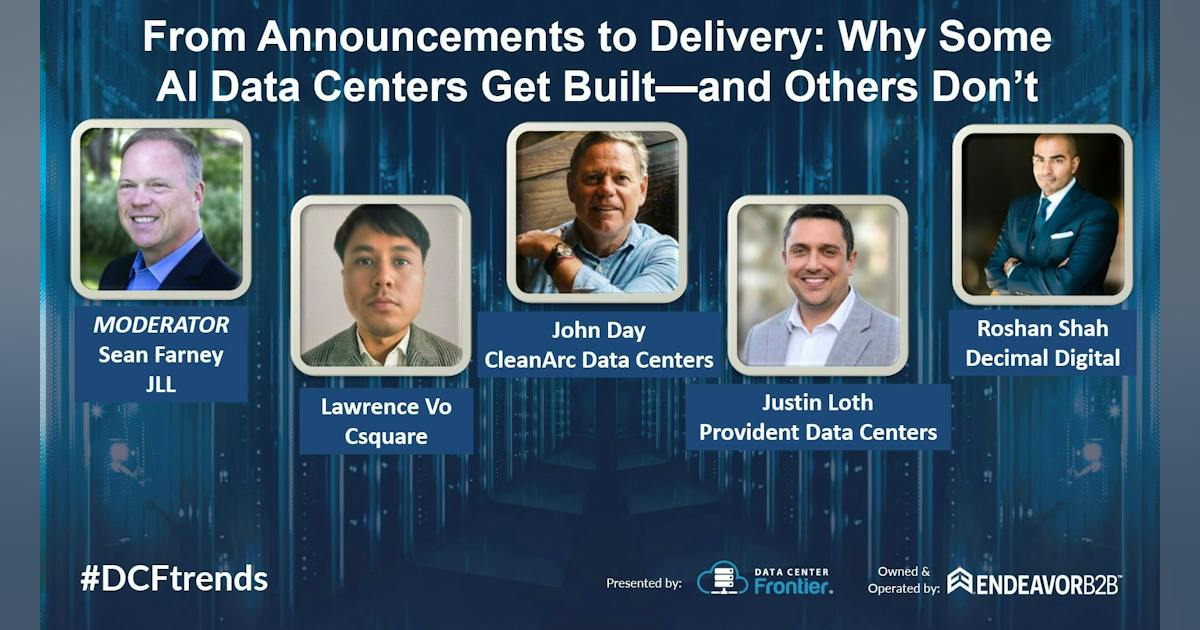
The AI infrastructure market has become very good at announcing gigawatts. Delivering them is another matter. That distinction framed one of the closing sessions of Day 1 at the Data Center Frontier Trends Summit 2026 (Aug. 4-6), where Sean Farney, vice president of data center strategy at JLL and a member of the Data Center Frontier Editorial Advisory Board, moderated a discussion on why some AI data center projects advance from concept to construction while others remain little more than ambitious site plans.
Farney was joined by Lawrence Vo, vice president of M&A and capex at Csquare; John Day, chief commercial officer at CleanArc Data Centers; Justin Loth, executive director of power development at Provident Data Centers; and Roshan Shah, co-founder and CEO of Decimal Digital.
The question Farney put before the group was straightforward: amid a market moving at what he called “the speed of light,” what separates the developers that actually get projects done from those that do not?
The answers repeatedly came back to the same point. In the current market, land, capital and an announcement are no longer enough. Developers have to prove that power is deliverable, infrastructure is ready, regulatory processes are moving, communities are receptive, talent is available and the commercial model can withstand changing conditions.
A Gigawatt on Paper Is Not a Gigawatt of Capacity
For Loth, who spent roughly 15 years on the utility side before joining Provident, the scale of current data center proposals alone should force the industry to think differently about what constitutes a credible project.
Before the hyperscale and AI expansion, he noted, gigawatts were a measure more commonly associated with cities than individual loads. “A 3.5 gigawatt campus,” Loth said, is roughly equivalent to the native load of Austin or San Antonio.
That scale makes the distinction between announced power and deliverable power critical. “You can have a CBRE or some kind of flyer that says a gigawatt of power available,” Loth said. “When is it available is my point.”
The due diligence goes considerably deeper than a headline capacity number. Developers and customers need to understand when power will arrive, what the load ramp looks like, whether an electric service agreement has been signed, whether long-lead equipment has been secured and whether sufficient generation exists behind the transmission capacity serving the site.
“When it really comes to closing breakers and making these operational,” Loth said, those details become decisive.
Transmission and generation also have to be considered together. A site may appear to have access to the transmission system, but that does not necessarily mean the generation required to support a new gigawatt-scale load is available on the timeline the customer expects.
For developers pitching enormous campuses, Loth’s message was essentially a familiar one applied to an unfamiliar scale: trust, but verify.
Finding the Contenders
Day described another way of separating projects that are advancing from projects that are mostly being marketed.
After CleanArc acquired its roughly 860-acre site south of Fredericksburg, Virginia, the company examined other large developments being promoted in the region. In many cases, bringing significant new transmission to a site requires a Certificate of Public Convenience and Necessity, or CPCN, filed with the Virginia State Corporation Commission.
The process is public. CleanArc used those filings as one measure of how far competing projects had actually progressed. “Out of like 30-some developments, there were seven,” Day said.
He was careful to note that not every development requires a CPCN. A project located near existing transmission or a substation with sufficient excess capacity could follow a different path.
But the exercise illustrated a broader point: regulatory filings, infrastructure commitments and actual investment provide a clearer picture of project maturity than announcements alone.
“There’s a lot of pretenders, not as many contenders,” Day said. Experience, the panel argued, is becoming another separator.
CleanArc itself is a relatively new platform, but Day said its top seven leaders collectively have about 137 years of direct data center experience. That matters because, despite unprecedented demand, he said developing campuses has arguably become harder.
There are labor constraints, equipment shortages, permitting issues, capital considerations and growing local opposition. Meanwhile, the influx of new developers attracted by AI demand has created another layer of friction.
Day compared the moment to a gold rush. Some new entrants will succeed. Others may learn quickly. But inexperienced developers can also consume utility, customer and local-government resources while advancing projects they do not yet have the ability to execute.
Hyperscalers still have to assess those sites because they cannot afford to overlook a viable opportunity. Planning commissions and boards of supervisors still have to process applications. Problems arise when applicants show up unable to answer fundamental questions about how a data center works or how their project will affect the community.
“There’s no replacement for having been there and done it at a smaller scale when you decide to dive in and do it at a massive scale,” Day said.
Community Support Becomes Part of Site Due Diligence
If power has traditionally dominated data center site selection, the panel made clear that local acceptance now belongs much earlier in the diligence process.
Shah offered the clearest example. Decimal Digital had secured an electric service agreement for a project in Ohio through what Shah described as a public and unanimously approved process. The company then acquired land in an industrial park already zoned for heavy industrial use.
From a conventional development standpoint, the project appeared well positioned. Then the municipality enacted a one-year moratorium. Shah said he did not learn how serious the opposition had become until the mayor summoned him to a meeting.
“I thought the mayor called me in to talk about kickstarting this project,” Shah said. Instead, the mayor suggested that Decimal leave.
Residents had raised concerns about electricity rates, water consumption, drought and what Shah characterized as fears about “toxic sludge,” among other issues. Rather than walk away, the company changed its approach. It began with listening.
Decimal representatives met residents at the American Legion, took people to breakfast and coffee, held town halls and collected the questions residents were asking. The company then produced a more than 20-page FAQ addressing those concerns, launched a project website where residents could review information and submit questions, and created a social media presence for the project.
Shah said some of the opposition appeared to come less from data centers specifically than from uncertainty about an unfamiliar kind of development.
Once the company understood the concerns, he said, the next step was education using engineering information, data and evidence. “If somebody came to me and said, hey, we’re going to be building a data center in your backyard, I’m going to have questions as well,” Shah said.
Day described a similar experience around CleanArc’s Virginia development. The company began by approaching the local economic development organization and asking where county officials actually wanted to see a data center. The resulting site had previously hosted a large flea market and had sat largely unused.
CleanArc later held a community event at a local elementary school, mailed invitations to nearby residents and stayed to answer questions directly.
Some attendees arrived visibly skeptical, Day recalled. By the end, he said, some of the people who had appeared most upset on arrival were among the most courteous and appreciative when they left.
The lesson was not that every resident had become a supporter. It was that many concerns were unanswered questions. “Listening is really powerful,” Day said.
Developers also have to distinguish between misunderstandings and legitimate impacts. If a project uses large amounts of water, for example, Day said the developer should acknowledge that rather than bury the answer in technical language. Where concerns are based on misconceptions, the response should remain simple and respectful.
His communications rule was borrowed from politics: “If you’re explaining, you’re losing.” The goal, he said, should be the shortest clear answer possible without dismissing the person asking the question.
Building With the Community, Not Around It
The panel pushed the community discussion beyond public meetings. Shah said developers should identify trusted local figures early, including economic development officials, fire and police leadership, school representatives and other community members who can evaluate the project independently.
Loth added that even vendor and engineering decisions can matter. Using a smaller local civil engineering firm familiar with the terrain, schools and people in a community can create a different relationship than bringing every resource in from outside the region.
“If folks from my community are bought into this and there’s people from my community that are working, maybe it’s not gonna be so bad,” Loth said.
Farney pointed to organized labor as another potentially important constituency. Data centers produce substantial construction demand for electricians, operating engineers and other trades whose members already live in the communities where projects are being proposed.
Day supplied perhaps the most tangible workforce example. During a fight over a proposed data center elsewhere in Virginia, he recalled a technician who said she was driving roughly 90 minutes each way to Ashburn for work. If the proposed project had moved forward closer to her home, her commute could have fallen to about 10 minutes.
The data center industry should be accurate about employment, Day said. Large campuses generate significant construction employment but are not necessarily massive sources of permanent operating jobs.
The other side of that equation, however, is significant local tax revenue without the same demands on schools, roads and other services associated with many forms of residential development.
For Shah, the larger lesson from Ohio was that community and political risk now belongs beside power, land and permitting in site selection.
He said Decimal subsequently evaluated a project in New York and detected what he described as political headwinds during due diligence. The company decided not to proceed at that point.
“Engaging early and factoring in whether you have community buy-in is an essential part of the due diligence process,” Shah said.
Not Every AI Opportunity Is a Gigawatt Campus
Vo brought a different dimension to the discussion: knowing which portion of the rapidly expanding market to pursue.
He divides the current business broadly into three areas: hyperscale infrastructure serving large training workloads; colocation supporting enterprise and inference requirements; and NeoCloud or GPU-as-a-service platforms.
Each comes with a different capital profile. Vo cited one 5 MW GPU deployment that required roughly $150 million of GPU investment. He said operators in that category can pursue returns around 25% unlevered, reflecting the higher capital and technology risk.
Colocation, he said, can target approximately 15% to 20% unlevered returns, while large hyperscale leases with major credit tenants generally operate at lower return expectations because of the security of those contracts.
Vo’s interest has shifted back toward the colocation segment partly because so much capital and attention have moved toward hyperscale development. He said some operators are selling sub-50 MW enterprise facilities to recycle capital into larger hyperscale projects, creating opportunity in parts of the middle market that may now be receiving less attention.
At the same time, AI demand is reaching directly into those facilities. CSquare operates roughly 500 MW of colocation capacity serving about 2,000 customers, according to Vo. During the past 12 months, he said, roughly 20% of its new leases have come from NeoCloud companies. That demand appeared “out of nowhere,” he said, and could continue growing.
The result is a market where the biggest campus announcement is not necessarily the only—or even the most attractive—opportunity. Developers and operators also need the agility to understand where customer demand is moving and which business model matches it.
AI Can Scale Productivity. It Still Can’t Turn a Wrench.
Talent represents another constraint that cannot be solved simply by announcing more projects.
Vo said Csquare is already using AI tools to increase employee productivity rather than simply adding people as the company grows. He estimated that his own productivity in some tasks had increased substantially through AI-assisted research and workflows.
But software has limits when the product being built is physical infrastructure. “AI can’t turn a wrench,” Day said. It cannot lay duct banks or perform the skilled electrical and mechanical work needed to build and operate campuses.
Loth also cautioned against confusing AI assistance with experienced infrastructure judgment. A billion-dollar investment still requires people capable of recognizing when engineering, utility or due-diligence work is going wrong.
Provident is trying to expand that pipeline through universities, internships and co-op programs, Loth said. For a company with fewer than 200 employees, he characterized its intern and co-op population as comparatively large.
CleanArc is taking a similar approach in Virginia. Day said the company has already been in discussions with Germanna Community College and local high schools about developing pathways for technicians, HVAC workers and electrical apprentices.
Farney added that JLL is testing robots for overnight facility rounds and readings, including systems equipped with thermal cameras that could identify developing heat problems and potentially reduce exposure to hazards such as arc flash.
That may automate pieces of facility operations. It does not eliminate the need for skilled people.
The Premium Moves From Megawatts Announced to Megawatts Executed
The discussion eventually returned to where it began: power.
Loth argued that the next competitive distinction in AI infrastructure will not come from announcing ever-larger numbers.
“The premium is not gonna be on the announcement of megawatts,” he said. “It’s probably gonna be in the execution of megawatts.”
That execution may increasingly require data centers to behave differently as grid loads.
Loth pointed to flexible computing loads and demand response as an important part of that future. He cited an ERCOT queue that he said exceeds 400 GW as an illustration of the scale of demand now confronting grid planners.
Rather than treating every data center load as fixed at a single location and operating level, he sees potential for hyperscale operators to move some machine-learning workloads among campuses or curtail them ahead of periods of tight power supply.
If that can be demonstrated reliably at scale, flexibility could become both a grid resource and a competitive advantage for operators seeking capacity.
Other power options remain more complicated.
Day questioned whether some of the intense recent attention around behind-the-meter natural gas and small modular reactors had begun to cool. Fully islanded gas generation can carry significant redundancy requirements, he noted, while fuel contracts may not align neatly with a short-term bridge-to-grid strategy.
Those issues do not eliminate behind-the-meter generation. They illustrate the same problem that ran through the rest of the panel: every apparent shortcut eventually runs into execution details.
Even the most futuristic concept raised during the session carried that qualification.
Vo said he was preparing to meet with a company staffed in part by former NASA engineers that is developing small orbital data centers, with an initial launch targeted for around 2031. The concept, as he described it, would perform computing in orbit while relying on terrestrial data centers for storage.
It was an appropriately futuristic note for a conference focused heavily on AI infrastructure. But the more immediate challenge remains firmly on the ground.
Projects still need generation. They need transmission. They need equipment, permits, customers, financing, experienced teams, skilled labor and communities willing to host them.
AI infrastructure may be entering an era measured in gigawatts. The harder metric is how many of those gigawatts ultimately make it to the breaker.