Stay Ahead, Stay ONMINE

Executive Roundtable: Speed Without Compromise

Matt Vincent is Editor in Chief of Data Center Frontier, where he leads editorial strategy and coverage focused on the infrastructure powering cloud computing, artificial intelligence, and the digital economy. A veteran B2B technology journalist with more than two decades of experience, Vincent specializes in the intersection of data centers, power, cooling, and emerging AI-era […]

Matt Vincent is Editor in Chief of Data Center Frontier, where he leads editorial strategy and coverage focused on the infrastructure powering cloud computing, artificial intelligence, and the digital economy. A veteran B2B technology journalist with more than two decades of experience, Vincent specializes in the intersection of data centers, power, cooling, and emerging AI-era infrastructure. Since assuming the EIC role in 2023, he has helped guide Data Center Frontier’s coverage of the industry’s transition into the gigawatt-scale AI era, with a focus on hyperscale development, behind-the-meter power strategies, liquid cooling architectures, and the evolving energy demands of high-density compute, while working closely with the Digital Infrastructure Group at Endeavor Business Media to expand the brand’s analytical and multimedia footprint. Vincent also hosts The Data Center Frontier Show podcast, where he interviews industry leaders across hyperscale, colocation, utilities, and the data center supply chain to examine the technologies and business models reshaping digital infrastructure. Since its inception he serves as Head of Content for the Data Center Frontier Trends Summit. Before becoming Editor in Chief, he served in multiple senior editorial roles across Endeavor Business Media’s digital infrastructure portfolio, with coverage spanning data centers and hyperscale infrastructure, structured cabling and networking, telecom and datacom, IP physical security, and wireless and Pro AV markets. He began his career in 2005 within PennWell’s Advanced Technology Division and later held senior editorial positions supporting brands such as Cabling Installation & Maintenance, Lightwave Online, Broadband Technology Report, and Smart Buildings Technology. Vincent is a frequent moderator, interviewer, and keynote speaker at industry events including the HPC Forum, where he delivers forward-looking analysis on how AI and high-performance computing are reshaping digital infrastructure. He graduated with honors from Indiana University Bloomington with a B.A. in English Literature and Creative Writing and lives in southern New Hampshire with his family, remaining an active musician in his spare time.


You can connect with Matt via LinkedIn or email.

You can connect with Matt via LinkedIn or email.

Shape
Shape
Stay Ahead

Explore More Insights

Stay ahead with more perspectives on cutting-edge power, infrastructure, energy,  bitcoin and AI solutions. Explore these articles to uncover strategies and insights shaping the future of industries.

Shape

On-prem VeloCloud Orchestrator under attack, only some versions patched

Mayuresh Dani, security research manager, at Qualys Threat Research Unit, warned that unpatched versions remain “exposed to active exploitation and have only compensating controls as a protection.” Arista said that organizations suspecting compromise should preserve VCO web access logs, backend application logs, system logs, database logs, and relevant file-system timestamps

Read More »

F5 fixes actively exploited zero-day flaw in BIG-IP APM

F5 advises customers to check installations for several indicators of compromise that require correlation as the presence of just one is not necessarily a sign of exploitation. “At a high level, multiple OAuth authentication failures, followed by suspicious commands, shortly followed by a TMM SIGABRT is the combination that should

Read More »

Oil prices rise as US-Iran breakthrough hopes fade

Oil prices rose again on Thursday, Sept. 24, extending Wednesday’s rebound as hopes for a near-term breakthrough in US-Iran negotiations faded. Brent futures rose above $107/bbl, while US West Texas Intermediate (WTI) climbed to $96.50/bbl. The gains erased the week’s earlier weakness, which came as signs of improving Middle East supply pushed prices lower. Iran and the US remain divided over terms for ending the conflict. Tehran is prioritizing an end to the US naval blockade on Iranian ports and the reopening of the Strait of Hormuz. A senior Iranian official said that both issues were discussed in indirect talks on Tuesday, but there was little sign of an imminent agreement. Rhetoric hardened at the UN General Assembly. US President Donald Trump used his address on Tuesday to threaten to “annihilate” Iran if no deal is reached. Iranian President Masoud Pezeshkian responded on Wednesday, saying Iran would not surrender to US pressure and calling Trump’s remarks a sign of a “bullying mentality.” He also said Tehran remained open to negotiations, though not under what he called the language of force. Tehran has also signaled that a negotiated reopening of Hormuz remains possible. A senior Iranian official said the strait could reopen within 7 days if Washington takes steps toward lifting the blockade. That keeps diplomacy relevant for oil prices, but the public positions of the two governments have shifted little. The result is a market still carrying a sizable geopolitical premium in Brent. Traders are weighing the possibility of an eventual diplomatic settlement against the risk that restricted Hormuz traffic and broader regional hostilities persist for longer than expected. Saudi Arabia, meanwhile, restarted its East-West Pipeline this week after a Sept. 11 drone attack forced it offline. The line moves crude to the Red Sea port of Yanbu, bypassing Hormuz.

Read More »

Energy Department Announces Speed to Power Investments Across 26 States to Lower Electricity Costs and Improve Grid Reliability

WASHINGTON—The U.S. Department of Energy’s (DOE) Office of Electricity (OE) today announced its intention to help fund 31 grid-improvement projects across 26 states as part of the Department’s Speed to Power through Accelerated Reconductoring and other Key Advanced Transmission Technology Upgrades (SPARK) initiative. The projects will receive $5.25 billion in total, $1.9 billion in federal funding from DOE and $3.35 billion in recipient cost-share funding, to improve grid reliability and lower electricity costs for approximately 100 million Americans. Project recipients are expected to reconductor or rebuild more than 1,500 miles of transmission lines and deploy Grid-Enhancing Technologies (GETs) across nearly 21,000 miles. Together, these efforts will make over 23 gigawatts of additional electricity capacity available. “Today’s announcement reinforces the Trump Administration’s commitment to commonsense energy addition policies that lower electricity prices and strengthen our grid,” said U.S. Secretary of Energy Chris Wright. “These investments will get more out of the infrastructure we already have, move more electricity across the grid, and help deliver affordable, reliable, and secure power that will fuel American prosperity for decades to come.”  “These selected SPARK projects put advanced transmission technologies to work, modernizing critical infrastructure, maximizing the capacity of existing lines, and unlocking more than 20 gigawatts of additional grid capacity,” said OE Assistant Secretary Catherine Jereza. “DOE is moving with urgency to strengthen our grid, lower costs, and ensure America has the energy infrastructure needed to power the next generation of economic growth.” In accordance with President Trump’s Executive Order, Unleashing American Energy, projects selected demonstrate how reconductoring—replacing existing power lines with higher capacity conductors—paired with other Advanced Transmission Technologies (ATTs), can expand grid capacity, increase operational efficiency, lower prices for American families and businesses, and improve overall system reliability and security of the nation’s electric grid.  By maximizing existing rights-of-way, the selected projects will eliminate congestion bottlenecks and avoid expensive greenfield construction—lowering operating costs to help reduce consumer

Read More »

EOG appoints Hibbard to succeed Janssen as CFO

@import url(‘https://fonts.googleapis.com/css2?family=Inter:wght@100..900&display=swap’); .ebm-page__main h1, .ebm-page__main h2, .ebm-page__main h3, .ebm-page__main h4, .ebm-page__main h5, .ebm-page__main h6 { font-family: Inter; } body { line-height: 150%; letter-spacing: 0.025em; } button, .ebm-button-wrapper { font-family: Inter; } .label-style { text-transform: uppercase; color: var(–color-grey); font-weight: 600; font-size: 0.75rem; } .caption-style { font-size: 0.75rem; color: color-mix(in srgb, currentColor 60%, transparent); } #onetrust-pc-sdk [id*=btn-handler], #onetrust-pc-sdk [class*=btn-handler] { background-color: #c19a06 !important; border-color: #c19a06 !important; } #onetrust-policy a, #onetrust-pc-sdk a, #ot-pc-content a { color: #c19a06 !important; } #onetrust-consent-sdk #onetrust-pc-sdk .ot-active-menu { border-color: #c19a06 !important; } #onetrust-consent-sdk #onetrust-accept-btn-handler, #onetrust-banner-sdk #onetrust-reject-all-handler, #onetrust-consent-sdk #onetrust-pc-btn-handler.cookie-setting-link { background-color: #c19a06 !important; border-color: #c19a06 !important; } #onetrust-consent-sdk .onetrust-pc-btn-handler { color: #c19a06 !important; border-color: #c19a06 !important; } <!–> EOG Resources Inc., Houston, has appointed Jeffrey W. Hibbard executive vice-president and chief financial officer, effective Jan. 1, 2027, succeeding Ann D. Janssen. Janssen, who elected to retire, will serve as an advisor during a transition period before her retirement in 2027. ]–> <!–> Jan. 7, 2026 ]–> <!–> Hibbard has served as EOG’s senior vice-president, finance, since joining the company in August 2025. Before joining EOG, he spent more than 20 years with Morgan Stanley, most recently as a managing director in the firm’s Global Energy Group. Janssen joined a predecessor company in 1995 and has worked at EOG and its predecessors for more than 30 years. She has served as executive vice-president and chief financial officer since January 2024. Previously, she held several finance and accounting leadership roles, including senior vice-president and chief accounting officer. ]–>

Read More »

US LNG exports on track to top 120 million tonnes in 2026, Energy Secretary says

US LNG exports are on track to exceed 120 million tonnes in 2026, setting another record as new Gulf Coast capacity ramps up and the US strengthens its position as the world’s largest LNG supplier, Energy Secretary Chris Wright said on Sept. 22. “Last year, for the first time in history, a country exported more than 100 million tonnes of LNG—and that country was the United States. And this year, we are on track to surpass 120 million tonnes,” Wright said in a post on X, crediting companies such as Caturus, which recently announced a major expansion of its Gulf Coast export plant.  The growth in US LNG exports this year is primarily driven by the commissioning of new projects along the Gulf Coast and the expansion of existing plants. Venture Global’s Plaquemines LNG in Louisiana has continued to ramp up since starting operations, and in March the Department of Energy (DOE) authorized an immediate 13% increase in its exports, bringing its total authorized capacity to 3.85 bcfd. In February, DOE approved a further expansion at Cheniere Energy’s Corpus Christi LNG project in Texas; the additional authorization of up to 0.47 bcfd brought the project’s total authorized export capacity to 4.45 bcfd. Outside the Gulf Coast, DOE in April approved a 22% increase in export capacity for the Elba Island LNG terminal in Georgia. Meanwhile, additional US LNG projects remain in the development or construction phase. Largest LNG exporter Over the past few years, the US has emerged as the world’s largest LNG exporter and a key supplier to the European gas market following the decline in Russian pipeline gas supplies. A distinctive feature of US LNG is that the majority of its production capacity is located along the Gulf Coast. With access to European and Asian markets via the

Read More »

EIA: US crude oil inventories up 3 million bbl

US crude oil inventories for the week ended Sept. 18, excluding the Strategic Petroleum Reserve, increased by 3.0 million bbl from the previous week, according to data from the US Energy Information Administration (EIA). At 426.4 million bbl, US crude oil inventories are about 2% above the 5-year average for this time of year, the EIA report indicated. Gasoline inventories decreased 1.7 million bbl, 6% below the 5-year average. Distillate inventories decreased 400,000 million bbl, 12% below the 5-year average. Propane-propylene inventories decreased 1.2 million bbl, 20% above the 5-year average. Total commercial petroleum inventories increased by 0.1 million bbl for the week. US crude oil refinery inputs averaged 16.8 million b/d for the week ended Sept. 18, which was 519,000 b/d less than the previous week’s average. Refineries operated at 94% of capacity. Gasoline output averaged 9.6 million b/d, and distillate production decreased to 5.2 million b/d. Crude oil imports decreased 1.2 million b/d to 5.9 million b/d. The 4-week average of 6.6 million b/d is 5.3% above the year-ago level. Gasoline imports averaged 401,000 b/d; distillate imports averaged 85,000 b/d. Over the past four weeks, total product supplied averaged 20.6 million b/d, up 0.5% year over year. The 4-week average for gasoline product supplied decreased 0.8% year over year to 8.8 million b/d, while the 4-week average for distillate product supplied increased 0.3% to 3.6 million b/d. The 4-week average for jet fuel product supplied increased 6.2% year over year.

Read More »

TotalEnergies, Amni take FID on $1.108-billion Ima gas project

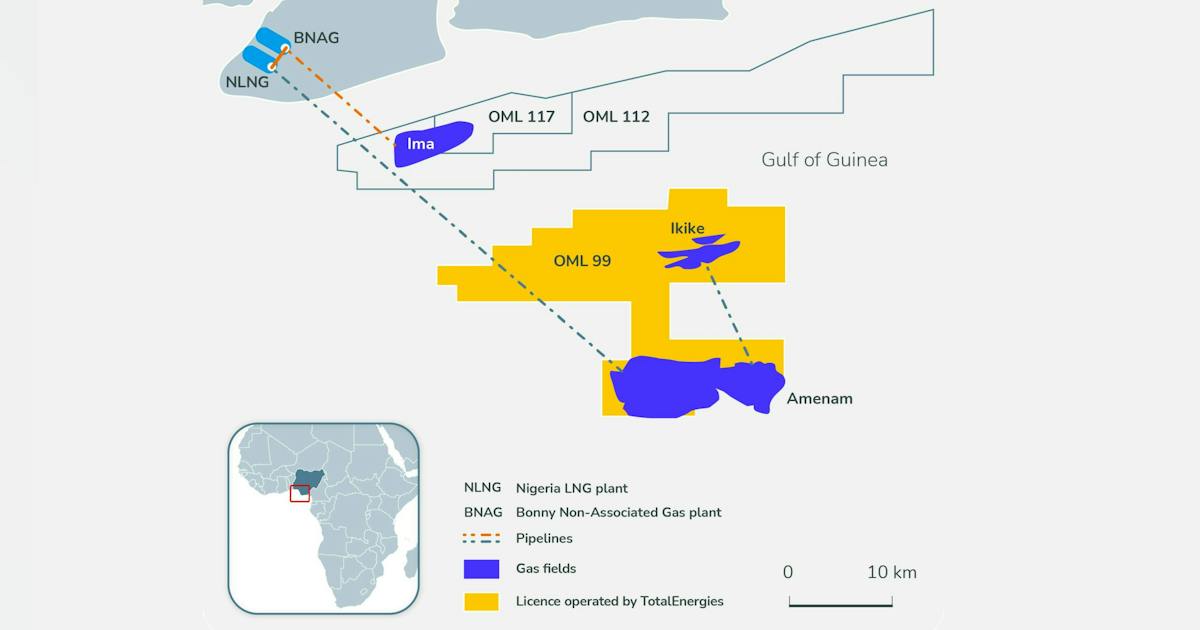
TotalEnergies EP Nigeria Ltd. has taken final investment decision (FID) to develop Ima gas field, which straddles the OML 112 and OML 117 offshore licenses in Nigeria, with partner Amni International Petroleum Development Co. Ltd. (Amni), targeting gas resources discovered alongside the original Ima oil accumulation. The project has an estimated development cost of US$1.108 billion and independently confirmed gross reserves of about 1.28 tcf of non-associated gas. At plateau, it is designed to produce about 350 MMscfd (more than 60,000 boe/d) for at least 8 years, Amni said Sept. 23. The shallow-water Ima gas field near Bonny Island will be developed through a single platform tied to Nigeria LNG (TotalEnergies, 15%) by a 22-km pipeline, with power supplied from shore, no flaring, and permanent methane detection and monitoring. First gas is targeted for October 2028. Once on stream, the field is expected to supply about one-third of the gas required for the Nigeria LNG Train 7 expansion, which is expected to increase liquefaction capacity to 30 million tonnes/year (tpy) from 22 million tpy, TotalEnergies said in a separate release. The FID follows a 2024 heads of terms agreement and completion of technical, commercial, and contractual work, including front-end engineering design (FEED) and execution of project agreements, AMNI said. The project will now move into engineering, procurement, and construction. The decision marks another step in TotalEnergies’ gas strategy in Nigeria. “After the Ubeta project sanctioned in 2024 and expected to start-up next year, Ima demonstrates again our ability to unlock new low-cost and low-emissions gas resources, following the incentives introduced by the Nigerian Government for non-associated gas developments,” said Nicolas Terraz, president of exploration and production at TotalEnergies. TotalEnergies operates the project with a 40% interest. Amni holds 60%. Amni’s Nigerian portfolio contains more than 60 million bbl of oil

Read More »

Amazon-Generac Deal Puts Backup Power in the AI Infrastructure Spotlight

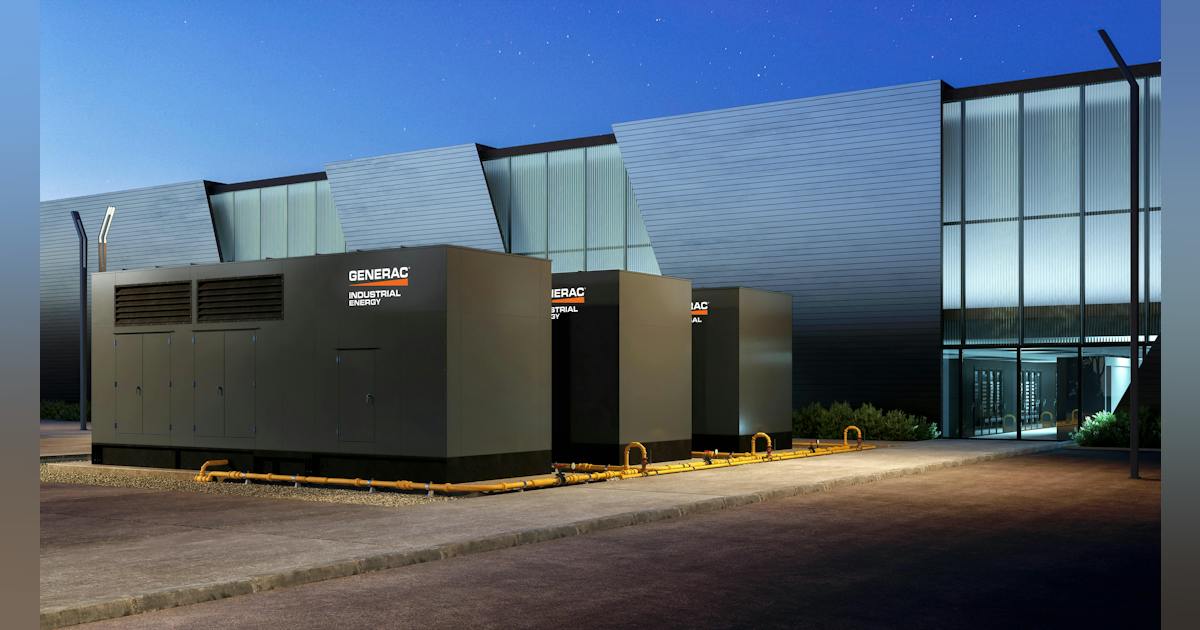
Amazon has struck a long-term supply agreement with Generac for backup generators supporting its data center buildout, tying one of the cloud industry’s largest infrastructure programs to a manufacturer that has been rapidly expanding into the hyperscale power market. Under the agreement disclosed in a Sept. 16 regulatory filing, Generac expects initial deliveries to Amazon totaling approximately $2.4 billion during 2027 and 2028. The commercial relationship could ultimately involve as much as $8 billion in qualifying generator purchases. The agreement also gives Amazon an equity interest in Generac’s success. Generac issued Amazon.com NV Investment Holdings a warrant to acquire as many as 1.69 million Generac shares at an exercise price of approximately $200.93 per share. About 308,000 shares vested when the agreement was signed, with additional tranches vesting as Amazon’s purchases increase. The warrant remains exercisable through September 2033. The distinction is important: the frequently cited $8 billion figure represents potential cumulative payments by Amazon for backup power generators, rather than an $8 billion equity investment. The maximum warrant covers roughly $340 million of Generac stock at the stated exercise price. CNBC first highlighted the equity component of the transaction, reporting that Generac shares surged more than 40% in extended trading following disclosure of the agreement. The shares ultimately gained about 18% during the following regular trading session. Generac Was Already Scaling for the Data Center Market For the data center industry, however, the more consequential part of the transaction may be the size and duration of Amazon’s equipment commitment. Generac has spent much of the past two years positioning itself as an alternative large-megawatt generator supplier as AI infrastructure development puts pressure on established power-equipment supply chains. DCF previously examined Generac’s push into hyperscale backup power, including its effort to shorten generator lead times and support campuses requiring hundreds

Read More »

Executive Roundtable: Speed Without Compromise

Matt Vincent is Editor in Chief of Data Center Frontier, where he leads editorial strategy and coverage focused on the infrastructure powering cloud computing, artificial intelligence, and the digital economy. A veteran B2B technology journalist with more than two decades of experience, Vincent specializes in the intersection of data centers, power, cooling, and emerging AI-era infrastructure. Since assuming the EIC role in 2023, he has helped guide Data Center Frontier’s coverage of the industry’s transition into the gigawatt-scale AI era, with a focus on hyperscale development, behind-the-meter power strategies, liquid cooling architectures, and the evolving energy demands of high-density compute, while working closely with the Digital Infrastructure Group at Endeavor Business Media to expand the brand’s analytical and multimedia footprint. Vincent also hosts The Data Center Frontier Show podcast, where he interviews industry leaders across hyperscale, colocation, utilities, and the data center supply chain to examine the technologies and business models reshaping digital infrastructure. Since its inception he serves as Head of Content for the Data Center Frontier Trends Summit. Before becoming Editor in Chief, he served in multiple senior editorial roles across Endeavor Business Media’s digital infrastructure portfolio, with coverage spanning data centers and hyperscale infrastructure, structured cabling and networking, telecom and datacom, IP physical security, and wireless and Pro AV markets. He began his career in 2005 within PennWell’s Advanced Technology Division and later held senior editorial positions supporting brands such as Cabling Installation & Maintenance, Lightwave Online, Broadband Technology Report, and Smart Buildings Technology. Vincent is a frequent moderator, interviewer, and keynote speaker at industry events including the HPC Forum, where he delivers forward-looking analysis on how AI and high-performance computing are reshaping digital infrastructure. He graduated with honors from Indiana University Bloomington with a B.A. in English Literature and Creative Writing and lives in southern New Hampshire with

Read More »

Floating Data Centers Move Toward Infrastructure Scale

Rather than constructing the building sequentially on a conventional site, Samsung can fabricate the floating structure and integrate much of the electrical, mechanical and cooling infrastructure in a shipyard. Site work at the eventual mooring location can proceed simultaneously. This has the potential to compress one of the longest parts of the data center development schedule. Modern shipyards already operate as enormous industrialized manufacturing environments capable of constructing highly complex LNG carriers, offshore production platforms and other structures containing power generation, electrical distribution, piping, controls and mechanical systems. Adding a floating data center effectively applies those capabilities to digital infrastructure. Samsung and Mousterian describe the facility as being fabricated off-site to shipyard standards. Instead of pouring foundations and constructing a data center building around the infrastructure, the facility becomes a manufactured asset that can be transported to its operating location. Samsung has also been building a broader development ecosystem around floating data centers. In June, the shipbuilder signed agreements with Greece-based Capital and Lloyd’s Register covering project development, investment sourcing and regulatory requirements, while LR Advisory is working with Samsung on North American market analysis, infrastructure assessments and commercial feasibility. Samsung also entered a joint development project with Supermicro to validate AI server infrastructure for offshore conditions, where vibration, vessel inclination, salt-laden air and rapid humidity changes can affect equipment reliability and lifespan. Samsung says it will develop positioning-control and salt- and humidity-protection technologies while Supermicro conducts operational verification of AI server infrastructure in river and marine environments. Unlocking Power That Data Centers Can’t Reach Mousterian’s model also addresses perhaps the biggest constraint facing today’s data center industry: power. The facilities are intended to be positioned near existing generation and maritime infrastructure, allowing them to reach electrical capacity that may be difficult to serve through a conventional land-based development. The

Read More »

Roundtable: Redefining Critical Infrastructure

Matt Vincent is Editor in Chief of Data Center Frontier, where he leads editorial strategy and coverage focused on the infrastructure powering cloud computing, artificial intelligence, and the digital economy. A veteran B2B technology journalist with more than two decades of experience, Vincent specializes in the intersection of data centers, power, cooling, and emerging AI-era infrastructure. Since assuming the EIC role in 2023, he has helped guide Data Center Frontier’s coverage of the industry’s transition into the gigawatt-scale AI era, with a focus on hyperscale development, behind-the-meter power strategies, liquid cooling architectures, and the evolving energy demands of high-density compute, while working closely with the Digital Infrastructure Group at Endeavor Business Media to expand the brand’s analytical and multimedia footprint. Vincent also hosts The Data Center Frontier Show podcast, where he interviews industry leaders across hyperscale, colocation, utilities, and the data center supply chain to examine the technologies and business models reshaping digital infrastructure. Since its inception he serves as Head of Content for the Data Center Frontier Trends Summit. Before becoming Editor in Chief, he served in multiple senior editorial roles across Endeavor Business Media’s digital infrastructure portfolio, with coverage spanning data centers and hyperscale infrastructure, structured cabling and networking, telecom and datacom, IP physical security, and wireless and Pro AV markets. He began his career in 2005 within PennWell’s Advanced Technology Division and later held senior editorial positions supporting brands such as Cabling Installation & Maintenance, Lightwave Online, Broadband Technology Report, and Smart Buildings Technology. Vincent is a frequent moderator, interviewer, and keynote speaker at industry events including the HPC Forum, where he delivers forward-looking analysis on how AI and high-performance computing are reshaping digital infrastructure. He graduated with honors from Indiana University Bloomington with a B.A. in English Literature and Creative Writing and lives in southern New Hampshire with

Read More »

How Communities Can Plan for AI Data Centers Before the Projects Arrive

The collision between AI infrastructure development and community opposition has become one of the defining data center stories of 2026. Developers are pursuing larger campuses, more power and compressed delivery schedules as AI accelerates demand for computing capacity. Meanwhile, local planning boards, elected officials and residents are increasingly being asked to make decisions about facilities whose scale, energy requirements and technological purpose may be unlike anything previously contemplated in their comprehensive plans. That gap is where Ilissa Miller believes much of the conflict begins. Miller, founder and CEO of iMiller Public Relations and a board member of the Open Infrastructure Exchange (OIX), joined the Data Center Frontier Show to discuss the OIX Digital Infrastructure Framework, an effort designed to give municipalities a more systematic way to think about data centers and other digital infrastructure before an individual development application lands in front of them. The idea is straightforward: communities routinely create long-range plans defining where homes, commercial development, industry and other land uses should go. Digital infrastructure should be part of that process as well. “Our vision for the framework was to help solve the problem by empowering communities to think about digital infrastructure,” Miller said, so municipalities can incorporate it into their comprehensive master plans and maintain control over how land is ultimately used. That distinction is key. The framework is not intended to convince communities to approve data centers. Nor does it prescribe what a town or county should decide. Instead, Miller said, it is meant to help public officials ask the right questions early enough to make those decisions deliberately. The Data Center May Not Be in the Plan One of the industry’s recurring problems is deceptively basic: many municipalities never anticipated data centers when writing their zoning codes and comprehensive plans. A parcel might already be

Read More »

Executive Roundtable: AI Infrastructure Under Pressure

Matt Vincent is Editor in Chief of Data Center Frontier, where he leads editorial strategy and coverage focused on the infrastructure powering cloud computing, artificial intelligence, and the digital economy. A veteran B2B technology journalist with more than two decades of experience, Vincent specializes in the intersection of data centers, power, cooling, and emerging AI-era infrastructure. Since assuming the EIC role in 2023, he has helped guide Data Center Frontier’s coverage of the industry’s transition into the gigawatt-scale AI era, with a focus on hyperscale development, behind-the-meter power strategies, liquid cooling architectures, and the evolving energy demands of high-density compute, while working closely with the Digital Infrastructure Group at Endeavor Business Media to expand the brand’s analytical and multimedia footprint. Vincent also hosts The Data Center Frontier Show podcast, where he interviews industry leaders across hyperscale, colocation, utilities, and the data center supply chain to examine the technologies and business models reshaping digital infrastructure. Since its inception he serves as Head of Content for the Data Center Frontier Trends Summit. Before becoming Editor in Chief, he served in multiple senior editorial roles across Endeavor Business Media’s digital infrastructure portfolio, with coverage spanning data centers and hyperscale infrastructure, structured cabling and networking, telecom and datacom, IP physical security, and wireless and Pro AV markets. He began his career in 2005 within PennWell’s Advanced Technology Division and later held senior editorial positions supporting brands such as Cabling Installation & Maintenance, Lightwave Online, Broadband Technology Report, and Smart Buildings Technology. Vincent is a frequent moderator, interviewer, and keynote speaker at industry events including the HPC Forum, where he delivers forward-looking analysis on how AI and high-performance computing are reshaping digital infrastructure. He graduated with honors from Indiana University Bloomington with a B.A. in English Literature and Creative Writing and lives in southern New Hampshire with

Read More »

Microsoft will invest $80B in AI data centers in fiscal 2025

And Microsoft isn’t the only one that is ramping up its investments into AI-enabled data centers. Rival cloud service providers are all investing in either upgrading or opening new data centers to capture a larger chunk of business from developers and users of large language models (LLMs).  In a report published in October 2024, Bloomberg Intelligence estimated that demand for generative AI would push Microsoft, AWS, Google, Oracle, Meta, and Apple would between them devote $200 billion to capex in 2025, up from $110 billion in 2023. Microsoft is one of the biggest spenders, followed closely by Google and AWS, Bloomberg Intelligence said. Its estimate of Microsoft’s capital spending on AI, at $62.4 billion for calendar 2025, is lower than Smith’s claim that the company will invest $80 billion in the fiscal year to June 30, 2025. Both figures, though, are way higher than Microsoft’s 2020 capital expenditure of “just” $17.6 billion. The majority of the increased spending is tied to cloud services and the expansion of AI infrastructure needed to provide compute capacity for OpenAI workloads. Separately, last October Amazon CEO Andy Jassy said his company planned total capex spend of $75 billion in 2024 and even more in 2025, with much of it going to AWS, its cloud computing division.

Read More »

John Deere unveils more autonomous farm machines to address skill labor shortage

Join our daily and weekly newsletters for the latest updates and exclusive content on industry-leading AI coverage. Learn More Self-driving tractors might be the path to self-driving cars. John Deere has revealed a new line of autonomous machines and tech across agriculture, construction and commercial landscaping. The Moline, Illinois-based John Deere has been in business for 187 years, yet it’s been a regular as a non-tech company showing off technology at the big tech trade show in Las Vegas and is back at CES 2025 with more autonomous tractors and other vehicles. This is not something we usually cover, but John Deere has a lot of data that is interesting in the big picture of tech. The message from the company is that there aren’t enough skilled farm laborers to do the work that its customers need. It’s been a challenge for most of the last two decades, said Jahmy Hindman, CTO at John Deere, in a briefing. Much of the tech will come this fall and after that. He noted that the average farmer in the U.S. is over 58 and works 12 to 18 hours a day to grow food for us. And he said the American Farm Bureau Federation estimates there are roughly 2.4 million farm jobs that need to be filled annually; and the agricultural work force continues to shrink. (This is my hint to the anti-immigration crowd). John Deere’s autonomous 9RX Tractor. Farmers can oversee it using an app. While each of these industries experiences their own set of challenges, a commonality across all is skilled labor availability. In construction, about 80% percent of contractors struggle to find skilled labor. And in commercial landscaping, 86% of landscaping business owners can’t find labor to fill open positions, he said. “They have to figure out how to do

Read More »

2025 playbook for enterprise AI success, from agents to evals

Join our daily and weekly newsletters for the latest updates and exclusive content on industry-leading AI coverage. Learn More 2025 is poised to be a pivotal year for enterprise AI. The past year has seen rapid innovation, and this year will see the same. This has made it more critical than ever to revisit your AI strategy to stay competitive and create value for your customers. From scaling AI agents to optimizing costs, here are the five critical areas enterprises should prioritize for their AI strategy this year. 1. Agents: the next generation of automation AI agents are no longer theoretical. In 2025, they’re indispensable tools for enterprises looking to streamline operations and enhance customer interactions. Unlike traditional software, agents powered by large language models (LLMs) can make nuanced decisions, navigate complex multi-step tasks, and integrate seamlessly with tools and APIs. At the start of 2024, agents were not ready for prime time, making frustrating mistakes like hallucinating URLs. They started getting better as frontier large language models themselves improved. “Let me put it this way,” said Sam Witteveen, cofounder of Red Dragon, a company that develops agents for companies, and that recently reviewed the 48 agents it built last year. “Interestingly, the ones that we built at the start of the year, a lot of those worked way better at the end of the year just because the models got better.” Witteveen shared this in the video podcast we filmed to discuss these five big trends in detail. Models are getting better and hallucinating less, and they’re also being trained to do agentic tasks. Another feature that the model providers are researching is a way to use the LLM as a judge, and as models get cheaper (something we’ll cover below), companies can use three or more models to

Read More »

OpenAI’s red teaming innovations define new essentials for security leaders in the AI era

Join our daily and weekly newsletters for the latest updates and exclusive content on industry-leading AI coverage. Learn More OpenAI has taken a more aggressive approach to red teaming than its AI competitors, demonstrating its security teams’ advanced capabilities in two areas: multi-step reinforcement and external red teaming. OpenAI recently released two papers that set a new competitive standard for improving the quality, reliability and safety of AI models in these two techniques and more. The first paper, “OpenAI’s Approach to External Red Teaming for AI Models and Systems,” reports that specialized teams outside the company have proven effective in uncovering vulnerabilities that might otherwise have made it into a released model because in-house testing techniques may have missed them. In the second paper, “Diverse and Effective Red Teaming with Auto-Generated Rewards and Multi-Step Reinforcement Learning,” OpenAI introduces an automated framework that relies on iterative reinforcement learning to generate a broad spectrum of novel, wide-ranging attacks. Going all-in on red teaming pays practical, competitive dividends It’s encouraging to see competitive intensity in red teaming growing among AI companies. When Anthropic released its AI red team guidelines in June of last year, it joined AI providers including Google, Microsoft, Nvidia, OpenAI, and even the U.S.’s National Institute of Standards and Technology (NIST), which all had released red teaming frameworks. Investing heavily in red teaming yields tangible benefits for security leaders in any organization. OpenAI’s paper on external red teaming provides a detailed analysis of how the company strives to create specialized external teams that include cybersecurity and subject matter experts. The goal is to see if knowledgeable external teams can defeat models’ security perimeters and find gaps in their security, biases and controls that prompt-based testing couldn’t find. What makes OpenAI’s recent papers noteworthy is how well they define using human-in-the-middle

Read More »