Stay Ahead, Stay ONMINE

Oak Ridge’s AI Factory Moment: Lux, Nuclear Power, and the Next Data Center Frontier

For much of its history, Oak Ridge has been associated with the Manhattan Project and the subsequent development of America’s nuclear research and production capabilities. Established during World War II, the community became home to major facilities for uranium enrichment, nuclear materials processing, scientific research, and ultimately high-performance computing. Today, that legacy is being repurposed […]

For much of its history, Oak Ridge has been associated with the Manhattan Project and the subsequent development of America’s nuclear research and production capabilities. Established during World War II, the community became home to major facilities for uranium enrichment, nuclear materials processing, scientific research, and ultimately high-performance computing.

Today, that legacy is being repurposed for a new generation of industrial development. The former K-25 uranium enrichment complex, once a critical part of the nation’s atomic weapons program, has been transformed into the East Tennessee Technology Park (ETTP), where extensive environmental cleanup and redevelopment have made former federal property available for commercial use.

At an October 27 gathering in Oak Ridge, federal officials and nuclear industry representatives highlighted more than $15 billion in announced nuclear-related projects across the region, an investment wave subsequently documented in a November 17 DOE report on Oak Ridge’s emerging energy hub. The investment figure largely represents planned private-sector development rather than completed capital spending. Regional officials also anticipate demand for thousands of construction workers over the next five years, with additional permanent manufacturing and operating positions potentially following as projects advance.

In March, DOE completed its largest Oak Ridge land transfer to date, conveying more than 700 acres for economic reuse. The transfer included a 624-acre parcel designated for Orano USA’s planned uranium enrichment complex and a 77-acre parcel associated with Oklo’s proposed nuclear fuel recycling development. Overall, more than 2,500 acres have been transferred from federal ownership for redevelopment, following decades of cleanup and the demolition of hundreds of former industrial structures.

For nuclear developers, the appeal is straightforward: large industrial sites, existing utility and transportation infrastructure, proximity to federal laboratories, and an established community of nuclear engineers, technicians, researchers, and specialized manufacturers.

For data center developers, the implications are somewhat different but no less relevant. Large AI campuses increasingly require industrial-scale sites with access to electrical infrastructure, water and cooling resources, and a workforce capable of constructing and maintaining highly specialized facilities. Brownfield redevelopment offers one potential alternative to entirely new industrial development, although it does not eliminate interconnection, environmental, or permitting requirements.

Oak Ridge’s advantage is not simply available land. It is the concentration of technical capabilities and energy-related industries taking shape around that land.

TVA’s Clinch River Project Marks a New Nuclear Milestone

One of the most consequential developments is occurring at TVA’s Clinch River Nuclear Site near Oak Ridge.

On September 29, 2026, the U.S. Nuclear Regulatory Commission (NRC) announced that it had approved a construction permit for Clinch River Unit 1, a planned 300-megawatt GE Vernova Hitachi BWRX-300 small modular reactor (SMR). As Reuters reported at the time, the decision represented a major regulatory milestone for the commercialization of smaller nuclear generating units. The permit was formally issued on September 28.

The NRC completed its review in approximately 14 months, ahead of its original schedule. The approval is especially important because it establishes a licensing precedent for a reactor design that utilities and developers hope can eventually be deployed in multiple locations using standardized engineering and modular construction techniques.

The BWRX-300 is based on established boiling-water reactor technology but incorporates a smaller generating unit and greater reliance on modular construction than conventional large nuclear plants. Its nominal 300-MW output could offer utilities a means of adding substantial firm generation capacity without undertaking the construction of a traditional gigawatt-scale reactor.

That prospect has obvious significance for utilities serving fast-growing data center markets. AI infrastructure projects are creating demand for continuous, reliable power at scales that can exceed the capacity available from existing local electrical systems.

However, a construction permit is not equivalent to an operating reactor. TVA must still make a final investment decision, complete construction, and secure a separate operating license before Clinch River can generate commercial electricity. In its November 2026 financial filing, TVA confirmed that it had not yet decided whether to proceed with construction.

The project has also become part of a much larger international nuclear investment discussion. In March, the United States and Japan announced a proposed strategic investment initiative involving up to $40 billion in GE Vernova Hitachi BWRX-300 projects in Tennessee and Alabama. The prospective development would encompass approximately 3 GW of generation, equivalent to ten 300-MW reactor units.

Federal officials have discussed the potential for additional reactor development in Tennessee and at TVA’s Bellefonte site in Alabama. Those plans remain prospective and should not be confused with fully financed or approved construction projects. The $40 billion initiative also falls outside the approximately $15 billion in regional nuclear projects highlighted at the October Oak Ridge event.

Nevertheless, the proposal illustrates the scale of interest in creating a repeatable SMR deployment model that could eventually support expanding industrial and computing loads across the TVA service territory.

Kairos Power Connects Advanced Nuclear Development to Google’s AI Infrastructure

While Clinch River represents an evolutionary approach to commercial nuclear generation, another Oak Ridge development is pursuing a more unconventional reactor technology with a direct connection to hyperscale data center energy procurement.

In April 2026, Kairos Power broke ground on its Hermes 2 Demonstration Plant at the former K-33 uranium enrichment site. The project is the company’s first power-producing reactor deployment and a central component of its agreement with Google to develop advanced nuclear generating capacity.

Hermes 2 is designed to provide up to 50 MW of electricity to the TVA grid, helping support Google’s data center operations in Tennessee and Alabama. Under the arrangement, TVA will purchase the electricity generated by the plant, with Google supporting the commercial development of the advanced nuclear technology.

The project is scheduled to begin operations in 2030, although that timeline remains subject to successful construction, licensing, testing, and commissioning.

As Data Center Frontier previously examined in David Chernicoff and Matt Vincent’s Google Backs Advanced Nuclear at TVA’s Clinch River as ORNL Pushes Quantum Frontiers, the arrangement reflects a growing convergence between hyperscale computing requirements and the development of advanced nuclear technologies.

Kairos is developing a fluoride salt-cooled, high-temperature reactor that uses TRISO fuel particles embedded in fuel pebbles. Rather than employing the pressurized water systems common to most existing commercial nuclear plants, the technology uses molten fluoride salt as a coolant.

Hermes 2 follows Hermes 1, a low-power demonstration reactor also under construction at Oak Ridge. Together, the projects are intended to establish the technical and operating foundation for larger commercial deployments.

Kairos is also investigating construction approaches that could influence the economics of future nuclear development, including factory-built components, modular assembly, precast concrete structures, and seismic isolation systems. Components are being manufactured at the company’s Albuquerque, New Mexico, campus before shipment to Tennessee.

The significance for Google and the broader data center industry lies in the commercial structure as much as the reactor technology. Hyperscalers are increasingly becoming participants in the development of new generating resources, helping support projects whose capital costs and development risks historically would have been carried primarily by utilities and energy companies.

At the same time, the distinction between contracted nuclear energy and physically dedicated generation remains important. Hermes 2 is not a standalone plant supplying a single isolated Google data center. Its electricity will enter the TVA system, supporting a broader regional grid that serves Google’s facilities alongside other customers.

Rebuilding the Nuclear Fuel Supply Chain

The expansion of advanced nuclear generation depends on another capability now receiving substantial investment around Oak Ridge: the domestic production of nuclear fuel.

Many proposed small modular reactors and microreactors require high-assay low-enriched uranium (HALEU), enriched to higher concentrations than the fuel typically used in conventional U.S. commercial nuclear reactors. Domestic production capacity remains limited, creating potential bottlenecks for reactor developers seeking to move from demonstration projects into commercial deployment.

The challenge extends beyond HALEU. According to the U.S. Energy Information Administration’s 2025 Uranium Marketing Annual Report, U.S.-origin enrichment services accounted for only 23% of separative work units purchased by operators of American civilian nuclear reactors in 2025. Foreign enrichment facilities provided the remaining 77%, underscoring the country’s continued reliance on overseas capabilities.

Much of Oak Ridge’s latest industrial development is directed toward addressing that imbalance.

Orano, LIS Technologies, Centrus, and BWXT

Orano USA is developing Project IKE, a planned $5 billion uranium enrichment complex on the 624-acre parcel transferred by DOE. The proposed 750,000-square-foot development is intended to become one of North America’s largest enrichment operations.

DOE announced a $900 million award to Orano Federal Services earlier in 2026 to expand domestic low-enriched uranium production capacity. The NRC accepted the Project IKE license application for detailed technical review in May.

A more recent development illustrates the complexities of translating these investments into operating infrastructure. In November, the NRC’s projected completion of the technical review shifted from April to June 2027 after the regulator granted additional time for Orano to respond to requests for information. As Nuclear Newswire reported November 13, the adjustment represents approximately two months of additional licensing review. Orano has indicated that the revised review schedule is not expected to delay its target for initial enrichment operations in 2031, although that remains dependent on licensing and execution.

Other manufacturers are advancing projects of their own.

In January, LIS Technologies announced approximately $1.38 billion in planned investment for a laser uranium enrichment facility at the former K-25 site, a project expected to create about 203 jobs. The company is pursuing a commercial application of laser isotope separation technology.

Centrus Energy announced plans to invest more than $560 million in an expansion of its Oak Ridge centrifuge manufacturing operations, with nearly 430 additional jobs anticipated. On October 29, Centrus reached a tangible manufacturing milestone when it began shipping newly manufactured centrifuges from Oak Ridge to Ohio for its uranium enrichment expansion.

BWX Technologies (BWXT) added another element in January with the opening of its Centrifuge Manufacturing Development Facility, supporting a National Nuclear Security Administration program to rebuild domestic enrichment capabilities for national security purposes. The company is participating in a federal program valued at approximately $1.5 billion.

These projects illustrate how Oak Ridge is becoming a manufacturing center for technologies essential to the long-term expansion of nuclear generation, even when the eventual power plants will be located elsewhere.

TRISO-X, Standard Nuclear, and the Advanced Fuel Market

Advanced reactor development also depends on the ability to manufacture specialized fuels at commercial scale.

TRISO-X, an X-energy subsidiary, completed vertical construction of its 214,000-square-foot TX-1 fuel fabrication plant in September and moved into interior construction and equipment installation. Once operational, the facility is expected to manufacture approximately 700,000 TRISO fuel pebbles annually, equivalent to five metric tons of uranium and enough fuel to support as many as eleven Xe-100 reactors.

In February, the NRC granted TRISO-X a 40-year special nuclear material license covering its TX-1 and planned TX-2 facilities. The company has also expanded its Oak Ridge property holdings and announced further fuel manufacturing and research development, with Tennessee officials associating the broader expansion with more than 1,100 prospective jobs.

As Chernicoff has examined in DCF’s earlier feature, Nuclear’s Next AI Test: Building at Scale, reactor technology is only one component of the emerging nuclear infrastructure equation. Commercializing advanced nuclear generation will also require fuel supply, manufacturing capacity, licensing, financing, and repeatable construction processes to develop in parallel.

Standard Nuclear is developing additional advanced fuel capacity in the same region. Construction is substantially complete at its new Oak Ridge production facility, with commissioning and authorization activities continuing. In its November 12 third-quarter update, the company reported progress toward a February 2027 target for DOE authorization to operate its new Tennessee and Idaho plants. Its existing Oak Ridge operation already manufactures TRISO fuel, and the company has established relationships with reactor developers including Radiant and Antares.

The downstream connections to data center power are beginning to emerge. Equinix has signed a preorder agreement for 20 of Radiant’s planned Kaleidos microreactors, each designed to provide approximately 1 MW of electricity. Radiant announced a $280 million investment in 2025 to establish microreactor manufacturing and research operations in Oak Ridge, and is targeting expanded local assembly operations by late 2028.

Radiant is also participating in a significant federal microreactor initiative. In August, the company announced a U.S. Army agreement valued at up to $750 million under the Janus program, tied to development and deployment milestones for its Kaleidos units.

Although these compact reactors are not intended to replace the large power systems serving hyperscale campuses, they could eventually provide options for remote facilities, military installations, specialized industrial loads, and applications requiring resilient localized generation.

Oklo’s Nuclear Fuel Recycling Ambitions

Oklo is pursuing a different part of the nuclear fuel cycle, with plans for an advanced fuel center involving investment of up to $1.68 billion at Oak Ridge.

The company has identified approximately 250 acres at the East Tennessee Technology Park for the proposed development, including property transferred from DOE to the community. The facility is intended to recover usable nuclear materials and support fuel production for Oklo’s Aurora reactor technology and potentially other advanced nuclear systems.

Oklo has also been pursuing power arrangements with data center operators and other large electricity customers. Its recycling initiative adds another dimension to Oak Ridge’s industrial development, connecting proposed reactor deployments with the longer-term challenge of fuel availability and management.

The broader significance is that Oak Ridge is assembling several components of an advanced nuclear supply chain within one region: enrichment technology, centrifuge manufacturing, specialized fuel fabrication, microreactor manufacturing, and potential fuel recycling.

Whether this industrial concentration can substantially accelerate commercial reactor deployment remains an open question. But the underlying capabilities address constraints that will matter increasingly as utilities and data center developers look toward nuclear energy for future capacity.

DOE Opens the Door to Commercial AI Data Centers at Oak Ridge

Alongside the nuclear investment, DOE is pursuing a separate initiative that could bring privately operated AI data centers directly onto federal property at Oak Ridge.

In September 2025, the department issued a request for proposals seeking private-sector partners interested in developing AI data centers and associated energy infrastructure on portions of the Oak Ridge Reservation. Two locations were identified: one at the East Tennessee Technology Park and another adjacent to Oak Ridge National Laboratory.

Oak Ridge was one of four DOE locations selected nationally for potential AI data center development, alongside Idaho National Laboratory, the Paducah Gaseous Diffusion Plant, and the Savannah River Site.

The prospective arrangements would place responsibility for financing, permitting, construction, operations, and eventual decommissioning on commercial developers. Those companies would also need to establish the necessary utility interconnection and power supply arrangements.

DOE has not publicly identified a developer selected for either Oak Ridge location.

That qualification matters. The designation of federal land for potential AI infrastructure development is not equivalent to a committed data center construction project, nor does it establish the availability of sufficient electrical capacity.

Still, the initiative represents a potentially important expansion of Oak Ridge’s role. The region could become not only a research and manufacturing center for energy technologies used by data centers, but also a location for large-scale commercial computing facilities themselves.

ORNL Builds a Research Center for the Next Generation of Data Centers

The regional transformation is also taking place inside Oak Ridge National Laboratory.

In February 2026, ORNL launched its Next-Generation Data Centers Institute, an initiative specifically intended to address the technical challenges arising from the rapid growth of AI computing infrastructure.

The institute brings together researchers working in electrical engineering, thermal management, grid science, cybersecurity, materials, and high-performance computing. Tom King, a longtime leader in electric grid research, was appointed its director in July.

Unlike research programs focused principally on semiconductor or processor performance, the institute is examining the computing facility as an integrated energy system.

That distinction is increasingly important for AI data centers. Modern rack-scale computing systems are pushing cooling, power distribution, and facility design requirements well beyond those of traditional enterprise computing environments. Direct-to-chip liquid cooling, high-capacity coolant distribution networks, higher-voltage electrical architectures, and more sophisticated control systems are moving toward the center of facility engineering.

ORNL’s existing supercomputing infrastructure offers a valuable environment for studying those challenges.

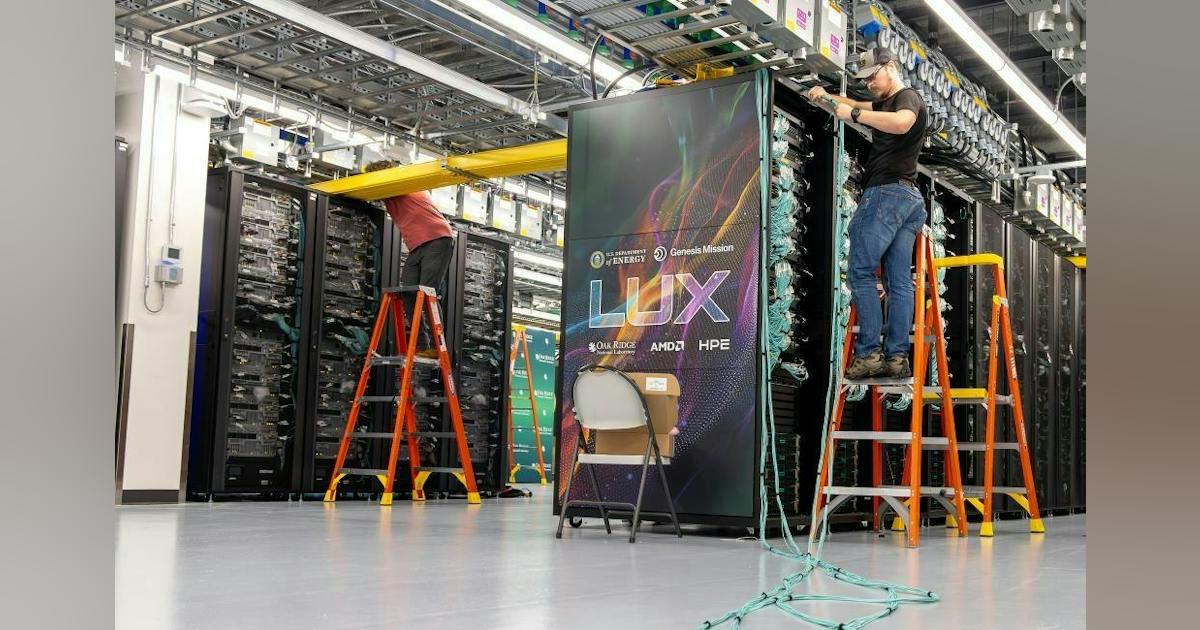
Frontier, the laboratory’s exascale supercomputer, already provides extensive experience with large-scale high-performance computing operations and liquid cooling. Lux adds another AI-oriented platform with substantial GPU capacity, direct-liquid-cooled server infrastructure, and advanced Ethernet networking.

The Next-Generation Data Centers Institute is investigating cooling techniques that include direct-to-chip and two-phase liquid systems, improved thermal recovery, and methods of coordinating facility cooling operations with computing workloads. It is also examining how increasingly large computing loads can interact more flexibly with electrical networks.

For commercial data center operators, these are practical research questions. Higher rack densities have made cooling and power distribution fundamental determinants of achievable computing capacity. At the same time, utilities are looking for ways to accommodate large, concentrated electrical loads without undermining grid reliability or imposing excessive infrastructure costs.

The institute’s work could help establish approaches for connecting workload scheduling, thermal management, and electricity consumption more directly to grid conditions.

Lux and the institute are distinct initiatives, but together they illustrate an important shift: AI infrastructure is becoming both the object of scientific research and a tool for conducting that research.

Fusion Adds Another Long-Term Energy Dimension

Oak Ridge’s energy research ambitions also extend into fusion technology, although commercial deployment remains considerably further away than the nuclear fission projects currently under development.

In August, ORNL and Kyoto Fusioneering announced plans to establish UNITY-3, an advanced fusion breeding blanket test facility in East Tennessee. Kyoto Fusioneering is relocating its U.S. headquarters to Tennessee as part of the collaboration.

The project will investigate technologies intended to capture energy from fusion reactions and support the production of tritium fuel, addressing engineering challenges that must be resolved before fusion can become a practical commercial energy source.

The collaboration combines ORNL’s expertise in materials science, neutron research, and high-performance computing with advanced fusion engineering capabilities. AI-enabled modeling and digital twin techniques will also support development and analysis.

Fusion should not be regarded as a near-term solution for data center power demand. However, its inclusion in the expanding Oak Ridge research ecosystem underscores the region’s longer-term role in developing technologies that could eventually influence industrial energy systems.

Workforce Development Becomes a Critical Constraint

The region’s growing concentration of nuclear projects presents a substantial workforce challenge.

In October, Oak Ridge Associated Universities (ORAU) released its East Tennessee Nuclear Workforce Demand Assessment, projecting that employment among participating nuclear industry companies could increase from approximately 17,000 workers to 21,000 by 2032.

The assessment identified potential shortages in several occupations, including nuclear reactor operators, chemical plant operators, electricians, pipefitters, and production supervisors. Construction labor demand is expected to become especially pronounced around the end of the decade, while the need for specialized operating personnel will continue beyond that period.

The problem is familiar to data center developers. Large AI campuses require many of the same skilled trades and technical professionals needed to construct nuclear facilities, electrical substations, manufacturing plants, and other industrial infrastructure.

Electricians, mechanical contractors, controls specialists, commissioning professionals, and experienced project managers are already important constraints on large data center construction schedules.

The concentration of new nuclear projects around Oak Ridge could intensify competition for these workers even as regional institutions seek to expand training capacity.

That challenge prompted another significant development on November 18, when the U.S. Department of Commerce and Tennessee announced a new nuclear workforce partnership. Under the arrangement, the state will align more than $12 million in workforce training funds with broader federal nuclear workforce development efforts, while the Economic Development Administration intends to provide a $750,000 technical-assistance grant.

Regional institutions, including the University of Tennessee, Roane State Community College, ORAU, and other technical education providers, are also expanding their involvement in workforce preparation.

Kairos Power’s Nuclear Center for Advanced Manufacturing and Precast initiative brings together the company, ORNL, educational institutions, construction organizations, and regional schools to investigate advanced manufacturing techniques and train workers for the construction of nuclear facilities.

These initiatives could improve the region’s capacity to deliver complex energy projects. In the near term, however, the pace of announced development may continue to exceed the available supply of qualified personnel.

Power Availability Remains the Central Development Question

The most important limitation facing Oak Ridge’s emergence as an AI infrastructure center is also the challenge confronting the broader data center industry: when sufficient electricity will actually become available.

TVA’s 2026 Integrated Resource Plan, approved by the utility’s board in August, identifies a potential need for approximately 11 GW to 32 GW of additional generating capacity through 2040, depending on future demand and resource assumptions.

The utility is pursuing a combination of natural gas generation, storage, solar power, demand-side resources, and longer-term nuclear technologies. The strategy reflects the practical reality that different technologies operate on very different development schedules.

New natural gas generation and grid infrastructure may be capable of addressing some nearer-term requirements. Large-scale nuclear development, including SMRs now advancing through regulatory and demonstration stages, is generally associated with longer construction and commercialization timelines.

For AI data center developers seeking electricity within the next two or three years, many of Oak Ridge’s proposed advanced nuclear projects will not provide an immediate answer.

This is a crucial distinction in evaluating the region’s prospects. Announced generating capacity is not the same as available capacity, and an approved reactor design does not automatically translate into electrical service for a commercial facility.

Transmission infrastructure, utility interconnection, financing, equipment availability, environmental requirements, and workforce capacity remain important variables.

As Chernicoff and Vincent have previously emphasized in DCF’s Nuclear Momentum Meets the Megawatt Test, the industry’s next challenge is not simply announcing nuclear projects, but converting regulatory approvals, investment commitments, demonstration systems, and fuel development into reliable commercial generation.

Even the DOE initiative to make federal property available for private AI data center development must contend with those requirements. A suitable industrial site does not necessarily come with the power capacity required to support a substantial computing campus.

The opportunity at Oak Ridge is therefore best understood as a long-term industrial and technological development rather than an immediate solution to the AI industry’s power constraints.

What Oak Ridge Means for the Next Data Center Frontier

For much of the data center industry’s history, facility operators could assume that electric utilities would provide sufficient power to support development, allowing data center engineering to concentrate principally on reliability, efficiency, computing capacity, and mechanical infrastructure.

The scale of modern AI computing is challenging that separation.

Hyperscalers and other large operators are increasingly participating in discussions about new generation projects, transmission expansion, energy procurement, fuel availability, and the operation of large electrical networks. At the same time, advanced nuclear developers are looking toward data centers as potential long-term customers capable of supporting substantial capital investment.

Oak Ridge offers an unusually concentrated example of these developments coming together.

The region now hosts operational AI and exascale computing infrastructure, advanced nuclear demonstration projects under construction, commercial fuel manufacturing expansion, proposed microreactor facilities, prospective nuclear recycling operations, and a federal initiative to attract private AI data centers onto DOE property.

The opening of Lux is significant because it adds another tangible computing capability to that ecosystem. The system is operational today, unlike many of the proposed energy projects whose commercial impact will depend on years of construction, licensing, and investment decisions.

The significance of Oak Ridge may ultimately have less to do with how many commercial AI data centers are built within its boundaries than with how many of the technologies used to power, cool, connect, and operate data centers elsewhere are developed and demonstrated there.

Advanced cooling architectures, grid-responsive computing, modular nuclear generation, high-performance networking, and domestic fuel manufacturing all address constraints that increasingly determine where and how AI infrastructure can expand.

Oak Ridge is beginning this transition with something many proposed energy and computing hubs lack: a long-established foundation of scientific research, industrial infrastructure, specialized manufacturing, and institutional experience.

The community that helped establish the technological foundations of the nuclear age is now positioning itself to influence another industrial transformation.

With Lux joining Frontier at the center of its computing infrastructure, Oak Ridge is demonstrating that the relationship between energy and artificial intelligence runs in both directions: AI requires increasingly sophisticated power and cooling systems, while AI itself is becoming a tool for developing the energy technologies that may eventually support its continued expansion.

For the data center industry, that convergence may prove to be Oak Ridge’s most important contribution to the next frontier of digital infrastructure.


Shape
Shape
Stay Ahead

Explore More Insights

Stay ahead with more perspectives on cutting-edge power, infrastructure, energy,  bitcoin and AI solutions. Explore these articles to uncover strategies and insights shaping the future of industries.

Shape

Critical flaw in VMware vCenter allows authentication bypass

Customers using the VMware Telco Cloud Platform and Infrastructure, also affected, should consult KB463116 for remediation instructions. The remaining four issues are: SDDC Manager SQL-injection vulnerability (CVE-2026-123891), rated 8.1 (Important) in severity; SDDC Manager authenticated command-injection vulnerability (CVE-2026-123892), rated 7.2 (Important); SDDC Manager local privilege-escalation vulnerability (CVE-2026-123893), rated 6.7 (Moderate),

Read More »

INPEX sanctions Ichthys LNG expansion project, awards contract

The INPEX Corp.-led Ichthys Joint Venture has sanctioned the next phase of development of the Ichthys LNG project offshore Western Australia and awarded a contract to a consortium of McDermott and Baker Hughes for part of the work. The development, designated Phase 2c Part 1, includes five production wells targeting

Read More »

IEA sees potential for looser oil, LNG markets after Hormuz crisis

Global oil and natural gas markets could face a period of more abundant supply and lower prices once disruptions in the Middle East ease, although the timing and extent of any recovery remain uncertain, according to the International Energy Agency’s (IEA) World Energy Outlook 2026. The outlook points to sharply different demand trajectories depending on how governments respond to the 2026 energy crisis. Under IEA’s Stated Policies Scenario (STEPS), global oil demand levels off at around 103 million b/d by 2030 before declining gradually, while natural gas demand continues growing until the mid-2030s. Under the Current Policies Scenario (CPS), consumption of both fuels continues to increase. The projections assume that constraints on Gulf oil and gas exports will ease into 2027 and that conditions will allow unimpeded transit through the Strait of Hormuz by end-2027. IEA cautioned that the scenarios are not forecasts and that considerable uncertainty remains over the duration of the crisis and the future of Middle East exports. The disruption to energy flows through the Strait of Hormuz has resulted in cumulative losses of 2.8 billion bbl of oil and 60 billion cu m (bcm) of natural gas supply from the Gulf. At its peak, global oil supply fell by 16.1 million b/d from pre-conflict levels. Ample inventories, increased production and exports from non-Gulf suppliers, alternative export routes, and reduced Chinese crude imports helped cushion the initial impact. IEA member countries also coordinated the release of 400 million bbl of emergency oil stocks, announced Mar. 11, 2026. As inventories declined and supply disruptions continued, however, higher prices increasingly weighed on consumption. Diesel markets have been particularly strained, with prices exceeding $200/bbl amid disruptions to Middle Eastern product exports and reduced Russian supplies. IEA’s November 2026 Oil Market Report expects global oil demand to decline by around 2.7

Read More »

Phelan Green advances development of South African SAF complex

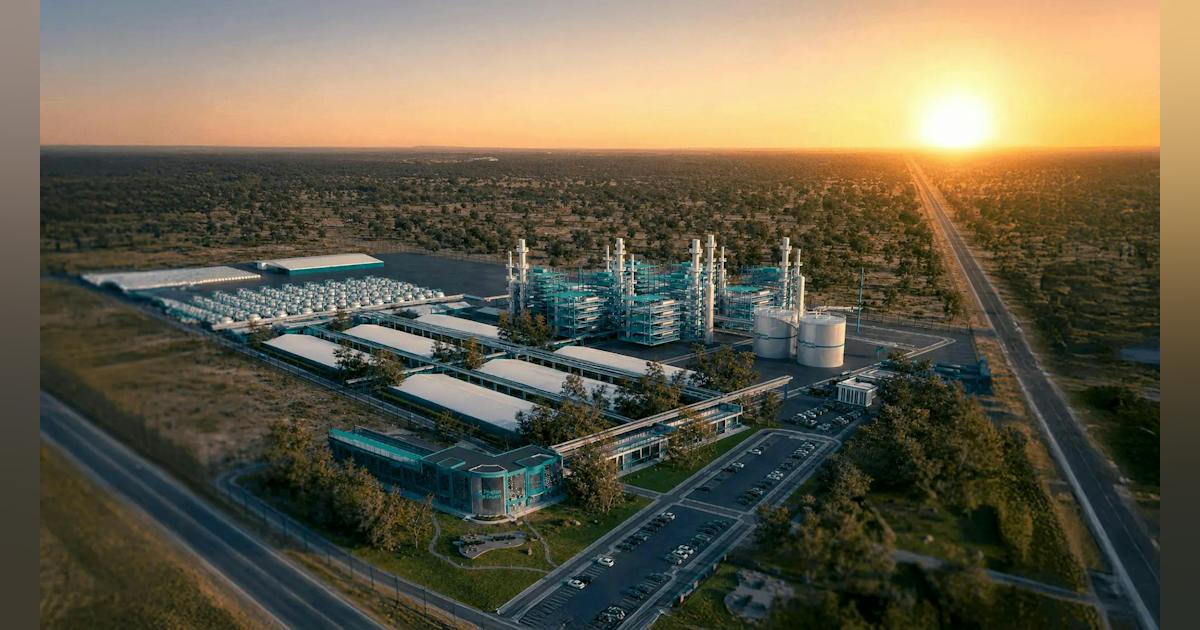
Privately held Phelan Green Group’s clean-fuels subsidiary Phelan eFuels has let a contract to Honeywell Technologies to deliver a suite of services to support the first-phase of its multi-phased electro sustainable aviation fuel (eSAF) production complex under development as part of the operator’s broader $2.5-billion Phelan Green Hydrogen project in Saldanha Bay, Western Cape, South Africa. As part of the contract, Honeywell Technologies will provide licensing for its proprietary Advanced Solvent Carbon Capture (ASCC) technology—a co-development of Honeywell UOP and the University of Texas (UT) at Austin—alongside modular engineering services for the Phase 1 eSAF plant on which Phelan Green recently took positive final investment decision to proceed, the service provider said in a release Nov. 18. The ASCC technology will enable the plant to capture carbon dioxide (CO2) from on-site flue gas which—under either scenario—will contribute to reduced CO2 emissions from the plant. This latest contract for the Phase 1 eSAF plant follows Phelan Green’s previous award earlier in the year to Honeywell UOP for licensing of its proprietary Fischer-Tropsch (FT) Unicracking process technology, which uses FT liquids and waxes made from CO2 to create eSAF that complies with aviation industry standards. Designed with a nameplate e-SAF production capacity of 35,000 tonnes/year (tpy) and scheduled to enter operation in third-quarter 2028, the Phase 1 plant supports Phelan Green’s goal of helping to establish South Africa as a competitive producer and exporter of lower-carbon aviation fuel in a process further streamlined by Honeywell Technologies’ integrated suite of technology, engineering, and equipment offerings, said Blair Phelan, Phelan Green’s managing director. The Phase 1 plant will also use Johnson Matthey PLC (JM) subsidiary JM Catalyst Technologies’ (JM CT) proprietary HyCOgen technology to catalytically convert CO2 and electrolytic (green) hydrogen into carbon monoxide (CO) that will be combined with hydrogen to form synthesis

Read More »

Grid operators need data center ride-through rules that protect reliability

Listen to the article 7 min This audio is auto-generated. Please let us know if you have feedback. Alan Cooper is CEO of ON.energy, a developer of power infrastructure.  On July 22, a mechanical failure forced a 230-kV transmission line in Northern Virginia offline. Within milliseconds, grid protection systems cleared the fault, as they are designed to do. The event would not have been a particularly noteworthy story, had it stopped there. It’s what happened next, though, that pointed to a growing challenge for grid reliability. Optional Caption Permission granted by Alan Cooper In response to the fault, data centers that had been drawing nearly 4 GW of energy, close to 4% of PJM’s load, collectively disconnected and switched to their on-site backup generation. The move sent voltage and frequency spiking across the system, a technically wonky but threatening result that caused power flickers as far away as Chicago. Thankfully, the prevailing grid conditions were strong enough to absorb the shock of the fault, so the grid held. But if the same event had hit Texas or even Northern Virginia at a time of higher demand, it could have caused a widespread outage. In West Texas, the Electric Reliability Counil of Texas estimates that a loss of as little as 3.2 GW could threaten grid reliability. The power sector is not unfamiliar with the need for things hooked up to the electricity grid to “ride through” disturbance events. In 2023, the Federal Energy Regulatory Commission told the North American Electricity Reliability Corp. to develop requirements that inverter-based supply resources like wind and solar facilities must follow to ensure they “ride through,” i.e., stay online, during certain disturbances. And this time around, NERC, FERC and several grid regions have been quick to identify a similar need for large loads to adhere

Read More »

Fuel constraints could challenge grid this winter, despite resource improvements: NERC

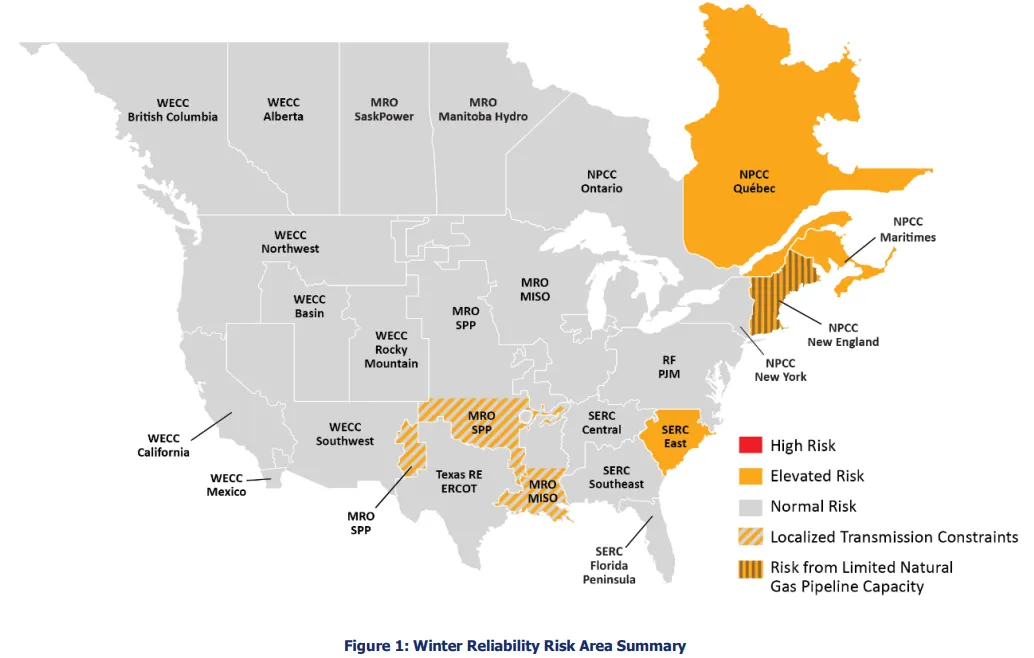
Listen to the article 3 min This audio is auto-generated. Please let us know if you have feedback. Dive Brief: The bulk power system’s winter reliability outlook has improved since last season, but the El Niño weather pattern and potential for extreme cold can present challenges that grid operators must remain aware of, the North American Electric Reliability Corp. said Wednesday in its annual seasonal outlook. On-peak capacity resources grew 26.2 GW over the 2025-26 winter, a 2.4% increase led by batteries and gas-fired generation, according to the 2026–2027 Winter Reliability Assessment. A slowdown in generator retirements is also contributing to the improved resource outlook, NERC said. The reliability watchdog’s outlook identified no areas facing a high risk of resource shortfalls this winter, but it found some areas in the Midwest, Southeast and New England where transmission system constraints, pipeline constraints and fuel risk scenarios may present problems during periods of extreme weather. Dive Insight: Electric demand is growing, but “there has also been strong growth in resources,” Mark Olson, manager of reliability assessments, said Wednesday in a call discussing the outlook. “In many ways, the industry is on better footing going into winter this year,” he said. However, Olson added that “historically, winter is the toughest operating period for the North American electric grid.”  While some models show the El Niño weather pattern can bring milder-than-average conditions that are a help to a constrained power system, “the reality is that extreme storms with ice and abnormal cold temperatures can lie within those averages,” Olson said. Retrieved from North American Electric Reliability Corp. “We’re talking to our industry stakeholders about the need for extra vigilance. El Niño is a variable that adds to uncertainty for the winter,” he said. Peak winter electric heating demand often coincides with higher residential gas usage,

Read More »

Energy Secretary Acts to Protect Mid-Atlantic Grid

WASHINGTON—U.S. Secretary of Energy Chris Wright issued an emergency order to reduce the risk of power outages and strengthen grid reliability across the mid-Atlantic region. The order permits PJM Interconnection, L.L.C. (PJM), in coordination with Talen Energy Corporation, to run Unit 4 at the Wagner Generating Station in Anne Arundel County, Maryland, to meet anticipated electricity demand. The order follows an application from PJM submitted on October 23, 2026.  “Energy shortfalls for 65 million Americans are simply unacceptable,” said U.S. Secretary of Energy Chris Wright.  “Previous orders in the mid-Atlantic region have helped keep the lights on and I’m confident this order will help do so in the coming months as well. Today’s order helps temporarily address the urgent need to strengthen grid reliability and ensure Americans across the mid-Atlantic region have access to affordable, reliable, and secure power, regardless of whether the sun shines or the wind blows.”   Secretary Wright previously granted PJM’s requests to operate Wagner Unit 4 beyond its operating limit to help maintain grid reliability.  PJM relied on Wagner Unit 4 during periods of unusually high temperatures earlier this summer, using the unit’s remaining operating hours. PJM has since reaffirmed to the Department of Energy (DOE) the continued need for Wagner Unit 4 to meet high electricity demand, strengthen grid reliability, and reduce the risk of power outages across the mid-Atlantic region.   The renewed order is effective from November 18, 2026, through December 31, 2026. 

Read More »

EIA: US crude oil inventories up 3.4 million bbl

US crude oil inventories for the week ended Nov. 13, excluding the Strategic Petroleum Reserve, increased by 3.4 million bbl from the previous week, according to data from the US Energy Information Administration (EIA). At 417.8 million bbl, US crude oil inventories are 3% below the 5-year average for this time of year, the EIA report indicated. Gasoline inventories increased 5.2 million bbl, 3% above the 5-year average. Propane-propylene inventories remained unchanged, 12% above the 5-year average. Total commercial petroleum inventories increased by 9.2 million bbl for the week. Distillate inventories increased 1.6 million bbl, 7% below the 5-year average. US crude oil refinery inputs averaged 16.9 million b/d for the week ended Nov. 13, which was 129,000 b/d less than the previous week’s average. Refineries operated at 95.7% of capacity. Gasoline output averaged 9.4 million b/d, and distillate production increased to 5.2 million b/d. Crude oil imports decreased 1.1 million b/d to 5.6 million b/d. The 4-week average of 6.3 million b/d is 13% above the year-ago level. Gasoline imports increased and averaged 533,000 b/d; distillate imports also increased and averaged 133,000 b/d. Over the past four weeks, total product supplied averaged 20.6 million b/d, down 0.3% year over year. The 4-week average for gasoline product supplied decreased 1.8% year over year to 8.7 million b/d, while the 4-week average for distillate product supplied increased 4.3% to 4.0 million b/d. The 4-week average for jet fuel product supplied increased 0.3% year over year.

Read More »

Oak Ridge’s AI Factory Moment: Lux, Nuclear Power, and the Next Data Center Frontier

For much of its history, Oak Ridge has been associated with the Manhattan Project and the subsequent development of America’s nuclear research and production capabilities. Established during World War II, the community became home to major facilities for uranium enrichment, nuclear materials processing, scientific research, and ultimately high-performance computing. Today, that legacy is being repurposed for a new generation of industrial development. The former K-25 uranium enrichment complex, once a critical part of the nation’s atomic weapons program, has been transformed into the East Tennessee Technology Park (ETTP), where extensive environmental cleanup and redevelopment have made former federal property available for commercial use. At an October 27 gathering in Oak Ridge, federal officials and nuclear industry representatives highlighted more than $15 billion in announced nuclear-related projects across the region, an investment wave subsequently documented in a November 17 DOE report on Oak Ridge’s emerging energy hub. The investment figure largely represents planned private-sector development rather than completed capital spending. Regional officials also anticipate demand for thousands of construction workers over the next five years, with additional permanent manufacturing and operating positions potentially following as projects advance. In March, DOE completed its largest Oak Ridge land transfer to date, conveying more than 700 acres for economic reuse. The transfer included a 624-acre parcel designated for Orano USA’s planned uranium enrichment complex and a 77-acre parcel associated with Oklo’s proposed nuclear fuel recycling development. Overall, more than 2,500 acres have been transferred from federal ownership for redevelopment, following decades of cleanup and the demolition of hundreds of former industrial structures. For nuclear developers, the appeal is straightforward: large industrial sites, existing utility and transportation infrastructure, proximity to federal laboratories, and an established community of nuclear engineers, technicians, researchers, and specialized manufacturers. For data center developers, the implications are somewhat different but no

Read More »

Dell and Microsoft drive private AI as enterprises seek greater data control

Dell Technologies and Microsoft are expanding their private cloud partnership with a new set of infrastructure offerings designed to let enterprises run AI models closer to their data, reduce reliance on public cloud services and maintain control over sensitive information. The announcement, made during Microsoft’s Ignite conference, extends Dell’s AI Factory with Nvidia initiative to Dell Private Cloud environments. It also reflects a growing industry push toward internally deployed AI inferencing, particularly among organizations dealing with sensitive corporate information, regulatory requirements and data residency restrictions, Dell stated. The expanded offering combines Dell Private Cloud, Microsoft Azure Local, Microsoft Foundry Local and Nvidia acceleration. The objective is to provide organizations with an integrated infrastructure for deploying heavy AI workloads inside their own data centers and firewalls, the companies said.

Read More »

StarlingX 13.0 updates the network stack for distributed edge deployments

Edge sites do not always come with the network gear that a data center takes for granted. That’s a challenge the open-source StarlingX project from the OpenInfra Foundation is now tackling in its 13.0 update. StarlingX is an open-source distributed cloud platform that combines Linux, Kubernetes, OpenStack, and Ceph. The OpenInfra Foundation hosts the project, and operators including Verizon, Vodafone, T-Systems and KDDI use it for 5G and Open Radio Access Network (O-RAN) infrastructure. Earlier this year, the StarlingX 12.0 update added precision timing capabilities to help networking stay on time. The 13.0 update tackles a different set of issues. Key features include: Gateway API support. Calico-based support is available to hosted applications, while platform services still use Ingress NGINX Optional certificate authority. The Enterprise Java Beans Certificate Authority (EJBCA) runs on the platform and serves certificates to hosted applications. Subcloud restore. A backup restores directly onto a factory-installed node at a subcloud, a remote edge site, with no operating system reinstall. Direct upgrades. Operators can upgrade from two releases back with a single reboot per host. Layer 2 switching. A new Open vSwitch application lets servers at sites with no router next to them bridge traffic and connect directly to aggregation routers. “The OpenvSwitch application adds Layer 2 switching to the K8S platform,” Greg Waines, a senior member of technical staff at Wind River and a StarlingX Technical Steering Committee member, told Network World. “A server can bridge traffic between its SR-IOV network interfaces and other servers, and it can forward traffic to the site routers.”

Read More »

Sovereign AI is about control, not just location

Guetari was open about the term itself being fuzzy. “Sovereignty is very vague and not always clear,” he told me. “It’s about control, auditability, observability.” He drew a line between data locality, meaning the data stays in-country, and sovereignty, which he described as being “more about control, control of what happens to your data and your workload.” He then made the case for why F5 belongs in that conversation: “This is what we have been doing for two decades.” F5 has always sat in the data path, deciding what an application can communicate with, enforcing security rules, and logging what happened. For a regulated bank or government agency, the ability to reconstruct exactly what happened after an incident is worth more than a press release about a data center’s location. The token is the new unit of economics The most interesting part of my conversation with Guetari wasn’t about security. It was about business models. He argued that every successful technology business has found the right unit to monetize. “The cloud is selling the unit of the cloud, which is the CPU core, very well. SaaS is the seat,” he said. “Telcos have been very successful early on using the voice minute, and then they moved to the gigabyte. Sooner or later, that unit will be the token, and most telcos will have to move to the token. And the ones who will not go to token, unfortunately, will be just pipes.”

Read More »

Palo Alto Networks bets $4.5B on enterprise AI with Applied Compute acquisition

GPUs and data centers To train and host those models, Palo Alto plans to build its own compute capacity, CFO Dipak Golechha said on the call. The spending “will mostly go to GPUs and servers,” with a smaller share for the facilities that house them, he said. Palo Alto will “continue to source from our cloud partners” and add dedicated capacity over time, Golechha said. Arora said the company aims for more than100 megawatts of compute in the next three to five years. Gogia said Palo Alto has sovereignty credentials for security data, including customer-held keys and a European Cortex service governed by Deutsche Telekom. “None of that yet extends to GPUs,” he said, adding that a US-headquartered operator faces the same jurisdictional questions as the hyperscalers it rents capacity from. “A sovereign hosting offer with no named region, operator or date is a promise looking for an address,” Gogia said. Compliance officers should ask Palo Alto for a region list, the operator, and a dated certification plan, he said.

Read More »

App developers turn to QVAC for AI tooling without the cloud  

In most instances today, adding AI to an app means sending user data to a third-party API, paying per request, and hoping the connection holds.    Tether’sQVAC is built on the opposite premise. It runs AI models directly on the user’s device. Data never leaves the hardware, there are no per-request costs, no rate limits, and no need for an internet connection once a model is downloaded.   QVAC SDK: the next milestone in cloud-free AI  While open-source tools and standards like llama.cpp, GGML, and ONNX have made local AI much more accessible in recent years, creating new possibilities for consumer devices, the edge AI ecosystem remains fragmented.    Against this backdrop, in 2026, Tether released a software development kit (SDK) that pulls together the best open tooling from across different domains of machine learning.    The centerpiece of Tether’sQVACSDK isFabric. Built on llama.cpp, it expands the engine to enable on-device fine tuning and additional AI capabilities—opening access to memory-intensive workloads previously only possible with expensive hardware or cloud services.    Building on GGML’s modular framework, QVAC Fabric is primarily oriented toward three backends: Vulkan, which covers most consumer-grade desktop and mobile chips; Metal and Core ML for Apple Silicon; and CUDA for higher-end NVIDIA GPU setups.   The QVAC SDK empowers developers with a unified interface for building multiplatformAIappsthatrunon-device. But although significant progress has been made in bringing inference to consumer devices, text generation alone is only one part of the pipeline that makes modern AI useful.    Bringing search to edge AI   RAG (retrieval-augmented generation) is what equips AI to import and process contextual information to enhance its output. Instead of language models relying solely on their training  data to answer questions, RAG lets them answer using a specific set of documents.    Implementing RAG into an AI app incurs significant memory overhead versus running a

Read More »

Microsoft will invest $80B in AI data centers in fiscal 2025

And Microsoft isn’t the only one that is ramping up its investments into AI-enabled data centers. Rival cloud service providers are all investing in either upgrading or opening new data centers to capture a larger chunk of business from developers and users of large language models (LLMs).  In a report published in October 2024, Bloomberg Intelligence estimated that demand for generative AI would push Microsoft, AWS, Google, Oracle, Meta, and Apple would between them devote $200 billion to capex in 2025, up from $110 billion in 2023. Microsoft is one of the biggest spenders, followed closely by Google and AWS, Bloomberg Intelligence said. Its estimate of Microsoft’s capital spending on AI, at $62.4 billion for calendar 2025, is lower than Smith’s claim that the company will invest $80 billion in the fiscal year to June 30, 2025. Both figures, though, are way higher than Microsoft’s 2020 capital expenditure of “just” $17.6 billion. The majority of the increased spending is tied to cloud services and the expansion of AI infrastructure needed to provide compute capacity for OpenAI workloads. Separately, last October Amazon CEO Andy Jassy said his company planned total capex spend of $75 billion in 2024 and even more in 2025, with much of it going to AWS, its cloud computing division.

Read More »

John Deere unveils more autonomous farm machines to address skill labor shortage

Join our daily and weekly newsletters for the latest updates and exclusive content on industry-leading AI coverage. Learn More Self-driving tractors might be the path to self-driving cars. John Deere has revealed a new line of autonomous machines and tech across agriculture, construction and commercial landscaping. The Moline, Illinois-based John Deere has been in business for 187 years, yet it’s been a regular as a non-tech company showing off technology at the big tech trade show in Las Vegas and is back at CES 2025 with more autonomous tractors and other vehicles. This is not something we usually cover, but John Deere has a lot of data that is interesting in the big picture of tech. The message from the company is that there aren’t enough skilled farm laborers to do the work that its customers need. It’s been a challenge for most of the last two decades, said Jahmy Hindman, CTO at John Deere, in a briefing. Much of the tech will come this fall and after that. He noted that the average farmer in the U.S. is over 58 and works 12 to 18 hours a day to grow food for us. And he said the American Farm Bureau Federation estimates there are roughly 2.4 million farm jobs that need to be filled annually; and the agricultural work force continues to shrink. (This is my hint to the anti-immigration crowd). John Deere’s autonomous 9RX Tractor. Farmers can oversee it using an app. While each of these industries experiences their own set of challenges, a commonality across all is skilled labor availability. In construction, about 80% percent of contractors struggle to find skilled labor. And in commercial landscaping, 86% of landscaping business owners can’t find labor to fill open positions, he said. “They have to figure out how to do

Read More »

2025 playbook for enterprise AI success, from agents to evals

Join our daily and weekly newsletters for the latest updates and exclusive content on industry-leading AI coverage. Learn More 2025 is poised to be a pivotal year for enterprise AI. The past year has seen rapid innovation, and this year will see the same. This has made it more critical than ever to revisit your AI strategy to stay competitive and create value for your customers. From scaling AI agents to optimizing costs, here are the five critical areas enterprises should prioritize for their AI strategy this year. 1. Agents: the next generation of automation AI agents are no longer theoretical. In 2025, they’re indispensable tools for enterprises looking to streamline operations and enhance customer interactions. Unlike traditional software, agents powered by large language models (LLMs) can make nuanced decisions, navigate complex multi-step tasks, and integrate seamlessly with tools and APIs. At the start of 2024, agents were not ready for prime time, making frustrating mistakes like hallucinating URLs. They started getting better as frontier large language models themselves improved. “Let me put it this way,” said Sam Witteveen, cofounder of Red Dragon, a company that develops agents for companies, and that recently reviewed the 48 agents it built last year. “Interestingly, the ones that we built at the start of the year, a lot of those worked way better at the end of the year just because the models got better.” Witteveen shared this in the video podcast we filmed to discuss these five big trends in detail. Models are getting better and hallucinating less, and they’re also being trained to do agentic tasks. Another feature that the model providers are researching is a way to use the LLM as a judge, and as models get cheaper (something we’ll cover below), companies can use three or more models to

Read More »

OpenAI’s red teaming innovations define new essentials for security leaders in the AI era

Join our daily and weekly newsletters for the latest updates and exclusive content on industry-leading AI coverage. Learn More OpenAI has taken a more aggressive approach to red teaming than its AI competitors, demonstrating its security teams’ advanced capabilities in two areas: multi-step reinforcement and external red teaming. OpenAI recently released two papers that set a new competitive standard for improving the quality, reliability and safety of AI models in these two techniques and more. The first paper, “OpenAI’s Approach to External Red Teaming for AI Models and Systems,” reports that specialized teams outside the company have proven effective in uncovering vulnerabilities that might otherwise have made it into a released model because in-house testing techniques may have missed them. In the second paper, “Diverse and Effective Red Teaming with Auto-Generated Rewards and Multi-Step Reinforcement Learning,” OpenAI introduces an automated framework that relies on iterative reinforcement learning to generate a broad spectrum of novel, wide-ranging attacks. Going all-in on red teaming pays practical, competitive dividends It’s encouraging to see competitive intensity in red teaming growing among AI companies. When Anthropic released its AI red team guidelines in June of last year, it joined AI providers including Google, Microsoft, Nvidia, OpenAI, and even the U.S.’s National Institute of Standards and Technology (NIST), which all had released red teaming frameworks. Investing heavily in red teaming yields tangible benefits for security leaders in any organization. OpenAI’s paper on external red teaming provides a detailed analysis of how the company strives to create specialized external teams that include cybersecurity and subject matter experts. The goal is to see if knowledgeable external teams can defeat models’ security perimeters and find gaps in their security, biases and controls that prompt-based testing couldn’t find. What makes OpenAI’s recent papers noteworthy is how well they define using human-in-the-middle

Read More »

Introducing Gemini 4 Neon

Delivers across enterprise, analytical, and scientific workEnterprise work lives in spreadsheets, PDFs, charts, audio, and video. Neon can synthesize across all of these inputs in

Read More »