Stay Ahead, Stay ONMINE

Vantage Data Centers Leaders Reflect On Ohio Campus Plans, North American Industry Surge

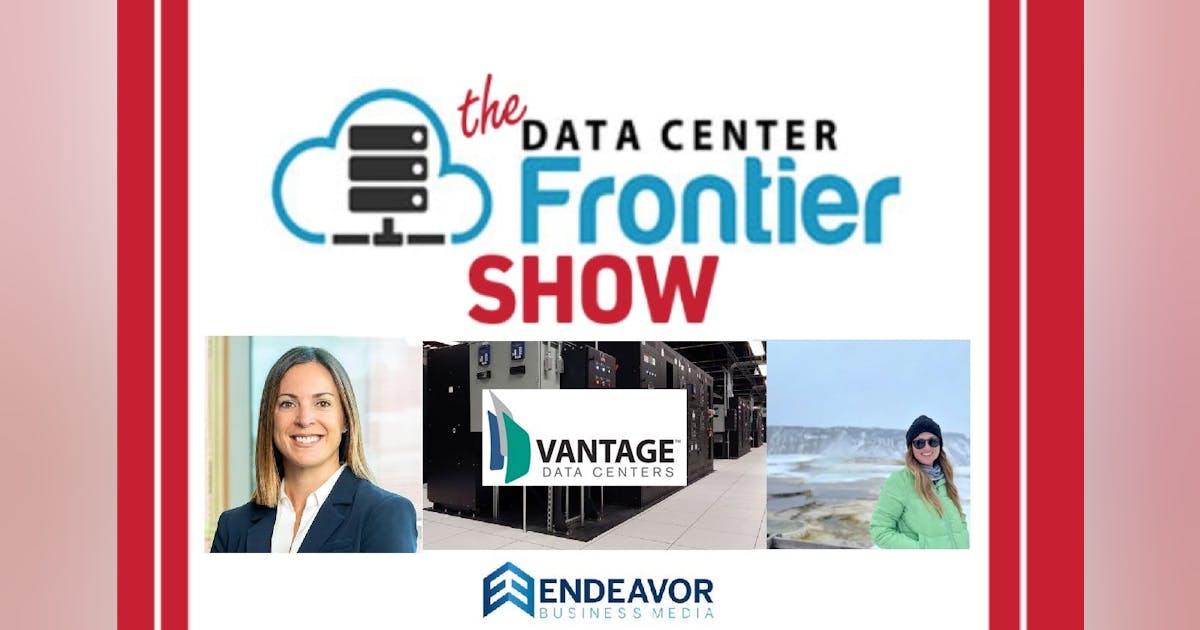
Recorded last December, for this episode of the Data Center Frontier Show Podcast, DCF Editor in Chief Matt Vincent spoke with Vantage Data Centers‘ North American President Dana Adams, and Kaitlin Monaghan, Vantage Data Centers’ North American Public Policy Director. As president of Vantage Data Centers’ North America business, Dana Adams oversees market development, sales, construction […]

Recorded last December, for this episode of the Data Center Frontier Show Podcast, DCF Editor in Chief Matt Vincent spoke with Vantage Data Centers‘ North American President Dana Adams, 
and Kaitlin Monaghan, Vantage Data Centers’ North American Public Policy Director.

As president of Vantage Data Centers’ North America business, Dana Adams oversees market development, sales, construction and operations across the United States and Canada. With nearly 18 years of experience in the data center sector, Adams has a track record of successfully leading high-growth companies and diverse teams at scale.

Prior to joining Vantage, Adams was the Chief Operating Officer for AirTrunk, the hyperscale data center giant serving the Asia-Pacific region. She was responsible for scaling operations, service delivery and customer success from one to five countries and established other critical business capabilities, including award-winning people, culture and sustainability programs, as the company grew from $3 to $10 billion.

Earlier in her career, Adams served as vice president and general manager at Iron Mountain where she helped drive nearly $2 billion in growth through global acquisitions and development projects. In addition, she held several leadership positions at Digital Realty, including vice president of portfolio management, where she oversaw $3 billion in data center assets.

Considered to be one of the most influential female executives in the industry, Adams was recognized by Data Economy on its power women list in 2019. She was a finalist in the 2020 and 2022 PTC awards as an outstanding female executive, an Infrastructure Masons (IM) 2022 award recipient and was recently featured by InterGlobix Magazine as an Inspiring Woman in Leadership. Adams earned a bachelor’s degree from Boston College and a Master of Business Administration from Simmons University.

Kaitlin Monaghan serves as the Director of Public Policy, North America, for Vantage Data Centers. In this role, she is responsible for leading a public policy program to support the company’s North American business. Monaghan partners with site selection, sustainability, tax, legal, energy and construction stakeholders to develop and advocate for Vantage’s position on a multitude of issues in current and future markets. 

Prior to joining Vantage, Monaghan held public policy roles at Rivian Automotive and the American Clean Power Association where she managed legislative, regulatory and economic development matters at all levels of government. She also serves as Energy and Environment Co-Chair for the Data Center Coalition (DCC). A Florida native, she is a graduate of the University of Florida with a B.S. in Environmental Science and has a law degree from Florida State University College of Law with a concentration in Energy Law.

Podcast

Talk on the podcast kicks off with a framing of Vantage Data Centers’ recently announced $2 billion investment in a new data center campus in New Albany, Ohio in the environs of Tier 2 industry hotspot Columbus, focusing on sustainability and efficiency. The discussion touches on how the Ohio market is becoming increasingly relevant for data centers due to strong connectivity and power availability, with most major hyperscalers already investing in the region. 

Along the way, we learn how Vantage’s new campus in New Albany will utilize a sustainable design aimed at achieving LEED Silver certification, emphasizing low power usage effectiveness (PUE) and waterless cooling systems. The discussion also examines how partnerships with local organizations, such as the New Albany Community Foundation and Columbus State Community College Foundation, will support workforce development and community engagement. 

Vantage’s Adams and Monaghan also speak on how continued collaboration with utilities and policymakers is essential to address power generation challenges while supporting future data center industry growth in North America.

Here’s a timeline of the interview’s key moments:

  • Dana Adams shares insights on how her experience as COO of Air Trunk in Sydney informs her current role, focusing on scaling hyperscale data centers in North America. 1:36
  • Kaitlin Monaghan discusses her background in energy law and highlights her focus on renewable energy policy. 3:57
  • Investment trends in Ohio’s data center market are discussed. Connectivity and power availability are identified as key factors. 7:11
  • The forthcoming OH1 data center campus is discussed. It will cover 70 acres and focus on sustainability. 9:57
  • The 200 megawatt campus will be built in phases. The first phase is set to open in late 2025. 10:37
  • Sustainable design principles are emphasized in the project. The design aims for low power usage effectiveness and minimal water usage. 11:31
  • Innovations in Ohio are discussed. The focus is on signal innovations for deployment. 13:00
  • Sustainable fuels integration is highlighted. Collaboration across the industry is emphasized to increase demand. 13:30
  • Challenges with new chip designs are addressed. Maximizing efficiency with GPUs in data centers is a key concern. 14:01
  • Partnerships with local organizations are discussed. Workforce development is emphasized as a key focus. 14:48
  • The importance of community engagement is highlighted. Vantage’s long-term commitment to local hiring is noted. 15:19
  • Trends in workforce development within the data center industry are analyzed. The significance of workforce as a pillar of sustainability is mentioned. 16:43
  • Insights into Vantage Data Centers’ growth are shared. Anticipation for 2025 includes a focus on infrastructure and workforce needs. 17:49
  • Challenges in power generation and transmission are addressed. Engagement with utilities and policymakers is emphasized for future growth. 19:54

DCF Show Podcast Quotes from Dana Adams, Vantage Data Centers – North American President 

On How AI Demand Is Driving North America’s Data Center Growth
Dana Adams:
“I joined Vantage in February of [2024], and prior to this role, I was the Chief Operating Officer for AirTrunk, based over in Sydney, Australia. This year really saw the opportunity shifting back to North America, where AI demand is driving incredible growth of our industry in the North American markets.”

On How Ohio Became a Key Overflow Market for Ashburn’s Constraints
Dana Adams:
“Ohio has really become an overflow market from Ashburn. As Ashburn has become so constrained over the last few years, we’ve seen a lot more investment moving into other markets, but in particular into Columbus, Ohio. As with all data center investment, it’s driven by a couple of common factors: availability of power in the Ohio region, strong connectivity running through Columbus connecting Ashburn, Chicago, and other core markets, and public announcements from major hyperscalers like Google, AWS, Meta, and Microsoft.”

On How Vantage Is Building a 200 MW Data Center Campus in New Albany
Dana Adams:
“This is about a 200-megawatt campus that we’ll be building [in New Albany] across one and a half million square feet. We’ll build in phases—three data centers on the campus—on a pretty aggressive schedule, with the first phase opening in late 2025 and then continuing the build from there.”

On How Vantage Is Advancing Sustainable Fuel Adoption in Data Centers
Dana Adams:
“The New Albany campus is really no exception to what we’re doing across all of our other markets. One thing that we have been working on is ways to drive more collaboration across the industry to increase demand for sustainable fuels so that we can build a more sustainable supply chain and use that more broadly. We are looking at more ways to integrate HVO and sustainable fuels into the portfolio.”

On How Vantage’s One Design Optimizes Efficiency for AI-Ready Data Centers
Dana Adams:
“The core really comes back to Vantage’s One Design. We are very focused on driving as low as possible of a PUE in our design. We also are very focused on minimizing water usage. We have a waterless design that we deploy, and our design is AI-ready so we can support liquid-to-liquid and higher densification.”

On How Data Centers Are Adapting to New GPU and Chip Design Challenges
Dana Adams:
“The challenge that our customers are navigating right now is how do we integrate the new chip designs into our data centers, and how do we design and operate the infrastructure in a way to really maximize efficiency with those GPUs and chips that we’re supporting now in the data center?”

On How Power Generation Constraints Are Impacting Data Center Expansion
Dana Adams:
“In particular, on the power generation side, this is where we have the most challenges as an industry. I think everyone’s very aware of the constraints that we face across North America from a power generation and transmission perspective.”

On How Vantage Is Partnering to Strengthen Infrastructure for AI Growth
Dana Adams:
“A huge focus for us going into the year will be ongoing engagement with the utilities, with IPPs, with policymakers, and regulatory bodies—who are all coming together to figure out how we can solve for this challenge of upgrading our country’s infrastructure and supporting technology and AI growth.”

DCF Show Podcast Quotes from Kaitlin Monaghan, Vantage Data Centers – North American Public Policy Director

On How a Background in Energy Law Shaped a Career in Data Center Policy
Kaitlin Monaghan:
“I am a lawyer by trade. My focus in law school was on energy law. I did some utility regulatory work briefly, some state-level government affairs in Florida. But I really started my career in 2013 working on energy policy in Washington, D.C. for the renewable energy industry.”

On How Renewable Energy Policies Drive Industry Growth and Transition
Kaitlin Monaghan:
“During my time in the renewables industry, our focus was really to drive demand for the industry by policies that would drive retirements of older, dirtier assets, create mandates for renewables, and incentives for renewables, because at that time, load growth was completely flat in the United States.”

On How the Data Center Industry Is Leading in Load Growth and Renewables
Kaitlin Monaghan:
“I think it’s a really exciting time for the industry where, as an industry, we’re driving unprecedented load growth and still leading renewable energy purchases globally.”

On How Ohio Is Positioning Data Centers as an Economic Growth Driver
Kaitlin Monaghan:
“The state [of Ohio] really sees the data center industry and economic development surrounding digital infrastructure as an opportunity. So they’ve done a really good job of attracting businesses like ours.”

On How Strategic Partnerships Helped Vantage DC Establish a Midwest Presence
Kaitlin Monaghan:
“We worked in partnership with One Columbus, with Jobs Ohio, and state leaders to really launch our footprint in Ohio, which has brought us to the Midwest.”

On How Vantage DC Embeds Community Engagement Into Its Long-Term Strategy
Kaitlin Monaghan:
“Community engagement is really at the core of what Vantage does. We develop, own, and operate these data center spaces, but we’re not just a developer. When we enter a community, we hire people locally, we have employees move from other locations, and we’re really there for the long term. We see workforce development as being really core to the continued success of our business and our ability to attract new talent. ”

Shape
Shape
Stay Ahead

Explore More Insights

Stay ahead with more perspectives on cutting-edge power, infrastructure, energy,  bitcoin and AI solutions. Explore these articles to uncover strategies and insights shaping the future of industries.

Shape

From packets to prompts: What Cisco’s AITECH certification means for IT pros

Cisco positions the AITECH learning path as a bridge from “traditional knowledge-based work” to innovation-driven roles augmented by AI, explicitly targeting professionals who need to design technical solutions, automate tasks, and lead teams using modern AI tools and methodologies. The curriculum spans AI-assisted code generation, AI-driven data analysis, model customization (including RAG),

Read More »

HPE’s latest Juniper routers target large‑scale AI fabrics

The three new models give customers several options for configurations and throughput capacity, but they all share support for the same deep buffers, security, and optics for AI network fabric buildouts, Francis said. In addition to the new hardware, HPE added new AI support, including a Model Context Protocol (MCP)

Read More »

Energy Department Announces $171.5 Million To Expand U.S. Geothermal Energy

Support for Field-Scale Tests and Exploration Drilling Can Help Advance Affordable, Reliable, Secure Geothermal Energy for American Homes and Businesses WASHINGTON—The U.S. Department of Energy (DOE) today announced a funding opportunity of $171.5 million to support next-generation geothermal field-scale tests for both electricity generation and exploration drilling to support characterization and potential confirmation of promising geothermal prospects. The activities enabled by this opportunity will help deliver on President Trump’s Executive Order, Unleashing American Energy by advancing geothermal technology, innovation, and exploration, in turn supporting the potential for geothermal energy to provide affordable, reliable, around-the-clock domestic electricity to Americans nationwide. “Work under this opportunity will directly support our commitments to advance energy addition, reduce energy costs for American families and businesses, and unleash American energy dominance and innovation,” said DOE Assistant Secretary of the Hydrocarbons and Geothermal Energy Office Kyle Haustveit. “Thanks to President Trump’s America First Energy Agenda, these demonstrations and drilling activities will help us realize the enormous potential of geothermal to spur domestic manufacturing, enable data center growth, and provide affordable, reliable, and secure energy solutions nationwide.” The funding opportunity includes six topics with varied levels of funding and awards anticipated. For the first round of applications, two of the six topics will be open, seeking field tests for enhanced geothermal systems and drilling for next-generation and hydrothermal resource characterization / confirmation. Although the United States leads the world in geothermal electricity capacity with about four gigawatts, DOE analysis shows the potential for at least 300 gigawatts of reliable, flexible geothermal power on the U.S. grid by 2050. Projects under this opportunity are expected to help derisk geothermal development approaches and locations nationwide, which can encourage private investment, spur industry growth, and help realize the country’s geothermal potential. Letters of Intent for the opportunity are due March 27, 2026, and full applications are due April 30, 2026.

Read More »

Energy Department Announces Largest Loan in Department History, Delivering Over $7 Billion in Electricity Cost Savings for Georgia and Alabama Customers

WASHINGTON—U.S. Secretary of Energy Chris Wright today announced the Department of Energy’s (DOE) Office of Energy Dominance Financing (EDF) has closed a historic $26.5 billion loan package to deliver over $7 billion in electricity cost savings to millions of customers in Georgia and Alabama. In accordance with President Trump’s Executive Order, Unleashing American Energy, this unprecedented loan package will support two wholly owned subsidiaries of Southern Company. Funded under President Trump’s Working Families Tax Cut, the investment will lower American energy costs, create thousands of jobs, and increase grid reliability in Georgia and Alabama. “Thanks to President Trump and the Working Families Tax Cut, the Energy Department is lowering energy costs and ensuring the American people have access to affordable, reliable, and secure energy for decades to come,” said Secretary Wright. “The President has been clear: America must reverse the energy subtraction agenda of past administrations and add more reliable power generation to our electrical grid. These loans will not only lower energy costs but also create thousands of jobs and increase grid reliability for the people of Georgia and Alabama.” The two loans will build or upgrade over 16 gigawatts (GW) of firm reliable power to the electrical grid. This includes 5 GW of new gas generation, 6 GW in nuclear improved through upgrades license renewals, hydropower modernization, battery energy storage systems and over 1,300 miles of transmission and grid enhancement projects. These loans represent the largest government investment aimed at directly lowering consumer energy costs and increasing grid reliability. Once all funds are received through the program, the loans are estimated to reduce Southern Company’s interest expenses by over $300 million per year, helping expedite lower electricity costs for customers. Southern Company is among the first utilities working with the DOE and the Trump Administration to restore American

Read More »

Energy Secretary Keeps Critical Generation Online in Mid-Atlantic

Emergency order keeps critical generation online and addresses critical grid reliability issues facing the Mid-Atlantic region of the United States WASHINGTON—U.S. Secretary of Energy Chris Wright issued an emergency order to address critical grid reliability issues facing the Mid-Atlantic region of the United States. The emergency order directs PJM Interconnection, L.L.C. (PJM), in coordination with Constellation Energy Corporation, to ensure Units 3 and 4 of the Eddystone Generating Station in Pennsylvania remain available for operation and to employ economic dispatch to minimize costs for the American people. The units were originally slated to shut down on May 31, 2025. “The energy sources that perform when you need them most are inherently the most valuable—that’s why natural gas and oil were valuable during recent winter storms,” Secretary Wright said. “Hundreds of American lives have likely been saved because of President Trump’s actions keeping critical generation online, including this Pennsylvania generating station which ran during Winter Storm Fern. This emergency order will mitigate the risk of blackouts and maintain affordable, reliable, and secure electricity access across the region.” The Eddystone Units were integral in stabilizing the grid during Winter Storm Fern. Between January 26-29, the units ran for over 124 hours cumulatively, providing critical generation in the midst of the energy emergency. As outlined in DOE’s Resource Adequacy Report, power outages could increase by 100 times in 2030 if the U.S. continues to take reliable power offline. Furthermore, NERC’s 2025 Long-Term Reliability Assessment warns, “The continuing shift in the resource mix toward weather-dependent resources and less fuel diversity increases risks of supply shortfalls during winter months.” Secretary Wright ordered that the two Eddystone Generating Station units remain online past their planned retirement date in a May 30, 2025 emergency order. Subsequent orders were issued on August 28, 2025 and November 26, 2025. Keeping these units operational

Read More »

Insights: Venezuela – new legal frameworks vs. the inertia of history

@import url(‘https://fonts.googleapis.com/css2?family=Inter:[email protected]&display=swap’); a { color: var(–color-primary-main); } .ebm-page__main h1, .ebm-page__main h2, .ebm-page__main h3, .ebm-page__main h4, .ebm-page__main h5, .ebm-page__main h6 { font-family: Inter; } body { line-height: 150%; letter-spacing: 0.025em; font-family: Inter; } button, .ebm-button-wrapper { font-family: Inter; } .label-style { text-transform: uppercase; color: var(–color-grey); font-weight: 600; font-size: 0.75rem; } .caption-style { font-size: 0.75rem; opacity: .6; } #onetrust-pc-sdk [id*=btn-handler], #onetrust-pc-sdk [class*=btn-handler] { background-color: #c19a06 !important; border-color: #c19a06 !important; } #onetrust-policy a, #onetrust-pc-sdk a, #ot-pc-content a { color: #c19a06 !important; } #onetrust-consent-sdk #onetrust-pc-sdk .ot-active-menu { border-color: #c19a06 !important; } #onetrust-consent-sdk #onetrust-accept-btn-handler, #onetrust-banner-sdk #onetrust-reject-all-handler, #onetrust-consent-sdk #onetrust-pc-btn-handler.cookie-setting-link { background-color: #c19a06 !important; border-color: #c19a06 !important; } #onetrust-consent-sdk .onetrust-pc-btn-handler { color: #c19a06 !important; border-color: #c19a06 !important; } In this Insights episode of the Oil & Gas Journal ReEnterprised podcast, Head of Content Chris Smith updates the evolving situation in Venezuela as the industry attempts to navigate the best path forward while the two governments continue to hammer out the details. The discussion centers on the new legal frameworks being established in both countries within the context of fraught relations stretching back for decades. Want to hear more? Listen in on a January episode highlighting industry’s initial take following the removal of Nicholas Maduro from power. References Politico podcast Monaldi Substack Baker webinar Washington, Caracas open Venezuela to allow more oil sales 

Read More »

Eni makes Calao South discovery offshore Ivory Coast

@import url(‘https://fonts.googleapis.com/css2?family=Inter:[email protected]&display=swap’); a { color: var(–color-primary-main); } .ebm-page__main h1, .ebm-page__main h2, .ebm-page__main h3, .ebm-page__main h4, .ebm-page__main h5, .ebm-page__main h6 { font-family: Inter; } body { line-height: 150%; letter-spacing: 0.025em; font-family: Inter; } button, .ebm-button-wrapper { font-family: Inter; } .label-style { text-transform: uppercase; color: var(–color-grey); font-weight: 600; font-size: 0.75rem; } .caption-style { font-size: 0.75rem; opacity: .6; } #onetrust-pc-sdk [id*=btn-handler], #onetrust-pc-sdk [class*=btn-handler] { background-color: #c19a06 !important; border-color: #c19a06 !important; } #onetrust-policy a, #onetrust-pc-sdk a, #ot-pc-content a { color: #c19a06 !important; } #onetrust-consent-sdk #onetrust-pc-sdk .ot-active-menu { border-color: #c19a06 !important; } #onetrust-consent-sdk #onetrust-accept-btn-handler, #onetrust-banner-sdk #onetrust-reject-all-handler, #onetrust-consent-sdk #onetrust-pc-btn-handler.cookie-setting-link { background-color: #c19a06 !important; border-color: #c19a06 !important; } #onetrust-consent-sdk .onetrust-pc-btn-handler { color: #c19a06 !important; border-color: #c19a06 !important; } Eni SPA discovered gas and condensate in the Murene South-1X exploration well in Block CI-501, Ivory Coast. The well is the first exploration in the block and was drilled by the Saipem Santorini drilling ship about 8 km southwest of the Murene-1X discovery well in adjacent CI-205 block. The well was drilled to about 5,000 m TD in 2,200 m of water. Extensive data acquisition confirmed a main hydrocarbon bearing interval in high-quality Cenomanian sands with a gross thickness of about 50 m with excellent petrophysical properties, the operator said. Murene South-1X will undergo a full conventional drill stem test (DST) to assess the production capacity of this discovery, named Calao South. Calao South confirms the potential of the Calao channel complex that also includes the Calao discovery. It is the second largest discovery in the country after Baleine, with estimated volumes of up to 5.0 tcf of gas and 450 million bbl of condensate (about 1.4 billion bbl of oil). Eni is operator of Block CI-501 (90%) with partner Petroci Holding (10%).

Read More »

CFEnergía to supply natural gas to low-carbon methanol plant in Mexico

CFEnergía, a subsidiary of Mexico’s Federal Electricity Commission (CFE), has agreed to supply natural gas to Transition Industries LLC for its Pacifico Mexinol project near Topolobampo, Sinaloa, Mexico. Under the signed agreement, which enables the start of Pacifico Mexinol’s construction phase, CFEnergía will supply about 160 MMcfd of natural gas for an unspecified timeframe noted as “long term,” Transition Industries said in a release Feb. 16. The natural gas—to be sourced from the US and supplied at market prices via existing infrastructure—will be used as “critical input for Mexinol’s production of ultra-low carbon methanol,” the company said. Pacifico Mexinol The $3.3-billion Mexinol project, when it begins operations in late 2029 to early 2030, is expected to be the world’s largest ultra-low carbon chemicals plant with production of about 1.8 million tonnes of blue methanol and 350,000 tonnes of green methanol annually. Supply is aimed at markets in Asia, including Japan, while also boosting the development of the domestic market and the Mexican chemical industry. Mitsubishi Gas Chemical has committed to purchasing about 1 million tonnes/year of methanol from the project, about 50% of the project’s planned production. Transition Industries is jointly developing Pacifico Mexinol with the International Finance Corporation (IFC), a member of the World Bank Group. Last year, the company signed a contingent engineering, procurement, and construction (EPC) contract with the consortium of Samsung E&A Co., Ltd., Grupo Samsung E&A Mexico SA de CV, and Techint Engineering and Construction for the project. MAIRE group’s technology division NextChem, through its subsidiary KT TECH SpA, also signed a basic engineering, critical and proprietary equipment supply agreement with Samsung E&A in connection with its proprietary NX AdWinMethanol®Zero technology supply to the project.

Read More »

Netskope targets AI-driven network bottlenecks with AI Fast Path

AI Fast Path focuses on optimizing traffic flows between enterprise users, the Netskope cloud, and major AI providers. Netskope says more than 90% of its 120 NewEdge data centers can now connect to leading AI applications in less than five milliseconds from the Netskope cloud, an effort aimed at minimizing added delay as traffic is inspected for data loss prevention (DLP), threat protection, and policy enforcement. “Customers realized that if they don’t adopt these AI apps, they’re probably going to be extinct in a few years. At the same time, we can’t afford to compromise on security,” Arandjelovic says. “So, with NewEdge and the AI Fast Path, we’ve created a super-optimized path where there is literally barely a bump in the wire. At the same time, they are not compromising security, because you’re passing through our cloud and getting all the benefits of our data protection and threat protection.” As a set of capabilities within NewEdge, AI Fast Path enables better performance and efficiency for AI applications. According to Netskope, AI Fast Path provides enterprises with:

Read More »

AMD strikes massive AI chip deal with Meta

The funding is also unique. Instead of a cash purchase, AMD has reportedly given Meta warrants to buy up to 160 million shares at $0.01 each. Stock warrants are financial instruments that give you the right (but not the obligation) to buy a company’s stock at a fixed price before a certain expiration date, according to the vendors. With 1.6 billion shares outstanding, Meta is poised to acquire 10% of AMD. But perhaps not. These shares vest only as Meta buys more computing capacity. The final tranche vests only if AMD’s stock price hits $600, according to a recent 8K filing. AMD shares are currently valued at just over $200 as of this writing. The deal is identical to the one AMD struck with OpenAI last October. That deal was also for 6 GW worth of GPUs and included a warrant for up to 160 million AMD common stock shares structured to payout once certain targets were met. Meta is not playing favorites. Last week it announced that it will also deploy standalone Nvidia Grace CPUs in its production data centers, citing greatly improved performance-per-watt. That doesn’t come as a surprise to Gaurav Gupta, vice president analyst at Gartner, who says we are compute constrained and Hyperscalers or frontier model companies will use a multisource approach to get access to compute.  “No one wants to be stuck with a single vendor. Diversify and then different workloads have different compute needs.,” he said.

Read More »

Nvidia lines up partners to boost security for industrial operations

Akamai extends its micro-segmentation and zero-trust security platform Guardicore to run on Nvidia BlueField GPUs The integration offloads user-configurable security processes from the host system to the Nvidia BlueField DPU and enables zero-trust segmentation without requiring software agents on fragile or legacy systems, according to Akamai. Organizations can implement this hardware-isolated, “agentless” security approach to help align with regulatory requirements and lower their risk profile for cyber insurance. “It delivers deep, out-of-band visibility across systems, networks, and applications without disrupting operations. Security policies can be enforced in real time and are capable of creating a strong protective boundary around critical operational systems. The result is trusted insight into operational activity and improved overall cyber resilience,” according to Akamai. Forescout works with Nvidia to bring zero-trust technology to OT networks Forescout applies network segmentation to contain lateral movement and enforce zero-trust controls. The technology would be further integrated into partnership work already being done by the two companies. By running Forescout’s on-premises sensor directly on the Nvidia BlueField, part of Nvidia Cybersecurity AI platform, customers can offload intensive computing tasks, such as deep packet inspections. This speeds up data processing, enhances asset intelligence, and improves real-time monitoring, providing security teams with the insights needed to stay ahead of emerging threats, according to Forescout. Palo Alto to demo Prisma AIRS AI Runtime Security on Nvidia BlueField DPU Palo Alto Networks recently partnered with Nvidia to run its Prisma AI-powered Radio Security(AIRs) package on the Nvidia BlueField DPU and will show off the technology at the conference. The technology is part of the Nvidia Enterprise AI Factory validated design and can offer real-time security protection for industrial network settings. “Prisma AIRS AI Runtime Security delivers deep visibility into industrial traffic and continuous monitoring for abnormal behavior. By running these security services on Nvidia BlueField, inspection

Read More »

Raising the temp on liquid cooling

IBM isn’t the only one. “We’ve been doing liquid cooling since 2012 on our supercomputers,” says Scott Tease, vice president and general manager of AI and high-performance computing at Lenovo’s infrastructure solutions group. “And we’ve been improving it ever since—we’re now on the sixth generation of that technology.” And the liquid Lenovo uses in its Neptune liquid cooling solution is warm water. Or, more precisely, hot water: 45 degrees Celsius. And when the water leaves the servers, it’s even hotter, Tease says. “I don’t have to chill that water, even if I’m in a hot climate,” he says. Even at high temperatures, the water still provides enough cooling to the chips that it has real value. “Generally, a data center will use evaporation to chill water down,” Tease adds. “Since we don’t have to chill the water, we don’t have to use evaporation. That’s huge amounts of savings on the water. For us, it’s almost like a perfect solution. It delivers the highest performance possible, the highest density possible, the lowest power consumption. So, it’s the most sustainable solution possible.” So, how is the water cooled down? It gets piped up to the roof, Tease says, where there are giant radiators with massive amounts of surface area. The heat radiates away, and then all the water flows right back to the servers again. Though not always. The hot water can also be used to, say, heat campus or community swimming pools. “We have data centers in the Nordics who are giving the heat to the local communities’ water systems,” Tease says.

Read More »

Vertiv’s AI Infrastructure Surge: Record Orders, Liquid Cooling Expansion, and Grid-Scale Power Reflect Data Center Growth

2) “Units of compute”: OneCore and SmartRun On the earnings call, Albertazzi highlighted Vertiv OneCore, an end-to-end data center solution designed to accelerate “time to token,” scaling in 12.5 MW building blocks; and Vertiv SmartRun, a prefabricated white space infrastructure solution aimed at rapidly accelerating fit-out and readiness. He pointed to collaborations (including Hut 8 and Compass Data Centers) as proof points of adoption, emphasizing that SmartRun can stand alone or plug into OneCore. 3) Cooling evolution: hybrid thermal chains and the “trim cooler” Asked how cooling architectures may change (amid industry chatter about warmer-temperature operations and shifting mixes of chillers, CDUs, and other components) Albertazzi leaned into complexity as a feature, not a bug. He argued heat rejection doesn’t disappear, even if some GPU loads can run at higher temperatures. Instead, the future looks hybrid, with mixed loads and resiliency requirements forcing more nuanced thermal chains. Vertiv’s strategic product anchor here is its “trim cooler” concept: a chiller optimized for higher-temperature operation while retaining flexibility for lower-temperature requirements in the same facility, maximizing free cooling where climate and design allow. And importantly, Albertazzi dismissed the idea that CDUs are going away: “We are pretty sure that CDUs in various shapes and forms are a long-term element of the thermal chain.” 4) Edge densification: CoolPhase Ceiling + CoolPhase Row (Feb. 3) Vertiv also expanded its thermal portfolio for edge and small IT environments with the: Vertiv CoolPhase Ceiling (launching Q2 2026): ceiling-mounted, 3.5 kW to 28 kW, designed to preserve floor space. Vertiv CoolPhase Row (available now in North America) for row-based cooling up to 30 kW (300 mm width) or 40 kW (600 mm width). Vertiv Director of Edge Thermal Michal Podmaka tied the products directly to AI-driven edge densification and management consistency, saying the new systems “integrate seamlessly

Read More »

Execution, Power, and Public Trust: Rich Miller on 2026’s Data Center Reality and Why He Built Data Center Richness

DCF founder Rich Miller has spent much of his career explaining how the data center industry works. Now, with his latest venture, Data Center Richness, he’s also examining how the industry learns. That thread provided the opening for the latest episode of The DCF Show Podcast, where Miller joined present Data Center Frontier Editor in Chief Matt Vincent and Senior Editor David Chernicoff for a wide-ranging discussion that ultimately landed on a simple conclusion: after two years of unprecedented AI-driven announcements, 2026 will be the year reality asserts itself. Projects will either get built, or they won’t. Power will either materialize, or it won’t. Communities will either accept data center expansion – or they’ll stop it. In other words, the industry is entering its execution phase. Why Data Center Richness Matters Now Miller launched Data Center Richness as both a podcast and a Substack publication, an effort to experiment with formats and better understand how professionals now consume industry information. Podcasts have become a primary way many practitioners follow the business, while YouTube’s discovery advantages increasingly make video versions essential. At the same time, Miller remains committed to written analysis, using Substack as a venue for deeper dives and format experimentation. One example is his weekly newsletter distilling key industry developments into just a handful of essential links rather than overwhelming readers with volume. The approach reflects a broader recognition: the pace of change has accelerated so much that clarity matters more than quantity. The topic of how people learn about data centers isn’t separate from the industry’s trajectory; it’s becoming part of it. Public perception, regulatory scrutiny, and investor expectations are now shaped by how stories are told as much as by how facilities are built. That context sets the stage for the conversation’s core theme. Execution Defines 2026 After

Read More »

Microsoft will invest $80B in AI data centers in fiscal 2025

And Microsoft isn’t the only one that is ramping up its investments into AI-enabled data centers. Rival cloud service providers are all investing in either upgrading or opening new data centers to capture a larger chunk of business from developers and users of large language models (LLMs).  In a report published in October 2024, Bloomberg Intelligence estimated that demand for generative AI would push Microsoft, AWS, Google, Oracle, Meta, and Apple would between them devote $200 billion to capex in 2025, up from $110 billion in 2023. Microsoft is one of the biggest spenders, followed closely by Google and AWS, Bloomberg Intelligence said. Its estimate of Microsoft’s capital spending on AI, at $62.4 billion for calendar 2025, is lower than Smith’s claim that the company will invest $80 billion in the fiscal year to June 30, 2025. Both figures, though, are way higher than Microsoft’s 2020 capital expenditure of “just” $17.6 billion. The majority of the increased spending is tied to cloud services and the expansion of AI infrastructure needed to provide compute capacity for OpenAI workloads. Separately, last October Amazon CEO Andy Jassy said his company planned total capex spend of $75 billion in 2024 and even more in 2025, with much of it going to AWS, its cloud computing division.

Read More »

John Deere unveils more autonomous farm machines to address skill labor shortage

Join our daily and weekly newsletters for the latest updates and exclusive content on industry-leading AI coverage. Learn More Self-driving tractors might be the path to self-driving cars. John Deere has revealed a new line of autonomous machines and tech across agriculture, construction and commercial landscaping. The Moline, Illinois-based John Deere has been in business for 187 years, yet it’s been a regular as a non-tech company showing off technology at the big tech trade show in Las Vegas and is back at CES 2025 with more autonomous tractors and other vehicles. This is not something we usually cover, but John Deere has a lot of data that is interesting in the big picture of tech. The message from the company is that there aren’t enough skilled farm laborers to do the work that its customers need. It’s been a challenge for most of the last two decades, said Jahmy Hindman, CTO at John Deere, in a briefing. Much of the tech will come this fall and after that. He noted that the average farmer in the U.S. is over 58 and works 12 to 18 hours a day to grow food for us. And he said the American Farm Bureau Federation estimates there are roughly 2.4 million farm jobs that need to be filled annually; and the agricultural work force continues to shrink. (This is my hint to the anti-immigration crowd). John Deere’s autonomous 9RX Tractor. Farmers can oversee it using an app. While each of these industries experiences their own set of challenges, a commonality across all is skilled labor availability. In construction, about 80% percent of contractors struggle to find skilled labor. And in commercial landscaping, 86% of landscaping business owners can’t find labor to fill open positions, he said. “They have to figure out how to do

Read More »

2025 playbook for enterprise AI success, from agents to evals

Join our daily and weekly newsletters for the latest updates and exclusive content on industry-leading AI coverage. Learn More 2025 is poised to be a pivotal year for enterprise AI. The past year has seen rapid innovation, and this year will see the same. This has made it more critical than ever to revisit your AI strategy to stay competitive and create value for your customers. From scaling AI agents to optimizing costs, here are the five critical areas enterprises should prioritize for their AI strategy this year. 1. Agents: the next generation of automation AI agents are no longer theoretical. In 2025, they’re indispensable tools for enterprises looking to streamline operations and enhance customer interactions. Unlike traditional software, agents powered by large language models (LLMs) can make nuanced decisions, navigate complex multi-step tasks, and integrate seamlessly with tools and APIs. At the start of 2024, agents were not ready for prime time, making frustrating mistakes like hallucinating URLs. They started getting better as frontier large language models themselves improved. “Let me put it this way,” said Sam Witteveen, cofounder of Red Dragon, a company that develops agents for companies, and that recently reviewed the 48 agents it built last year. “Interestingly, the ones that we built at the start of the year, a lot of those worked way better at the end of the year just because the models got better.” Witteveen shared this in the video podcast we filmed to discuss these five big trends in detail. Models are getting better and hallucinating less, and they’re also being trained to do agentic tasks. Another feature that the model providers are researching is a way to use the LLM as a judge, and as models get cheaper (something we’ll cover below), companies can use three or more models to

Read More »

OpenAI’s red teaming innovations define new essentials for security leaders in the AI era

Join our daily and weekly newsletters for the latest updates and exclusive content on industry-leading AI coverage. Learn More OpenAI has taken a more aggressive approach to red teaming than its AI competitors, demonstrating its security teams’ advanced capabilities in two areas: multi-step reinforcement and external red teaming. OpenAI recently released two papers that set a new competitive standard for improving the quality, reliability and safety of AI models in these two techniques and more. The first paper, “OpenAI’s Approach to External Red Teaming for AI Models and Systems,” reports that specialized teams outside the company have proven effective in uncovering vulnerabilities that might otherwise have made it into a released model because in-house testing techniques may have missed them. In the second paper, “Diverse and Effective Red Teaming with Auto-Generated Rewards and Multi-Step Reinforcement Learning,” OpenAI introduces an automated framework that relies on iterative reinforcement learning to generate a broad spectrum of novel, wide-ranging attacks. Going all-in on red teaming pays practical, competitive dividends It’s encouraging to see competitive intensity in red teaming growing among AI companies. When Anthropic released its AI red team guidelines in June of last year, it joined AI providers including Google, Microsoft, Nvidia, OpenAI, and even the U.S.’s National Institute of Standards and Technology (NIST), which all had released red teaming frameworks. Investing heavily in red teaming yields tangible benefits for security leaders in any organization. OpenAI’s paper on external red teaming provides a detailed analysis of how the company strives to create specialized external teams that include cybersecurity and subject matter experts. The goal is to see if knowledgeable external teams can defeat models’ security perimeters and find gaps in their security, biases and controls that prompt-based testing couldn’t find. What makes OpenAI’s recent papers noteworthy is how well they define using human-in-the-middle

Read More »