Stay Ahead, Stay ONMINE

Is fake grass a bad idea? The AstroTurf wars are far from over.

A rare warm spell in January melted enough snow to uncover Cornell University’s newest athletic field, built for field hockey. Months before, it was a meadow teeming with birds and bugs; now it’s more than an acre of synthetic turf roughly the color of the felt on a pool table, almost digital in its saturation. The day I walked up the hill from a nearby creek to take a look, the metal fence around the field was locked, but someone had left a hallway-size piece of the new simulated grass outside the perimeter. It was bristly and tough, but springy and squeaky under my booted feet. I could imagine running around on it, but it would definitely take some getting used to. My companion on this walk seemed even less favorably disposed to the thought. Yayoi Koizumi, a local environmental advocate, has been fighting synthetic-turf projects at Cornell since 2023. A petite woman dressed that day in a faded plum coat over a teal vest, with a scarf the colors of salmon, slate, and sunflowers, Koizumi compulsively picked up plastic trash as we walked: a red Solo cup, a polyethylene Dunkin’ container, a five-foot vinyl panel. She couldn’t bear to leave this stuff behind to fragment into microplastic bits—as she believes the new field will. “They’ve covered the living ground in plastic,” she said. “It’s really maddening.”  The new pitch is one part of a $70 million plan to build more recreational space at the university. As of this spring, Cornell plans to install something like a quarter million square feet of synthetic grass—what people have colloquially called “astroturf” since the middle of the last century. University PR says it will be an important part of a “health-promoting campus” that is “supportive of holistic individual, social, and ecological well-being.” Koizumi runs an anti-plastic environmental group called Zero Waste Ithaca, which says that’s mostly nonsense. This fight is more than just the usual town-versus-gown tension. Synthetic turf used to be the stuff of professional sports arenas and maybe a suburban yard or two; today communities across the United States are debating whether to lay it down on playgrounds, parks, and dog runs. Proponents say it’s cheaper and hardier than grass, requiring less water, fertilizer, and maintenance—and that it offers a uniform surface for more hours and more days of the year than grass fields, a competitive advantage for athletes and schools hoping for a more robust athletic program. But while new generations of synthetic turf look and feel better than that mid-century stuff, it’s still just plastic. Some evidence suggests it sheds bits that endanger users and the environment, and that it contains PFAS “forever chemicals”—per- and polyfluoroalkyl substances, which are linked to a host of health issues. The padding within the plastic grass is usually made from shredded tires, which might also pose health risks. And plastic fields need to be replaced about once a decade, creating lots of waste. Yet people are buying a lot of the stuff. In 2001, Americans installed just over 7 million square meters of synthetic turf, just shy of 11,000 metric tons. By 2024, that number was 79 million square meters—enough to carpet all of Manhattan and then some, almost 120,000 metric tons. Synthetic turf covers 20,000 athletic fields and tens of thousands of parks, playgrounds, and backyards. And the US is just 20% of the global market.  Where real estate is limited and demand for athletic facilities is high, artificial turf is tempting. “It all comes down to land and demand.” Frank Rossi, professor of turf science, Cornell Those increases worry folks who study microplastics and environmental pollution. Any actual risk is hard to parse; the plastic-making industry insists that synthetic fields are safe if properly installed, but lots of researchers think that isn’t so. “They’re very expensive, they contain toxic chemicals, and they put kids at unnecessary risk,” says Philip Landrigan, a Boston College epidemiologist who has studied environmental toxins like lead and microplastics. But at Cornell, where real estate is limited and demand for athletic facilities is high, synthetic turf was a tempting option. As Frank Rossi, a professor of turf science at Cornell, told me: “It all comes down to land and demand.” In 1965, Houston’s new, domed base­ball stadium was an icon of space-age design. But the Astrodome had a problem: the sun. Deep in the heart of Texas, it shined brightly through the Astrodome’s skylights—so much so that players kept missing fly balls. So the club painted over the skylights. Denied sunlight, the grass in the outfield withered and died. A replacement was already in the works. In the late 1950s a Ford Foundation–funded educational laboratory determined that a soft, grasslike surface material would give city kids more places to play outside and had prevailed upon the Monsanto corporation to invent one. The result was clipped blades of nylon stuck to a rubber base, which the company called ChemGrass. Down it went into Houston’s outfield, where it got a new, buzzier name: AstroTurf. Workers lay artificial turf at the Astrodome in Houston on July 13, 1966. Developed by Monsanto, the material was originally known as ChemGrass but was later renamed AstroTurf after the stadium.AP PHOTO/ED KOLENOVSKY, FILE That first generation of simulated lawn was brittle and hard, but quality has improved. Today, there are a few competing products, but they’re all made by extruding a petroleum-based polymer—that’s plastic—through tiny holes and then stitching or fusing the resulting fibers to a carpetlike bottom. That gets attached to some kind of padding, also plastic. In the 1970s the industry started layering that over infill, usually sand; by the 1990s, “third generation” synthetic turf had switched to softer fibers made of polyethylene. Beneath that, they added infill that combined sand and a soft, cheap shredded rubber made from discarded automobile tires, which pile up by the hundreds of millions every year. This “crumb rubber” provides padding and fills spaces between the blades and the backing. In the early 1980s, nearly half the professional baseball and football fields in the US had synthetic turf. But many players didn’t like it. It got hotter than real grass, gave the ball different action, and seemed to be increasing the rate of injuries among athletes. Since the 1990s, most pro sports have shifted back toward grass—water and maintenance costs pale in comparison to the importance of keeping players happy or sparing them the risk of injury.  But at the same time, more universities and high schools are buying the artificial stuff. The advantages are clear, especially in places where it rains either too much or not enough. A natural-grass field is usable for a little more than 800 hours a year at the most, spread across just eight months in the cooler, wetter northern US. An artificial-turf field can see 3,000 hours of activity per year. For sports like lacrosse, which begins in late winter, this makes artificial turf more appealing. Most lacrosse pitches are now synthetic. So are almost all field hockey pitches; players like the way the even, springy turf makes the ball bounce. Furthermore, supporters say synthetic turf needs less maintenance than grass, saving money and resources. That’s not always true; workers still have to decompact the playing surface and hose it off to remove bird poop or cool it down. Sometimes the infill needs topping up. But real grass allows less playing time, and because grass athletic fields often need to be rotated to avoid damage, synthetic ground cover can require less space. Hence the market’s explosive growth in the 21st century. The city and town of Ithaca—two separate political entities with overlapping jurisdiction over Cornell construction projects—held multiple public meetings about the university’s new synthetic fields: the field hockey pitch and a complex called the Meinig Fieldhouse. Koizumi’s group turned up in force, and a few folks who worked at Cornell came to oppose the idea too—submitting pages of citations and studies on the risks of synthetic grass. At two of those meetings, dozens of Cornell athletes turned out to support the turf. Representatives of the university and the athletic department declined to speak with me for this story, citing an ongoing lawsuit from Zero Waste Ithaca. But before that, Nicki Moore, Cornell’s director of athletics, told a local newspaper that demand from campus groups and sports teams meant the fields were constantly overcrowded. “Activities get bumped later and later, and sometimes varsity teams won’t start practicing until 10 at night, you know?” Moore told the paper. “Availability of all-weather space should normalize scheduling a great deal.” That argument wasn’t universally convincing. “It’s a bad idea, but that’s from the environmental perspective,” says Marianne Krasny, director of Cornell’s Civic Ecology Lab and one of the speakers at those hearings. “Obviously the athletic department thinks it’s a great idea.” GETTY IMAGES .cst-large, .cst-default { width: 100%; } @media (max-width: 767px) { .cst-block { overflow-x: hidden; } } @media (min-width: 630px) { .cst-large { margin-left: -25%; width: 150%; } @media (min-width: 960px) { .cst-large { margin-left: -16.666666666666664%; width: 140.26%; } } @media (min-width: 1312px) { .cst-large { width: 145.13%; } } } @media (min-width: 60rem) { .flourish-embed { width: 60vw; transform: translateX(-50%); left: 50%; position: relative; } } Members of Cornell on Fire, a climate action group with members from both the university and the town, joined in opposing the use of artificial turf, citing the fossil-fuel origins of the stuff. They described the nominal support of the project from student athletes as inauthentic, representing not grassroots support but, yes, an astroturf campaign.  Sorting out the actual science here isn’t simple. Over time, the plastic that synthetic turf is made of sheds bits of itself into the environment. In one study, published in 2023 in the journal Environmental Pollution, researchers found that 15% of the medium-­size and microplastic particles in a river and the Mediterranean Sea outside Barcelona, Spain, came from artificial turf, mostly in the form of tiny green fibers. Back in 2020, the European Chemicals Agency estimated that infill material from artificial-­turf fields in the European Union was contributing 16,000 metric tons of microplastics to the environment each year—38% of all annual microplastic pollution. Most of that came from the crumb rubber infill, which Europe now plans to ban by 2031.  This pollution worries the Cornell activists. Ithaca is famous for scenic gorges and waterways. The new field hockey pitch is uphill from a local creek that empties into Cayuga Lake, the longest of the Finger Lakes and the source of drinking water for over 40,000 people. And it’s not just the plastic bits. When newer generations of synthetic turf switched to durable high-density polyethylene, the new material gunked up the extruders used in the manufacturing process. So turf makers started adding fluorinated polymers—a type of PFAS. Some of these environmentally persistent “forever chemicals” cause cancer, disrupt the endocrine system, or lead to other health problems. Research in several different labs has found PFAS in many types of plastic grass. But the key to assessing the threat here is exposure. Heather Whitehead, an analytical chemist then at the University of Notre Dame, found PFAS in synthetic turf at levels around five parts per billion—but estimated it’d be in water running off the fields at three parts per trillion; for context, the US Environmental Protection Agency’s legal drinking-water limit on one of the most widespread and dangerous PFAS chemicals is four parts per trillion. “These chemicals will wash off in small amounts for long periods of time,” says Graham Peaslee, Whitehead’s advisor and an emeritus nuclear physicist who studies PFAS concentrations. “I think it’s reason enough not to have artificial turf.” This gets confusing, though. There are over 16,000 different types of PFAS, few have been well studied, and different ­companies use different manufacturing techniques. Companies represented by the Synthetic Turf Council now “use zero intentionally added PFAS,” says Melanie Taylor, the group’s president. “This means that as the field rolls off the assembly line, there are zero PFAS-formulated materials present.” Some researchers are skeptical of the industry’s assurances. They’re hard to confirm, especially because there are a lot of ways to test for PFAS. The type of synthetic turf going onto the new field hockey pitch at Cornell is called GreenFields TX; the university had a sample tested using an EPA method that looks for 40 different PFAS compounds. It came back negative for all of them. The local activists countered that the test doesn’t detect the specific types they’re most concerned about, and in 2025 they paid for three more tests on newly purchased synthetic turf. Two clearly found fluorine—the F in “PFAS”—and one identified two distinct PFAS compounds. (The company that makes GreenFields TX, TenCate, declined to comment, citing ongoing litigation.) PFAS isn’t the only potential problem. There’s also the crumb rubber made from tires. A billion tires get thrown out every year worldwide, and if they aren’t recycled they sit in giant piles that make great habitats for rats and mosquitoes; they also occasionally catch fire. Lots of the tires that go into turf are made of styrene-­butadiene rubber, or SBR. In bulk, that’s bad. Butadiene is a carcinogen that causes leukemia, and fumes from styrene can cause nervous system damage. SBR also contains high levels of lead. But how much of that comes out of synthetic-­turf infill? Again, that’s hotly debated. Researchers around the world have published suggestive studies finding potentially dangerous levels of heavy metals like zinc and lead in synthetic turf, with possible health risks to people using the fields. But a review of many of the relevant studies on turf and crumb rubber from Canada’s National Collaborating Centre for Environmental Health determined that most well-conducted health risk assessments over the last decade found exposures below levels of concern for cancer and certain other diseases. A 2017 report by the European Chemicals Agency—the same people who found all those microplastics in the environment—“found no reason to advise people against playing sports on synthetic turf containing recycled rubber granules as infill material.” And a multiyear study from the EPA, published in 2024, found much the same thing—although the researchers said that levels of certain synthetic chemicals were elevated inside places that used indoor artificial turf. They also stressed that the paper was not a risk assessment.  The problem is, the kinds of cancers these chemicals can cause may take decades to show up. Long-term studies haven’t been done yet. All the evidence available so far is anecdotal—like a series for the Philadelphia Inquirer that linked the deaths of six former Phillies players from a rare type of brain cancer called glioblastoma to years spent playing on PFAS-containing artificial turf. That’d be about three times the usual rate of glioblastoma among adult men, but the report comes with a lot of cautions—small sample size, lots of other potential causes, no way to establish causation. Synthetic turf has one negative that no one really disputes: It gets very hot in the sun—as hot as 150 °F (66 °C). This can actually burn players, so they often want to avoid using a field on very hot days. A field hockey player from Cornell University passes the ball during a game played on artificial turf at Bryant University in 2025. Cornell’s own turf field will be ready for the 2026 season.GETTY IMAGES Athletes playing on artificial turf also have a higher rate of foot and ankle injuries, and elite-level football players seem to be more predisposed to knee injuries on those surfaces. But other studies have found rates of knee and hip injury to be roughly comparable on artificial and natural turf—a point the landscape architect working on the Cornell project made in the information packet the university sent to the city. Athletic departments and city parks departments say that the material’s upsides make it worthwhile, given that there’s no conclusive proof of harm. Back in Ithaca, Cornell hired an environmental consulting firm called Haley & Aldrich to assess the evidence. The company concluded that none of the university’s proposed installations of artificial turf would have a negative environmental impact. People from Cornell on Fire and Zero Waste Ithaca told me they didn’t trust the firm’s findings; representatives from Haley & Aldrich declined to comment. Longtime activists say that as global consumption of fossil fuels declines, petrochemical companies are desperate to find other markets. That means plastics. “There’s a big push to shift more petrochemicals into plastic products for an end market,” says Jeff Gearhart, a consumer product researcher at the Ecology Center. “Industry people, with a vested interest in petrochemicals, are looking to expand and build out alternative markets for this stuff.” All that and more went before the decision-­makers in Ithaca. In September 2024, the City of Ithaca Planning Board unanimously issued a judgment that the Meinig Fieldhouse would not have a significant environmental impact and thus would not need to complete a full environmental impact assessment. Six months later, the town made the same determination for the field hockey pitch. Zero Waste Ithaca sued in New York’s supreme court, which ruled against the group. Koizumi and lawyers from Pace University’s Environmental Litigation Clinic have appealed. She says she’s still hopeful the court might agree that Ithaca authorities made a mistake by not requiring an environmental impact statement from the college. “We have the science on our side,” she says. Ithaca is a pretty rarefied place, an Ivy League university town. But these same tensions—potential long-term environmental and public health consequences versus the financial and maintenance concerns of the now—are pitting worried citizens against their representatives and city agencies around the country.  New York City has 286 municipal synthetic-­turf fields, with more under construction. In Inwood, the northernmost neighborhood in Manhattan, two fields were approved via Zoom meetings during the pandemic, and Massimo Strino, a local artist who makes kaleidoscopes, says he found out only when he saw signs announcing the work on one of his daily walks in Inwood Hill Park, along the Hudson River. He joined a campaign against the plan, gathering more than 4,300 signatures. “I was canvassing every weekend,” Strino says. “You can count on one hand, literally, the number of people who said they were in favor.”  But that doesn’t include the group that pushed for one of those fields in the first place: Uptown Soccer, which offers free and low-cost lessons and games to 1,000 kids a year, mostly from underserved immigrant families. “It was turning an unused community space into a usable space,” says David Sykes, the group’s executive director. “That trumped the sort of abstract concerns about the environmental impacts. I’m not an expert in artificial turf, but the parks department assured me that there was no risk of health effects.” Artificial turf doesn’t go away. “You’re going to be paying to get rid of it. Somebody will have to take it to a dump, where it will sit for a thousand years.” Graham Peaslee, emeritus nuclear physicist studying PFAS concentrations, University of Notre Dame New York City councilmember Christopher Marte disagrees. He has introduced a bill to ban new artificial turf from being installed in parks, and he hopes the proposal will be taken up by the Parks Committee this spring. Last session, the bill had 10 cosponsors—that’s a lot. Marte says he expects resistance from lobbyists, but there’s precedent. The city of Boston banned artificial turf in 2022.   Upstate, in a Rochester suburb called Brighton, the school district included synthetic-­turf baseball and softball diamonds in a wide-ranging February 2024 capital improvement proposition. The measure passed. In a public meeting in November 2025, the school board acknowledged the intent to use synthetic grass—or, as concerned parents had it, “to rip up a quarter ­million square feet of this open space and replace it with artificial turf,” says David Masur, executive director of the environmental group PennEnvironment, whose kids attend school in Brighton. Parents and community members mobilized against the plan, further angered when contractors also cut down a beloved 200-year-old tree. School superintendent Kevin McGowan says it’s too late to change course. Masur has been working to oppose the plan nevertheless—he says school boards are making consequential decisions about turf without sharing information or getting input, even though these fields can cost millions of dollars of taxpayer money. In short, the fights can get tense. On Martha’s Vineyard, in Massachusetts, a meeting about plans to install an artificial field at a local high school had to be ended early amid verbal abuse. A staffer for the local board of health who voiced concern about PFAS in the turf quit the board after discovering bullet casings in her tote bag, she said, which she perceived as a death threat. After an eight-year fight, the board eventually banned artificial turf altogether.  What happens next? Well, outdoor artificial turf lasts only eight to 12 years before it needs to be taken up and replaced. The Synthetic Turf Council says it’s at least partially recyclable and cites a company called BestPLUS Plastic Lumber as a purveyor of products made from recycled turf. The company says one of its products, a liner called GreenBoard that artificial turf can be nailed into, is at least 40% recycled from fake grass. Joseph Sadlier, vice president and general manager of plastics recycling at BestPLUS, says the company recycles over 10 million pounds annually.  Yet the material is piling up. In 2021, a Danish company called Re-Match announced plans to open a recycling plant in Pennsylvania and began amassing thousands of tons of used plastic turf in three locations. The company filed for bankruptcy in 2025. In Ithaca, university representatives told planning boards that it would be possible to recycle the old artificial turf they ripped out to make way for the Meinig Fieldhouse. That didn’t happen. An anonymous local activist tracked the old rolls to a hauling company a half-hour’s drive south of campus and shared pictures of them sitting on the lot, where they stayed for months. It’s unclear what their ultimate fate will be. That’s the real problem: Artificial turf just doesn’t go away. “You’re going to be paying to get rid of it,” says Peaslee, the PFAS expert. “Somebody will have to take it to a dump, where it will sit for a thousand years.” At minimum, real grass is a net carbon sink, even including installation and maintenance. Synthetic turf releases greenhouse gases. One life-­cycle analysis of a 2.2-acre synthetic field in Toronto determined that it would emit 55 metric tons of carbon dioxide over a decade. Plastic fields need less water to maintain, but it takes water to make plastic, and natural grass lets rainwater seep into the ground. Synthetic turf sends most of it away as runoff. It’s a boggling set of issues to factor into a decision. Rossi, the Cornell turf scientist, says he can understand why a school in the northern United States might go plastic, even when it cares about its students’ health. “It was the best bad option,” he says. Concerns about microplastics and PFAS are “significant issues we have not fully addressed.” And they need to be.  Douglas Main is a journalist and former senior editor and writer at National Geographic.

A rare warm spell in January melted enough snow to uncover Cornell University’s newest athletic field, built for field hockey. Months before, it was a meadow teeming with birds and bugs; now it’s more than an acre of synthetic turf roughly the color of the felt on a pool table, almost digital in its saturation. The day I walked up the hill from a nearby creek to take a look, the metal fence around the field was locked, but someone had left a hallway-size piece of the new simulated grass outside the perimeter. It was bristly and tough, but springy and squeaky under my booted feet. I could imagine running around on it, but it would definitely take some getting used to.

My companion on this walk seemed even less favorably disposed to the thought. Yayoi Koizumi, a local environmental advocate, has been fighting synthetic-turf projects at Cornell since 2023. A petite woman dressed that day in a faded plum coat over a teal vest, with a scarf the colors of salmon, slate, and sunflowers, Koizumi compulsively picked up plastic trash as we walked: a red Solo cup, a polyethylene Dunkin’ container, a five-foot vinyl panel. She couldn’t bear to leave this stuff behind to fragment into microplastic bits—as she believes the new field will. “They’ve covered the living ground in plastic,” she said. “It’s really maddening.” 

The new pitch is one part of a $70 million plan to build more recreational space at the university. As of this spring, Cornell plans to install something like a quarter million square feet of synthetic grass—what people have colloquially called “astroturf” since the middle of the last century. University PR says it will be an important part of a “health-promoting campus” that is “supportive of holistic individual, social, and ecological well-being.” Koizumi runs an anti-plastic environmental group called Zero Waste Ithaca, which says that’s mostly nonsense.

This fight is more than just the usual town-versus-gown tension. Synthetic turf used to be the stuff of professional sports arenas and maybe a suburban yard or two; today communities across the United States are debating whether to lay it down on playgrounds, parks, and dog runs. Proponents say it’s cheaper and hardier than grass, requiring less water, fertilizer, and maintenance—and that it offers a uniform surface for more hours and more days of the year than grass fields, a competitive advantage for athletes and schools hoping for a more robust athletic program.

But while new generations of synthetic turf look and feel better than that mid-century stuff, it’s still just plastic. Some evidence suggests it sheds bits that endanger users and the environment, and that it contains PFAS “forever chemicals”—per- and polyfluoroalkyl substances, which are linked to a host of health issues. The padding within the plastic grass is usually made from shredded tires, which might also pose health risks. And plastic fields need to be replaced about once a decade, creating lots of waste.

Yet people are buying a lot of the stuff. In 2001, Americans installed just over 7 million square meters of synthetic turf, just shy of 11,000 metric tons. By 2024, that number was 79 million square meters—enough to carpet all of Manhattan and then some, almost 120,000 metric tons. Synthetic turf covers 20,000 athletic fields and tens of thousands of parks, playgrounds, and backyards. And the US is just 20% of the global market. 

Where real estate is limited and demand for athletic facilities is high, artificial turf is tempting. “It all comes down to land and demand.”

Frank Rossi, professor of turf science, Cornell

Those increases worry folks who study microplastics and environmental pollution. Any actual risk is hard to parse; the plastic-making industry insists that synthetic fields are safe if properly installed, but lots of researchers think that isn’t so. “They’re very expensive, they contain toxic chemicals, and they put kids at unnecessary risk,” says Philip Landrigan, a Boston College epidemiologist who has studied environmental toxins like lead and microplastics.

But at Cornell, where real estate is limited and demand for athletic facilities is high, synthetic turf was a tempting option. As Frank Rossi, a professor of turf science at Cornell, told me: “It all comes down to land and demand.”


In 1965, Houston’s new, domed base­ball stadium was an icon of space-age design. But the Astrodome had a problem: the sun. Deep in the heart of Texas, it shined brightly through the Astrodome’s skylights—so much so that players kept missing fly balls. So the club painted over the skylights. Denied sunlight, the grass in the outfield withered and died.

A replacement was already in the works. In the late 1950s a Ford Foundation–funded educational laboratory determined that a soft, grasslike surface material would give city kids more places to play outside and had prevailed upon the Monsanto corporation to invent one. The result was clipped blades of nylon stuck to a rubber base, which the company called ChemGrass. Down it went into Houston’s outfield, where it got a new, buzzier name: AstroTurf.
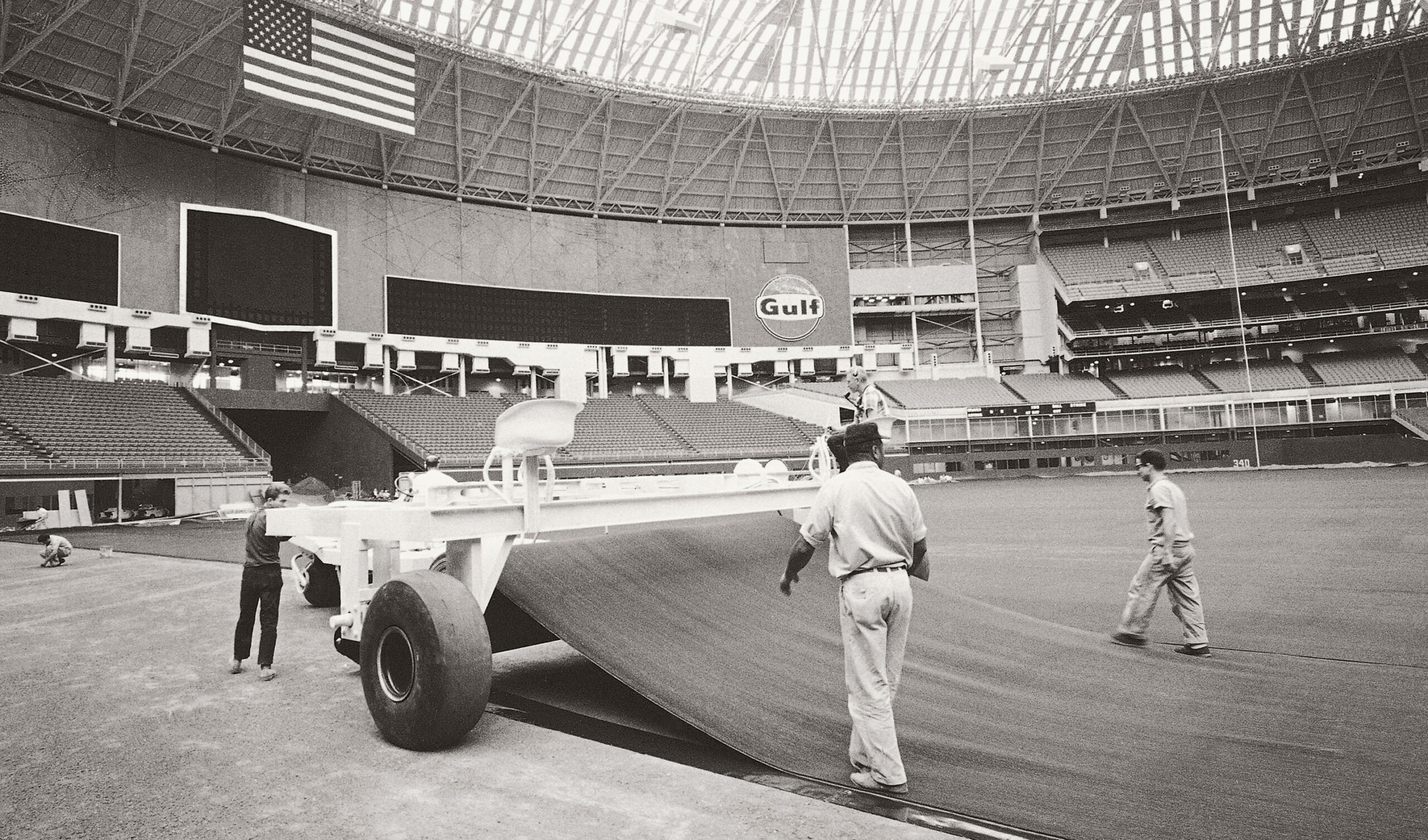
Workers lay artificial turf at the Astrodome in Houston on July 13, 1966. Developed by Monsanto, the material was originally known as ChemGrass but was later renamed AstroTurf after the stadium.
AP PHOTO/ED KOLENOVSKY, FILE

That first generation of simulated lawn was brittle and hard, but quality has improved. Today, there are a few competing products, but they’re all made by extruding a petroleum-based polymer—that’s plastic—through tiny holes and then stitching or fusing the resulting fibers to a carpetlike bottom. That gets attached to some kind of padding, also plastic. In the 1970s the industry started layering that over infill, usually sand; by the 1990s, “third generation” synthetic turf had switched to softer fibers made of polyethylene. Beneath that, they added infill that combined sand and a soft, cheap shredded rubber made from discarded automobile tires, which pile up by the hundreds of millions every year. This “crumb rubber” provides padding and fills spaces between the blades and the backing.

In the early 1980s, nearly half the professional baseball and football fields in the US had synthetic turf. But many players didn’t like it. It got hotter than real grass, gave the ball different action, and seemed to be increasing the rate of injuries among athletes. Since the 1990s, most pro sports have shifted back toward grass—water and maintenance costs pale in comparison to the importance of keeping players happy or sparing them the risk of injury. 

But at the same time, more universities and high schools are buying the artificial stuff. The advantages are clear, especially in places where it rains either too much or not enough. A natural-grass field is usable for a little more than 800 hours a year at the most, spread across just eight months in the cooler, wetter northern US. An artificial-turf field can see 3,000 hours of activity per year. For sports like lacrosse, which begins in late winter, this makes artificial turf more appealing. Most lacrosse pitches are now synthetic. So are almost all field hockey pitches; players like the way the even, springy turf makes the ball bounce.

Furthermore, supporters say synthetic turf needs less maintenance than grass, saving money and resources. That’s not always true; workers still have to decompact the playing surface and hose it off to remove bird poop or cool it down. Sometimes the infill needs topping up. But real grass allows less playing time, and because grass athletic fields often need to be rotated to avoid damage, synthetic ground cover can require less space. Hence the market’s explosive growth in the 21st century.


The city and town of Ithaca—two separate political entities with overlapping jurisdiction over Cornell construction projects—held multiple public meetings about the university’s new synthetic fields: the field hockey pitch and a complex called the Meinig Fieldhouse. Koizumi’s group turned up in force, and a few folks who worked at Cornell came to oppose the idea too—submitting pages of citations and studies on the risks of synthetic grass.

At two of those meetings, dozens of Cornell athletes turned out to support the turf. Representatives of the university and the athletic department declined to speak with me for this story, citing an ongoing lawsuit from Zero Waste Ithaca. But before that, Nicki Moore, Cornell’s director of athletics, told a local newspaper that demand from campus groups and sports teams meant the fields were constantly overcrowded. “Activities get bumped later and later, and sometimes varsity teams won’t start practicing until 10 at night, you know?” Moore told the paper. “Availability of all-weather space should normalize scheduling a great deal.”

That argument wasn’t universally convincing. “It’s a bad idea, but that’s from the environmental perspective,” says Marianne Krasny, director of Cornell’s Civic Ecology Lab and one of the speakers at those hearings. “Obviously the athletic department thinks it’s a great idea.”
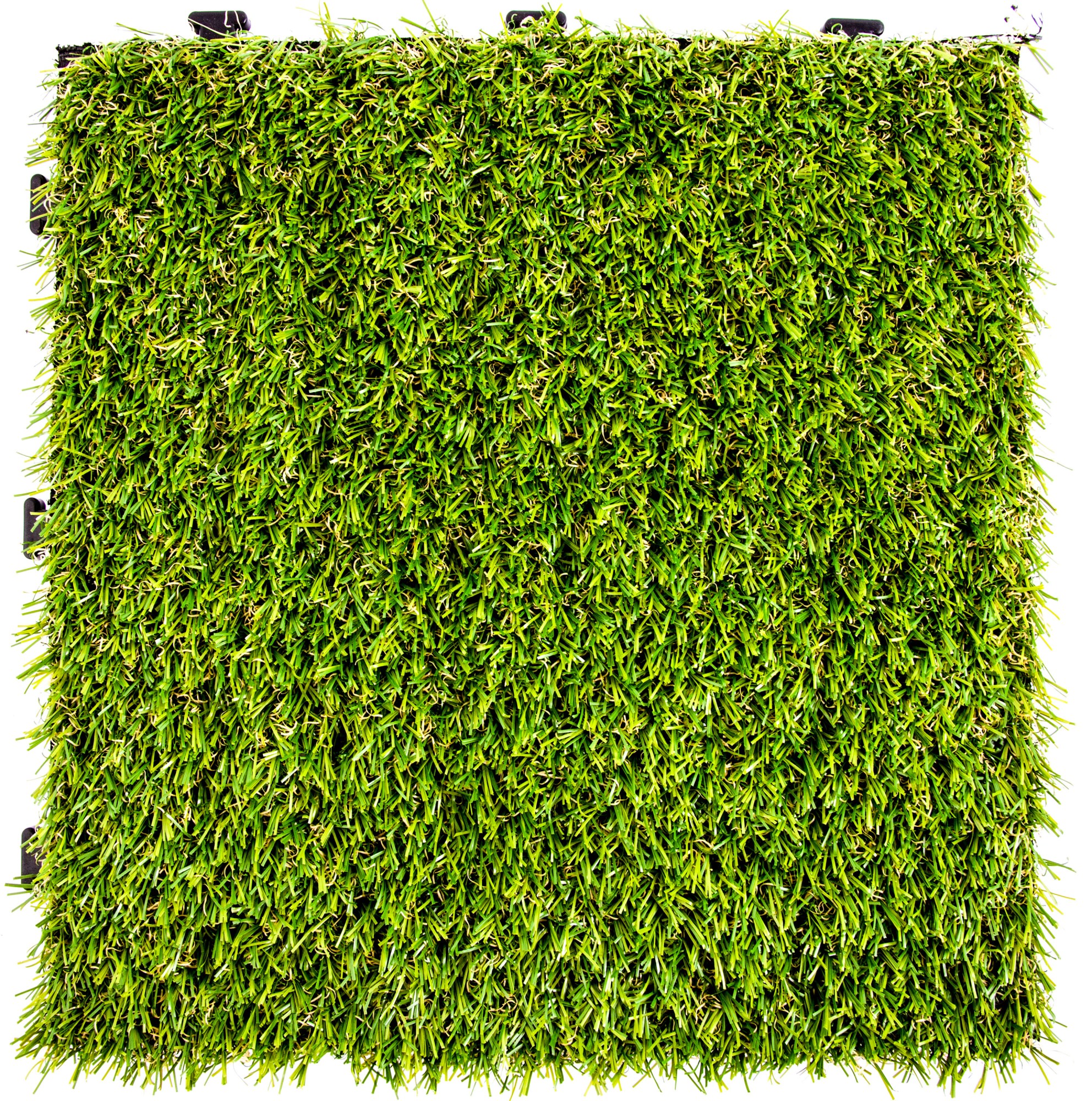
square patch of artificial turf

GETTY IMAGES

.cst-large,
.cst-default {
width: 100%;
}

@media (max-width: 767px) {
.cst-block {
overflow-x: hidden;
}
}

@media (min-width: 630px) {
.cst-large {
margin-left: -25%;
width: 150%;
}

@media (min-width: 960px) {
.cst-large {
margin-left: -16.666666666666664%;
width: 140.26%;
}
}

@media (min-width: 1312px) {
.cst-large {
width: 145.13%;
}
}
}

@media (min-width: 60rem) { .flourish-embed { width: 60vw; transform: translateX(-50%); left: 50%; position: relative; } }

Members of Cornell on Fire, a climate action group with members from both the university and the town, joined in opposing the use of artificial turf, citing the fossil-fuel origins of the stuff. They described the nominal support of the project from student athletes as inauthentic, representing not grassroots support but, yes, an astroturf campaign. 

Sorting out the actual science here isn’t simple. Over time, the plastic that synthetic turf is made of sheds bits of itself into the environment. In one study, published in 2023 in the journal Environmental Pollution, researchers found that 15% of the medium-­size and microplastic particles in a river and the Mediterranean Sea outside Barcelona, Spain, came from artificial turf, mostly in the form of tiny green fibers. Back in 2020, the European Chemicals Agency estimated that infill material from artificial-­turf fields in the European Union was contributing 16,000 metric tons of microplastics to the environment each year—38% of all annual microplastic pollution. Most of that came from the crumb rubber infill, which Europe now plans to ban by 2031. 

This pollution worries the Cornell activists. Ithaca is famous for scenic gorges and waterways. The new field hockey pitch is uphill from a local creek that empties into Cayuga Lake, the longest of the Finger Lakes and the source of drinking water for over 40,000 people.

And it’s not just the plastic bits. When newer generations of synthetic turf switched to durable high-density polyethylene, the new material gunked up the extruders used in the manufacturing process. So turf makers started adding fluorinated polymers—a type of PFAS. Some of these environmentally persistent “forever chemicals” cause cancer, disrupt the endocrine system, or lead to other health problems. Research in several different labs has found PFAS in many types of plastic grass.

But the key to assessing the threat here is exposure. Heather Whitehead, an analytical chemist then at the University of Notre Dame, found PFAS in synthetic turf at levels around five parts per billion—but estimated it’d be in water running off the fields at three parts per trillion; for context, the US Environmental Protection Agency’s legal drinking-water limit on one of the most widespread and dangerous PFAS chemicals is four parts per trillion. “These chemicals will wash off in small amounts for long periods of time,” says Graham Peaslee, Whitehead’s advisor and an emeritus nuclear physicist who studies PFAS concentrations. “I think it’s reason enough not to have artificial turf.”

This gets confusing, though. There are over 16,000 different types of PFAS, few have been well studied, and different ­companies use different manufacturing techniques. Companies represented by the Synthetic Turf Council now “use zero intentionally added PFAS,” says Melanie Taylor, the group’s president. “This means that as the field rolls off the assembly line, there are zero PFAS-formulated materials present.”

Some researchers are skeptical of the industry’s assurances. They’re hard to confirm, especially because there are a lot of ways to test for PFAS. The type of synthetic turf going onto the new field hockey pitch at Cornell is called GreenFields TX; the university had a sample tested using an EPA method that looks for 40 different PFAS compounds. It came back negative for all of them. The local activists countered that the test doesn’t detect the specific types they’re most concerned about, and in 2025 they paid for three more tests on newly purchased synthetic turf. Two clearly found fluorine—the F in “PFAS”—and one identified two distinct PFAS compounds. (The company that makes GreenFields TX, TenCate, declined to comment, citing ongoing litigation.)

PFAS isn’t the only potential problem. There’s also the crumb rubber made from tires. A billion tires get thrown out every year worldwide, and if they aren’t recycled they sit in giant piles that make great habitats for rats and mosquitoes; they also occasionally catch fire. Lots of the tires that go into turf are made of styrene-­butadiene rubber, or SBR. In bulk, that’s bad. Butadiene is a carcinogen that causes leukemia, and fumes from styrene can cause nervous system damage. SBR also contains high levels of lead.

But how much of that comes out of synthetic-­turf infill? Again, that’s hotly debated. Researchers around the world have published suggestive studies finding potentially dangerous levels of heavy metals like zinc and lead in synthetic turf, with possible health risks to people using the fields. But a review of many of the relevant studies on turf and crumb rubber from Canada’s National Collaborating Centre for Environmental Health determined that most well-conducted health risk assessments over the last decade found exposures below levels of concern for cancer and certain other diseases. A 2017 report by the European Chemicals Agency—the same people who found all those microplastics in the environment—“found no reason to advise people against playing sports on synthetic turf containing recycled rubber granules as infill material.” And a multiyear study from the EPA, published in 2024, found much the same thing—although the researchers said that levels of certain synthetic chemicals were elevated inside places that used indoor artificial turf. They also stressed that the paper was not a risk assessment. 

The problem is, the kinds of cancers these chemicals can cause may take decades to show up. Long-term studies haven’t been done yet. All the evidence available so far is anecdotal—like a series for the Philadelphia Inquirer that linked the deaths of six former Phillies players from a rare type of brain cancer called glioblastoma to years spent playing on PFAS-containing artificial turf. That’d be about three times the usual rate of glioblastoma among adult men, but the report comes with a lot of cautions—small sample size, lots of other potential causes, no way to establish causation.

Synthetic turf has one negative that no one really disputes: It gets very hot in the sun—as hot as 150 °F (66 °C). This can actually burn players, so they often want to avoid using a field on very hot days.

A field hockey player from Cornell University passes the ball during a game played on artificial turf at Bryant University in 2025. Cornell’s own turf field will be ready for the 2026 season.
GETTY IMAGES

Athletes playing on artificial turf also have a higher rate of foot and ankle injuries, and elite-level football players seem to be more predisposed to knee injuries on those surfaces. But other studies have found rates of knee and hip injury to be roughly comparable on artificial and natural turf—a point the landscape architect working on the Cornell project made in the information packet the university sent to the city. Athletic departments and city parks departments say that the material’s upsides make it worthwhile, given that there’s no conclusive proof of harm.

Back in Ithaca, Cornell hired an environmental consulting firm called Haley & Aldrich to assess the evidence. The company concluded that none of the university’s proposed installations of artificial turf would have a negative environmental impact. People from Cornell on Fire and Zero Waste Ithaca told me they didn’t trust the firm’s findings; representatives from Haley & Aldrich declined to comment.

Longtime activists say that as global consumption of fossil fuels declines, petrochemical companies are desperate to find other markets. That means plastics. “There’s a big push to shift more petrochemicals into plastic products for an end market,” says Jeff Gearhart, a consumer product researcher at the Ecology Center. “Industry people, with a vested interest in petrochemicals, are looking to expand and build out alternative markets for this stuff.”

All that and more went before the decision-­makers in Ithaca. In September 2024, the City of Ithaca Planning Board unanimously issued a judgment that the Meinig Fieldhouse would not have a significant environmental impact and thus would not need to complete a full environmental impact assessment. Six months later, the town made the same determination for the field hockey pitch.

Zero Waste Ithaca sued in New York’s supreme court, which ruled against the group. Koizumi and lawyers from Pace University’s Environmental Litigation Clinic have appealed. She says she’s still hopeful the court might agree that Ithaca authorities made a mistake by not requiring an environmental impact statement from the college. “We have the science on our side,” she says.


Ithaca is a pretty rarefied place, an Ivy League university town. But these same tensions—potential long-term environmental and public health consequences versus the financial and maintenance concerns of the now—are pitting worried citizens against their representatives and city agencies around the country. 

New York City has 286 municipal synthetic-­turf fields, with more under construction. In Inwood, the northernmost neighborhood in Manhattan, two fields were approved via Zoom meetings during the pandemic, and Massimo Strino, a local artist who makes kaleidoscopes, says he found out only when he saw signs announcing the work on one of his daily walks in Inwood Hill Park, along the Hudson River. He joined a campaign against the plan, gathering more than 4,300 signatures. “I was canvassing every weekend,” Strino says. “You can count on one hand, literally, the number of people who said they were in favor.” 

But that doesn’t include the group that pushed for one of those fields in the first place: Uptown Soccer, which offers free and low-cost lessons and games to 1,000 kids a year, mostly from underserved immigrant families. “It was turning an unused community space into a usable space,” says David Sykes, the group’s executive director. “That trumped the sort of abstract concerns about the environmental impacts. I’m not an expert in artificial turf, but the parks department assured me that there was no risk of health effects.”

Artificial turf doesn’t go away. “You’re going to be paying to get rid of it. Somebody will have to take it to a dump, where it will sit for a thousand years.”

Graham Peaslee, emeritus nuclear physicist studying PFAS concentrations, University of Notre Dame

New York City councilmember Christopher Marte disagrees. He has introduced a bill to ban new artificial turf from being installed in parks, and he hopes the proposal will be taken up by the Parks Committee this spring. Last session, the bill had 10 cosponsors—that’s a lot. Marte says he expects resistance from lobbyists, but there’s precedent. The city of Boston banned artificial turf in 2022.  

Upstate, in a Rochester suburb called Brighton, the school district included synthetic-­turf baseball and softball diamonds in a wide-ranging February 2024 capital improvement proposition. The measure passed. In a public meeting in November 2025, the school board acknowledged the intent to use synthetic grass—or, as concerned parents had it, “to rip up a quarter ­million square feet of this open space and replace it with artificial turf,” says David Masur, executive director of the environmental group PennEnvironment, whose kids attend school in Brighton. Parents and community members mobilized against the plan, further angered when contractors also cut down a beloved 200-year-old tree. School superintendent Kevin McGowan says it’s too late to change course. Masur has been working to oppose the plan nevertheless—he says school boards are making consequential decisions about turf without sharing information or getting input, even though these fields can cost millions of dollars of taxpayer money.

In short, the fights can get tense. On Martha’s Vineyard, in Massachusetts, a meeting about plans to install an artificial field at a local high school had to be ended early amid verbal abuse. A staffer for the local board of health who voiced concern about PFAS in the turf quit the board after discovering bullet casings in her tote bag, she said, which she perceived as a death threat. After an eight-year fight, the board eventually banned artificial turf altogether. 


What happens next? Well, outdoor artificial turf lasts only eight to 12 years before it needs to be taken up and replaced. The Synthetic Turf Council says it’s at least partially recyclable and cites a company called BestPLUS Plastic Lumber as a purveyor of products made from recycled turf. The company says one of its products, a liner called GreenBoard that artificial turf can be nailed into, is at least 40% recycled from fake grass. Joseph Sadlier, vice president and general manager of plastics recycling at BestPLUS, says the company recycles over 10 million pounds annually. 

Yet the material is piling up. In 2021, a Danish company called Re-Match announced plans to open a recycling plant in Pennsylvania and began amassing thousands of tons of used plastic turf in three locations. The company filed for bankruptcy in 2025.

In Ithaca, university representatives told planning boards that it would be possible to recycle the old artificial turf they ripped out to make way for the Meinig Fieldhouse. That didn’t happen. An anonymous local activist tracked the old rolls to a hauling company a half-hour’s drive south of campus and shared pictures of them sitting on the lot, where they stayed for months. It’s unclear what their ultimate fate will be.

That’s the real problem: Artificial turf just doesn’t go away. “You’re going to be paying to get rid of it,” says Peaslee, the PFAS expert. “Somebody will have to take it to a dump, where it will sit for a thousand years.” At minimum, real grass is a net carbon sink, even including installation and maintenance. Synthetic turf releases greenhouse gases. One life-­cycle analysis of a 2.2-acre synthetic field in Toronto determined that it would emit 55 metric tons of carbon dioxide over a decade. Plastic fields need less water to maintain, but it takes water to make plastic, and natural grass lets rainwater seep into the ground. Synthetic turf sends most of it away as runoff.

It’s a boggling set of issues to factor into a decision. Rossi, the Cornell turf scientist, says he can understand why a school in the northern United States might go plastic, even when it cares about its students’ health. “It was the best bad option,” he says. Concerns about microplastics and PFAS are “significant issues we have not fully addressed.” And they need to be. 

Douglas Main is a journalist and former senior editor and writer at National Geographic.

Shape
Shape
Stay Ahead

Explore More Insights

Stay ahead with more perspectives on cutting-edge power, infrastructure, energy,  bitcoin and AI solutions. Explore these articles to uncover strategies and insights shaping the future of industries.

Shape

Matador Resources names CFO, COO

@import url(‘https://fonts.googleapis.com/css2?family=Inter:[email protected]&display=swap’); .ebm-page__main h1, .ebm-page__main h2, .ebm-page__main h3, .ebm-page__main h4, .ebm-page__main h5, .ebm-page__main h6 { font-family: Inter; } body { line-height: 150%; letter-spacing: 0.025em; } button, .ebm-button-wrapper { font-family: Inter; } .label-style { text-transform: uppercase; color: var(–color-grey); font-weight: 600; font-size: 0.75rem; } .caption-style { font-size: 0.75rem; opacity: .6; } #onetrust-pc-sdk

Read More »

ICYMI: RefComm Expoconference—why it’s the diamond of downstream events

In this ICYMI episode of Oil & Gas Journal’s ReEnterprised podcast, downstream editor Robert Brelsford explains why the technical content he has repeatedly encountered at one refining conference continues to deliver practical value for professionals responsible for refining operations. Drawing on more than 20 years covering the petroleum industry, he’s covered every facet of the refining operations, including delayed coking, fluid catalytic cracking, sulfur recovery units, and more. Brelsford describes technical sessions where refinery peer presenters candidly share detailed case studies, including operational challenges, how issues unfolded in real time, and the best practices recommended for operators facing similar conditions—allowing attendees to leave with actionable knowledge directly applicable to daily refinery operations. The episode also addresses the growing challenge of knowledge transfer as decades of hands‑on experience exit the workforce. Brelsford highlights targeted training and presentations designed for refinery personnel at all career stages, particularly newer operators who cannot rely on written documentation alone to replace lost unit expertise. Across training and technical sessions alike, the focus remains on real‑world solutions to real‑world problems, reinforcing safety, troubleshooting capability, and operational excellence long after the event ends.

Read More »

United Arab Emirates to leave OPEC

The United Arab Emirates (UAE), a member of the Organization of the Petroleum Exporting Countries (OPEC) since 1967 and one of its largest producers, said it will exit the organization effective May 1, citing a need for greater flexibility in managing its production strategy. The move comes at a time of heightened geopolitical tension and severe supply disruption tied to the ongoing Iran conflict and the closure of the Strait of Hormuz. UAE Energy Minister Suhail Mohamed al-Mazrouei said the decision followed a careful review of the country’s energy strategy. Stay updated on oil price volatility, shipping disruptions, LNG market analysis, and production output at OGJ’s Iran war content hub. The departure removes a key source of spare capacity from OPEC’s quota system and raises immediate questions about the group’s ability to coordinate supply policy. The UAE has in recent years invested heavily to expand upstream capacity, targeting production levels well above its current OPEC allocation. Tensions between the UAE and OPEC leadership—particularly over baseline production quotas—have persisted for several years, reflecting broader divergence in strategy among core Gulf producers. By exiting, Abu Dhabi gains full autonomy to align output with market conditions and national revenue objectives rather than collective targets set by the group. Market reaction Front-month crude futures showed limited immediate reaction following the announcement. At the time of writing, Brent crude had risen above $110/bbl—its highest level in 3 weeks—as stalled US-Iran negotiations showed little progress toward a deal that could restore oil flows through the Strait of Hormuz. The market remains tightly focused on near-term disruptions stemming from restricted flows through Hormuz, which continues to constrain export volumes across the region. As a result, any incremental barrels from the UAE are unlikely to reach global markets in the immediate term. While the immediate market impact may be limited,

Read More »

Petrobras aims for additional ownership in defined portion of Campos basin

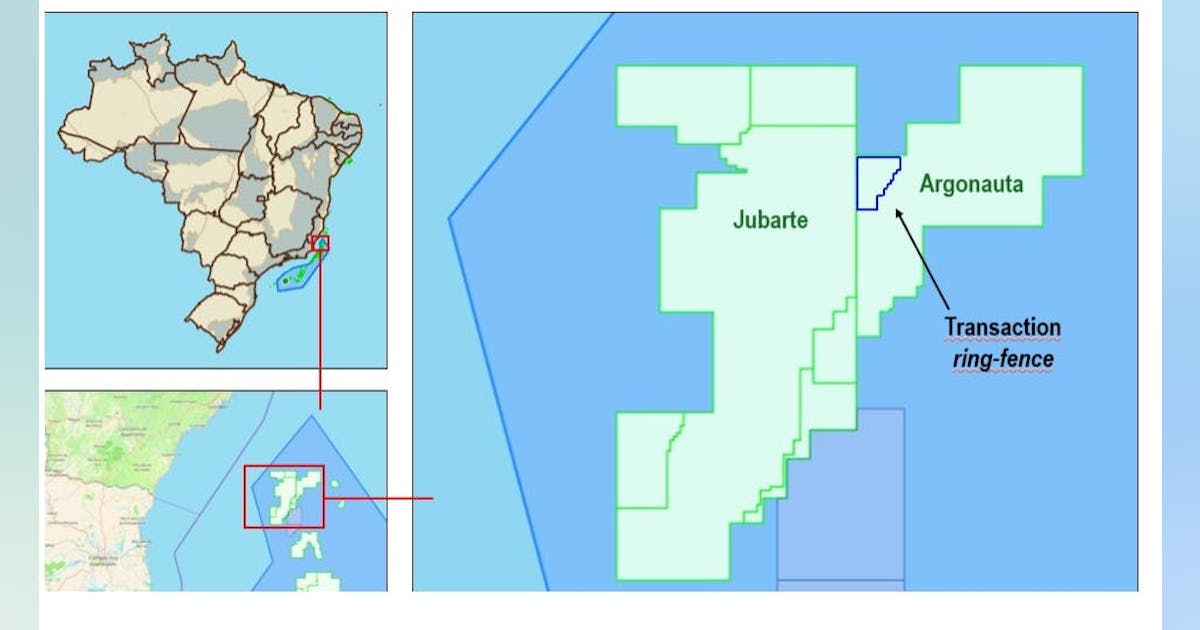
Petróleo Brasileiro SA (Petrobras) has agreed to acquire 100% of a defined portion of the Argonauta field associated with the shared Jubarte reservoir in Brazil’s Campos basin from Shell Brasil Petróleo Ltda., ONGC Campos Ltda., and Brava Energia (formerly Enauta Petróleo e Gás Ltda.). The transaction involves assets within the BC‑10 concession linked to Petrobras’ existing unitization agreement for the presalt Jubarte reservoir, which has been in effect since Aug. 1, 2025. The acquired Argonauta portion represents a 0.86% interest in the Jubarte shared reservoir under the unitization agreement. Total consideration will be R$700 million and US$150 million, to be paid in three installments: R$100 million at closing; R$600 million on Jan. 15, 2027, or at closing, whichever occurs later; and US$150 million 2 years after closing. Following completion of the transaction, Petrobras will increase its interest in the Jubarte shared reservoir to 98.11%. The Brazilian federal government, represented by Pré‑Sal Petróleo SA (PPSA), will retain its 1.89% interest related to the extension of the reservoir into non‑contracted areas. Petrobras said the transaction will also simplify shared‑asset management. Upon closing, the negotiation process for equalization will be concluded, along with any remaining discussions related to unitization or production balancing between the Jubarte reservoir and the acquired Argonauta area. According to Petrobras, the acquisition offers attractive economic and financial terms and is aligned with the company’s strategy to strengthen and streamline its operations in the Campos basin. The transaction is subject to customary closing conditions, including approval from Brazil’s National Agency of Petroleum, Natural Gas and Biofuels (ANP) and the Administrative Council for Economic Defense (CADE). Parque das Baleias The Jubarte shared reservoir is operated by Petrobras as part of the Parque das Baleias development in the northern Campos basin, in water depths of 1,220–1,400 m. Jubarte is the principal field

Read More »

Maurel & Prom discovers gas at Hechicero 1X on Sinú 9 block, Colombia

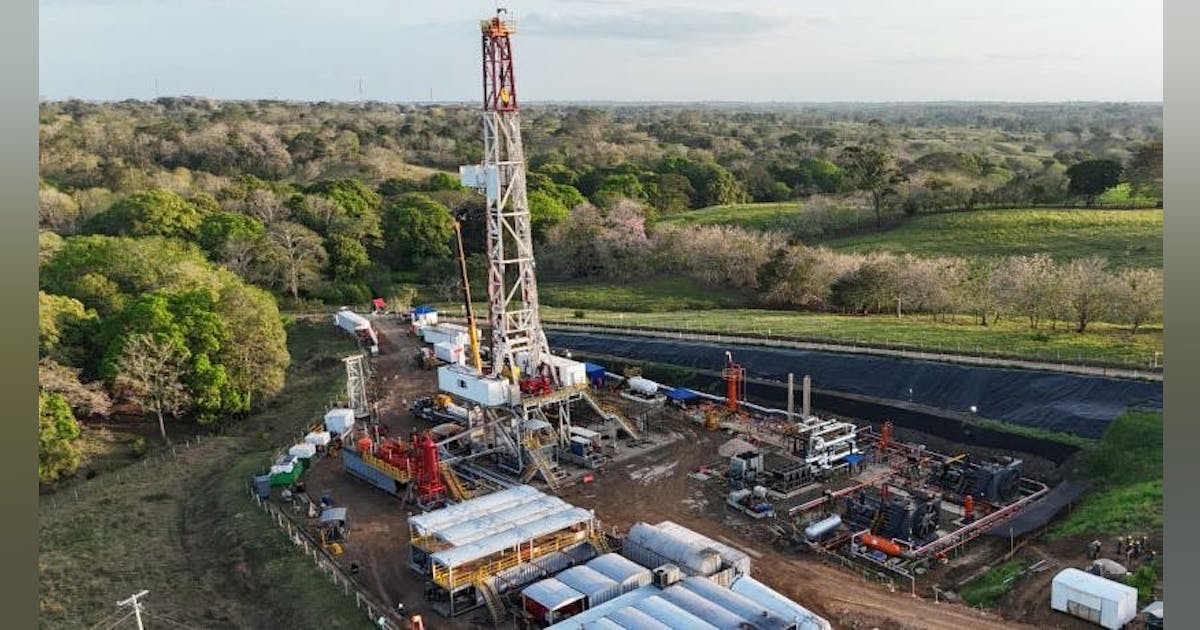
Maurel & Prom SA has made a gas discovery on Sinú‑9 block in Colombia, confirming gas across multiple intervals. The operator expects to bring the well into production in the coming days. The Hechicero‑1X well was spudded Feb. 24 and drilled to a total depth of 8,500 ft MD on Mar. 28. Electric logs confirmed gas across several intervals within the Ciénaga de Oro (CDO) formation, the primary target, with 288 ft of net pay, the operator said in a release Apr. 28. Additional gas‑bearing reservoirs were identified in the shallower Porquero formation and the deeper Pre‑CDO–San Cayetano interval, with net pay of 149 ft and 103 ft, respectively. Partner NG Energy International Corp., in a separate release Apr. 28, said results are consistent with the Magico‑1X and Brujo‑1X wells.  Hechicero‑1X was completed to allow selective production from five CDO intervals and the Pre‑CDO–San Cayetano interval. Initial tests conducted Apr. 24 on the Pre‑CDO–San Cayetano interval delivered an instantaneous rate of 26.4 MMcfd at 1,800 psi wellhead pressure through a restricted 43/128‑in. choke. Maurel & Prom plans to bring the well on stream from the Pre‑CDO–San Cayetano interval using existing infrastructure tied into Colombia’s national transportation system. The rig will next move to Magico‑2X, the second well in the six‑well exploration campaign.

Read More »

Golden Pass LNG ships first export cargo

Editor’s Note: Updated Apr. 23 to include information provided by the US Energy Information Administration.  Golden Pass LNG, a joint venture between QatarEnergy and ExxonMobil Corp., has loaded and shipped its first LNG export cargo from the plant in Sabine Pass, Tex. The departure comes following first LNG production from Train 1 late last month. Once fully operational, Golden Pass LNG expects to export about 18 million tons/year (tpy) of LNG. Golden Pass LNG is the 10th LNG plant in the US, the US Energy Information Administration (EIA) noted in a separate release Apr. 23. It is the only new US LNG export plant currently expected to begin LNG shipments this year, EIA said. Construction and commissioning continue on Trains 2 and 3, which are expected to come online in turn, following stable operation of Train 1. EIA noted Golden Pass aims to start up Train 2 in second-half 2026 and Train 3 in first-half 2027. QatarEnergy holds 70% interest in Golden Pass LNG, while ExxonMobil holds the remaining 30%. LNG demand  ExxonMobil forecasts natural gas demand to rise 20% by 2050 and LNG demand to rise by 3% per year through 2050. The operator is developing four LNG projects and, by 2030, expects to double its supply compared to 2020 to more than 40 million tpy.

Read More »

Ecopetrol agrees to acquire equity stake in Brava Energia with plans for increased ownership

State-owned Ecopetrol SA, Bogotá, Colombia, has agreed to acquire a 26% equity stake in Brava Energia SA from a group of shareholders and plans to launch a tender offer to increase its ownership to 51%, which would give it control of the Brazilian oil and gas independent. The move would add exposure to roughly 81,000 boe/d of production and 459 MMboe of reserves, expanding Ecopetrol’s footprint in Brazil. Ecopetrol entered into share purchase agreement with Jive, Yellowstone, and Bloco Somah Printemps Quantum, which together constitute a group holding about 26% of the outstanding common shares of Brava Energia. Brava Energia, the second-largest independent company listed in the Brazilian market in terms of reserves and production, was incorporated in 2024 from the merger between 3R Petroleum Óleo e Gás SA and Enauta Participações SA. Completion of the deal is subject to certain conditions, including, among others, approval by Brazil’s Administrative Council for Economic Defense (CADE), the grant of certain waivers and consents considering Brava’s financing instruments and relevant commercial agreements, as well as the purchase by Ecopetrol SA, or one of its affiliates or subsidiaries within the Ecopetrol Group, of the number of shares required to achieve a 51% controlling stake of Brava’s voting share capital. Ecopetrol plans to launch a voluntary tender offer on the B3 stock exchange in Brazil to buy additional shares to reach 51% controlling stake at R$23.00 per share, subject to regulatory requirements and certain conditions. Ecopetrol in Brazil In Brazil, Ecopetrol, through subsidiary Ecopetrol Óleo e Gás do Brasil Ltda., holds 30% interest in 11 blocks in the southern area of Santos basin in consortium with Shell Brasil Petróleo Ltda. (operator, 70%).  The company also holds a 30% non-operated interest in Gato do Mato (BM-S-54) and Sul de Gato do Mato (production sharing agreement), which

Read More »

The Power Certainty Premium: GPC Infrastructure CEO Jim Summers on Delivering Gas-Powered Compute at AI Scale

Reliability Is the Real Constraint Summers evaluates every large-scale power decision against four pillars: legal, economic, sustainable, and reliable. In the current market, one dominates. Reliability — defined not merely as uptime, but as certainty of project execution — has become the industry’s most pressing problem. “There’s a lot of noise in the market,” Summers says. “The question is whether a project is real; whether it can be delivered on time, and whether it can maintain multiple nines once it’s operating.” Legal frameworks for behind-the-meter generation are largely settled. Economics matter, particularly across multi-year development cycles. Sustainability factors in, though in many cases it has been deferred behind more immediate concerns. Execution, by contrast, is now existential. Hyperscalers are no longer evaluating power sources alone: they are evaluating delivery credibility. From Megawatts to Certainty, Speed, and Risk Transfer Historically, data centers relied on utilities to supply three things together: energy, predictable timelines, and manageable risk. That bundle has broken down. Utilities face long interconnection queues, uncertain delivery dates, and rising infrastructure costs. For developers, that uncertainty has created what industry observers and stakeholders are starting to call a “power certainty premium,” i.e. a willingness to pay more for guaranteed timelines. GPC’s customers, Summers says, are no longer buying megawatts alone. They are buying speed to market, certainty of delivery, and risk transfer. “Even if the timeline isn’t shorter, they want a date certain,” he notes. “Utilities often can’t provide that today.” That evolution is driving demand for on-site, behind-the-meter generation, where developers control timelines and cost structures rather than waiting on grid expansion. Supply Chain as the New Critical Path Remove the grid and a new constraint appears: equipment availability. For GPC, the primary gating factor is supply chain; specifically the “prime mover,” the generation equipment itself. Large industrial turbines

Read More »

AI data flows force rethink of data center networking at Backblaze

According to a report that Backblaze released this morning, traffic from content delivery networks and hosting and Internet services providers have stayed largely within historical norms over the past year. But traffic from hyperscalers and neoclouds fluctuated dramatically, with steep climbs in September and October and another uptick in March. Another network traffic change related to AI is geography. “Traditionally, it didn’t matter where cloud infrastructure was located,” says Nowak. But with AI workloads, if storage is close to compute, enterprises get lower latency and higher throughput. Today, Virginia and California have a high concentration of AI compute providers. This, in turn, brings in more storage companies. “In July, we chose to double our footprint in US East to increase the proximity to hyperscalers and neoclouds,” says Nowak. And that, in turn, leads to even more demand for compute, and even greater concentration. “There’s a snowball effect,” Nowak says. Why neoclouds for AI? Enterprises might think that they don’t need to worry about network traffic details if they’re using a hyperscaler for their AI workloads because the data and the processing both stay within the cloud. But there are advantages to using a third-party storage provider combined with neoclouds for the GPUs. According to a report released by Synergy Research Group in early April, neocloud revenues hit $9 billion in the fourth quarter of 2025, a 223% year-over-year increase. Revenues passed $25 billion for the whole year and are expected to hit $400 billion by 2031.

Read More »

TD Cowen: AI Adoption Is Already Here. Infrastructure Demand Is What Comes Next.

Enterprise AI adoption is no longer emerging. It is already embedded and beginning to scale in ways that will reshape data center demand. The latest TD Cowen GenAI Adoption Survey makes that clear. Across 689 U.S. enterprises, 92% are now using at least one major AI platform, with Microsoft Copilot, Google Gemini, and ChatGPT forming the core triad of daily enterprise tooling. That’s the baseline. The more important story is what comes next. AI is moving quickly from assistive software to autonomous systems, and that shift carries direct implications for compute demand, power consumption, and infrastructure design. From Copilots to Autonomous Systems Today’s enterprise AI footprint is already broad, but it is still largely human-in-the-loop. That is beginning to change. Roughly a third of respondents say they already have semi-autonomous AI agents running in production, while another large cohort is piloting or planning deployments over the next 12 to 18 months. By 2027, more than three-quarters expect to be running AI agents capable of executing multi-step workflows without human intervention. This is not incremental adoption. It is a step-function shift. Autonomous agents don’t just respond to prompts; they execute tasks, interact with enterprise systems, and continuously access data. For data centers, that translates into more persistent, baseline load: exactly the kind of demand profile that stresses power delivery, increases utilization, and accelerates capacity planning timelines. To wit: AI is moving from a bursty workload to a continuous one. ROI Is No Longer the Question At the same time, the debate around AI return on investment is effectively over. Three-quarters of respondents report positive ROI, while only a small minority report negative outcomes. A meaningful share is already seeing multiples of return on their investments. The implication seems straightforward: AI budgets are becoming durable. This is no longer experimental spend that

Read More »

BYOP Moves to the Center of Data Center Strategy

Self-Sufficiency Becomes a Feature, Not a Risk Consider Wyoming’s Project Jade, where county commissioners approved an AI campus tied to 2.7 GW of new natural gas-fired generation being developed by Tallgrass Energy. Reporting from POWER described the project as a “bring your own power” model designed for a high degree of self-sufficiency, with a mix of natural gas generation and Bloom fuel cells. The campus is expected to scale significantly over time. What stands out is not only the size, but the positioning. Self-sufficiency is becoming a selling point both for developers seeking to de-risk timelines, and for local stakeholders wary of overloading existing utility infrastructure. Fuel Cells and Nuclear: The Middle Ground and the Long Game Fuel cells occupy an important middle ground in this shift. Bloom Energy’s 2026 report positions fuel cells as a leading onsite option due to shorter lead times, modular deployment, and lower local emissions. Market activity suggests that interest is real. For developers, fuel cells can be easier to permit than large turbine installations and can be deployed incrementally. That makes them effective as bridge-to-grid solutions or as permanent components of hybrid architectures. Advanced nuclear remains the most strategically significant, but least immediate, BYOP pathway. Companies including Switch and other data center operators have explored partnerships with Oklo around its Aurora small modular reactor design. Nuclear holds long-term appeal because it offers firm, low-carbon power at scale. But for current AI buildouts, it remains a future option rather than a near-term construction solution. The immediate reality is that gas and modular onsite systems are closing the time-to-power gap, while nuclear is being positioned as a longer-duration successor as licensing and deployment timelines evolve. The model itself is also evolving. BYOP is beginning to blur the line between developer, energy provider, and compute customer. Reuters

Read More »

Microsoft Builds for Two Worlds: Sovereign Cloud and AI Factories

So far in 2026, across the United States and overseas, Microsoft is building an infrastructure portfolio at full hyperscale. The strategy runs on two tracks. The first is familiar: sovereign cloud expansion involving new regions, local data residency, and compliance-driven enterprise infrastructure. The second is larger and more consequential: purpose-built AI factory campuses designed for dense GPU clusters, liquid cooling, private fiber, and power acquisition at a scale that extends far beyond traditional cloud infrastructure. Despite reports last year that Microsoft was pulling back on data center development, the company is accelerating. It is not only advancing its own large-scale campuses, but also absorbing premium AI capacity originally aligned with OpenAI. In Texas and Norway, projects tied to OpenAI’s infrastructure plans have shifted back into Microsoft’s orbit. Even after contractual changes gave OpenAI greater flexibility to source compute elsewhere, Microsoft remains the market’s most reliable backstop buyer for top-tier AI infrastructure. It no longer needs to control every OpenAI build to maintain its position. In 2026, Microsoft is still the company best positioned to turn uncertain AI demand into deployed capacity, e.g. concrete, steel, power, and silicon at scale. Building at Industrial Scale The clearest indicator of Microsoft’s intent is its capital spending. In its January 2026 earnings cycle, Reuters reported that Microsoft’s quarterly capital expenditures reached a record $37.5 billion, up nearly 66% year over year. The company’s cloud backlog rose to $625 billion, with roughly 45% of remaining performance obligations tied to OpenAI. About two-thirds of that quarterly capex was directed toward compute chips. To be clear: this is no speculative buildout. Microsoft is deploying capital against a massive, committed demand pipeline, even as it maintains significant exposure to OpenAI-driven workloads. The company is solving two infrastructure problems at once: supporting broad Azure and Copilot growth, while ensuring

Read More »

AI’s Execution Era: Aligned and Netrality on Power, Speed, and the New Data Center Reality

At Data Center World 2026, the industry didn’t need convincing that something fundamental has shifted. “This feels different,” said Bill Kleyman as he opened a keynote fireside with Phill Lawson-Shanks and Amber Caramella. “In the past 24 months, we’ve seen more evolution… than in the two decades before.” What followed was less a forecast than a field report from the front lines of the AI infrastructure buildout—where demand is immediate, power is decisive, and execution is everything. A Different Kind of Growth Cycle For Caramella, the shift starts with scale—and speed. “What feels fundamentally different is just the sheer pace and breadth of the demand combined with a real shift in architecture,” she said. Vacancy rates have collapsed even as capacity expands. AI workloads are not just additive—they are redefining absorption curves across the market. But the deeper change is behavioral. “Over 75% of people are using AI in their day-to-day business… and now the conversation is shifting to agentic AI,” Caramella noted. That shift—from tools to delegated workflows—points to a second wave of infrastructure demand that has not yet fully materialized. Lawson-Shanks framed the transformation in more structural terms. The industry, he said, has always followed a predictable chain: workload → software → hardware → facility → location. That chain has broken. “We had a very predictable industry… prior to Covid. And Covid changed everything,” he said, describing how hyperscale demand compressed deployment cycles overnight. What followed was a surge that utilities—and supply chains—were not prepared to meet. From Capacity to Constraint: Power Becomes Strategy If AI has a gating factor, it is no longer compute. It is power. “Before it used to be an operational convenience,” Caramella said. “Now it’s a strategic advantage—or constraint if you don’t have it.” That shift is reshaping executive decision-making. Power is no

Read More »

Microsoft will invest $80B in AI data centers in fiscal 2025

And Microsoft isn’t the only one that is ramping up its investments into AI-enabled data centers. Rival cloud service providers are all investing in either upgrading or opening new data centers to capture a larger chunk of business from developers and users of large language models (LLMs).  In a report published in October 2024, Bloomberg Intelligence estimated that demand for generative AI would push Microsoft, AWS, Google, Oracle, Meta, and Apple would between them devote $200 billion to capex in 2025, up from $110 billion in 2023. Microsoft is one of the biggest spenders, followed closely by Google and AWS, Bloomberg Intelligence said. Its estimate of Microsoft’s capital spending on AI, at $62.4 billion for calendar 2025, is lower than Smith’s claim that the company will invest $80 billion in the fiscal year to June 30, 2025. Both figures, though, are way higher than Microsoft’s 2020 capital expenditure of “just” $17.6 billion. The majority of the increased spending is tied to cloud services and the expansion of AI infrastructure needed to provide compute capacity for OpenAI workloads. Separately, last October Amazon CEO Andy Jassy said his company planned total capex spend of $75 billion in 2024 and even more in 2025, with much of it going to AWS, its cloud computing division.

Read More »

John Deere unveils more autonomous farm machines to address skill labor shortage

Join our daily and weekly newsletters for the latest updates and exclusive content on industry-leading AI coverage. Learn More Self-driving tractors might be the path to self-driving cars. John Deere has revealed a new line of autonomous machines and tech across agriculture, construction and commercial landscaping. The Moline, Illinois-based John Deere has been in business for 187 years, yet it’s been a regular as a non-tech company showing off technology at the big tech trade show in Las Vegas and is back at CES 2025 with more autonomous tractors and other vehicles. This is not something we usually cover, but John Deere has a lot of data that is interesting in the big picture of tech. The message from the company is that there aren’t enough skilled farm laborers to do the work that its customers need. It’s been a challenge for most of the last two decades, said Jahmy Hindman, CTO at John Deere, in a briefing. Much of the tech will come this fall and after that. He noted that the average farmer in the U.S. is over 58 and works 12 to 18 hours a day to grow food for us. And he said the American Farm Bureau Federation estimates there are roughly 2.4 million farm jobs that need to be filled annually; and the agricultural work force continues to shrink. (This is my hint to the anti-immigration crowd). John Deere’s autonomous 9RX Tractor. Farmers can oversee it using an app. While each of these industries experiences their own set of challenges, a commonality across all is skilled labor availability. In construction, about 80% percent of contractors struggle to find skilled labor. And in commercial landscaping, 86% of landscaping business owners can’t find labor to fill open positions, he said. “They have to figure out how to do

Read More »

2025 playbook for enterprise AI success, from agents to evals

Join our daily and weekly newsletters for the latest updates and exclusive content on industry-leading AI coverage. Learn More 2025 is poised to be a pivotal year for enterprise AI. The past year has seen rapid innovation, and this year will see the same. This has made it more critical than ever to revisit your AI strategy to stay competitive and create value for your customers. From scaling AI agents to optimizing costs, here are the five critical areas enterprises should prioritize for their AI strategy this year. 1. Agents: the next generation of automation AI agents are no longer theoretical. In 2025, they’re indispensable tools for enterprises looking to streamline operations and enhance customer interactions. Unlike traditional software, agents powered by large language models (LLMs) can make nuanced decisions, navigate complex multi-step tasks, and integrate seamlessly with tools and APIs. At the start of 2024, agents were not ready for prime time, making frustrating mistakes like hallucinating URLs. They started getting better as frontier large language models themselves improved. “Let me put it this way,” said Sam Witteveen, cofounder of Red Dragon, a company that develops agents for companies, and that recently reviewed the 48 agents it built last year. “Interestingly, the ones that we built at the start of the year, a lot of those worked way better at the end of the year just because the models got better.” Witteveen shared this in the video podcast we filmed to discuss these five big trends in detail. Models are getting better and hallucinating less, and they’re also being trained to do agentic tasks. Another feature that the model providers are researching is a way to use the LLM as a judge, and as models get cheaper (something we’ll cover below), companies can use three or more models to

Read More »

OpenAI’s red teaming innovations define new essentials for security leaders in the AI era

Join our daily and weekly newsletters for the latest updates and exclusive content on industry-leading AI coverage. Learn More OpenAI has taken a more aggressive approach to red teaming than its AI competitors, demonstrating its security teams’ advanced capabilities in two areas: multi-step reinforcement and external red teaming. OpenAI recently released two papers that set a new competitive standard for improving the quality, reliability and safety of AI models in these two techniques and more. The first paper, “OpenAI’s Approach to External Red Teaming for AI Models and Systems,” reports that specialized teams outside the company have proven effective in uncovering vulnerabilities that might otherwise have made it into a released model because in-house testing techniques may have missed them. In the second paper, “Diverse and Effective Red Teaming with Auto-Generated Rewards and Multi-Step Reinforcement Learning,” OpenAI introduces an automated framework that relies on iterative reinforcement learning to generate a broad spectrum of novel, wide-ranging attacks. Going all-in on red teaming pays practical, competitive dividends It’s encouraging to see competitive intensity in red teaming growing among AI companies. When Anthropic released its AI red team guidelines in June of last year, it joined AI providers including Google, Microsoft, Nvidia, OpenAI, and even the U.S.’s National Institute of Standards and Technology (NIST), which all had released red teaming frameworks. Investing heavily in red teaming yields tangible benefits for security leaders in any organization. OpenAI’s paper on external red teaming provides a detailed analysis of how the company strives to create specialized external teams that include cybersecurity and subject matter experts. The goal is to see if knowledgeable external teams can defeat models’ security perimeters and find gaps in their security, biases and controls that prompt-based testing couldn’t find. What makes OpenAI’s recent papers noteworthy is how well they define using human-in-the-middle

Read More »